The gentle summer rain falling on the reflective water, lined with muted shades of gray and green foliage, combine to create a scene so peaceful, you must remember to take a next breath.
The gentle summer rain falling on the reflective water, lined with muted shades of gray and green foliage, combine to create a scene so peaceful, you must remember to take a next breath.
The mid-summer sunlight dimmed, as amorphous white clouds, heavy with moisture, washed over the blue sky. Deep shadows settled in among the layers of leaves that blended the crowns of oaks and maples into a coarse, solid green curtain. The leaves of the Norway maples on the outer edge of the woodlot appeared pale matte green in the dim light and hung motionless at a sixty-five-degree angle as the atmosphere held its breath in anticipation of the impending rain.
As the rain began, the earliest errant drops chose random dance partners among the leafy branches. Though not a breeze was evident, individual leaves began to dance while others remained perfectly still. Partners were exchanged and switched until the full burst of rain fell from the clouds to engage all the leaves to move to the rhythm of the falling rain.
A gentle summer rain is a perfect complement to a warm summer day. Clear blue skies and unfiltered sunshine heat the earth and plants to further warm the air from below. Pollen and dust, at the mercy of the breeze, settle everywhere.
The heat rising from the earth mixes with the already warmed atmosphere to create a layer of suffocating air. The promise of relief comes, when in late afternoon, billowy white clouds appear on the horizon in dramatic contrast against the unobstructed azure blue sky. The transient clouds, directed by upper atmosphere winds, obscure the sun as they drift across the sky, trailing rain in their wake. Immediately the stifling temperature falls as cool raindrops hit the dry earth. Each drop a micro explosion, as dust and pollen are washed away and reconstituted into the soil. In the aftermath, on the field where the clash of violent heat transfer and exploding dust particles flew, a veil of white mist hangs low over the battleground as the sunshine returns.
While the rainfall was sudden, it was expected. In fact, the coming rain was preceded by a distinct odor.
Researchers claim the familiar scent that sometimes fills the air prior to a coming rain is ozone being pulled to earth from high in the atmosphere and most often occurs after a dry spell.
In the temporary shelter under a full leafed tree, another odor, distinct from the ozone, fills your nostrils. It is best described as organic and to me, smells like what I think rich moist soil smells like. Even without rain, upon entering mature woods there is that same odor, enhanced by the heavy foliage which contains the moisture in the air as it mixes with the natural composting of decaying plant matter. The odor, initially after a rain begins to fall, is from the composting bacteria in the soil mixed with ozone, the combination named petrichor.
Sun showers are a summer event where magic seems to partner with nature to produce a contradictory reality. The sun shines while the rain falls, no clouds obscure the sun. A meteorological phenomenon that is best left unexplained to be thoroughly enjoyed. Consider it a momentary truce among the elements who constantly clash for dominance in the atmospheric heavens.
Whether a sun shower, cloud burst or late afternoon thunderstorm, refreshing, best describes a summer rain, it is an invitation to step out and feel the cool gentle rain on your face, and try to catch a few drops on your tongue. It is life, composed mostly of water, who recognizes itself in the heaven sent drops of rain, especially during a warm and gentle summer rain.
Author Joe Mish has been running wild in New Jersey since childhood when he found ways to escape his mother’s watchful eyes. He continues to trek the swamps, rivers and thickets seeking to share, with the residents and visitors, all of the state’s natural beauty hidden within full view. To read more of his writing and view more of his gorgeous photographs visit Winter Bear Rising, his wordpress blog. Joe’s series “Nature on the Raritan, Hidden in Plain View” runs monthly as part of the LRWP “Voices of the Watershed” series. Writing and photos used with permission from the author. Contact jjmish57@msn.com. See more articles and photos at winterbearrising.wordpress.com.
The Lower Raritan Watershed Partnership (LRWP) and Friends are petitioning the Commissioners of Middlesex County, New Jersey for development of a community boathouse and launch facility on the Raritan River Waterfront. We have three main objectives:
Protect and store the boats and equipment for Youth and Community Rowing Clubs and for personal human powered watercraft and gear;
Increase access to the Raritan Riverfront for human powered watercraft, including a universal access launch; and
Preserve and increase public access to the Raritan River.
Why should Middlesex County Commissioners support a community boathouse and launch facility on the Raritan River?
Middlesex County is the largest landholder of Raritan River-adjacent land. Public access to the Raritan, and public facilities and opportunities for on-River recreation, are in short supply in Middlesex County.
Who would use a community boathouse and launch facility on the Raritan River?
The building and associated boat storage and launch will provide secure indoor and outdoor facilities for equipment belonging to community, youth, High School, and other rowing clubs.
Facilities will include secure boat and gear storage for personal watercraft, accessible in a “self-store / self-serve” structure.
The public will be able to rent space within the boathouse for workshops, meetings, and events; use observation decks for data gathering, birdwatching and exploration; and utilize publicly accessible docks for launch of kayaks, canoes and other human powered watercraft.
What are the public benefits of this community boathouse project?
This project increases access to the Raritan River for the general public by providing facilities for the secure storage of human powered watercraft to facility and enjoyment of our waterways.
This project strengthens partnerships of human powered watercraft users to work together to provide opportunities for public outdoor recreation on the Raritan River by creating a center for community.
How does this project fit into the County’s strategic plans?
The Community Boathouse Project fits within many planning documents, priorities, and goals that the County has developed through due diligence processes. These include Destination2040 Plan development, County Open Space planning, Middlesex County Parks & Recreation programming, and other County-led initiatives.
We received a fair amount of precipitation in the Lower Raritan this week. Riverine sites have higher bacteria loads than the sites on/near Raritan Bay that experience tidal flushing. Happy Weekend!
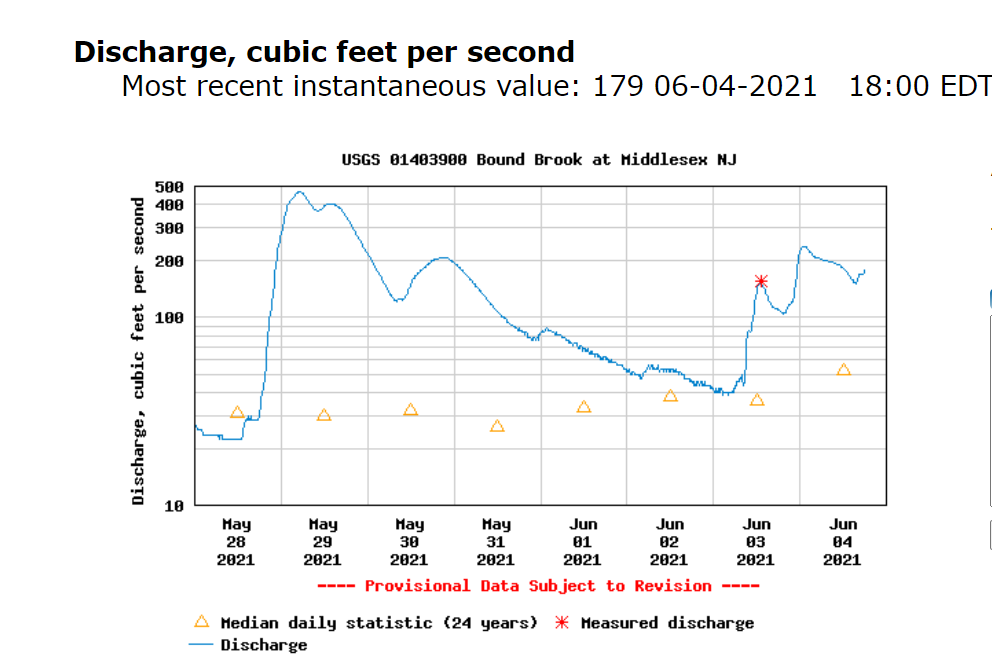
What a soggy week in the Lower Raritan, with 1.56 inches accumulated in our rain gauge in the 24 hours since our water quality monitoring activities yesterday morning June 3. The USGS flood gage shows discharge significantly above the 24 year median daily statistic.
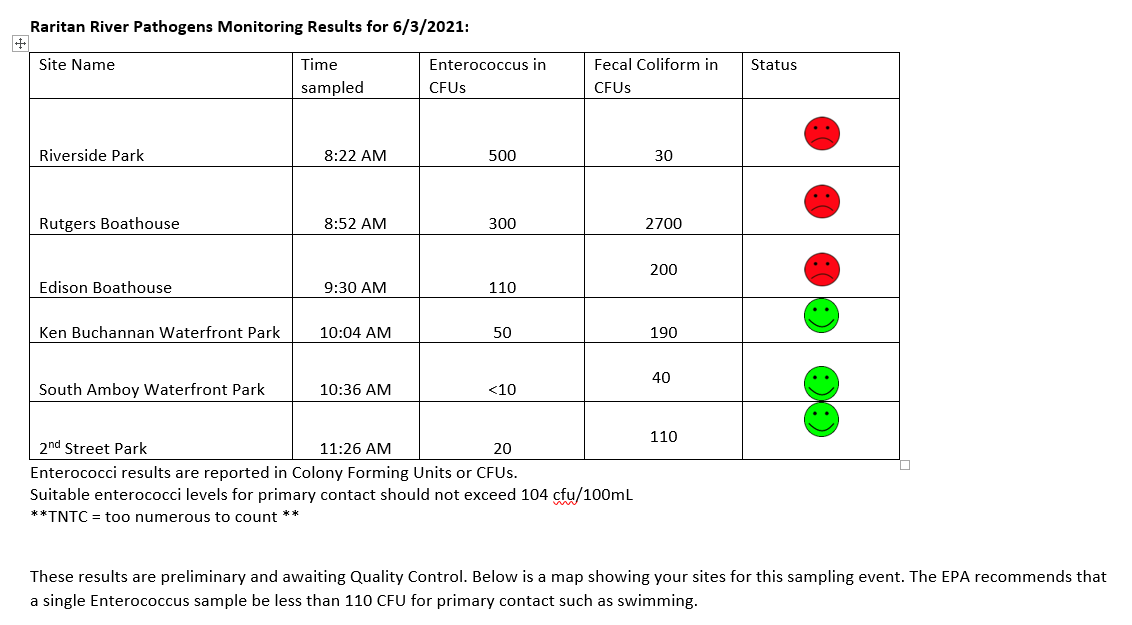
With such significant precipitation please know that our pathogens sampling numbers for six non-bathing public access beach sites captured during June 3, 2021 monitoring are not reflective of the current situation. (See here for more on our pathogens monitoring program):
Enterococci results are reported in Colony Forming Units or CFUs. Suitable levels for primary contact should not exceed 110 cfu/100mL. Pathogens/Enterococci levels are used as indicators of the possible presence of disease-causing bacteria in recreational waters. Such pathogens may pose health risks to people fishing and swimming in a water body. Sources of bacteria include Combined Sewer Overflows (CSOs), improperly functioning wastewater treatment plants, stormwater runoff, leaking septic systems, animal carcasses, and runoff from manure storage areas.
Huge thanks to our partners: Rutgers Cooperative Extension of Middlesex County and the New England Interstate Water Pollution Control Commission.
Field Notes:
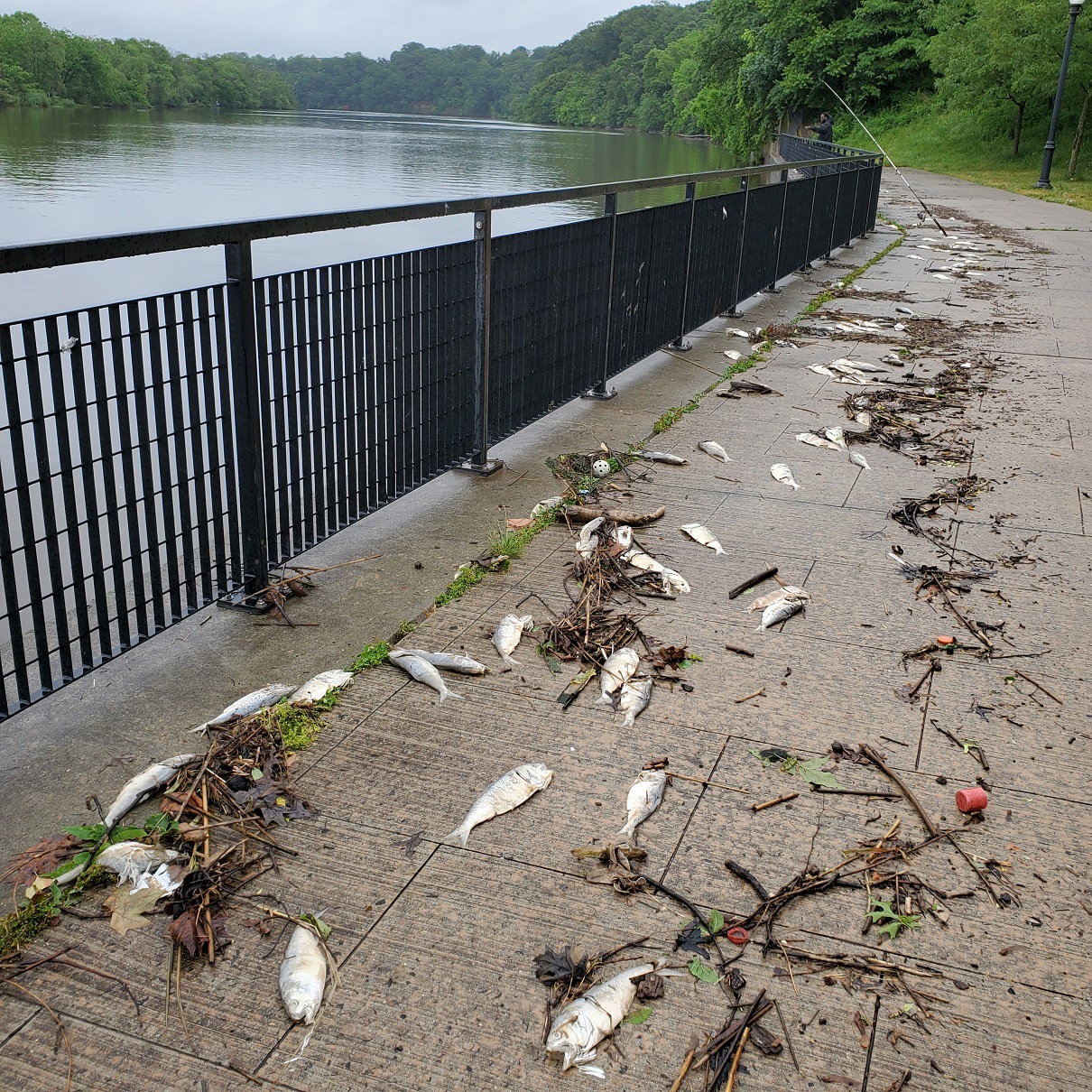
We were concerned we would observe a repeat of the fish kill from the week prior. This photo shows the Boyd Park site on 5.31.2021 after the first wave of heavy rains. Thankfully the numbers of dead fish were far fewer this week.
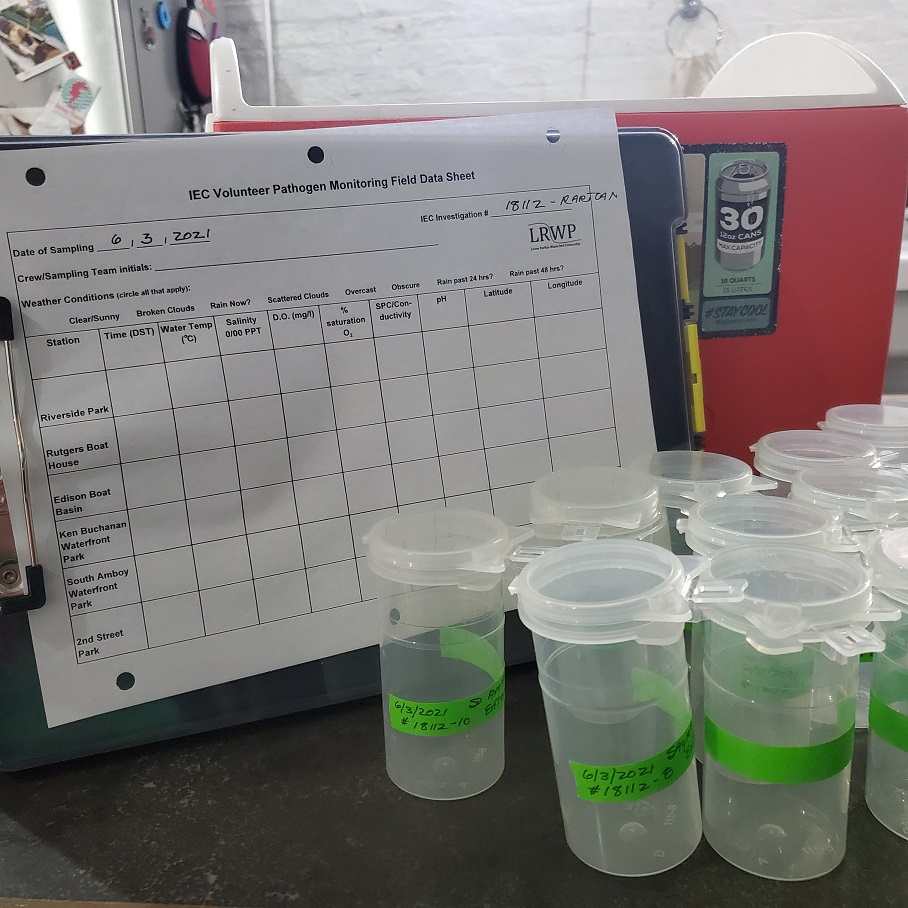
Data sheet, sample bottles and cooler
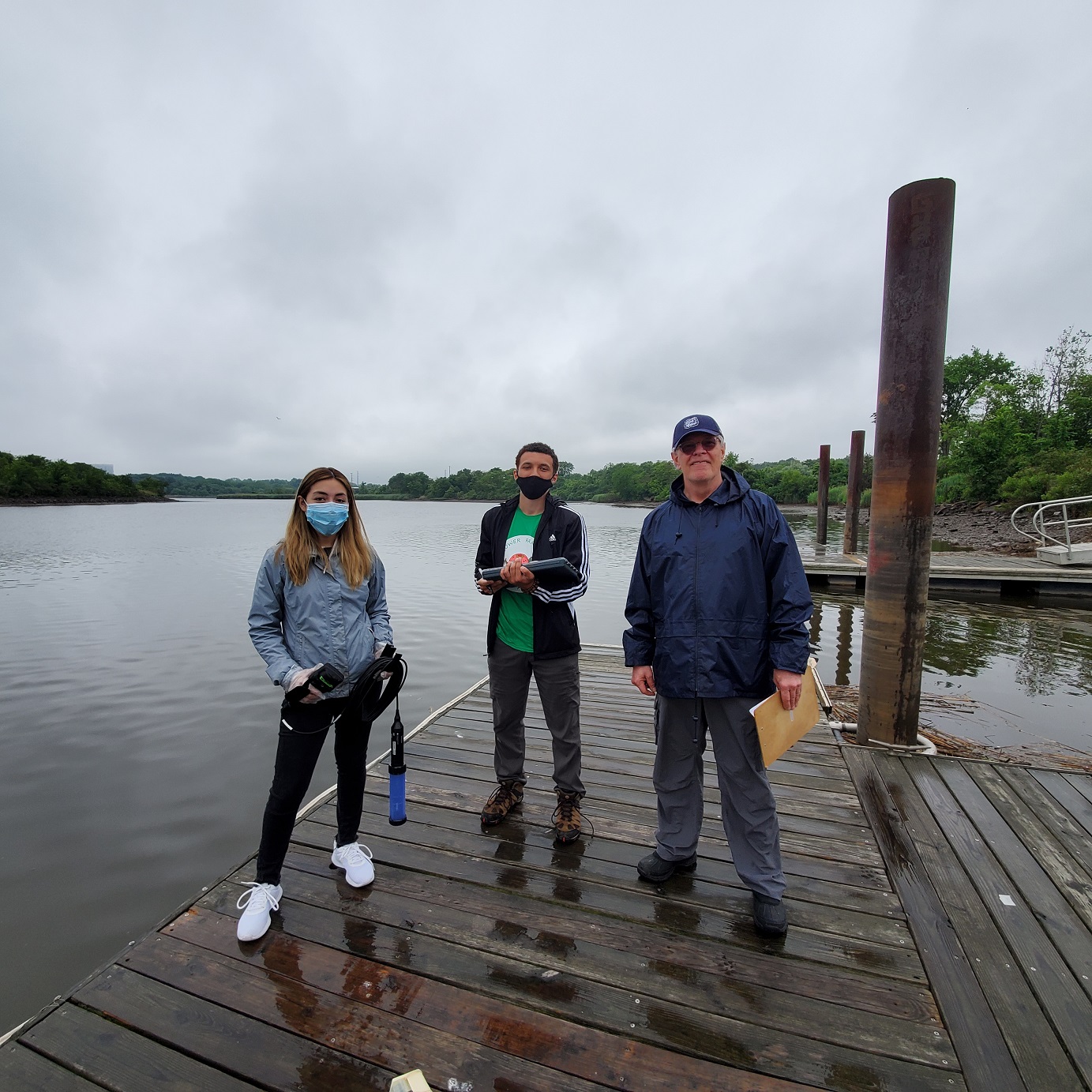
Jocelyn Palomino, Jason Acevdo and volunteer Frank Dahl at the Edison Boat Basin
For Summer 2021 the Lower Raritan Watershed Partnership and our Rutgers Cooperative Extension of Middlesex County partners are building up our pathogens monitoring program in several new ways.
With grant support from The Watershed Institute we have engaged Jocelyn Palomino as a Project Coordinator to lead sampling and conduct outreach focused on engagement with the Spanish-speaking community. This will involve sampling demonstrations at our Perth Amboy 2nd Street Park site, boat trips, and more.
Earlier this Spring we started meeting with the US Environmental Protection Agency (EPA) regarding improving our understanding of pathogens flows into the Raritan. In addition to our six (6) non-bathing public access beach monitoring sites, for Summer 2021 the EPA will monitor an additional 22 in-channel sites for fecal/enterococcus going all the way up to Bound Brook and including the D&R Canal;
With support from the EPA, we will continue genetic source studies at our 6 sites AS WELL AS at the EPA’s 22 new sites to determine whether the fecal is human/bird/dog/horse etc.;
We are working with Interstate Environmental Commission to compare IDEXX vs. membrane filtration technology. This means that each of our samples will be analyzed by BOTH methods during this monitoring season. It will be an interesting comparison to run these numbers for the whole summer. NJDEP ONLY accepts the more stringent IDEXX method.
We are working with Rutgers Office of Analytics to develop a predictive model based on our data. That is, our goal with the model is to input precipitation, rainfall, tidal influence, etc. for those dates that we cannot go out sampling, and still get a good sense for what the likelihood of fecal/entero levels.
We are planning more water-based reconnaissance for outfalls and compromised sewage infrastructure at our sites, particularly the Piscataway site.
We are working with Brenda Allen, a doctoral candidate with the Center for Remote Sensing and Spatial Analysis, to help us understand possible land use impacts on our numbers, and help us prioritize where we start our on-the-ground sleuthing;
We are working with a start-up technology company to deploy a water-based drone that can travel the Raritan catching samples as-needed. They will deploy the drone within the next few weeks.
We continue to build a research program to better understand risks, and in this regard we are working to get Middlesex County Health involved. With EPA now very invested, we hope that with the IDEXX vs. membrane filtration comparison study we’ll be able to convince NJDEP to work with us (and our data) as well.
Running for 20 weeks through Summer 2021, the Lower Raritan Watershed Partnership and Rutgers Cooperative Extension of Middlesex County (RCE) will gather data and other information on water quality for public access sites along the tidal portions of the Raritan River at locations considered non-bathing beaches. This project is supported through grants from the Interstate Environmental Commission (IEC) and The Watershed Institute.
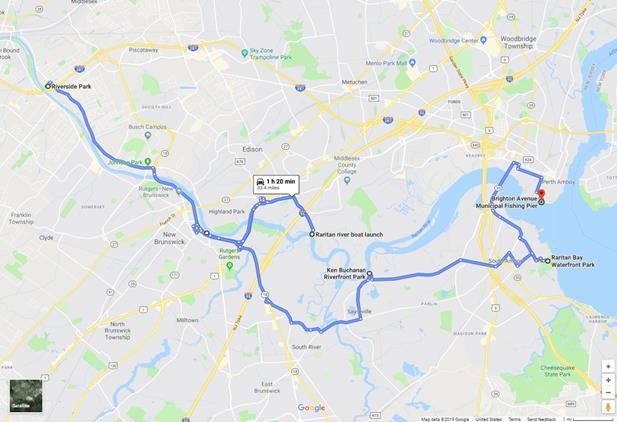
Summer 2021 Pathogens/Bacteria Monitoring Sites
LRWP and RCE will monitor non-bathing beach sites with active kayak/canoe launches and/or fishing and other primary contact activities that, as non-bathing beach sites, are not regularly monitored by the New Jersey Department of Environmental Protection (NJDEP) or the New Jersey Department of Health and Human Services and lack sufficient water quality data.
In addition to yielding important data about the health and safety of our waterways, the Project will also allow for development of civic science and expanded volunteer environmental monitoring programming within the Lower Raritan Watershed and Middlesex County, NJ. We are working with an approved Quality Assurance Project Plan (QAPP), provided by the IEC, which will allow for data generated from this project to inform water quality policy and regulatory decisions at all levels of government within the project area, and to educate the public about the safety of recreating on the River.
Real-time reporting of enteroccocus data will be posted every Friday on the LRWP facebook page and website, and through the New York City Water Trail Association’s citizen’s water quality testing program. Users will be able to easily interpret the data as being above or below the recommended water quality standards for primary contact recreation.
Enterococci levels are used as indicators of the possible presence of disease-causing bacteria in recreational waters. Such pathogens may pose health risks to people fishing and swimming in a water body. Sources of bacteria include Combined Sewer Overflows (CSOs), improperly functioning wastewater treatment plants, stormwater runoff, leaking septic systems, animal carcasses, and runoff from manure storage areas. Enterococci results are reported in Colony Forming Units or CFUs. Suitable levels should not exceed 104 cfu/100mL.
The following are details on our monitoring sites. We will share more information about each location throughout the monitoring period. For more information about the program please contact: info@lowerraritanwatershed.org
LR1
Riverside Park, 430 River Rd, Piscataway
40.54067
-74.51219
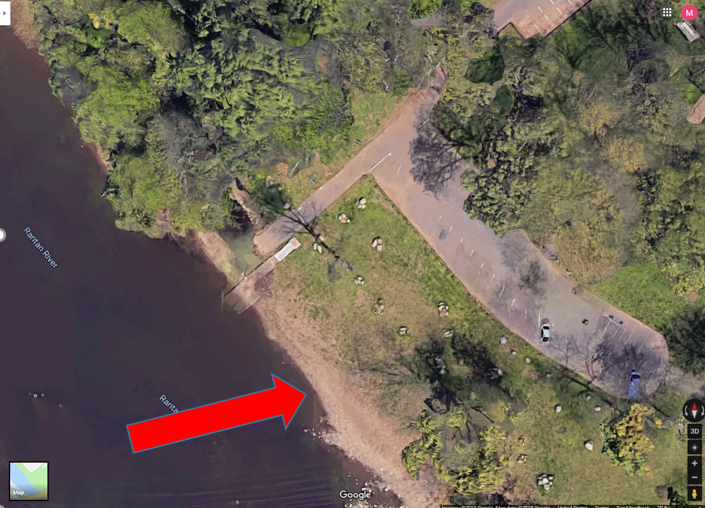
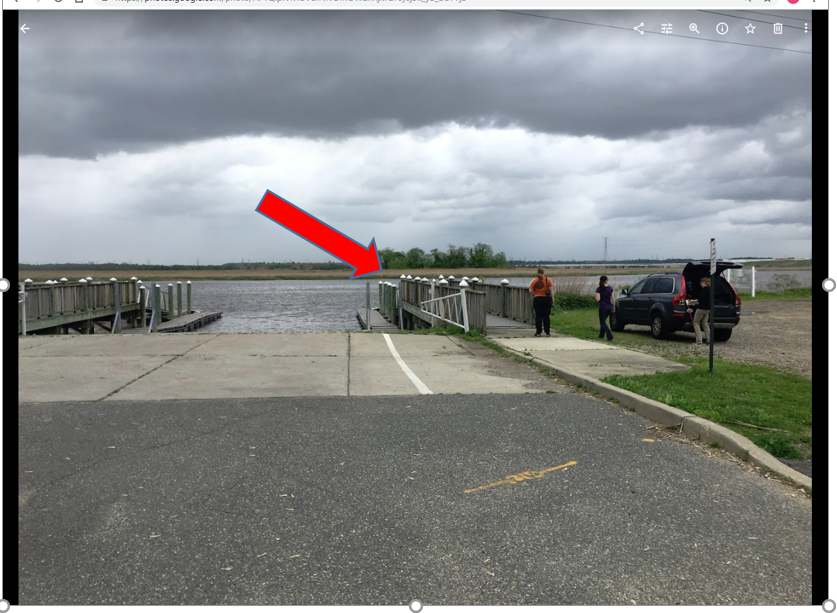
Wading site. Waders must be worn. Red arrow indicates the sampling location as this is where fishing has been observed. Access the river to the left of the boat ramp (when facing the river). Do not take the sample from the boat ramp as it is too muddy and slippery.
Bathrooms are available at this site from 10am to 2pm
LR2
Rutgers Boathouse, 5 Memorial Pkwy, New Brunswick
40.48826
-74.43384
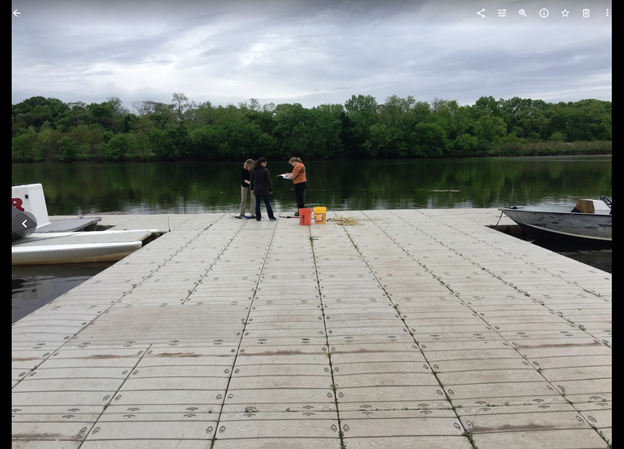
Sampling location is in the middle of the Rutgers boathouse dock as indicated in picture. Bathrooms may be available at the boathouse if they are open and at Boyd Park just west of the boathouse.
Sampling
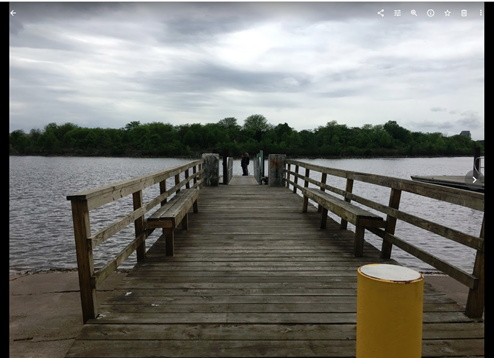
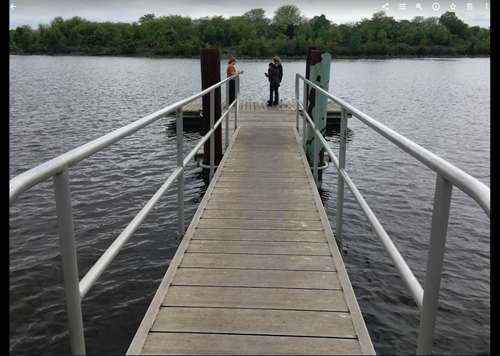
location is at the end of the dock. No bathrooms are available at this site.
LR4
Ken Buchanan Riverfront Park River Road, Sayreville, NJ 08872
40.47483
-74.35586
LR5
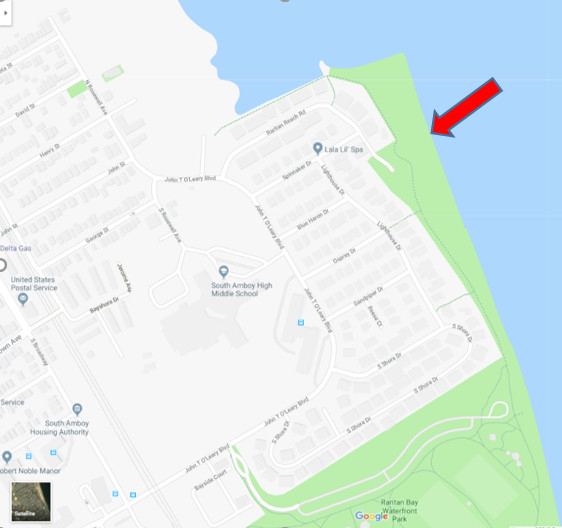
Raritan Bay Waterfront Park 201 John T O’Leary Blvd South Amboy, NJ 08879 *sample off Raritan Reach Road north of park
40.48334
-74.2698
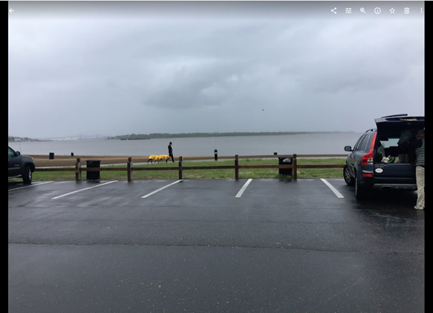
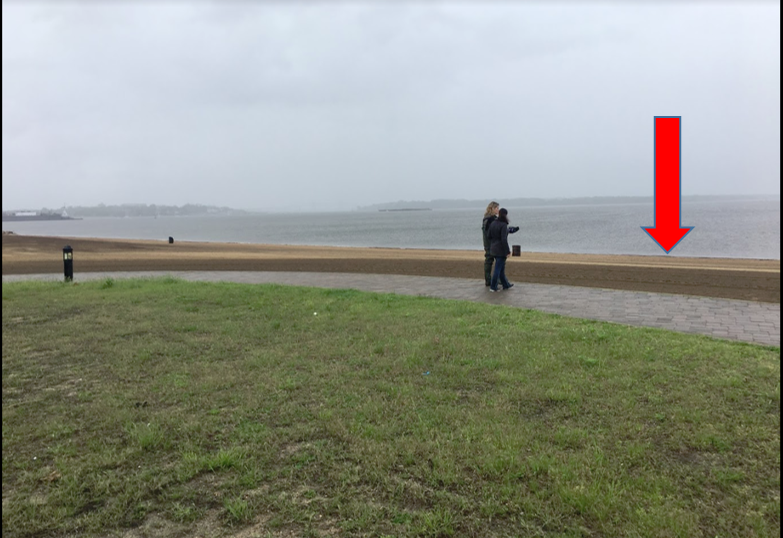
Wading site and waders must be worn. Access the sampling location off the parking lot at the end of Raritan Reach Rd. This is northwest of the park. The site is a beach. No bathrooms available.
LR6
Perth Amboy Waterfront & Future 2nd Street Park 45-93 2nd St, Perth Amboy, NJ 08861
40.50007
-74.27719
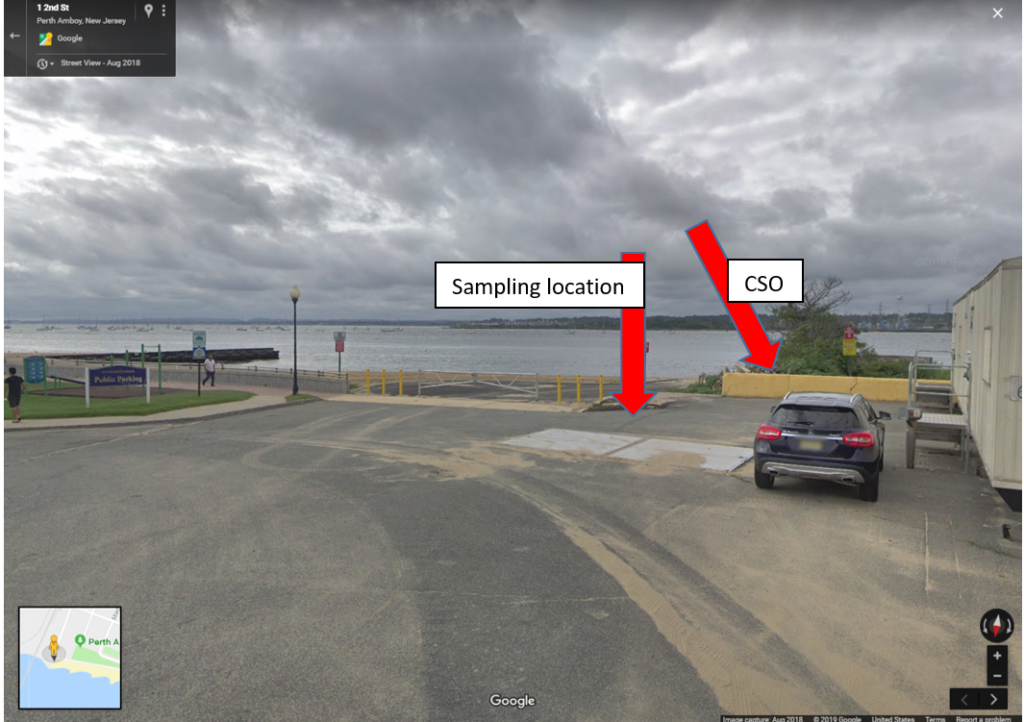
This is a wading site and waders must be worn. Sampling location is at the beach next to the combined sewer outfall pipe. No bathrooms are available.
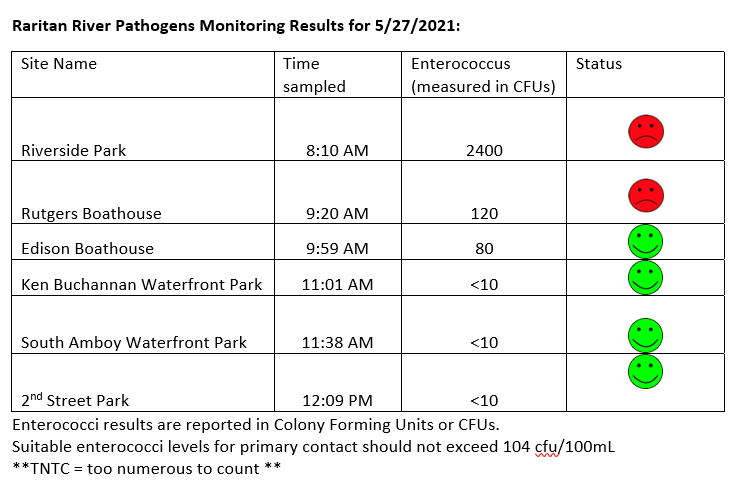
For those of you making plans to be on the Raritan, see below for pathogens sampling results for six non-bathing public access beach sites for yesterday, May 27/2021. (See here for more on our pathogens monitoring program).
Enterococci results are reported in Colony Forming Units or CFUs. Suitable levels for primary contact should not exceed 104 cfu/100mL. Please note that while the numbers look good for our Edison, Sayreville, South Amboy and Perth Amboy sites, we have received significant rainfall since sampling, which typically increases bacteria loading into our waters. Pathogens/Enterococci levels are used as indicators of the possible presence of disease-causing bacteria in recreational waters. Such pathogens may pose health risks to people fishing and swimming in a water body. Sources of bacteria include Combined Sewer Overflows (CSOs), improperly functioning wastewater treatment plants, stormwater runoff, leaking septic systems, animal carcasses, and runoff from manure storage areas.
Huge thanks to our partners: Rutgers Cooperative Extension of Middlesex County and the New England Interstate Water Pollution Control Commission.
Field Notes:
What a beautiful day to kick off monitoring for 2021! We were joined in the field by our new Project Coordinator Jocelyn Palomino, project interns Jason Acevedo and Julisa Collado, Jessica Bonamusa from the Interstate Environmental Commission, and Stan Stephenson with the Environmental Protection Agency.
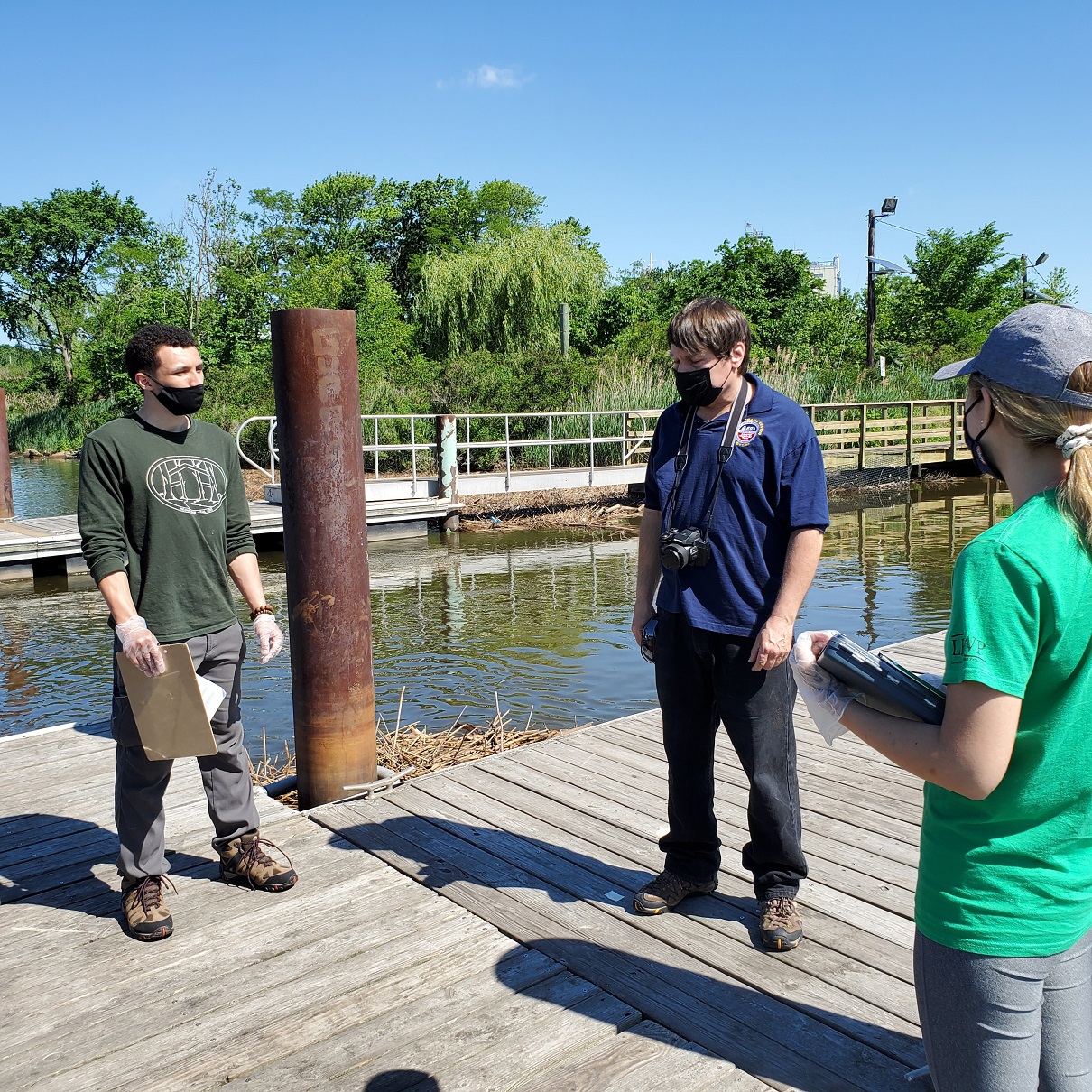
What a beautiful day to kick off monitoring for 2021! We were joined in the field by our new Project Coordinator Jocelyn Palomino, project interns Jason Acevedo and Julisa Collado, Jessica Bonamusa from the Interstate Environmental Commission, and Stan Stephenson with the Environmental Protection Agency. Pictured here from left to right are Jason, Stan and Jocelyn.
The Edison, Sayreville and South Amboy sites were busy with boating activity. Almost two dozen boat trailers were parked at the Ken Buchanan Boat Ramp in Sayreville, and we waved to folks on jet skis in the water there.
Please enjoy the Raritan safely! Be sure to wash thoroughly with soap and hot water after any contact with our waters.
Ken Buchanan Boat Ramp in Sayreville, with a view of the former JCP&L Power Plant.
Dave Bean / NJDEP: Office of Natural Resource Restoration
501 East State Street, Mail Code 501-01 / PO Box 420 / Trenton, NJ 08625-0420
RE: Proposed Settlement Agreement for Natural Resource Damages, in the Matter of Kinder Morgan, Inc. and Related Entities – HEADGATES DAM REMOVAL PROJECT
Dear Dave Bean:
The Lower Raritan Watershed Partnership (LRWP) is writing to express full and enthusiastic support for the proposed settlement agreement for Natural Resources Damages in the Matter of Kinder Morgan as it relates to the Headgates Dam Removal Project in Hillsborough Township, Somerset County. We understand this project to include restoration activities that will significantly enhance habitat connectivity, improve water quality, and expand recreational opportunities for the Lower Raritan River and Watershed.
The LRWP formed in 2014 to address legacy contamination and current pollution in the Raritan River and the Lower Raritan Watershed. Our mission is to conserve, enhance and restore the natural resources of the New Jersey Watershed Management Area 9, the Lower Raritan Watershed. Specifically regarding the proposed interventions to replace and relocate of a section of the Bridgewater Township 54-inch sanitary sewer line, replace the Raritan Water Power Canal, and remove the Headgates Dam, these activities will not only directly improve resources impacted by legacy contamination, but will benefit a broad spectrum of the Raritan River’s ecology and enable other environmental and human use benefits. Significant ecological, environmental and human use benefits have in fact already been realized following recent removal of a series of dams (Robert Street, Nevius Street, and Calco) on the lower portion of the Raritan River between the towns of Bridgewater and Bound Brook. We expect the proposed restoration activities for the Headgates Dam Removal Project to likewise advance multiple Lower Raritan Watershed stakeholder goals.
The LRWP is also aware that these interventions will expand access to several thousand acres of non-tidal freshwater mid to upper reaches of the Raritan River’s major tributaries. Removal of Headgates Dam in particular will enhance maturation and rearing habitat for striped bass, American shad, American eel, blueback herring, and alewife, and should significantly increase the abundance of anadromous and catadromous species, which will improve the ecological health of the Raritan River.
The LRWP’s only concerns with the proposal are short term sediment transport impacts following dam removal. However, we are confident that sound planning to reduce potential environmental consequences will be put in place, and further expect that the proposed projects will provide long term restorative benefits to water chemistry, specifically decreased water temperatures in formerly impounded sections, and increased dissolved oxygen concentrations. These changes will benefit riverine biota from the most basic food chain level up to the top predators for many years to come.
Enhancing fish populations in the Raritan River system is important for fresh and marine ecosystems. It is especially appropriate as the National Marine Fisheries Service (NMFS) lists the estuarine portion of the Raritan River as an important migratory pathway for anadromous alewife and blueback herring, species which NOAA lists as of special concern. The Lower Raritan Watershed Partnership feels that the proposed projects could help to reverse declining population trends, and anadromous fish returning to spawn each spring in the Raritan River provide an attraction to the general public in the Raritan River Basin. The removal of Headgates Dam is important to the LRWP, and we fully support the proposed projects.
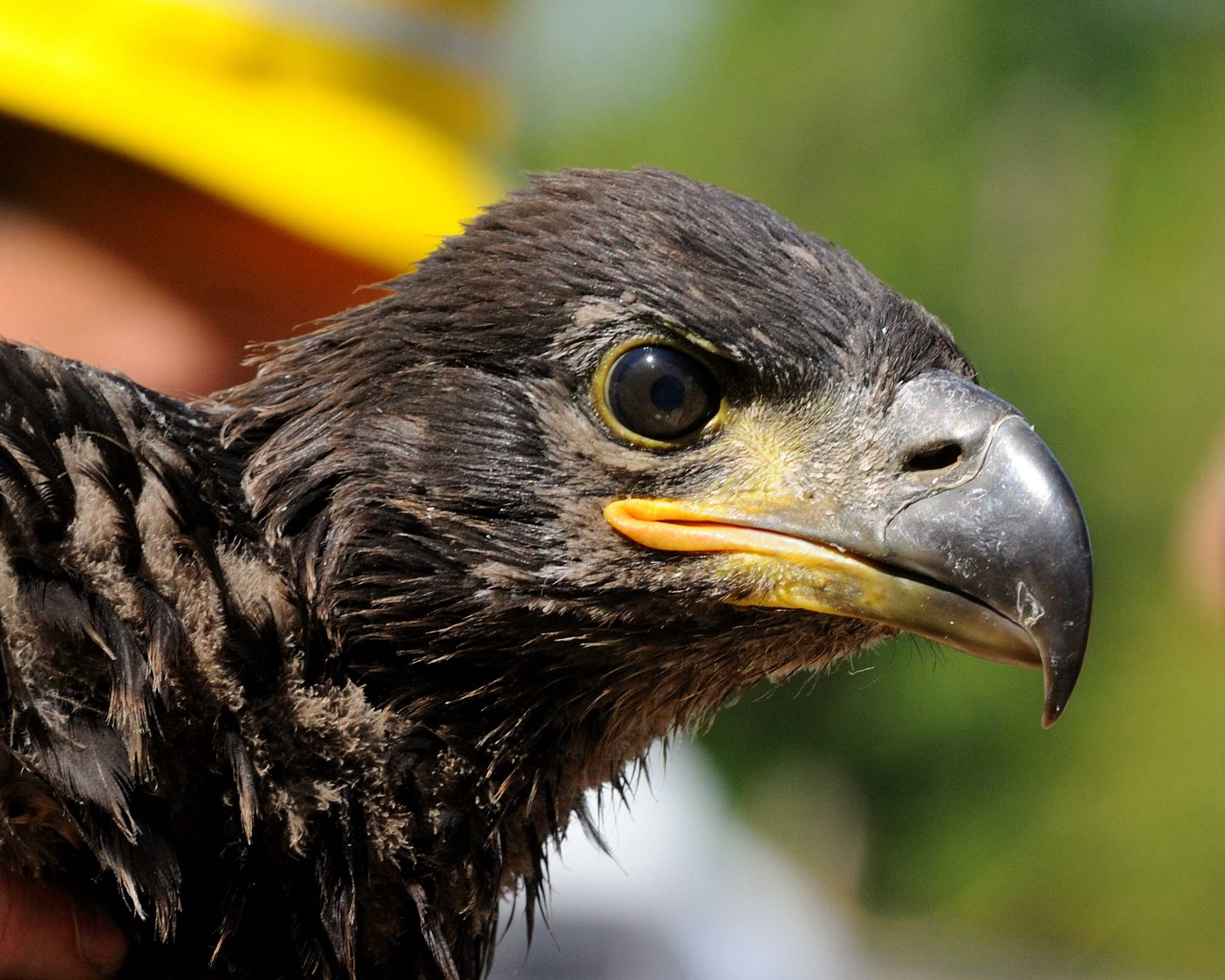
Eagle chick is alert as it is prepped for a physical exam by Dr. Erica Miller, DVM.
Not that the eagles ever left, however, their nest of six years was removed, which gave rise to wild speculation as to their fate.
High tension towers were being replaced, one of which held their nest. Though in past years, the nest had been removed accidently, remodeled and relocated from the left to the right to the center by the eagles themselves, the middle of the tower arm seemed to be the final site.
Much to the eagle’s surprise, the home tower dating back to the 1920s was removed and a new style tower constructed in its place. Though ‘science’ says eagles bond and nest in January, our eagles were never polled and began to bond and touch up the nest in October. Just as the power company took down the tower.
The eagles appeared upset, one screeching at the other as they were perched nearby. Hearts were breaking in sympathy. Before the old tower was deconstructed, the giant nest was cradled, lowered by crane and stored on site. The plan was to return the nest on a new style platform as encouragement for the eagles to return. That was the plan but would the eagles agree?
We watched that pair daily and never once did an eagle land on that tower. It didn’t look good.
Then a new nest was started a mile downstream and hopes soared for our faithful pair. During one twenty minute period, the suspected male brought six large branches to the nest where both eagles discussed their placement.
The nest grew larger and finally looked like it was move-in ready. Still, no eagle would land on the nest platform in the new tower. It was in a way, comforting, to see eagles nesting in a giant sycamore tree rather than in non organic, cold metal tower draped with high tension wires.
During nest construction many images were taken and shared. On one occasion, a pair of adult eagles was observed downstream of the nest and another pair at the nest in the sycamore. Were there two pair of eagles or did the eagles seen downstream make it to the nest before the observer could?
Sure enough photo evidence and direct simultaneous observation revealed there were two pairs of eagles seen at different times on the new nest. Now what?
Then one day an eagle was seen perched on the rail at the nest on the tower! Would eagles occupy both nests, would there be a territorial dispute?
One eagle on the tower nest was hopeful, but why would they go through the trouble and wasted energy to construct a beautiful downstream nest?
It was a confusing time, as we all concluded the sycamore nest was the nest of record. Then both eagles were seen on the tower, the suspected male bringing material to the rebuild the nest. January twenty-third was the last date eagles were recorded on the downstream nest while activity picked up at the tower.
Now the question was, who were the eagles at the tower, the interlopers or the faithful pair? Try as we might from images and observed past individual behavior, we could not definitively conclude their identity.
The original pair had an easily seen size difference, the conclusion was the larger bird was the female. This is a generalization which may not be true in every case. This pair was closer in size to each other. The original larger bird had a unique expressive head movement not seen by the bird identified as the female.
Was the male from the original pair with a new female? We concluded there was no sure way to tell.
Now a fully prepared downstream nest awaited tenants, hopefully, the other eagle pair. No such luck as the nest was now declared abandoned. At one point a local red tail hawk and then an immature eagle briefly visited the nest.
The other eagle pair left the area though several un-banded immature eagles were commonly observed.
Now all attention was on the pair of eagles nesting at the tower. When the nest was relocated in the new tower, an eagle cam was installed but failed to function. The plan was to remedy the camera during the banding session.
When the eagles were observed mating, the countdown to egg laying began. Hatching followed on schedule and the day to conduct the banding of the chicks was set.
May fourteenth, a crew from PSE&G, the state zoologist heading the project, and the state veterinarian, along with eagle project volunteers, participated in the banding of two eagles determined to be males. Each bird given a thorough physical exam, blood samples drawn, beak, talons and primary feather measured, weights taken. Green aluminum bands, H-04 and H-05 were placed around the legs. The concerned parents circled the tower while the banding was in progress.
The two eagles were determined to be males and banded with green anodized aluminum leg bands inscribed, H-04 and H-05. H-04 had the green band placed on the left leg, H-05 on the right leg. The intent is to make identification at a distance easier.
Both eagles passed the exam with flying colors and were rewarded with two whole fish placed in the nest compliment of the NJ Endangered and Non Game Species Program, headed by Kathy Clark.
When the eagles were returned to the nest, a consolation prize of two large fish was left as a compensation for their trouble. After everyone left, the parents returned to the nest and as in past years, continued to care for their young. This year, the world will stand witness to the rearing and eventual fledging of two young eagles whose shadows will glide over the earth to the amazement and wonder of our children and grandchildren.
Thanks to PSE&G we now have a live webcam, an incredible gift to the world of nature and environmental education. The eagle webcam may be accessed at:
This will spark curiosity to ignite the desire to seek deeper knowledge, not just about eagles but the entire interrelated community of nature, of which we are a part; a benefit to all.
Author Joe Mish has been running wild in New Jersey since childhood when he found ways to escape his mother’s watchful eyes. He continues to trek the swamps, rivers and thickets seeking to share, with the residents and visitors, all of the state’s natural beauty hidden within full view. To read more of his writing and view more of his gorgeous photographs visit Winter Bear Rising, his wordpress blog. Joe’s series “Nature on the Raritan, Hidden in Plain View” runs monthly as part of the LRWP “Voices of the Watershed” series. Writing and photos used with permission from the author. Contact jjmish57@msn.com. See more articles and photos at winterbearrising.wordpress.com.
The LRWP is working in partnership with a broad coalition to ban Neonics (neurotoxins that decimate bees and other wildlife populations), to encourage passage of a “Save the Bees” Bill. With nudging from environmental groups around the state, New Jersey’s legislature is poised enact the strongest, smartest restrictions in the country to rein in widespread pollution of the state with neurotoxic neonicotinoid pesticides—or “neonics.” The bill, A2070/S1016, isn’t just good news for New Jersey’s bees, birds, and other wildlife, but also the state’s mostly pollinator-dependent farmers and all residents that value clean water and a healthy environment.
New Jersey’s pollinators are disappearing, with beekeepers losing between 40% to 50% of their colonies annually for most of the last decade. Honeybees are a $7 million industry in New Jersey and—along with wild bees and other pollinators—help pollinate nearly $200 million worth of fruits and vegetables annually. These include some of the state’s most valuable food crops, including blueberries, cherries, apples, peaches, pumpkins, cucumbers, tomatoes, and squash. Rutgers University research indicates many of these crops are “pollinator limited”—meaning a lack of pollinators is already resulting in lower crop yields.