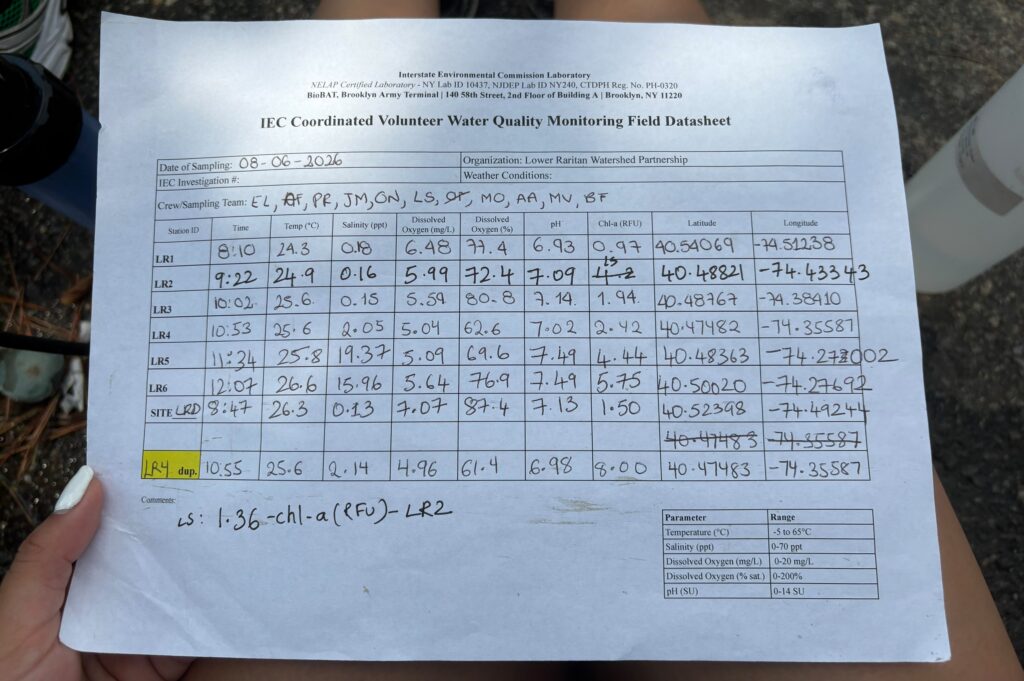
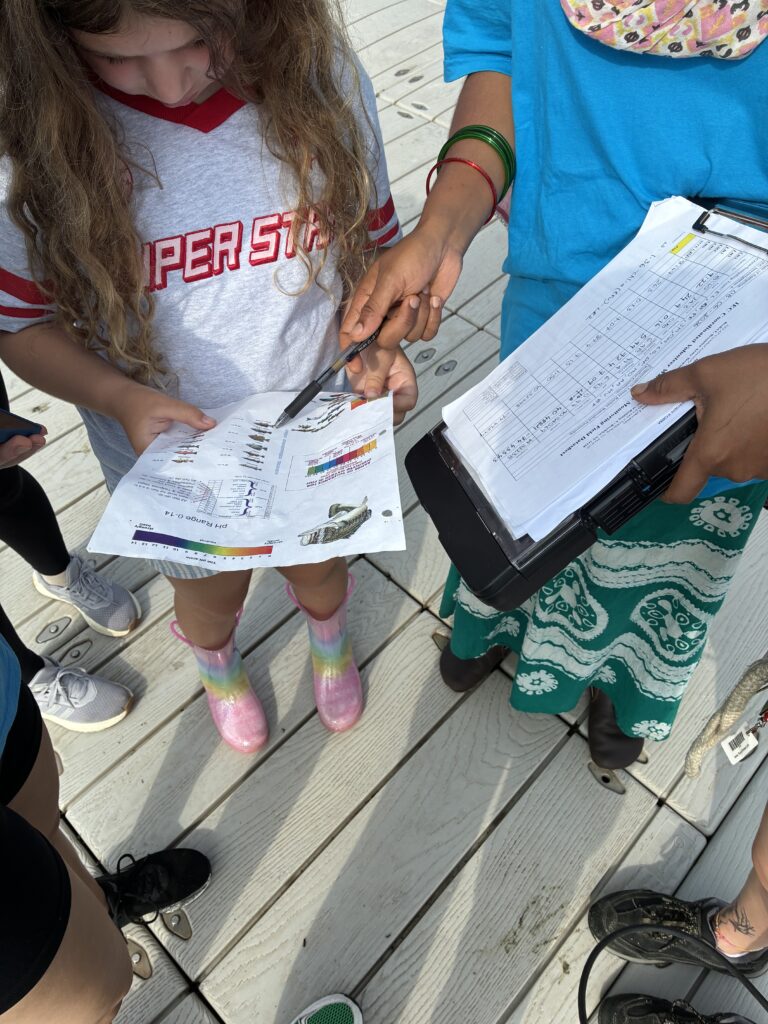
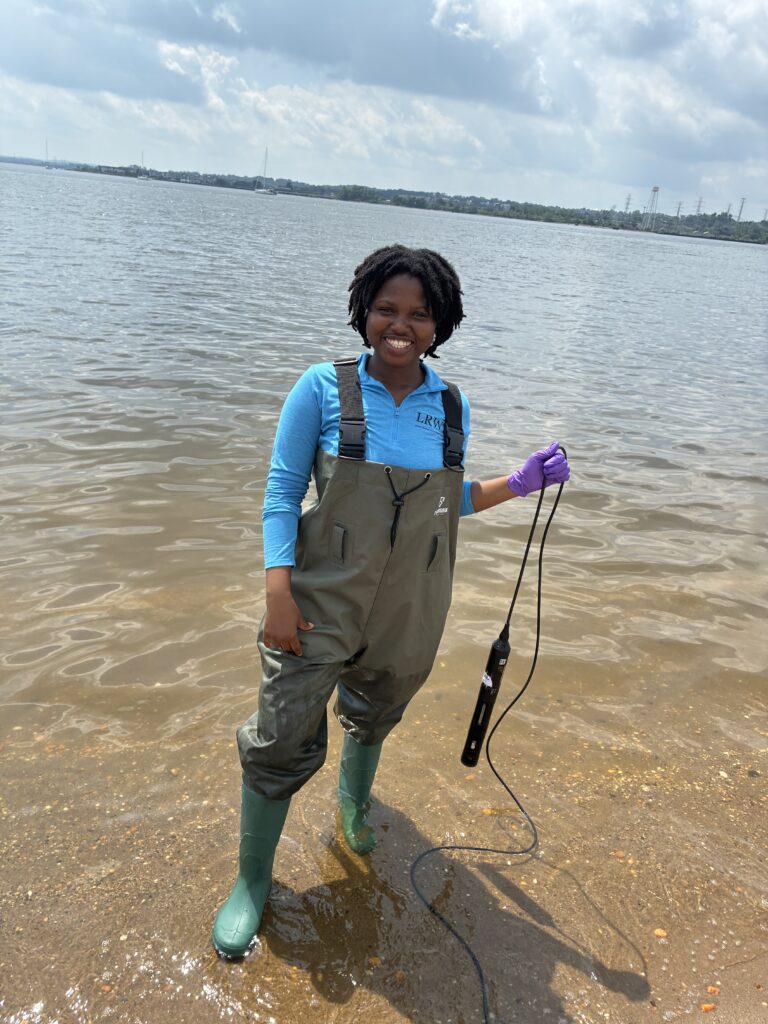
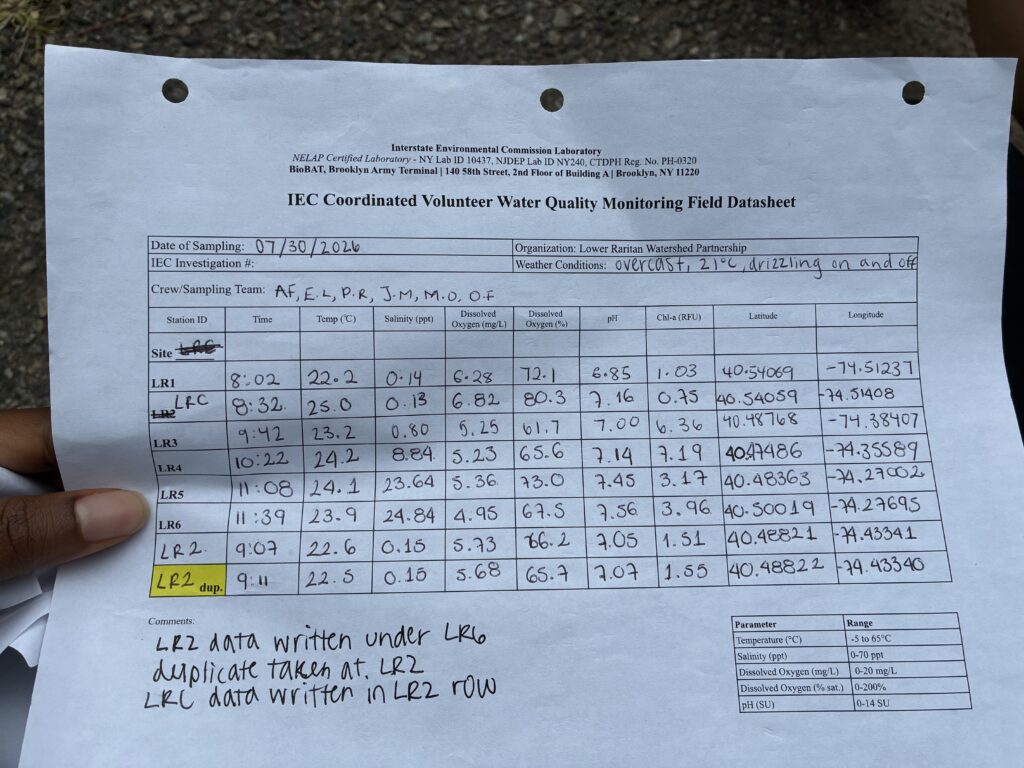
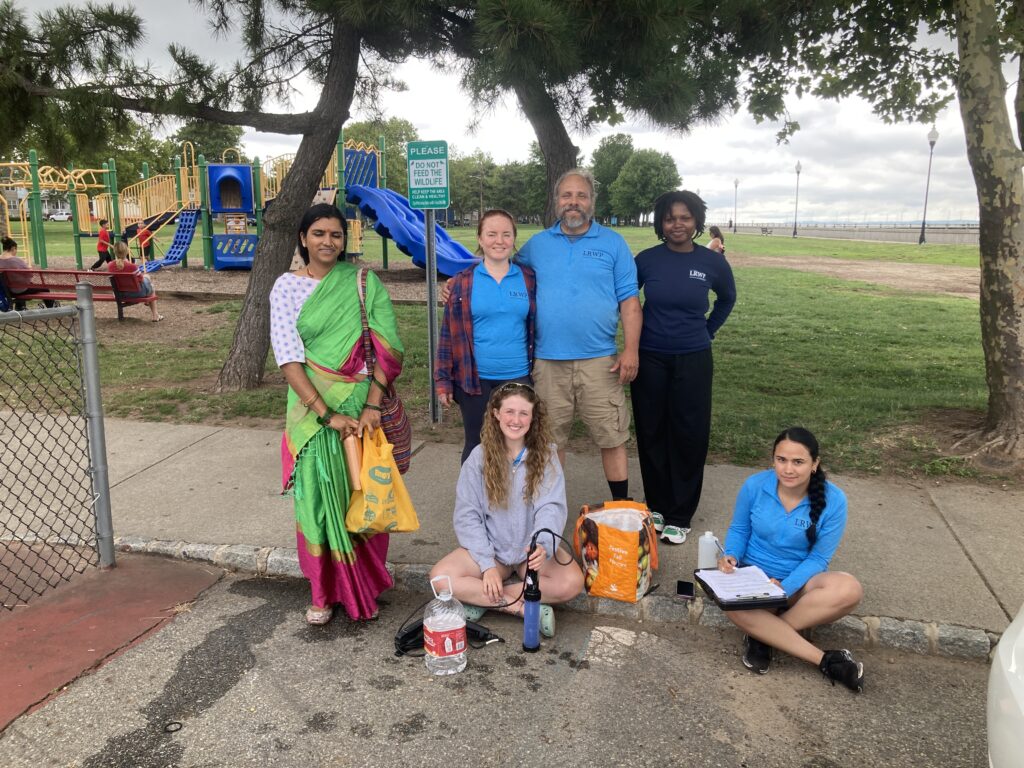
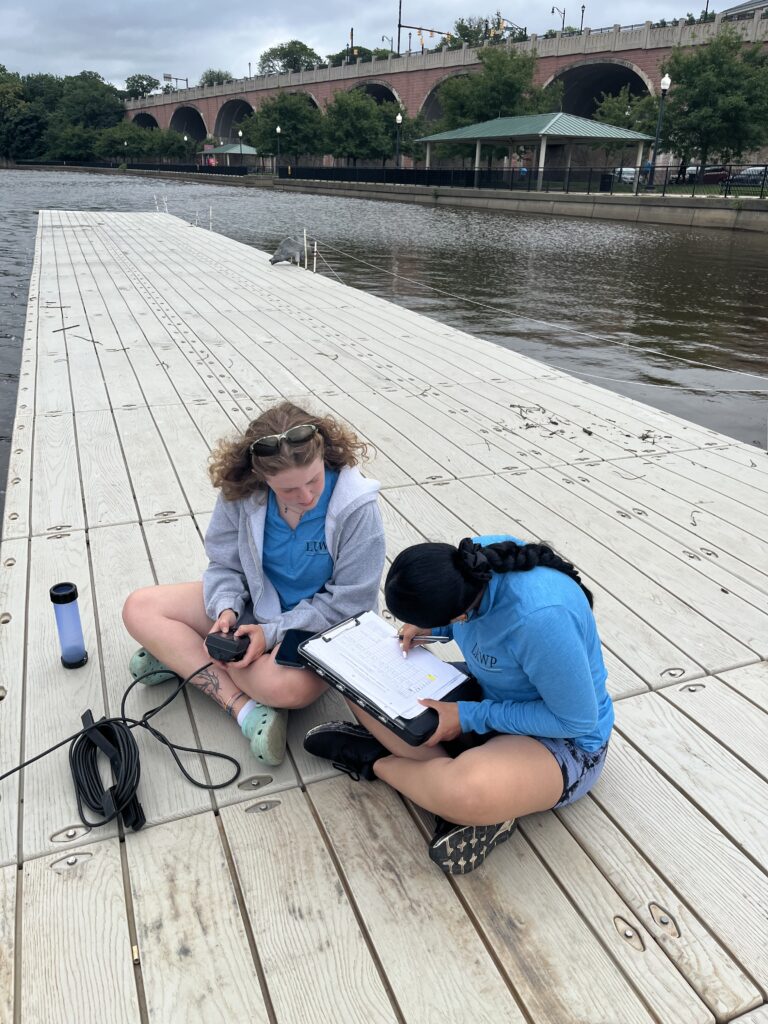
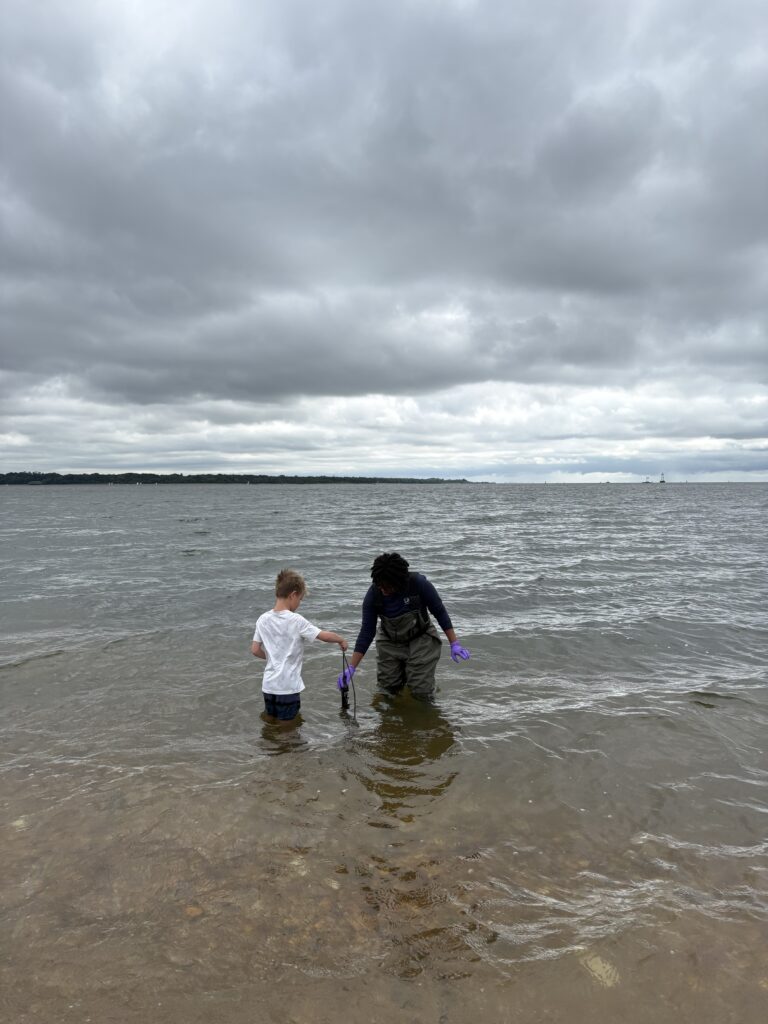
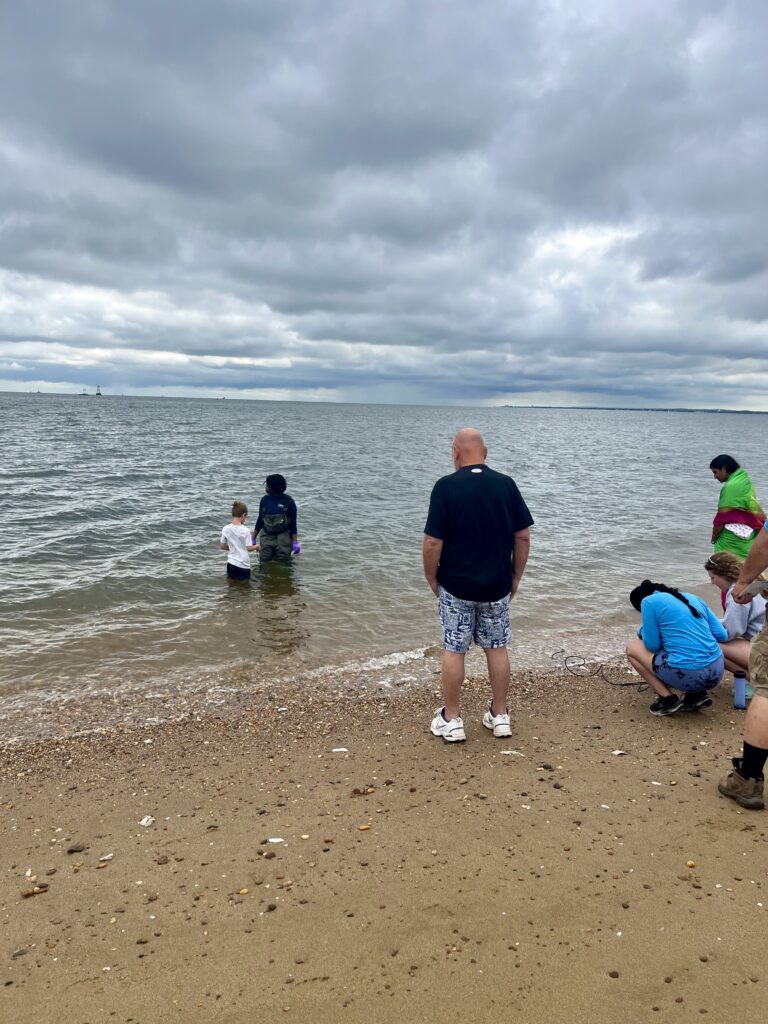
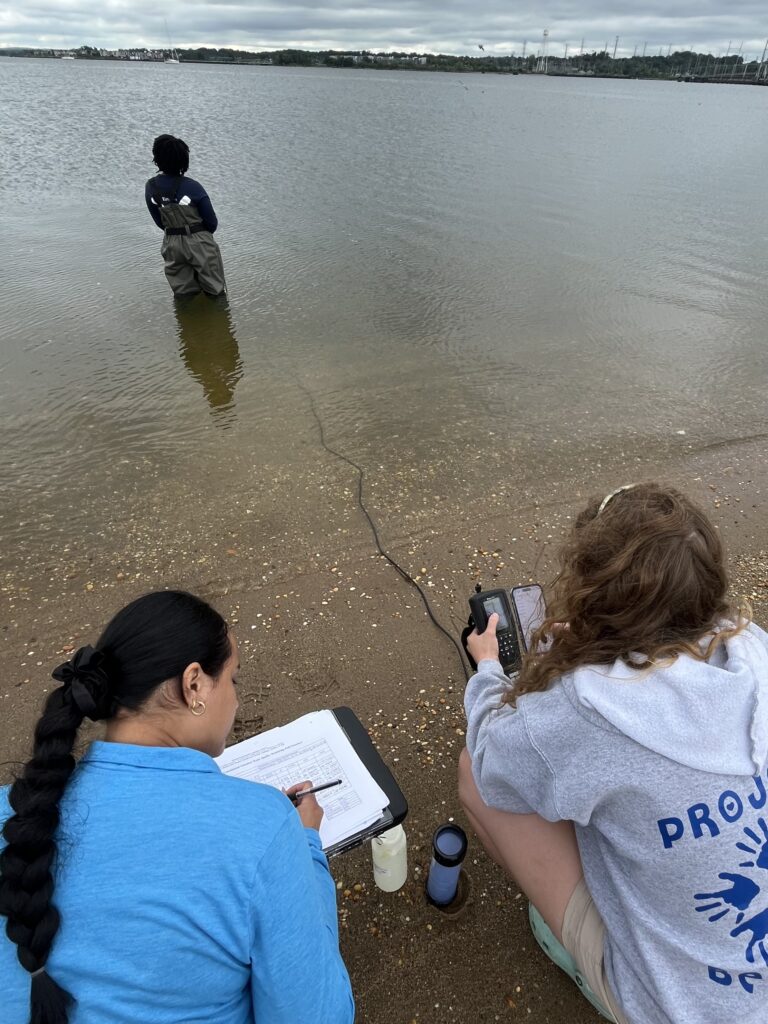
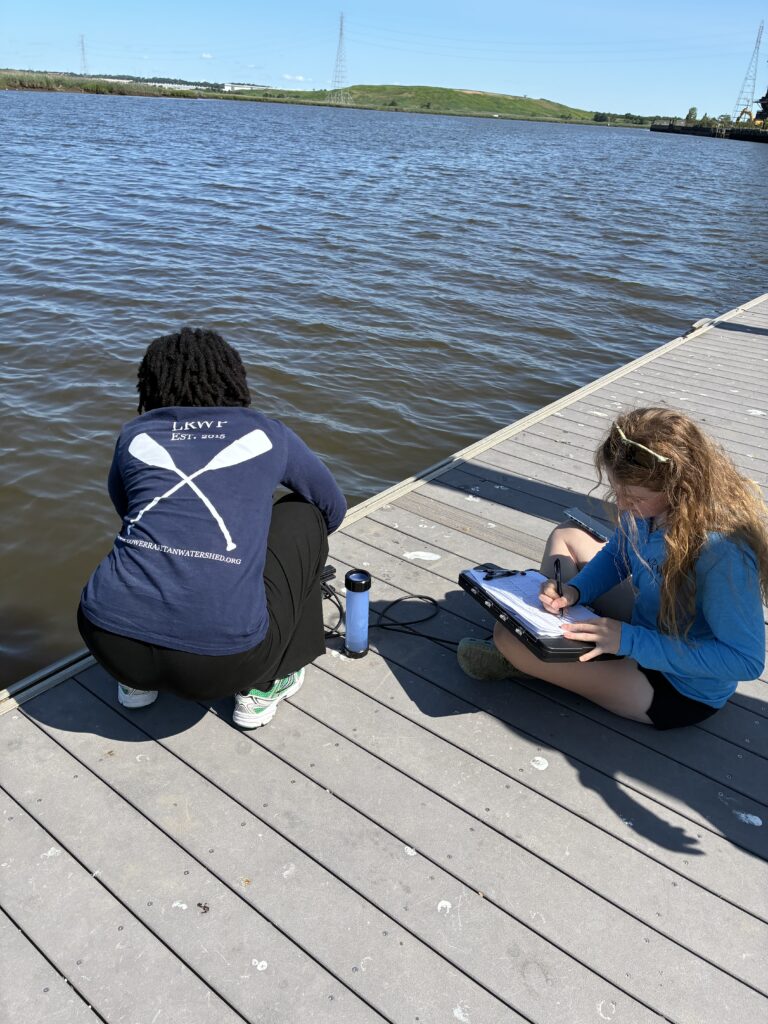
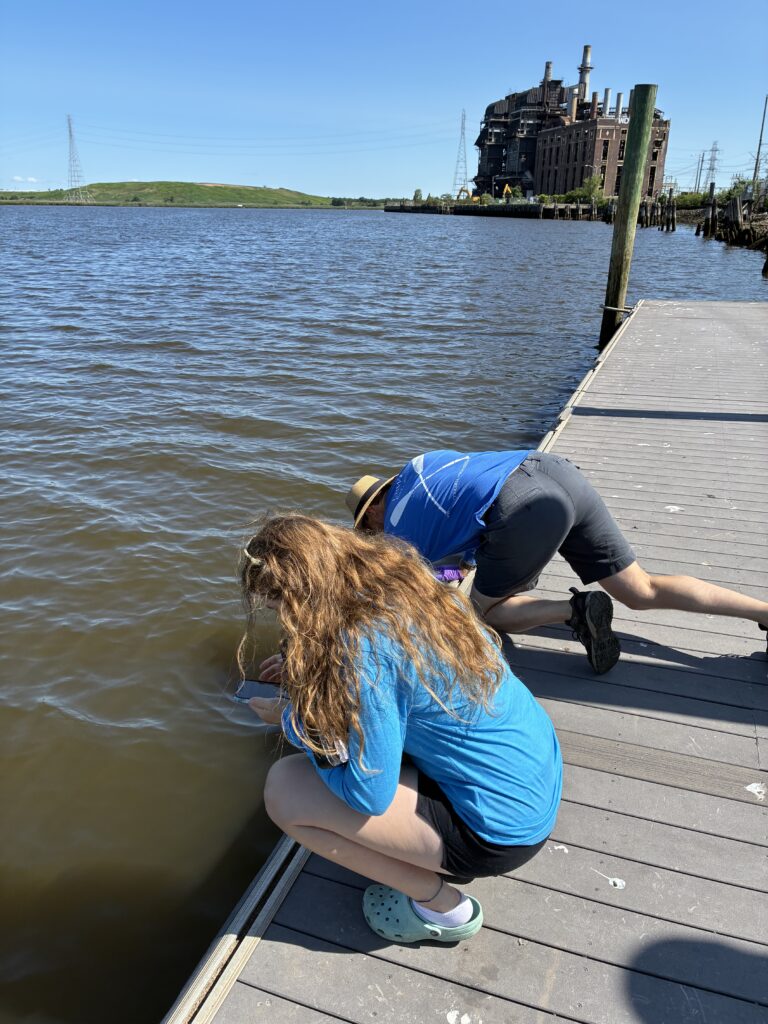
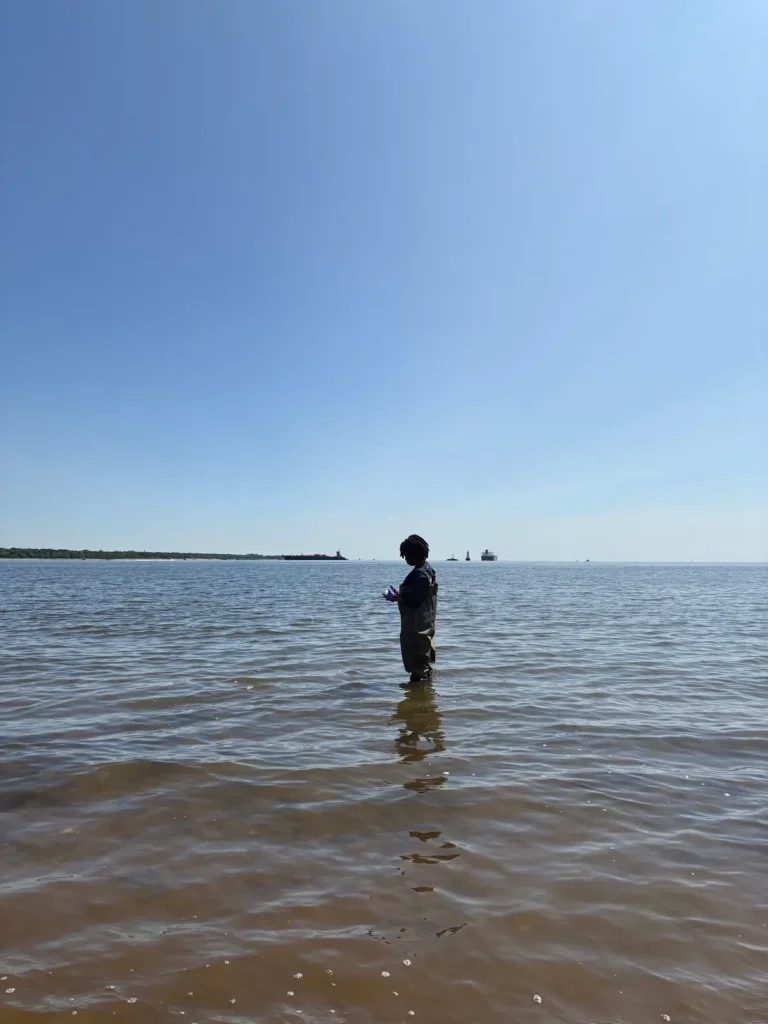
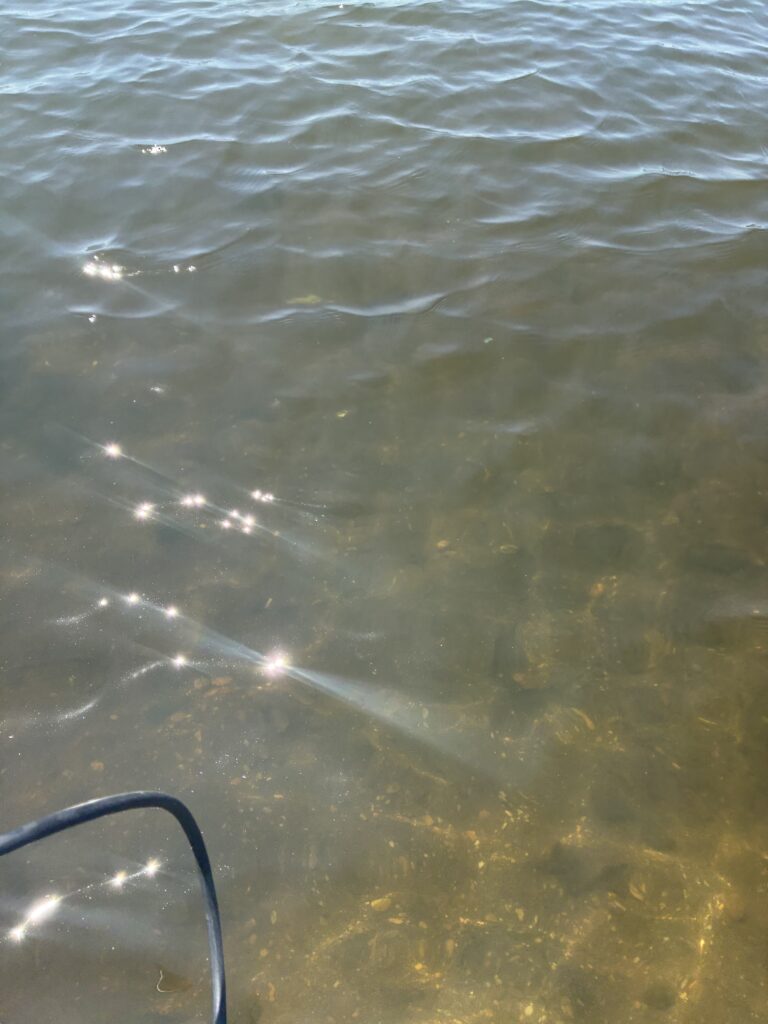
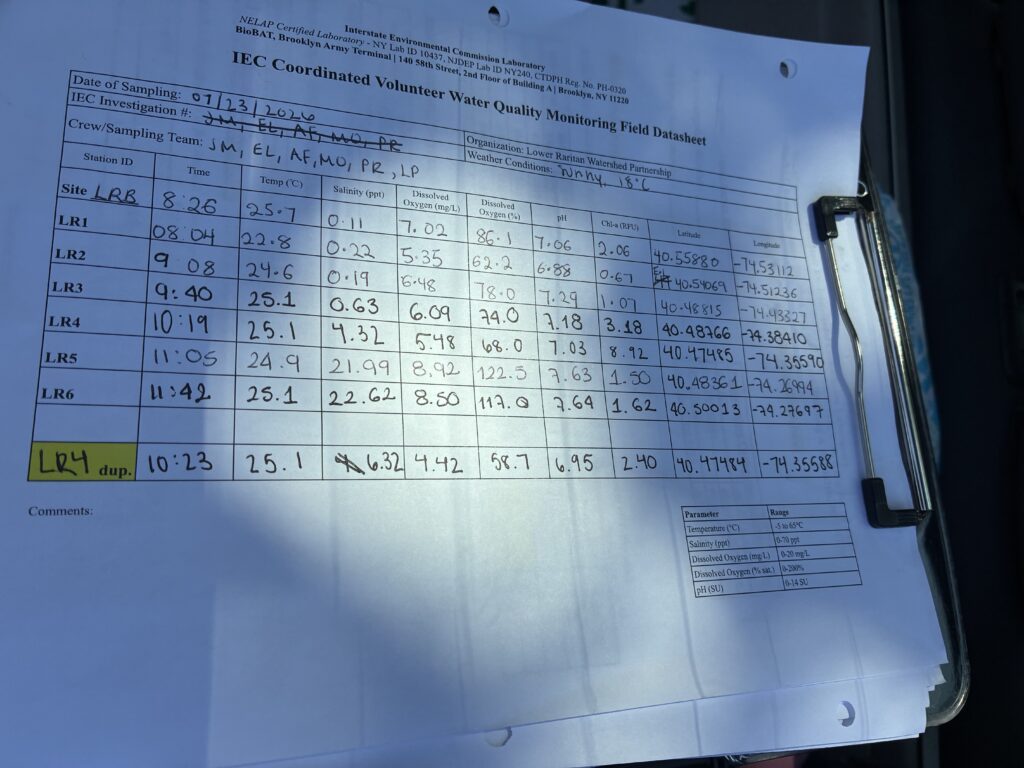
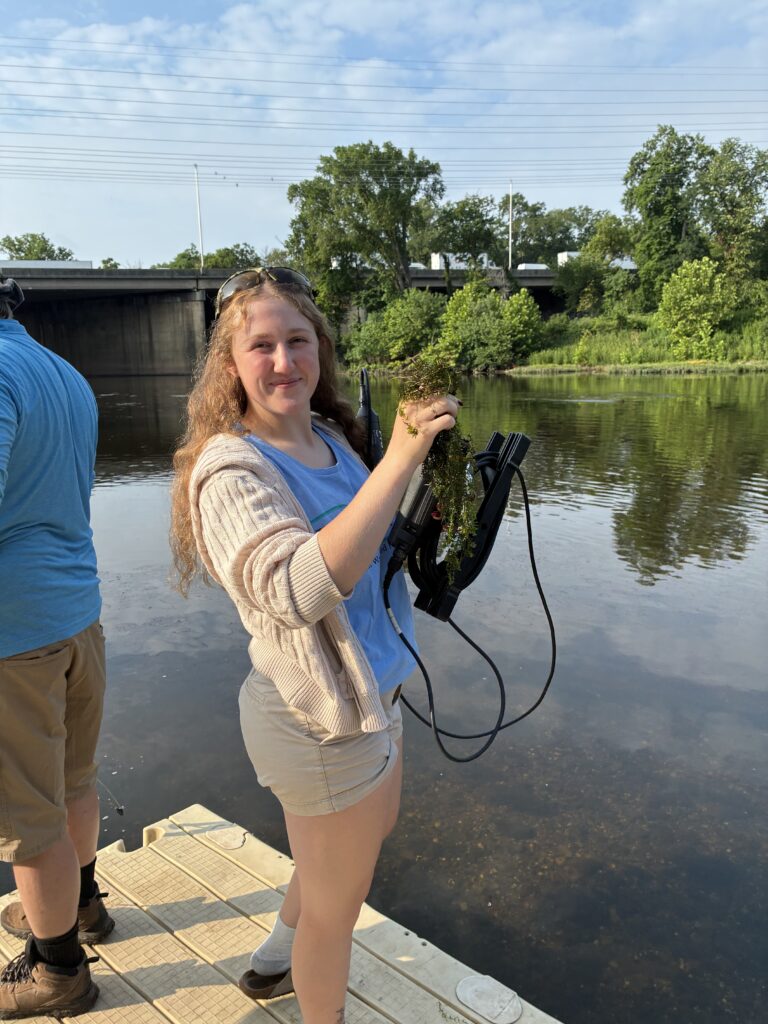
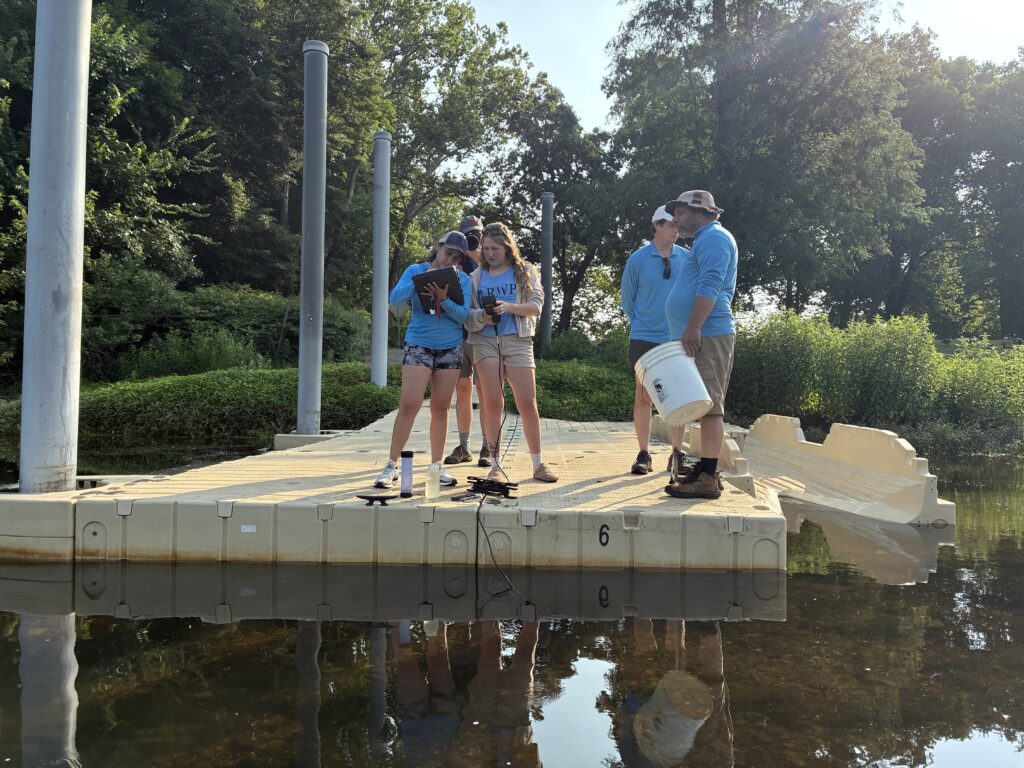
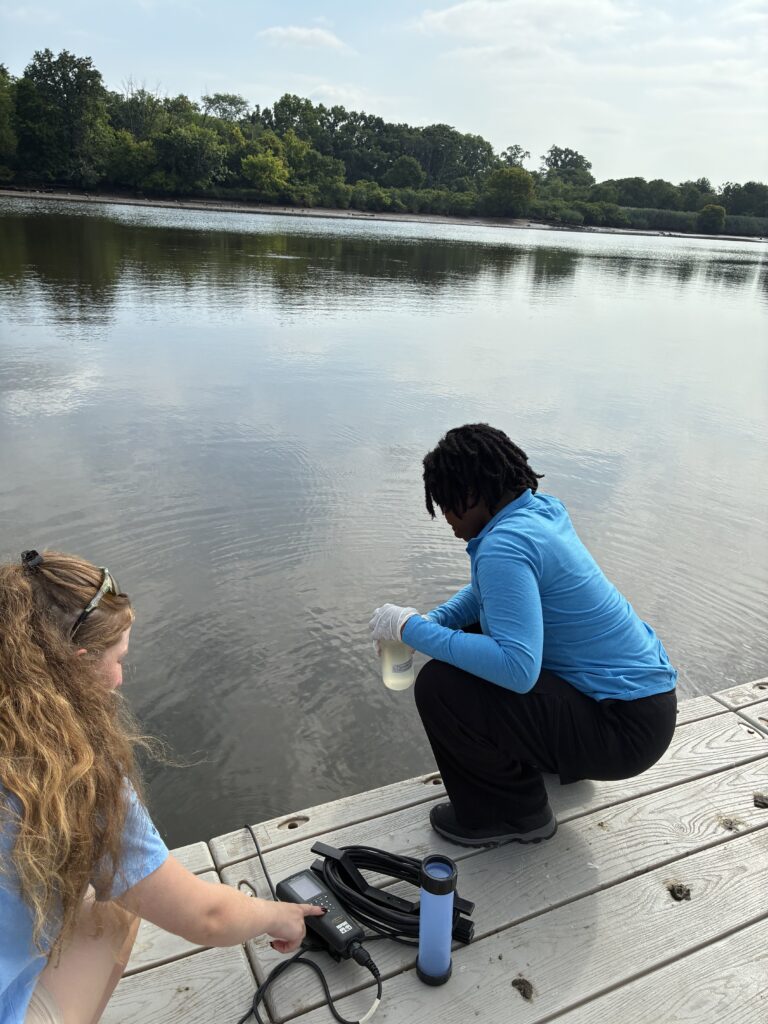
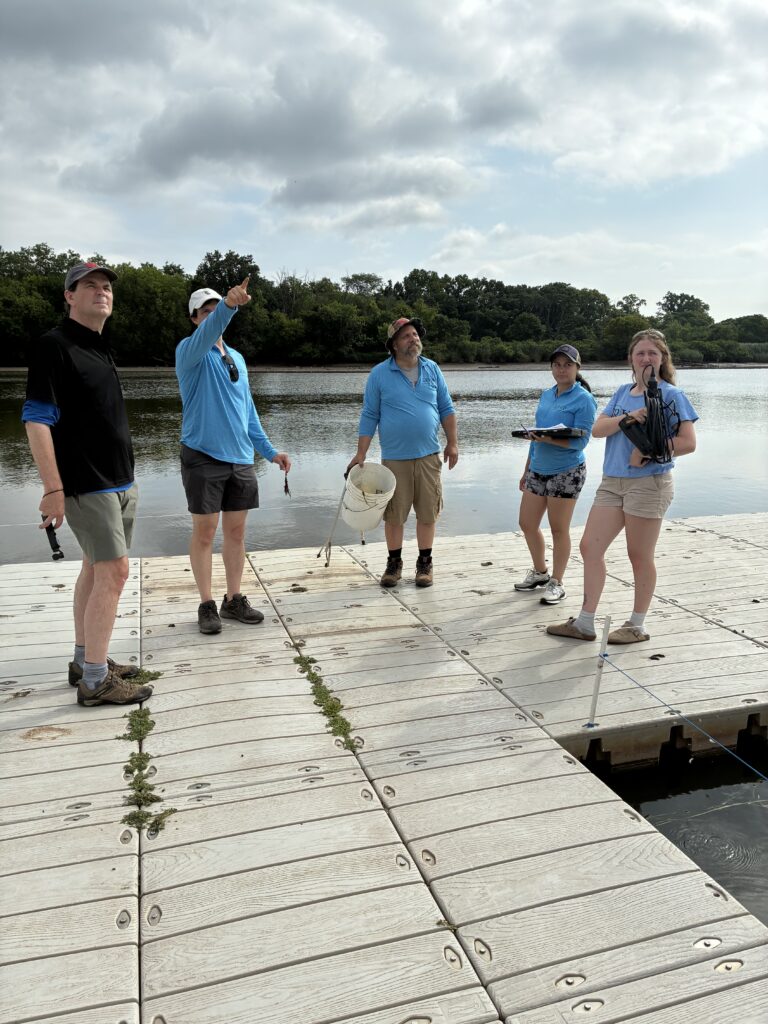
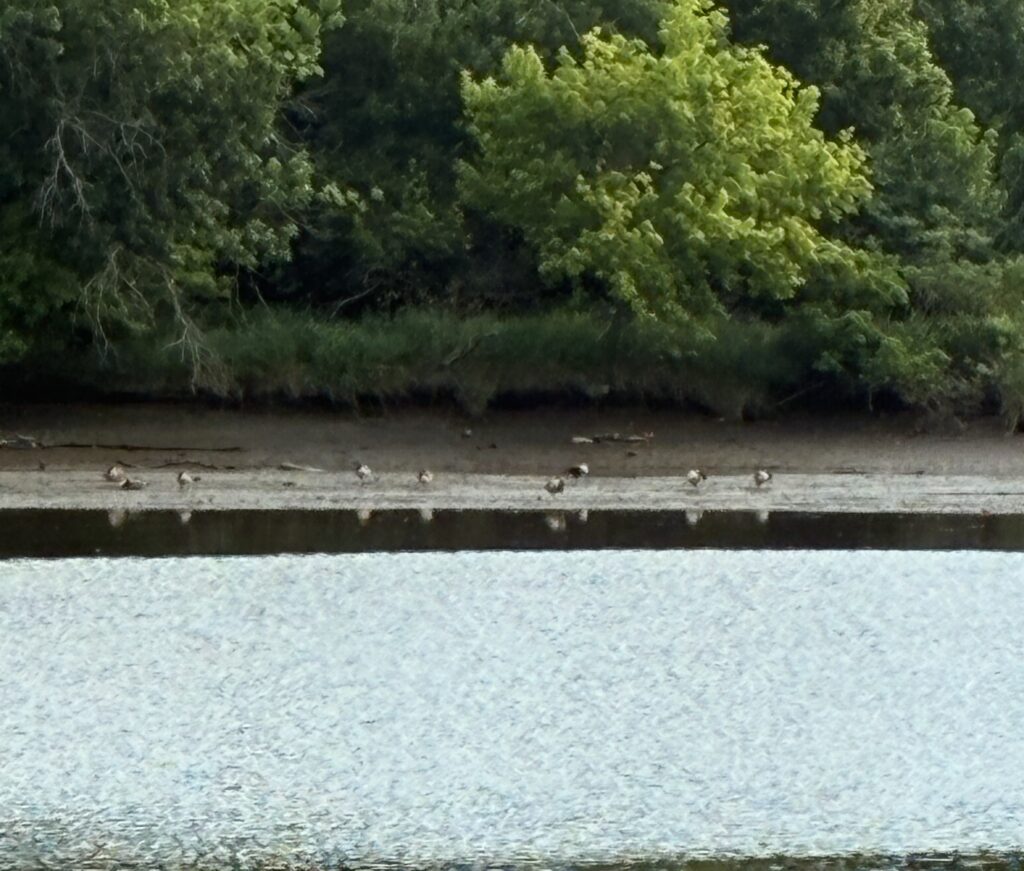
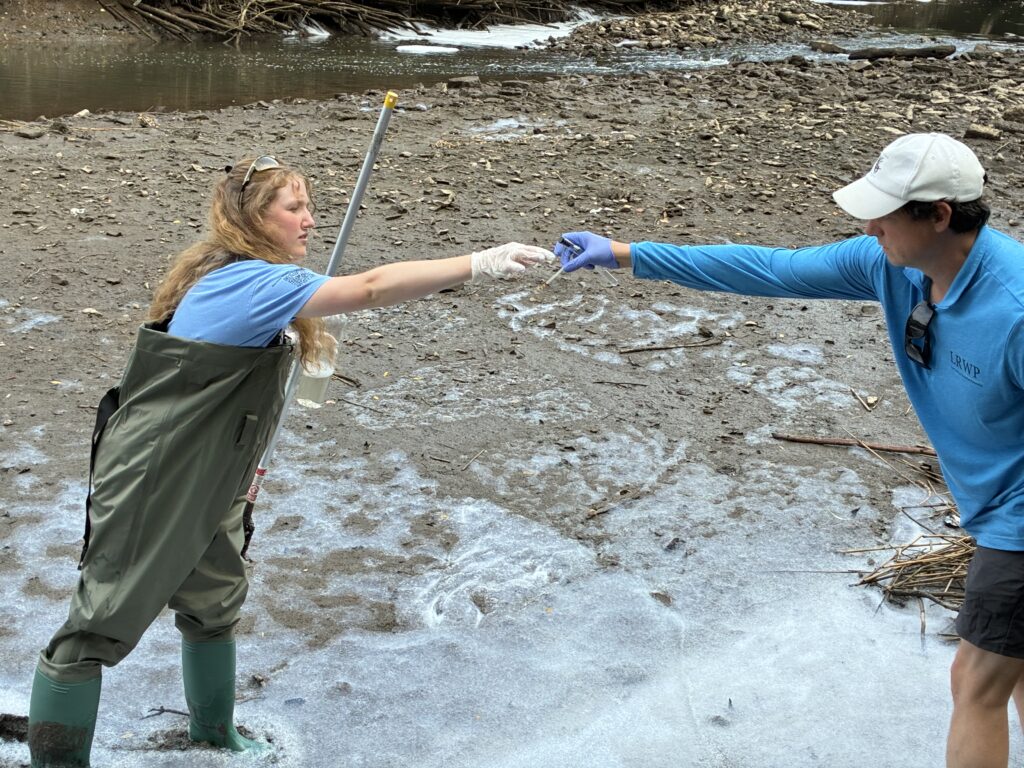
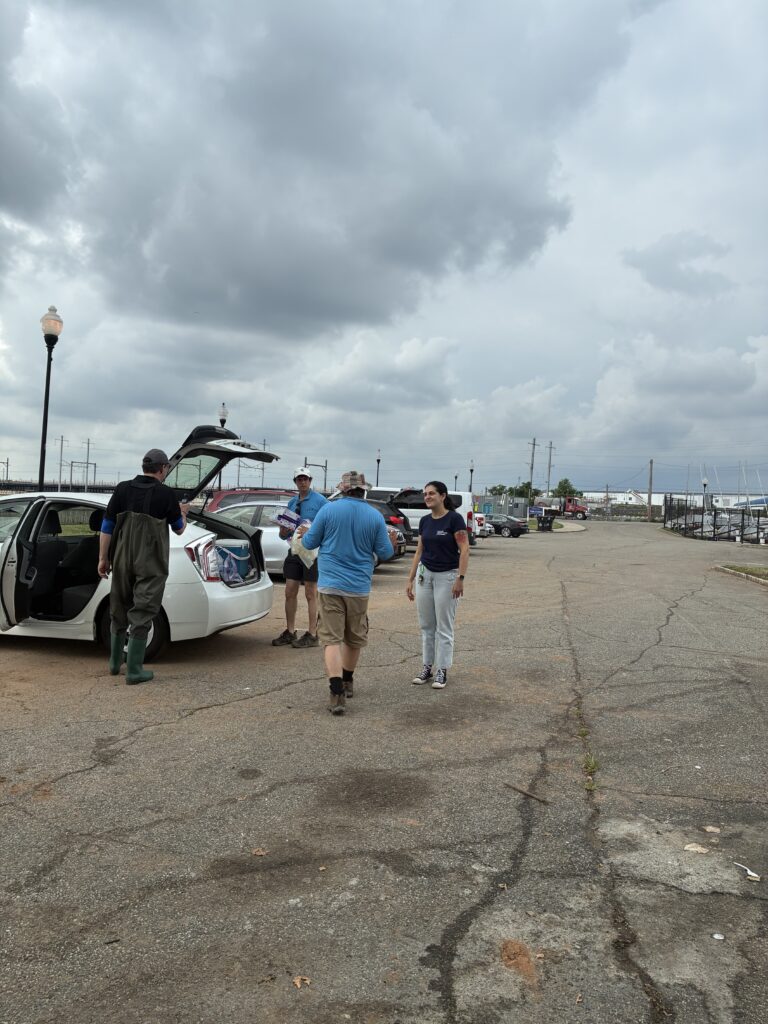
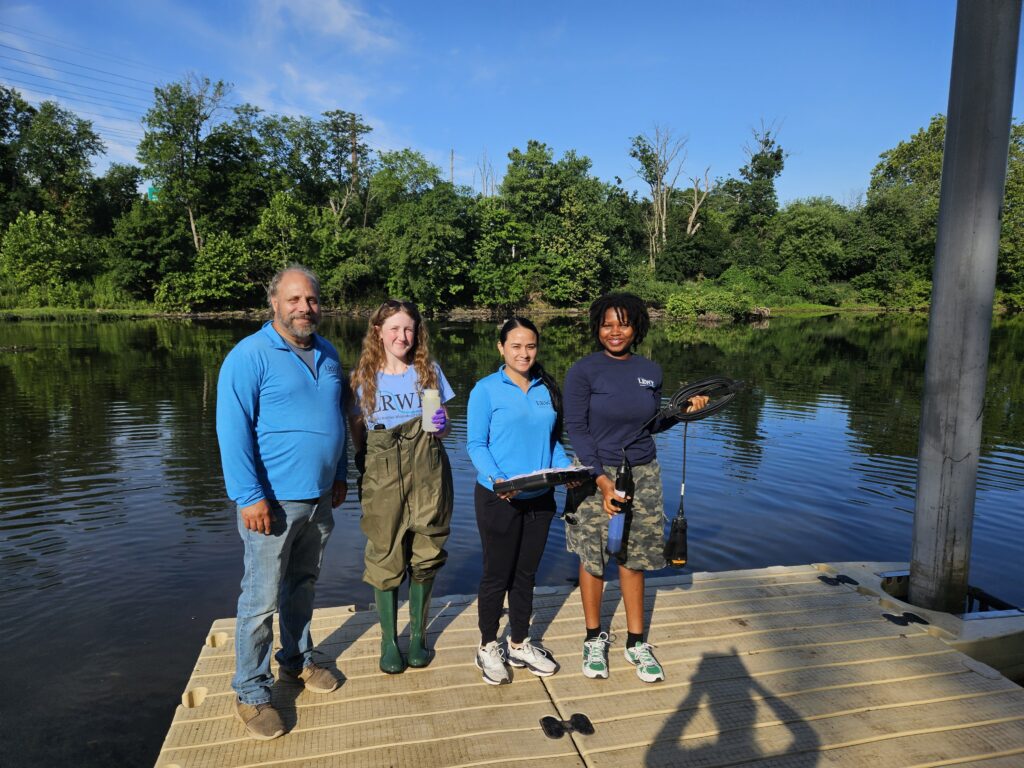
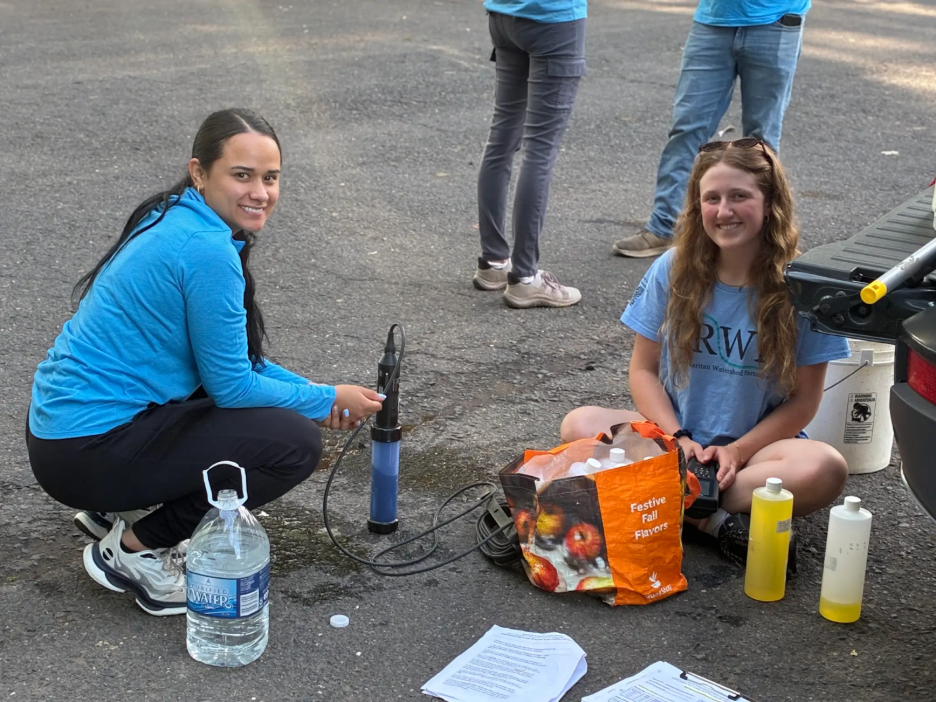
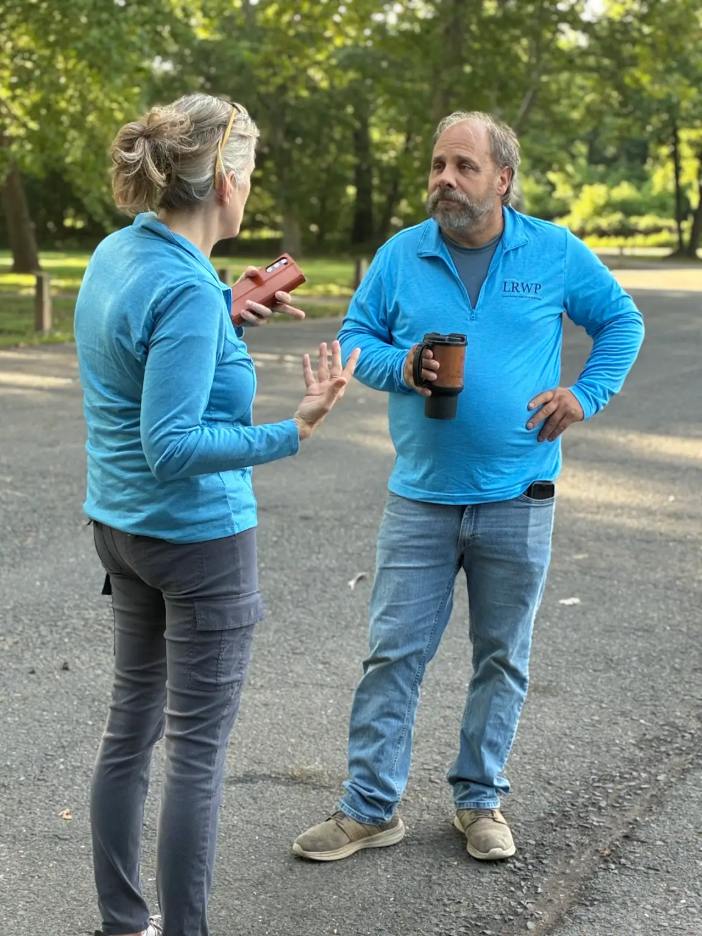
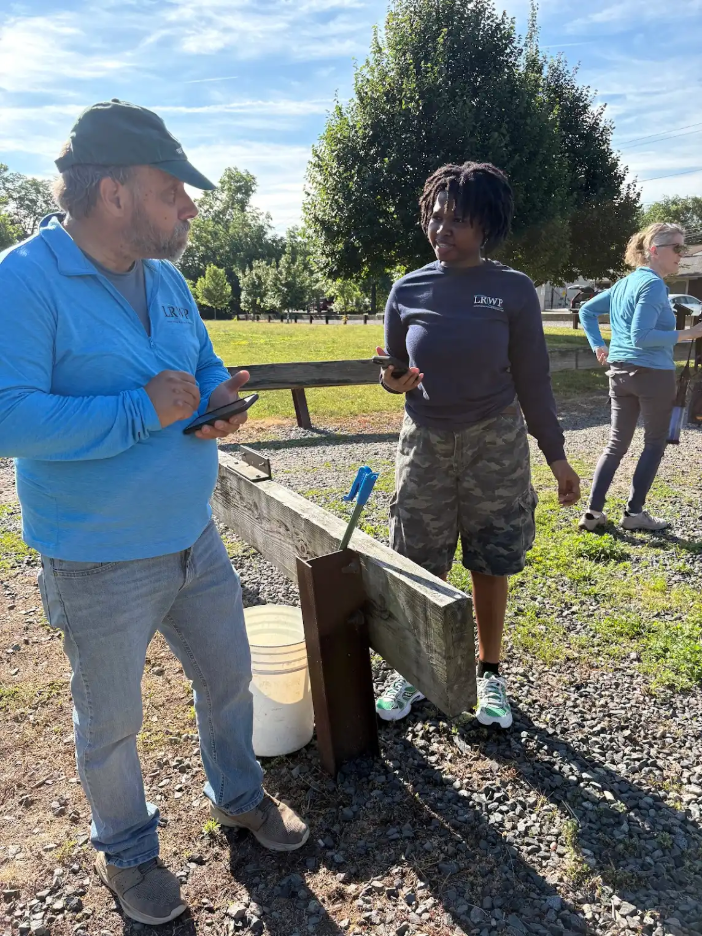
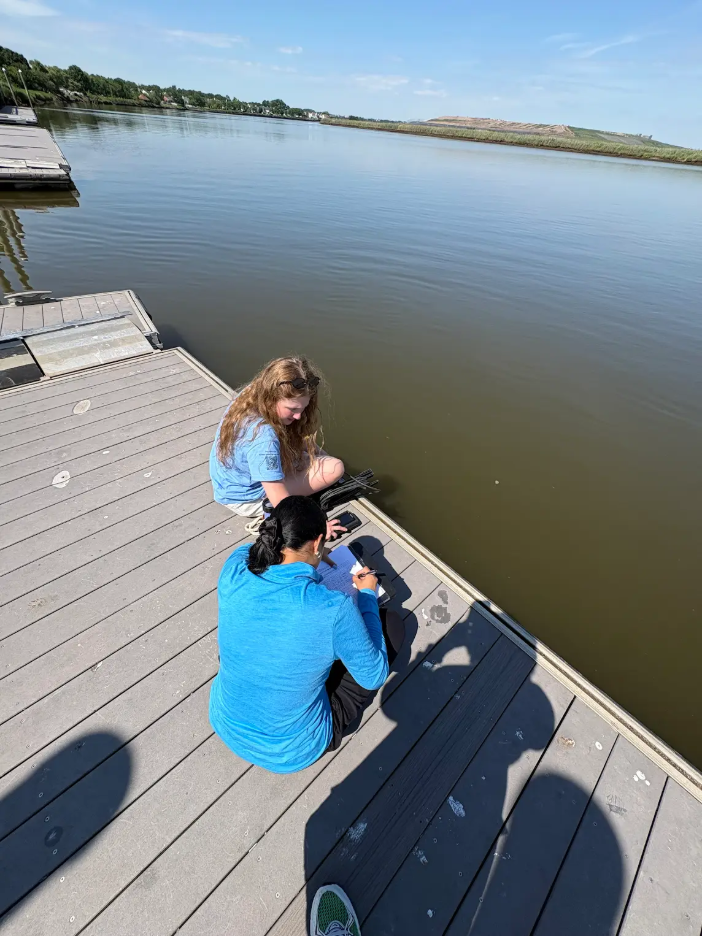
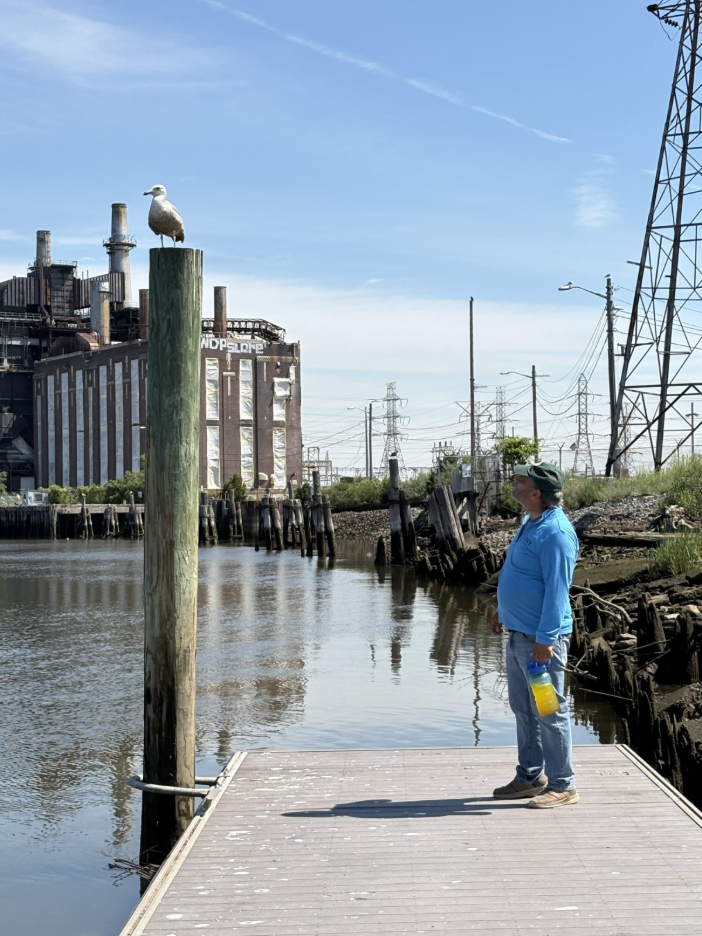
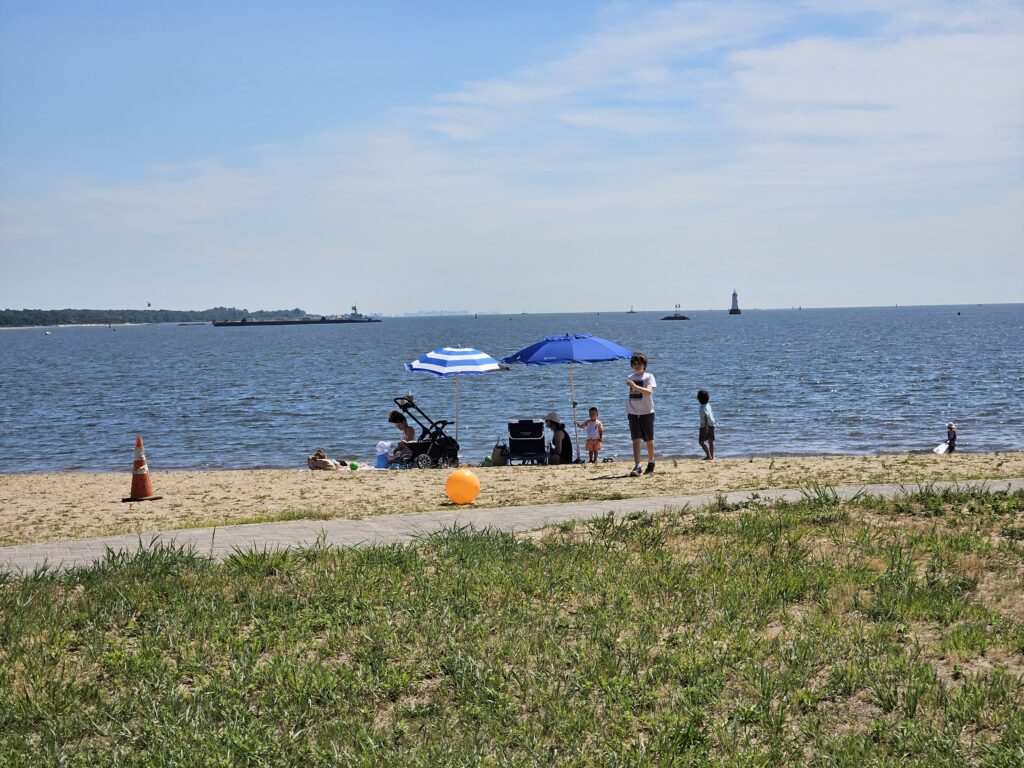
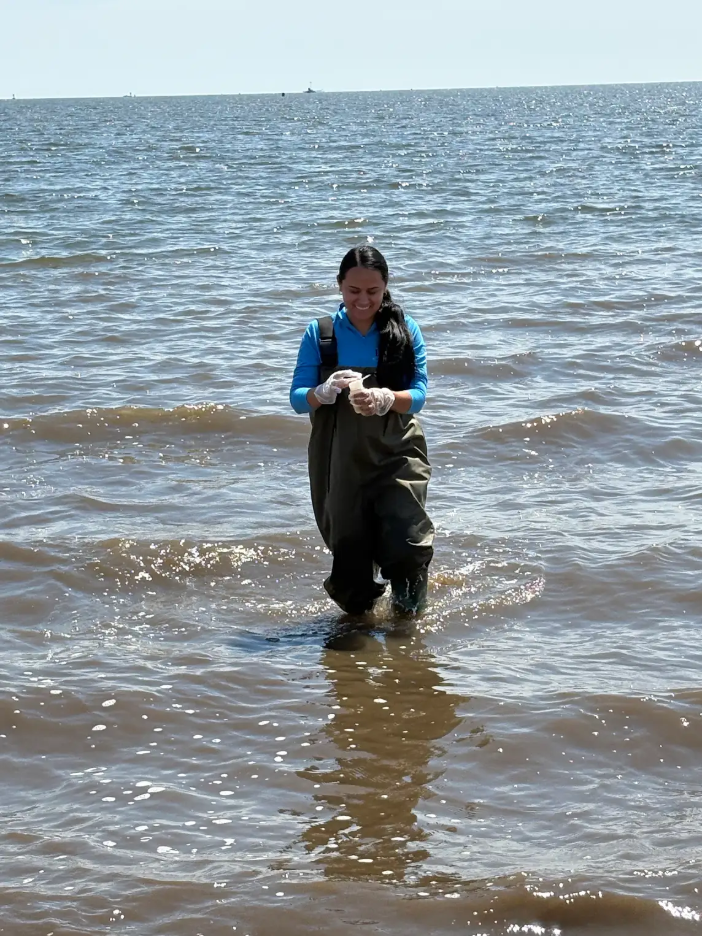
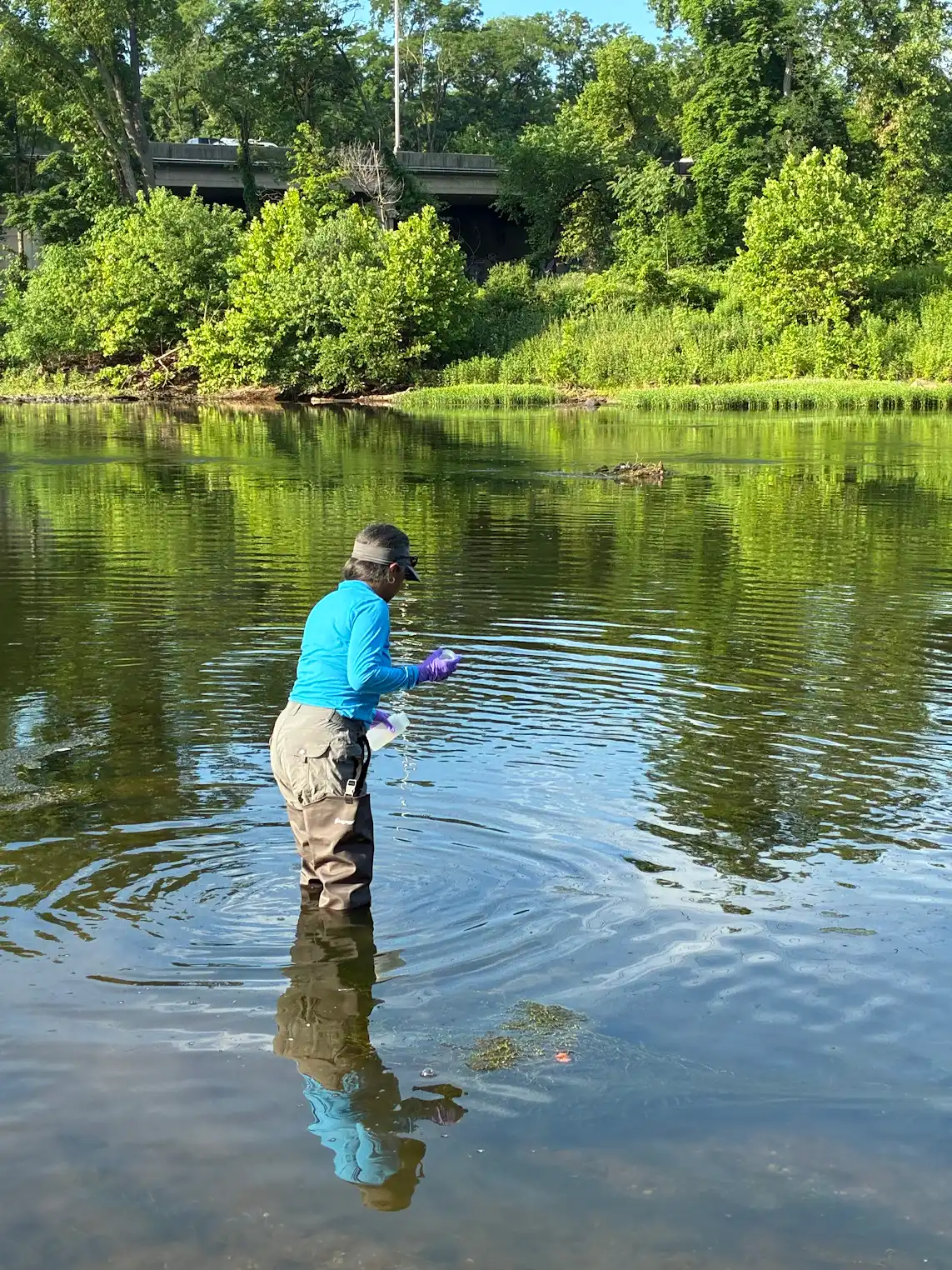
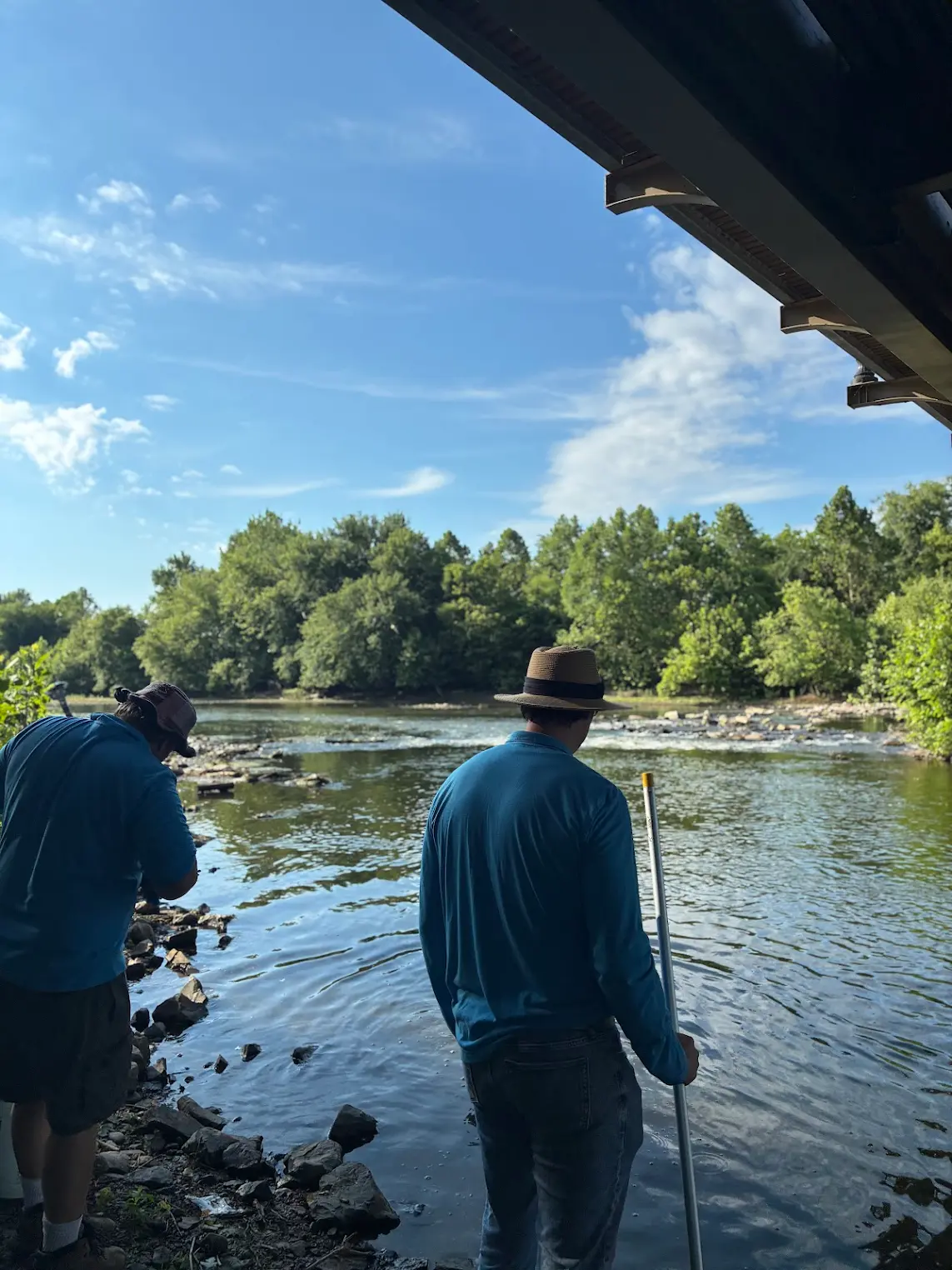
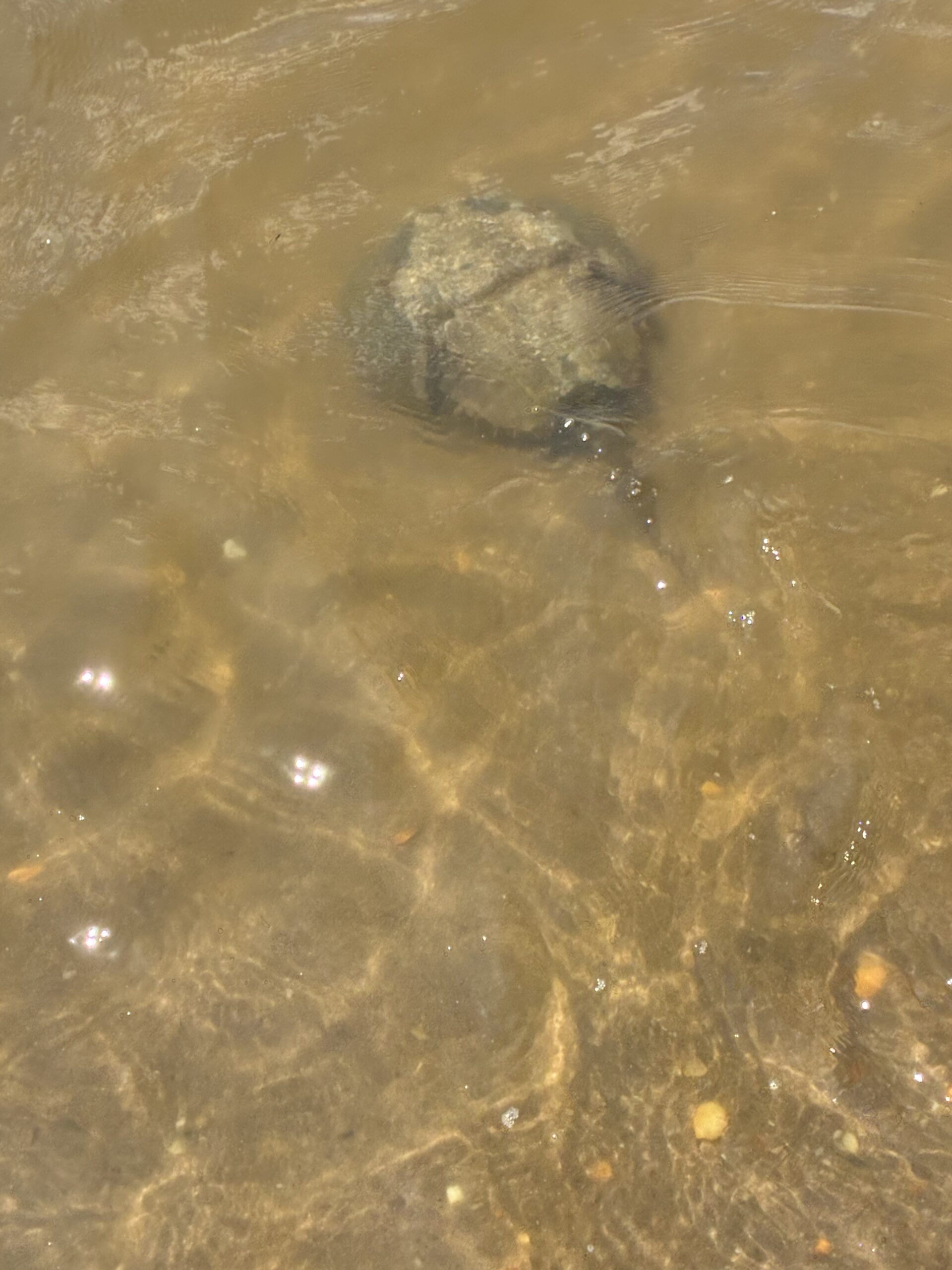
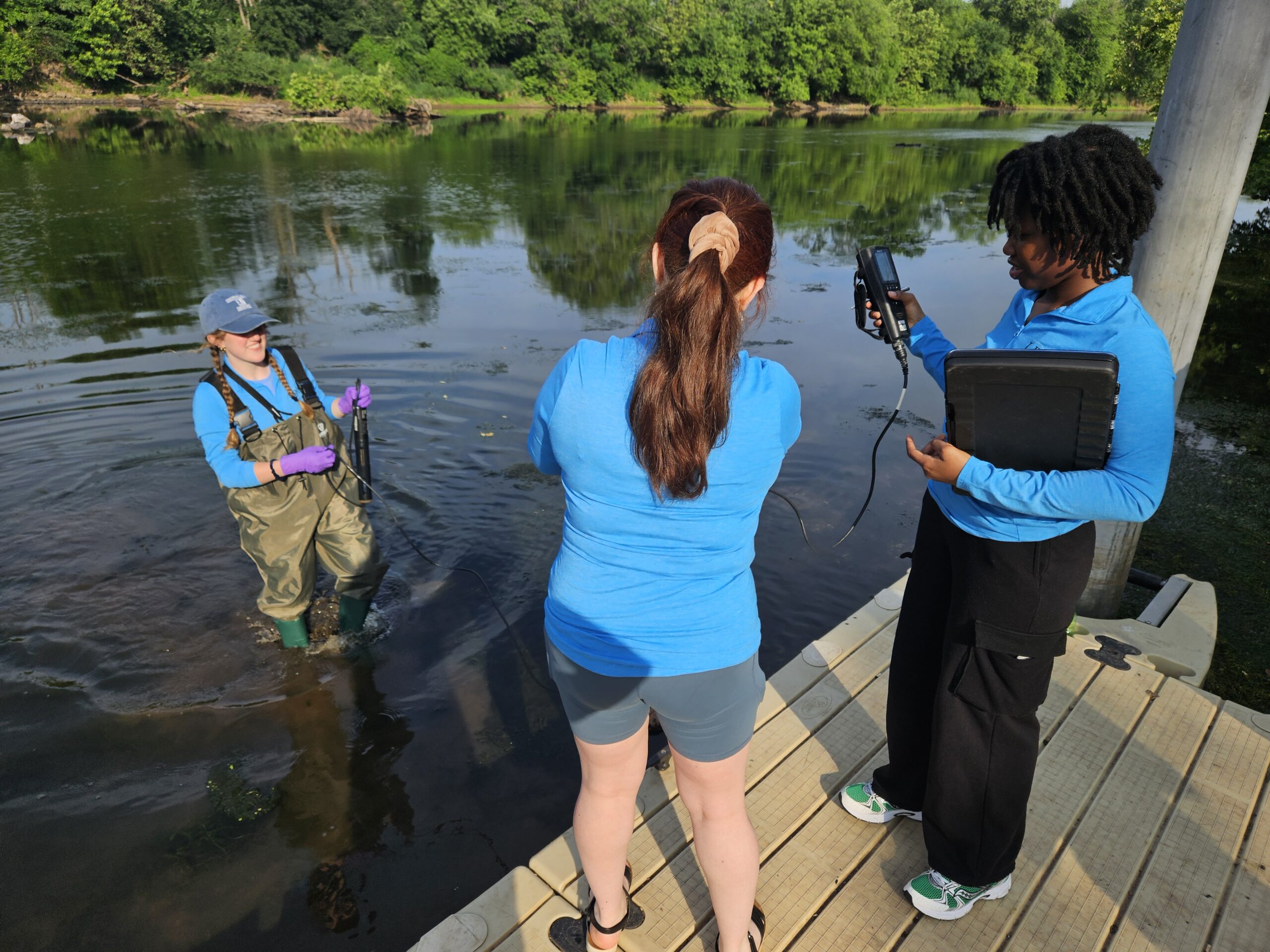
All parameters seemed to be in safe ranges at the time of monitoring today. Photo by Paula Rubio.
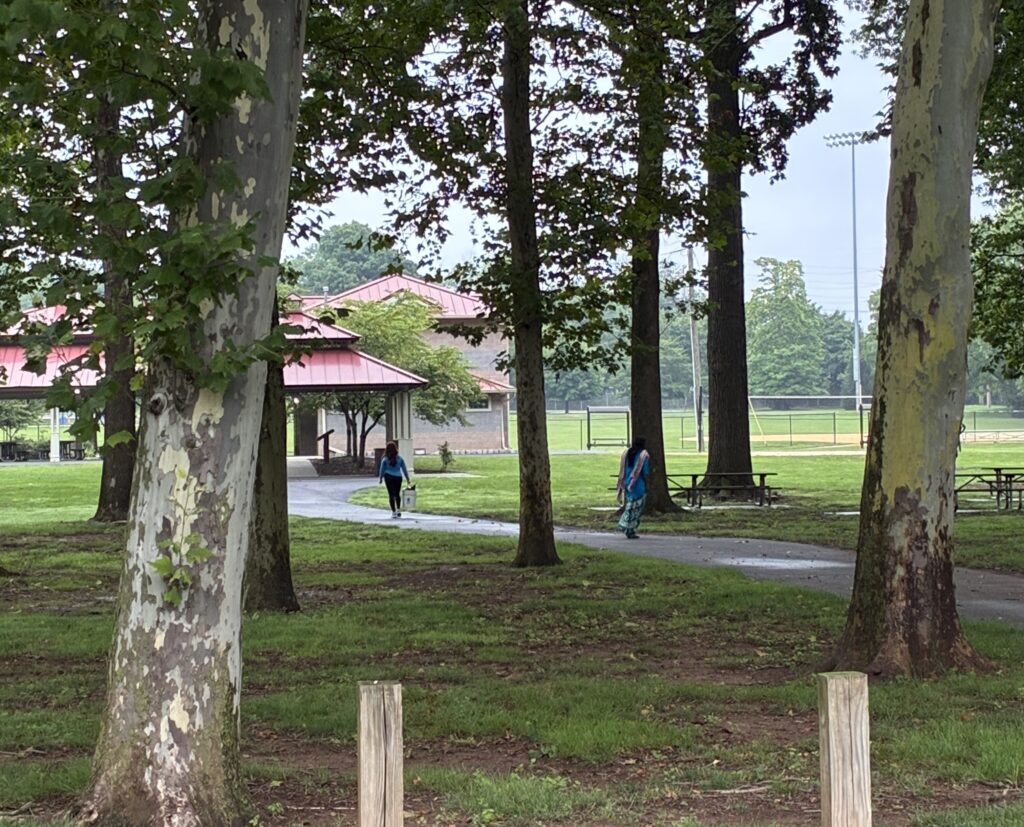
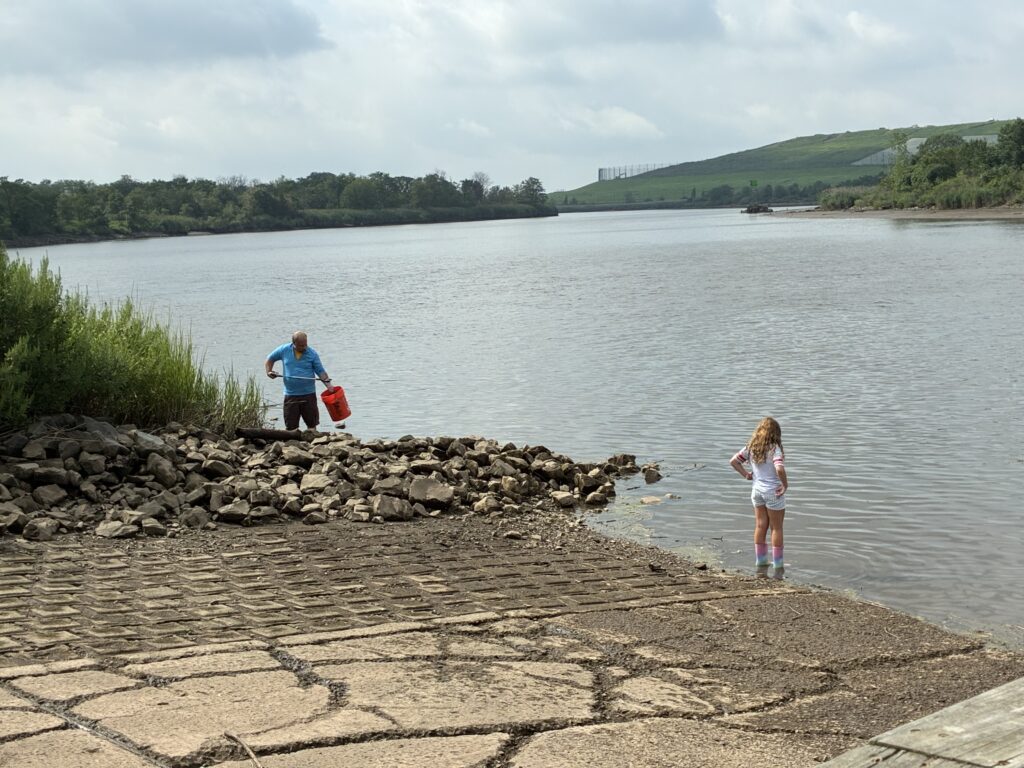
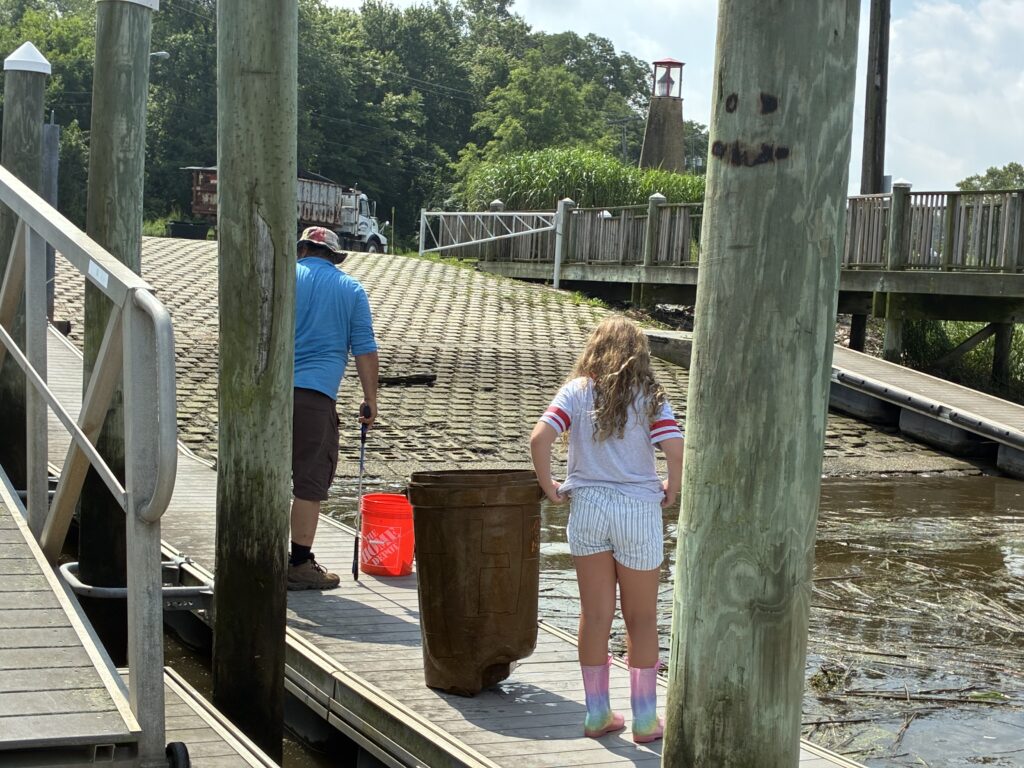
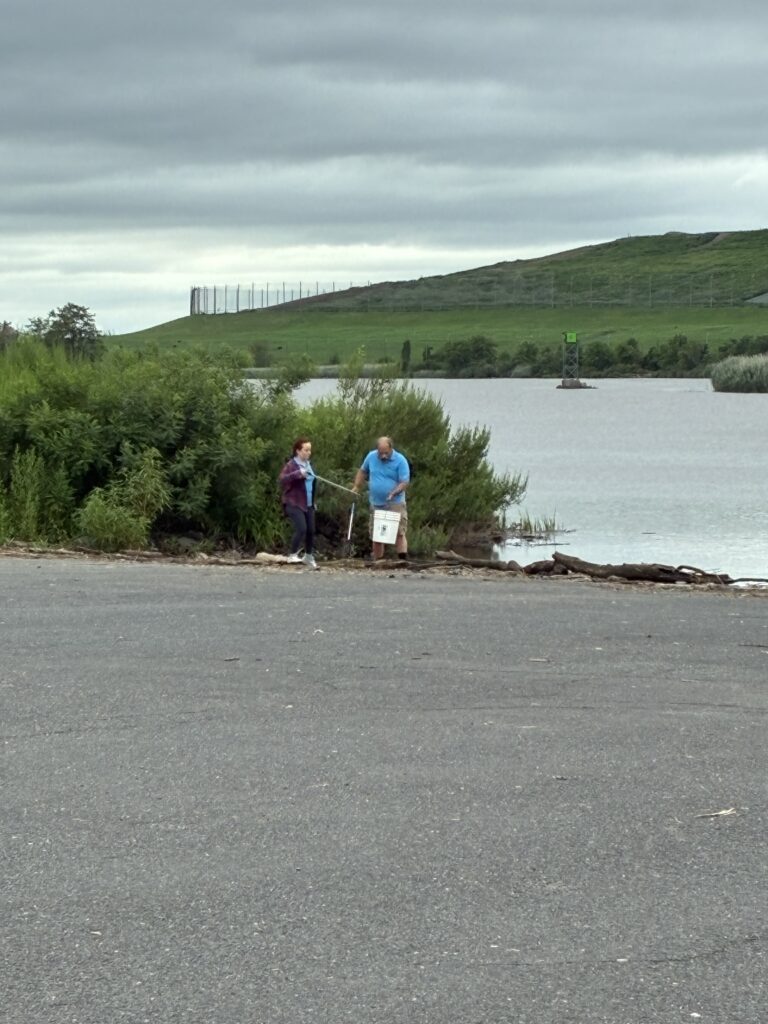
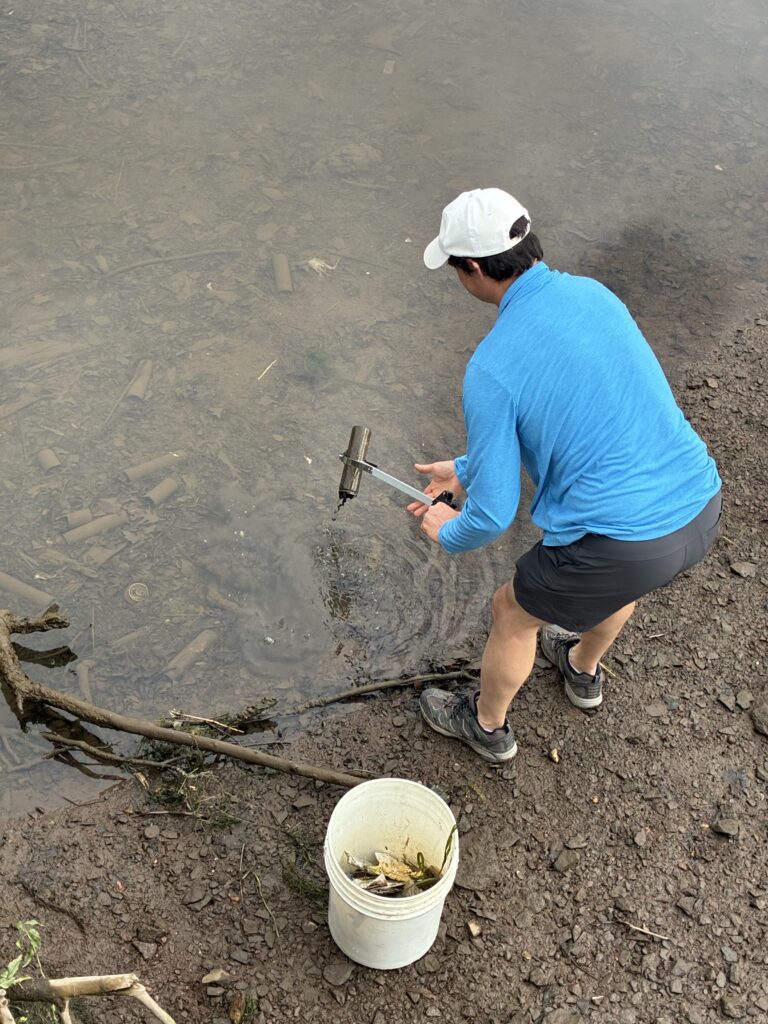
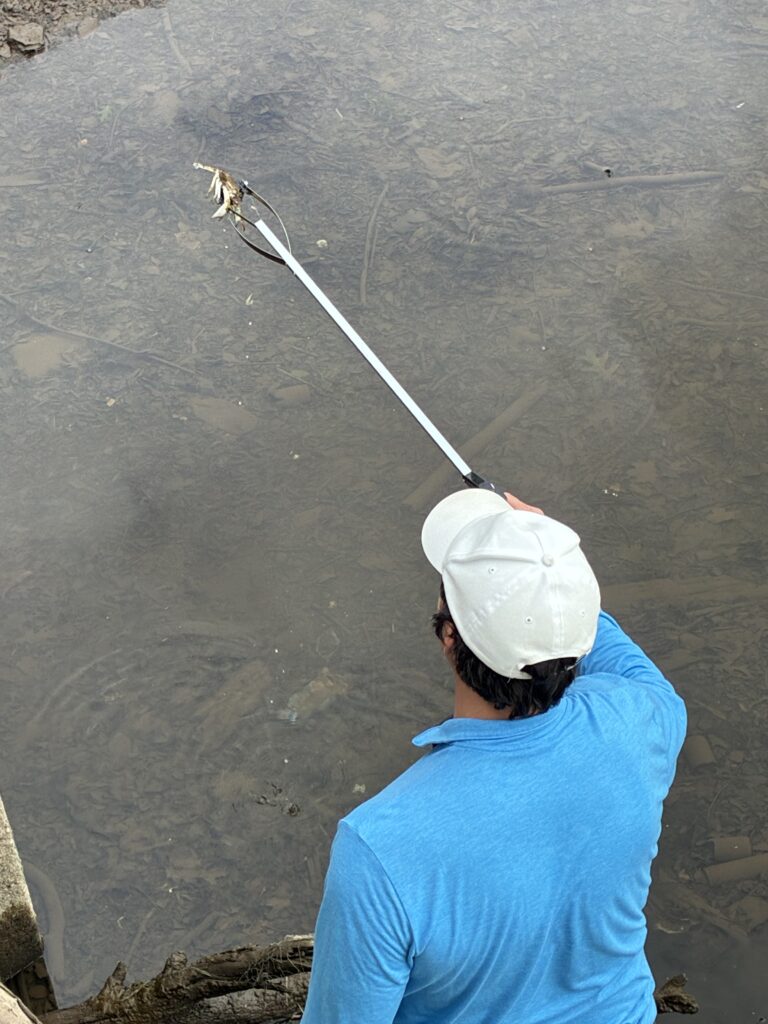
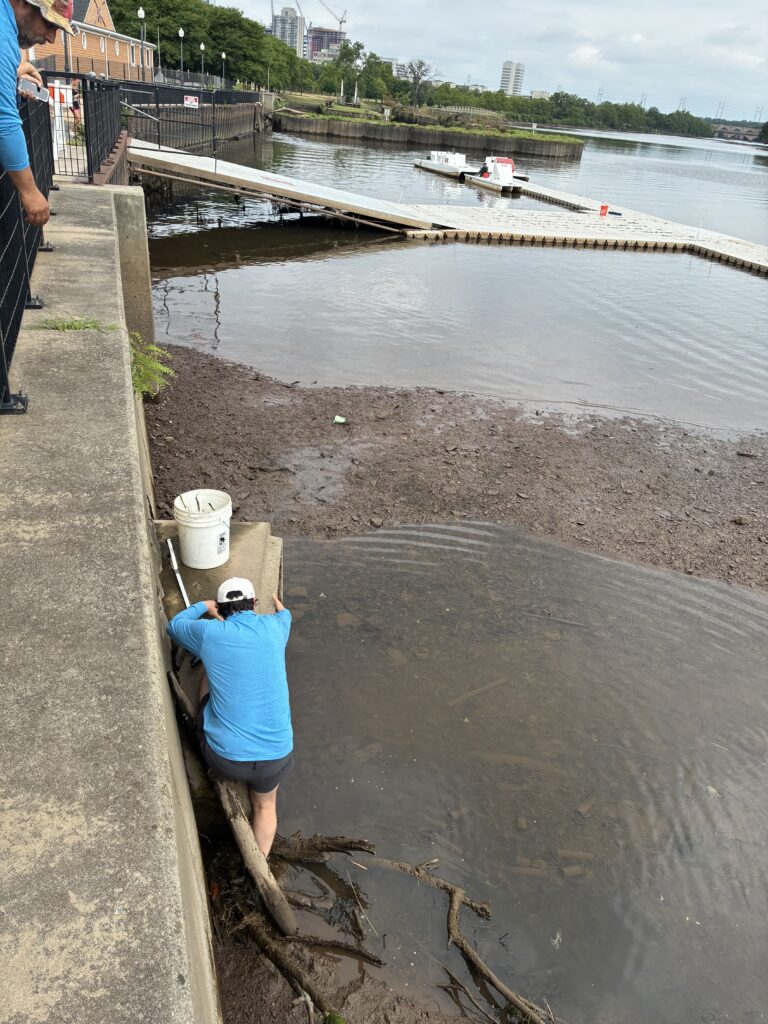
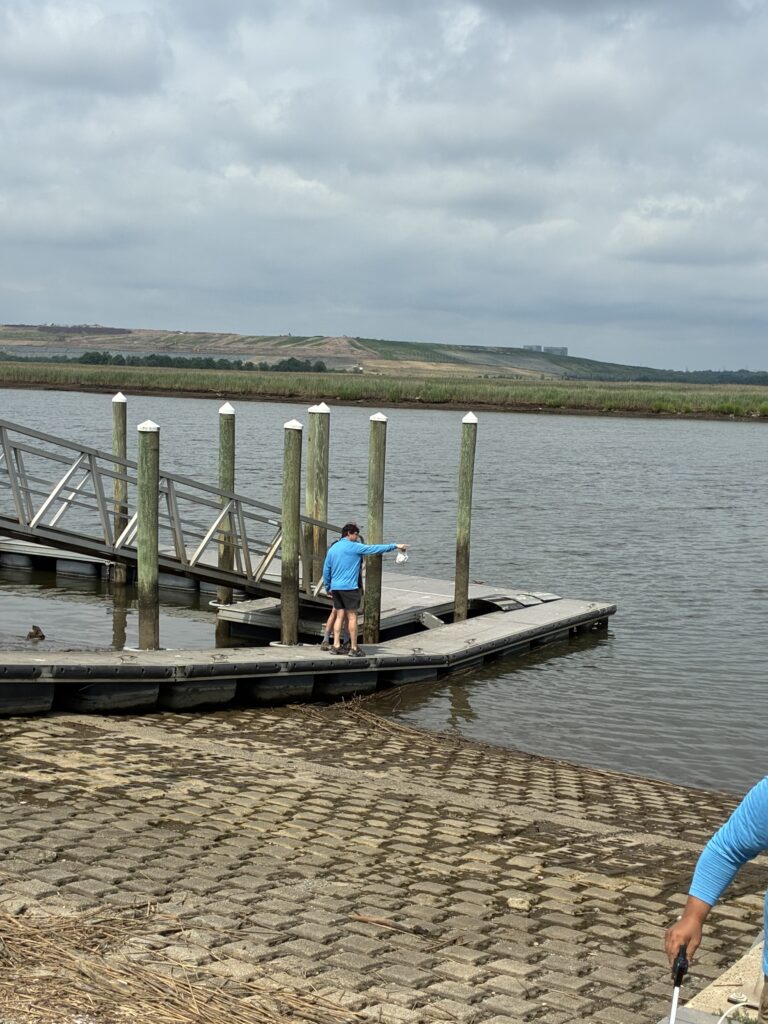
Olesya, Lakshmi and Bryanna collected five gallons of trash at Riverside Park. Laksmi and Olesya are seen going to empty the trash bucket into a larger trash can. Photo by Endurance Laryea
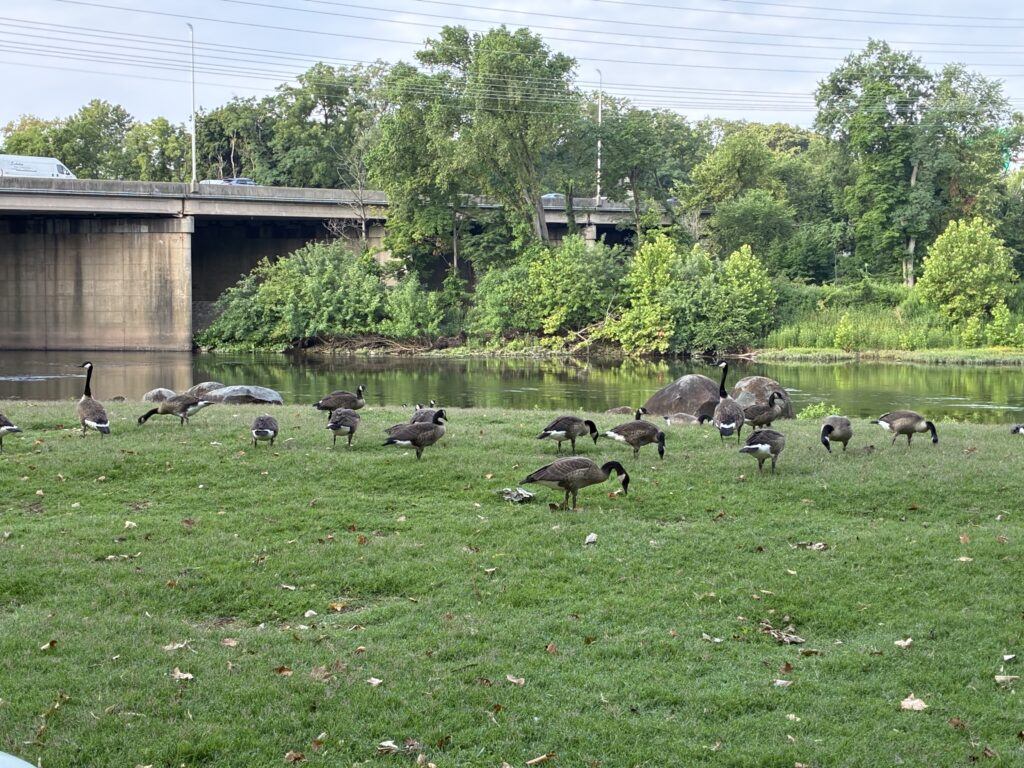
I wondered where all the geese were when we arrived at the parking lot today. After sampling, Olesya pointed them out to me– they had moved further downstream from the park. The increase in scrub growth along the bank of the river makes it difficult for them to access it from the parking lot. This is great for Riverside Park because it reduces the amount of fecal matter from the geese t that gets washed into the river during rainfall. But wouldn’t the geese just find somewhere else along the river? Yes, they might. However, it may not impact Riverside Park as much as it does when the geese are at this site. This site is one where people come into primary contact with the river, so it would best for the geese to move elsewhere where people do not come into contact with the river.
Photo by Endurance Laryea.
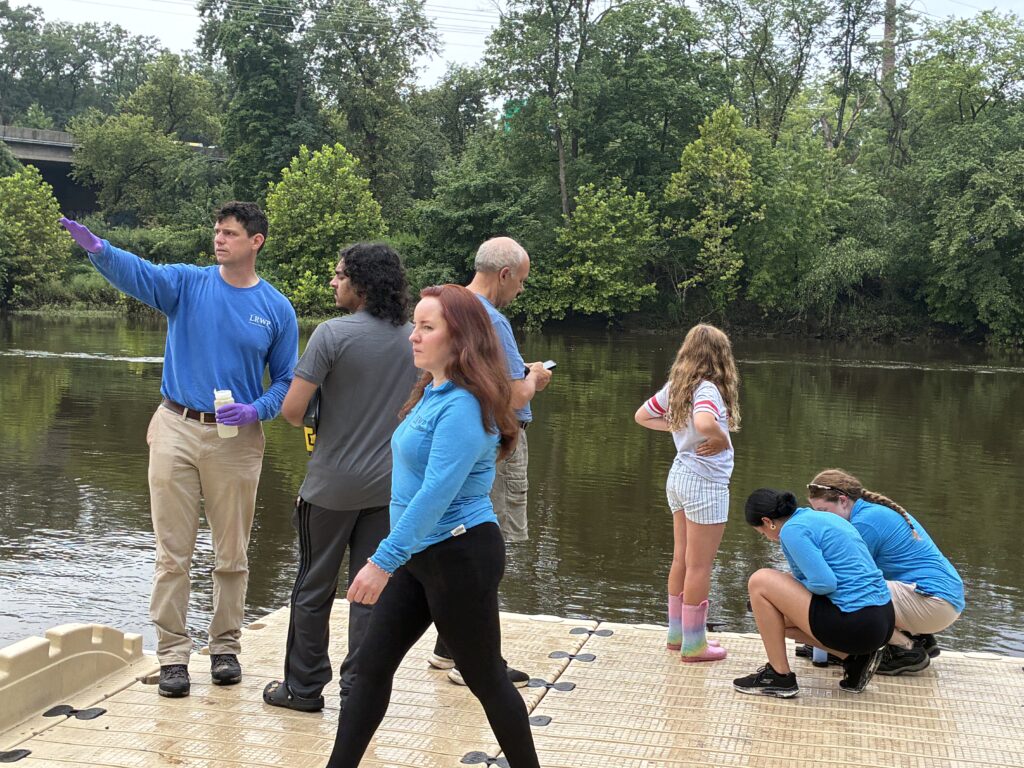
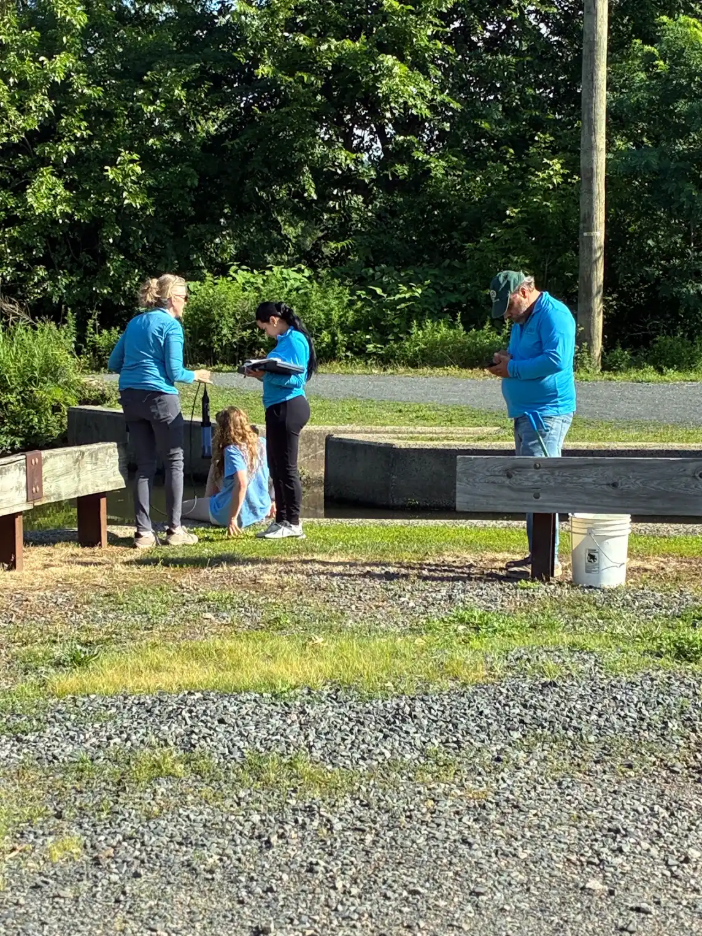
A huge team today! John explains the landscape at Riverside Park to Michael, a resident of Piscataway, Art completes the visual habitat assessment for Riverside Park, Ashley and Paula take hydrological measurement while Bryanna observes. By Endurance Laryea
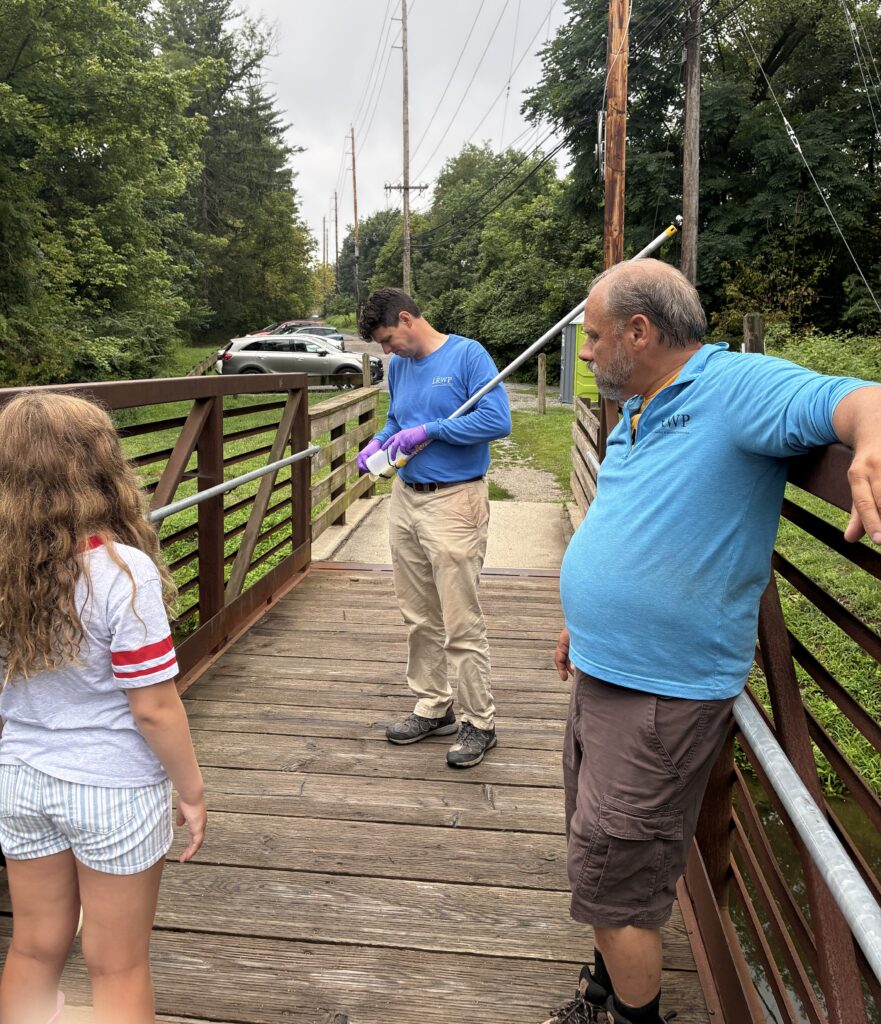
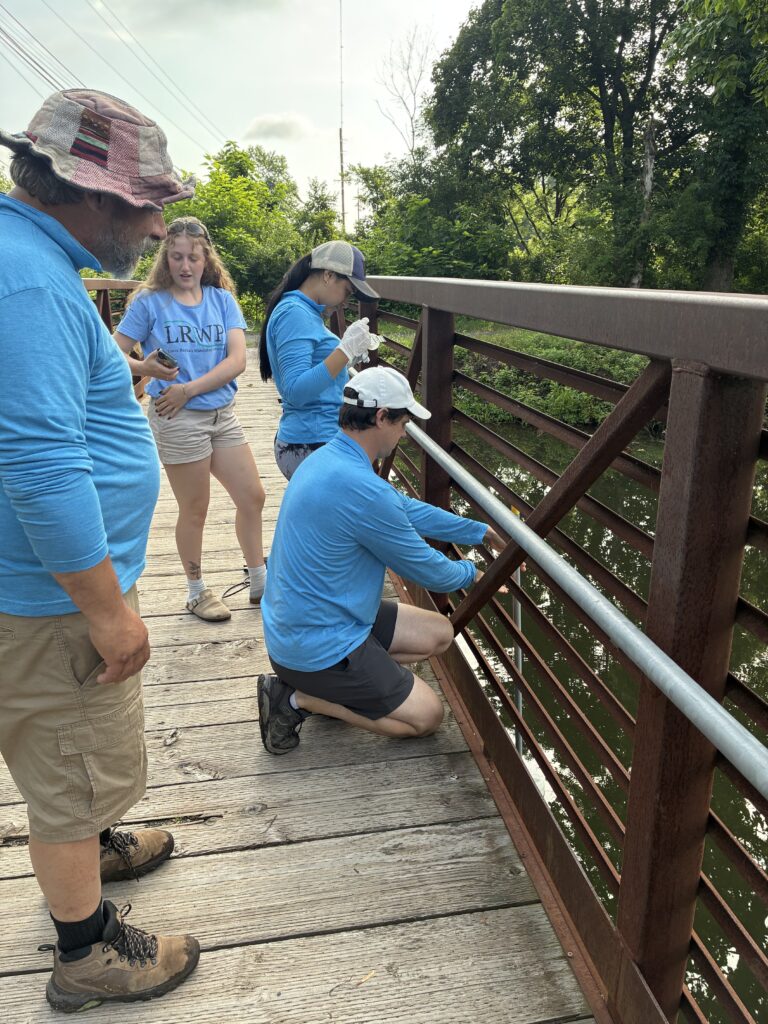
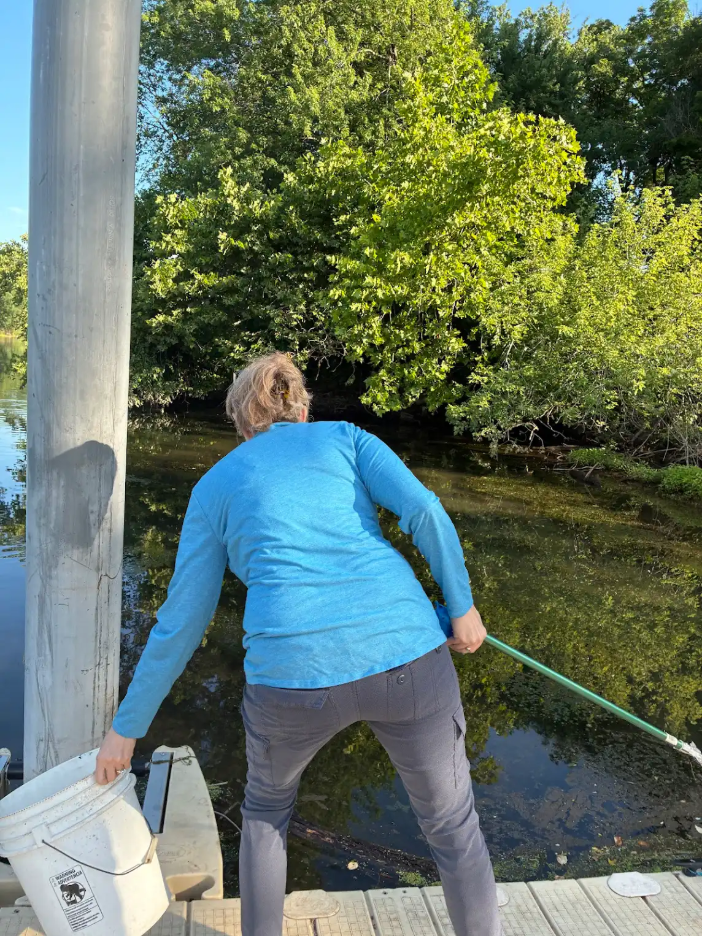
On the bridge of the D&R canal near the Van Wickle House, John gets ready for sampling duties as he straps the sample bottle on the sampling stick. The canals are the only sites that usually require a sampling stick because of how far the surface of the water is from wherever we stand. Photo by Endurance Laryea
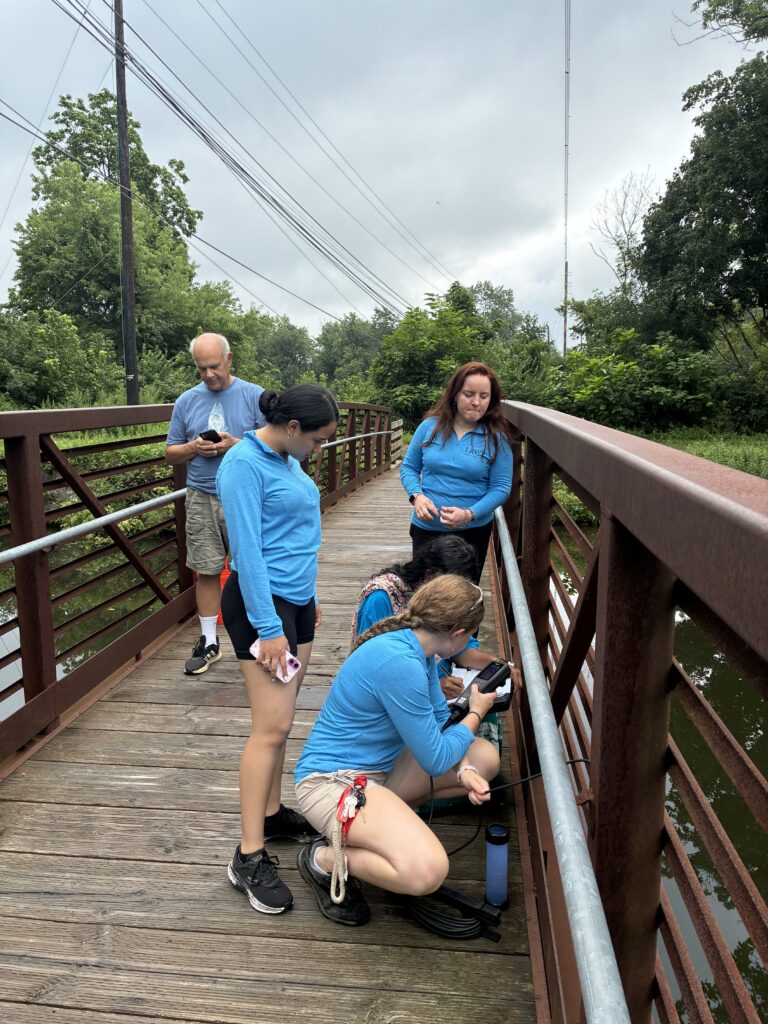
Art completes the habitat assessment for D&R canal whileLakshmi and Ashley handle measurement recording. Photo by Endurance Laryea.
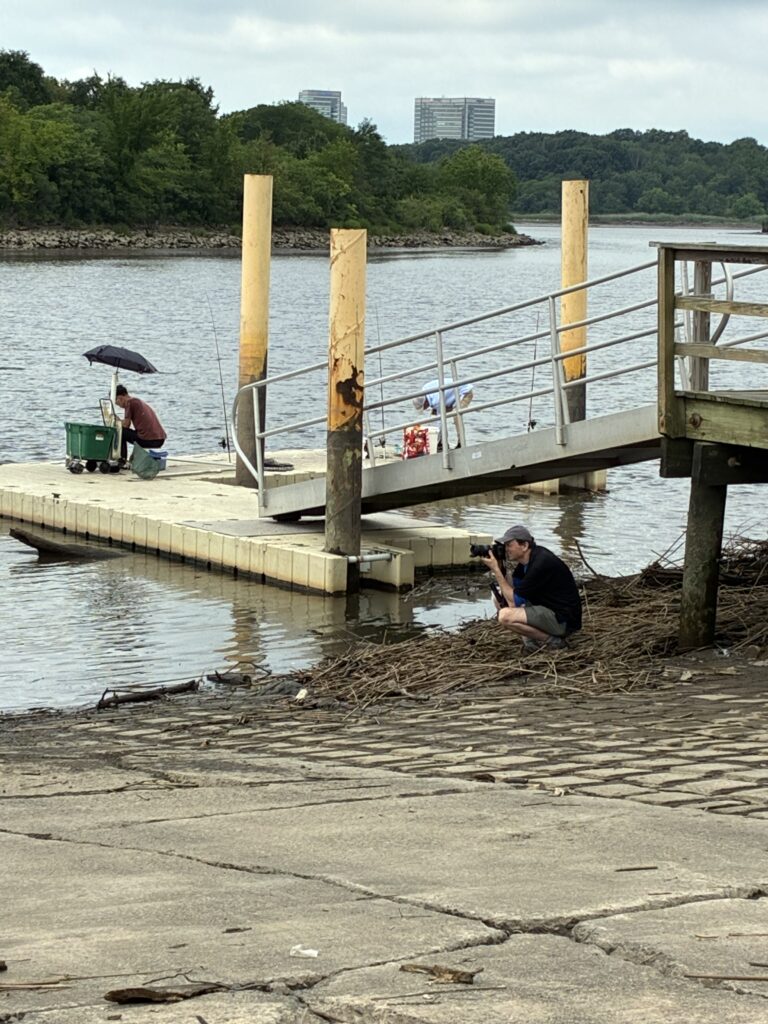
Turns out I am not the only one who thinks this is a great photo spot. Two people appeared to be in the middle of a photo shoot at the site–I’m sure their pictures turned out great! Photo by Mike Orsini
The tide was higher at Piscataway when we started monitoring but it has gone out by the time we reached Rutgers Boat House, New Brunswick.
Photo by Endurance Laryea.
John had a fun activity for Bryanna. He gave her a sheet that had information on the ranges of temperature, pH and dissolved oxygen levels and their effect on fish activity. Lakshmi, Olesya, Paula, Ashley and I guided her as she compared the measurements we had gotten so far to the information on the sheet. She then concluded that all the fishes were fine because the parameters were all in the safe range according to the sheet.
Photo by Endurance Laryea.
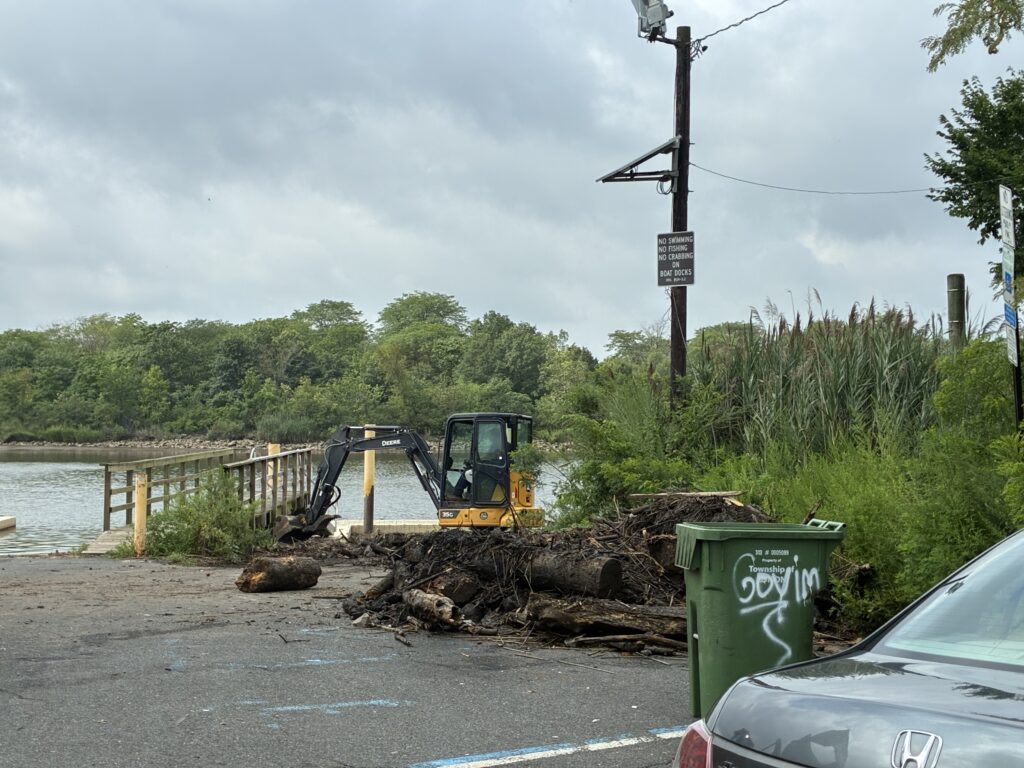
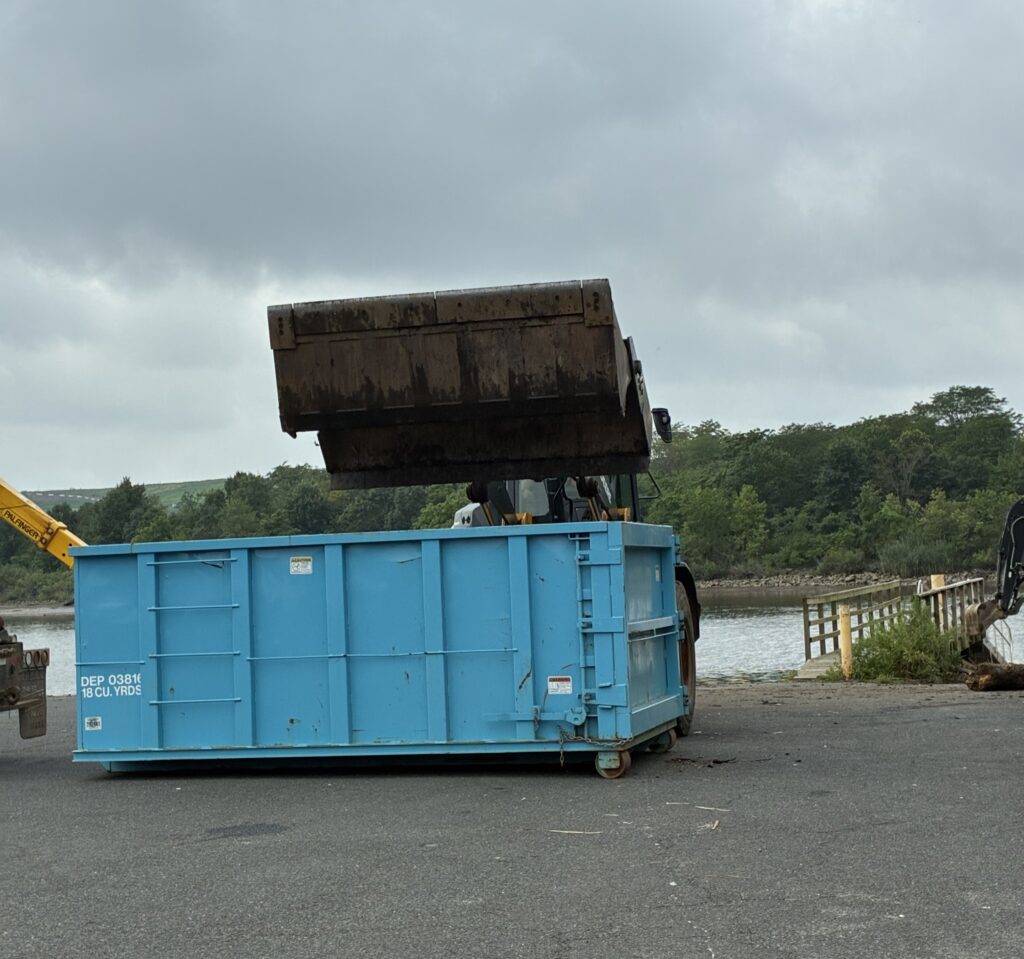
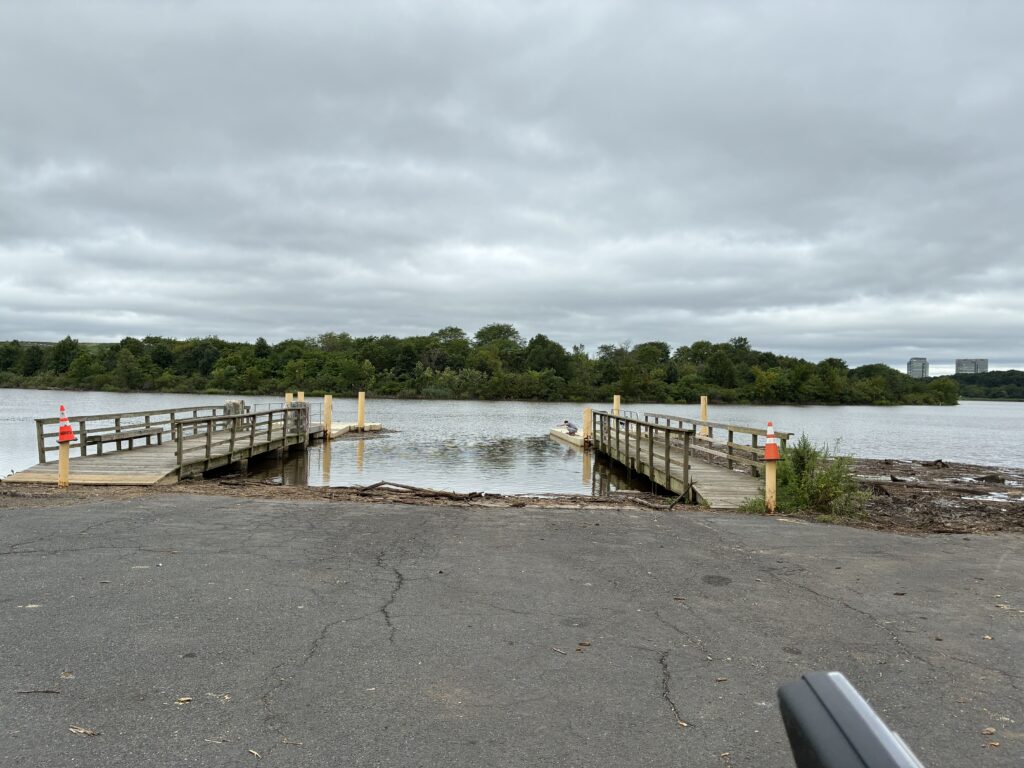
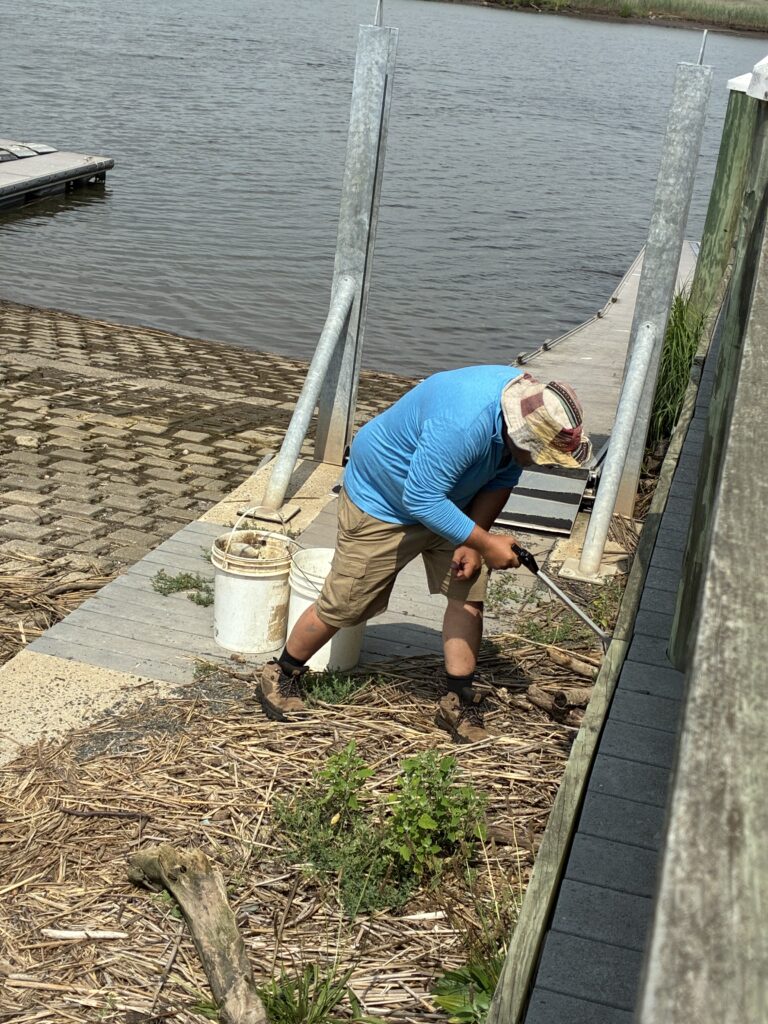
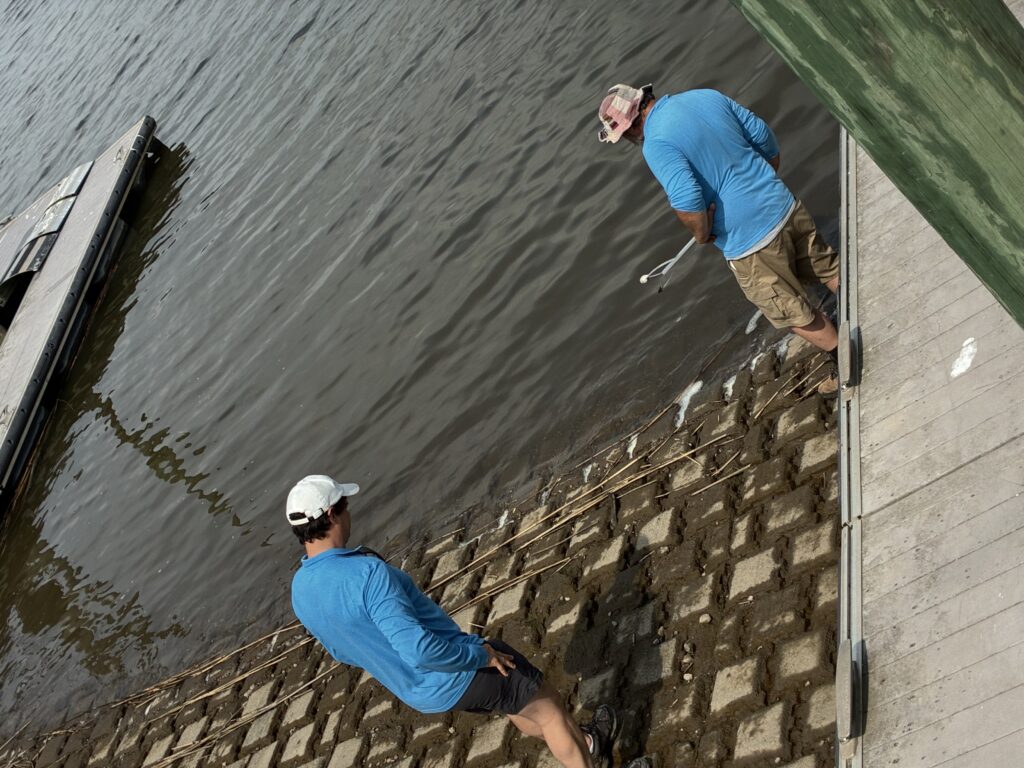
Second cleanup, since the start of pathogens monitoring this summer, witnessed at Edison Boat Launch today.
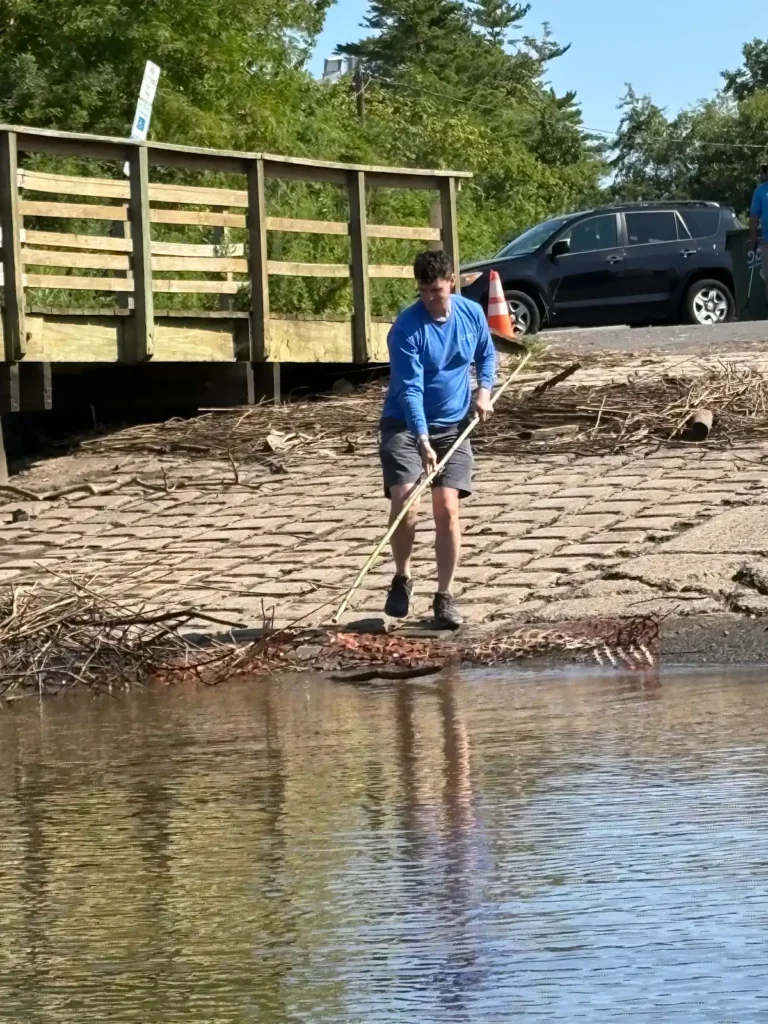
Last time, the cleanup was done between the two docks only. This time, it was being done at the right side of the right dock where most of the debris is and gets swept to the middle of the docks. It will now be easier for boats and kayaks to access the river at this site.
Photos by Endurance Laryea.
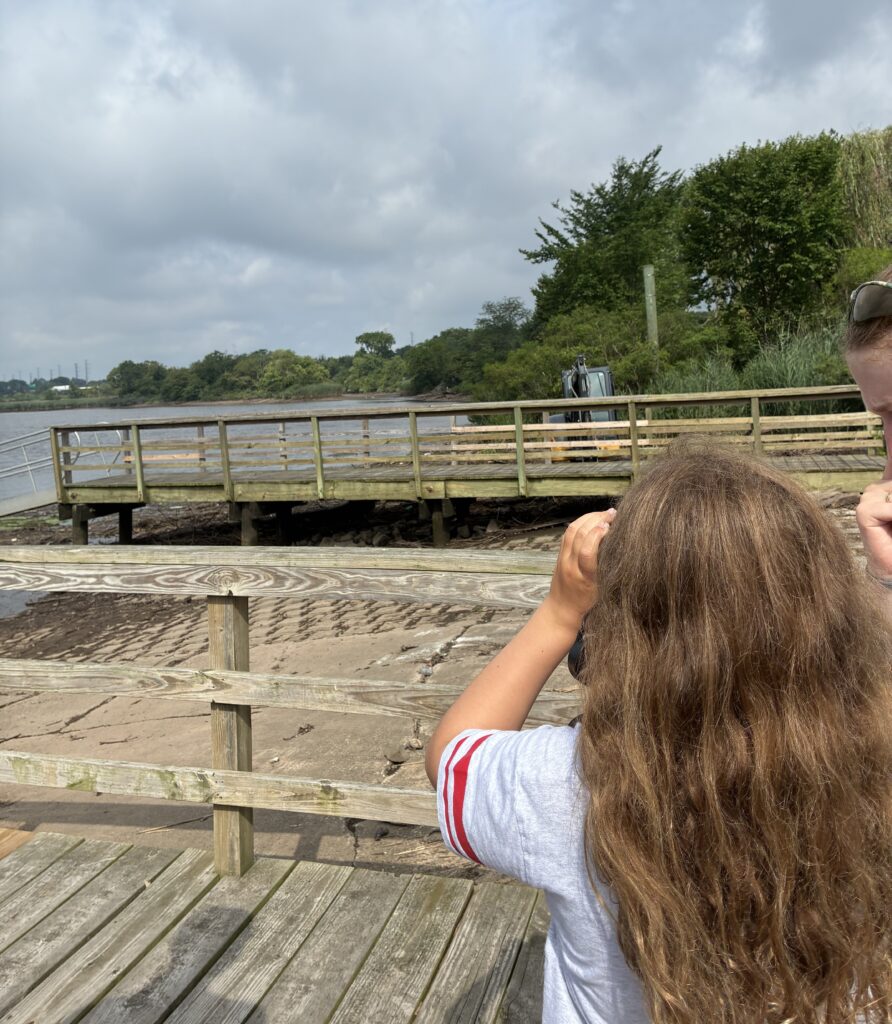
Art spotted a bird and gave his binoculars to Bryanna for her to try spotting and identifying it too. Photo by Endurance Laryea.
After a couple of minutes, she exclaimed, ‘Oh I see it, it’s a bald eagle!’ It was, indeed, a bald eagle. Photo by Ashley Fritz.
Mike on trash duty while Bryanna washes her boots at the bank of the river. Photo by Endurance Laryea.
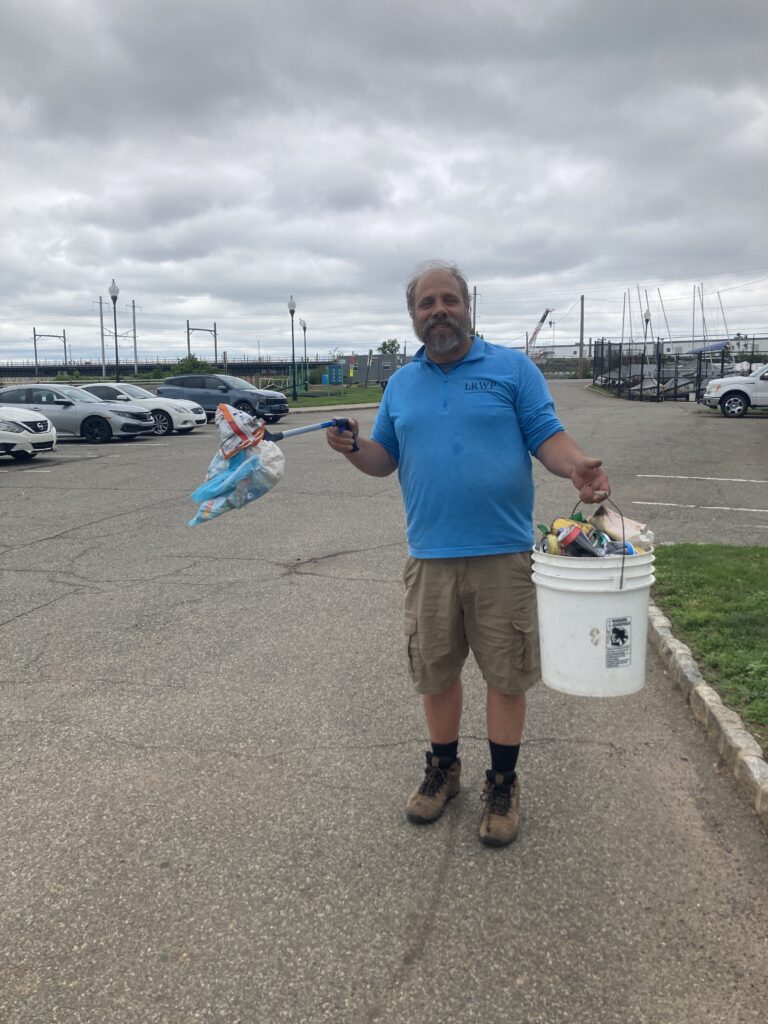
Mike pulled out this huge plastic bucket out from the river at Sayreville. This is his largest pick-up yet! Photo by Endurance Laryea.
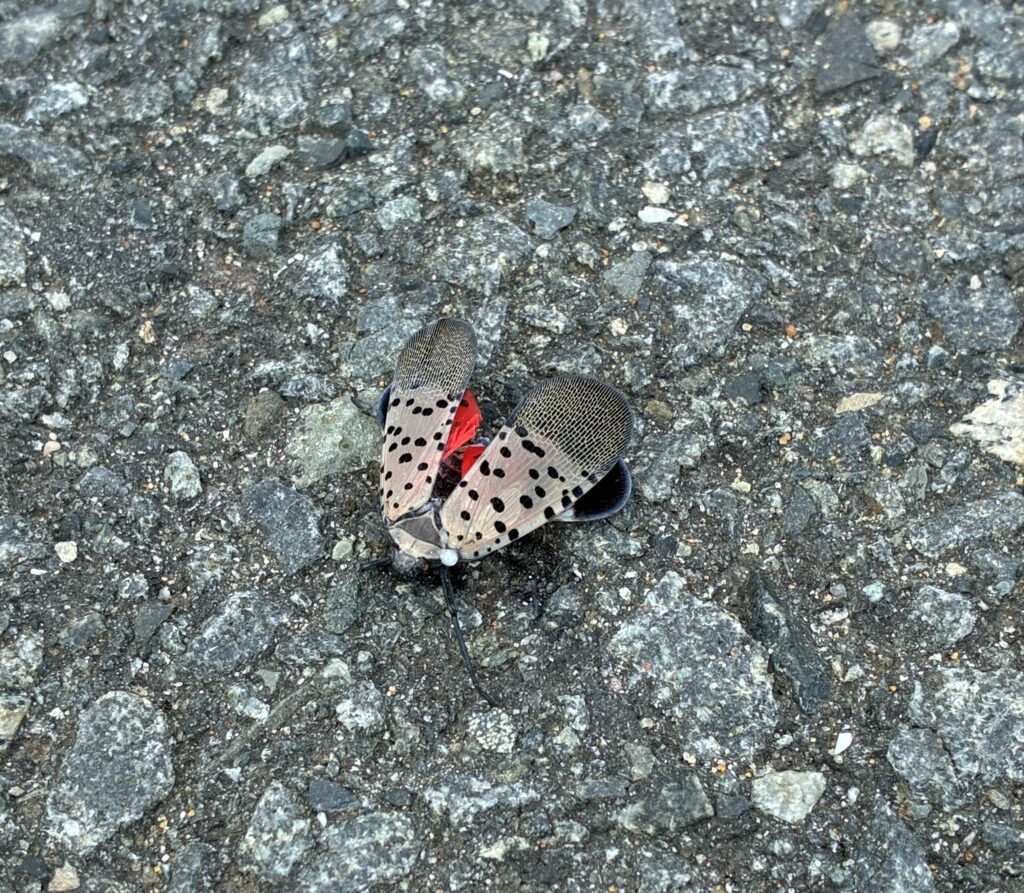
This is a spotted lantern fly, spotted (no pun intended) on the parking lot of Waterfront Park in South Amboy. Spotted lantern is an invasive species in the United States that cause significant damage to agricultural crops and ornamental plants as well. So, unfortunately, when seen, these beautiful flies need to be stepped on to prevent damage to prevent damage to New Jersey plants. Photo by Endurance Laryea
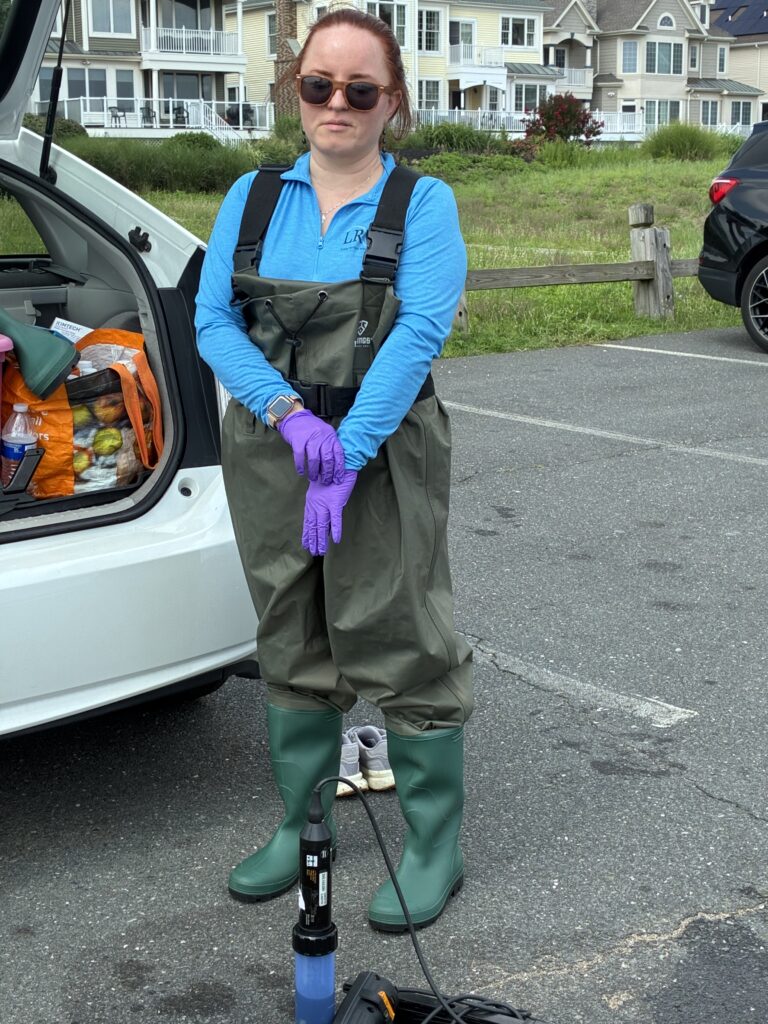
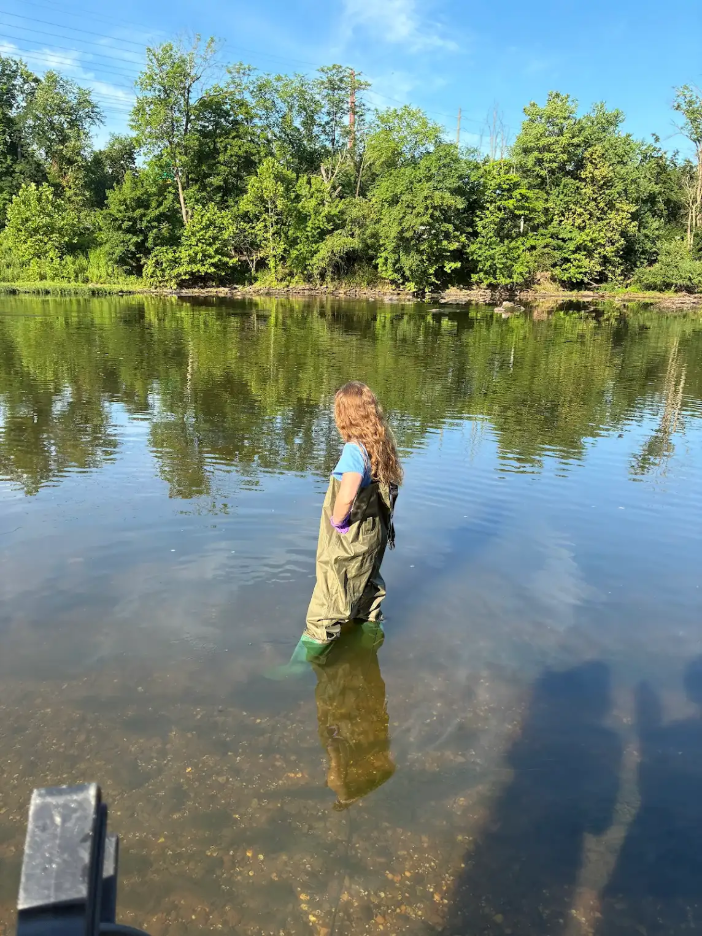
Olesya gets ready for sampling duties at Waterfront Park with her waders. Photo by Endurance Laryea.
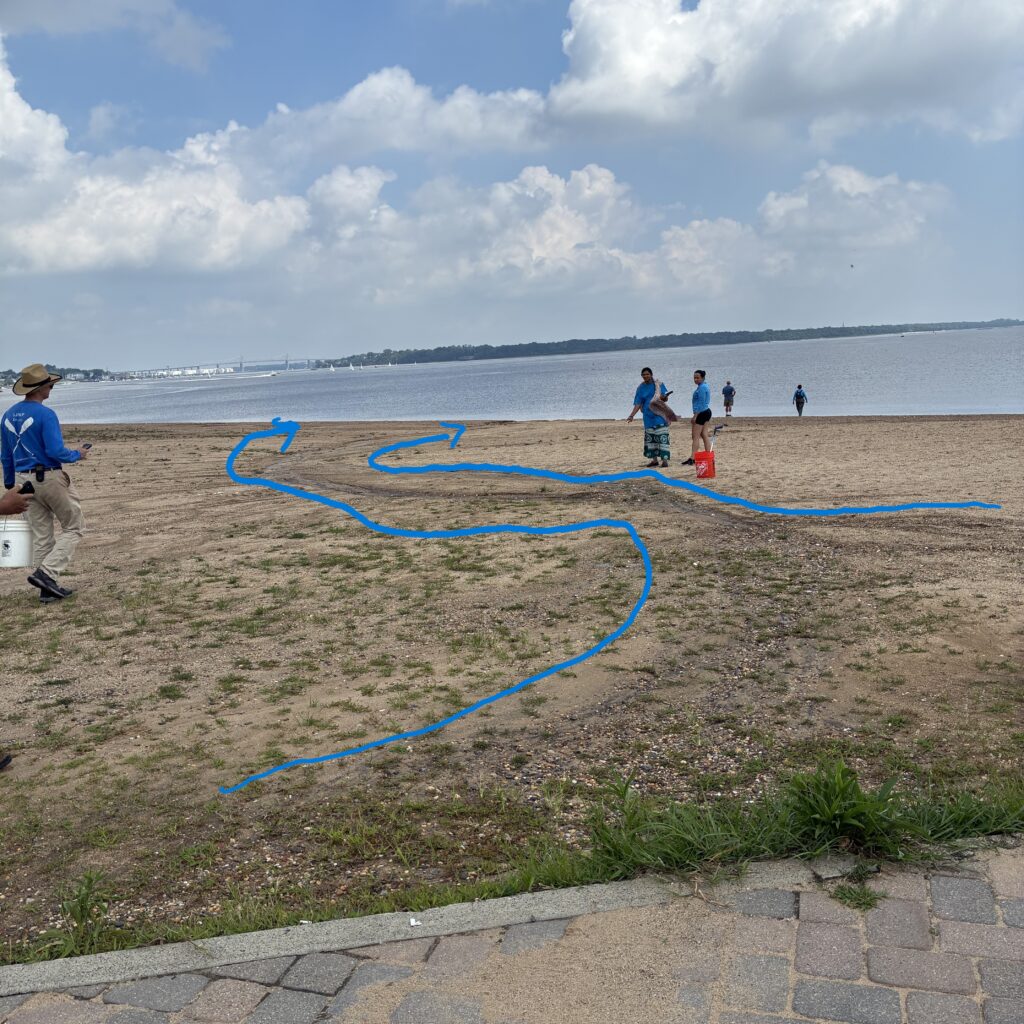
This erosion pathway created by rushing rainwater from the parking lot and walkway can be a highway for pollutants (like sediments, debris, litter) to get into the river. This is known as Nonpoint Source Pollution. Nonpoint Source Pollution (NPS), defined by the EPA, is any type of pollution that is not coming from a point source such as a sewage pipe, an industrial pipe or channel etc. It could be from land or road runoff. One simple way to curb Nonpoint Source Pollution is to keep litter, pet waste and debris out of roads, parking lots etc., to prevent them from getting washed into the river during precipitation. Basic Information about Nonpoint Source (NPS) Pollution | US EPA Photo by Endurance Laryea.
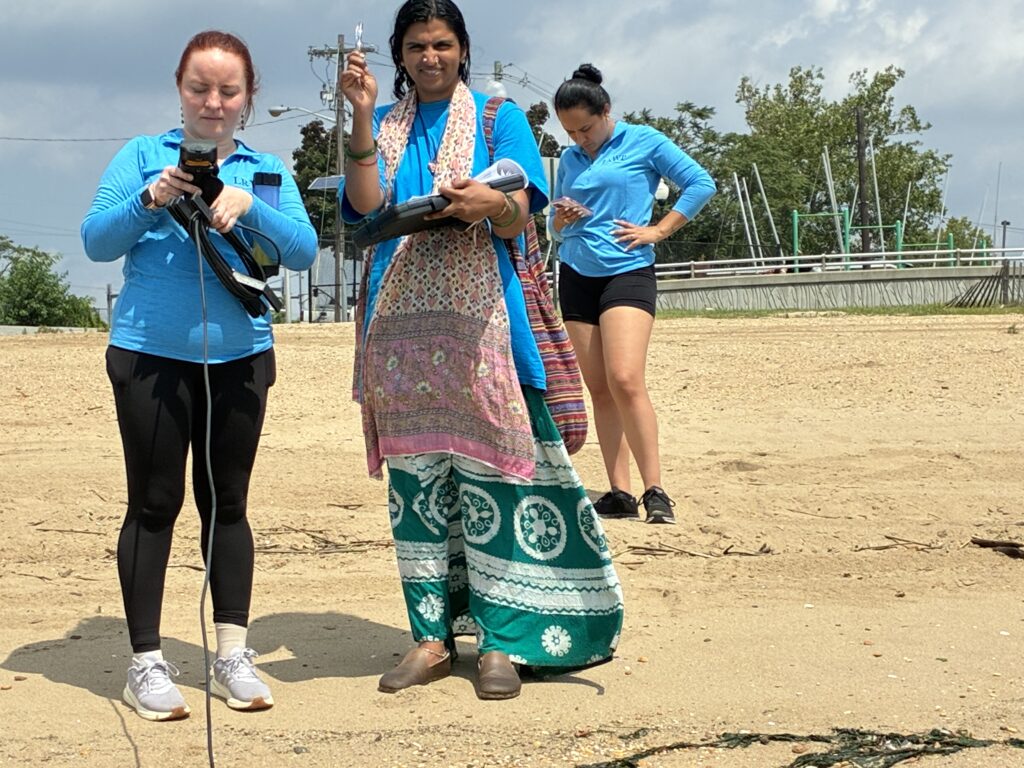
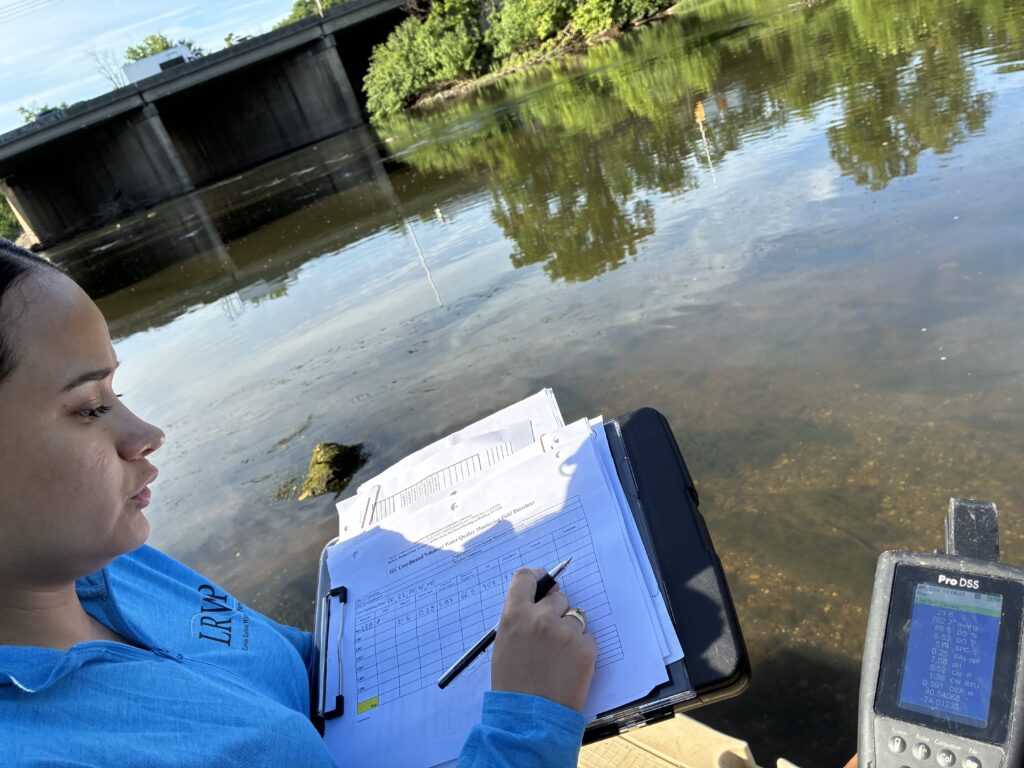
Olesya and Lakshmi on measurement recording duty. Photo by Endurance Laryea.
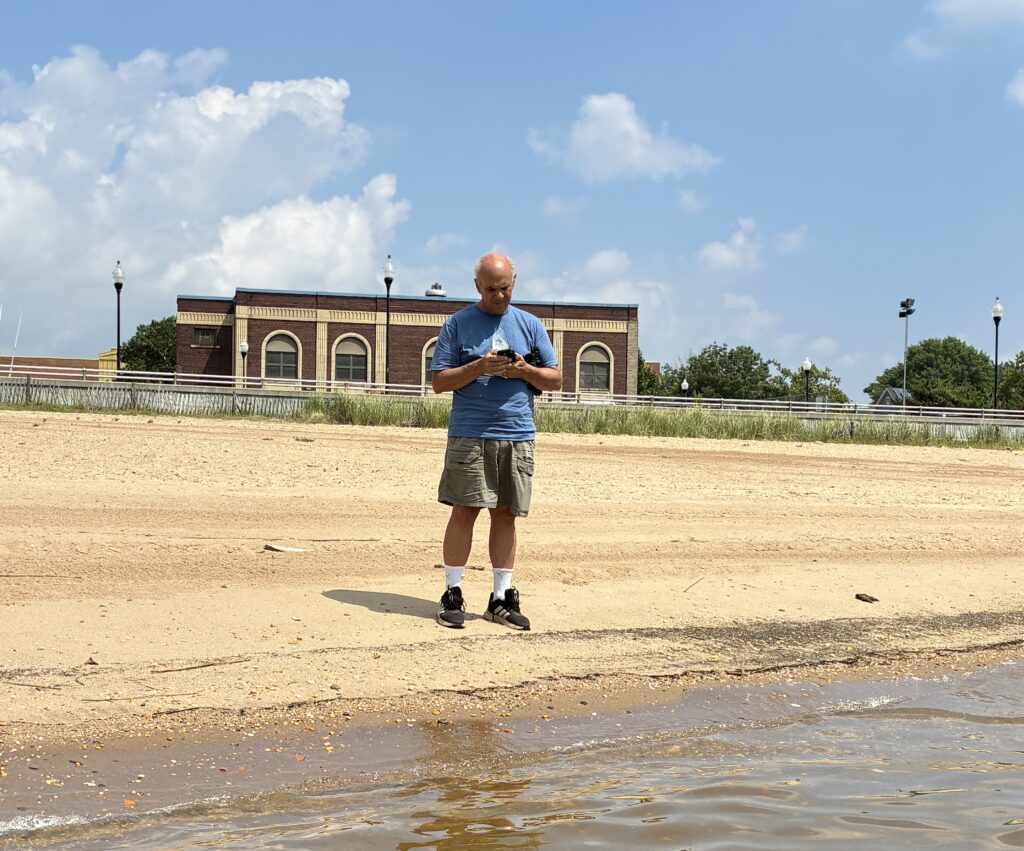
Art on visual habitat assessment duty. Photo by Endurance Laryea.
Endurance poses for a photo at the end of monitoring. Photo by Lakshmi
We started and ended monitoring session today with cloudy skies and cool temperatures. While it rained before and after the session, we stayed dry thanks to some excellent timing.
All our parameters seemed to be in a good range; however, we expected the enterococci and fecal matter levels to be on the higher end due to the precipitation we experienced in the past 48 hours.
Photo by Endurance Laryea.
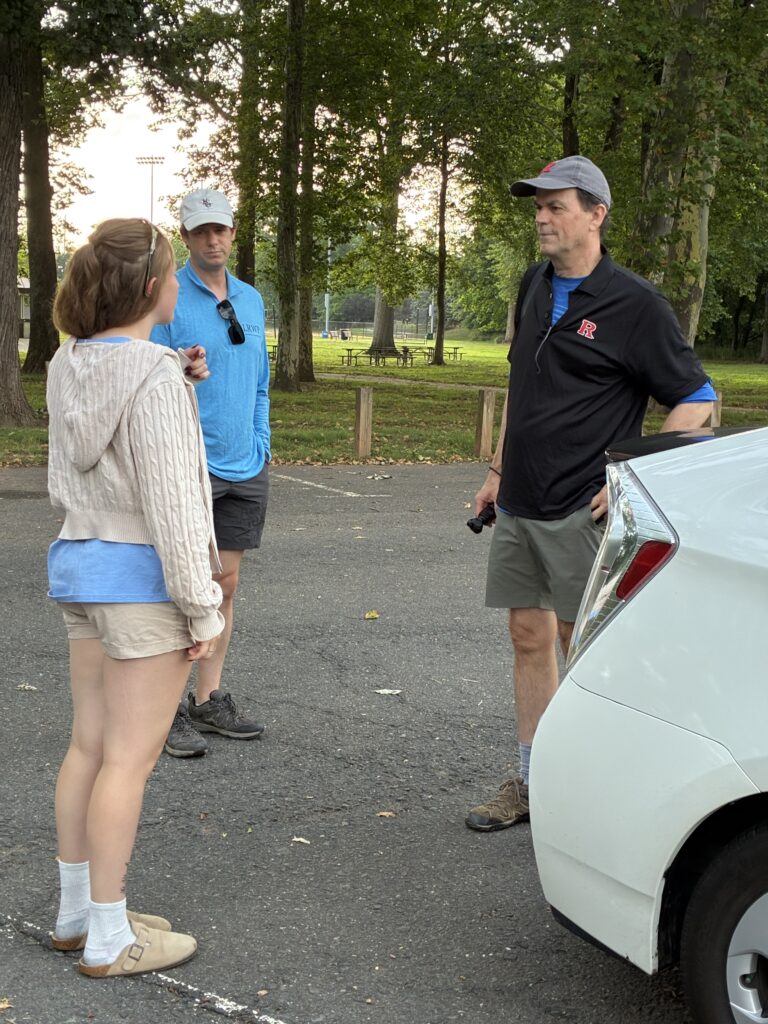
The team today! Lakshmi, Olesya, Endurance, Ashley, Paula and John (taking photo).
We were joined by Lakshmi at Edison where John pointed out some important features of the landscape around the river and explain the goals and activities of the LRWP Pathogens Monitoring sessions this summer.
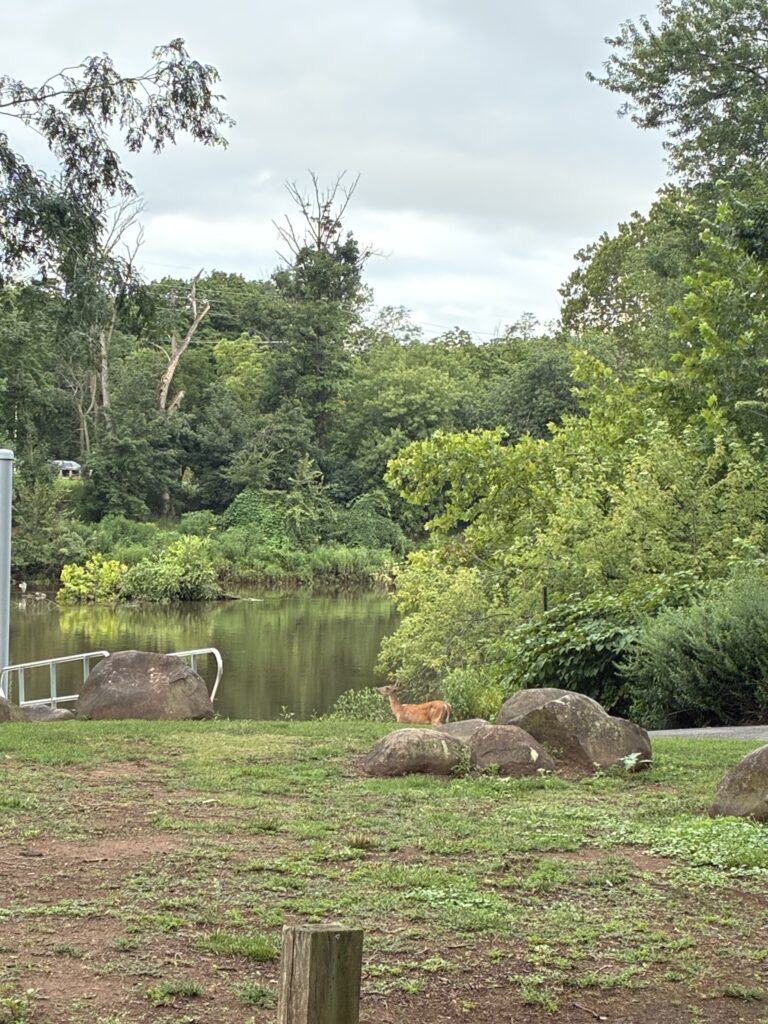
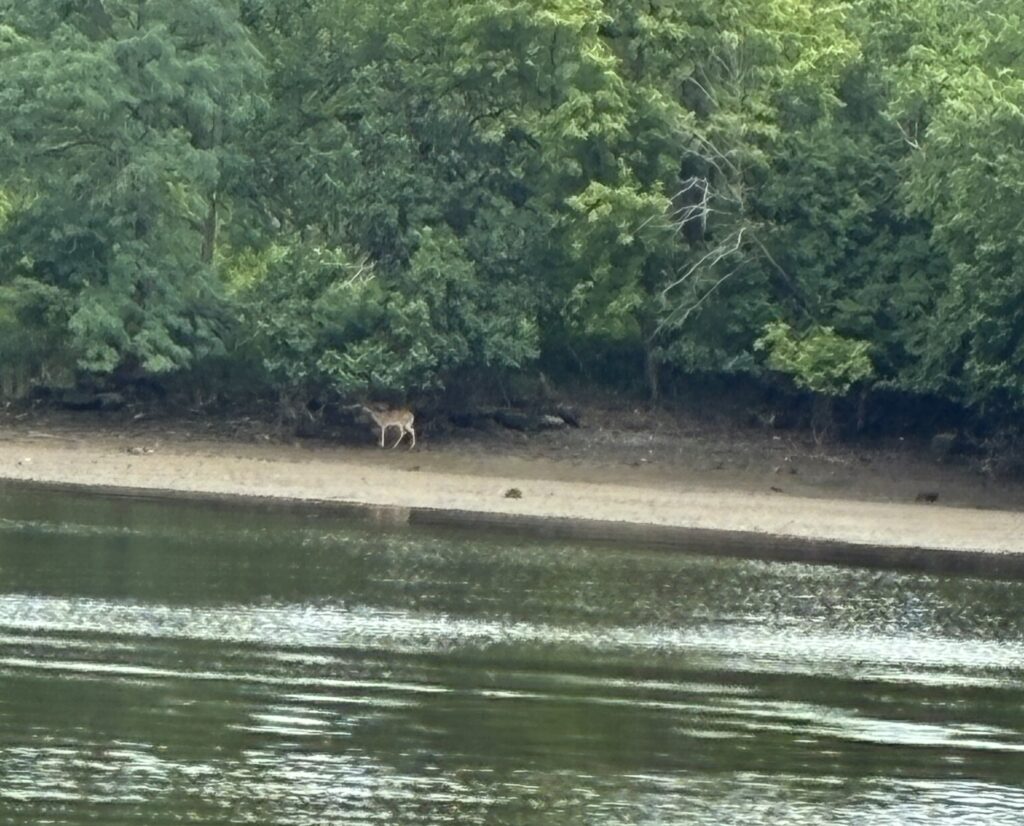
This deer was seen wandering about in circles at Riverside Park, Piscataway when we got there this morning. It seemed to have lost its way–maybe strayed from its herd? Photo by Endurance Laryea.
High tide and stormwater led to high water levels at all seven sites.
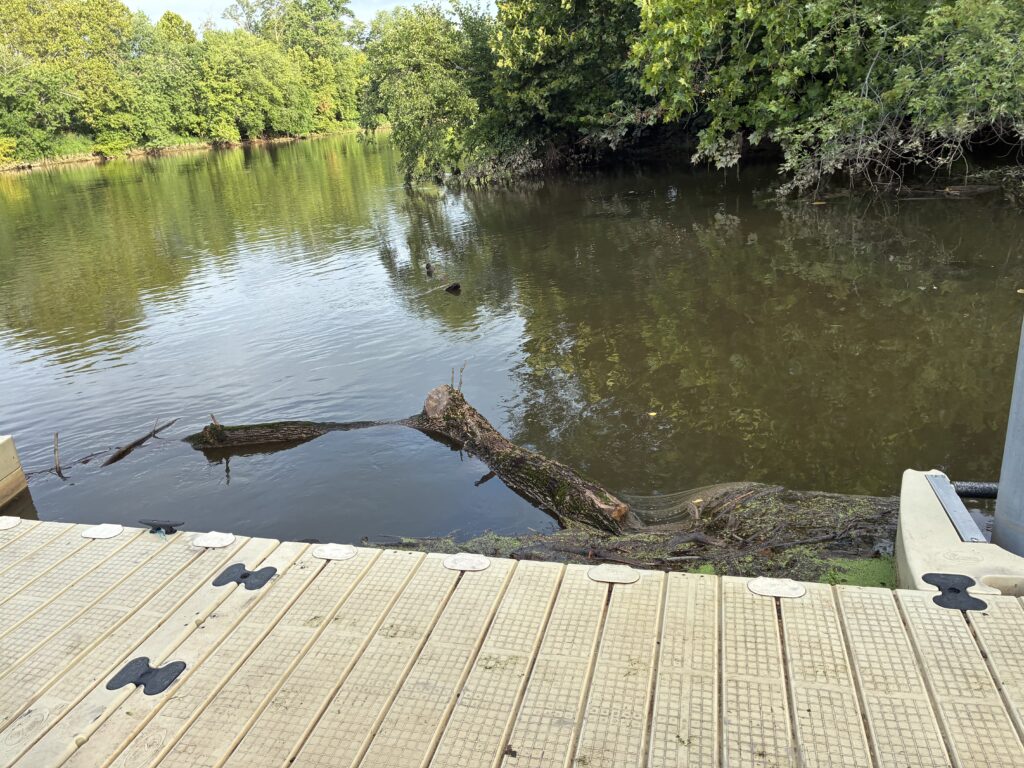
An ash tree trunk floating near the dock. Several ash trees have died and fallen off near the river at Riverside Park, and this may have been washed in by the storm in the last couple of days. The LRWP team is currently working to try to restore trees in the riparian zone. Photo by Endurance Laryea.
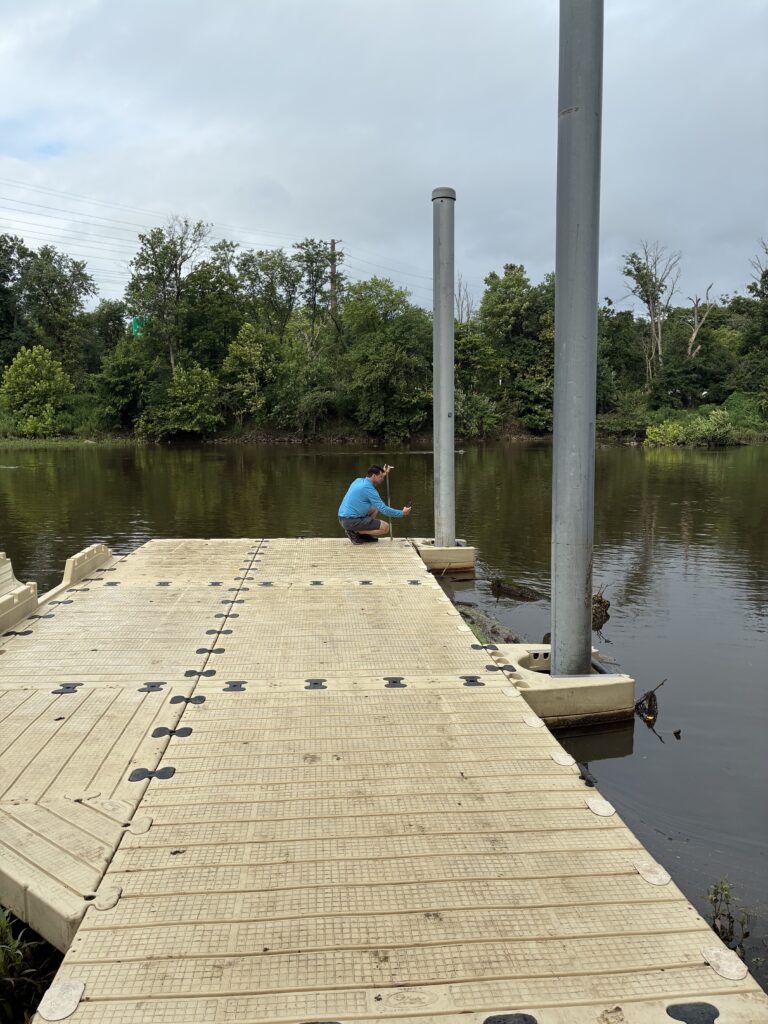
John made some height demarcations on one of the poles to make it easier to see changes in river depth. Photo by Endurance Laryea.
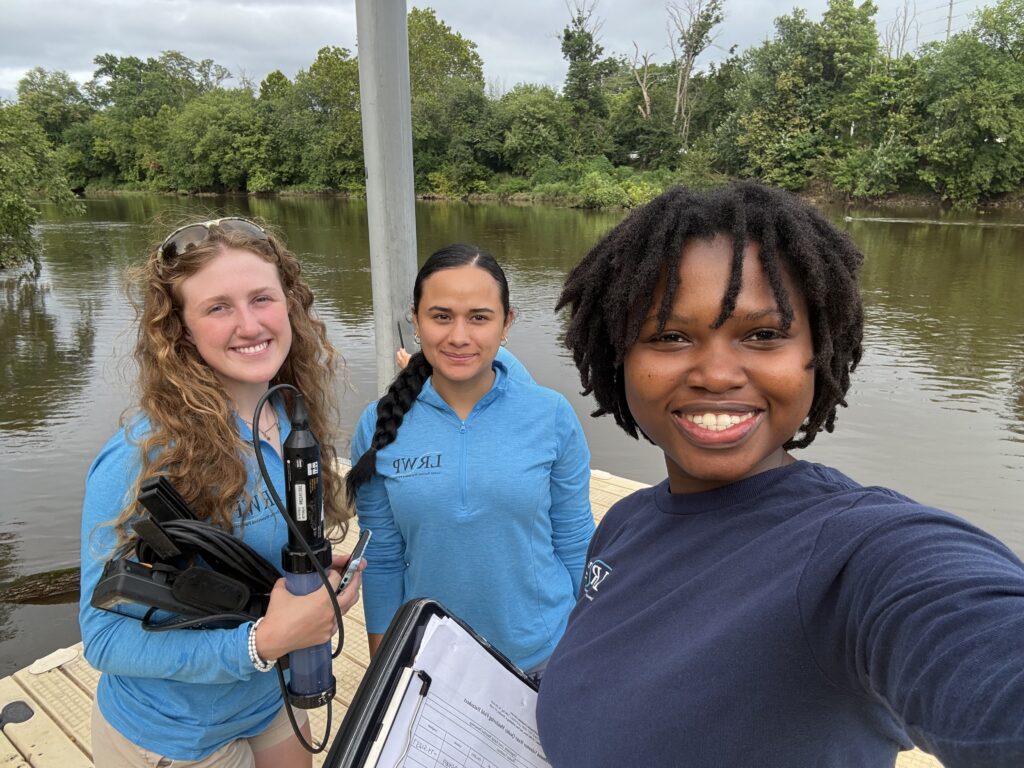
Ashley, Paula and Endurance pose for a photo after taking samples and hydrological measurements at riverside Park. John can be spotted in the background measuring the river depth and making demarcations on the pole. Photo by Endurance Laryea.
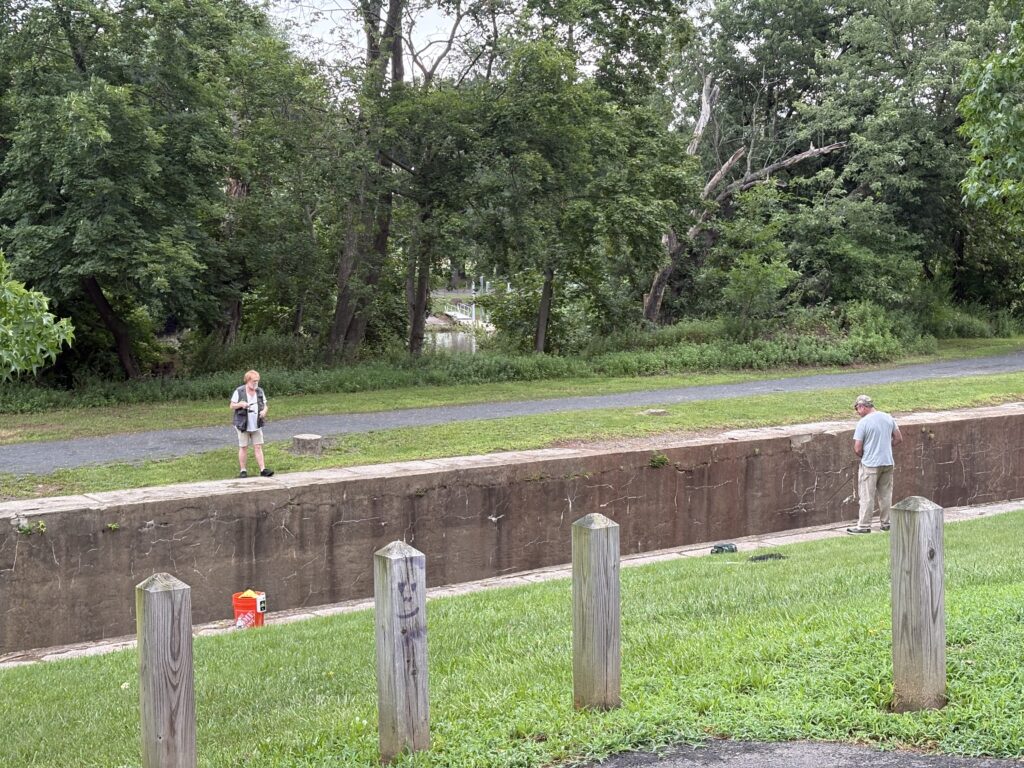
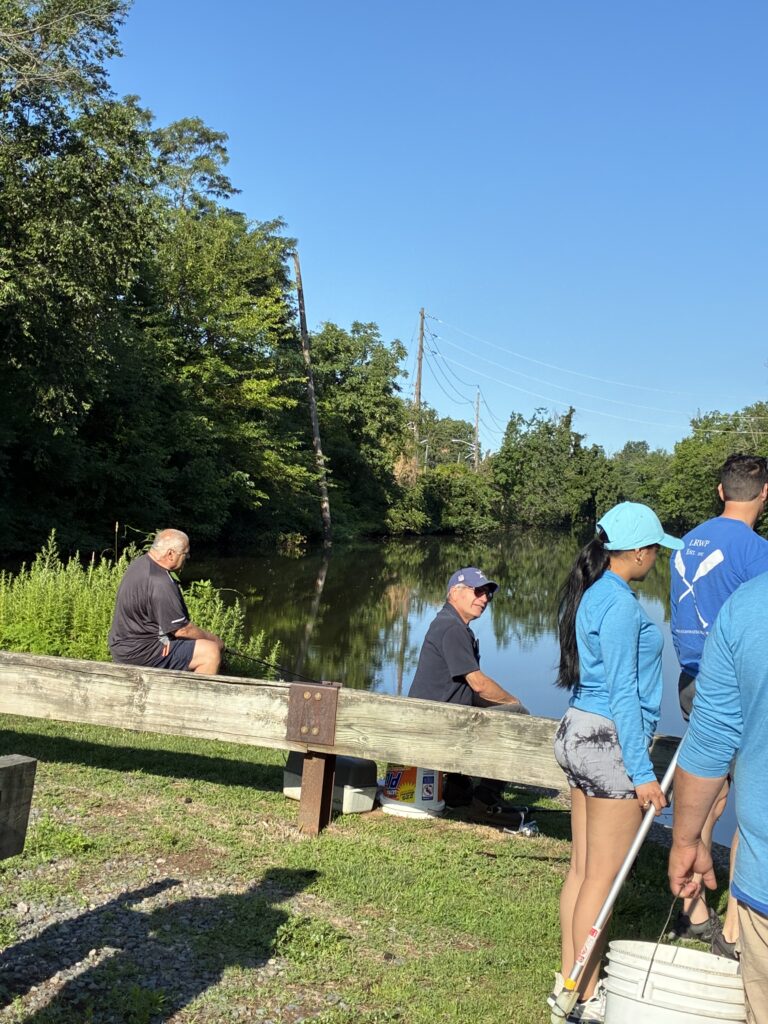
Two fishermen spotted at the Five-Mile Lock, Easton Avenue. At the time we came for monitoring and sampling, they had not had any luck. Hopefully they did after we had left. Photo by Ashley Fritz.
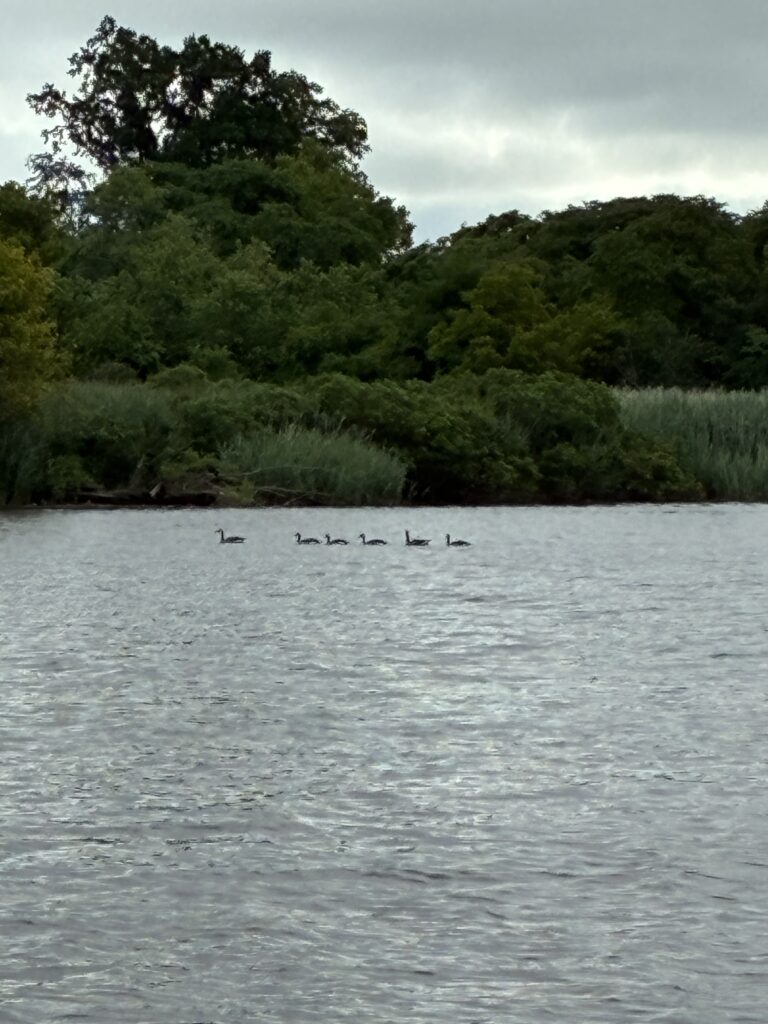
Ever wondered why ducks or geese move in a straight line on water? They remind me of elementary school kids being led by their teachers on a field trip. No teacher wants to get back to school only to realize that they lost a kid! It is a similar concept with these birds; however, another theory is that they do this to conserve their energy. The leader duck creates a ‘momentum’ ahead that the ones trailing behind paddle on. Less tiredness, less slacking!
Canada geese swimming in a straight line at Rutgers Boathouse, New Brunswick. Photo by Endurance Laryea.
Paula and Ashley recording hydrological parameters at Rutgers Boathouse. Photo by Olesya Nabokova.
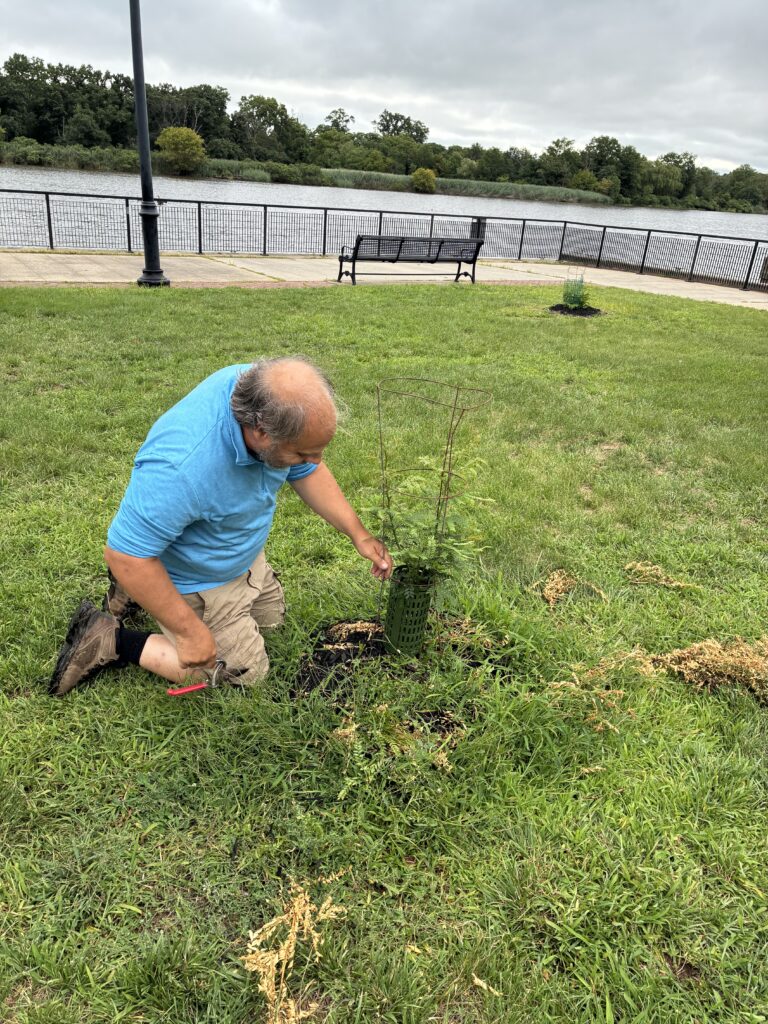
The honey locust trees pruned by Mike and John at Rutgers Boathouse have been fairing really well in the past couple of weeks. Thanks to the stewards at the Rutgers Boathouse who have been maintaining them and making they are not mowed down when cutting the grass.
Mike making sure the tree guards are sturdy. Photo by Endurance Laryea.
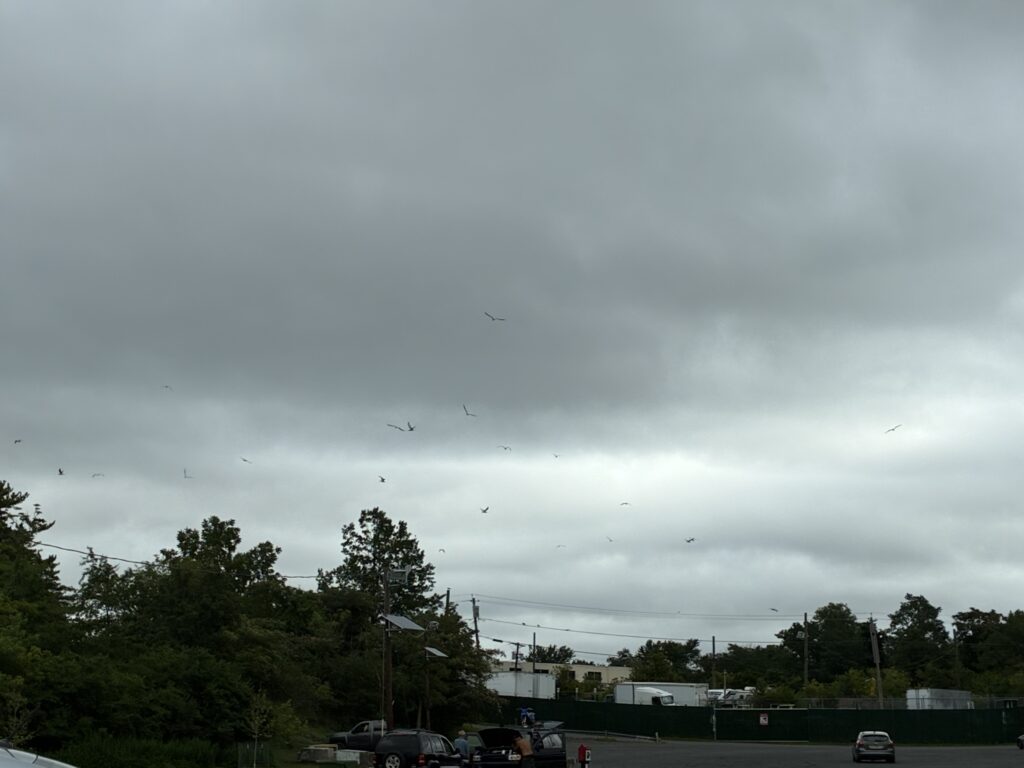
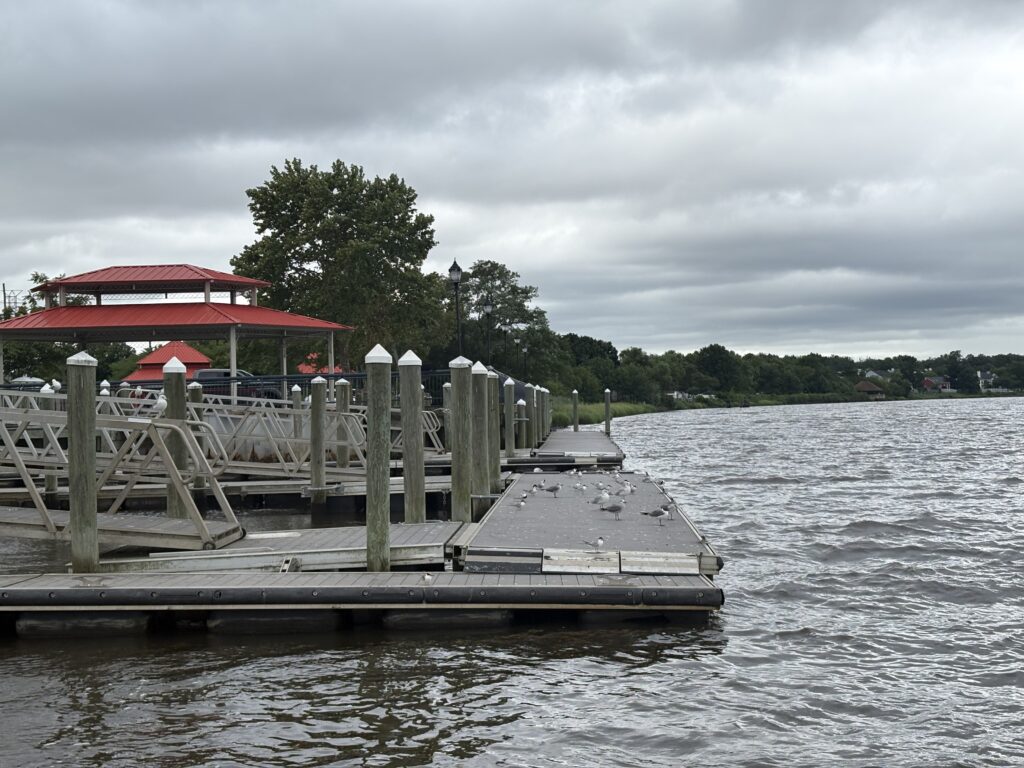
Seagulls flying frantically at Edison Boat Launch as the clouds get thicker and darker. Photo by Endurance Laryea.
Man crabbing during high tide at Edison. Photo by Endurance Laryea.
Olesya and Mike on Trash duty.Photo by Endurance Laryea.
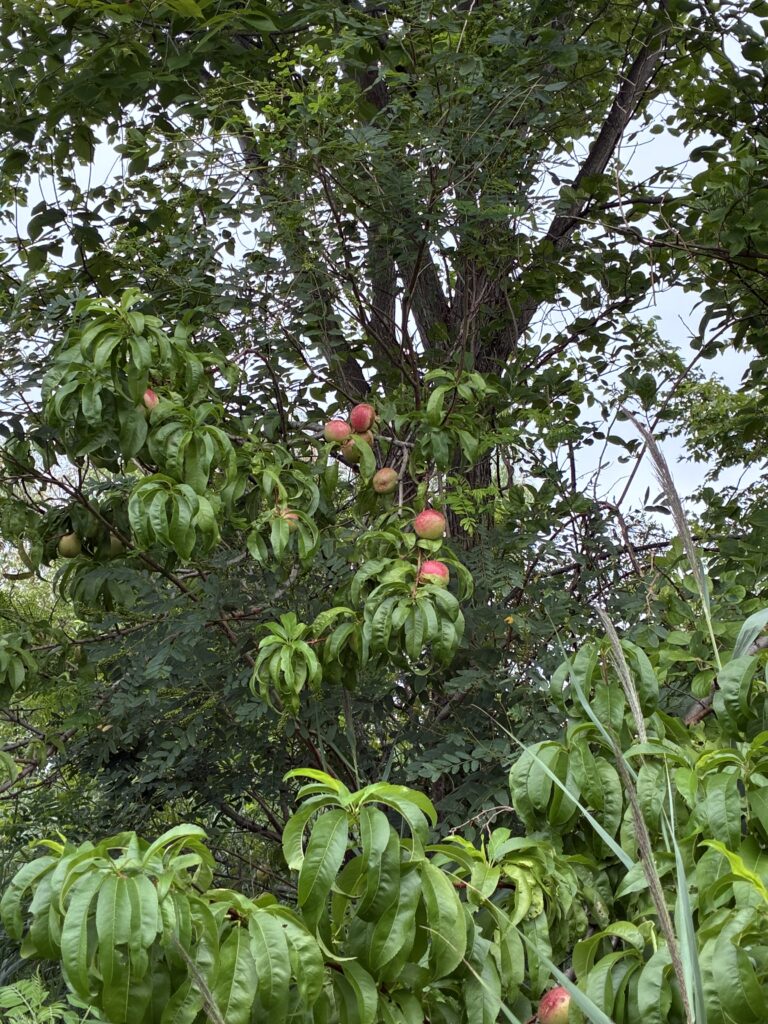
John spotted this apple tree with its fruits almost ready to harvest. Apple flowers start to bloom in the spring. By early summer, pollination takes place and the fruits start to develop. Pollination is the beginning of the reproductive process in plants. It is followed by fertilization which is when the fruit start to develop. By late summer to early fall, the apples are ripe and ready to be harvested. Photo by Endurance Laryea
High tide in Sayreville too. Photo by Ashley Fritz.
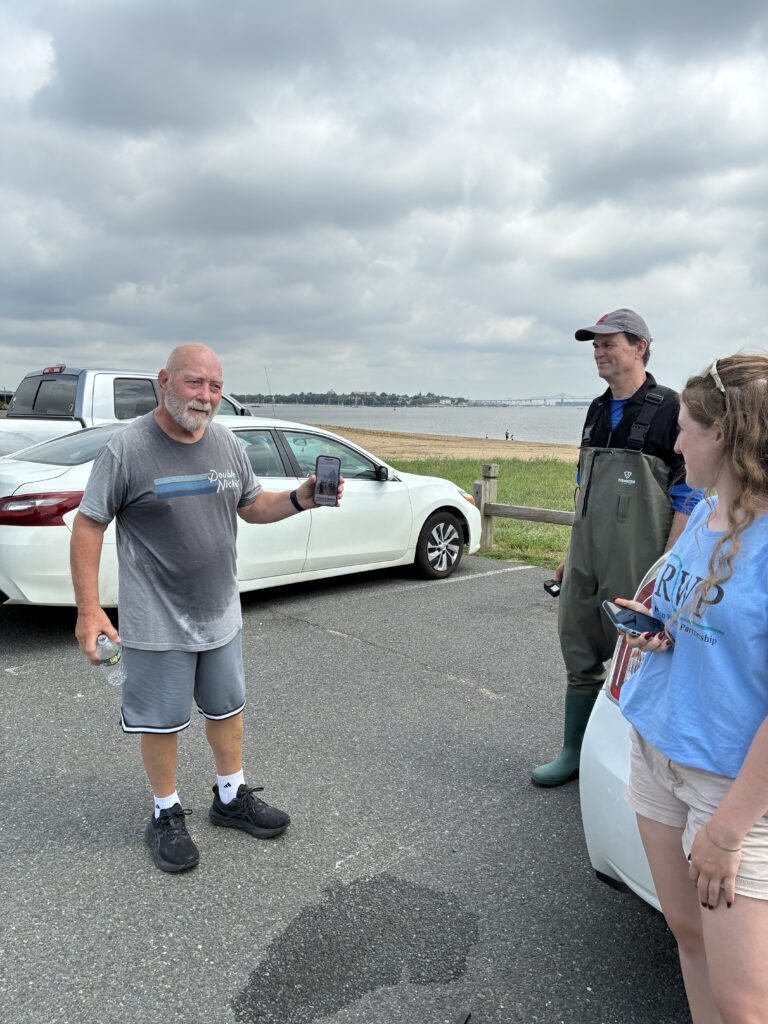
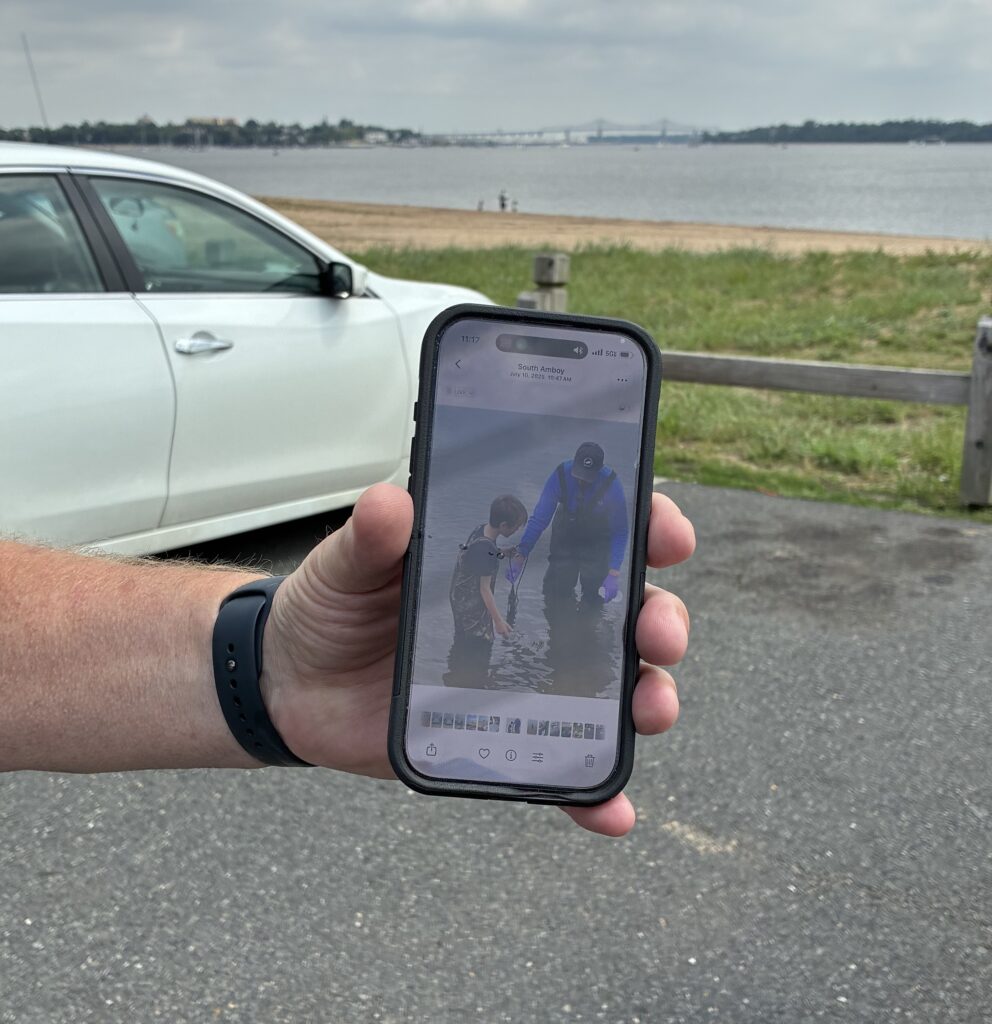
Remember the grandfather who reminded us of his grandson a couple of weeks ago at Waterfront Park, South Amboy? He came with his grandson, Gavin, to sample with us today at this site! Gavin has grown so much within the year that he outgrew his waders, so he had to go in with his swim shorts. We were excited that he was able to join us today! Photo by Ashley Fritz.
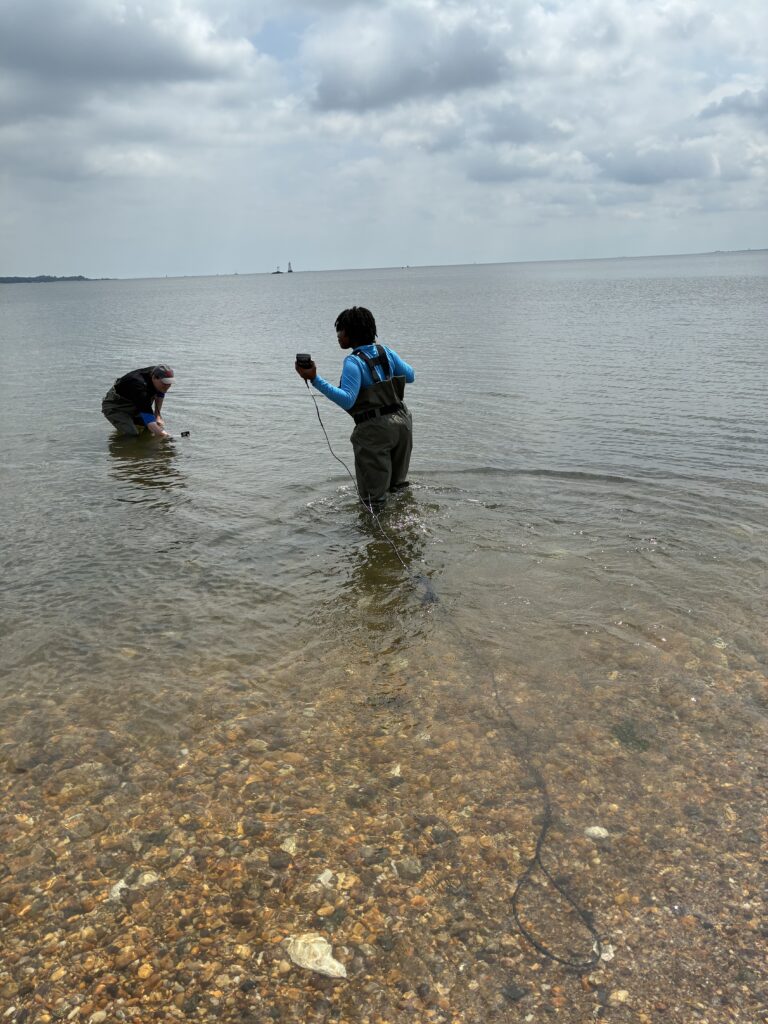
Gavin’s grandfather looks on while he and Endurance hold the sonde in the river and Paula and Ashley record the measurements. Photo by John Meyer.
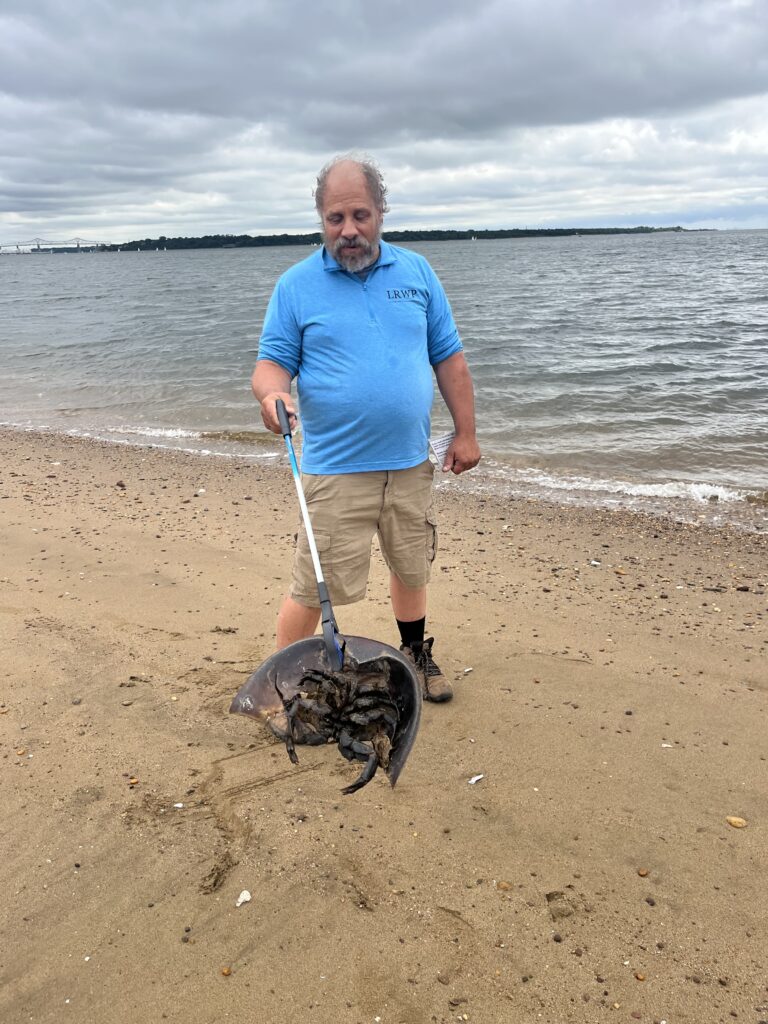
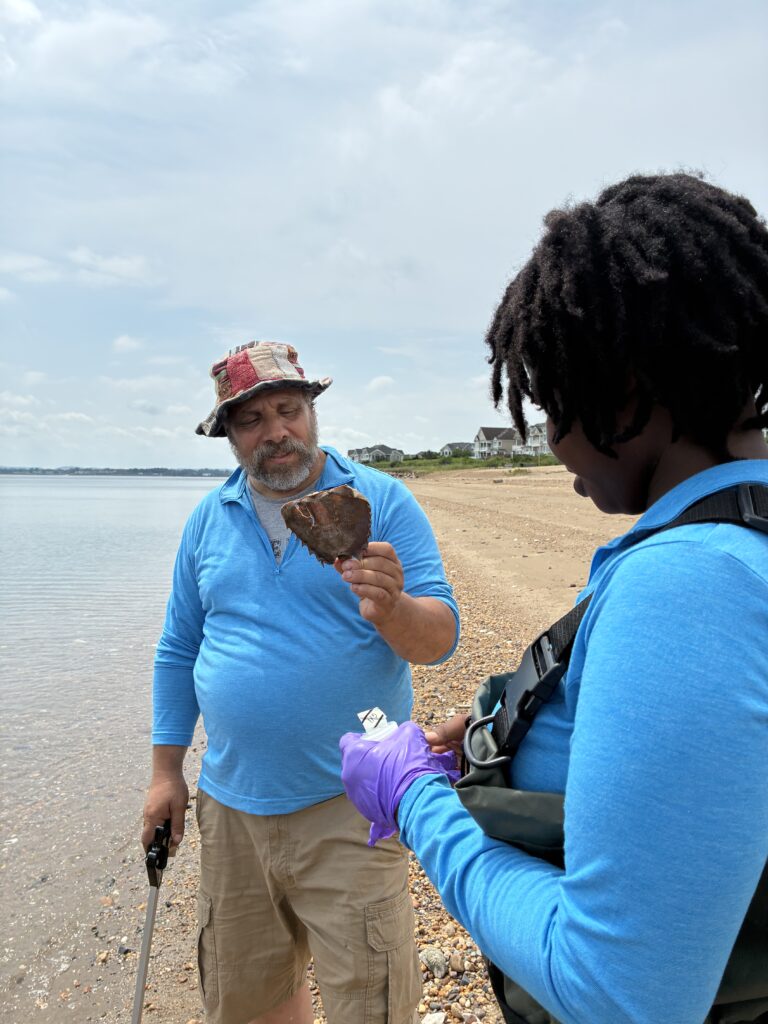
Mike holds up a half of a dead horseshoe crab. Photo by Olesya Nobokova.
Paula, Ashley and Endurance on sampling duties in Perth Amboy. Photo by Olesya Nobokova.
Mike holds up a baby diaper with his trash picker in one hand and 5-gallon bucket full of trash in the other at Perth Amboy. A poor sight to see! Photo by John Meyer.
Photo by Endurance Laryea.
Enjoy your weekend and remember to be safe if you decide to spend your time on the river this weekend!
By Endurance Laryea, LRWP Summer Research Intern and J.M. Meyer.
The fourth pathogen monitoring session of the month took place on Thursday, July 23rd. Each week during the summer, from May to October, the Lower Raritan Watershed Partnership and Rutgers Cooperative Extension of Middlesex County run a volunteer-based monitoring program along the Raritan River. We collect water quality samples at six non-bathing public access beach sites, provide our samples to the Interstate Environmental Commission for analysis in their laboratory, and report the results to the public. Our mission is to share this data with the community and partners to ensure the safe use of the Raritan River for all.
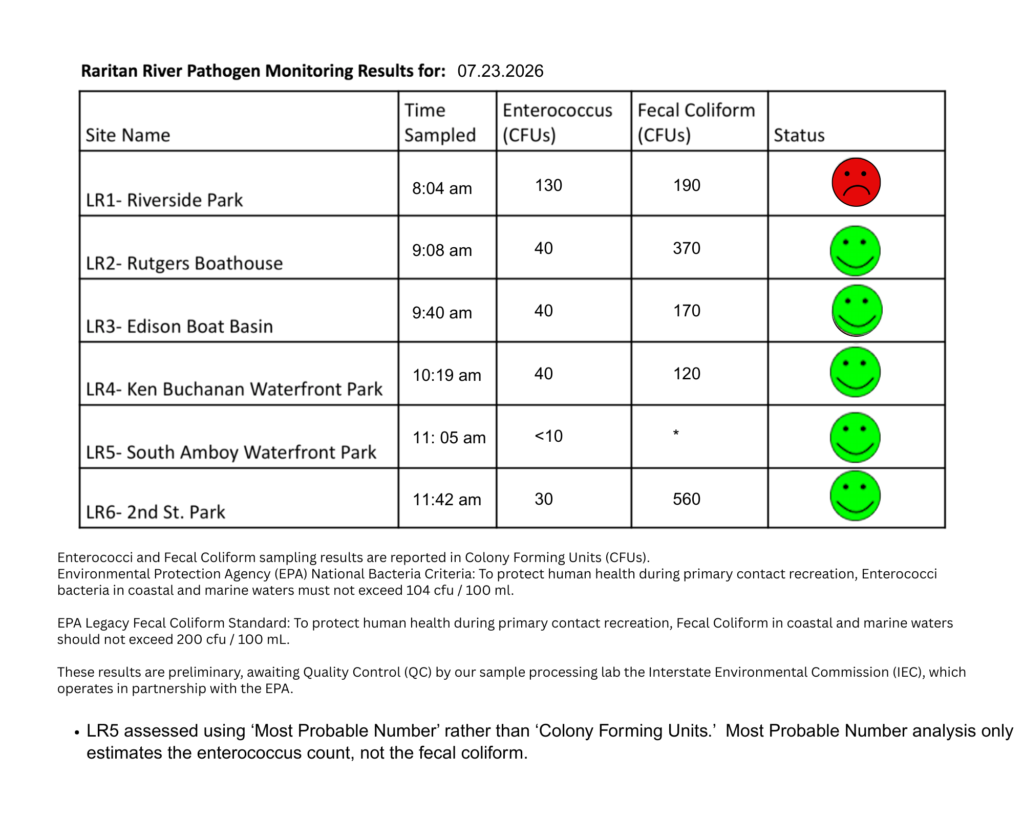
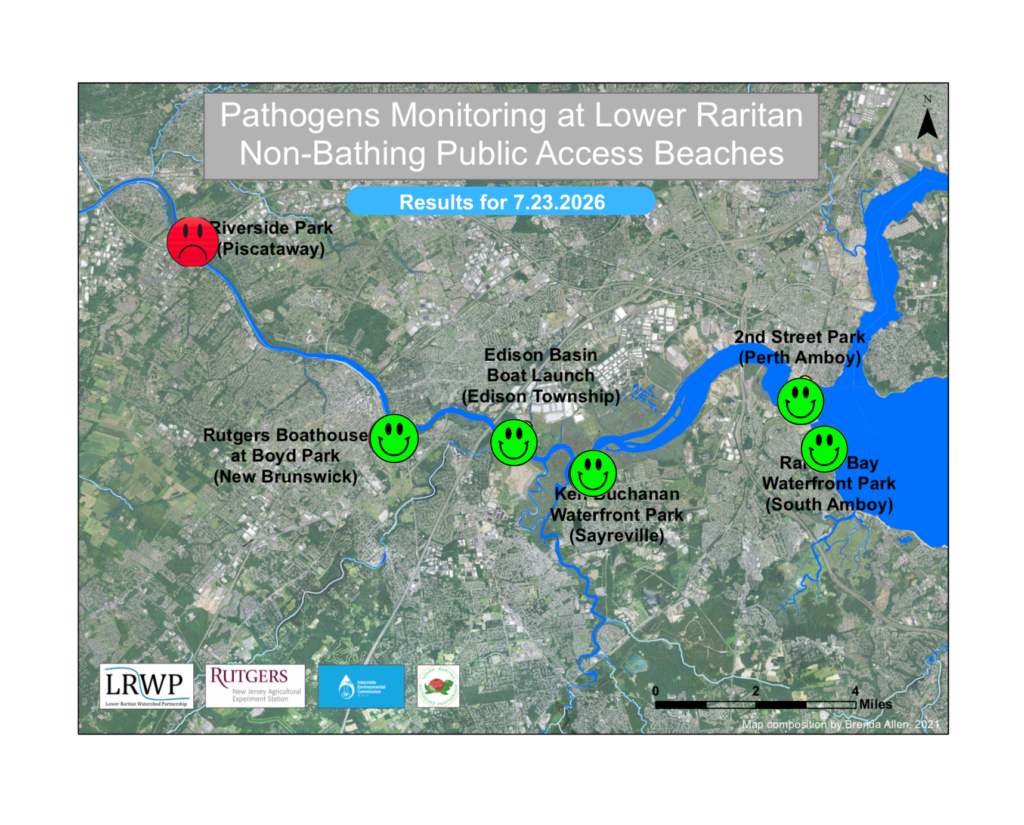
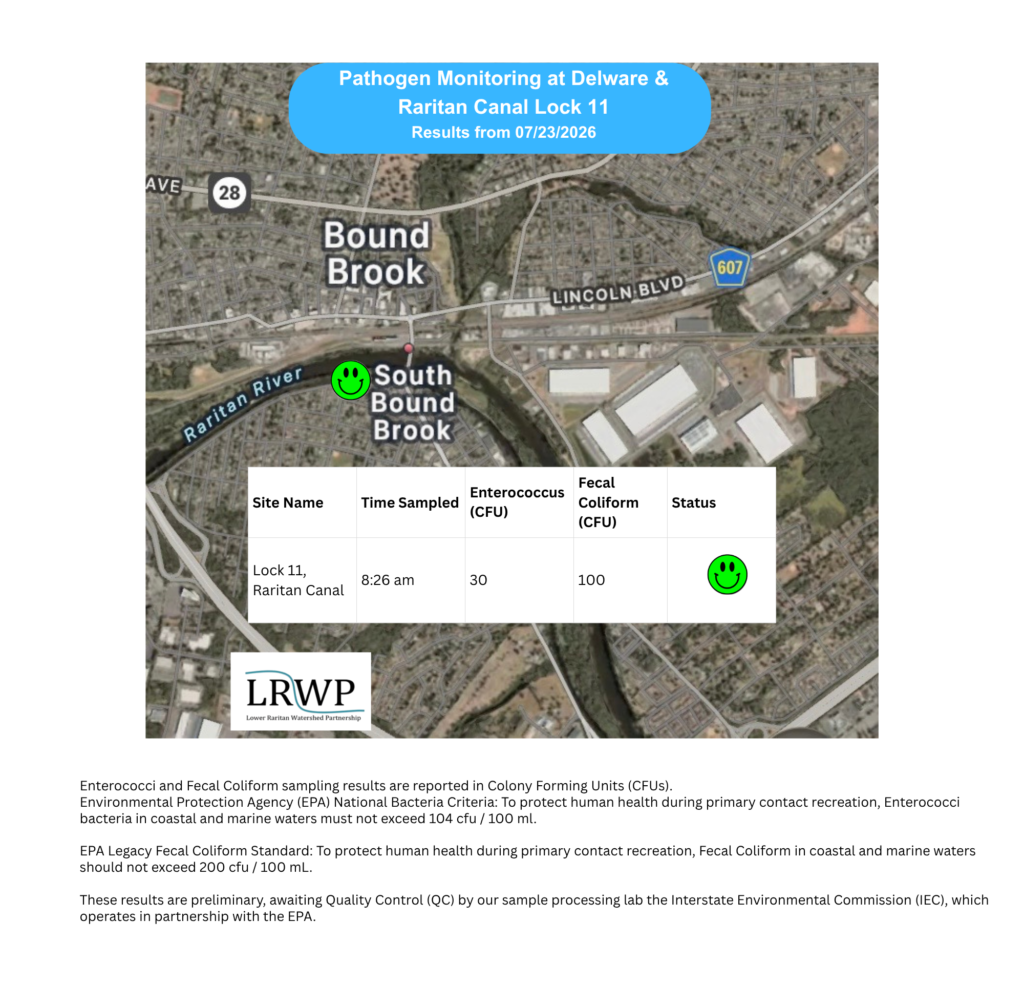
Our lab results for water quality samples taken on Thursday, July 23rd, 2026, show Enterococcus bacteria levels exceeding the EPA federal water quality standard of 104 cfu/100mL at one of our regular monitoring sites this week. The problem sites are indicated by the red frown on the map and chart and include Riverside Park (Piscataway). Green smiles on the chart and map indicate the sites with bacteria levels safe for recreation and include the following: Rutgers Boathouse (New Brunswick), Edison Boat Basin (Edison), Ken Buchanan Waterfront Park (Sayreville), 2nd Street Park (Perth Amboy), and South Amboy Waterfront Park.
Pathogens/Enterococci levels are used as indicators of the possible presence of disease-causing bacteria in recreational waters. Such pathogens may pose health risks to people coming in primary contact with the water (touching) through recreational activities like fishing, kayaking or swimming in a water body. Possible sources of bacteria include Combined Sewer Overflows (CSOs), improperly functioning wastewater treatment plants, stormwater runoff, leaking septic systems, animal carcasses, pet waste, wildlife waste, and runoff from manure storage areas.
In order to better understand why Riverside Park, Piscataway has been our worst performing site over the past six years, we have started sampling further upstream. On July 23rd, we sampled the canal at Lock 11, South Bound Brook, a third time since we started pathogens monitoring this season. The lab analysis produced 30 enterococci cfu per 100mL which passes the EPA federal water quality standard of 104 cfu/100mL. Again, this site passed the test, as it has every week that we’ve tested it.
Our goal in reporting these results is to give residents a better understanding of the potential health risks related to primary contact during water-based recreation. If you are planning on recreating on the Raritan this weekend, make sure to stay safe and wash up after any activities!
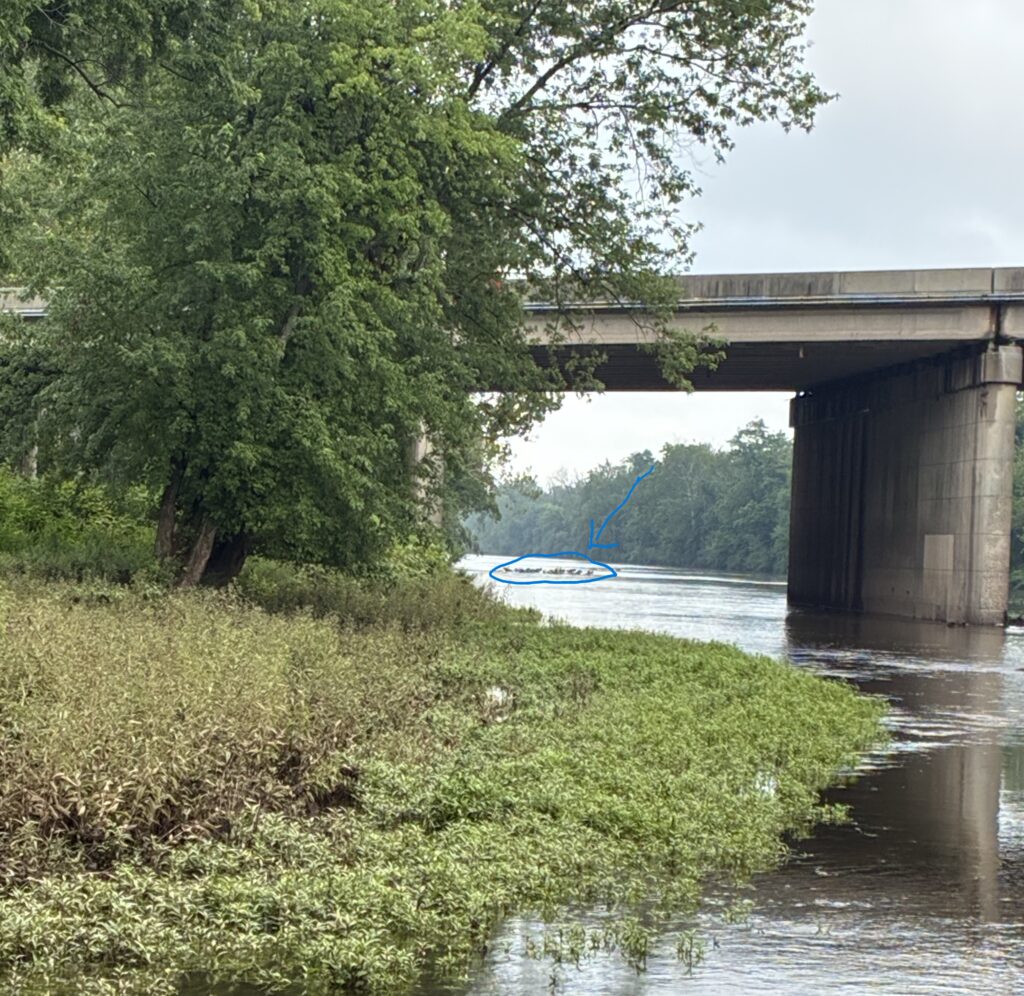
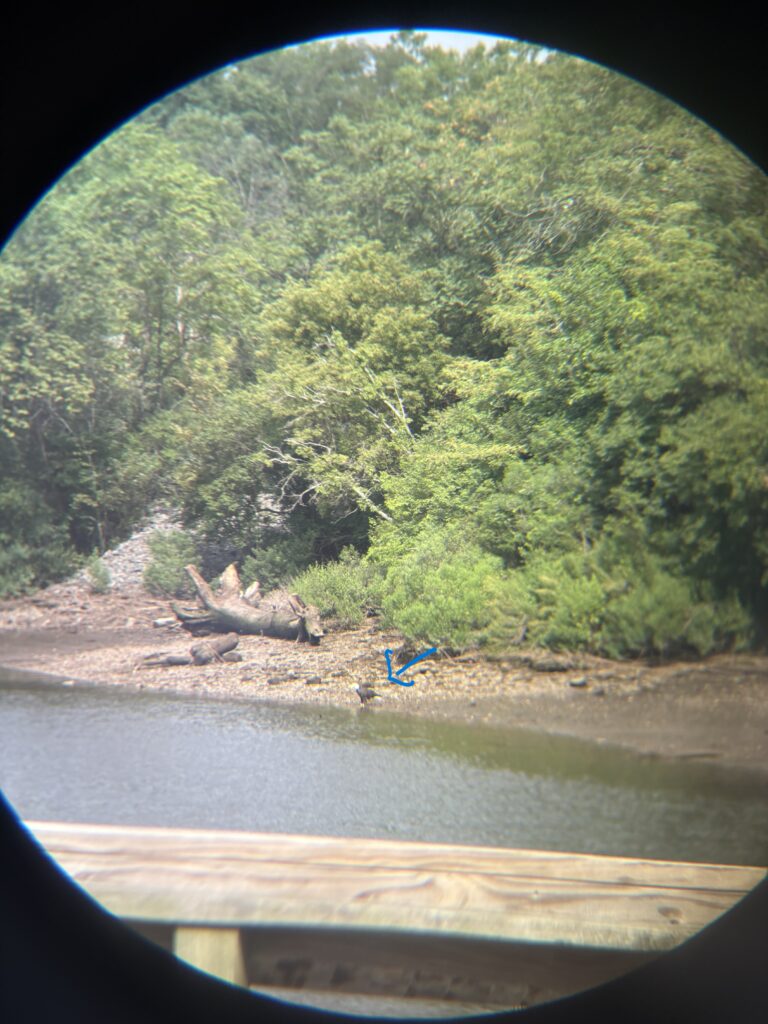
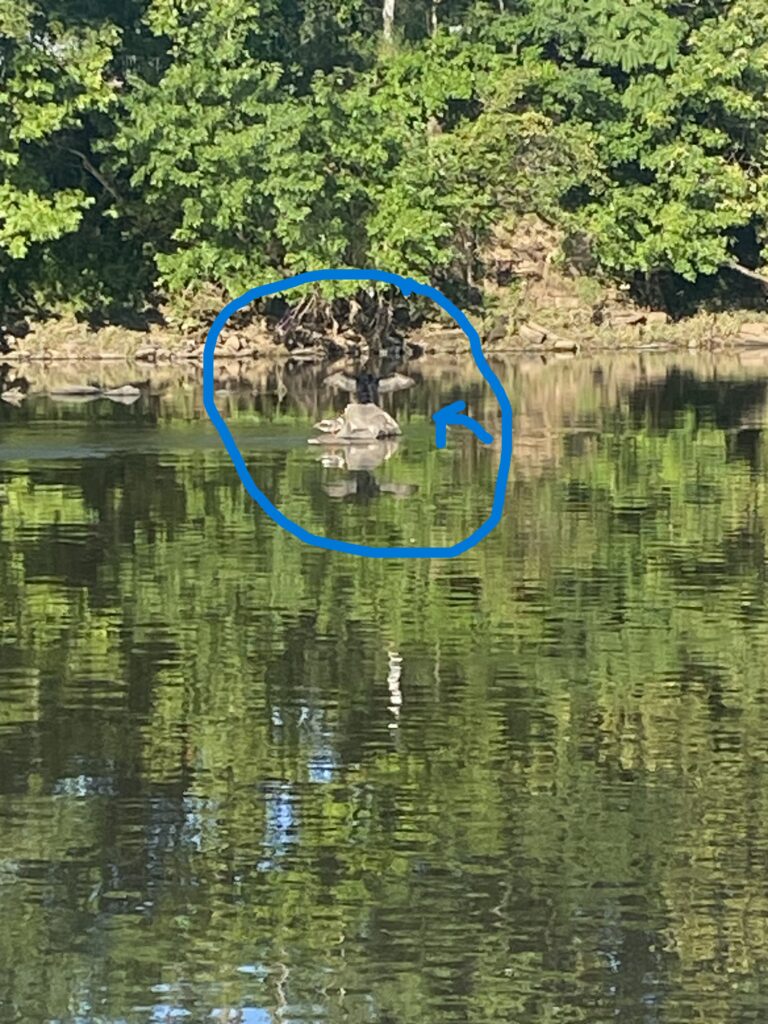
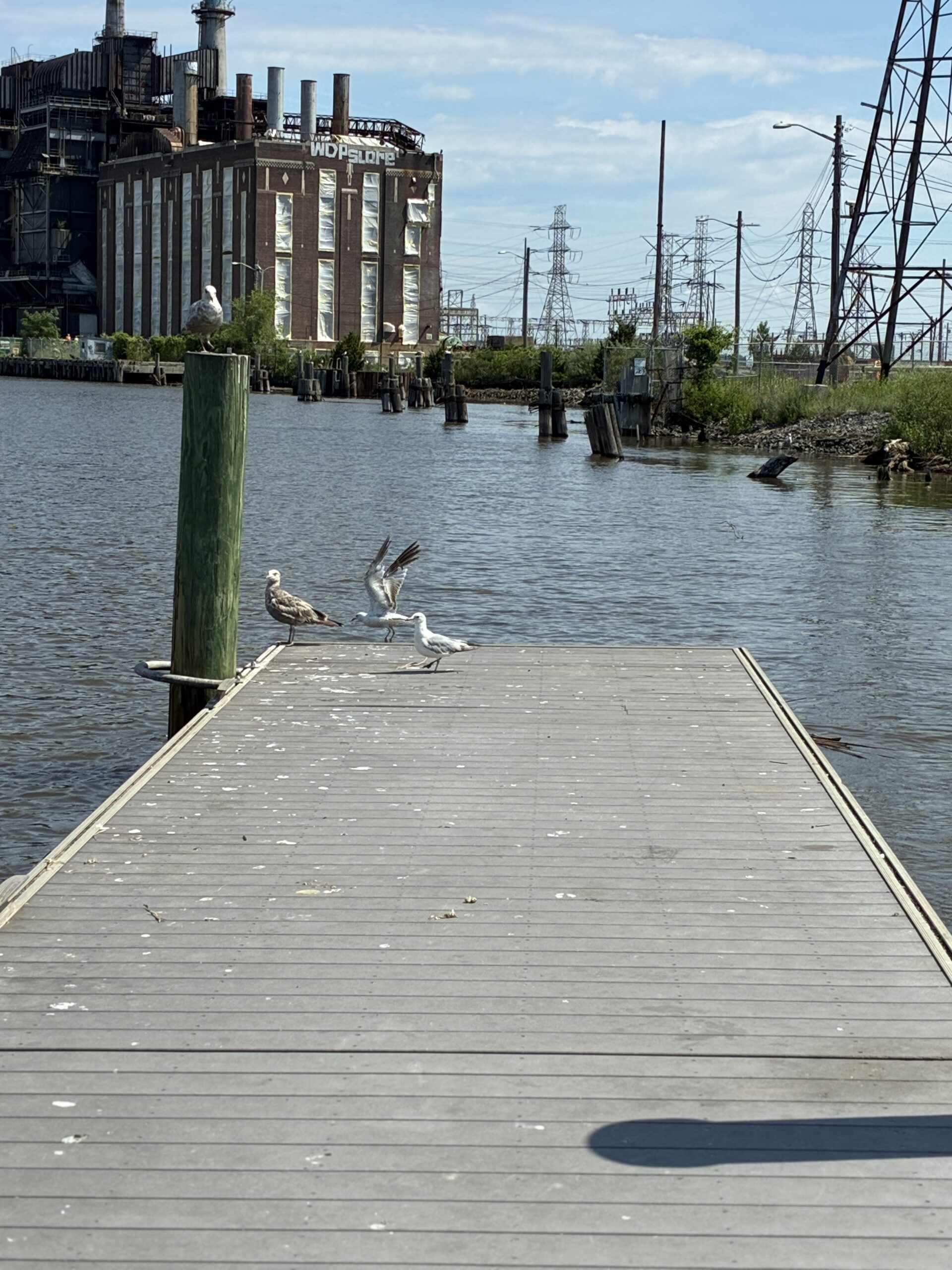
We were greeted by two birds this morning. One with its wings outstretched on a rock in the middle of the river and a smaller bird with orange feet and crest on a smaller rock beside it. Birds may stretch their wings for various reasons like temperature regulation, blood circulation, drying of their feathers or even a territorial sign. Not sure which this one was doing though. From where we stood, we were not able identify what kind of birds they were. Photo by Mike Orsini.
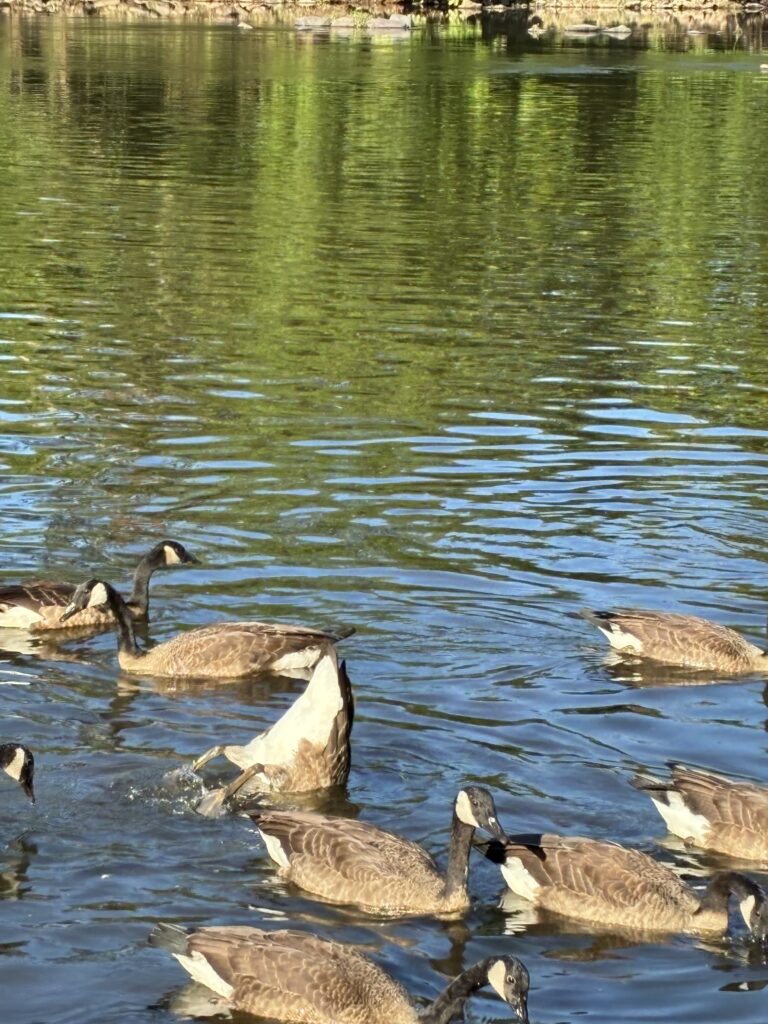
Who knew Canadian geese were into gymnastics? Here is a goose doing a handstand–or in this case, ‘beakstand’–to feed. We did not see them catch any fish, but they fed on some waterweeds while we were there. Photo by Endurance Laryea.
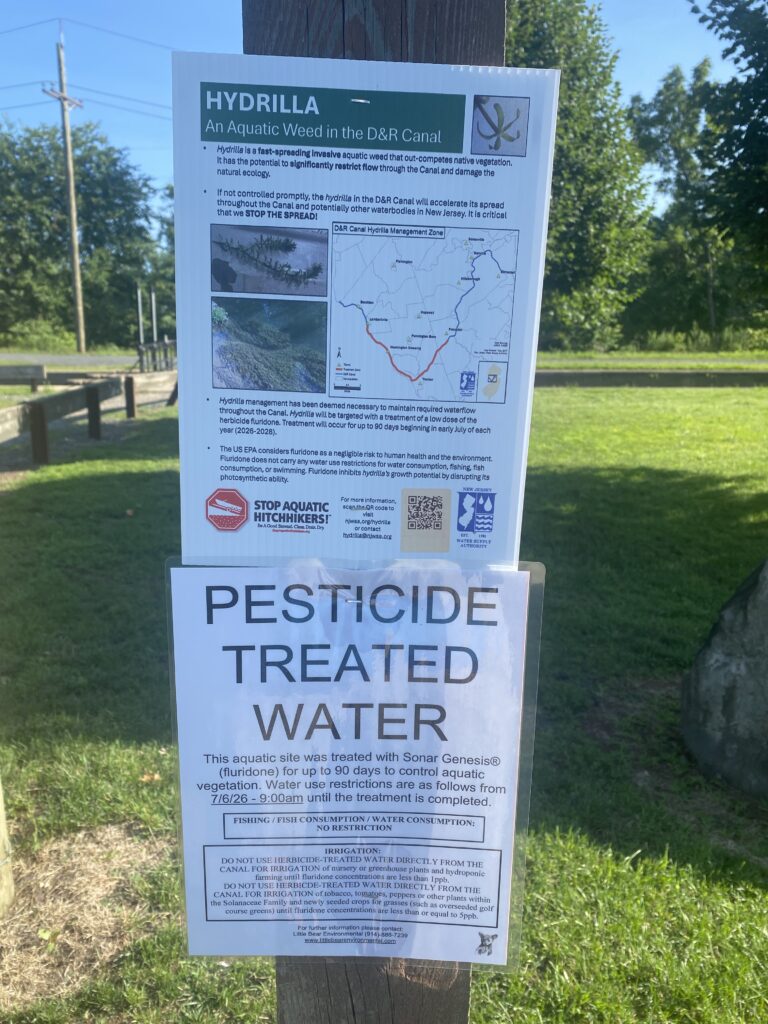
A public notice has been put up at Five Mile Lock, South Bound Brook, New Jersey to warn the community on usage of the D&R canal water. At the moment, there are no fishing or water consumption restrictions, however, there are warnings on the usage of the water for plant irrigation purposes. The canal has been treated with Sonar Genesis, an aquatic herbicide that is sprayed on the surface of the water to impede the photosynthetic processes of water weeds. The purpose of that was to control the growth of Hydrilla in the canal. Hydrilla is an invasive species. As discussed in last week’s post, invasive species are harmful to the ecosystems in which they are non-native hence, the need for management.
Photo by Mike Orsini.
“Where are the fishes”, two fishermen inquired at Five Mile Lock, South Bound Brook , New Jersey. We have not spotted any fish at this site since we started monitoring this season and this was the first time seeing any fishing activity going on here. Photo by Endurance Laryea.
Photo by Endurance Laryea.
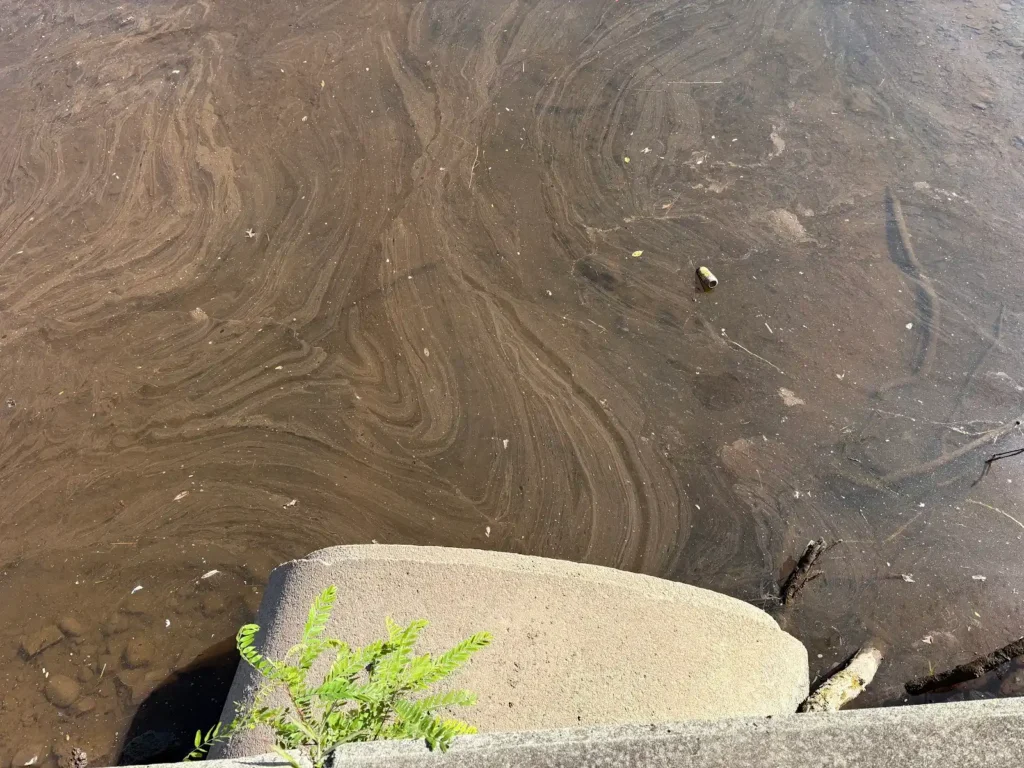
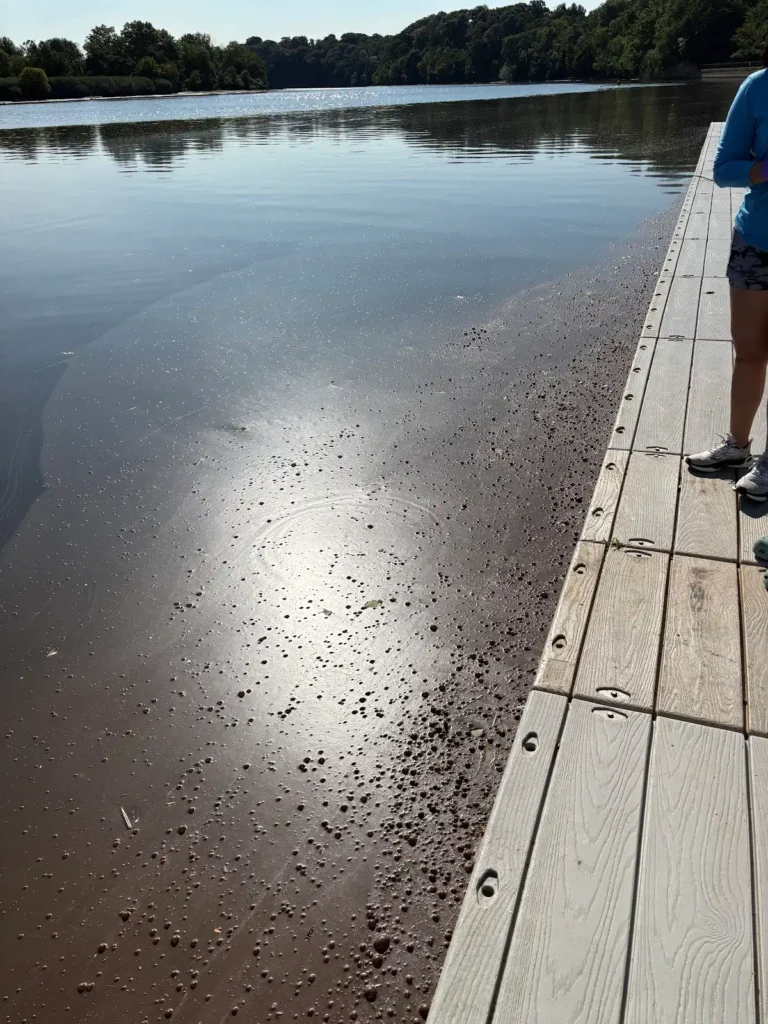
At Rutgers Boat House, New Brunswick, what looked like a biofilm was all over the surface of the water surrounding the dock. It appeared to be coming out of the outfall–possibly, organic matter being washed into the river. Think of a biofilm as a community of bacteria. They form when bacteria attach itself to a surface (In this case, the water surface), produce a glue-like substance called Extracellular Polymeric Substances (EPS) to help them stick to each other and the surface of attachment better, then reproduce forming a slimy layer of film on the surface of attchment. Biofilms can be found in various places, dranaige pipes, water storage tanks, down your kitchen drain, and even your teeth!
Photos by Paula Rubio.
Photo by Ashley Fritz.
John taking out plastic from the water at Edison Boat Launch. Photo by Ashley Fritz.
Ashley, John and Endurance on sampling and sonde measurement duties. Photos by Paula Rubio.
Endurance on sampling duty at South Amboy. Photo by John Meyer.
A massive algal bloom at Perth Amboy. The water was greenish and murky unlike the clear color it has had for the past couple of weeks. Photo by Endurance Laryea.
Photo by Endurance Laryea.
Thankfully, oxygen levels rose back to normal, and we did not experience the fish dead we feared!
By Endurance Laryea, LRWP Summer Research Intern and J.M. Meyer.
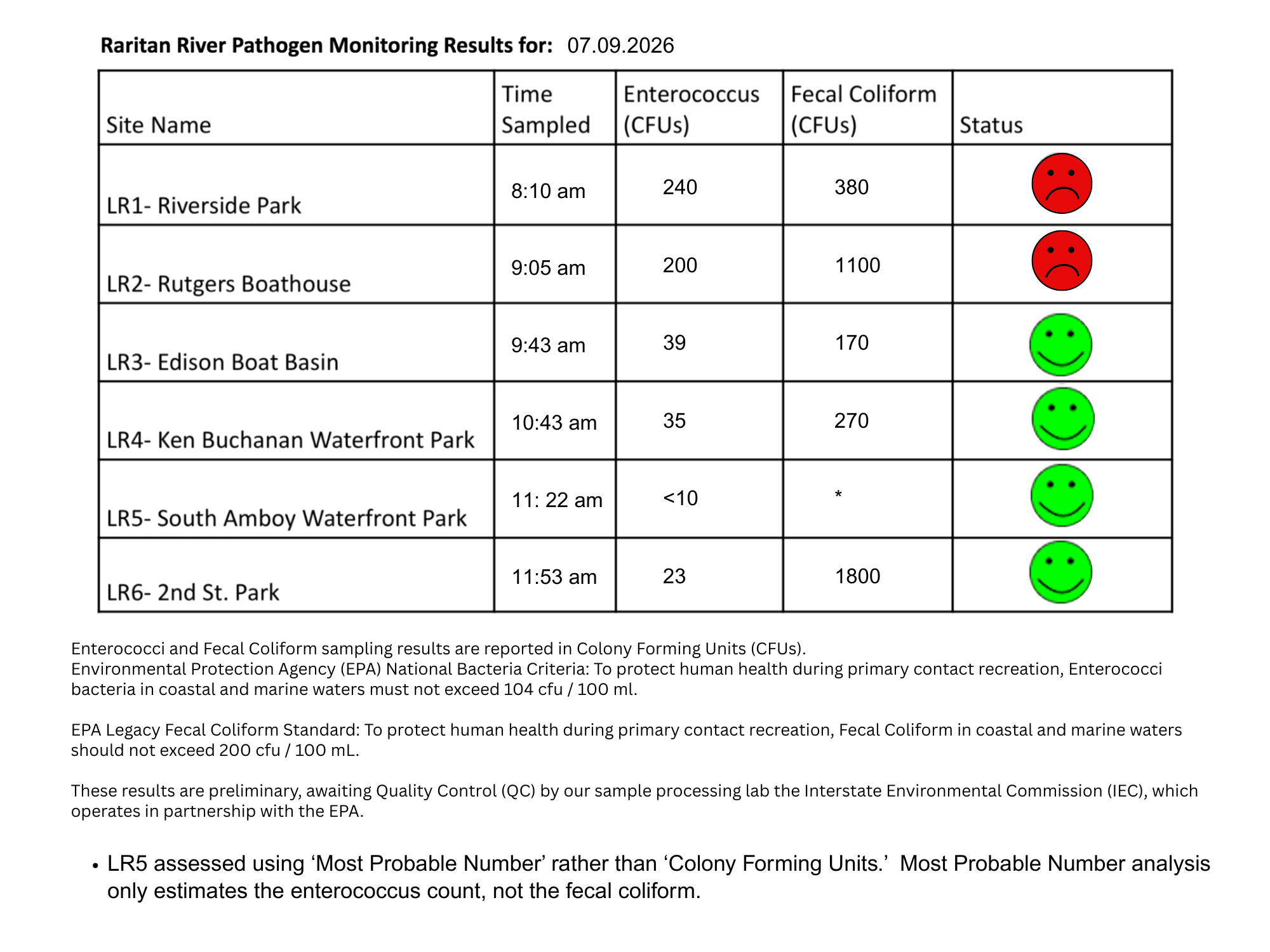
The second pathogen monitoring session of the month took place on Thursday, July 9th. Each week during the summer, from May to October, the Lower Raritan Watershed Partnership and Rutgers Cooperative Extension of Middlesex County run a volunteer-based monitoring program along the Raritan River. We collect water quality samples at six non-bathing public access beach sites, provide our samples to the Interstate Environmental Commission for analysis in their laboratory, and report the results to the public. Our mission is to share this data with the community and partners to ensure the safe use of the Raritan River for all.
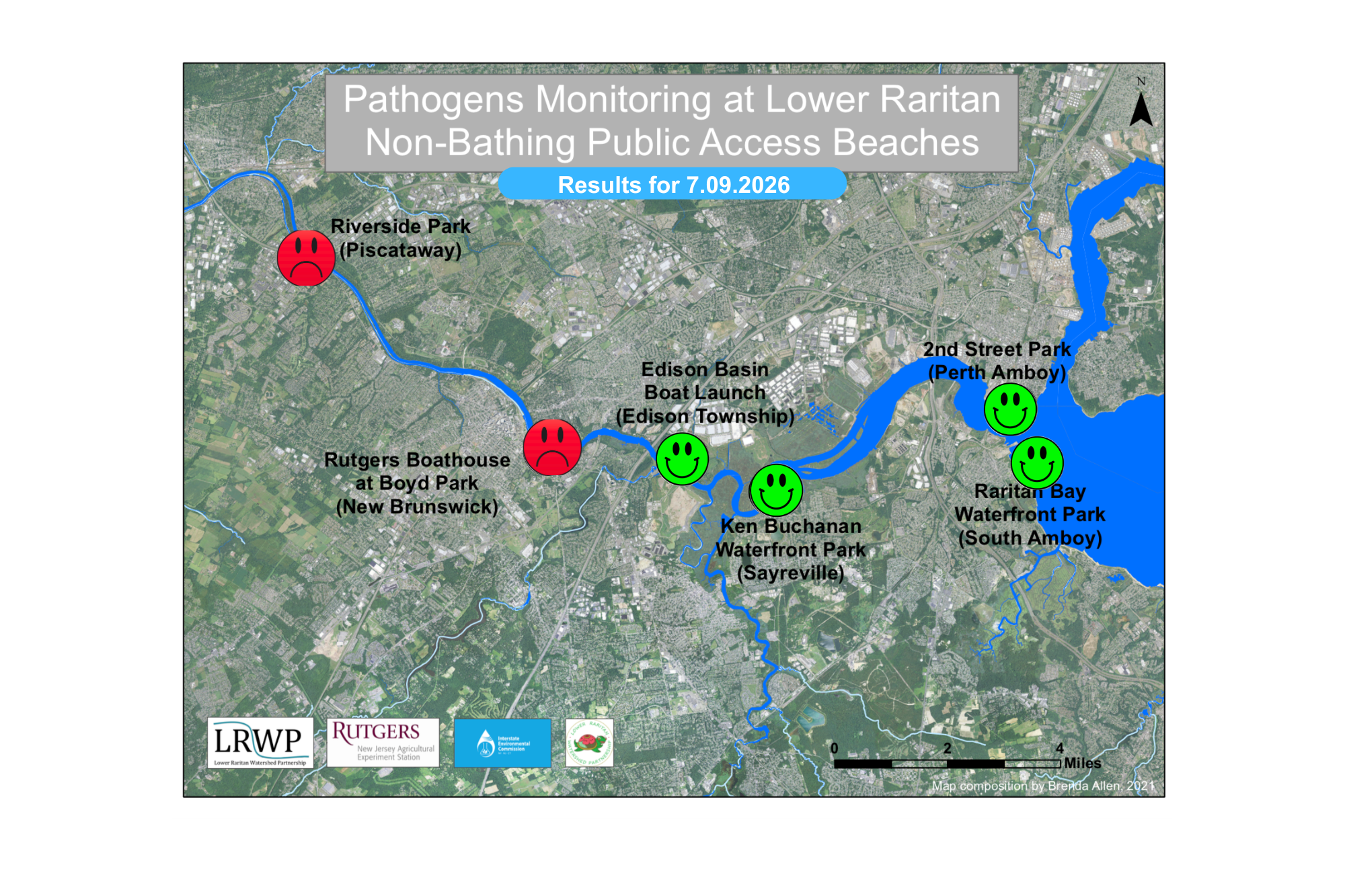
Our lab results for water quality samples taken on Thursday, July 9th, 2026, show Enterococcus bacteria levels exceeding the EPA federal water quality standard of 104 cfu/100mL at twoof our monitoring sites this week. The problem site is indicated by the red frown on the map and chart: Riverside Park (Piscataway) and Rutgers Boathouse (New Brunswick). Green smiles on the chart and map indicate the sites with bacteria levels safe for recreation and include the following: Edison Boat Basin (Edison), Ken Buchanan Waterfront Park (Sayreville)2nd Street Park (Perth Amboy).
Pathogens/Enterococci levels are used as indicators of the possible presence of disease-causing bacteria in recreational waters. Such pathogens may pose health risks to people coming in primary contact with the water (touching) through recreational activities like fishing, kayaking or swimming in a water body. Possible sources of bacteria include Combined Sewer Overflows (CSOs), improperly functioning wastewater treatment plants, stormwater runoff, leaking septic systems, animal carcasses, pet waste, wildlife waste, and runoff from manure storage areas.
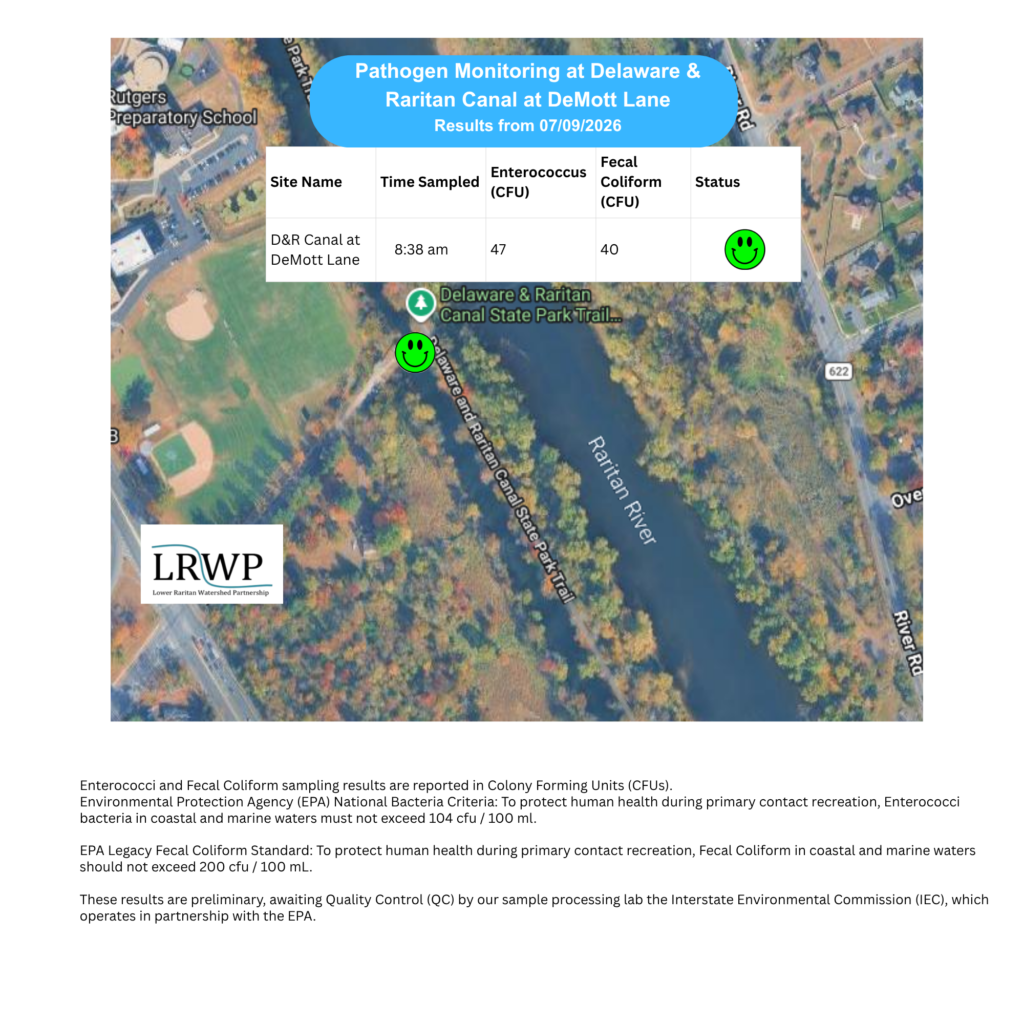
In order to better understand why Riverside Park, Piscataway has been our worst performing site over the past six years, we have started sampling further upstream. On July 7th, we sampled the DeMott Lane D&R Canal site a second time since we started pathogens monitoring this season. The lab analysis produced 47 enterococci colony per 100mL passing the EPA federal water quality standard of 104 cfu/100mL. It also passed the test during our first month of monitoring.
Our goal in reporting these results is to give residents a better understanding of the potential health risks related to primary contact during water-based recreation. If you are planning on recreating on the Raritan this weekend, make sure to stay safe and wash up after any activities!
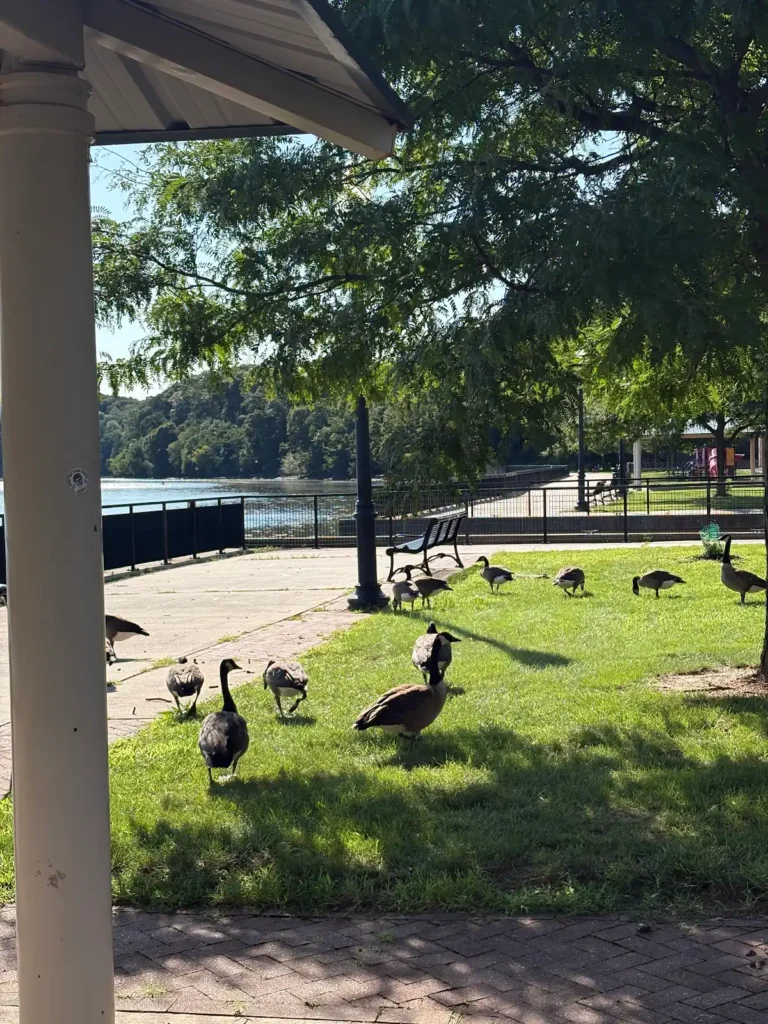
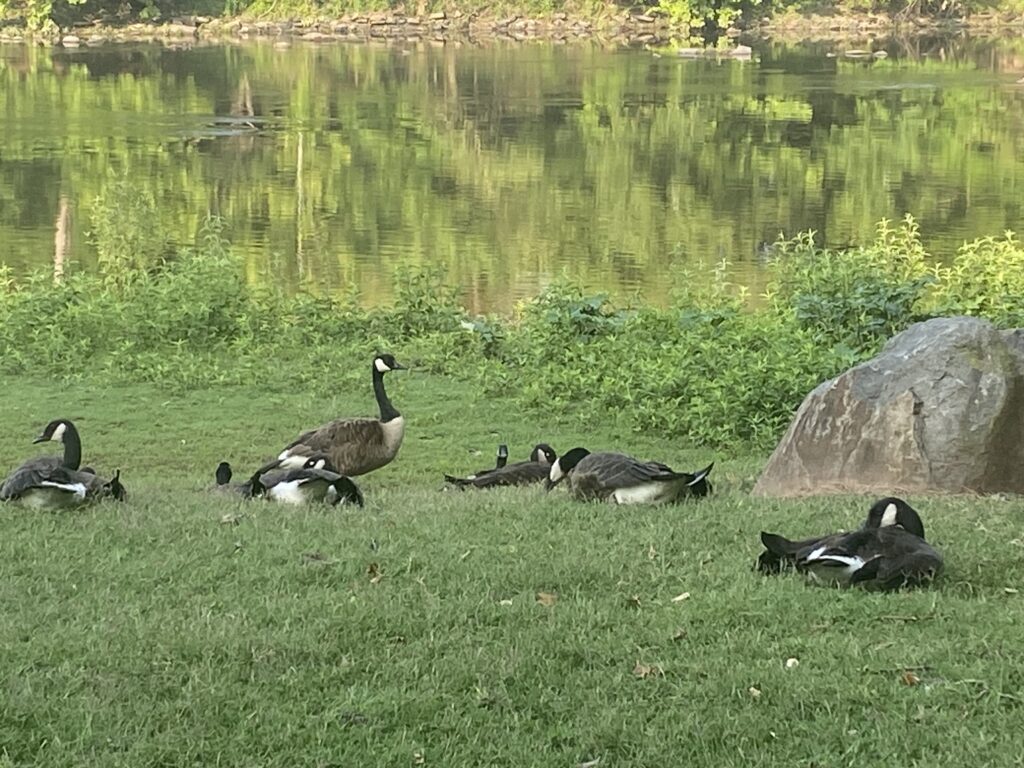
With no ‘goose chasing’ vehicles in sight, the Canada geese lounge in the summer shade at Riverside Park. Photo by Michael Orsini.
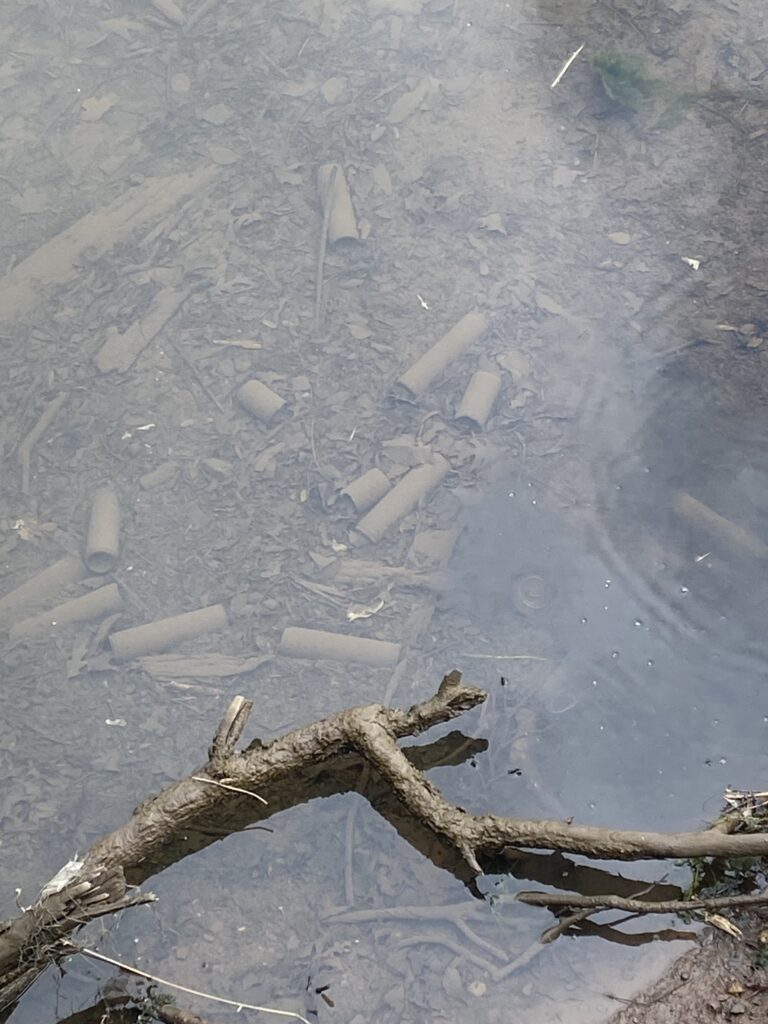
Thanks to the low tide, Dr. John found numerous ofrenda votive candles at the mouth of the Rutgers Boathouse Culvert. — Photo by Michael Orsini.
A close up of the votive candles. Photo by Michael Orsini.
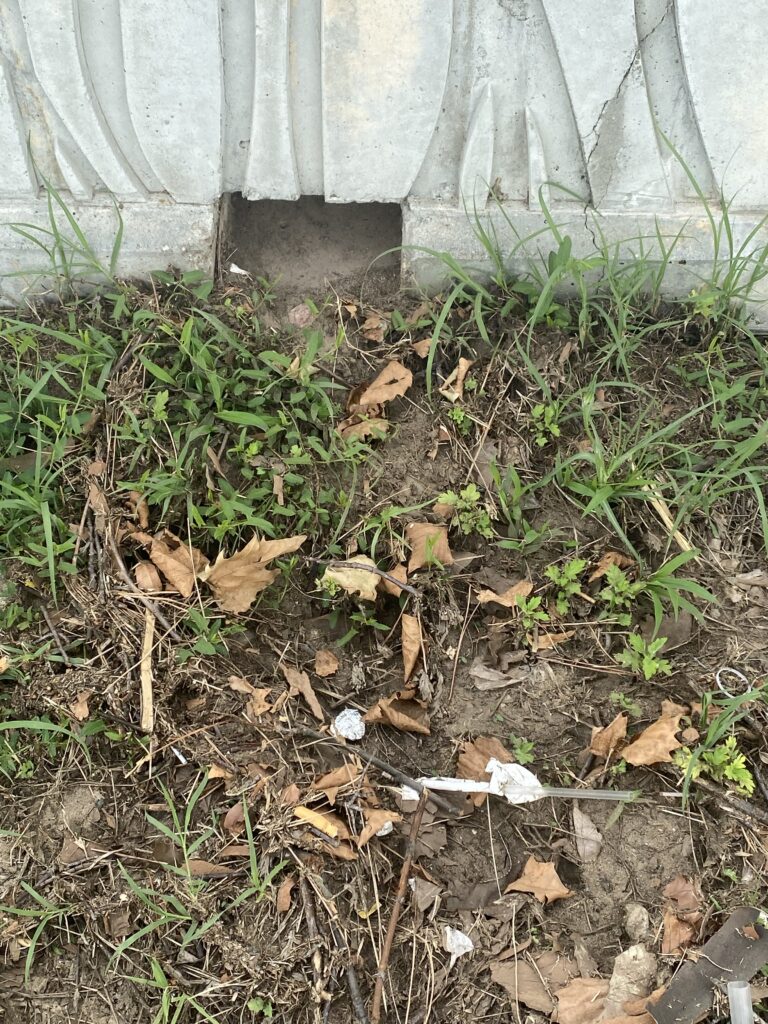
The Perth Amboy beach wall has numerous drainage openings to allow water to runoff onto the beach. Unfortunately, scores of cigarette butts and candy wrappers hitch a ride through the small portal. Please properly dispose of your trash! — Photo by Michael Orsini.
From fallen trees to mysterious bubbles, the LRWP team had quite an adventure during today’s monitoring session and we had John Munson, a video producer for Rutgers Today join us in our escapades as well!
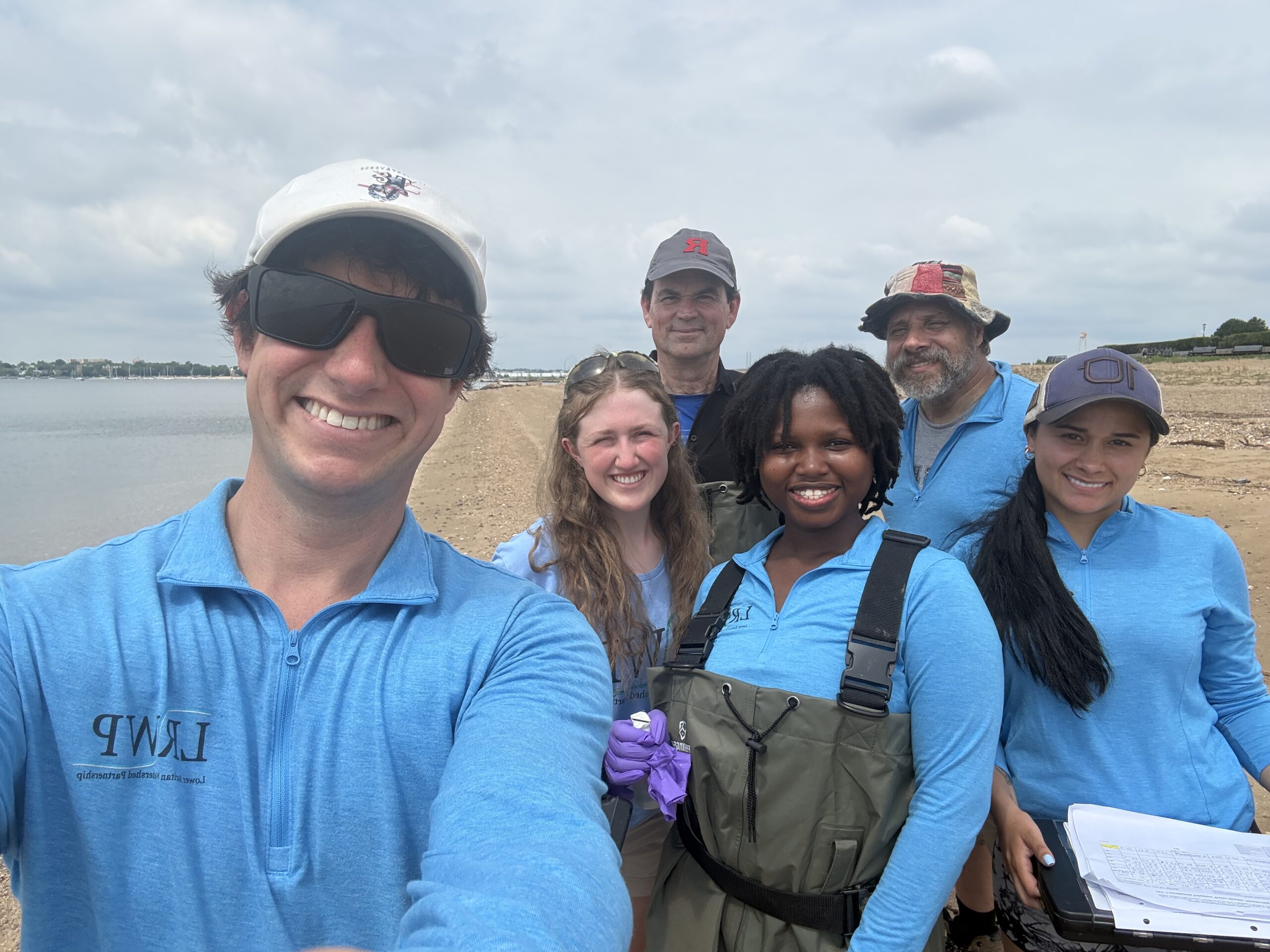
The team today!
John, Endurance, Ashley, Paula, Mike and John from Rutgers Today pose for a group photo at the Waterfront Park in South Amboy. Photo by Endurance Laryea.
Today, John, the video director for Rutgers Today, the official daily news source for Rutgers University, joined the monitoring session to film a feature highlighting the work we do.
Ashley introducing herself to John- Photo by Endurance Laryea.
Starting off in Piscataway, we encountered a Raritan River flushed with precipitation from the past week. The water level was enough to submerge the elodea and algae that is usually sighted on the stream bank.
Tidal flats completely covered by high tide- Photo by Endurance Laryea.
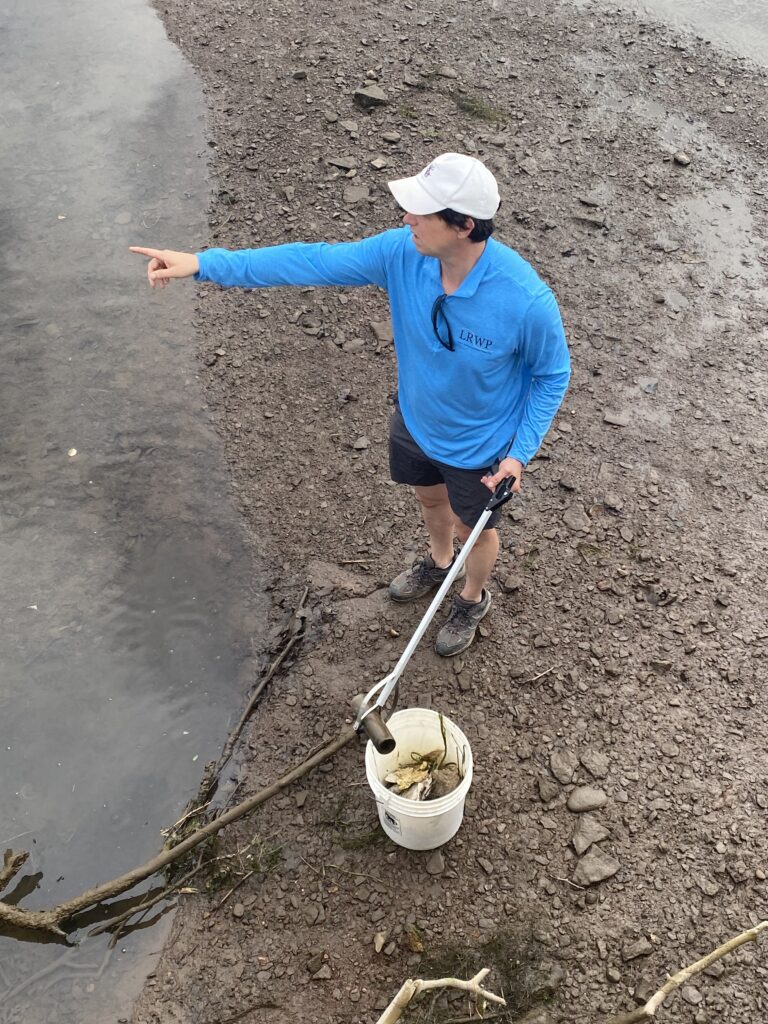
Last week, Olesya was able to pick up trash here. Today you could not walk here without protective boots.
Ashley holds up an elodea plant. Photo by Endurance Laryea.
Ashley and Paula record hydrological measurements. Photo by Endurance Laryea.
We cannot forget about the goslings who are now as big as the parent geese now!Photo by Endurance Laryea.
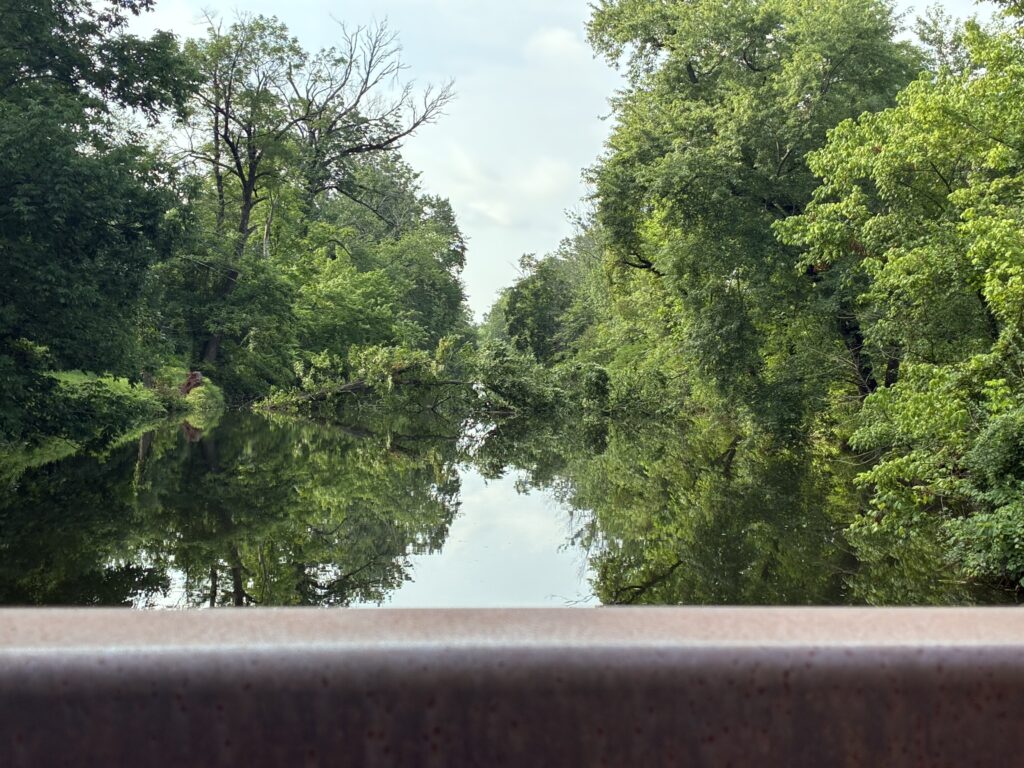
The next site was the Delaware & Raritan Canal; one of the four new sites added to the monitoring sites this summer. It was our second time sampling this summer. Unfortunately, we were met with the sight of a fallen tree across the canal. I spoke of how beautiful this site was when we first visited. It still is, however, this fallen tree reminds us of how inevitable change is in nature.
A tree fallen across the D&R Canal. The photo was taken facing downstream of the canal. Photo by Endurance Laryea.
John and Paula handling the skillful maneuvering required to collect the sample from the canal bridge. Photo by Endurance Laryea.
Extremely low tides at Rutgers Boathouse today!
The outfall pipe at Rutgers Boathouse completely exposed. Photo by Endurance Laryea.
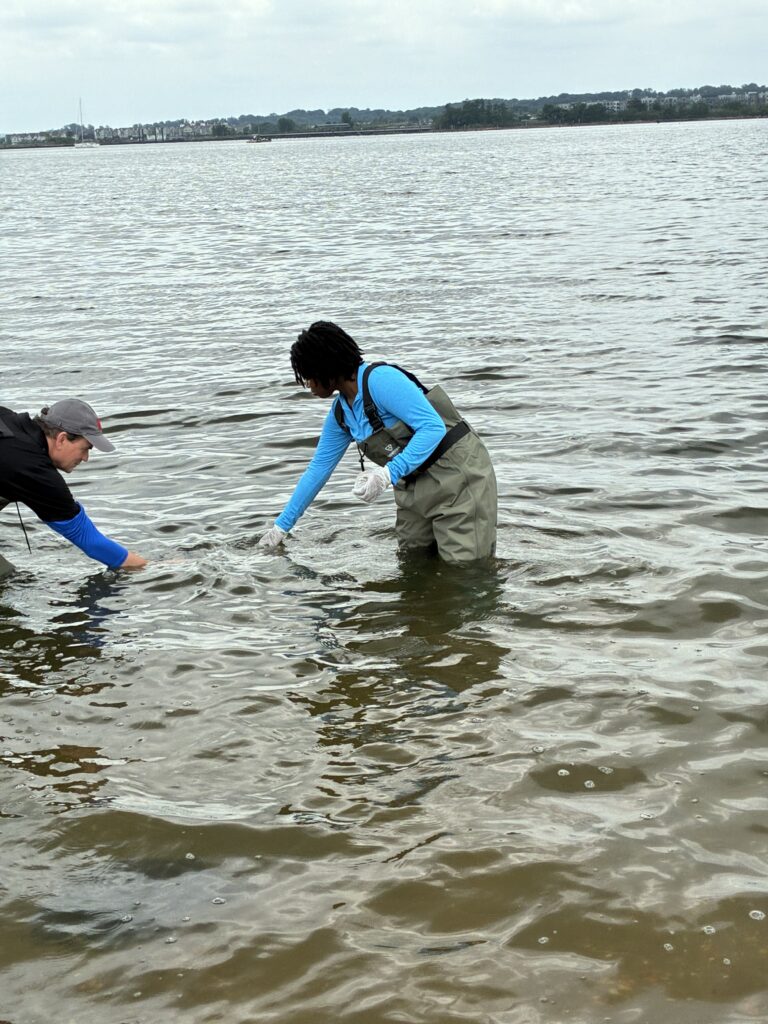
Endurance takes the sample while Ashley records measurements. Photo by Paula Rubio.
John shows the team where the drains connect to the outfall. Photo by Endurance Laryea.
Some geese and deer were spotted here too.
Photos by Endurance Laryea and Paula Rubio.
What seemed to be used votive candle containers were spotted at the mouth of the outfall pipe. John jumped down to identify and retrieve as much as he could–a bold move worthy of its own theme music.
“John displayed amazing dexterity and catlike reflexes to retrieve and identify candles”–funny remark from Mike on John’s daring move. Photo by Endurance Laryea.
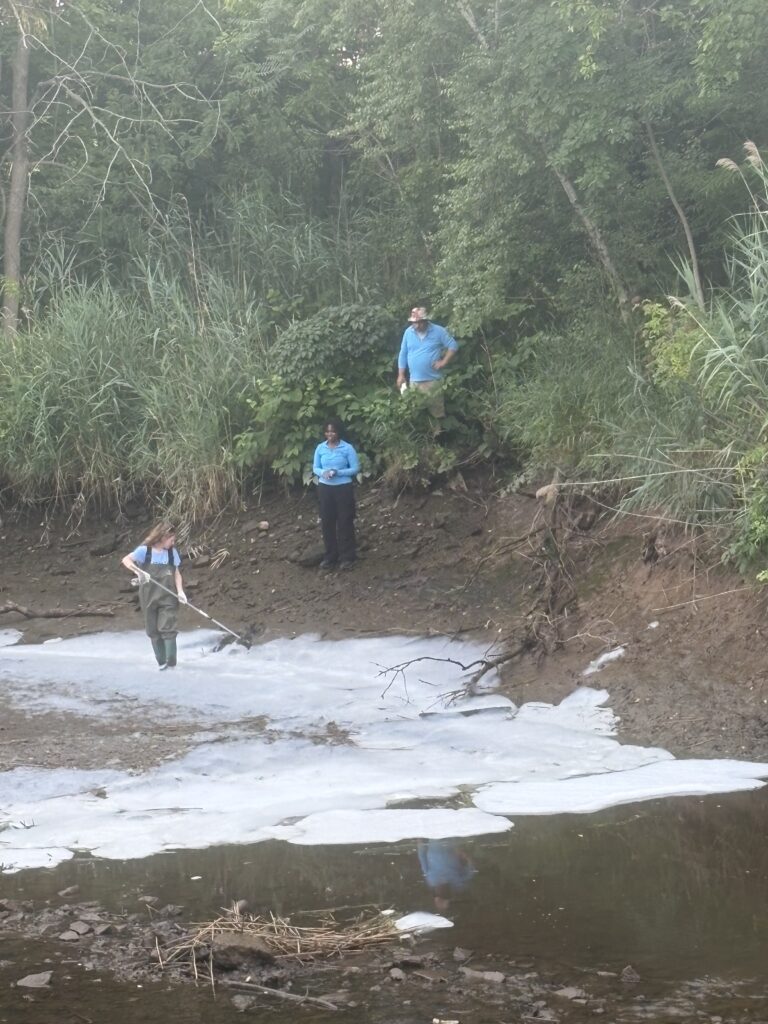
Mystery foam at Edison today!
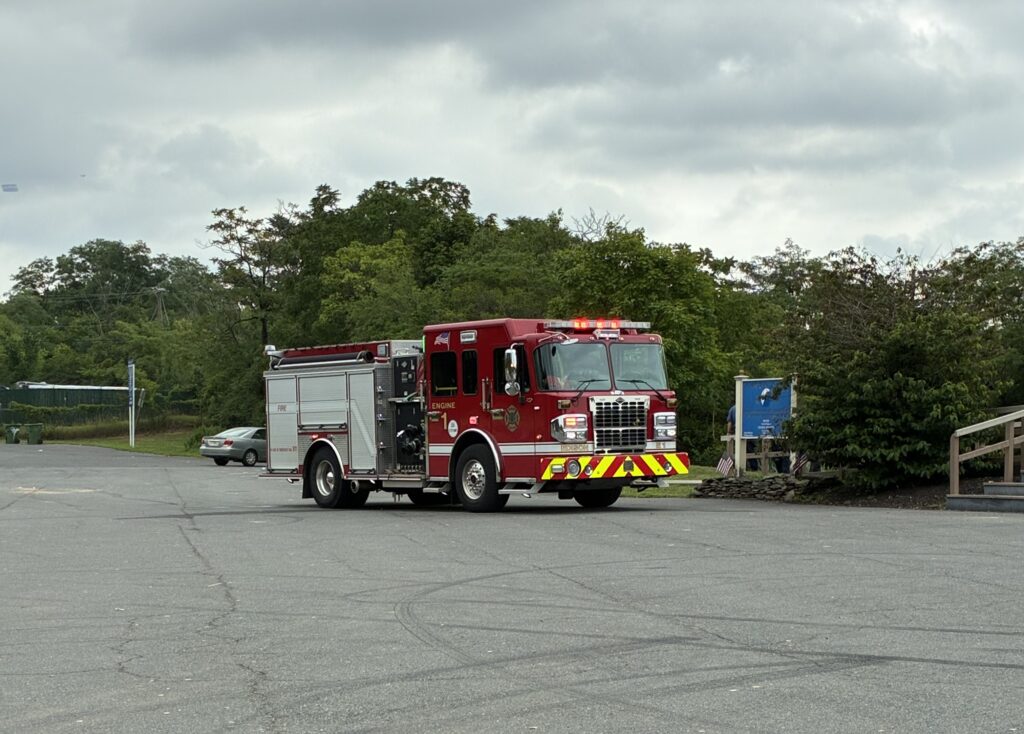
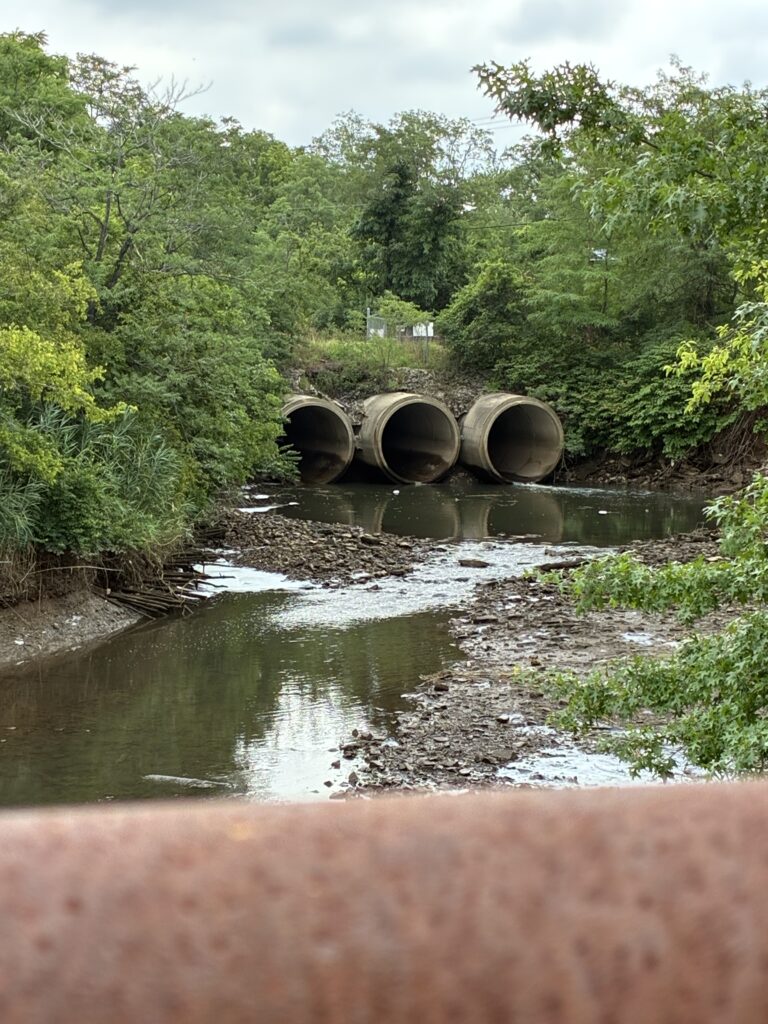
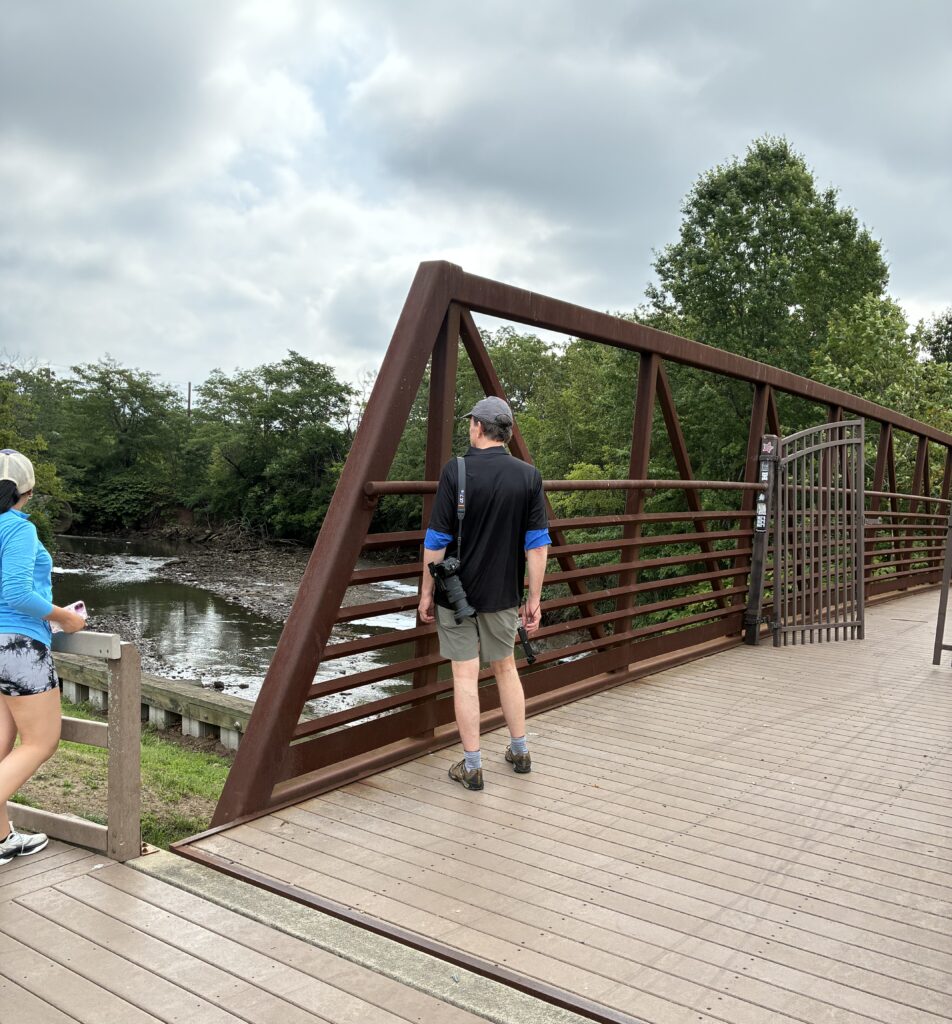
We came to meet the Fire Truck parked at the Edison Boat Basin parking lot, close to the bridge across Mill Brook stream–a stream that flows into the Lower Raritan. Upon further inquiry by John and Mike, they were told that a fisherman had called the fire department concerning a questionable amount of foam in the Mill Brook stream.
Photos By Endurance Laryea.
On the theme of courageous moments today, the LRWP team offered to take a sample and get it tested if possible. Braving numerous potential hazards, Mike and I accompanied Ashley with John, the video director, in tow to collect a sample of the foam and water in a bottle since we did not have an extra sample bottle.
John later joined Ashley in the stream to test for the pH of the bubbles. Photos by Endurance Laryea.
On the brighter side at the dock of the boat basin, two men were spotted crabbing while we collected our sample sampled and recorded our measurements.
John, the video director, takes photos while two men crab at the dock. Photo by Endurance Laryea.
Our next site, Sayreville…
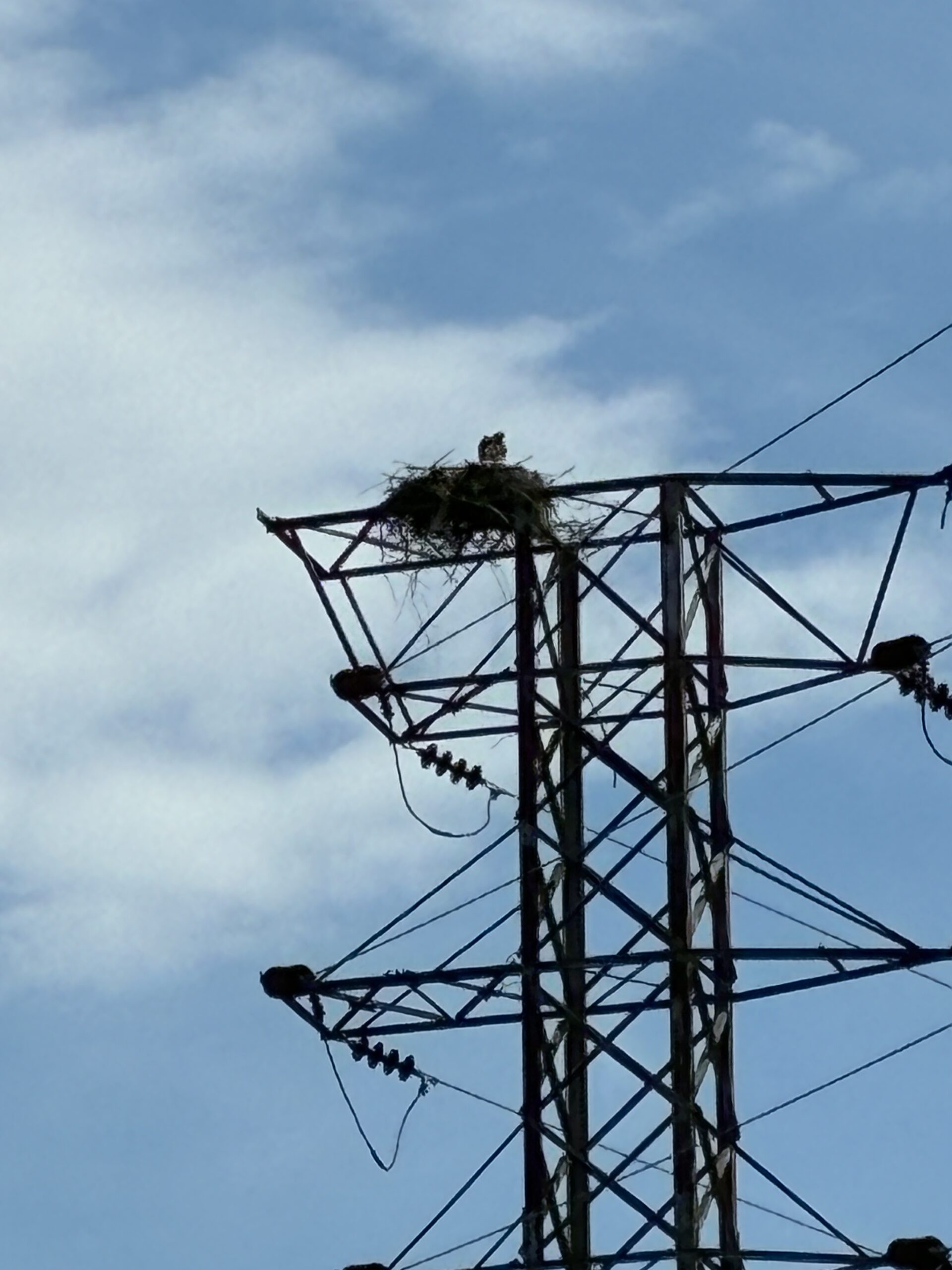
We think the baby ospreys have hatched! Can you tell in the photo? Photo by Endurance Laryea.
The cutest crows I have ever seen. Photo by Endurance Laryea.
Photo by Endurance Laryea.
(What was Dr. John Doing)
“Once you see it, you can’t leave it!”-Mike. Trust Mike to go into any corner to pick up trash so long as his eyes sights it!
Mike on trash pick-up duty in Sayreville. Photo by Endurance Laryea.
John and Mike inspecting foam that was suspected to be detergent used to wash off the boat docks at Sayreville. Photo by Endurance Laryea.
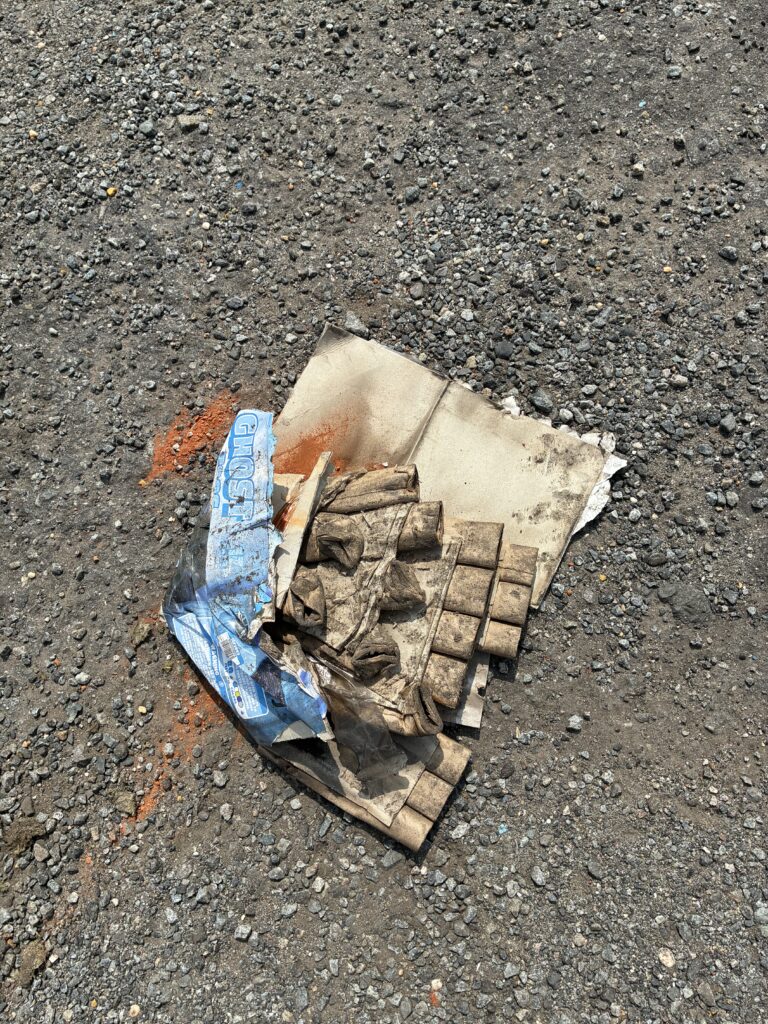
This was the second used firework packaging we came across today. I’m sensing a strong July 4th energy. Photo by Endurance Laryea.
Like a reward, after the mysterious events the preceded this morning, we were taken down a sweet memory lane at Waterfront Park, South Amboy by a man who recognized the LRWP team. During one of the monitoring sessions last year, his grandson had fun joining John into the river to collect a sample in his adorable waders. It was such a wholesome moment!
Photos by Endurance Laryea.
John, the video director, films as I go in to take measurements at South Amboy. Photo by Endurance Laryea.
Mike has a souvenir for John –the shell of a horseshoe crab.
Last site–Perth Amboy!
More films at Perth Amboy. Photo by Endurance Laryea.
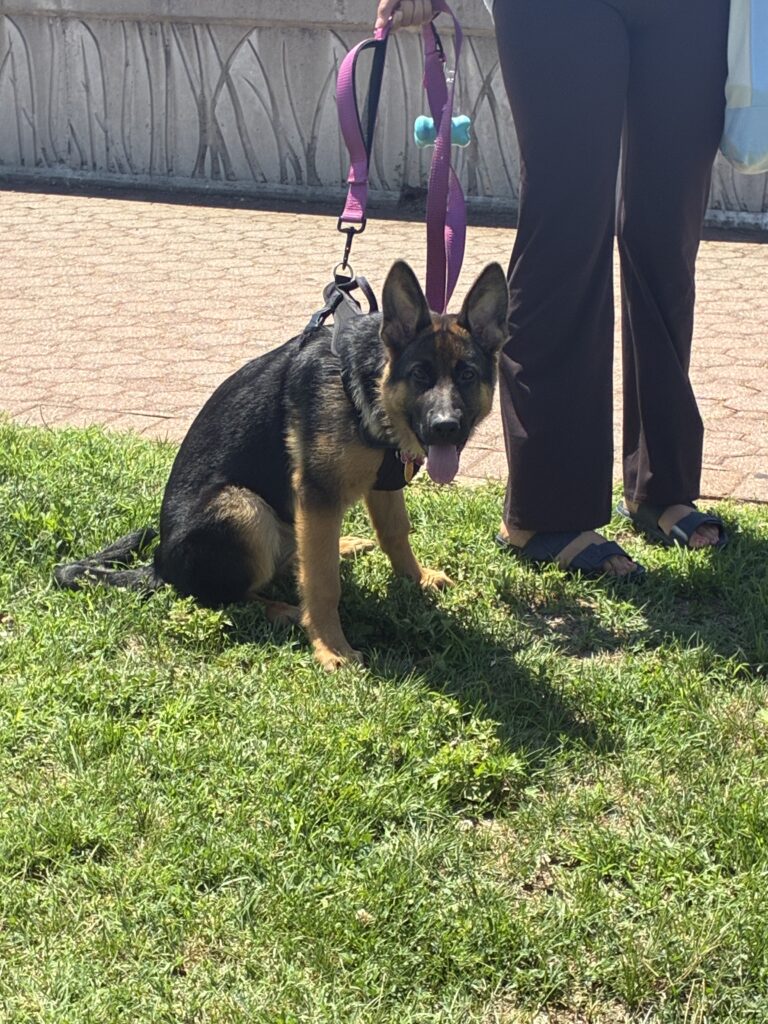
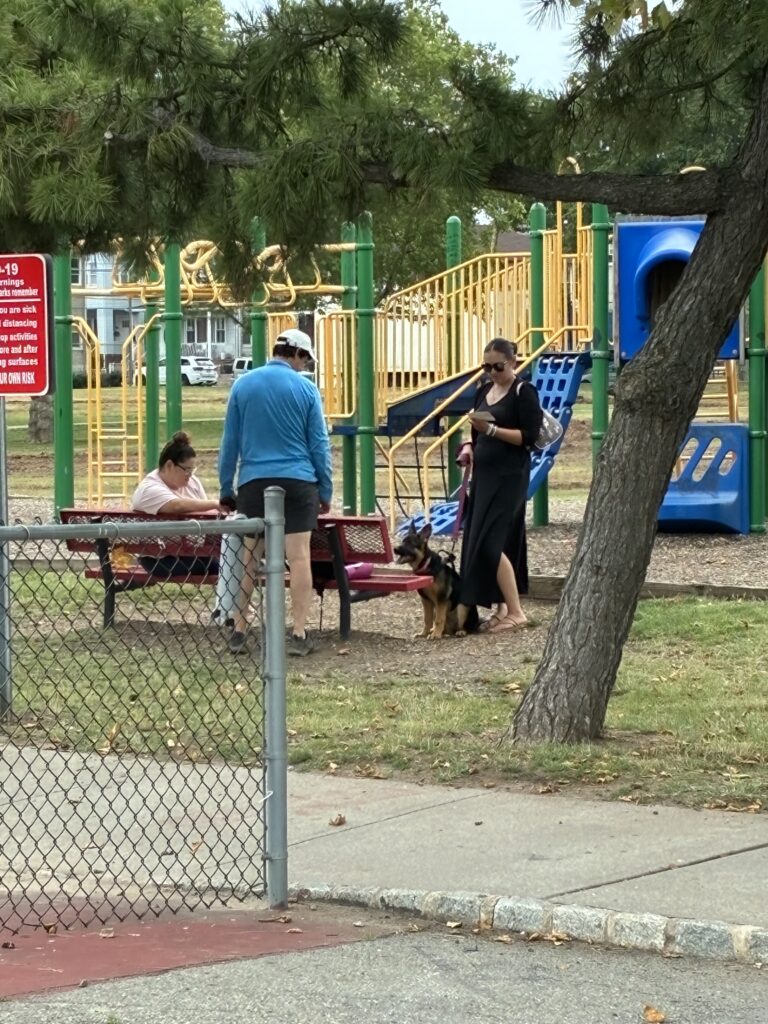
John shares LRWP postcards with locals. The dog seems to capture his attention. Photo by Endurance Laryea.
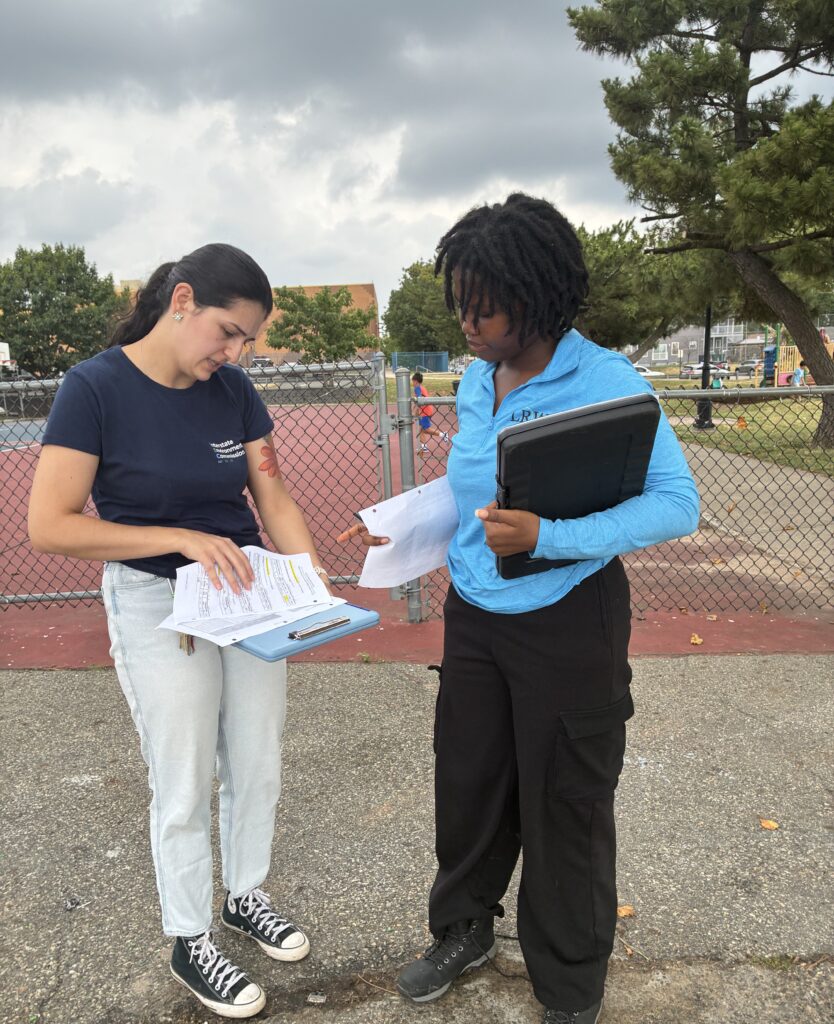
It’s a wrap at Perth Amboy minutes before the sky opens its flood gate. Alexa from the Interstate of Environmental Commission (IEC) comes to pick up our samples and provide us with more sampling bottles, calibrating buffers and gloves sufficient for the next couple of weeks.
Photos by Endurance Laryea.
An adventurous monitoring session as usual. Hope you can join us one of these days of monitoring. Stay dry and cool!
On a clear and sunny morning, the team set out today for the fourth monitoring session of the month. Most of the sites were serene with little activity. A beautiful reminder that rest is part of nature.
The team, today! Mike, Ashley, Paula, Endurance and Heather (taking the photo)- Photo by Heather Fenyk.
With beautiful smiles, Paula and Ashley pause quickly for a moment from calibrating the sonde to pose for a quick photo. Photo by Endurance Laryea.
Mike and Heather had an intriguing conversation about landscape development—discussing ways in which the environment around the river sites we visit can be improved to help water safety.
Launching the day’s sampling at our first site, Riverside Park, is Ashley taking the sample. Photo by Endurance Laryea.
Paula records the values of pH, salinity, chlorophyll RFU, oxygen saturation, temperature amongst others from the sonde. Photo by Endurance Laryea.
Heather on trash pickup duty at Riverside Park. Photo by Endurance Laryea.
We visited Lock 11 for the second time. It is amongst the four new sites we are investigating this summer, and it passed the EPA safety level for enterococcus CFU on our last visit, and it passed again this time with a value of 80 CFU, below the safety level of 105 CFU.
Heather, Ashley, and Paula take measurements from the canal at Lock 11 while Mike completes the visual assessment form. Photo by Endurance Laryea.
Photo by Paula Rubio.
Of all the sites, New Brunswick was our busiest site today.
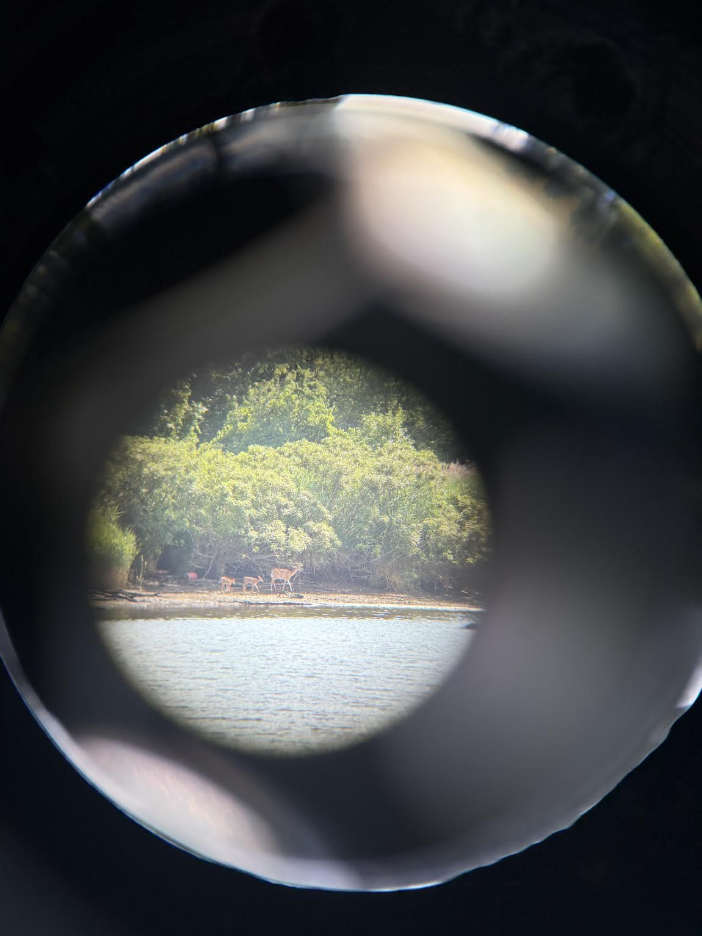
At Rutgers Boat House, two fawns and a doe were spotted on the other side. We thought they were the cutest things we saw today! Photo taken by Ashley Fritz.
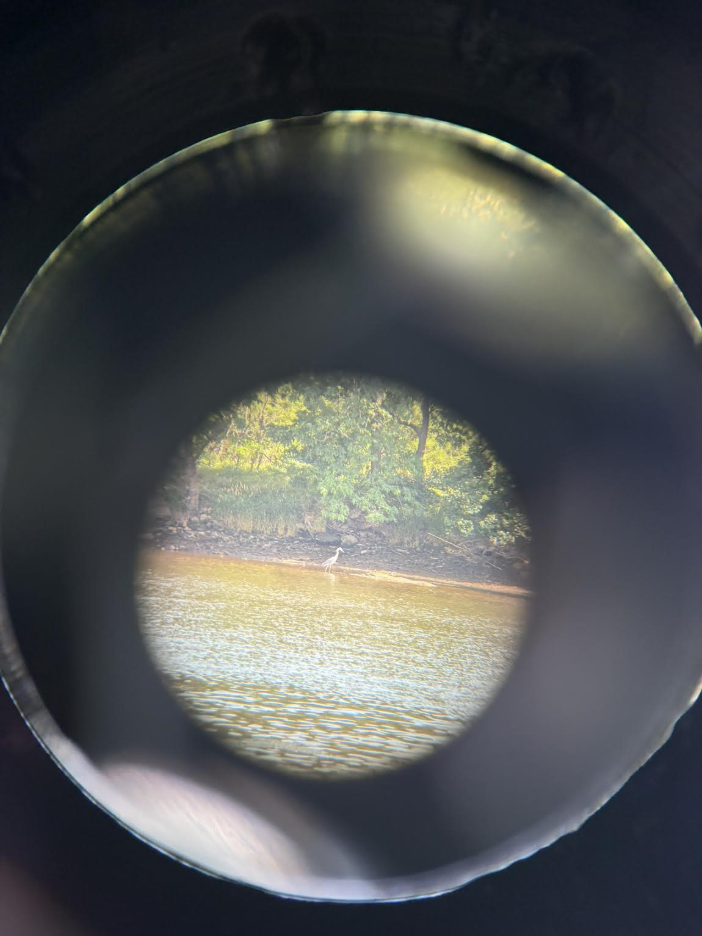
That’s Asley’s favorite bird, the Great Blue Heron! Photo by Ashley Fritz.
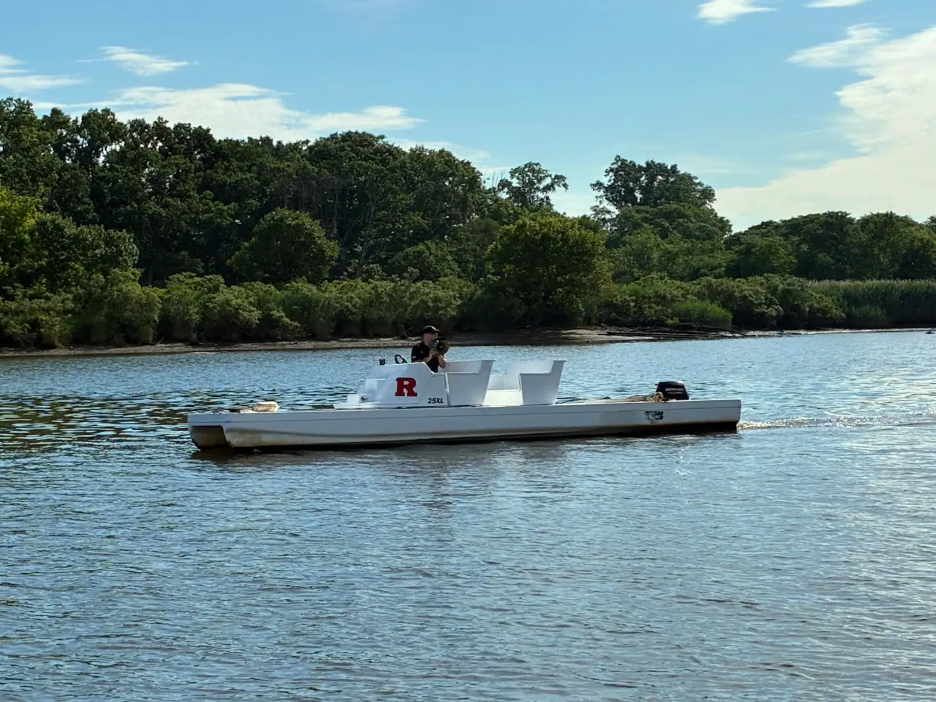
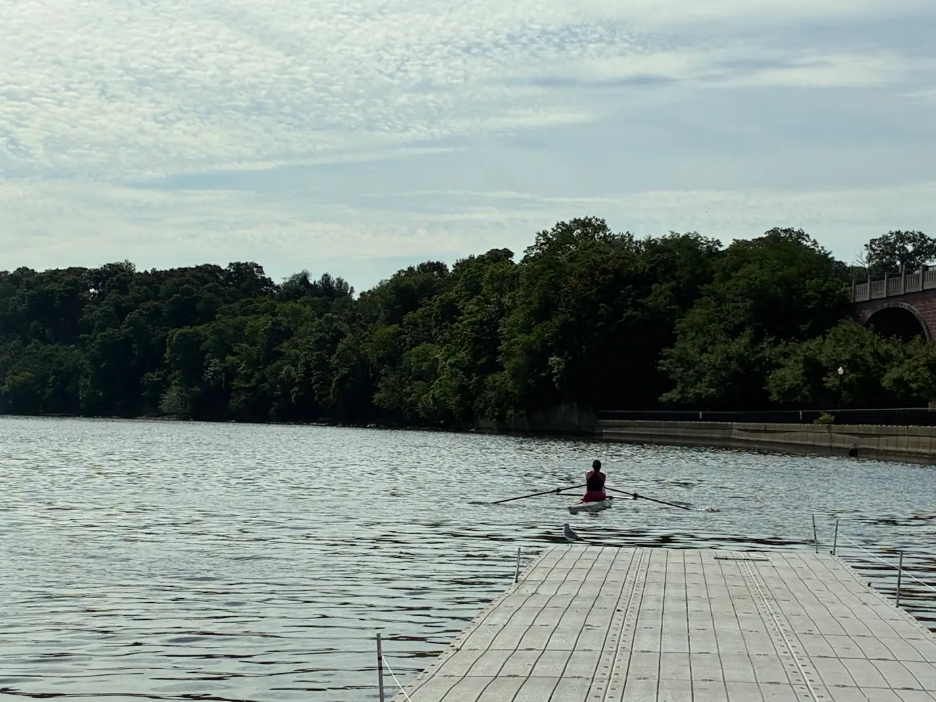
Today is not the first time seeing this Rutgers rower and her coach. But today, the team had the opportunity to explain what the Lower Raritan Watershed Partnership and its team does.
Photo by Ashley Fritz.
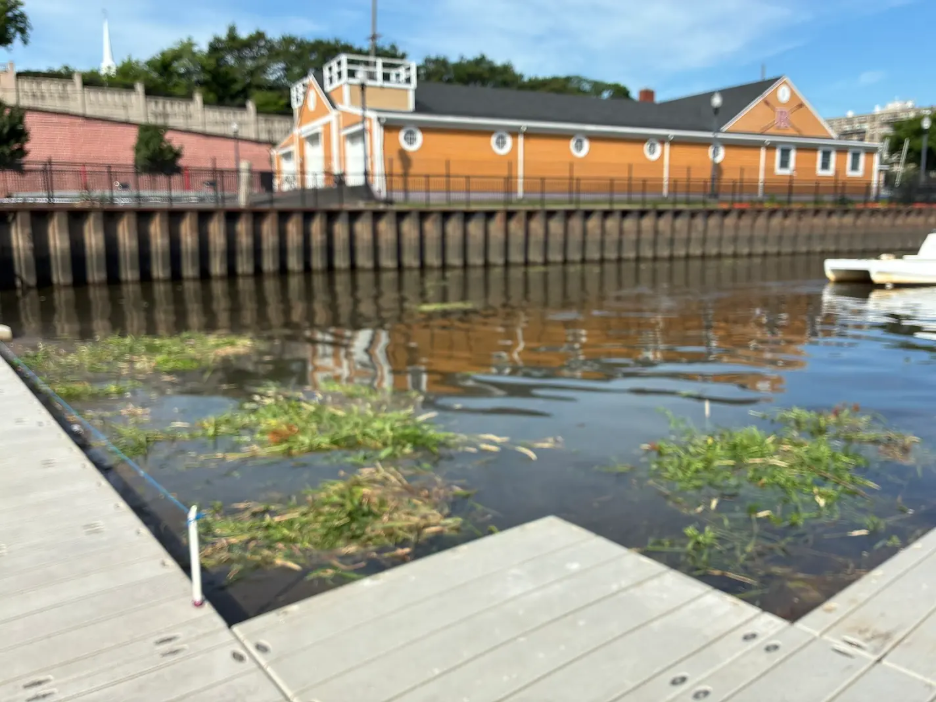
Grass being cut from the vegetation near the boat house floating near the dock. Photo by Endurance Laryea.
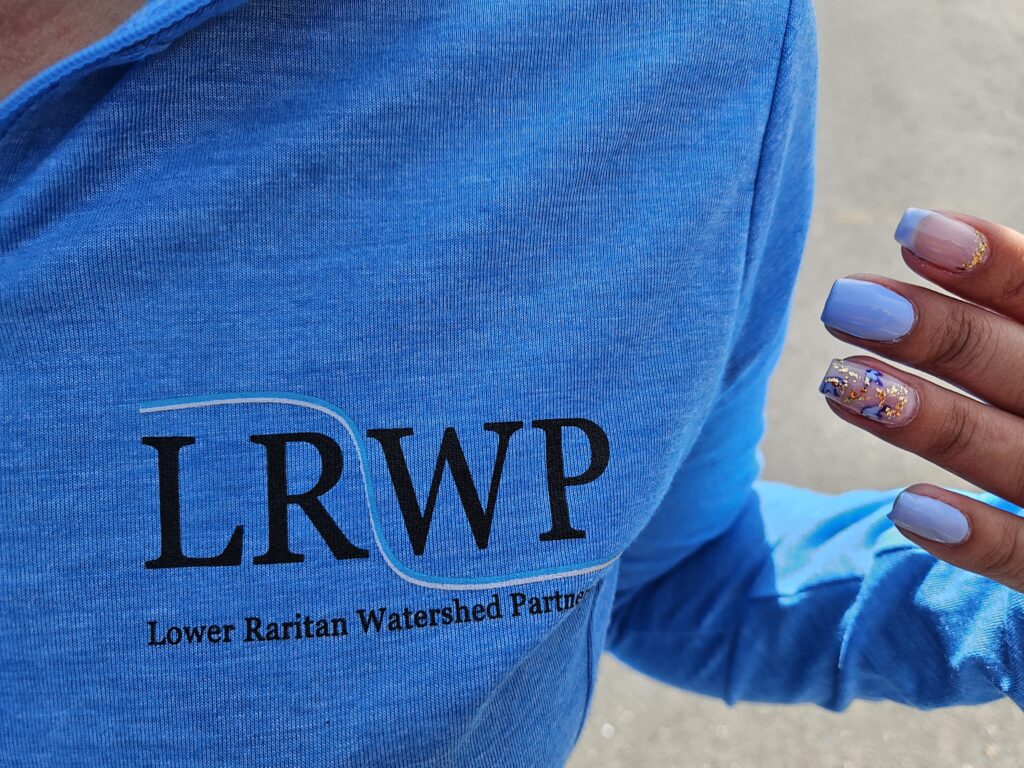
Heather was so excited about Paula’s nails matching LRWP’s colors that she had to take a picture! Photo by Heather Fenyk.
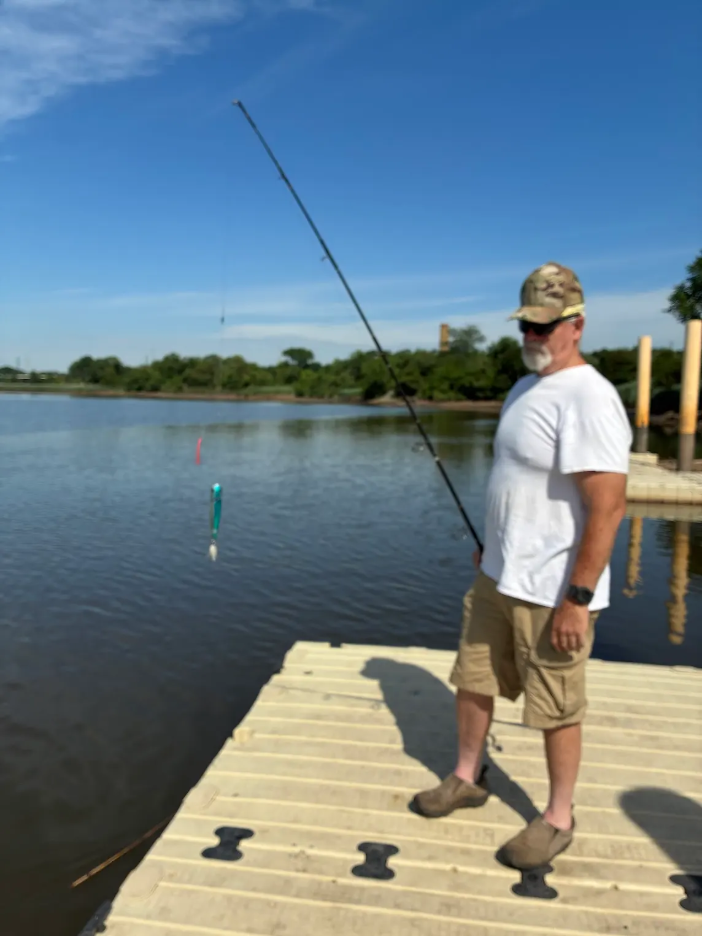
Not much was happening at Edison Boat Launch today, but we did speak to this nice fisherman with his line and hook and bait. He had not caught any fish at the time of our conversation and reasoned that it may be due to low tides. He was the only one at the boat launch by the time we were done and leaving. Photo by Endurance Laryea.
Ashley and Paula recording values at Sayreville. Photo by Endurance Laryea.
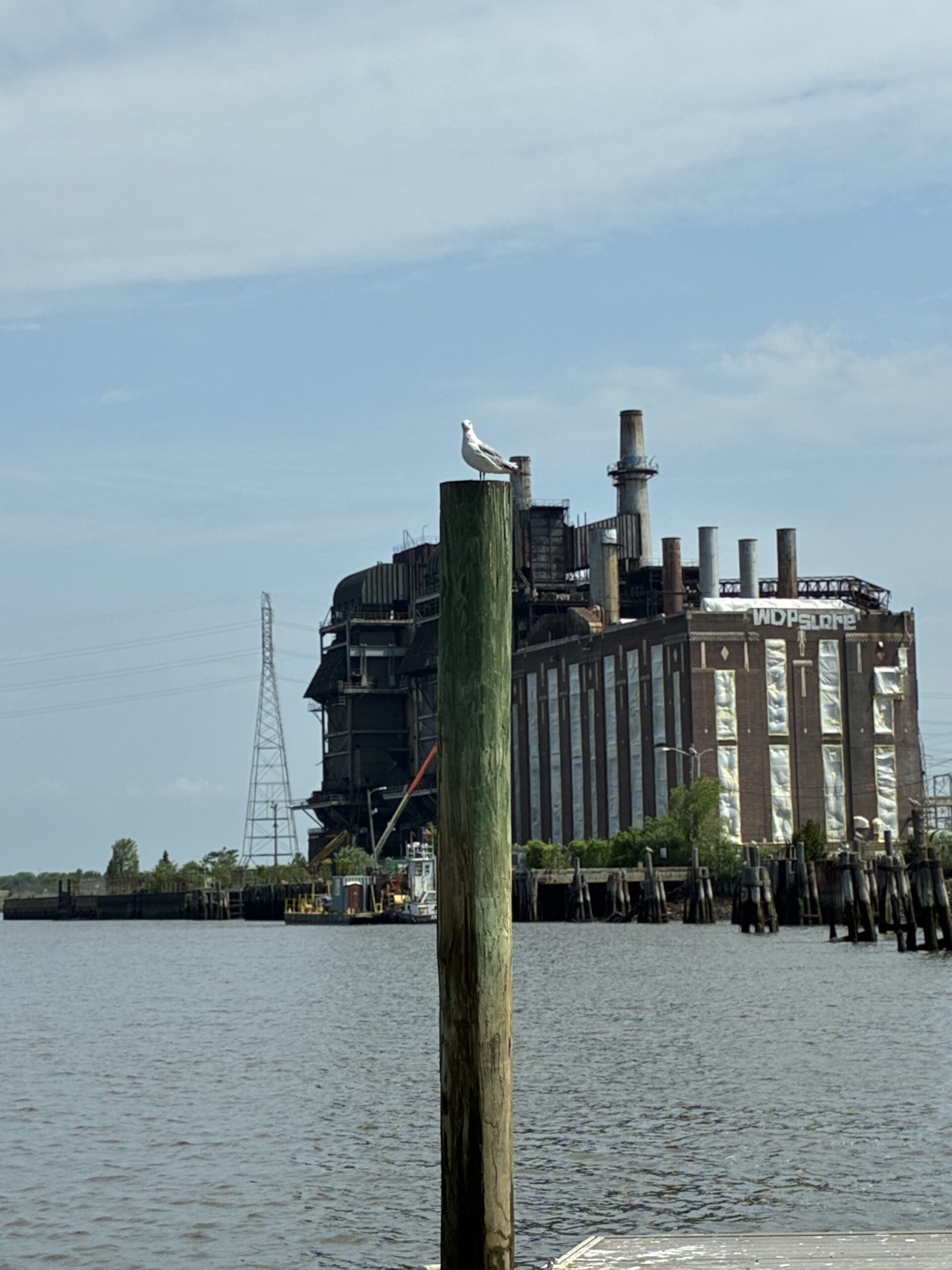
Taken aback by the presence of the seagull on the pole, after he has stood by the pole for a while without noticing it, Mike expresses his surprise to the seagull as though it can understand him. A funny encounter that I had to capture. Photo by Endurance Laryea.
A family spotted picnicking at Waterfront Park, South Amboy. Photo by Heather Fenyk.
Paula on sampling duty at South Amboy. Photo by Endurance.
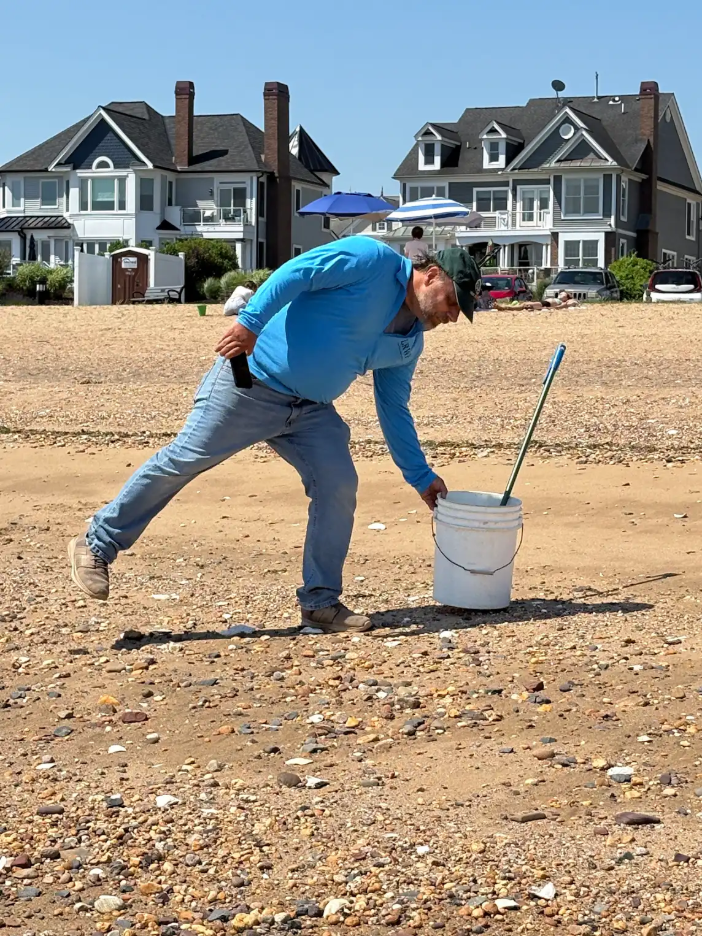
Mikeon trash pickup duty. Photo by Endurance Laryea.
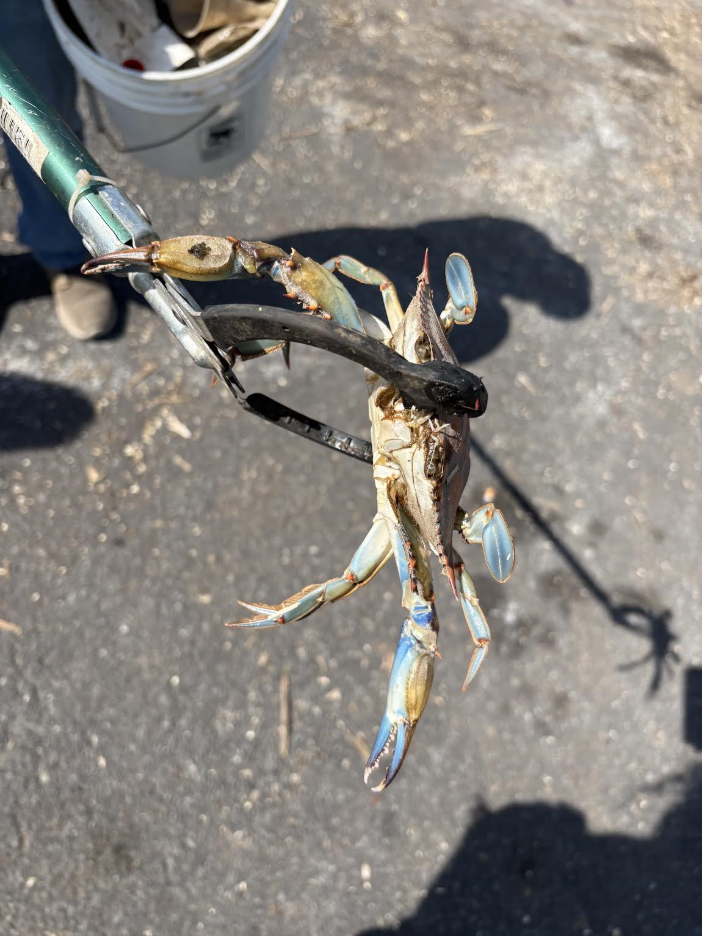
A dead blue crab on the shore at Waterfront Park, South Amboy.
Our monitoring session was wrapped up at 2nd Street Park, Perth Amboy. The last sample bottle of the day was added to the cooler. We proceeded with the post-sampling calibration of the sonde as we waited for Alexa, a representative from the Interstate Environmental Commission (IEC), to pick up our samples and send them to the lab for testing.
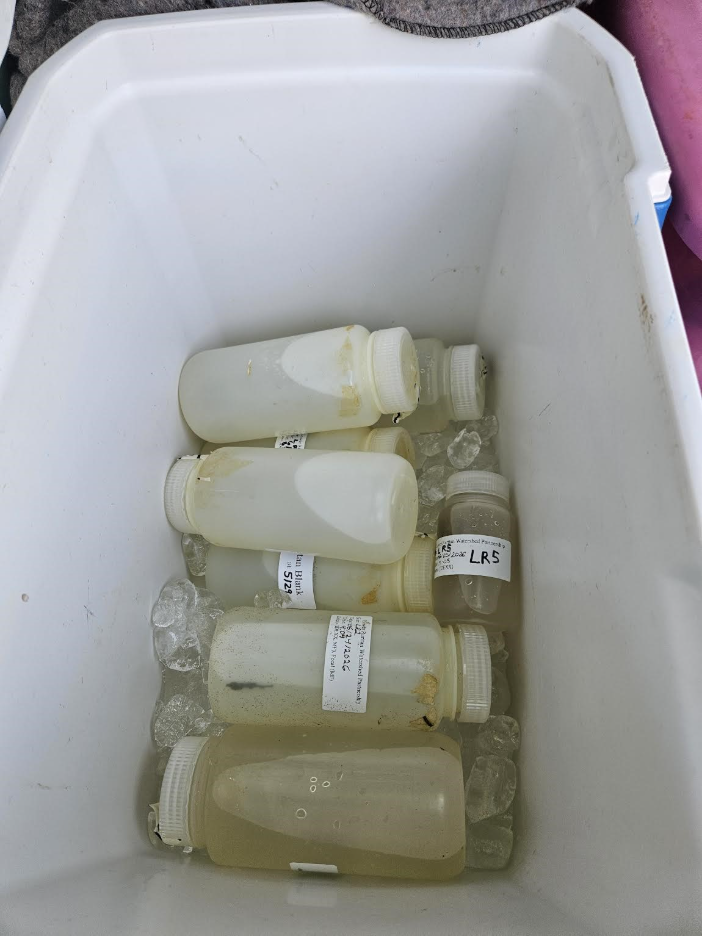
Samples from all seven sites visited today and a blank sample. The blank sample is a sample of pure water which is placed together with the samples in the cooler and used as a reference for comparison during testing—it serves as a control. Photo by Heather Fenyk.
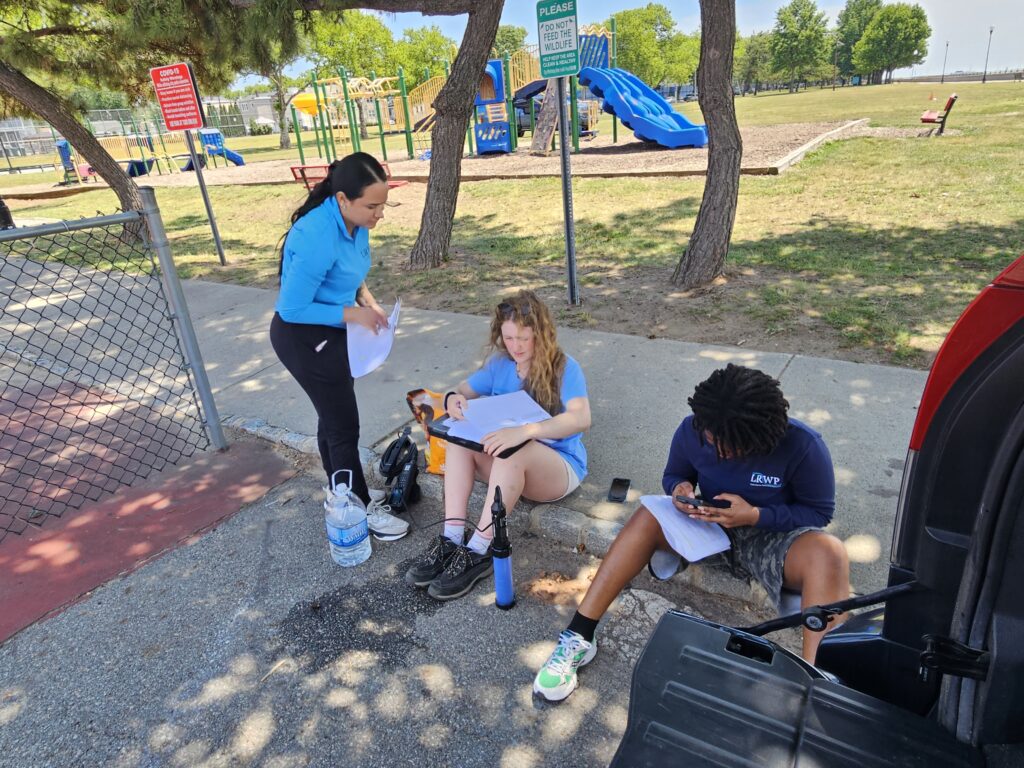
Paula, Ashley, and Endurance handling post-sampling calibration and visual habit evaluation. Photo by Heather Fenyk.
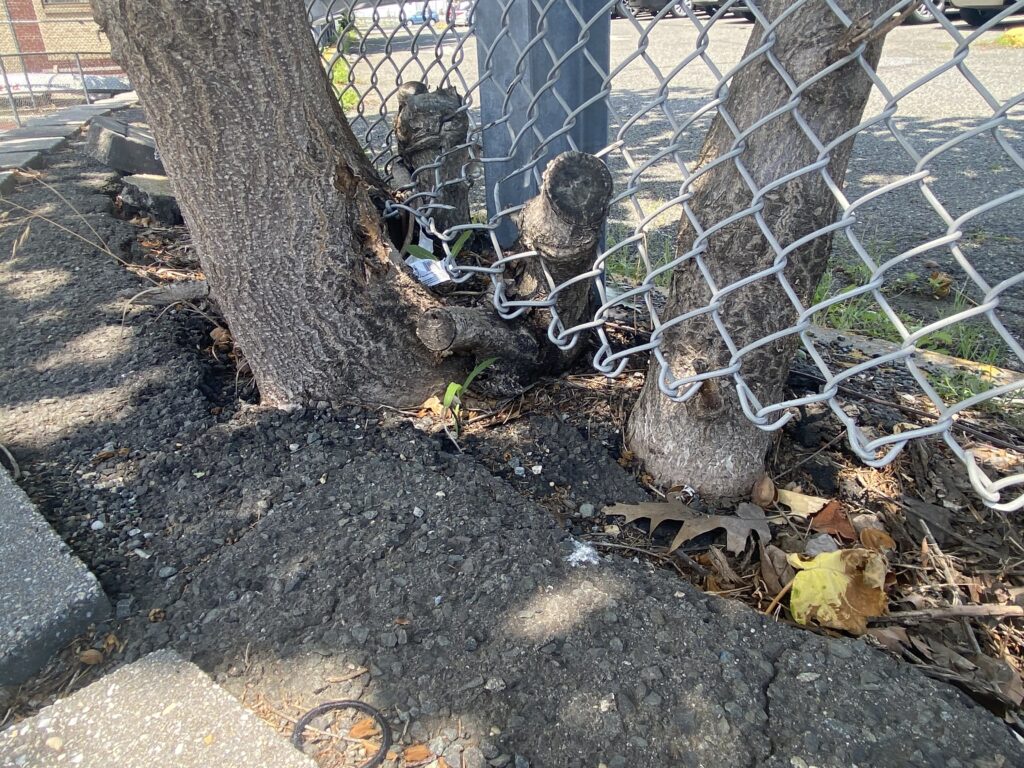
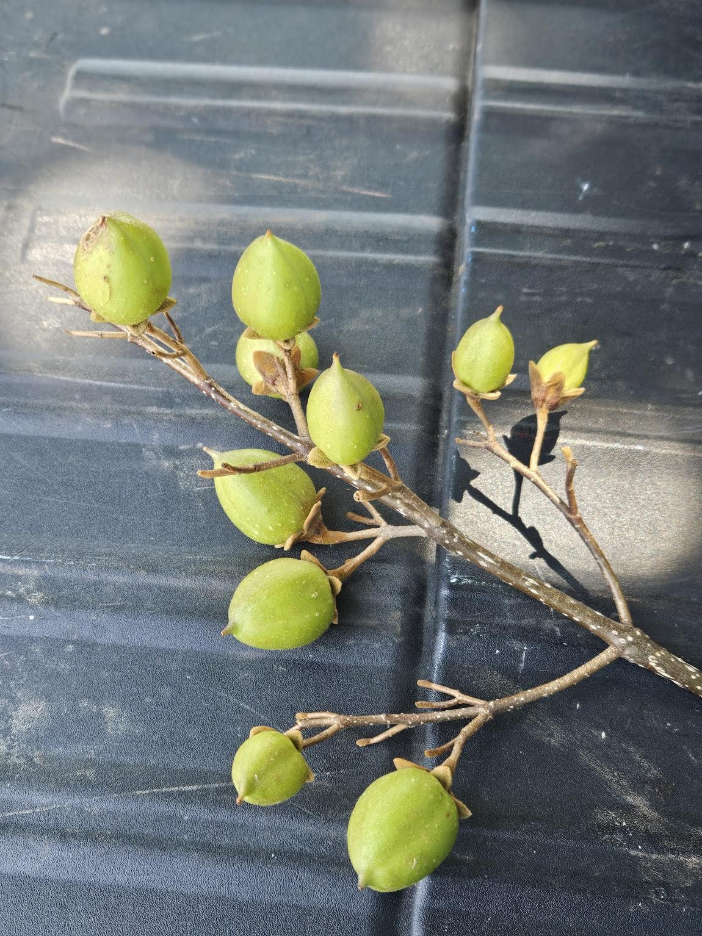
We ended the session today with a lesson on resilience from this tree. The tree grows through the chain link fence of a parking lot in the elementary school at Perth Amboy. Regardless of its compromising habitat, the tree is keeps thriving and bearing fruits!
By Endurance Laryea, LRWP Summer Research Intern and J.M. Meyer.
The second pathogen monitoring session of the month took place on Thursday, June 17th. Each week during the summer, from May to October, the Lower Raritan Watershed Partnership and Rutgers Cooperative Extension of Middlesex County run a volunteer-based monitoring program along the Raritan River. We collect water quality samples at six non-bathing public access beach sites, provide our samples to the Interstate Environmental Commission for analysis in their laboratory, and report the results to the public. Our mission is to share this data with the community and partners to ensure the safe use of the Raritan River for all.
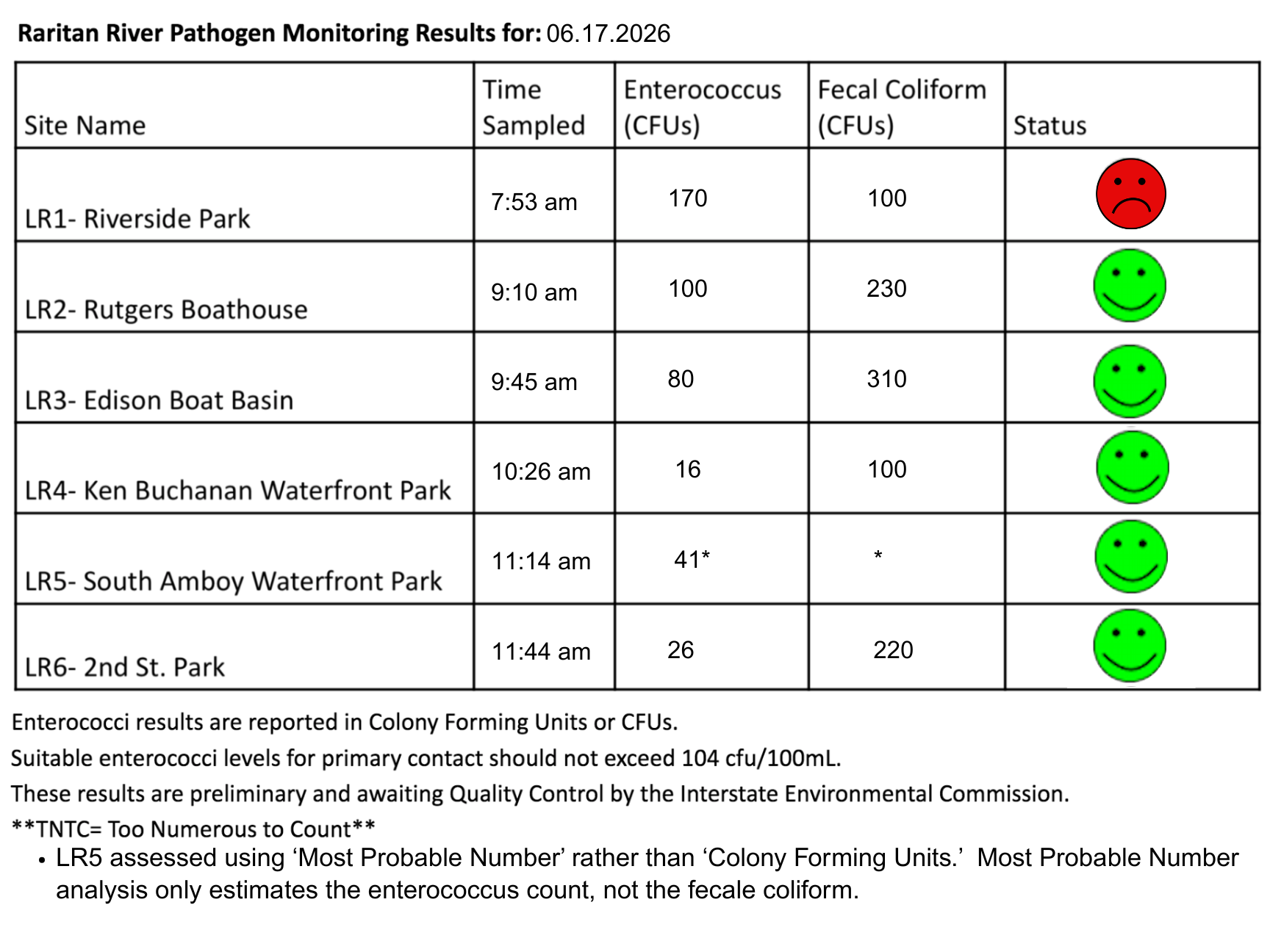
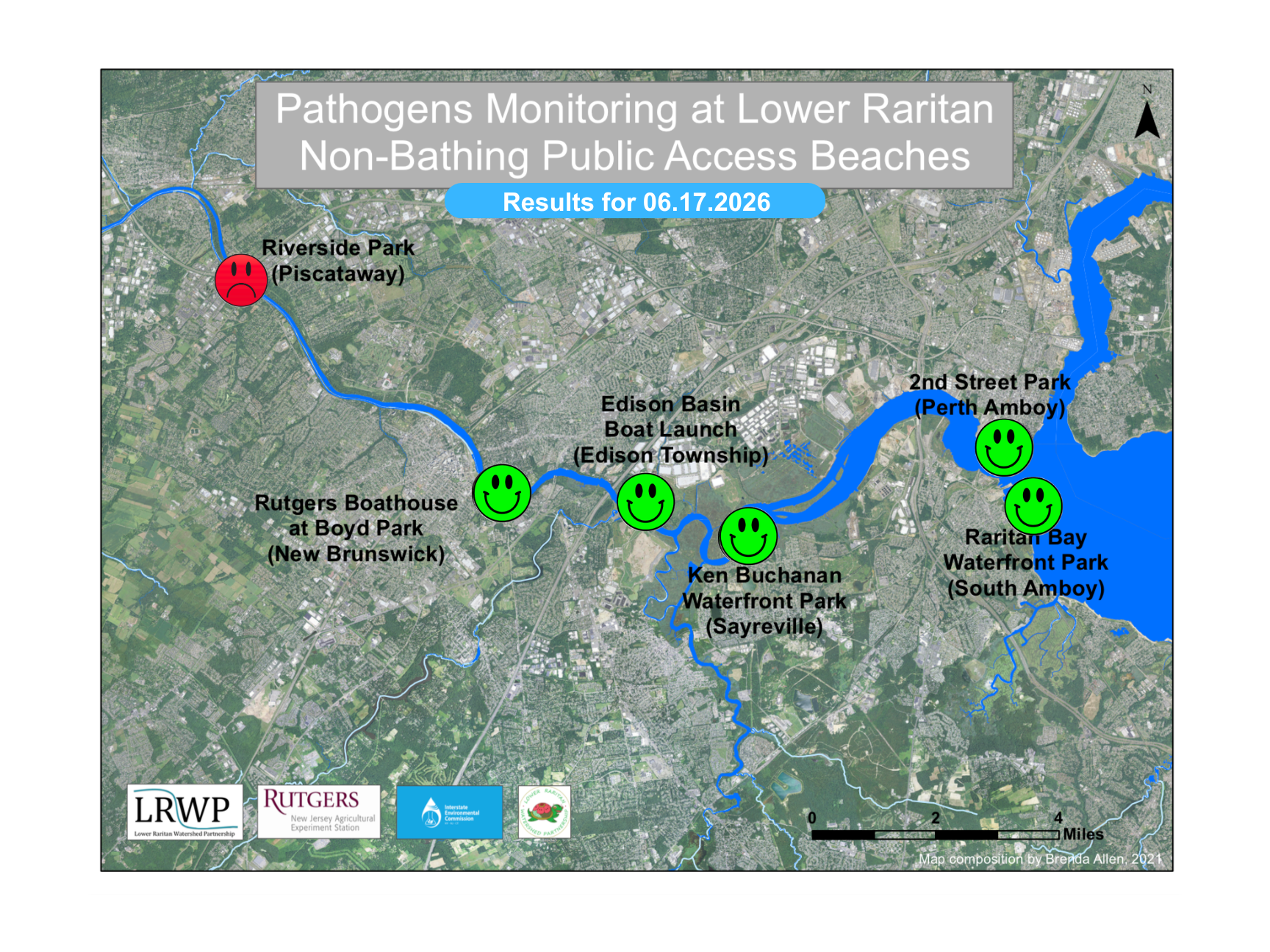
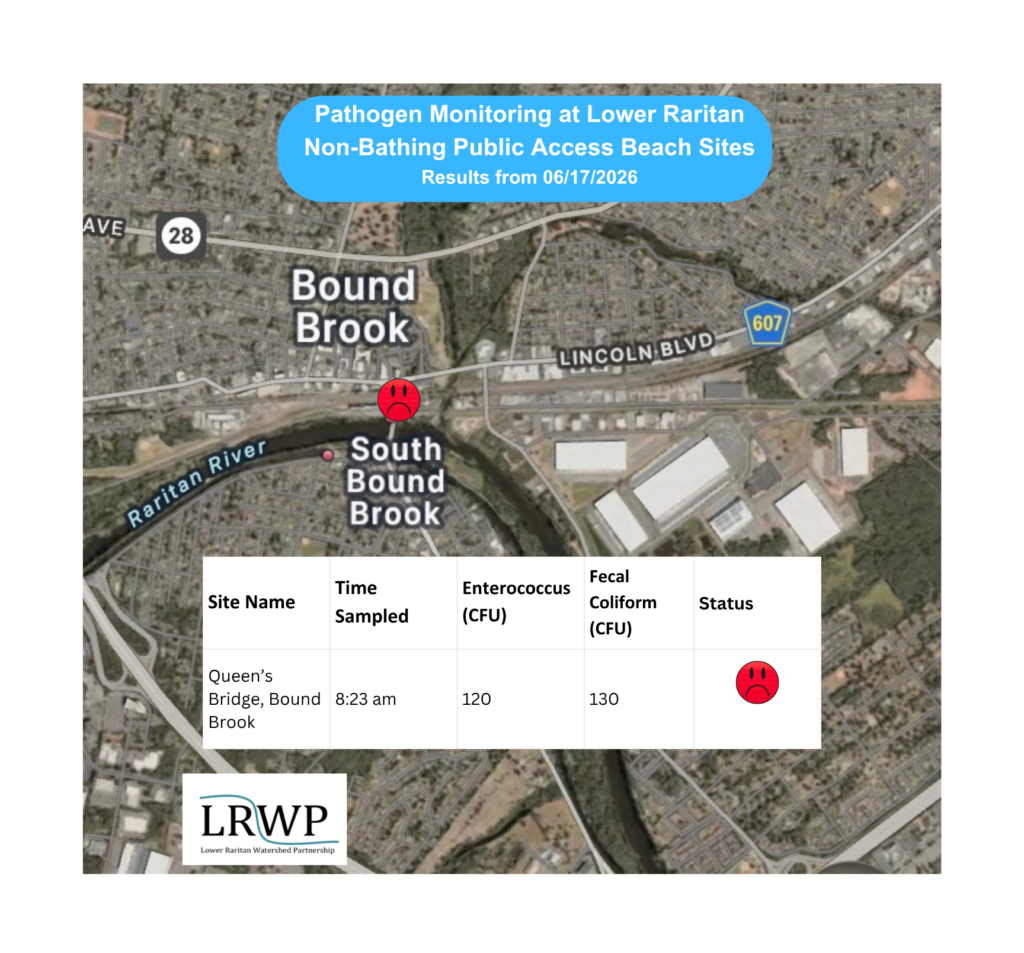
Our lab results for water quality samples taken on Thursday, June 17th, 2026, show Enterococcus bacteria levels exceeding the EPA federal water quality standard of 104 cfu/100mL at one of our monitoring sites this week. The problem site is indicated by the red frown on the map and chart: Riverside Park (Piscataway). Green smiles on the chart and map indicate the sites with bacteria levels safe for recreation and include the following: Rutgers Boathouse (New Brunswick), Edison Boat Basin (Edison), Ken Buchanan Waterfront Park (Sayreville)2nd Street Park (Perth Amboy).
Pathogens/Enterococci levels are used as indicators of the possible presence of disease-causing bacteria in recreational waters. Such pathogens may pose health risks to people coming in primary contact with the water (touching) through recreational activities like fishing, kayaking or swimming in a water body. Possible sources of bacteria include Combined Sewer Overflows (CSOs), improperly functioning wastewater treatment plants, stormwater runoff, leaking septic systems, animal carcasses, pet waste, wildlife waste, and runoff from manure storage areas.
In order to better understand why Riverside Park, Piscataway has been our worst performing site over the past six years, we have started sampling further upstream. On June 17th, we sampled The Queens Bridge Recreational Access/Kayak Launch site a second time since we started pathogens monitoring this season. The lab analysis produced 120 enterococci cfu per 100mL exceeding the EPA federal water quality standard of 104 cfu/100mL. It also failed the test during our first week of monitoring; it was an especially rainy week, and our sample scored a most-probable-number of 2909 entero per 100 mL! Gross! Yet that same rainy week Riverside Park registered a score of more than 6,000 colony forming units per 100 mL.
Perhaps in dry weather we might suggest that upstream flow accounts for most of the bacteria numbers in Riverside Park, but that in wet weather there are many other sources of pollutants. These are interesting if preliminary results.
Our goal in reporting these results is to give residents a better understanding of the potential health risks related to primary contact during water-based recreation. If you are planning on recreating on the Raritan this weekend, make sure to stay safe and wash up after any activities!
This morning’s weather was just perfect for all the exciting adventures we were going to embark on. It was a clear and sunny morning with temperatures in the 70’s.
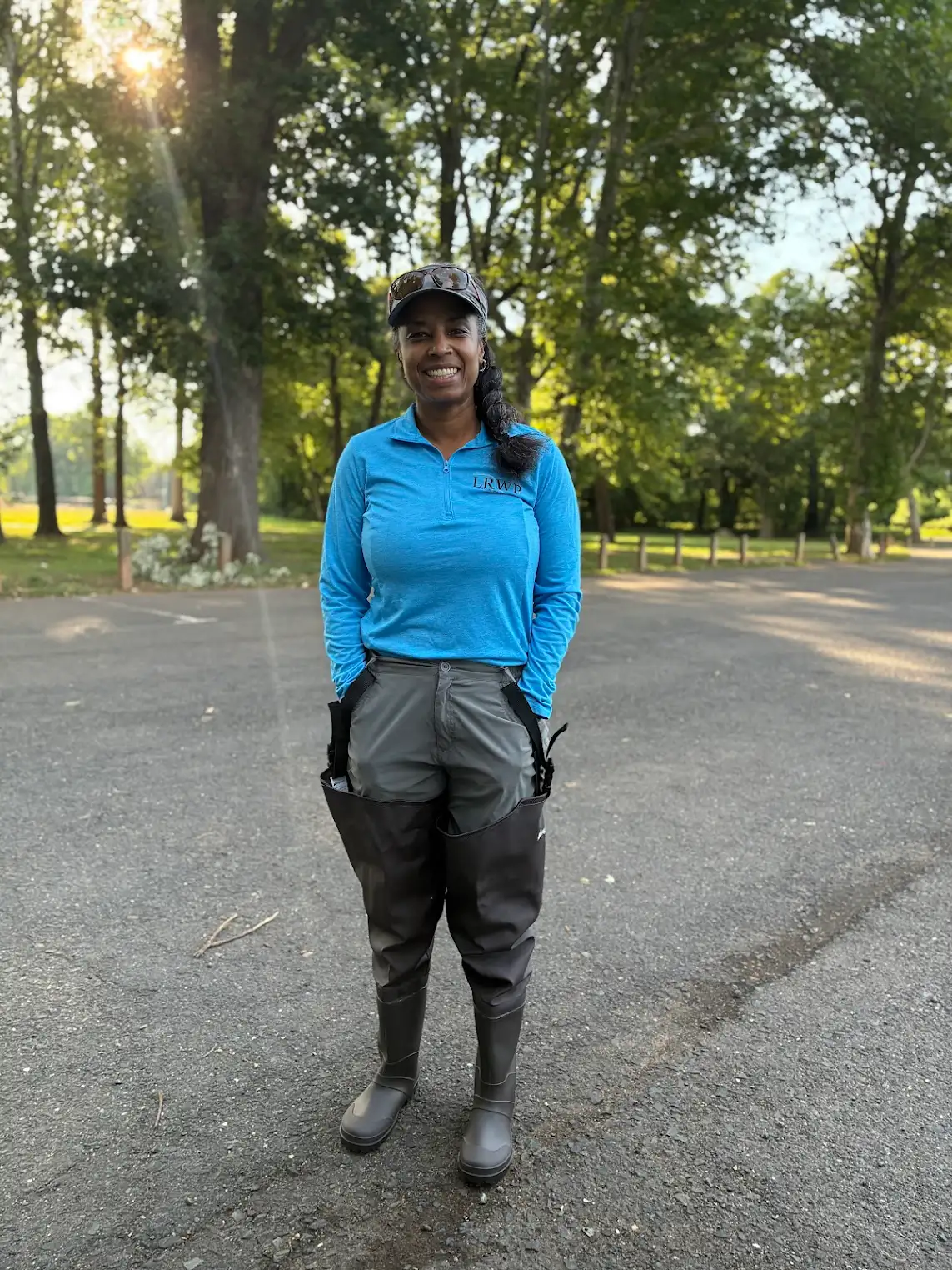
Ready to kick off June 17th’s pathogens monitoring session, Lydia came prepared and excited in her hip waders! Photo by Endurance Laryea.
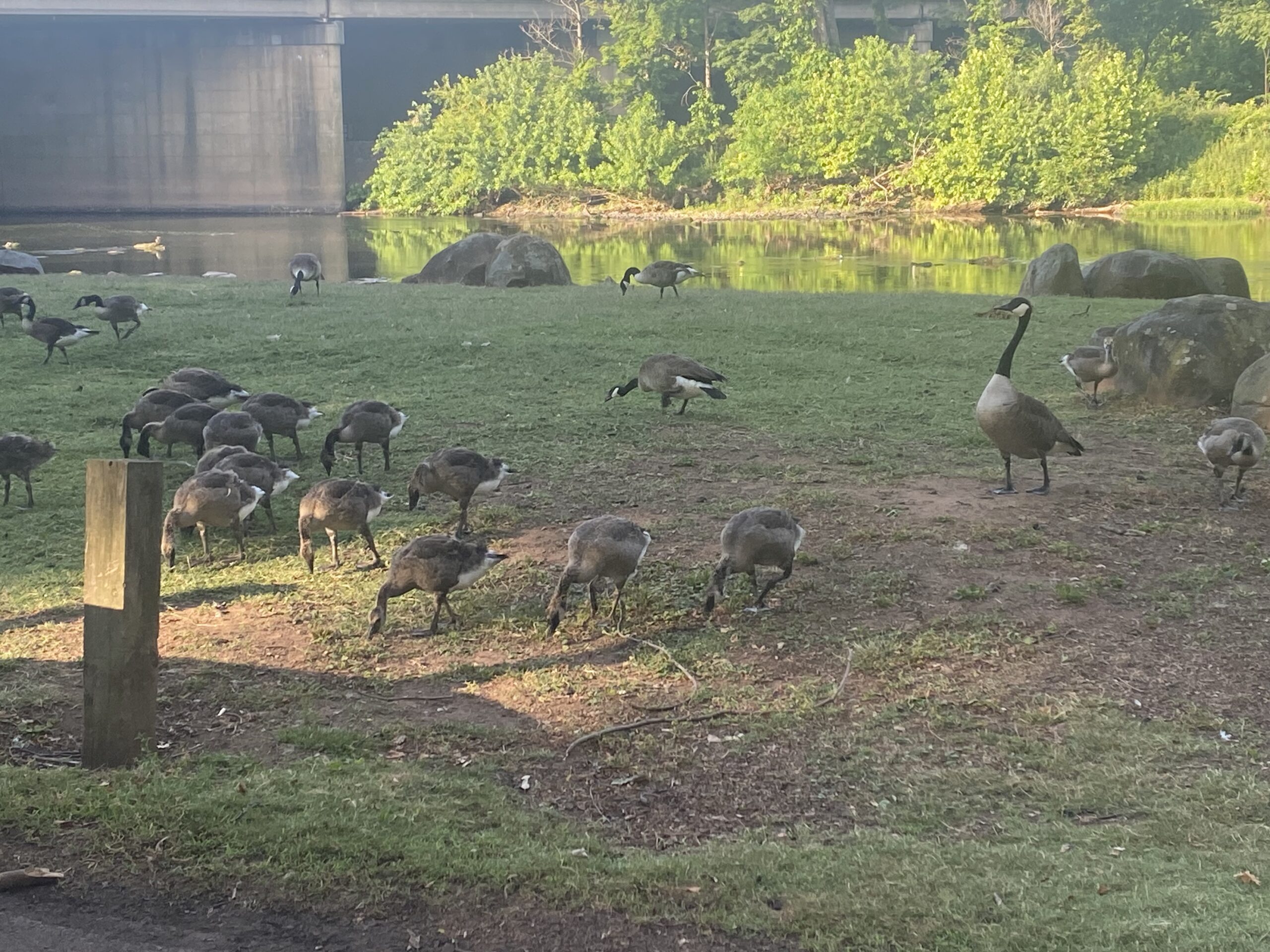
Our friends at Riverside Park were seen going about their day peacefully. Can you guess why? No Geese chasers to rattle their morning! I am not sure if the Geese Chasers ever came today but for the entire duration of our pathogens monitoring at this site, we did not see the geese and goslings fleeing into the river at the sight of a Geese Chaser car. We were surprised to see how big the goslings have become since we last saw them. Almost the same size as their parents-incredible! Photo by Mike Orsini.
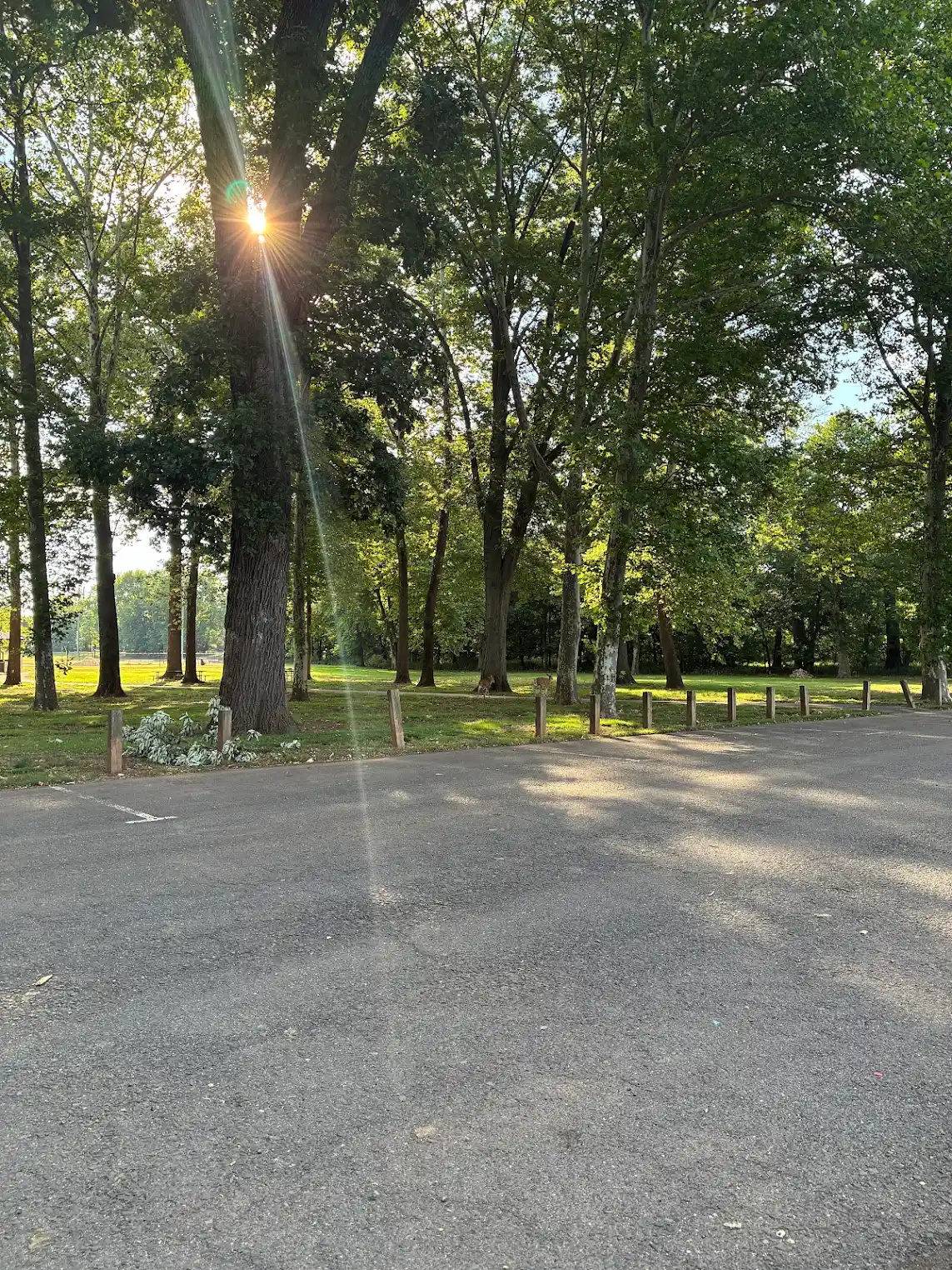
Four deer spotted dashing across the park at Riverside Park. Photo by Endurance Laryea.
Lydia taking a sample at Riverside Park. Photo by Endurance Laryea.
Our second site today was The Queens Bridge Recreational Access/Kayak Launch site. It is one of our four new sites this season and today was the second visit. So much was going in this one site that we would have spent the whole morning exploring it if care was not taken! John and Mike talked about the trees; Lydia, some other plants like lady’s thumb and poison ivy; and Art about the birds. Their enthusiasm for what they knew was so contagious that it made me excited even if I did not know what they were talking about.
Mike and John sampling duties at Queens Bridge. Photo by Endurance Laryea.
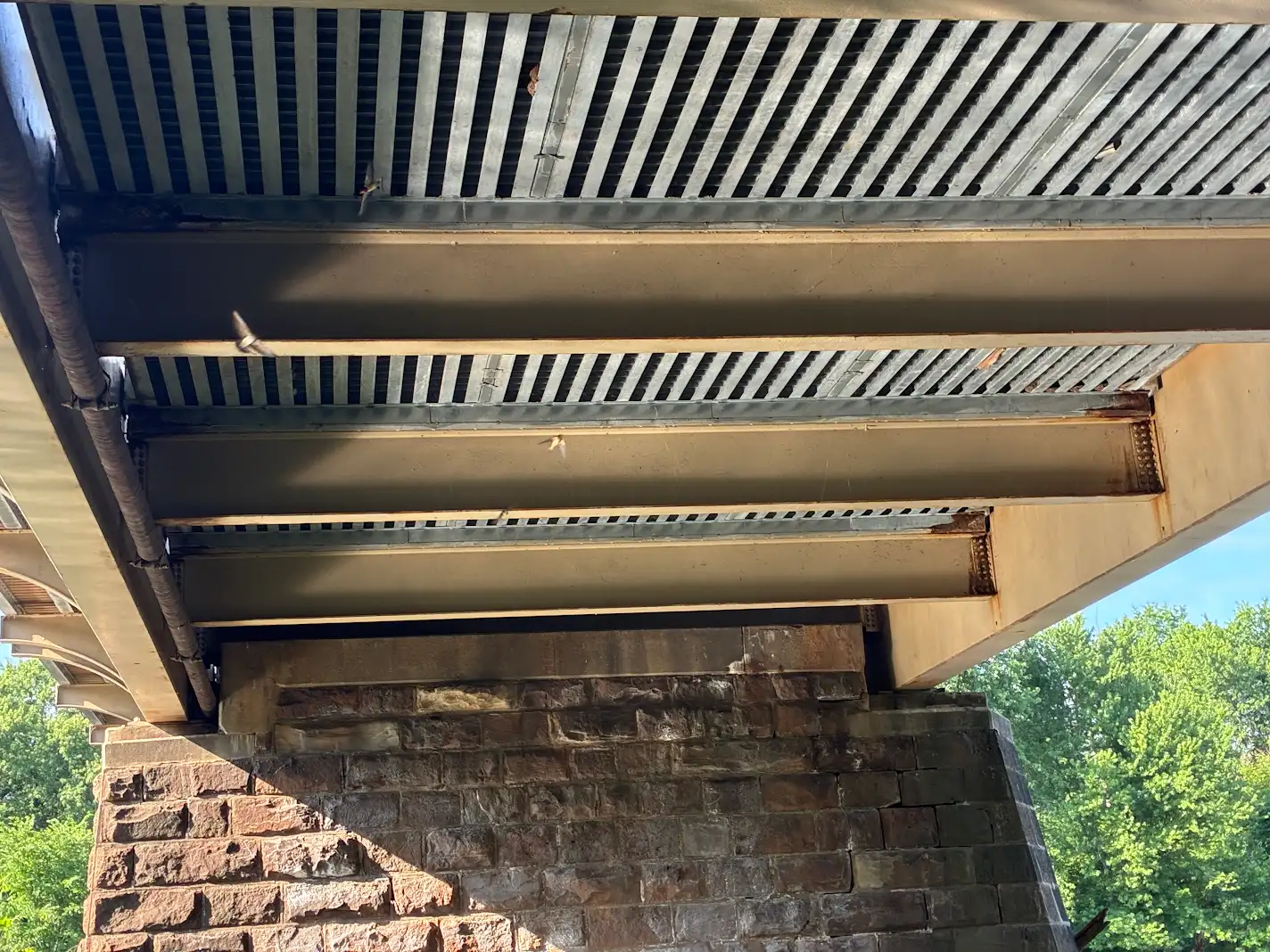
Barn swallows spotted under the bridge at Queens Bridge. Art explained that they got their names because of their habit of building nests in barns, sheds and similar man-made structures. John noted that they were not present the last time they visited this site in the first week of pathogens monitoring. Photo by Endurance Laryea.
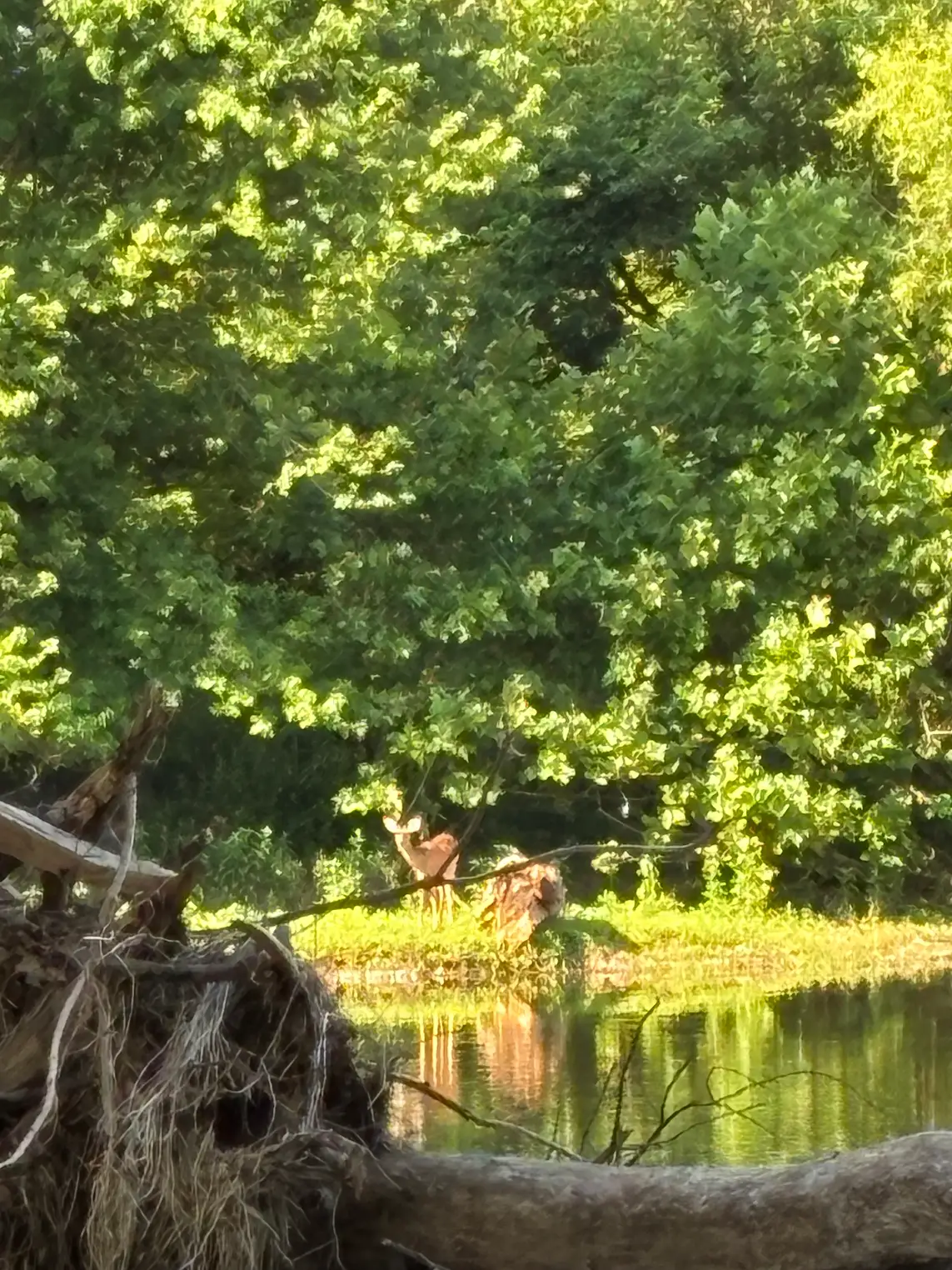
A deer sighted across the river from us. Photo by Endurance Laryea.
We also saw a flotilla of goslings paddling across the river without a parent goose. Photo by Endurance Laryea
At Rutgers Boathouse today, we noticed high tide. And for the second time, we saw the minnows. It seems to me that they are observed when there is high tide because we did not see them last week when there was low tide.
In our grand effort to capture them in a bucket so that we get a better view of them, we only caught one-barely noticeable- out of the thousands we saw. They are incredibly sensitive to disturbances. Photo by Endurance Laryea.
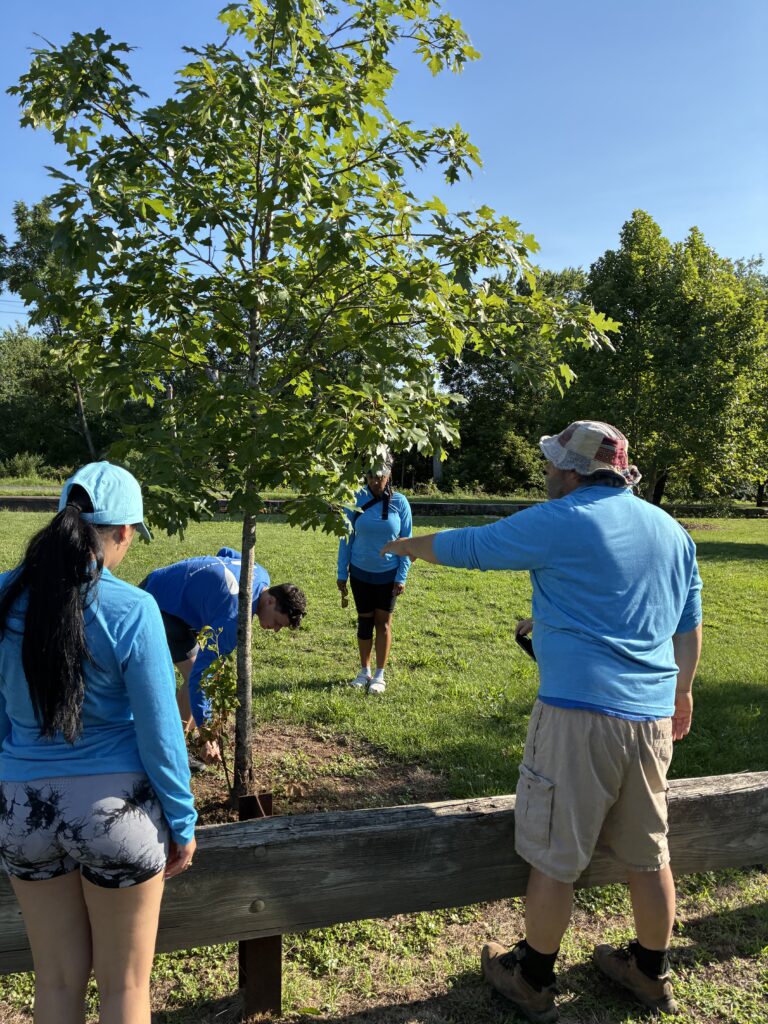
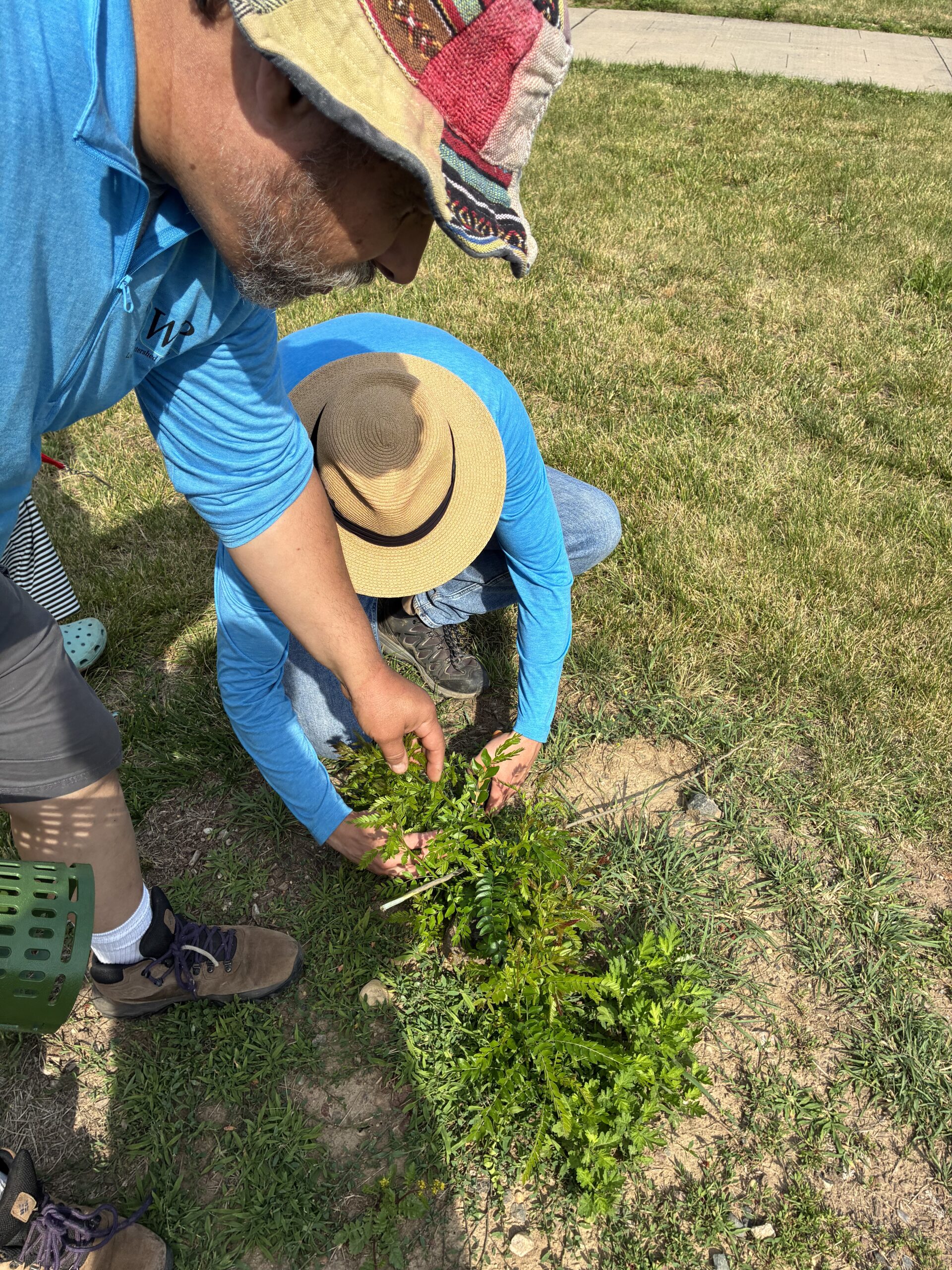
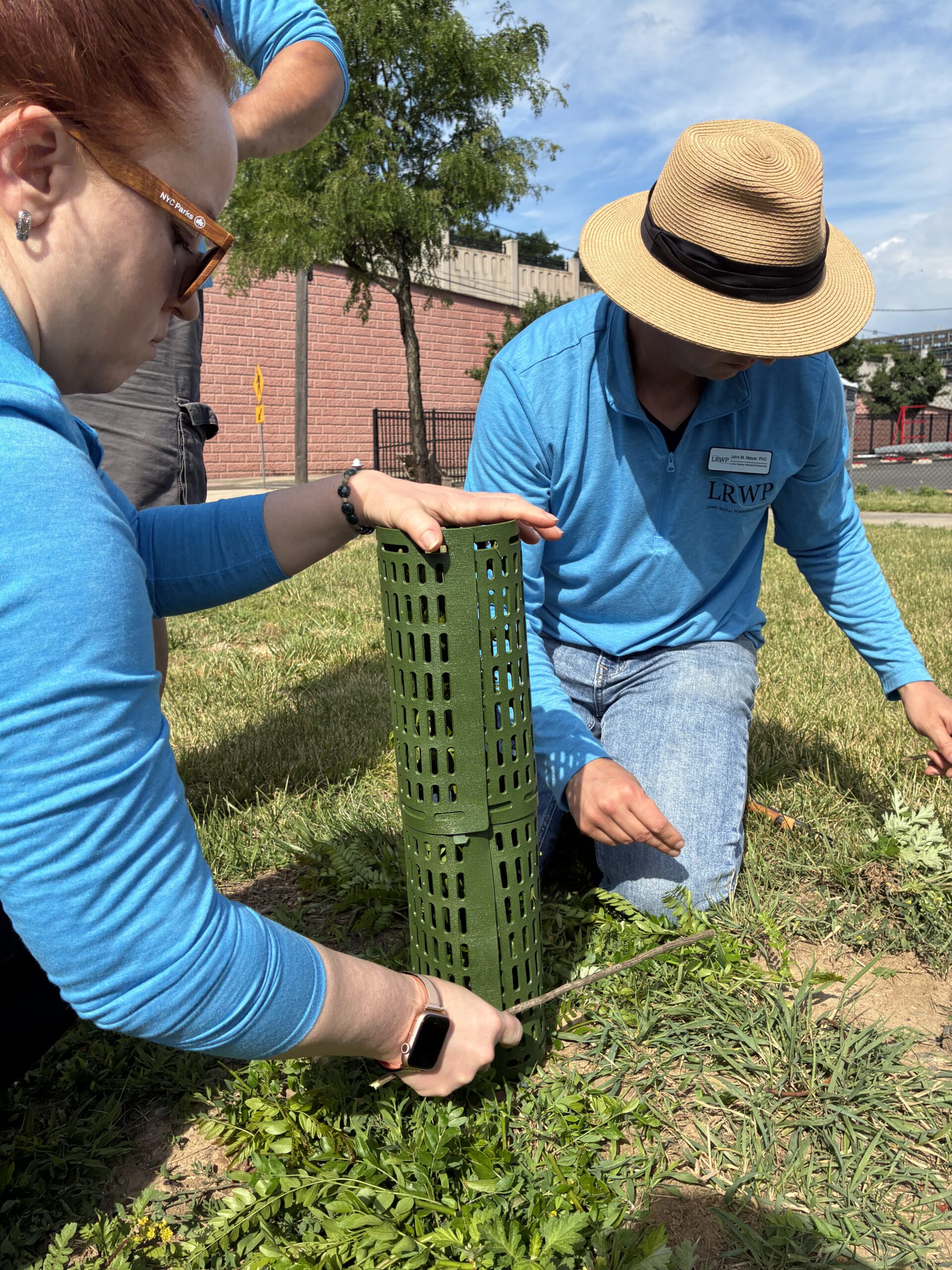
There are a few honey locust stumps that have started to grow little sprouts at the New Brunswick site. John and Mike have chosen one to put a guard around and see how it fares for the week. The smaller branches were pruned, and the guard was put around the tallest branch to enable it grow as a ‘leader’ without significant competition from rival sprouts.
Mike and John pruning the little branches of the honey locust stump. Photo by Endurance Laryea.
Olesya and John stabilizing the guard with twigs. Photo by Endurance Laryea.
Clean up at Edison Boat Launch today!
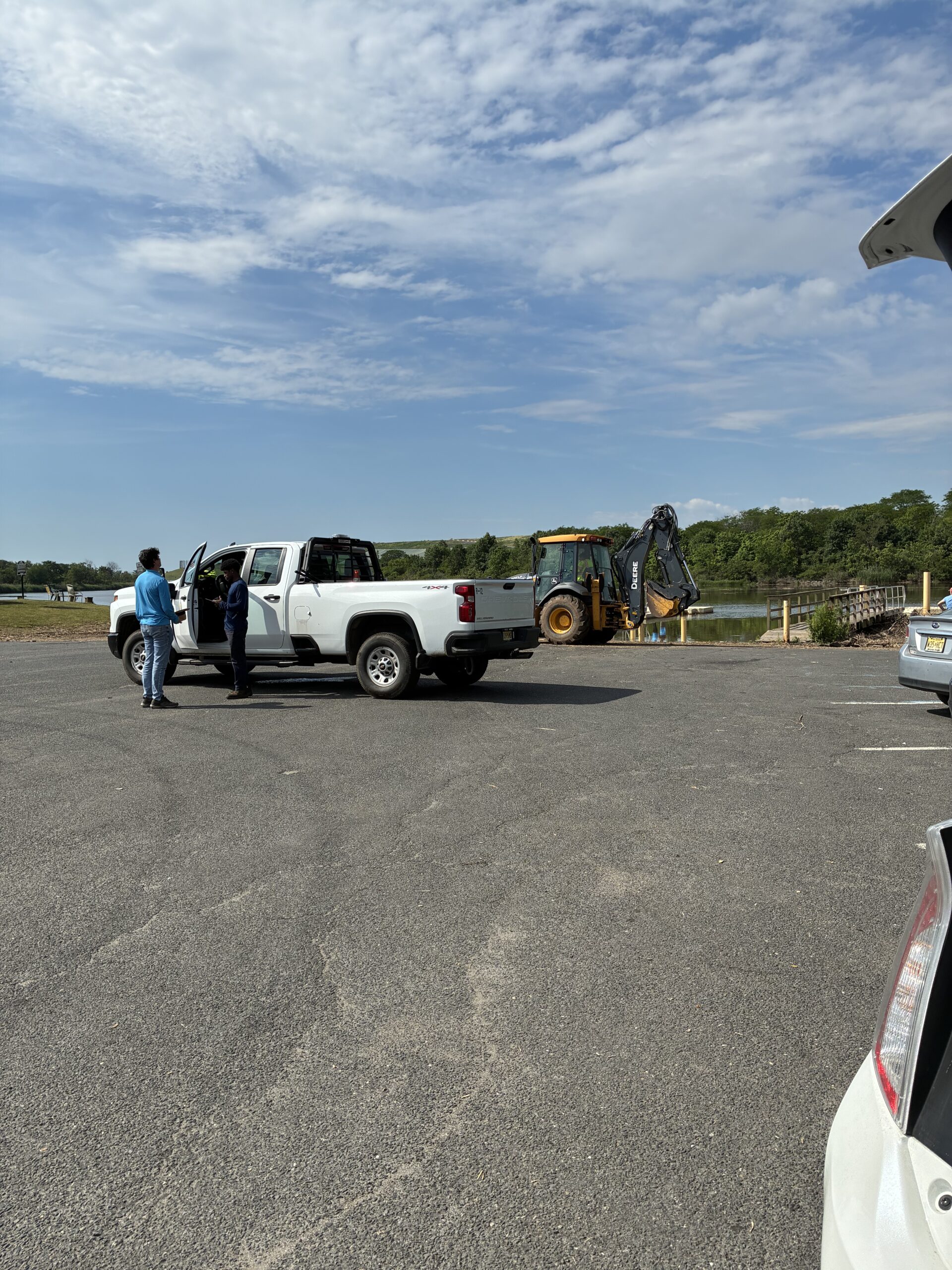
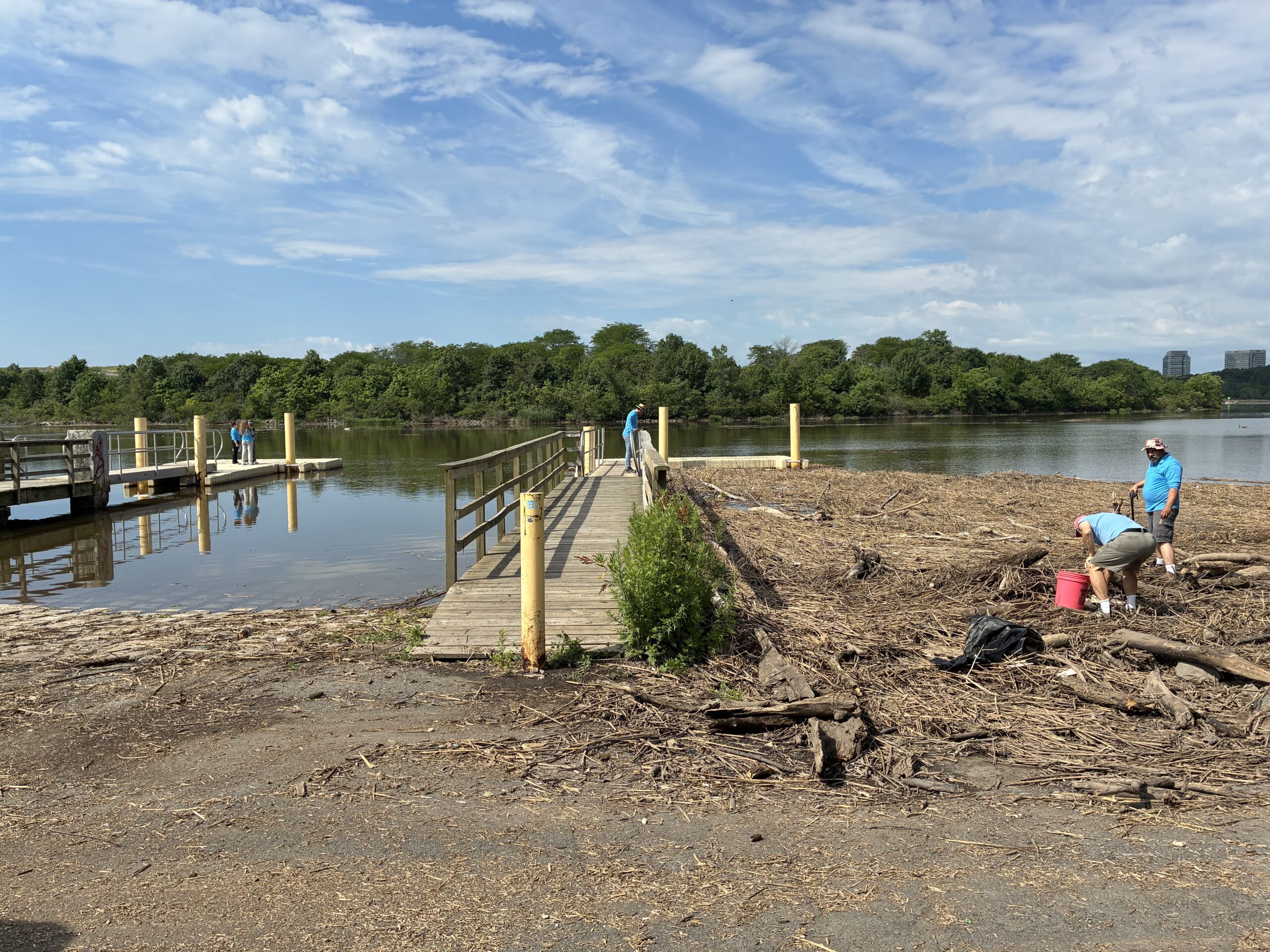
After John inquired about what they were doing, the public service workers explained that they were cleaning up the debris between the two docks on the river to allow easy access by boats and kayaks.
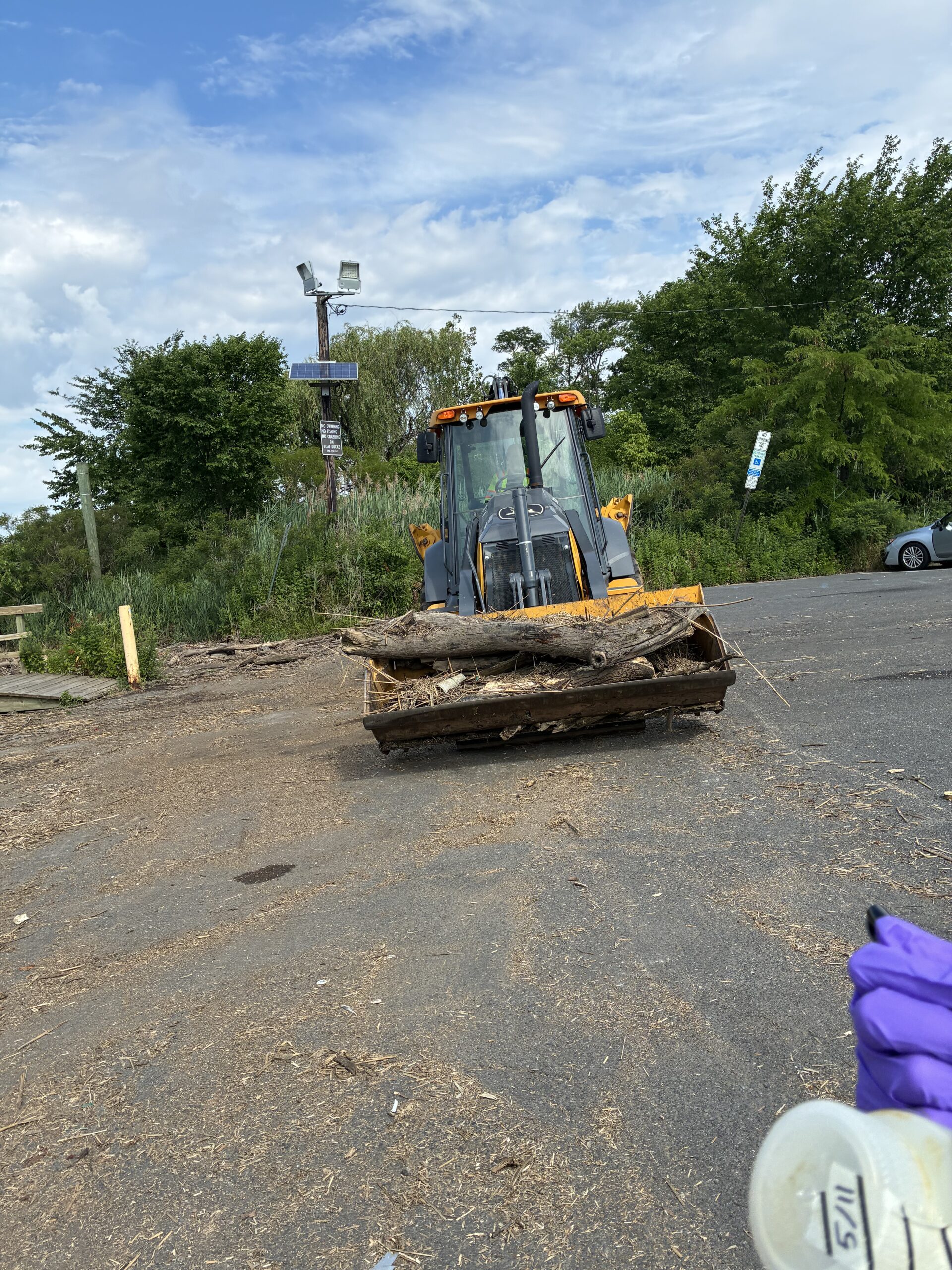
A backhoe loader used in the debris clean up. Photo by Endurance Laryea
Every time we visit this site, we try our best to pick up trash caught up in the debris. It is so much that we only do what time allows. It would be lovely if everyone who visits picks up a few pieces of garbage-with proper protective wear, of course 🙂
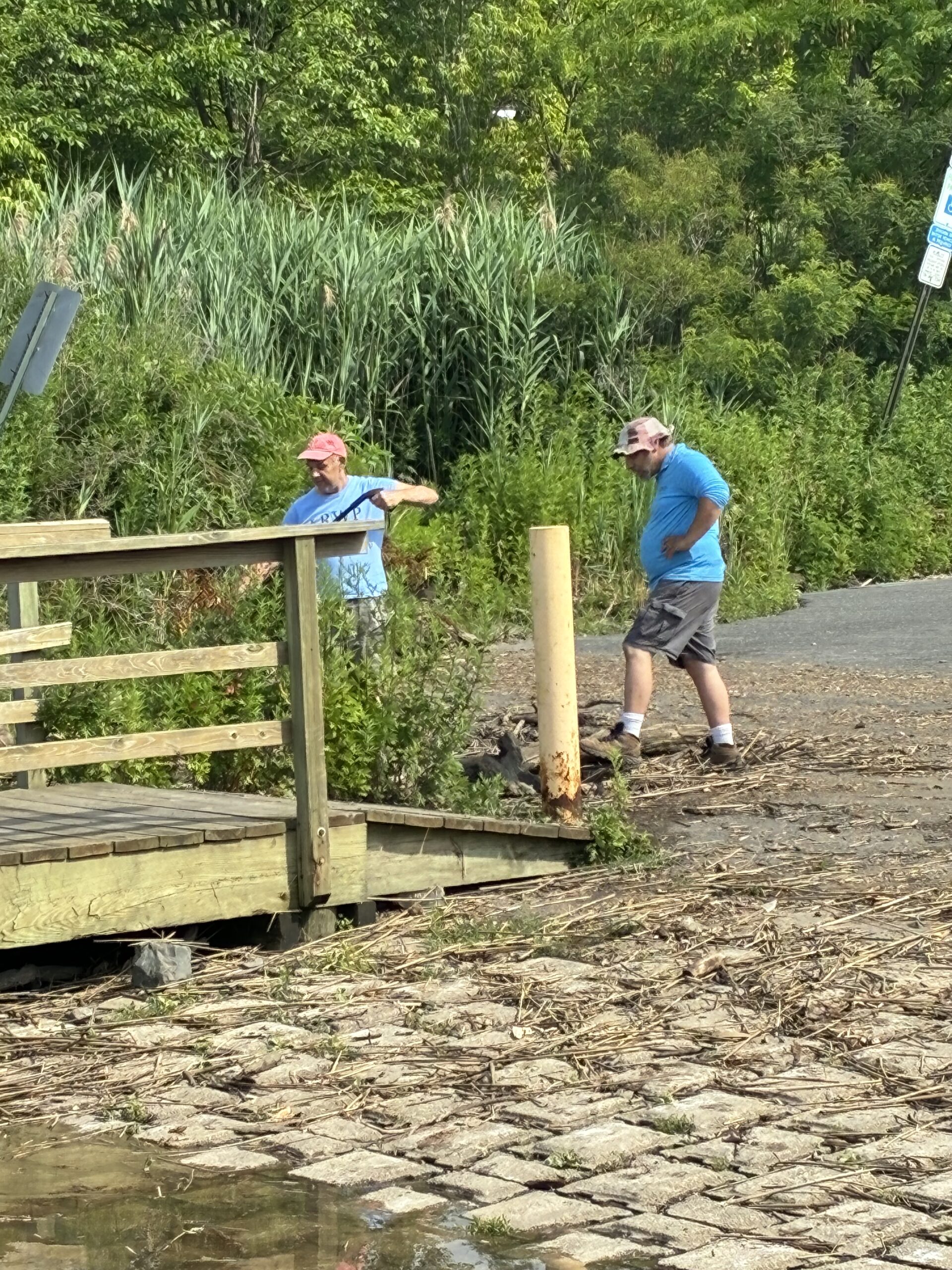
Art and Mike on trash duty. Photo by Endurance Laryea.
Not much activity other than our familiar friends were spotted at Sayreville — several seagulls, but only one osprey in the nest, instead of the mated pair we saw last week.
Photos by Endurance Laryea.
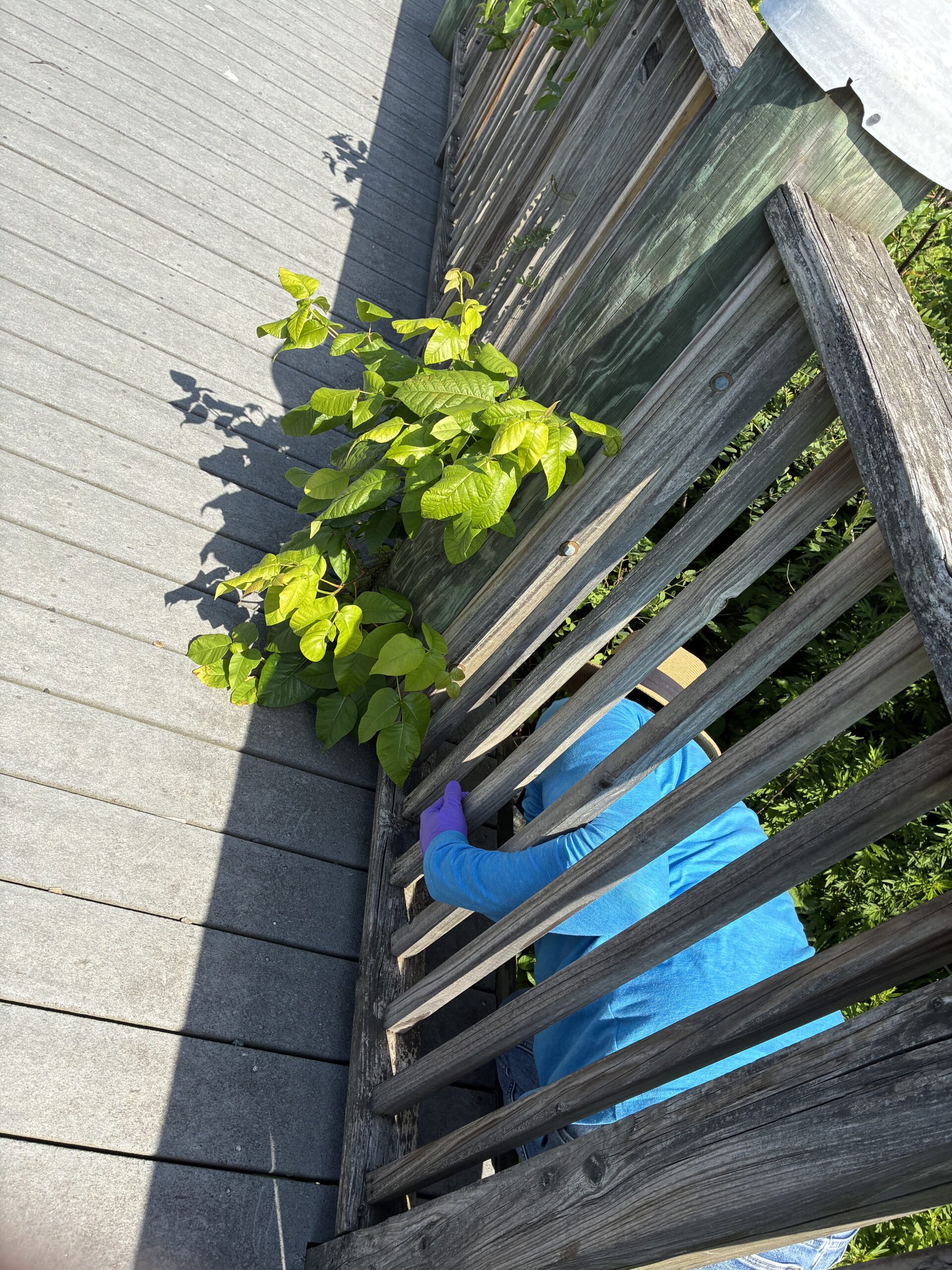
John cutting the roots of a Poison Ivy plant that has grown through the dock railings. With the number of Poison Ivy plants pointed out today, I am certain that I will be able to spot them in the future–hopefully. Photo by Endurance Laryea.
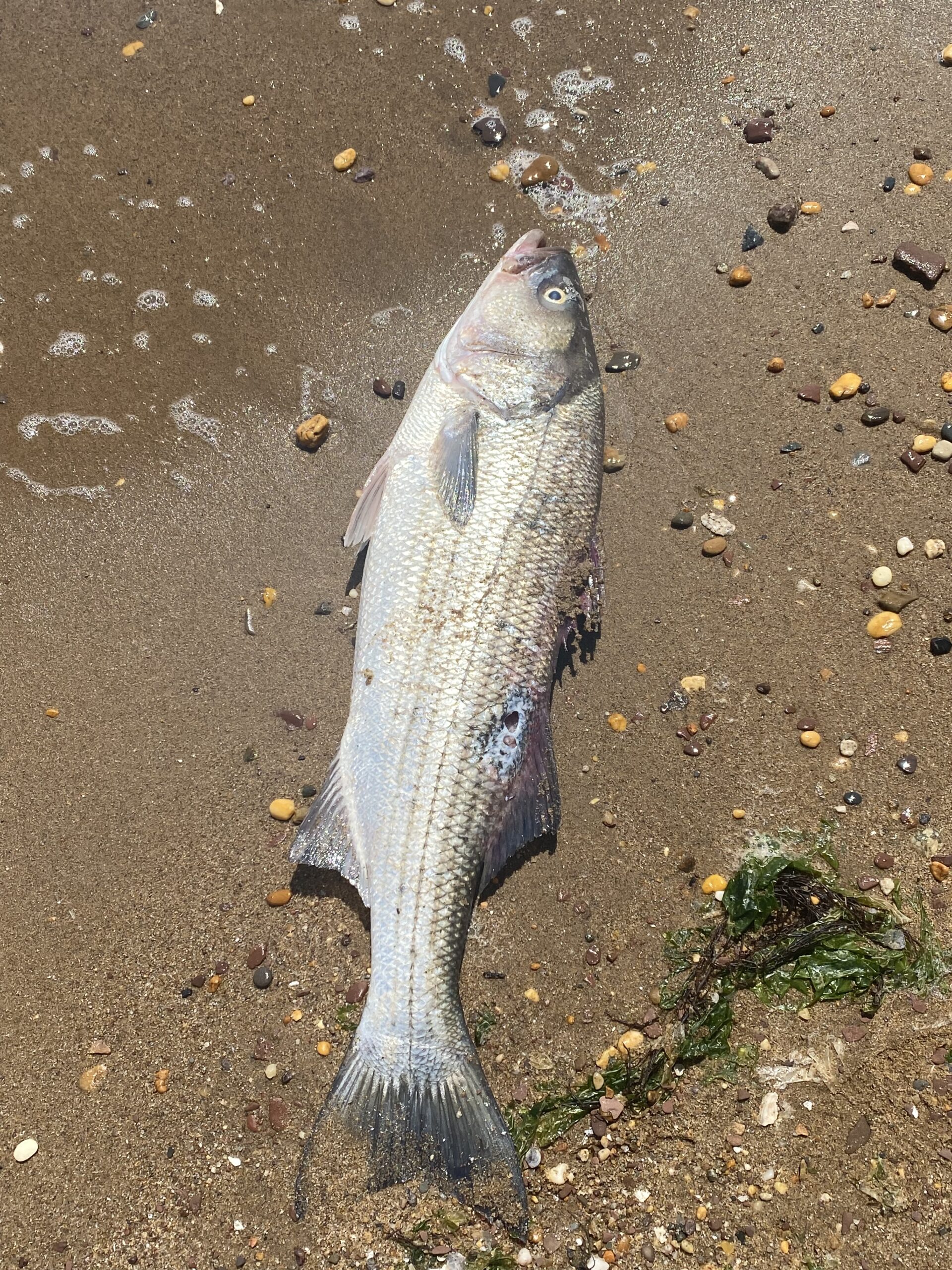
If you have been following our blog posts this summer, you may have read that it striped bass season. In our second week, we saw what seemed to be the gills of a striped bass on the shore of the Raritan Bay Waterfront Park in South Amboy. Today, we saw a dead striped bass on the shore with a decaying hole close to the second dorsal fin. It could have been washed to the shore a few minutes or hours before we got there because it did not give off a decaying odor and it looked pretty fresh.
A dead striped bass at the shore on Raritan Bay Waterfront Park, South Amboy. Photo by Art Allgauera.
It is also horseshoe crab mating season. I felt something tap the boots of my waders in Perth Amboy while collecting the last sample of the day. I looked down to see a curious horseshoe crab coming towards my boots a second time. They are not dangerous so try not to panic the next time you encounter them 🙂
As I looked down to figure out what tapped my boots, I also noticed a cluster of minnows circling around me. Photos by Endurance Laryea.
The second pathogen monitoring session of the month took place on Thursday, June 11th. Each week during the summer, from May to October, the Lower Raritan Watershed Partnership and Rutgers Cooperative Extension of Middlesex County run a volunteer-based monitoring program along the Raritan River. We collect water quality samples at six non-bathing public access beach sites, provide our samples to the Interstate Environmental Commission for analysis in their laboratory, and report the results to the public. Our mission is to share this data with the community and partners to ensure the safe use of the Raritan river for all.
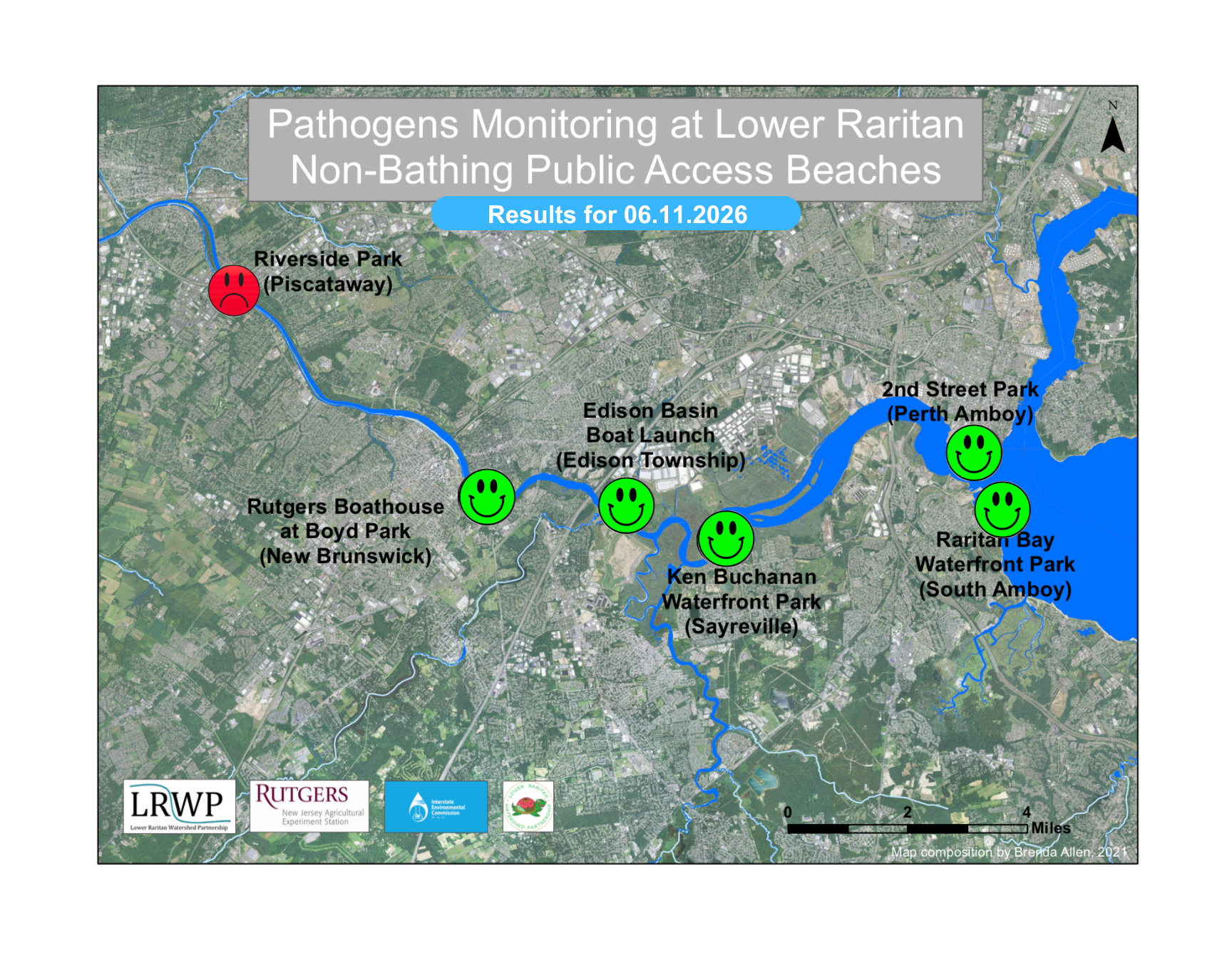
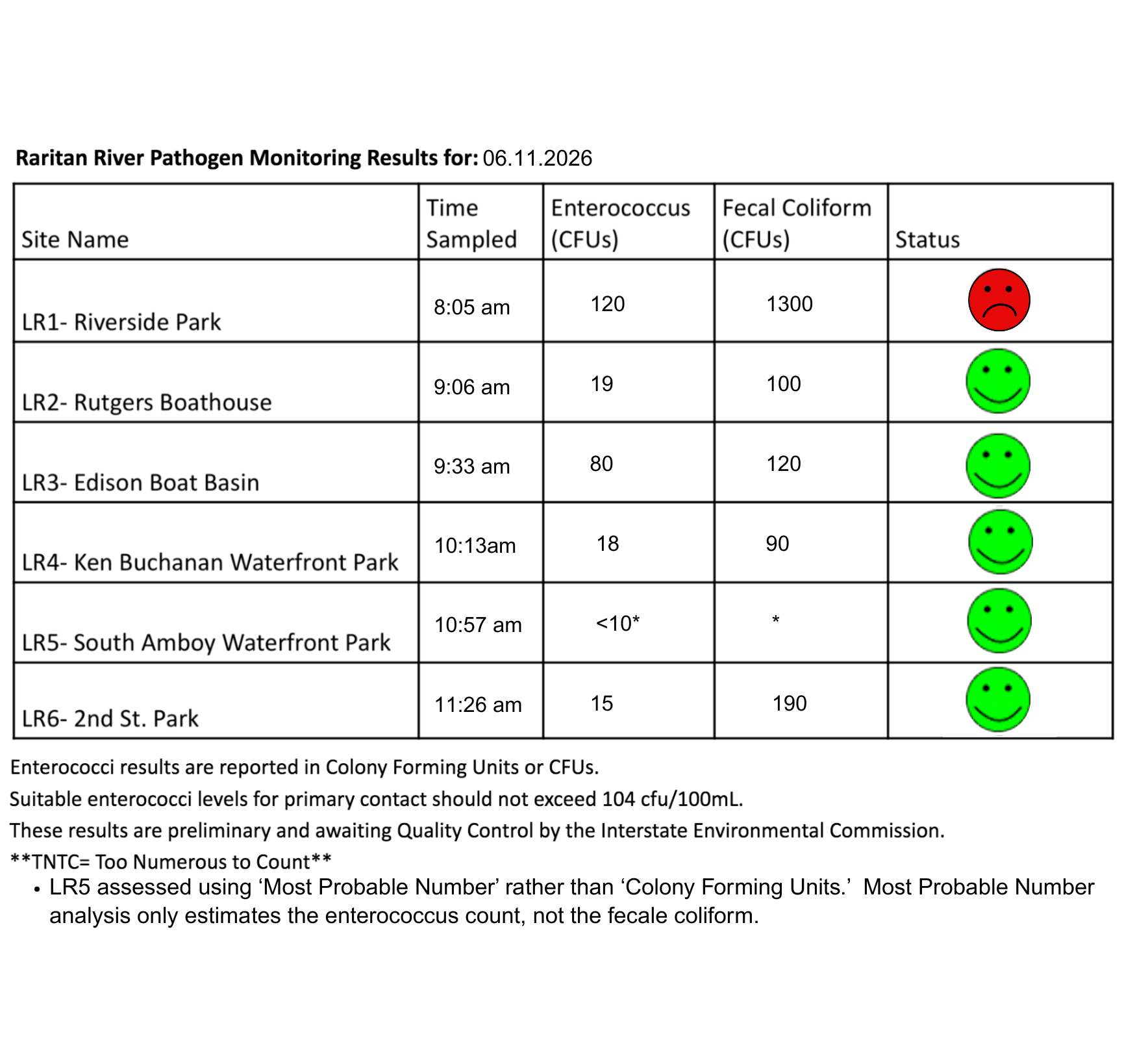
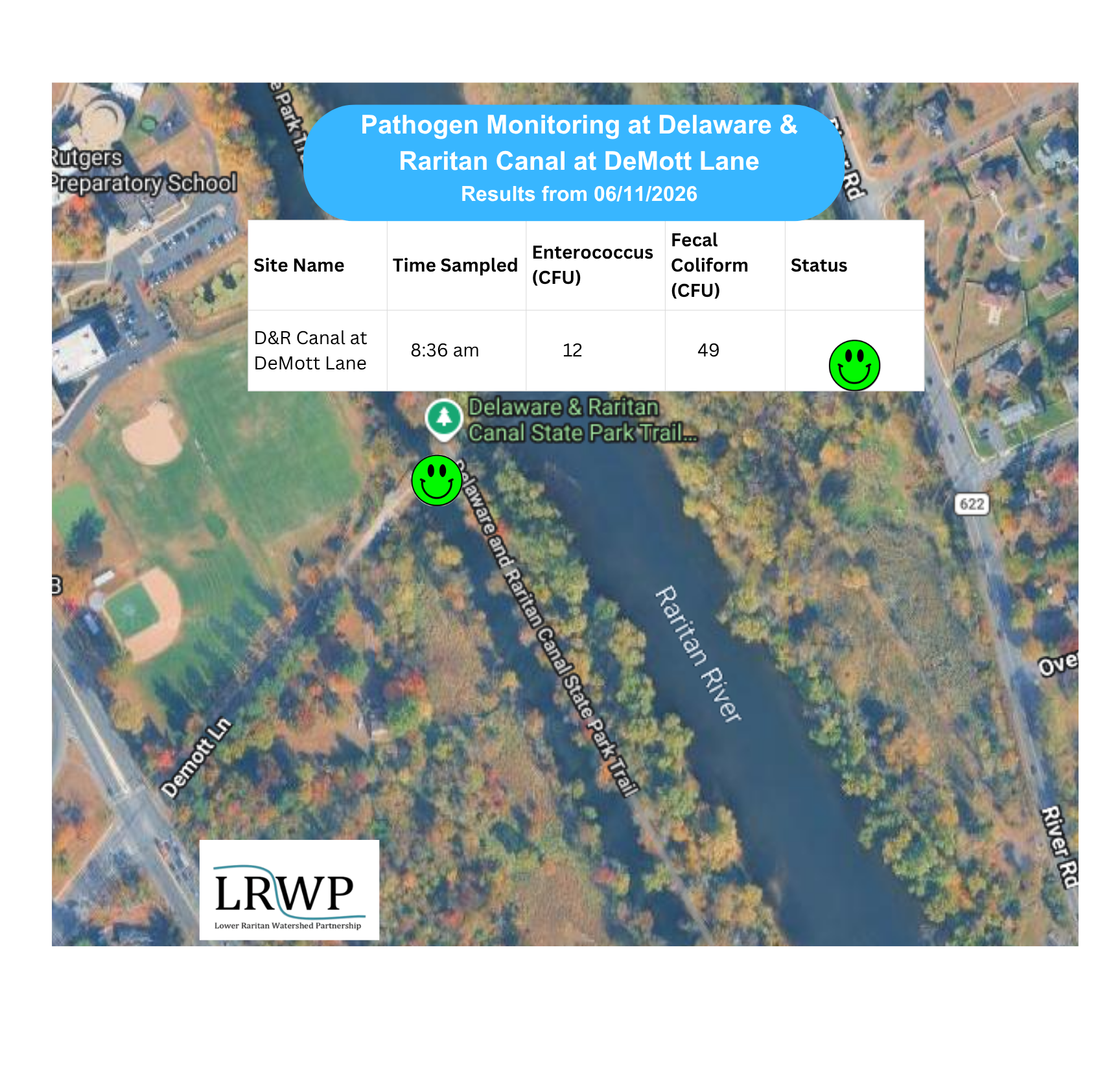
Our lab results for water quality samples taken on Thursday, June 11th, 2026, show Enterococcus bacteria levels exceeding the EPA federal water quality standard of 104 cfu/100mL at one of our monitoring sites this week. Problem sites are indicated by red frowns on the map and chart: Riverside Park (Piscataway). Green smiles on the chart and map indicate the sites with bacteria levels safe for recreation and include the following: Rutgers Boathouse (New Brunswick), Edison Boat Basin (Edison), Ken Buchanan Waterfront Park (Sayreville), Raritan Bay Waterfront Park (South Amboy), 2nd Street Park (Perth Amboy). For South Amboy, we were unable to analyze enough fluid to complete the membrane filtration process required to measure Colony Forming Units. We have therefore marked that site with an asterisk. Statistical analysis of the sample produced a ‘Most Probable Number’ of <10 enterococci per 100 mL, and we were unable to assess fecal coliform.
We also want to advise the public that after we finished testing, our area experienced a brief thunderstorm. The rain almost certainly flushed more entero and fecal pathogens into the river, and so the green smiley faces on our chart and map should be taken with a grain of salt … or a grain of … something.
Pathogens/Enterococci levels are used as indicators of the possible presence of disease-causing bacteria in recreational waters. Such pathogens may pose health risks to people coming in primary contact with the water (touching) through recreational activities like fishing, kayaking or swimming in a water body. Possible sources of bacteria include Combined Sewer Overflows (CSOs), improperly functioning wastewater treatment plants, stormwater runoff, leaking septic systems, animal carcasses, pet waste, wildlife waste, and runoff from manure storage areas.
In order to better understand why Riverside Park, Piscataway is our worst performing site over the past six years, we have started sampling further upstream, as well as in the Delaware & Raritan Canal. On June 11th, we sampled the D&R Canal at DeMott Lane in Somerset County, New Jersey. We took our sample at the bridge adjacent to the Van Wickle House. The lab analysis produced an estimate of 12 enterococci ‘colony forming units’ per 100 mL, and 49 fecal. We find it interesting that our first three canal sites have had less entero and fecal than the adjacent river. The waters in the canal appear relatively stagnant and we expected worse results than we see.
Our goal in reporting these results is to give residents a better understanding of the potential health risks related to primary contact during water-based recreation. If you are planning on recreating on the Raritan this weekend, make sure to stay safe and wash up after any activities!
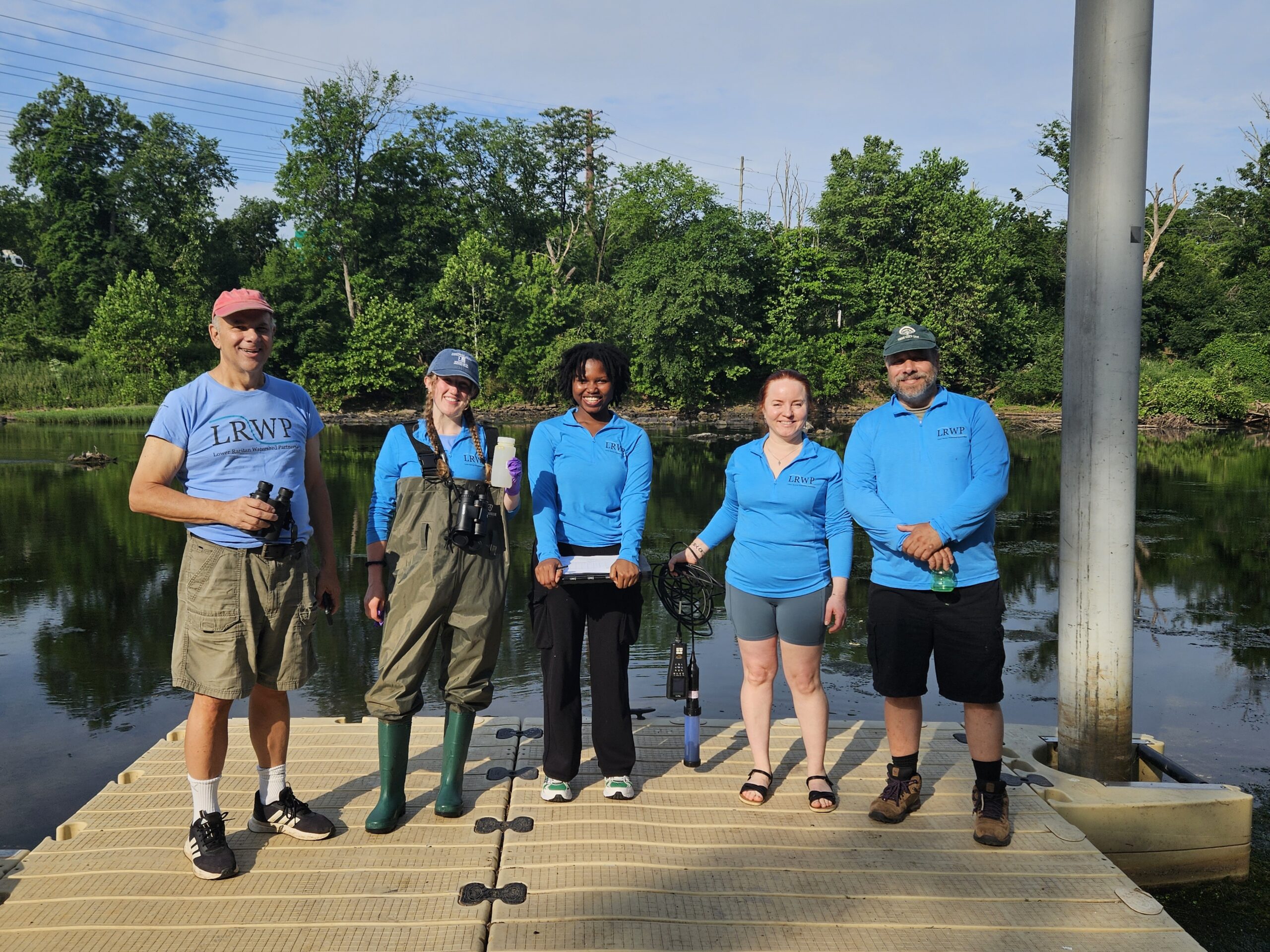
Art, Ashley, Endurance, Olesya and Mike (left to right) kick off pathogens monitoring at Riverside Park on Thursday morning. Photo credit: Heather Fenyk.
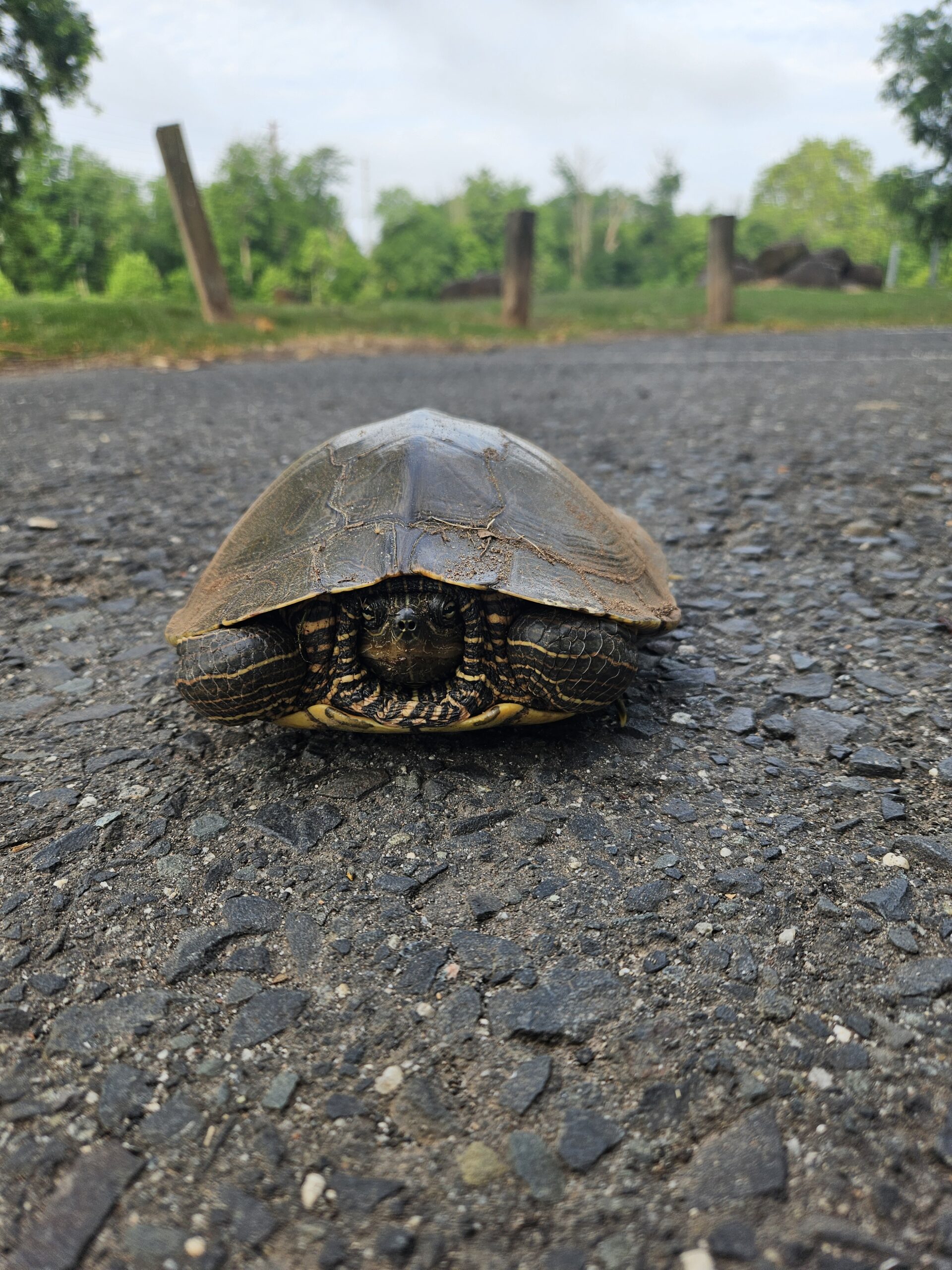
This adorable turtle was spotted on the parking lot by John when we arrived at Riverside Park to start calibrating. It was carefully evaded by the Geese Chasers driver from last week, who succeeded in scaring the gaggle of geese away from the parking lot into the river just by the sight of the car. Photo credit: Heather Fenyk.
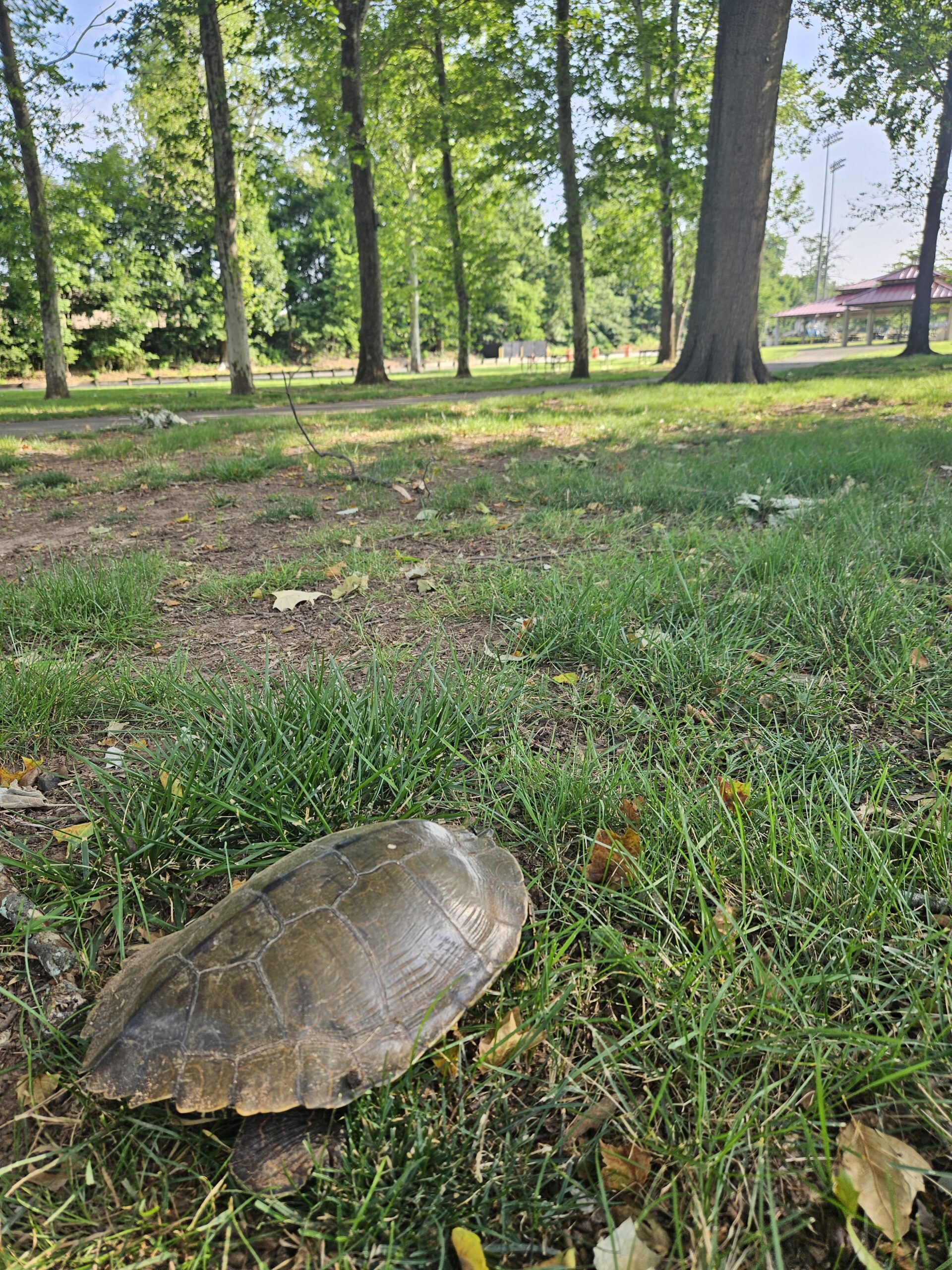
Heather later moved it into the grass for safety in the direction it was initially going. Turtles are likely to return to the path they were on if you moved them away from the direction that they were initially headed which may put them at risk later on when you or anyone else is there to help. Photo credit: Heather Fenyk
Ashley, Olesya and Endurance wrapping up measurements at Riverside Park. Photo credit: Heather Fenyk.
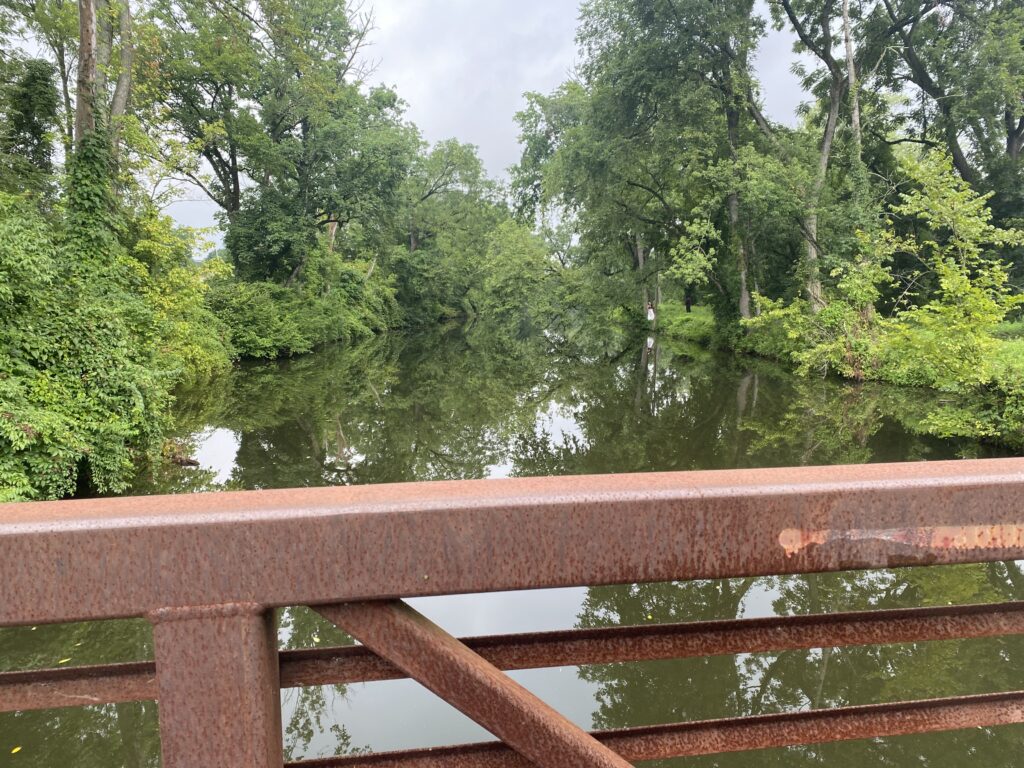
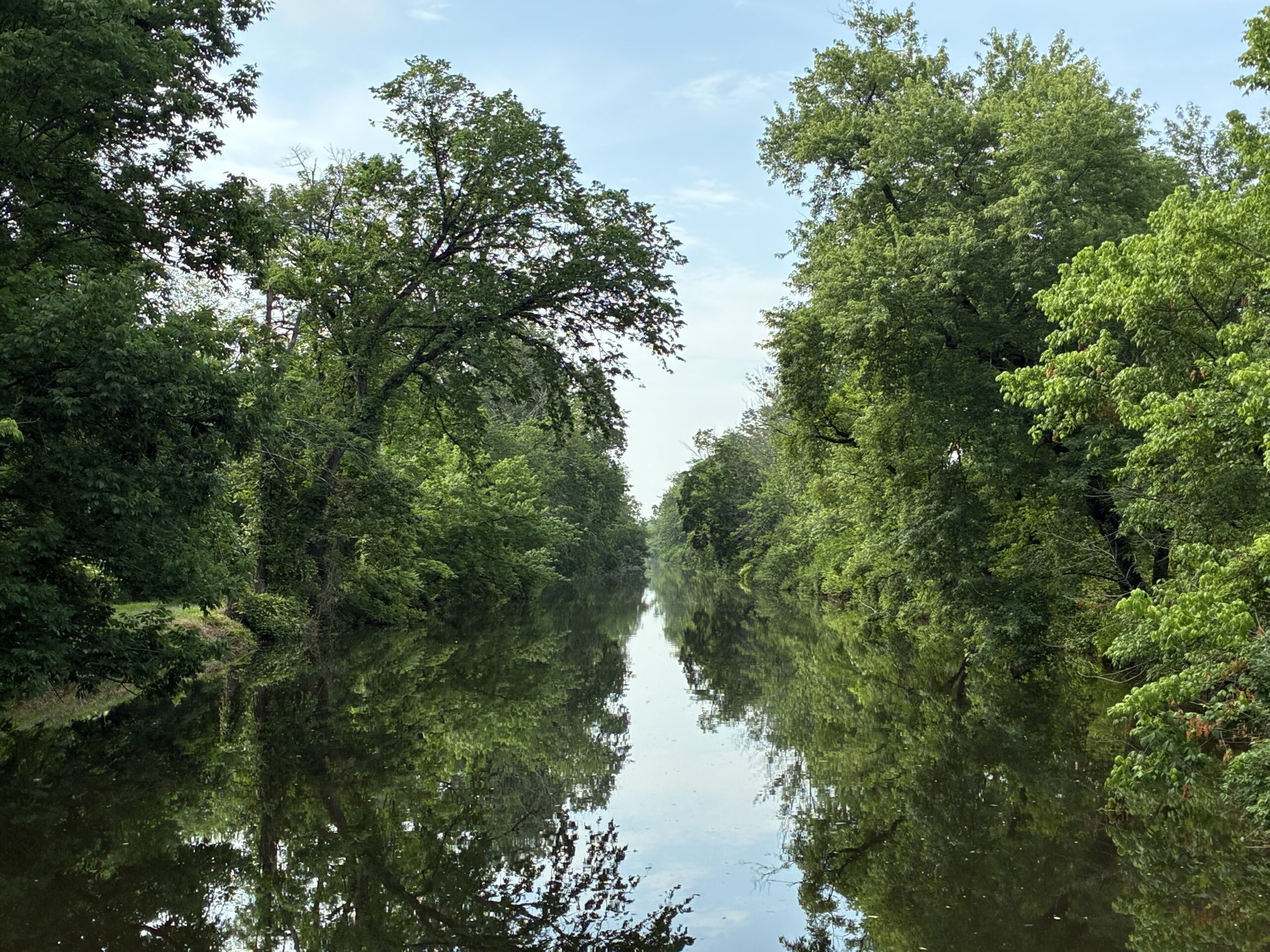
This serene and breathtaking view was taken from the bridge of the D&R Canal, DeMott Lane, Somerset County, near the Van Wickle House. This is the fourth of our new sites this year. Unlike the previous three new sites, this canal does not have lock, just a beautiful bridge. It is a perfect place to go for a walk and just appreciate nature. Photo credit: Endurance Laryea
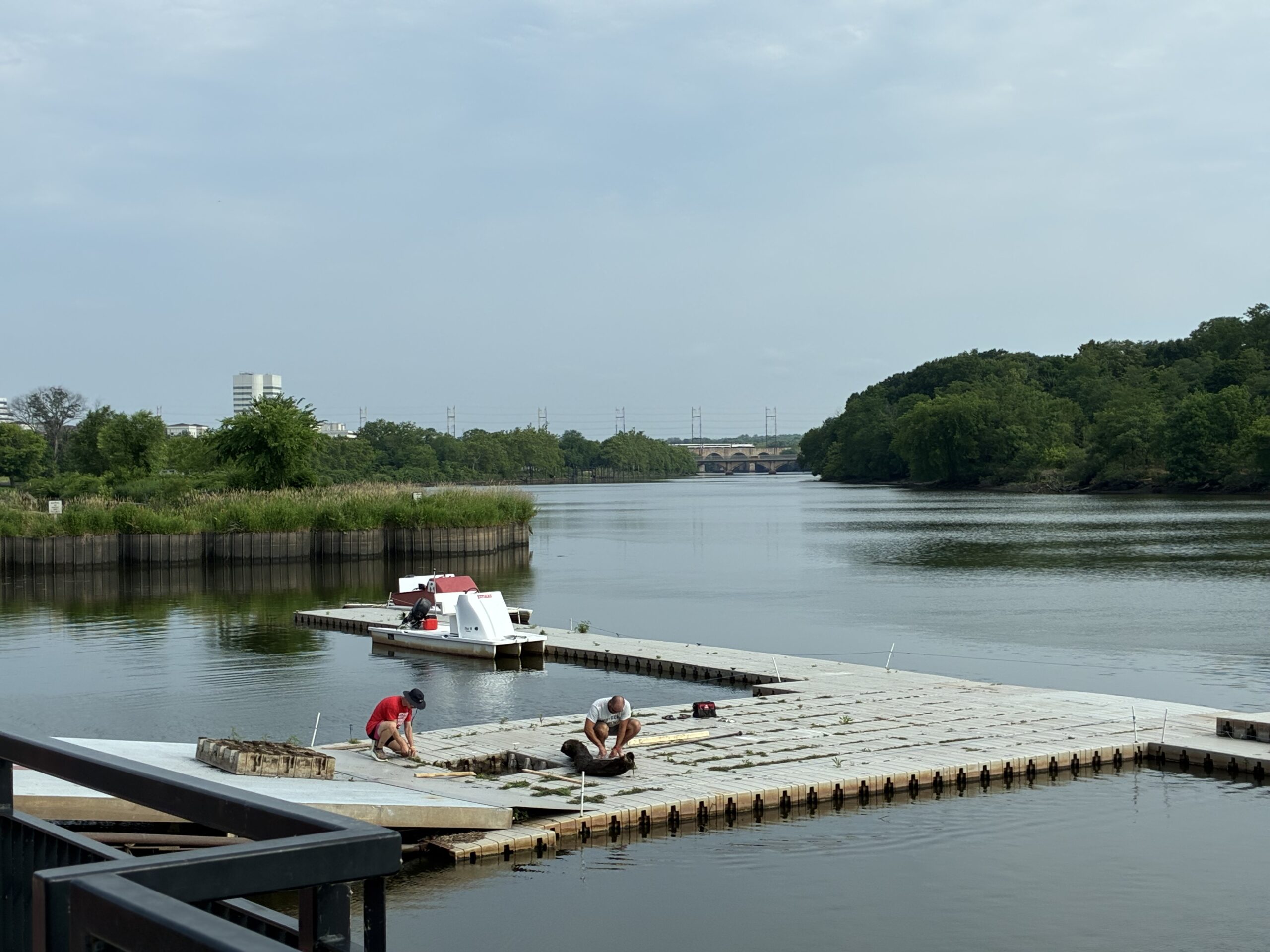
At Rutgers Boat House, New Brunswick, two men work to take out a log that had been caught under the dock and was causing it to be lifted in that area. Photo credit: Endurance Laryea
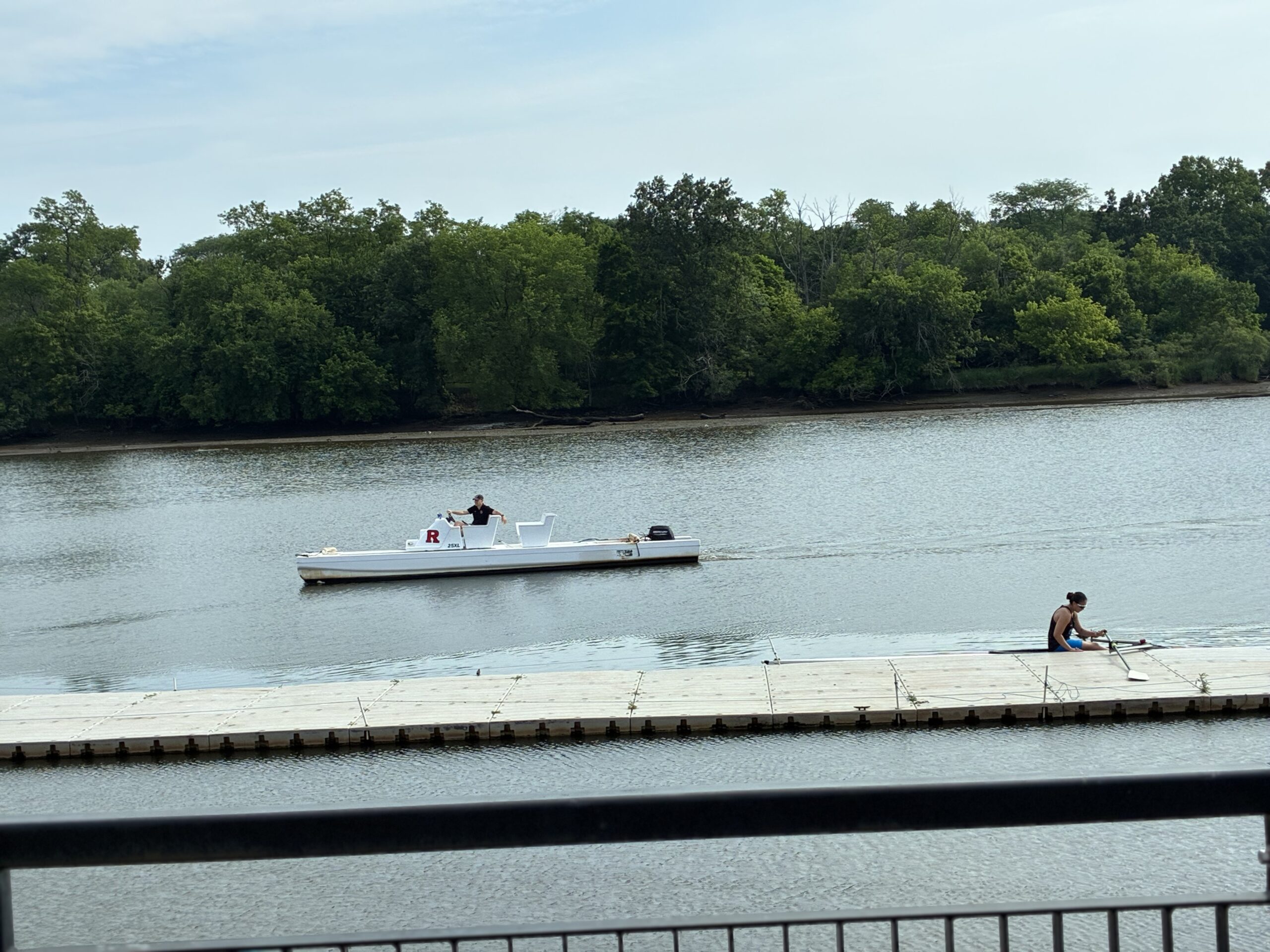
Coaches from the Rutgers rowing team approach the dock. Photo credits: Endurance Laryea.
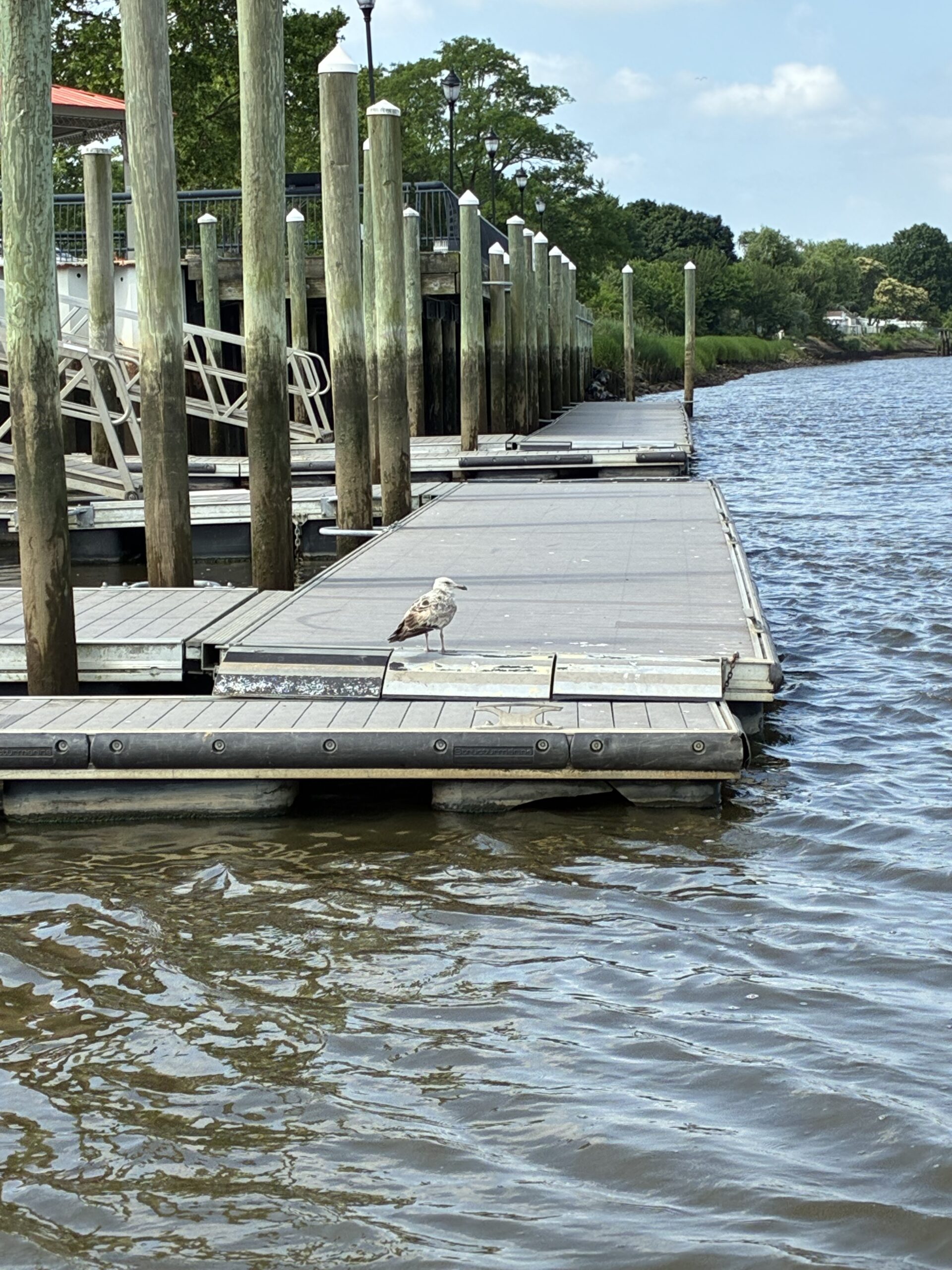
Two different types of seagulls spotted at Ken Buchanan Waterfront Park, Sayreville. Photo credits: Endurance Laryea.
We also spotted the ospreys in their nest today! There were two of them and we watched as one caught a fish in swift dive into the water. For some reason, it did not go directly into its nest after the successful catch but rather lingered around. Unfortunately, we did not catch that on camera.
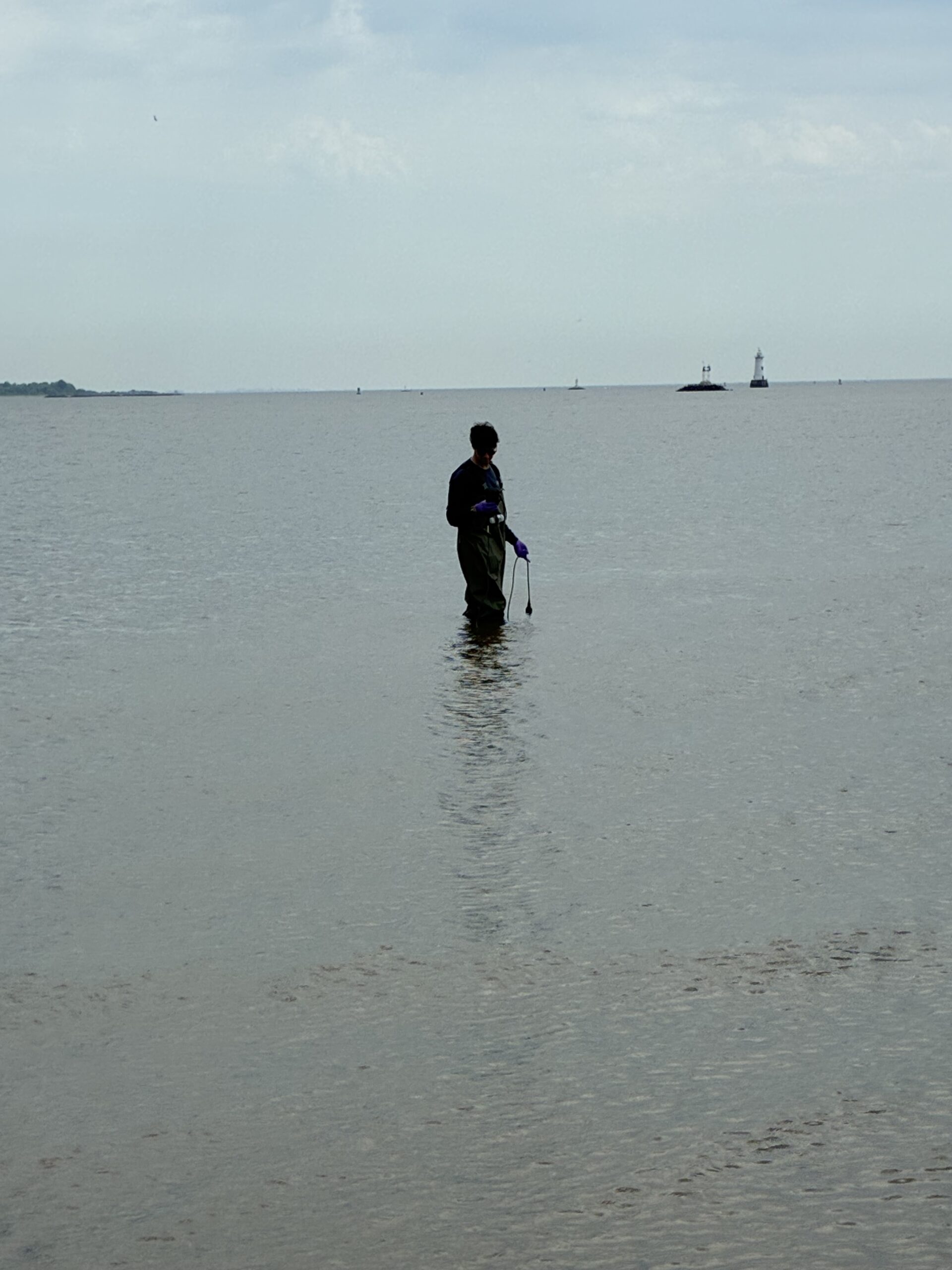
John calling out the measurements to Ashley because he had to take the sonde with him further into the river due to the low tide.
It was a low tide day on the river this morning. Most of the banks were shallower than usual so we had to go further into the river to get samples and measurements. A couple of the banks revealed filamentous algae that would usually be hidden or not clearly seen.
Today’s pathogen monitoring was smooth and fun as always- meeting new people and having great conversations and good laughs. We were done and celebrating a job well done just before the sun hit its full strength! Looking forward to another great time next week 🙂
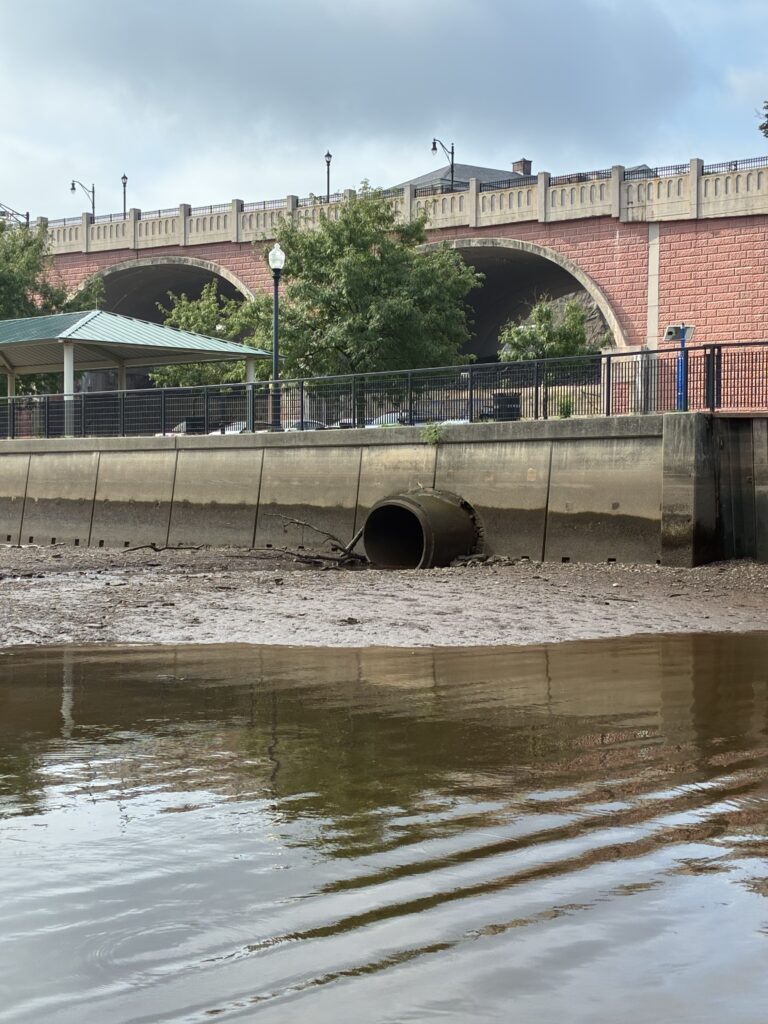
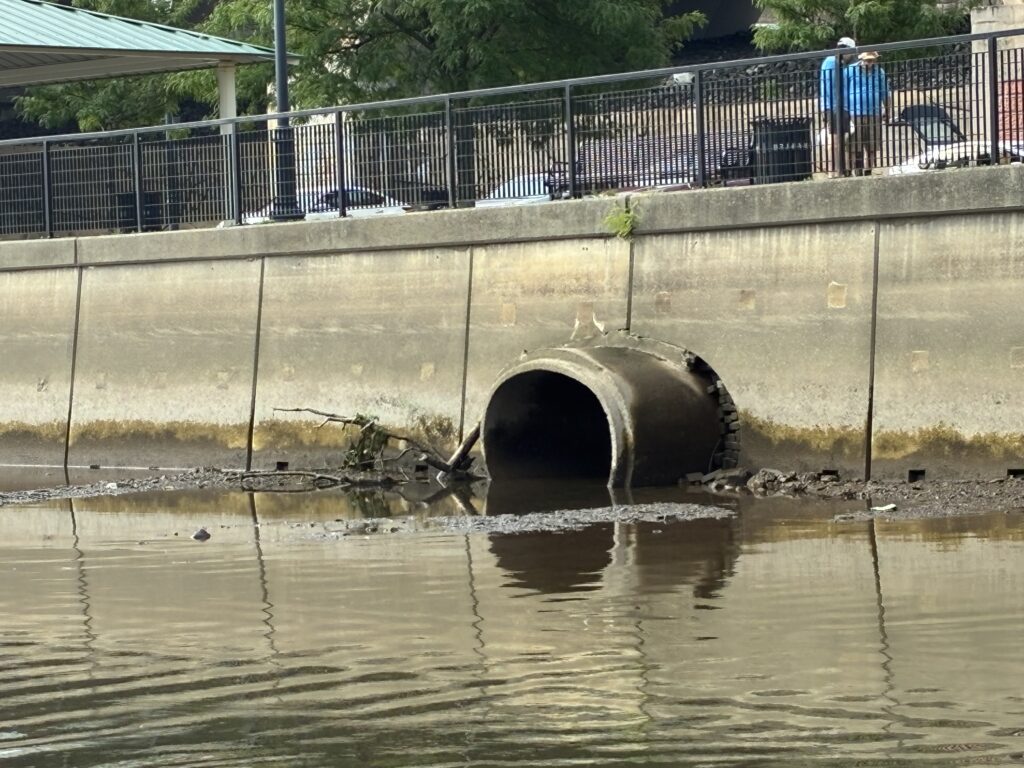
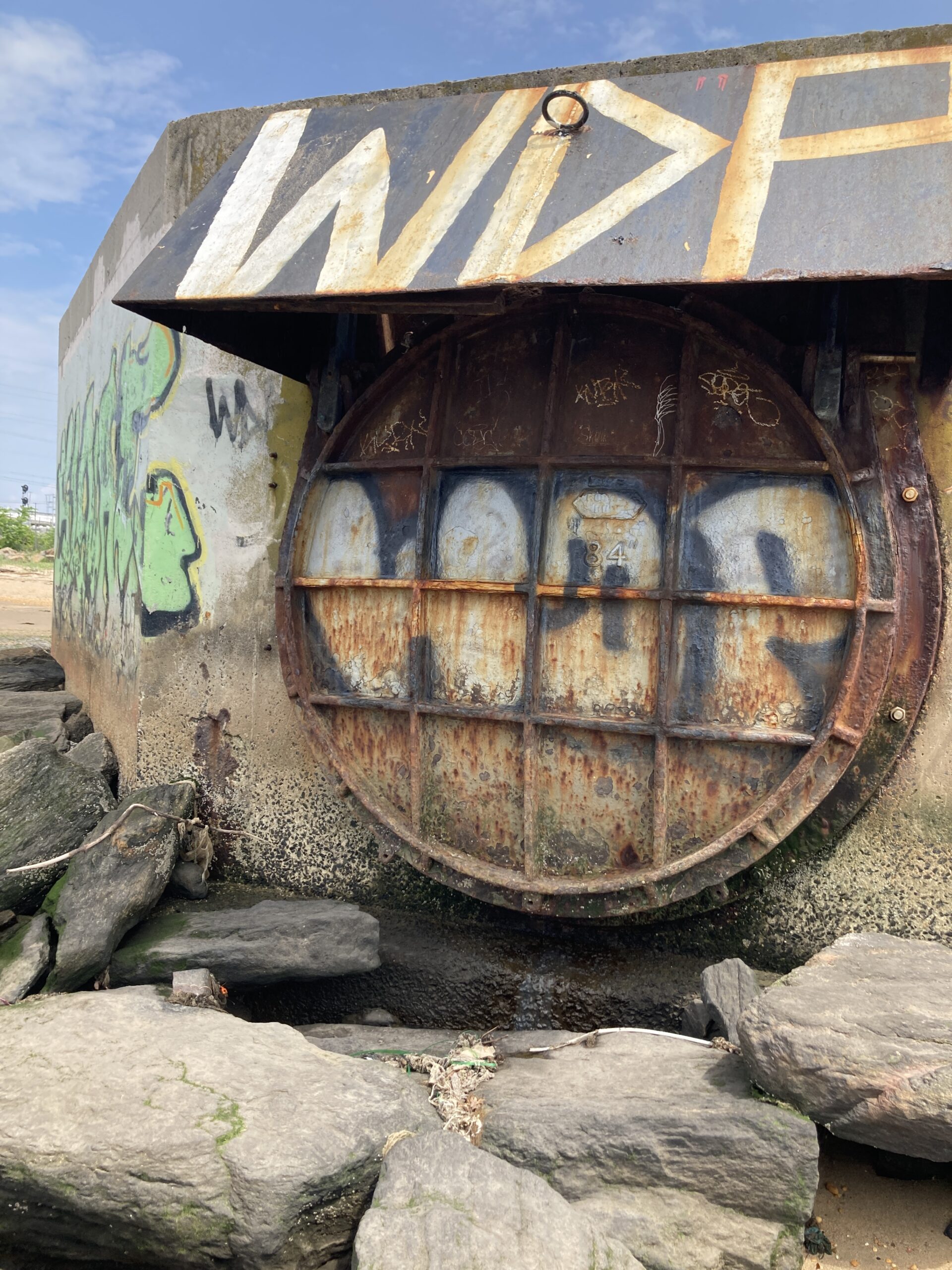
This behemoth of a pipe is one of Perth Amboy’s notorious combined sewer outfalls. At low tide, it is completely visible. Unlike in South Amboy, sanitary wipes litter the shore line. While this outfall will probably be necessary for decades to come, Perth Amboy could greatly reduce the amount of sewage flowing into Raritan Bay by disconnecting roof gutters from the sewer system, daylighting streams, creating simple catch basins, and installing rain gardens. With a few simple steps, Perth Amboy could have one of the best waterfronts in America, and prevent the spread of infectious disease. — Photo credit: J.M. Meyer.
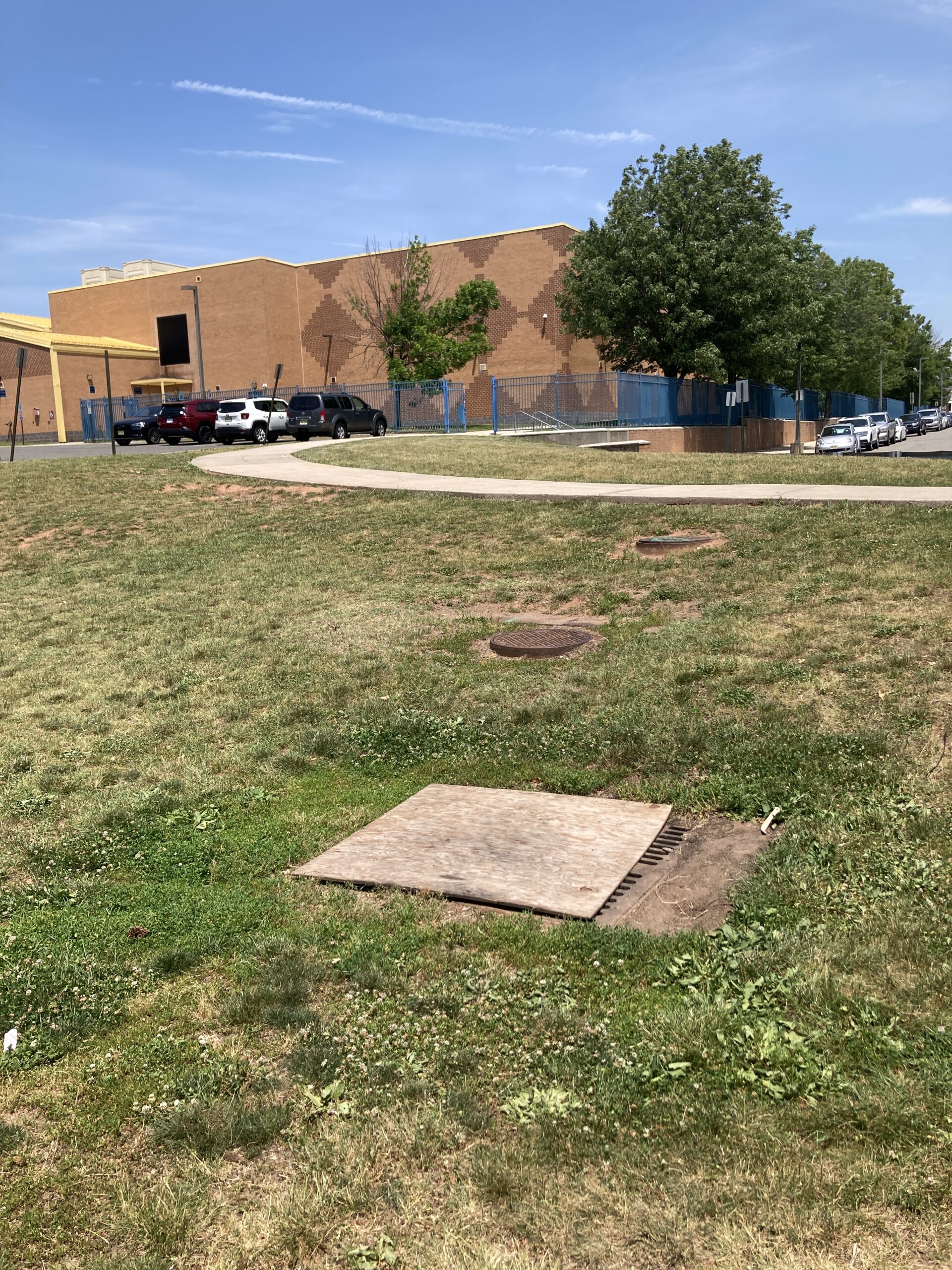
Teachers at the nearby Robert Wilentz elementary school try to mitigate the smell of sewage by covering the storm drains with plywood. — Photo by J. M. Meyer.