Article and photos by Joe Sapia
Note: The yard references are to my house in the section of Monroe between Helmetta and Jamesburg in South Middlesex County. My yard is in a Pine Barrens outlier on the Inner Coastal Plain, the soil is loamy, and my neighborhood is on the boundary of Gardening Zones 6b (cooler) and 7a (warmer). Afield references are to the Pine Barrens around Helmetta, unless otherwise noted. Notes and photographs are for the period covered, unless otherwise noted.
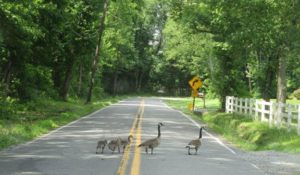
Mama and Papa Canada geese, “Branta canadensis,” and their young cross a road in the Dayton section of South Brunswick, Middlesex County, and stop my Jeep in its tracks. Silly geese! (On a serious note, humans could learn from the dedicated parenting of Canada geese.)
GOOD TO BE BACK HOME: Sorry for missing last week’s “Garden and Afield,” but I was down in New Orleans or traveling to and from. I was attending receptions for a medical residency graduation (of Dr. Anthony M. Sciascia II, the son of my college buddy) and wedding (of Anthony and Nancy). I had a wonderful time with the Sciascia clan who has treated me as family since our Marquette University days that began more than 40 years ago. But I always enjoy getting back home….
SOME N’AWLINS FLAVOR IN THE JERSEY MIDLANDS: New Orleans is known for its coffee made from the roots of chicory, “Cichorium intybus.” Well, guess what has began blooming in the Jersey Midlands? Chicory, the blue flower along roadsides and other disturbed areas. It is a foreign species naturalized here. That is, a weed. But a weed with a nice-looking flower.
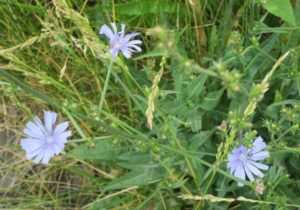
Chicory growing on a Monroe roadside.
IN THE GARDEN: While I was gone, my garden did not get its daily watering, even more critical because we had some very hot temperatures, near 100! But I began harvesting lettuce in earnest.
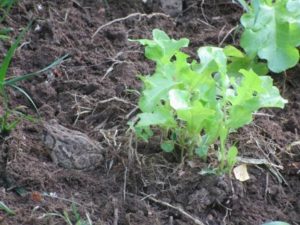
Lake Valley Seeds’s “Salad Bowl Green Heirloom Lettuce” grows in my garden. Next to the lettuce is nature’s pesticide, a toad — probably an American toad, “Anaxyrus americanus.” (Thanks to Sam Skinner, a Monmouth County Park System naturalist who set me in the right direction on the tentative identification of this toad.)
MY ORGANIC GARDEN: I just mentioned the wild toad as a natural pesticide. But, nowadays, people seem to be touchy over the term “organic,” arguing its meaning or arguing that “organic” does not mean purely natural. As I was taught in journalism, say exactly what you mean, rather than using labels. So, here is how I food garden – I add nothing to the mix except water.
MANALAPAN BROOK: The Brook flows about 400 feet from my front yard, but, thankfully, I am about 150 feet from its floodplain – so, close enough to enjoy the waterway, but far enough away not to be affected by flooding. This time of year, the Brook has a summer feel, with lush vegetation growing in the floodplain and, on this day, bright sunlight creeping through the trees. My section of the Brook is between “Jamesburg Lake” (Lake Manalapan) and “Spotswood Lake” (DeVoe Lake). Its watershed drains 40.7 square miles, according to the United States Geological Survey, in Middlesex and Monmouth Counties.
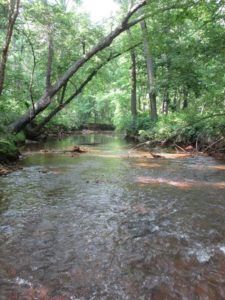
Manalapan Brook, looking downstream toward Helmetta
LIGHTNING BUGS: I saw the first lightning bug, a member of the “Lampyridae” insect family, of the season June 4. On June 17, as I was putting together this “Garden and Afield,” I watched fireflies in my backyard. There seemed to be more than normal, maybe a half-dozen to a dozen, but not the numbers I remember when I was a kid. They flash to signal mates.
ELSEWHERE IN THE YARD: Also in the yard over the last two weeks were rabbit, genus “Lepus”; the state bird, the Eastern goldfinch, “Spinus tristis,”; and my friend, the catbird, “Dumetella carolinensis.” The rabbits allow me to get within a few feet of them, probably because I go about my normal business, not TRYING to get close. The male goldfinch is brightly colored, a beautiful bird – “wild canaries” in the yard. I love catbirds. When I work in the yard or hike the Pine Barrens around Helmetta, catbirds perch nearby and keep me company.
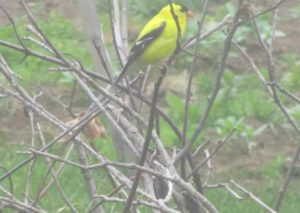
An Eastern goldfinch. Brightly colored, so it is a male.
WHITE ORCHID: Faye Bray, a friend from the Outdoor Club of South Jersey, reported a rare white variety of the pink lady-slipper orchid, “Cypripedium acaule,” in the Whitesbog, Burlington County, area of the Pine Barrens. “It’s freaking remarkable,” Faye said. (Unfortunately, we could not get a photograph for “Garden and Afield.”)
TURTLES: Turtles have been laying eggs, meaning females have been moving around. On my trip to and from New Orleans, I saw a half-dozen or so dead along the Interstate highways, apparently struck by vehicles. Up here in the Midlands, I have heard of various encounters with turtles. One, a person moved a box turtle, “Terrapene carolina,” to water. Wait, a box turtle is a land animal. Two, another person moved a snapping turtle, “Chelydra serpentina,” to a pond, possibly interrupting its egg-laying. So, my advice is, unless there is a compelling reason, leave wildlife alone. Generally, it knows what it is doing, it does not need humans to mess up its life.
TICKS: Ticks are bad this year. Essentially, they cling to vegetation and wait for a mammal to brush by them, then they attach. We have three ticks locally: deer tick, “Ixodes scapularis”; lone star tick, “Amblyomma americanum,” The female is easily distnguishable by the light-colored dot on her back; wood tick, also known as the dog tick, “Dermacentor variabilis.”
Get a tick ID pocket card. It will show the size and colors of not only these ticks, but in different stages of development. See http://www.tickencounter.org/tick_identification/guide.
There is no need to panic. Tick-borne diseases are relatively rare — I mean, if everyone in range of a tick, or even bitten by a tick, were to get sick, there would be a very sick population. However, be vigilant. In the yard, keep grass trimmed. If in the woods, take precautions by dressing properly. (If I am wearing long pants, for example, I tuck them in my socks.) And check for ticks on one’s body. When coming in from the woods or other places ticks are likely, wash the clothes and bathe as soon as possible.
If a tick is crawling on oneself, simply flick it off — It may take a few tries. If one is attached, take tweezers and grab it behind the head and pull it out. Then flush it down the toilet, throw it in a fire, or, if needed for observation, put it with an alcohol-doused cotton swab in a closed container.
If bitten, observe the bite for abnormalities, such as the Lyme Disease bull’s eye, seek medical help if concerned. The big tick disease locally is Lyme. However, New Jersey is now watching for Powassan virus.
My yard is wildlife-friendly and I take no special precautions in the yard, other than observing my clothes and body. I am always in the woods and fields, I found one tick on my body this season, but 10x or 20x that on my clothes — the point being, notice them before they get on one’s body.
Regarding the yard, keep the grass cut. I have tall-grass wildlife patches in my yard and have not found a tick on me yet while doing yardwork, etc. I would be more concerned with cats and dogs bringing them inside.
If you look them up online, use the scientific name, so as not to confuse species and colloquial names.
LETHAL ANIMALS: I would say on a daily basis, the three most lethal animals in the Pine Barens around Helmetta are the tick, mosquito, and pet dog. The former two could do a number for life, while the latter one could be hurtful for the moment.
In the Piedmont region of the Jersey Midlands, I would add copperhead snake, “Agkistrodon contortrix.” In the main Pine Barrens, the rattlesnake, “Croatus horridus.” But the chances of getting bit by either is rare.
Throughout the Midlands, a wandering black bear, “Ursus americanus,” could be a threat – but unlikely. If you see one, stay clear and that should be enough.
YOU SAY “MUSKMELON,” I SAY “MUSHMELON”: My friend Virginia Lamb, who I have turned to for advice (environmental, gardening, and general) over the years, said in reference to my using “mushmelon,” “It’s ‘muskmelon, not ‘mushmelon.’” She is correct, in a more formal sense. But I am correct, too, in a more informal way. So, I responded in an e-mail, “Local colloquialism = mushmelon. I use that only in my blog. Normally, when I talk, I say cantaloupe. (Kind of like the colloquialism “garden snake” for “garter snake.)” Yes, we are all talking cantaloupe.
SCIENTIFIC NAMES: My use of scientific names also has prompted some discussion. Sunil Nair, who has followed my Internet nature posts, said, “Love the fact that you write the genus names, too.” But Virginia Lamb noted, “Just a note on reader preference: I feel the Latin names interrupt the folksy flow of the prose and would prefer they be noted at the end. But that may just be me.” I am considering Virginia’s point. As for using scientific names, I do it so there is no question what is being discussed. “Swamp pink” could be the “Arethusa bulbosa” orchid or it could be the “Helonias bullata” lily. But a scientific name is a scientific name is a scientific name.
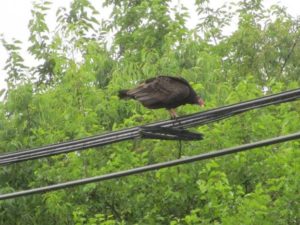
A turkey vulture, “Cathartes aura,” sits on a roadside utility line in Monroe after I spooked it when it was eating a dead ground hog, “Marmota monax.” Here, it is easily identified by its red head. Turkey vultures are commonly seen, soaring in a circle, their wings tipped into a V.
SUNRISE/SUNSET: For June 18, Sunday, to June 24, Saturday, the sun will rise between 5:25 and 5:30 a.m. and set about 8:30 p.m.
DATE TO KEEP IN MIND, JUNE 21: The longest daylight of the year is Wednesday, June 21, the summer solstice, when the sun rises at 5:28 a.m. and sets at 8:31 p.m. After June 21, daylight gets shorter.
DATE TO KEEP IN MIND, JUNE 24: St. John the Baptist Day. Sophie Majka, a neighbor who died March 8 at 92-years-old, had told me blueberries are ready to pick in the Pine Barrens around Helmetta on St. John’s Day, June 24. So, that is a target I look to.
WEATHER: The National Weather Service forecasting station for the area is at http://www.weather.gov/phi/.
SOURCES: As you can see, I have already mentioned various sources of information. Additionally, I enjoy listening to Mike McGrath’s “You Bet Your Garden” radio show on WHYY, 90.9 FM, out of Philadelphia – or on the Internet at http://whyy.org/cms/youbetyourgarden/. I also read Sally McCabe’s “In the Garden, It’s Time To…” column in the Philadelphia Inquirer newspaper, or on the Internet at philly.com.
MORE N’AWLINS FLAVOR IN HELMETTA: Why do I love traveling in the South? Maybe because I am a boy of the South – South Middlesex County. And my local roots go back to Helmetta, whose founder, for lack of a better term, George Washington Helme, was a Confederate military officer. Although a native of Kingston, Pennsylvania, Helme was a New Orleans resident during the Civil War. After the war, he came up to Helmetta, where his wife’s, Margaret Appleby Helme’s, family had a snuff mill operation – one that George would eventually take over. The George W. Helme Snuff Mill provided my family with work for approximately 75 years, from circa 1900 to 1976. The mill stopped manufacturing snuff in 1993 and, now, it is being converted into housing.
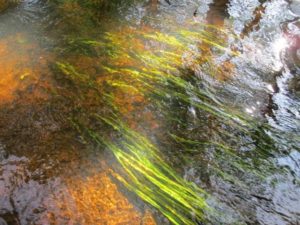
Looking into sunlit Manalapan Brook, here between Helmetta and Jamesburg.
Joe Sapia, 60, is a lifelong Monroe resident. He is a Pine Barrens naturalist and an organic vegetable-fruit gardener.
He gardens the same backyard plot as did his Italian-American father, Joe Sr., and his Polish-immigrant, maternal grandmother, Annie Poznanski Onda. Both are inspirations for his food gardening. Joe is active with the Rutgers University Master Gardeners/Middlesex County program. He draws inspiration on the Pine Barrens around Helmetta from his mother, Sophie Onda Sapia, who lived her whole life in these Pines, and his Grandma Annie. Joe’s work also is at @JosephSapia on Twitter.com, along with Facebook.com on the Jersey Midlands page.
Article and photos by Joe Sapia
Note: The yard references are to my house in the section of Monroe between Helmetta and Jamesburg in South Middlesex County. My yard is in a Pine Barrens outlier on the Inner Coastal Plain, the soil is loamy, and my neighborhood is on the boundary of Gardening Zones 6b (cooler) and 7a (warmer). Afield references are to the Pine Barrens around Helmetta, unless otherwise noted. Notes and photographs are for the period covered, unless otherwise noted.
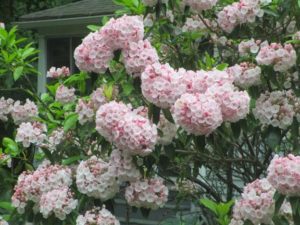
Mountain laurel, “Kalmia latifolia,” in bloom in the Pine Barrens around Helmetta, specifically the Jamesburg Park section of East Brunswick, Middlesex County.
MORE MOUNTAIN LAUREL LORE: I have mentioned here before the Pine Barrens lore I had heard, “The snapping turtle lays its eggs when mountain laurel blooms.” Here is some woods lore I just heard, “The deer would give birth around the time mountain laurel blooms.”
If you find a fawn, “Odocoileus virginianus,” seemingly by itself, leave it. Its mother is probably nearby, waiting for you to leave. If you come across a snapper, “Chelydra serpentine,” that needs to be moved from, say, a road, move it to safety in the direction it is traveling. It probably is a female, heading to uplands to lay eggs or returning to water after laying eggs. BE CAREFUL WITH SNAPPERS. More Piney lore, “Only the setting sun or lightning makes a snapping turtle let go.” I move them with a shovel, preferably a big grain shovel. Joey lore, “If a snapping turtle bites and will not let go, shove a wire in its nostril. Or maybe a flashing light will make it let go.”
Wild mountain laurel is virtually impossible to transplant.
Mountain laurel’s scientific name is “Kalmia latifolia.” The genus name comes from Pehr Kalm, a European botanist who worked in the South Jersey area in the 1700s. He published the influential “Travels into North America.” The plant’s species name is Latin for “broad-leaved.”
A SHORE GARDEN: On a newspaper reporting freelance story, I was at the home of artist Laura Petrovich-Cheney and her husband, educator and craftsman Peter Cheney, in Asbury Park, Monmouth County. Their property is on Deal Lake. There, a great egret, “Ardea alba”, and red-winged blackbird, “Agelaius phoeniceus,” flew along the lake. Purple martins, “Progne subis,” nest in houses on the property. In the gardens were various flowers in bloom: roses, poppies, daylilies (budding), peonies, yarrow, and trumpet vine honeysuckle. Also in gardens were Tears of Mary, tomato, eggplant, cucumbers, herbs, raspberry bushes, and a fig tree.
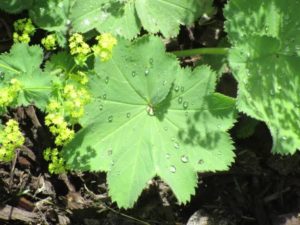
“Tears of Mary” plant in the Petrovich-Cheney and Cheney garden in Asbury Park, Monmouth County.
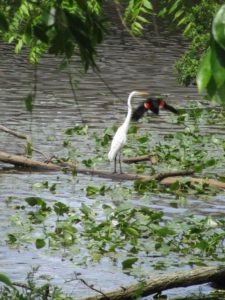
A red-winged blackbird flies past a great egret on Deal Lake at the Cheney and Petrovich-Cheney garden.
BIRD BATHS IN THE YARD: When my birdbath broke a few years ago, I took the bath part and laid it on the ground. When that had seen its days, I started using a garbage can lid, laying it on the ground. Now, I use large saucers – two in the backyard along the fruit and vegetable garden and one in the front yard. They are used by various animals: bird; squirrel; “Sciurus carolinensis”; and neighborhood cat, maybe even by skunk, “Mephitis mephitis”; chipmunk, “Tamias striatus”; raccoon, “Procyon lotor”; and ground hog, “Marmota monax.”
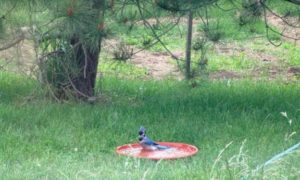
A blue jay, “Cyanocitta cristata,” in one of my backyard bird baths.
WATERING THE GARDEN: I water the garden before 10 a.m. so as not to lose water to evaporation in the heat of the day and so the garden dries by nightfall, preventing fungal growth. I use two watering methods – one, by sprinkling can if I have enough clean water accumulated (from rain, the cellar de-humidifier, and so on) and, two, by running a sprinkler. Sitting there with a cup of coffee and watching the sprinkler go back and forth is so relaxing. This week, a mourning dove, “Zenaida macroura,” joined me.
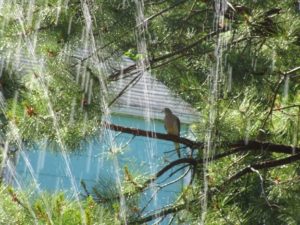
A mourning dove perches in a pitch pine – “Pinus rigida,” transplanted to my backyard from a Pine Barrens woods in Monmouth County – and hangs out with me as I watched the sprinkler water the garden.
BUTTERFLIES: As I have mentioned before, I am noticing a lot of tiger swallowtails, “Papilio glaucus,” the females black and the males yellow, this year. I usually cannot shoot a good photograph because they do not sit still. This week around my garden, I had a very cooperative female, allowing me to photograph away.
A female tiger swallowtail cruises over my garden.
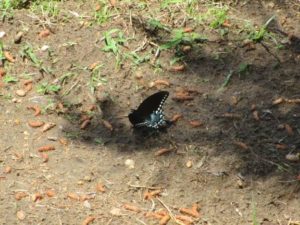
She rests in the garden.
DELAWARE RIVER AT FIELDSBORO: I was along the Delaware River near Fieldsboro, Burlington County. This is where the river transforms from commercial shipping (here and south) to recreational (here and north). Although the water here is fresh, there is a tidal effect as far north on the river as the area of Trenton, Mercer County.
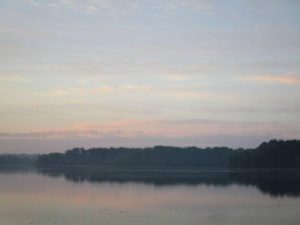
Dawn on the Delaware River, looking toward the area of Fieldsboro, Burlington County.
CLOUDS: Over the last several months, clouds have been spectacular. On the evening of May 31, Wednesday, I was along the Delaware River in the Fieldsboro area. It was clear where I was, but to the north were storm clouds with occasional streaks of lightning. The lightning was too sporadic for me to catch a photograph, but I shot pictures of the storm clouds and sunset. (Tip on photographing lightning: If the lightning is flashing near enough to one another, do not try to catch the flash. Instead, just keep on cranking pictures and hopefully there will be a usable shot of lighting in the batch – and hopefully you were not struck by lightning!)

Man in the cloud blows fire at a jet along the Delaware River.
LIGHTNING: A few years back, a Jersey Shore beachgoer at the Atlantic Ocean in clear weather was struck and killed by “out of the blue lightning” because, despite the clear weather at the beach, a thunderstorm was near enough. So, play it safe. The rule I follow, “If you hear thunder, you can be struck by lightning.” Seek cover.
NIGHT SKY: At dawn, look for the bright “star” in the East – the planet Venus. The Full Rose Moon is Friday, June 9. On Saturday, June 3, I stood on my back porch and looked at the moon, with the planet Jupiter just off it. I find it fascinating I can stand in my yard and look at the wonders of the night sky in the home I grew up in – and followed the USA-Soviet Union “Space Race” in the 1960s. Turn off the outside lights, let your eyes adjust for 20 minutes to 30 minutes, and enjoy a naked-eye view of the Night Sky.

The planet Jupiter aligned with the moon on the night of Saturday, June 3.
UNDER THE PORCH: After working an overnight shift, I came home to find a pile of dirt under one of my back porches, the one at the Florida room. Enough dirt in the pile to fill a wheelbarrow. I suspect a ground hog. I raked up the dirt and moved it to my garden, where I likely will rake it out in the fall. As for the animal hole, I let it be. Wildlife is welcome in my yard, but I prefer it does not mess with my vegetable-fruit garden.
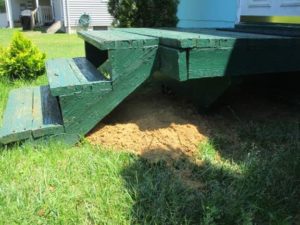
The work of a ground hog, I presume.
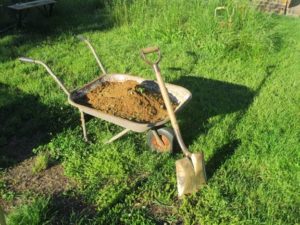
Off to the garden with the dirt. I can always find a use for it.
SUNRISE/SUNSET: For June 4, Sunday, to June 17, Saturday, the sun will rise about 5:30 a.m. and set about 8:25 p.m.
WEATHER: The National Weather Service forecasting station for the area is at http://www.weather.gov/phi/.
MY GARDEN: I continue with the three Ws – water, weed, and wait. The cool weather plants of lettuce and carrot are growing nicely, but the pea are lame. As for the warm weather plants, cucumber, mushmelon, and sweet corn, along with zinnia, are poking through the ground. No sign yet of tomato. (And I am thinking I may abandon planting tomato from seed. I am considering for next year buying plants and transplanting them into the garden.)
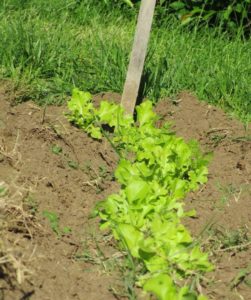
Salad Bowl Lettuce,” by Lake Valley Seed, growing in my garden.
UPCOMING “GARDEN AND AFIELDS”: After I publish a “Notes from Garden and Afield,” I panic, thinking, Will I be able to fill next week’s issue? Then, I realize there is plenty happening afield and in the garden. Alas, because of a scheduling conflict I have, “Notes from Garden and Afield” will not publish June 11. The plan is for it to return June 18. Meanwhile, check out on your own what is happening afield and in the garden.
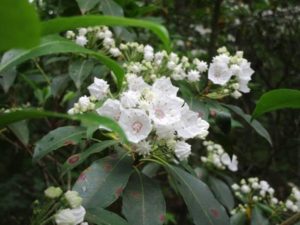
Mountain laurel, in bloom and about to bloom fully, in Jamesburg Park.
Joe Sapia, 60, is a lifelong Monroe resident. He is a Pine Barrens naturalist and an organic vegetable-fruit gardener.
He gardens the same backyard plot as did his Italian-American father, Joe Sr., and his Polish-immigrant, maternal grandmother, Annie Poznanski Onda. Both are inspirations for his food gardening. Joe is active with the Rutgers University Master Gardeners/Middlesex County program. He draws inspiration on the Pine Barrens around Helmetta from his mother, Sophie Onda Sapia, who lived her whole life in these Pines, and his Grandma Annie. Joe’s work also is at @JosephSapia on Twitter.com, along with Facebook.com on the Jersey Midlands page.
The following include May 2017 highlights of local/state news-worthy environmental concerns, as well as national headlines to watch:
New Jersey Water Supply Plan Update: After a 20 year wait, the New Jersey Department of Environmental Protection released a 2017-2022 Water Supply Master Plan Update. Specific to the Lower Raritan Watershed and our “Central Drought Region” are proposed Capital Improvement Projects including a North/South Branch Confluence pumping station, the Kingston Quarry Reservoir, water transfers from central to coastal North Drought Regions and the Six Mile Run Reservoir (pages 74-77).
New Jersey Freshwater Wetland Protection Act (FWPA) Rules Amendments: The NJDEP is proposing comprehensive amendments to NJ’s FWPA. These amendments propose significant revisions particularly to mitigation rules, and also to transition area (freshwater wetland buffer) impacts. Of note is that the proposed revisions increase the degree to which transition areas can be impacted by development. Written comments will be accepted until June 30th.
Rollbacks on Obama-era climate rules: Last week the Federal Highway Administration announced that it will delay the effective date of Green House Gas emissions analysis and air quality studies on US Interstate roadways.
Rollbacks on Pesticides: The Hill reports that House passed legislation last week to loosen federal regulations on pesticides. The “Reducing Regulatory Burdens Act of 2017” would reverse a 2009 court decision that requires that anyone applying pesticides secure a general permit under the Clean Water Act, opening the door to increased pesticide impacts on our waters.
Trump to pull out of Paris Climate Accord: Reuters reports that the United states will no longer be part of the landmark Paris Climate Agreement designed to reduce impacts of global warming.
Article and photos by Joe Sapia
Note: The yard references are to my house in the section of Monroe between Helmetta and Jamesburg in South Middlesex County. My yard is in a Pine Barrens outlier on the Inner Coastal Plain, the soil is loamy, and my neighborhood is on the boundary of Gardening Zones 6b (cooler) and 7a (warmer). Afield references are to the Pine Barrens around Helmetta, unless otherwise noted. Notes and photographs are for the period covered, unless otherwise noted.
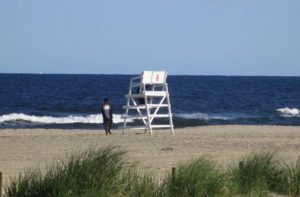
The Atlantic Ocean beach at Bradley Beach, Monmouth County
THE JERSEY SHORE SUMMER SEASON: The traditional Jersey Shore summer season arrives with Memorial Day Weekend, this weekend, and ends with Labor Day, this year September 4. (A tip: Jersey Shore people know September is a great month at the Shore – the crowds are gone and the weather and ocean are still warm.)
SPRINGTIME AT TONY’S MARKET: A favorite Jersey Midlands place of mine for decades has been Tony’s Farm and Garden Center in the Windsor section of Robbinsville, Mercer County. A nice selection of various products and owned and operated by the warm and helpful Ciaccio family. I regularly patronize three nursery-garden centers: Ferris Farms in East Brunswick, Krygier’s Nursery in South Brunswick, and Tony’s. At Tony’s, I buy houseplants and houseplant supplies. And I try to always shoot photographs at Tony’s.
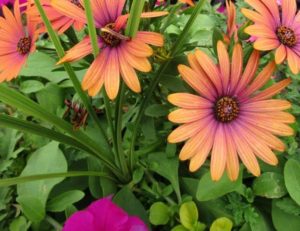
Flowers at Tony’s Farm and Garden Center in the Windsor section of Robbinsville, Mercer County.
SIX-MILE RUN RESERVOIR SITE: On Wednesday, May 24, I hiked this area in Franklin, Somerset County, with the Outdoor Club of South Jersey. The area, about 3,000 acres and part of the Delaware and Raritan Canal State Park, had been planned for a reservoir, but that did not come to be. The terrain of red shale soil and traprock is part of the Piedmont geologic region. While pretty terrain – an area that I want to re-visit soon – much of it appears to be grown-over farmland, rather than a pure ecosystem.
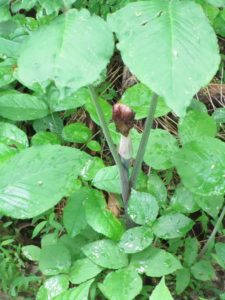
A Jack in the Pulpit flower, “Arisaema triphyllum,” in past-peak bloom at Six-Mile Run Reservoir.
MUSHROOMS: The wet weather may have produced mushrooms popping up in your yard or you simply may see mushrooms in the woods. BE CAREFUL! In my 60 years, I have learned only two mushrooms I feel comfortable picking – and I probably would still eat them with hesitancy out of fear, warranted or not. Remember the adage, “There are old mushroom pickers. There are bold mushroom pickers. There are NO bold AND old mushroom pickers.” It may be best to stay away from mushrooms in garden or afield.
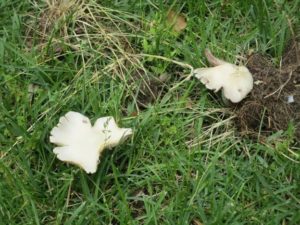
Mushrooms popping up post-rain in my backyard.
TURTLES AND MOUNTAIN LAUREL: Some Pine Barrens lore, “When the mountain laurel blooms, the snapping turtle lays its eggs.” Mountain laurel, “Kalmia latifolia,” is coming into bloom and, yes, snapping turtles, “Chelydra serpentina,” and other turtles are moving about. On Saturday, May 27, Priscilla “Peppy” Bath reported seeing a snapping turtle near her Mercer County home: “There was a huge turtle in the road. We stopped. Another car stopped and the turtle was not injured. But it was a big snapping turtle and the man was afraid to pick it up. Then, a young man on a bicycle came along and he picked it up and got it out of the road.” On the same day, I was driving on Route 206 in Burlington County and had to swerve to miss a box turtle, “Terrapene carolina carolina,” crossing 206. The car behind my Jeep hit it, but it appeared to nick it safely, knocking it to the side of the road. So, a heads-up while driving. If you move a turtle, move it in the direction it was traveling. If it is a snapper, I would use a shovel, not my hands. And, if using one’s hands, do not pick it up by its tail, which could injure it.
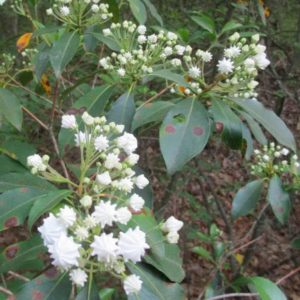
Mountain laurel about ready to go into full bloom at Jamesburg Park in the Pine Barrens around Helmetta.
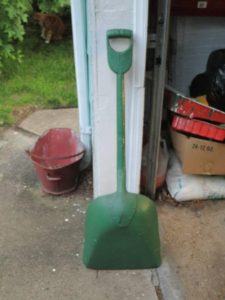
I keep this type of grain shovel in my Jeep to move snapping turtles off roads.
TREE MULCHING: I see so many examples of “volcano” mulching, or the wrong way to mulch a tree. Creating the volcano-look, or the pileup of mulch against a tree could cause too much wetness around the bark or make the tree susceptible to insect infestation or disease. Instead, use the “doughnut” method of placing the “doughnut hole” outside of the tree and its exposed roots, so the mulch is not touching bark. Outside of the hole, the mulch should be about only 2 or 3 inches in depth, so as not to overwet the tree. The outer rim of the “doughnut” should go to the end of the root ball or the tree canopy/drip line. If a tree is established, there is no need for mulching.
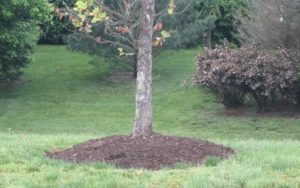
The mulch “volcano,” or the wrong way to mulch a tree, in South Brunswick, Middlesex County.
BLACKWELLS MILLS GARDENS: The gardens looked beautiful, here — in Franklin, Somerset County — which is part of Delaware and Raritan Canal State Park.
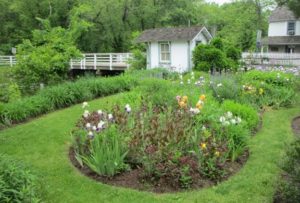
The garden at the circa 1830 bridge tender station at Blackwells Mills.
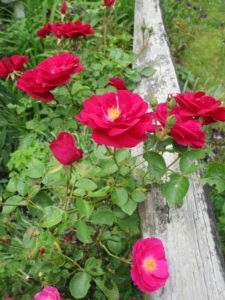
Flowers at Blackwells Mills.
MOON: The crescent moon waxes toward the June 9 Full Strawberry Moon.
GARDEN AND AFIELD: I already had some lower broom sedge, “Andropogon virginicus variety abbreviates,” gathered, here, in the Pine Barrens around Helmetta on display on my kitchen table. So, with my “Knock Out” Roses blooming, I just added some of those to the vase.
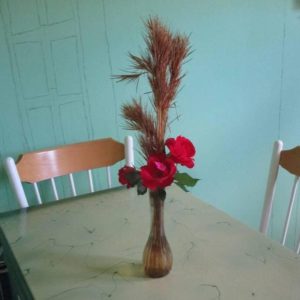
“Knock Out” Roses and lower broom sedge on my kitchen table.
SUNRISE/SUNSET: For the week of May 28, Sunday, to June 3, Saturday, the sun will rise about 5:30 a.m. and set about 8:20 p.m.
WEATHER: The National Weather Service forecasting station for the area is at http://www.weather.gov/phi/.
MY GARDEN: I am simply practicing the three Ws: Water, Weed, and Wait – waiting for lettuce, carrot, pea, sweet corn, tomato, mushmelon, cucumber, and zinnia to grow and be picked.
Joe Sapia, 60, is a lifelong Monroe resident. He is a Pine Barrens naturalist and an organic vegetable-fruit gardener.
He gardens the same backyard plot as did his Italian-American father, Joe Sr., and his Polish-immigrant, maternal grandmother, Annie Poznanski Onda. Both are inspirations for his food gardening. Joe is active with the Rutgers University Master Gardeners/Middlesex County program. He draws inspiration on the Pine Barrens around Helmetta from his mother, Sophie Onda Sapia, who lived her whole life in these Pines, and his Grandma Annie. Joe’s work also is at @JosephSapia on Twitter.com, along with Facebook.com on the Jersey Midlands page.
Article and photos by Joe Mish
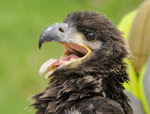
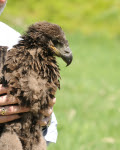
Three generations of eagles have cast their shadows over the land along the South Branch. Eagles are often seen but not recognized because the white head and tail are not developed until the 4th or 5th year.
A large dark bird perched on a light gray branch of a dead tree that hung low over the South Branch. I was quite a distance upriver, my attention focused navigating the shallow water when I caught sight of that dark, solid brown bird. Thinking it was a large hawk, I pulled the camera from the bag in the event I might get near enough for a photo. I aligned the canoe with the current when I was quite close, traded the paddle for the camera and began to click away. I drifted directly under the co-operative bird and began to wonder at the exceptionally large beak. I couldn’t imagine that after viewing the images online, I had been in the presence of a juvenile bald eagle.
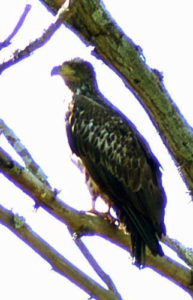
That event occurred in the spring of 2011. It was the very first time I ever saw an eagle on the South Branch and almost discounted it as an oversized, unidentified hawk.
Since 2011, I had been seeing more eagles of different age groups in that same area and in December of 2014, the first sticks were assembled into a nest. By late March 2015 eggs were being incubated and two eaglets hatched in April and banded in May with green aluminum bands E14 and E15.
Up to that point eagles had existed for most people only as a concept or an image on coin of the realm or marketed products with a patriotic flare.
The question now on eagle watcher’s minds after the 2015 success was what would happen next year? Would the eagles return? Would they use the same nest? Was the nest too close to human activity and be abandoned?
Late December 2015 a pair of adults thought to be the same eagles from the previous year, began to build a new nest opposite the old nest. It seemed quite a random decision and in human terms, spiked with a heavy dose of humor attributed to the obsessive behavior of one of the pair. they have a perfectly good nest, why are they building another?
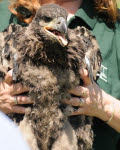
Eagles have been known to build nests and not use them, sometimes called, practice nests, as a best guess. In any event, the nest went up in record time and another pair of eagles hatched, banded and fledged in the spring of 2016. That year the eaglets were banded with green bands bearing E43 and E44.
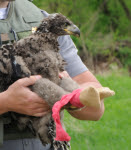
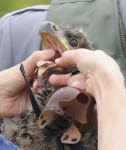
Reputed to mate for life, eagles tend to go separate ways after raising their young, often to far off destinations. One of a local pair had been tracked to Long island and the other to
Philadelphia. Given the vagaries of nature, sickness, accident and foul play it is somewhat miraculous they meet again, same time, same place, to raise another brood.
In late 2016 the eagle’s nest was destroyed and hearts sank for the production a third generation of new eagles on the South Branch.
Our eagles would not let us down as sticks began to reappear and another new nest was constructed. Speculation was ripe with concern that it was too late or the disturbance would discourage the eagles from mating and laying eggs. Right on schedule eggs were laid and two eaglets hatched in the spring of 2017. Banding took place in May and green bands E57 and E58 were affixed to the legs of a feisty pair of 2017 South Branch graduates.
Three years in a row, two eagles produced and fledged six offspring along the South Branch. In that nest they delivered three generations of eagles to someday impress the children of today’s children with the spectacular view of a wild and free eagle casting its shadow across the land.
This eagle pair has demonstrated persistence, patience, devotion and tolerance with their presence along the South Branch; Qualities that would serve all communities well to embrace.
Author’s note: See winterbearrising.wordpress.com bottom of gallery2, for age difference by plumage and a video snippet from the 2017 eagle banding.
Author Joe Mish has been running wild in New Jersey since childhood when he found ways to escape his mother’s watchful eyes. He continues to trek the swamps, rivers and thickets seeking to share, with the residents and visitors, all of the state’s natural beauty hidden within full view. To read more of his writing and view more of his gorgeous photographs visit Winter Bear Rising, his wordpress blog. Joe’s series “Nature on the Raritan, Hidden in Plain View” runs monthly as part of the LRWP “Voices of the Watershed” series. Writing and photos used with permission from the author.
Article and photos by Joe Sapia
Note: The yard references are to my house in the section of Monroe between Helmetta and Jamesburg in South Middlesex County. My yard is in a Pine Barrens outlier on the Inner Coastal Plain, the soil is loamy, and my neighborhood is on the boundary of Gardening Zones 6b (cooler) and 7a (warmer). Afield references are to the Pine Barrens around Helmetta, unless otherwise noted. Photographs are for the period covered, unless otherwise noted.

Packets of some of the seeds I planted in my garden this year.
THE GARDEN: Shooting for May 20, I planted my garden pretty much on target, May 19 and 20, directly sowing Rutgers Heirloom Tomato, Heirloom Cucumber Straight Eight, Hale’s Best Jumbo Heirloom Cantaloupe, Northern Xtra-Sweet Hybrid (Sh2) Sweet Corn, and State Fair Mix Zinnia, all by Burpee, along with Cut and Come Again Zinnia by Agway. I started Red Cherry Tomato by Lake Valley Seed inside and transplanted them outside. Earlier in the season, I directly sowed cool-season crops: Salad Bowl Lettuce, Rainbow Blend Carrot, and Sugar Daddy Snap Pea, all the Lake Valley Seed brand. My garden is approximately 950 square feet, or about 315 row-feet. Now, it is the three Ws: Water (by 10 a.m. daily, unless the ground is wet), Weed, Wait.

Lettuce growing nicely in my garden.
DEALING WITH MOTHER NATURE AND FATHER REALITY: I was planting the garden, working with no shirt on, when I finally paid attention to the buzzing around me. Ugh, bees! But I noticed they were not aggressive. I did some research and it appears my garden has beneficial ground bees, which will help with pollination. Thank you, Mother Nature. As for Father Reality, I had plowed areas for zinnias in the front yard and corn in a section of the backyard, only to find out contractors are ready to go on a house-remodeling project that has been planned for about two years. OK, no problem, I just re-grouped, abandoning plow lines too close to the house so as not to impede the work and plowed new lines. Father Reality turned out to be not so bad.
MOUNTAIN LAUREL AND TURTLES: Mountain laurel, “Kalmia latifolia,” is coming into bloom. With that, I recall some Pine Barrens lore: The snapping turtle lays its eggs when the mountain laurel blooms. Yep, there are reports of turtles moving around: snappers, “Chelydra serpentine”; painters, “Chrysemys picta”; boxers, “Terrapene Carolina.” If you move a turtle off a road, move it in the direction it was traveling. A water turtle is likely a female, either heading to high ground to lay eggs or returning to water after laying eggs. Safely moving snapping turtles: I use a shovel, preferably a wide grain shovel; I keep a grain shovel in my Jeep this time of year. More Piney lore: Only the setting sun or lightning makes the snapping turtle let go. A snapper’s chopped-off head will continue biting. Joey lore: If a snapping turtle will not let go, try shoving a wire up a nostril.
COLLIERS MILLS WMA: The state Colliers Mills Wildlife Management Area is about 13,000 acres in the Pine Barrens in Jackson and Plumsted, Ocean County. It basically runs from Six Flags Great Adventure in the north to Joint Base McGuire-Dix-Lakehurst in the south. Woods, fields, swamps, waterways, and bodies of water comprise the essentially undeveloped property. WMAs, or “game lands” as they are known elsewhere outside of New Jersey, basically are wildlife habitats and hunting grounds. Painted turtles, “Chrysemys picta,” basked. Yellow pond lilies, “Nuphar lutea,” were in bud. Pine Barrens hudsonia, “Hudsonia ericoides,” bloomed.

A painted turtle basks on Colliers Lake in the Colliers Mills Wildlife Management Area. Yellow pond lilies budding.

Pine Barrens hudsonia in bloom at the Colliers Mills WMA.
BEARS: Reports of roaming black bear, “Ursus americanus,” continue this spring. This week, there was a report of a bear in Millstone/Monmouth County. Stay clear and all should be all right. The bears are acting as bears do, looking for their own turf or to mate.
“KNOCK OUT” ROSES: My “Knock Out” roses started blooming. What a beautiful flowering addition to the yard. Other than trimming them, I do no maintenance on them. (They are thorny. Ask my foot. Foolishly walking barefooted last year, I stepped on a thorn, which stayed in my foot probably for weeks. I learned my lesson. I now wear shoes around the Knock Outs.)

Knock Outs bloom in my backyard.
YARDWORK: On Wednesday, I trimmed the shrubs. At one point, I simply lifted my arm to trim some high shrubs and nearly went down on all fours with a pain in my left side/back. I hobbled to the house and lie down. Awakened Thursday, feeling better, and cut the lawn. On Friday, I prepared the garden and planted. On Saturday, I finished the planting. Feeling 60-years-old and beat up Saturday night!
BE ATTUNED TO NATURE: It is amazing how much of the natural world “happens” in front of us, rather than we having to go look for it. At Helmetta Pond, I watched a smaller bird harass a bigger bird, unfortunately too far away for me to identify. Standing in my backyard recently, I watched a black-colored bird harass a red-tailed hawk, “Buteo jamaicensis,” then I watched two red-tails circle around in the sky. And, as I have mentioned previously, I keep seeing a great egret, “Ardea alba,” fly by my house. So, keep an eye out.
PINK LADY-SLIPPER ORCHIDS: Seems to be a great year for pink lady-slipper orchids, “Cypripedium acaule.” I am seeing nice ones, here, in the Pine Barrens around Helmetta (and hearing of sightings in the main Pine Barrens). This week on a walk in the woods, I saw about 25, with about one-fifth blooming. In another spot, there were about 65. So, I saw almost 100.

Two blooming pink lady-slippers at Jamesburg Park in the Pine Barrens around Helmetta.

Pine Barrens around Helmetta – Gall of the wool-sower wasp, “Callirhytis seminator,” on a member of the white oak, genus “Quercus,” family. How to identify a member of the white oak family: Look at the round edges of the leaves, like bullets, rather than points, like arrows. Oaks with pointy leaves are members of the red oak family.
HUNTERDON COUNTY: Arguably New Jersey’s most beautiful county.

Green Sergeant’s Bridge, outside of Sergeantsville/Hunterdon County, the last remaining publicly owned covered bridge in New Jersey.

Cut hay in a field between Stockton and Sergeantsville/Hunterdon County.
BUTTERFLIES: For what it is worth, I have been seeing a lot of tiger swallowtails, “Papilio glaucus,” flying around.
SUNRISE/SUNSET: For the week of May 21, Sunday, to May 27, Saturday, the sun will rise about 5:35 a.m. and set about 8:15 p.m.
WEATHER: The National Weather Service forecasting station for the area is at http://www.weather.gov/phi/.
STAY ALERT: Stay alert with camera at the ready. There is a lot to see in garden and afield.

Pine Barrens “tea” water flowing over the spillway at Lake Success in the Colliers Mills Wildlife Management Area/Ocean County. Iron and vegetative matter color the water.
Joe Sapia, 60, is a lifelong Monroe resident. He is a Pine Barrens naturalist and an organic vegetable-fruit gardener.
He gardens the same backyard plot as did his Italian-American father, Joe Sr., and his Polish-immigrant, maternal grandmother, Annie Poznanski Onda. Both are inspirations for his food gardening. Joe is active with the Rutgers University Master Gardeners/Middlesex County program. He draws inspiration on the Pine Barrens around Helmetta from his mother, Sophie Onda Sapia, who lived her whole life in these Pines, and his Grandma Annie. Joe’s work is also at @JosephSapia on Twitter.com, along with Facebook.com on the Jersey Midlands page.
Article and Photos by Joe Sapia
Note: The yard references are to my house in the section of Monroe between Helmetta and Jamesburg in South Middlesex County. My yard is in a Pine Barrens outlier on the Inner Coastal Plain, the soil is loamy, and my neighborhood is on the boundary of Gardening Zones 6b (cooler) and 7a (warmer). Afield references are to the Pine Barrens around Helmetta, unless otherwise noted. Photographs are for the period covered, unless otherwise noted.
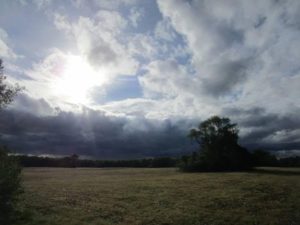
The Van Dyke Farm at Pigeon Swamp, South Brunswick/Middlesex County, where growing crops meets the woods.
VAN DYKE FARM: A favorite place to shoot photographs of mine is the Van Dyke Farm at Pigeon Swamp in South Brunswick/Middlesex County. It offers big-sky views to the west and the setting sun. See http://www.middlesexcountynj.gov/About/ParksRecreation/Pages/PR/VanDyke.aspx.
SOURLAND MOUNTAIN: I hiked one of my favorite Midlands places, Sourland Mountain on the boundary of Somerset, Hunterdon, and Mercer counties with a club I have been a member of for about 35 years, the Outdoor Club of South Jersey. On the mountain, I saw various flowers in bloom: showy orchid, “Galearis spectabilis,”; rue anemone, “Anemonella thalictroides”; and spring beauties, “”Claytonia virginica.” Being on the Piedmont with its rocky terrain, Sourland Mountain is much different than my generally flat and sandy Pine Barrens around Helmetta.
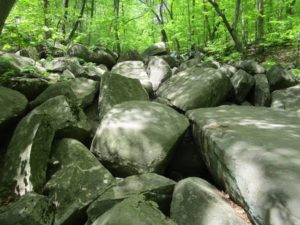
The Roaring Rocks boulder field on Sourland Mountain. Notice the hikers in the upper part of the photo.
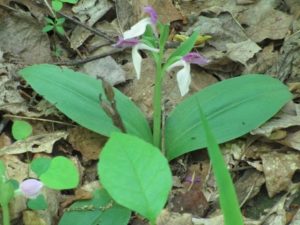
A showy orchid on Sourland Mountain
FLATLANDERS VERSUS HILLTOPPERS: For purposes of this writing, New Jersey has four geological areas, which run northeast to southwest: from west to east, Ridges and Valleys, Highlands, Piedmont, and Coastal Plain. (The Coastal Plain can be divided into two areas, Inner and Outer, making it five regions.) Generally, the Midlands are divided into the Piedmont and Coastal Plain, with distinct characteristics. The generally flat Coastal Plain has white, sandy soil (think Shore and Pine Barrens) and dark soil (think conventional farming areas). The rolling Piedmont has red shale and traprock boulders.
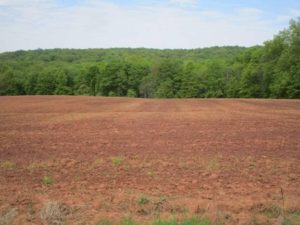
Piedmont red shale at Sourland Mountain, which is in the background.
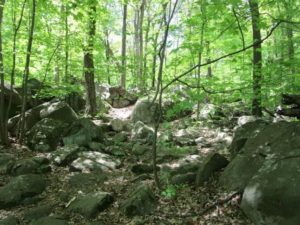
Traprock boulders on Sourland Mountain.
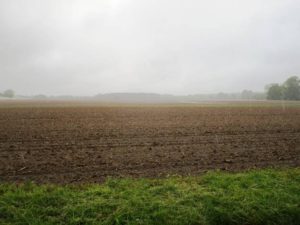
Coastal Plain dark soil at Cranbury/Middlesex County.
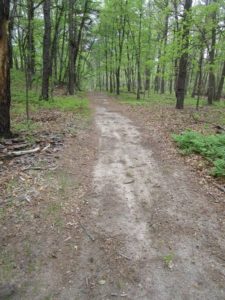
White, sandy soil in the Pine Barrens of Helmetta on the Coastal Plain.
FULL MOON AND PLANTING: The full moon was May 10, Wednesday, and some feel it is OK, now, to plant warm weather crops. Not me, especially with the cooler weather we have been having. I am still waiting for May 20 (if it warms up) to June 1 (if it remains on the cool side). Then, I will plant my warmer season crop – tomatoes, mushmellon, sweet corn, and cucumbers, along with zinnias to attract pollinators and for their beauty.
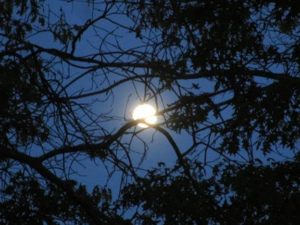
The near-Full Corn-Planting Moon. The full moon was Wednesday, May 10.
FOOD GARDEN: I weeded for the first time around the cool weather crops — “Salad Bowl” heirloom lettuce, “Rainbow Blend” carrots, and “Sugar Daddy” snap peas, all “Lake Valley Seed Company” brand — that have sprouted. I continue watering the garden.
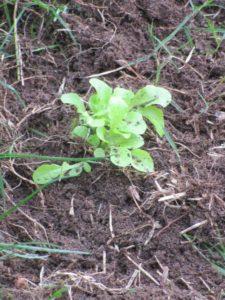
Lake Valley Seed Company “Salad Bowl” heirloom lettuce growing in my garden.
WATERING THE FOOD GARDEN: My goal is to give the food garden a thorough watering by 10 a.m. This allows the garden to retain water, rather than have the water evaporate in the heat of day, and allows the garden to dry by the dewy nightfall to prevent fungal growth.
KEEPING WILDLIFE AWAY, CAYENNE PEPPER: I was talking a waitress at the Dayton Diner in South Brunswick/Middlesex County. An experienced gardener, she recommended using cayenne pepper as a method of pest control around the garden. I plan on trying that.
ALONG THE SOUTH RIVER: My travels took me across the South River at Old Bridge village on the boundary of Old Bridge, Sayreville, and East Brunswick, all in Middlesex County. On my way back, I stopped to shoot photographs between Old Bridge village and the New Causeway on the boundary of South River and Sayreville, both in Middlesex County. The South River is formed by the meeting of Manalapan and Matchaponix brooks on the Spotswood-Old Bridge boundary at DuHerNaL Lake/Middlesex County. (DuHerNaL Lake gets its name from the three companies that had used it as a reservoir: DuPont, Hercules, and National Lead.) Normally, I do not think of inland self, 25 or so miles from the Atlantic Ocean, living near salt water, but the tidal effect begins at the bottom of the DuHerNal Lake dam, only a little more than 4 miles from my house.
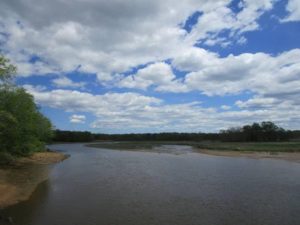
The South River at low tide at Old Bridge village.
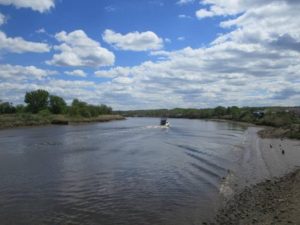
The South River at low tide at the New Causeway on the South River-Sayreville boundary. This scene looks upstream toward the railroad bridge and the South River Boat Club — Sayreville on the left, South River on the right.
KILLDEER: When I was at the South River at Cannon Brothers Park in South River, I spooked a killdeer, “Charadrius vociferous.” The species screeches a “kill-deer” call. Because of the way the bird was acting, panicked but not leaving the area, I suspect it had a nest nearby it was trying to divert me from. An adult killdeer will even fake a broken wing to get a predator to follow it, rather than have the predator attack the ground nest. I could not find a nest.
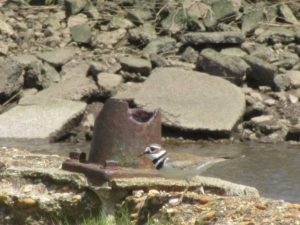
A killdeer along the South River in South River.
TURKEYS: Some thoughts from Bob Eriksen, the retired state turkey biologist, on “Meleagris gallopavo,” “…Wild turkeys that have adapted to suburbia will sometimes nest in among shrubs in a yard. I had one nest next to a gravestone in a cemetery. Most of the time turkey nests are in the woods or in an overgrown field. Hens will tuck in next to a tree trunk, at the base of a shrub, or in a blowdown, especially if there is a branch within a few feet. They like to have a bit of overhead cover. Once the grass in hayfields is tall enough to hide the hen crouched down (usually second week of May), a hen turkey will nest in a hayfield. Cover is the main consideration. Hens are pretty secretive approaching the nest. They may circle or use different approaches when they go to the nest to lay. When the clutch is large enough (10-12 eggs), she will begin to incubate. For the first couple of nights after she has completed her clutch, she may tree roost, but that changes fast. Once incubation begins, the hen will be on the nest 20 or more hours a day.” (A shout out to Bob for always being so helpful.)
JERSEY MIDLANDS LORE: Another good source of information is legendary Helmetta outdoorsman Ralph “Rusty” Richards, 84-years-old. During one of our occasional breakfasts of members of 100-year Helmetta families, Rusty was talking about deer-hunting. In the early part of the 20th Century, white-tailed deer, “Odocoileus virginianus,” were almost gone from New Jersey because of over-hunting. As the state brought them back, they gradually re-settled. About 1950, they were in the Broadway Woods area of South Brunswick/Middlesex County, only a few miles from Helmetta, according to Rusty. Then, about 1955, they were settled around Helmetta, Rusty said.
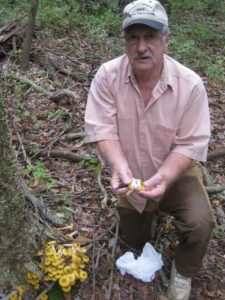
In 2011, Rusty Richards with “opienki” mushrooms, genus “Armillaria,” in the Pine Barrens around Helmetta.
BOBWHITE: Did I hear a bobwhite quail, “Colinus virginianus,” calling in my neighborhood? If so, it would have been a return to my childhood when one could hear the “Bob White” call at night. Bobwhites have become rare in New Jersey because of habitat loss, but, in recent years, there has been an effort to welcome them back. So, was it a wild bobwhite or not? I do not know….
TICKS: Reports are still coming in on how bad a tick season it is.
I am hearing reports of deer ticks, “Ixodes scapularis,” and lone star ticks, “Amblyomma americanum.” Various reasons may be causing the problem, including warm weather generating acorn growth and, in turn, the acorns providing abundant food to tick-carrying animals, along with the recent rainy weather. “More rain typically enhances tick season,” said meteorologist Steve DiMartino.
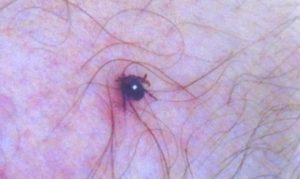
A lone star tick on my leg. Lone star ticks are easily identifiable by the yellow dot on their backs.
PINE BARRENS AROUND HELMETTA: Pink lady-slipper orchids, “Cypripedium acaule,” continue to bloom. I know of a spot that has about 75 lady-slippers, with about five in bloom. If you see a pink lady-slipper, look around for more in the area; I see them in clusters. And do not pick them!
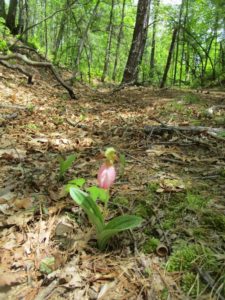
A blooming pink lady-slipper orchid, with another, left and to the rear of the blooming orchid, poking through the ground.
SUNRISE/SUNSET: For the week of May 14, Sunday, to May 20, Saturday, the sun will rise at about 5:40 a.m. and set at about 8:10 p.m.
WEATHER: Go to the National Weather Service forecasting station for the area, http://www.weather.gov/phi/.
THE END-OF-THE-WEEK RAIN: I look to a thorough rain around May 15 to green up the woods for the season. The steady, heavy rain of Saturday, May 13, should have accomplished that. By late Saturday night as the rain continued, my rain gauge showed 2.3 inches.
WEATHER: Go to the National Weather Service forecasting station for the area, http://www.weather.gov/phi/.
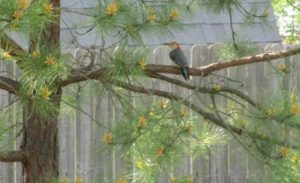
A red-bellied woodpecker, “Melanerpes carolinus,” sitting in a pitch pine, “Pinus rigida,” in my backyard.
Joe Sapia, 60, is a lifelong Monroe resident. He is a Pine Barrens naturalist and an organic vegetable-fruit gardener.
He gardens the same backyard plot as did his Italian-American father, Joe Sr., and his Polish-immigrant, maternal grandmother, Annie Poznanski Onda. Both are inspirations for his food gardening. Joe is active with the Rutgers University Master Gardeners/Middlesex County program. He draws inspiration on the Pine Barrens around Helmetta from his mother, Sophie Onda Sapia, who lived her whole life in these Pines, and his Grandma Annie.
Article and photos by Joe Sapia
Note: The yard references are to my house in the section of Monroe between Helmetta and Jamesburg in South Middlesex County. My yard is in a Pine Barrens outlier on the Inner Coastal Plain, the soil is loamy, and my neighborhood is on the boundary of Gardening Zones 6b (cooler) and 7a (warmer). Afield references are to the Pine Barrens around Helmetta, unless otherwise noted. Photographs are for the period covered, unless otherwise noted.
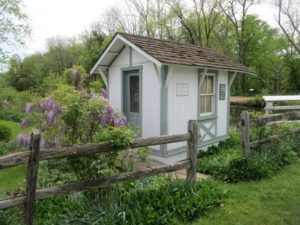
In the Delaware and Raritan State Park, the historic bridgetender station, circa 1830, and garden at Blackwells Mills in Franklin/Somerset County.
GARDEN AND YARD: In my food garden, peeking through the soil are cool weather vegetables of lettuce and carrots. I had not seen any noticeable sign of peas coming up, but Cranbury/Middlesex County farmer Roy Reinhardt advised me to be patient; He was right, there they were a few days later. Wild onions, “Allium canadense,” are coming up in my lawn; If only I enjoyed onions more than I do, I would have a nice bounty.
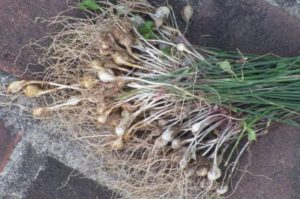
Wild onions growing in the yard.
RAIN: The rain May 5, Friday, was drenching. Kathy Krygier of Krygier’s Nursery in South Brunswick/Middlesex County reported about 1.75 inches. Other reports from the Jersey Midlands, via the wunderground.com website, include Lambertville/Hunterdon County, 1.63 inches; Somerville/Somerset County, 1.16 inches; the Mill Lake Manor section of Monroe, 2.05 inches; Little Silver/Monmouth County, 2.02 inches; Miller Air Park in Berkeley/Ocean County, 2.63 inches; the Chatsworth area/Burlington County, 1.62 inches; and Ewing/Mercer County, 1.63 inches.
UPCOMING FOOD GARDEN DATES: For planting the warm season crop, my rule of thumb is May 20 (in a warm season) to June 1 (in a cooler season), with steady overnight temperatures of 55 or higher. Some planters go by Mother’s Day (this year, May 14), some go by May 15. Helmetta farmer Timmy Mechkowski says after the May full moon – this year, this Wednesday, May 10, the Full Corn-Planting Moon.
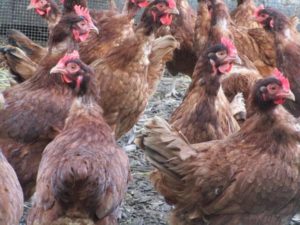
Rhode Island red chickens at the Mechkowski Farm in Helmetta.
INTERNATIONAL SPACE STATION: Possible sightings of the ISS are May 8, Monday, 4:47 a.m. to 4:50 a.m, tracking west southwest to north northeast; May 9, Tuesday, 3:57 a.m. to 3:59 a.m., south to east northeast; May 10, Wednesday, 4:40 a.m. to 4:44 a.m., west to north northeast; May 12, Friday, 4:32 a.m. to 4:36 a.m., west northwest to north northeast. Caution: One needs a clear sky and, at times, a clear view well above the horizon.
EGRET: I have noticed a great egret, “Ardea alba,” fly by my house two or three times in recent weeks, along with once about 1-1/2 miles away. I suspect it is the same bird. Just an interesting sighting.
TURKEY: A wild turkey, “Meleagris gallopavo,” greeted me when I turned onto my street.
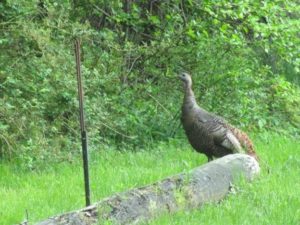
A wild turkey in the neighborhood.
TICKS: Reports are coming in about ticks being out with a vengeance in New Jersey. I, for example, have pulled deer ticks, “Ixodes scapularis,” and lone star ticks, “Amblyomma americanum,” off my clothes. From Chris Bevins, “How are you making out with ticks? They are ferocious this year and first time I’m seeing lone star ticks in abundance.” And Frank Ulatowski says he had about a dozen on him or his clothes after being up at the Delaware Water Gap area.
PINE BARRENS AROUND HELMETTA: Pink lady-slipper orchids, “Cypripedium acaule,” are coming into bloom. Flowering dogwood, “Cornus florida,” remains in bloom. Pitch pine, “Pinus rigida,” have long “candles” of new growth. Cinammon fern, “Osmunda cinnamomea,” is in its fiddlehead state and unfurling. Northern gray treefrogs, “Hyla versicolor,” continue calling vociferously. Spring peeper treefrogs, “Pseudacris crucifer,” continue calling. Sunfish, genus “Lepomis,” guarded their nests at Helmetta Pond. Antlion larvae, “Hesperoleon abdominalis,” had pits to capture ants. And I captured a nice photo of some kind of dragonfly in the woods.
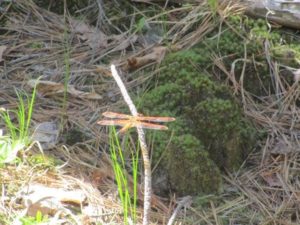
A dragonfly at Jamesburg Park/Middlesex County.
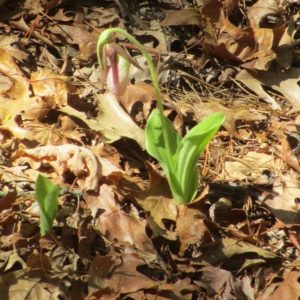
A pink lady-slipper orchid in bloom, right. Left, lady-slipper leaves poking through the ground.
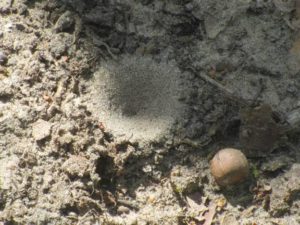
The pit of an antlion larva, or doodlebug. The larva sits in a pit awaiting a meal of an ant. The larva eventually evolves into a flying insect. To put the size of the pit in perspective, that is an acorn sitting nearby.
DELAWARE AND RARITAN CANAL: I visited a Franklin/Somerset County section of the D&R Canal State Park, specifically the area between Route 518 and Blackwells Mills. Various animals were active — great blue heron, “Ardea herodias”; Gray catbird, “Dumetella carolinensis”; redbelly turtles, “Pseudemys rubriventris.” Spring beauties, “Claytonia virginica,” remain in bloom. I saw as-big-as-my-forearm poison ivy, “Toxicodendron radicans” — “Hairy rope, don’t be a dope!” As a kid, I could touch it and not get a rash, but twice I got it bad as an adult years ago — perhaps it was because of the hot days, me sweating, my pores open. Now, I take no chances!
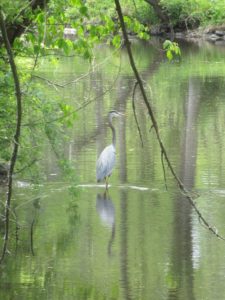
A great blue heron in the D&R Canal.
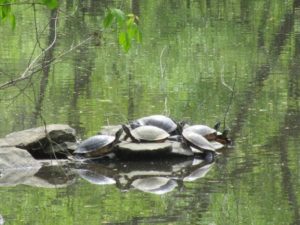
Basking redbelly turtles in the D&R Canal.
TURTLES CROSSING ROADS: A heads-up for turtles crossing roads. There has been a lot of reported movement lately. If driving, watch out for them. If trying to move them, one, do it safely and, two, move the turtle in the direction it was traveling. (For snapping turtles, “Chelydra serpentina,” BE CAREFUL. Some Piney lore, only lightning or the setting sun will make a snapper let go. Me, I use a grain shovel I keep in my Jeep to move snappers across roads.) I was driving through Pigeon Swamp in South Brunswick/Middlesex County recently and saw what I think was an eastern painted turtle, “Chrysemys picta,” crossing a road. By the time I turned around to move it, it was gone.
SUNRISE/SUNSET: For the week of May 7, Sunday, to May 13, Saturday, the sun will rise at about 5:45 a.m. and set at about 8:05 p.m.
WEATHER: Go to the National Weather Service forecasting station for the area, http://www.weather.gov/phi/.
UPCOMING AFIELD DATE: The first soaking rain around May 15 should green up the woods for the season.
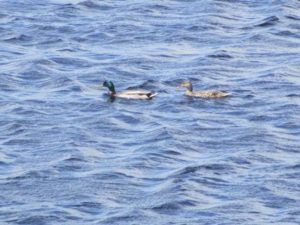
Mallards, “Anas platyrhynchos,” at Helmetta Pond. Left, the colorful male, and, right, the more drabby, brown female.
Joe Sapia, 60, is a lifelong Monroe resident. He is a Pine Barrens naturalist and an organic vegetable-fruit gardener.
He gardens the same backyard plot as did his Italian-American father, Joe Sr., and his Polish-immigrant, maternal grandmother, Annie Poznanski Onda. Both are inspirations for his food gardening. Joe is active with the Rutgers University Master Gardeners/Middlesex County program. He draws inspiration on the Pine Barrens around Helmetta from his mother, Sophie Onda Sapia, who lived her whole life in these Pines, and his Grandma Annie.
Article and photos by Joe Sapia
Notes from Garden and Afield in the Jersey Midlands
“From the Raritan River to the Mullica River, From the Delaware River to the Atlantic Ocean….”
Week of 2017, April 23, Sunday, to April 29, Saturday
Note: The yard references are to my house in the section of Monroe between Helmetta and Jamesburg in South Middlesex County. My yard is in a Pine Barrens outlier on the Inner Coastal Plain, the soil is loamy, and my neighborhood is on the boundary of Gardening Zones 6b (cooler) and 7a (warmer). Afield references are to the Pine Barrens around Helmetta, unless otherwise noted.

Helmetta Pond at dusk
PINE BARRENS AROUND HELMETTA: Flowering dogwoods, “Cornus florida,” are flowering. Pitch pines, “Pinus rigida,” have their “candles,” or new growth. Northern gray treefrogs, “Hyla versicolor” and northern spring peeper treefrogs, “Pseudacris crucifer crucifer,” are calling.

Flowering dogwoods in the Pine Barrens around Helmetta, specifically in an East Brunswick section of the Jamesburg Park Conservation Area.

“Candles,” or new growth, on a pitch pine in the Pine Barrens around Helmetta.

“Candles,” or new growth, on a pitch pine in the Pine Barrens around Helmetta.
SOURLAND MOUNTAIN WILDFLOWERS: This week, I drove the Piedmont geologic formation from the Delaware River in Hunterdeon County to its meeting the Inner Coastal Plain in South Middlesex County. When I crossed Sourland Mountain on the boundary of Hunterdon, Mercer, and Somerset counties, I saw spring beauties, “Claytonia virginica,” in bloom. Mayapples, “Podophyllum peltatum,” were “umbrella-ing,” their leaves in umbrella-like formation. Mayapples should be blooming about this time, although I did not notice any flowering.

Spring beauties on Sourland Mountain

Mayapples, in their umbrella look, on Sourland Mountain.
TICKS: Ticks are out. While in the woods, I have pulled deer ticks, “Ixodes scapularis,” and a lone star tick, “Amblyomma americanum,” off my clothes.
IN MY GARDEN: Lettuce is sprouting, but I still await carrots and peas.
GARDEN FLOWERING IN LAMBERTVILLE: Ornamental flowers were flourishing in Lambertville, making the town more beautiful than it already is.

Flowers in Lambertville.
SHAD ON THE DELAWARE RIVER: In talking to Lambertville locals April 28, the peak of the American shad, “Alosa sapidissima,” migration up the Delaware River had already passed. But shad were still around – and the Shad Fest wraps up April 30.

Catching shad on the Delaware River.
SNOWFALL FOR 2016-2017: The season ended with 26.5 inches of snow, the last snowfall on March 15. In terms of total snowfall, this was right about average. (The measurements were at my home and the average snowfall figure would be for my area. These recordings are unofficial.)
SUNRISE/SUNSET: For the week of April 30, Sunday, to May 6, Saturday, the sun will rise at about 5:50 a.m. to 6 a.m. and set at about 7:50 p.m. to about 8 p.m.
WEATHER: Go to the National Weather Service forecasting station for the area, http://www.weather.gov/phi/.
DATES TO KEEP IN MIND: For the woods, the first drenching rain around May 15 should green up the woods. For the food garden, my rule of thumb is to plant warm weather vegetables and fruits about May 20 if the weather has been warm and June 1 if the weather has been cool – Look for consistent overnight temperatures of 55 or warmer.
Joe Sapia, 60, is a lifelong Monroe resident. He is a Pine Barrens naturalist and an organic vegetable-fruit gardener.
He gardens the same backyard plot as did his Italian-American father, Joe Sr., and his Polish-immigrant, maternal grandmother, Annie Poznanski Onda. Both are inspirations for his food gardening. Joe is active with the Rutgers University Master Gardeners/Middlesex County program. He draws inspiration on the Pine Barrens around Helmetta from his mother, Sophie Onda Sapia, who lived her whole life in these Pines, and his Grandma Annie.
The following are the headlines on our watch list:
National Monuments Under Threat: On April 26 President Trump signed an Executive Order to roll back the Antiquities Act, which could change National Monument designation (and the protections that that designation affords) for our National Monuments.
Offshore Drilling EO: On April 28 President Trump signed an Executive Order to expand offshore oil and natural gas drilling. The Order instructs the Interior to review ways to take down barriers to drilling, including in the Atlantic.
Marches for Science and Climate: Throughout April tens of thousands of people took to the streets in over 600 communities to celebrate science and its critical role in both society and policy, and to bring attention to the science that underscores our understanding of climate change.