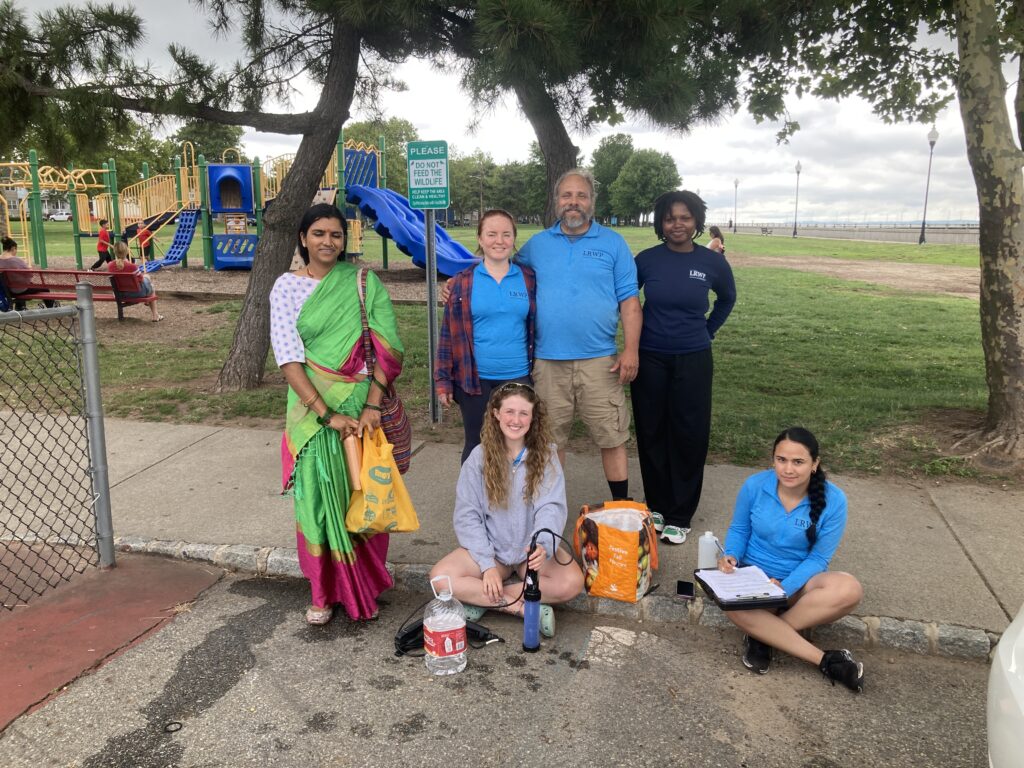
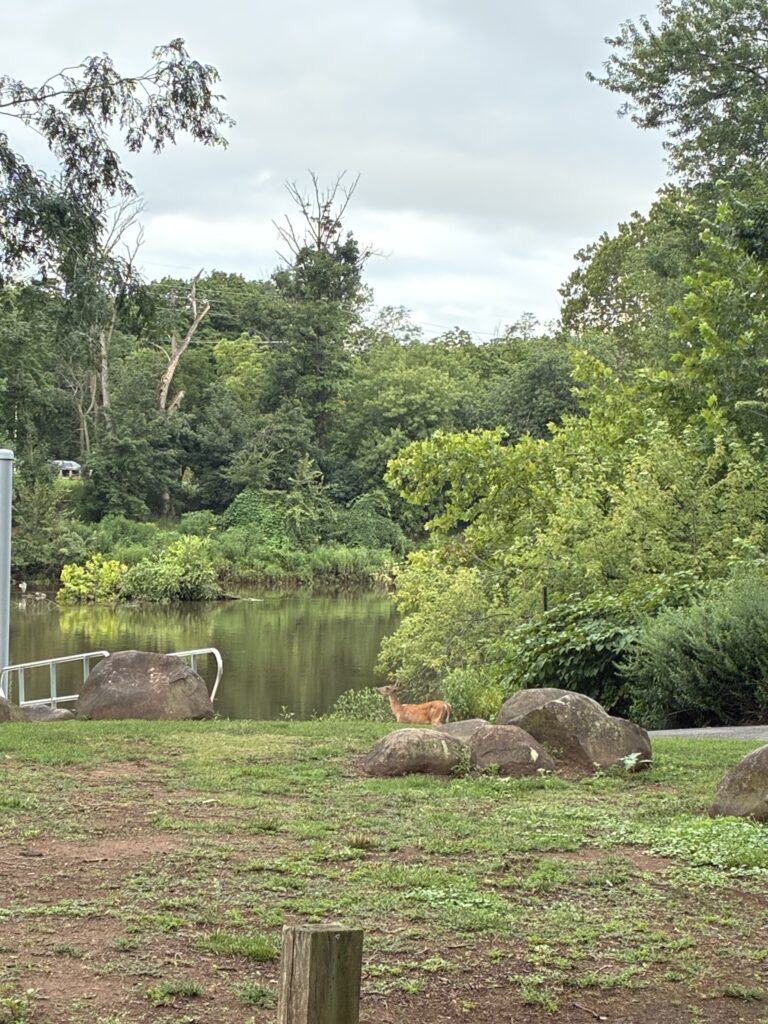
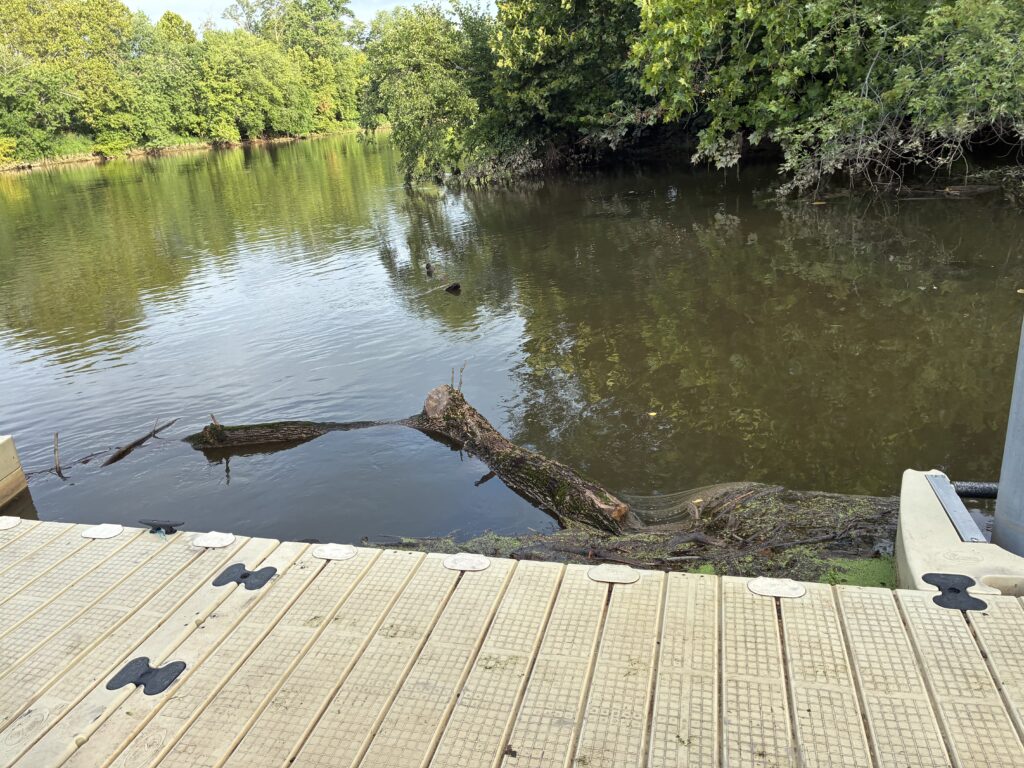
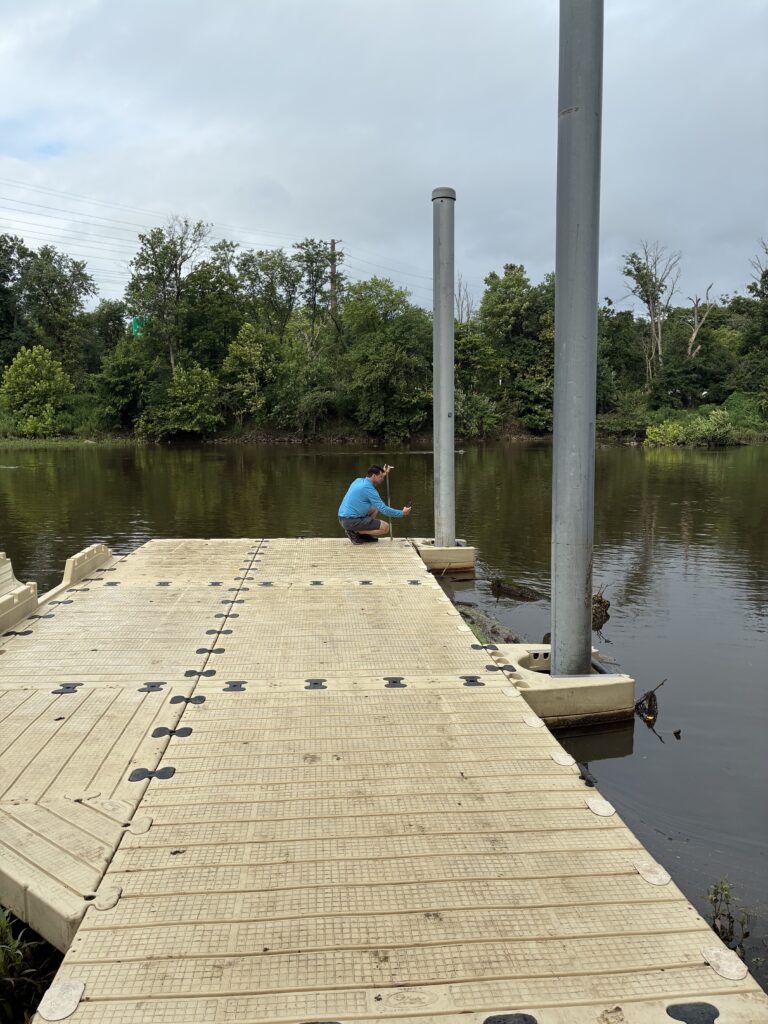
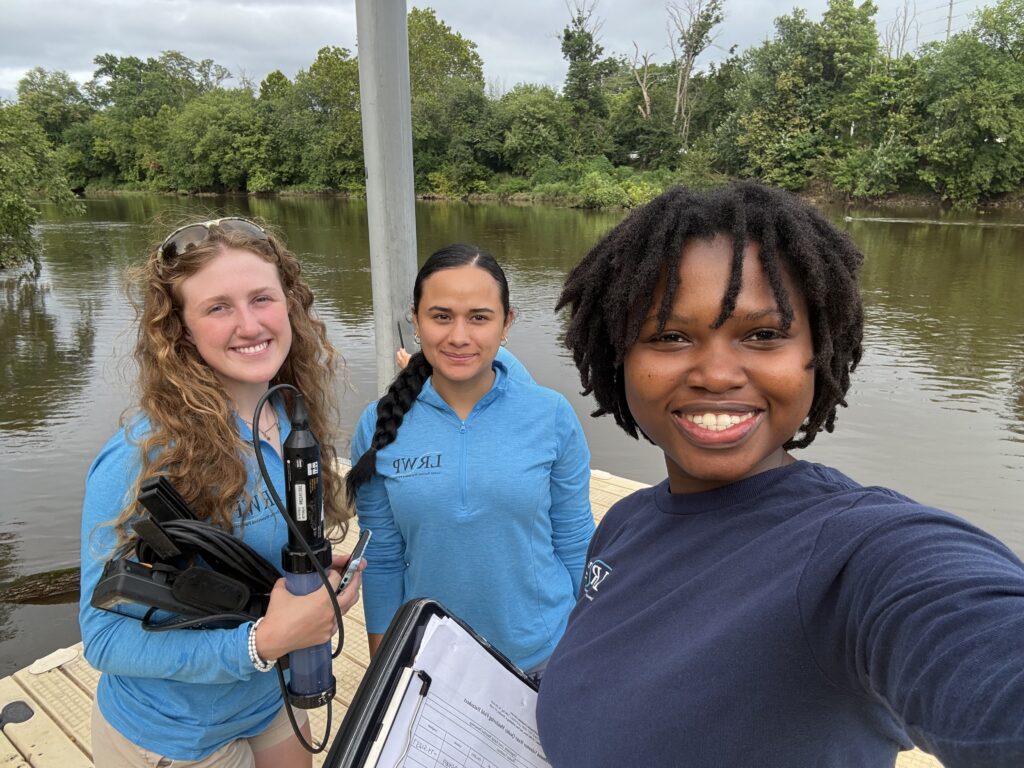
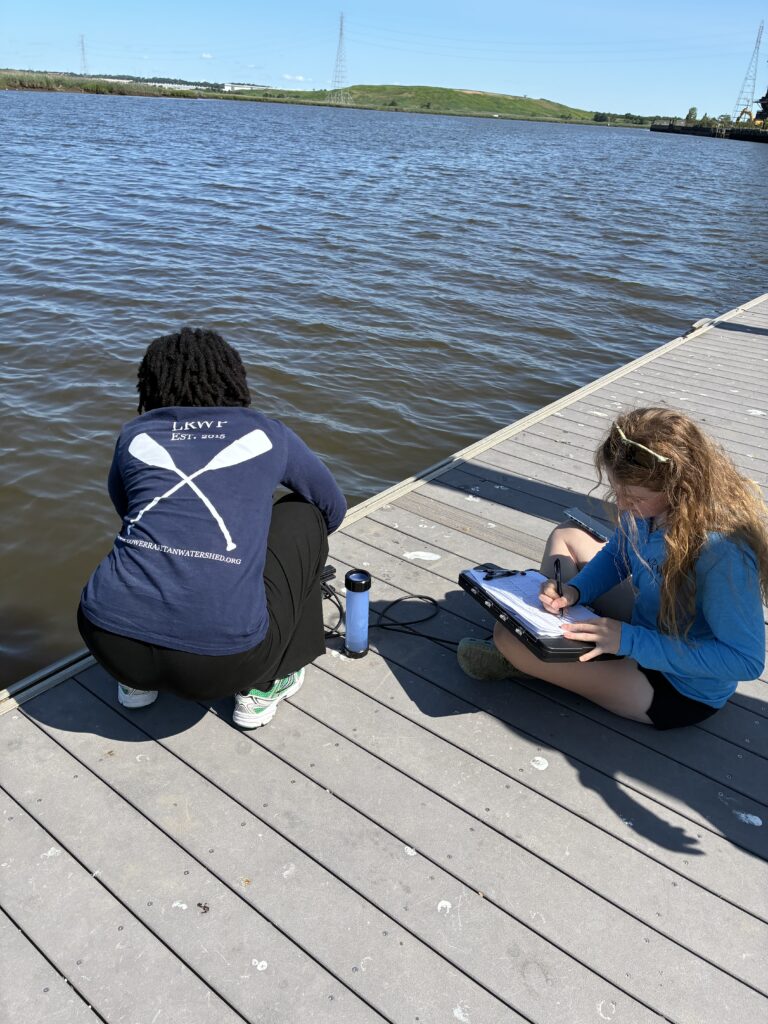
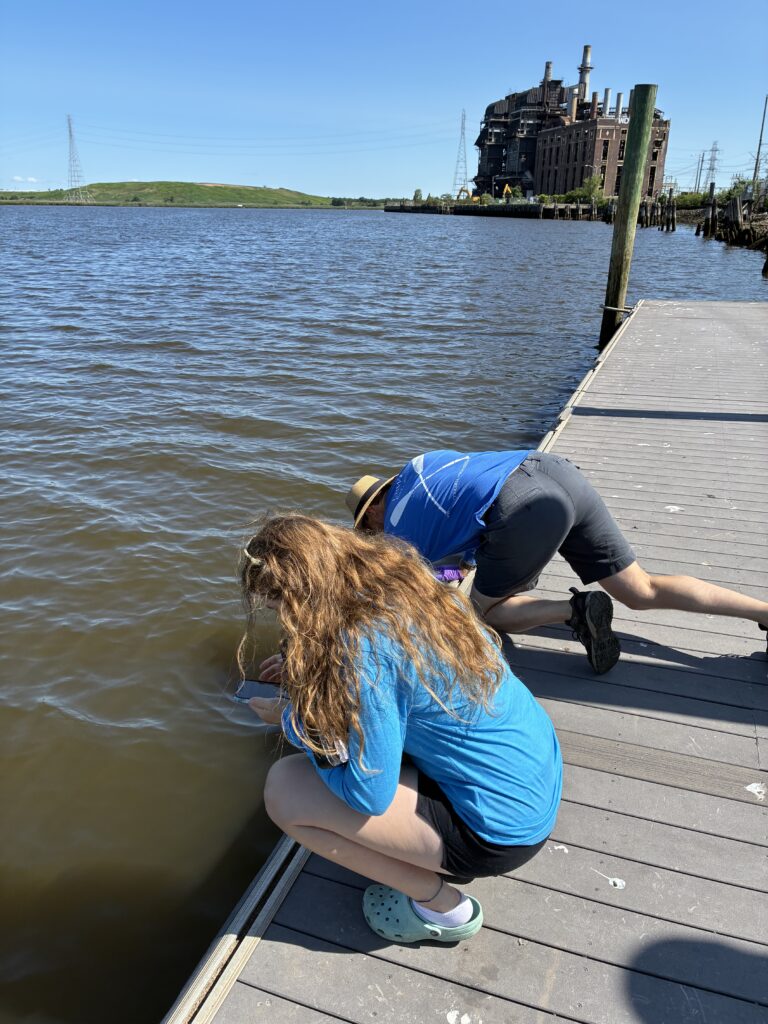
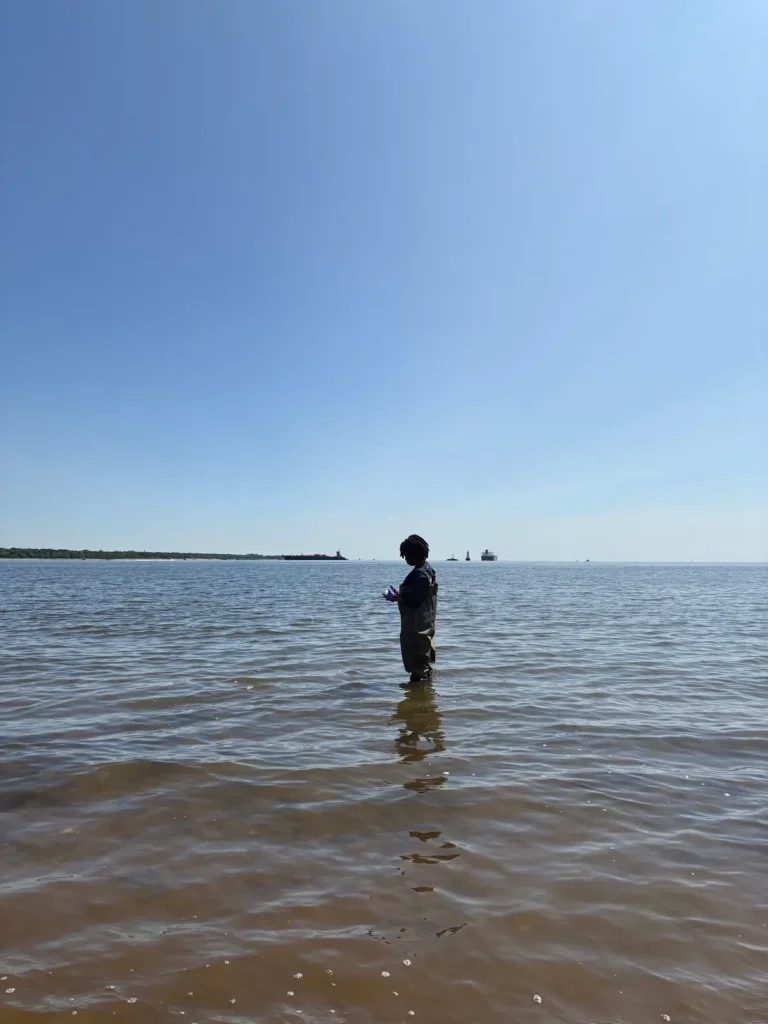
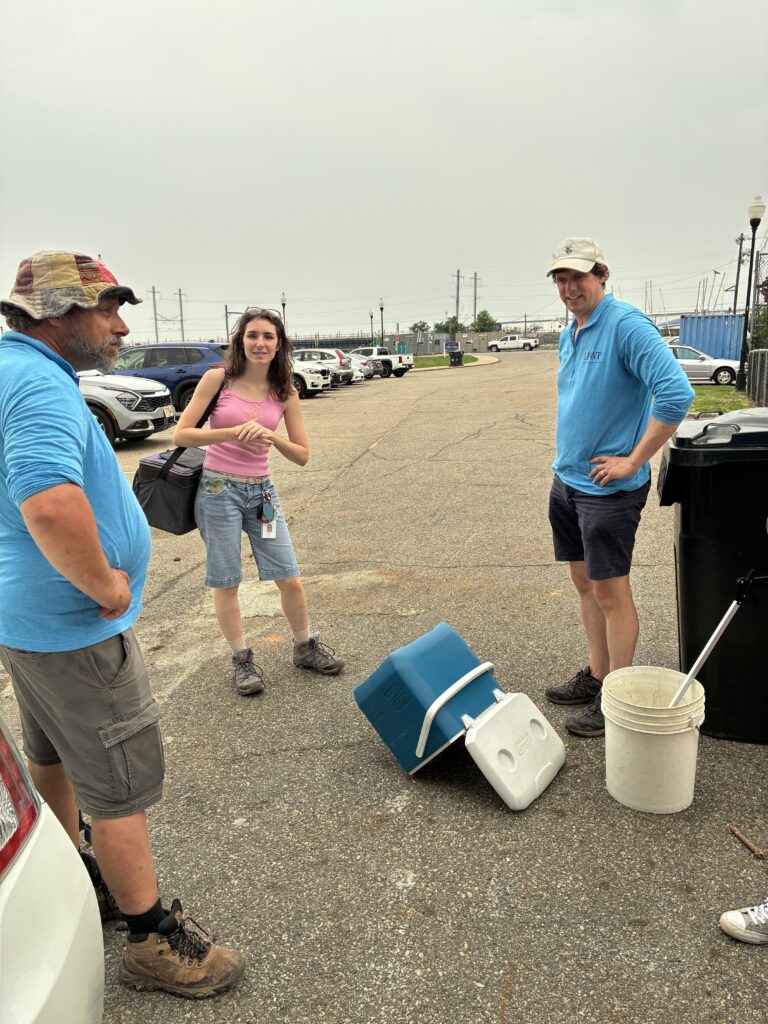
The third pathogen monitoring session of the month took place on Thursday, August 20th. Each week during the summer, from May to October, the Lower Raritan Watershed Partnership and Rutgers Cooperative Extension of Middlesex County run a volunteer-based monitoring program along the Raritan River. We collect water quality samples at six non-bathing public access beach sites, provide our samples to the Interstate Environmental Commission for analysis in their laboratory, and report the results to the public. Our mission is to share this data with the community and partners to ensure the safe use of the Raritan River for all.
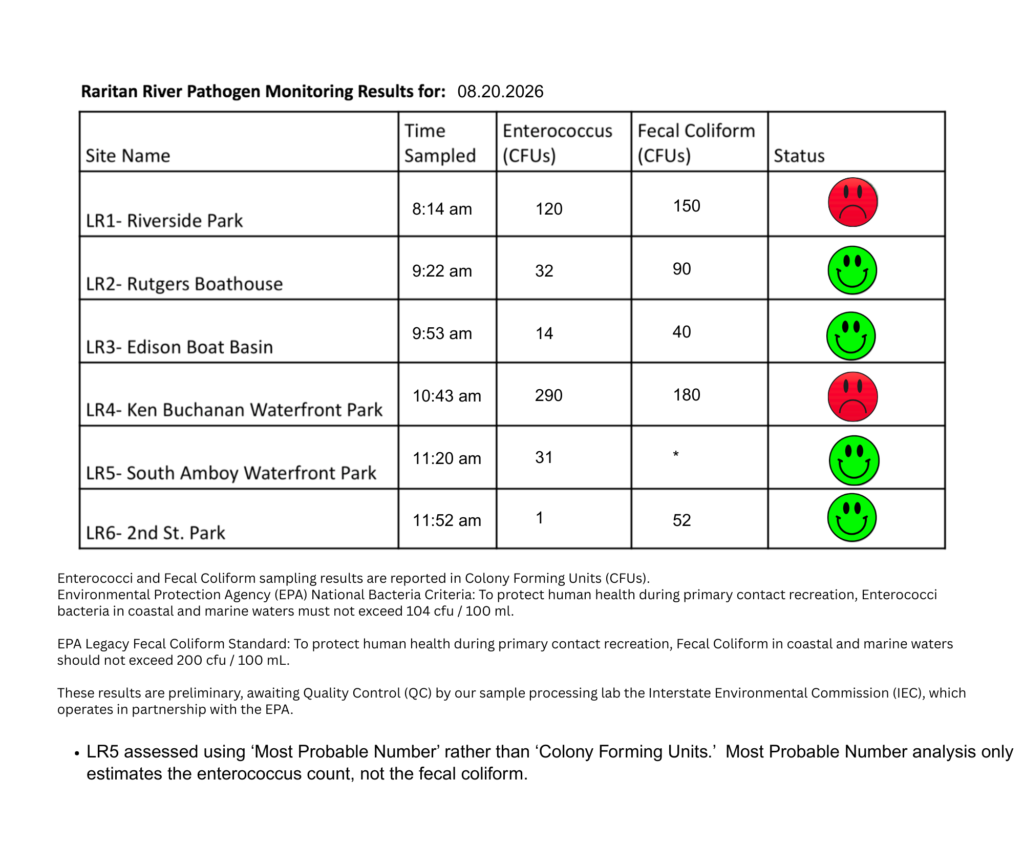
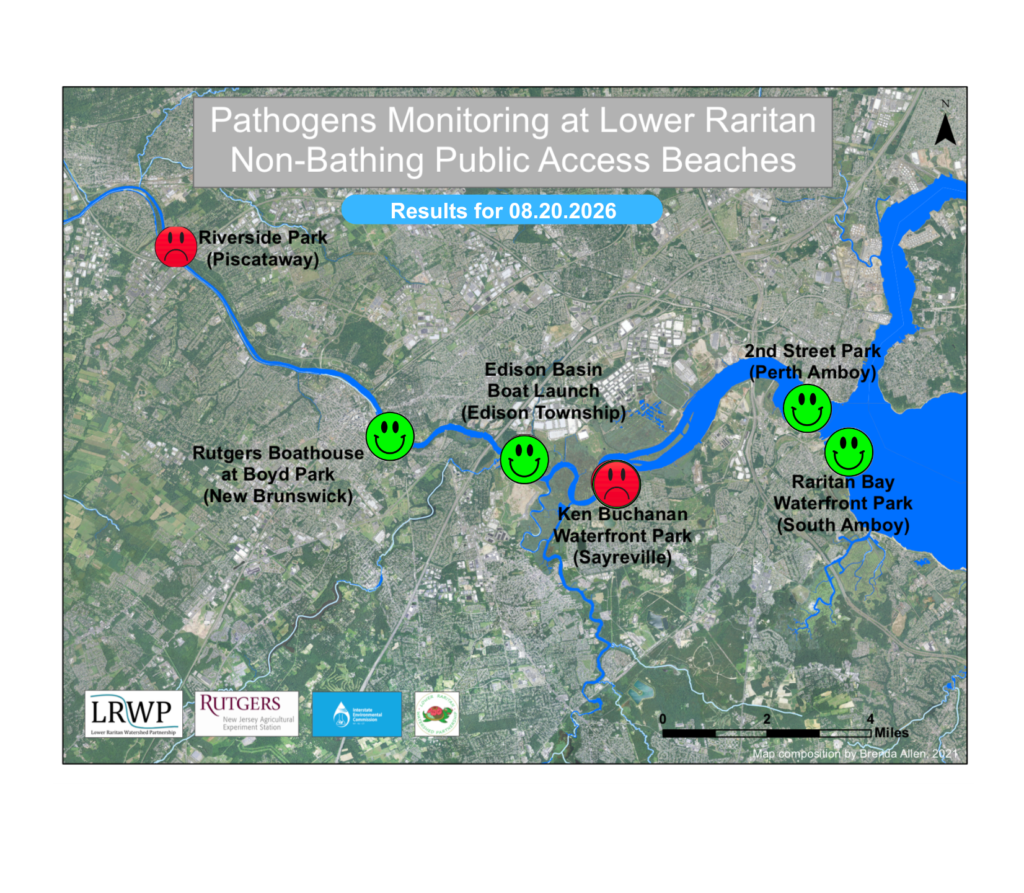
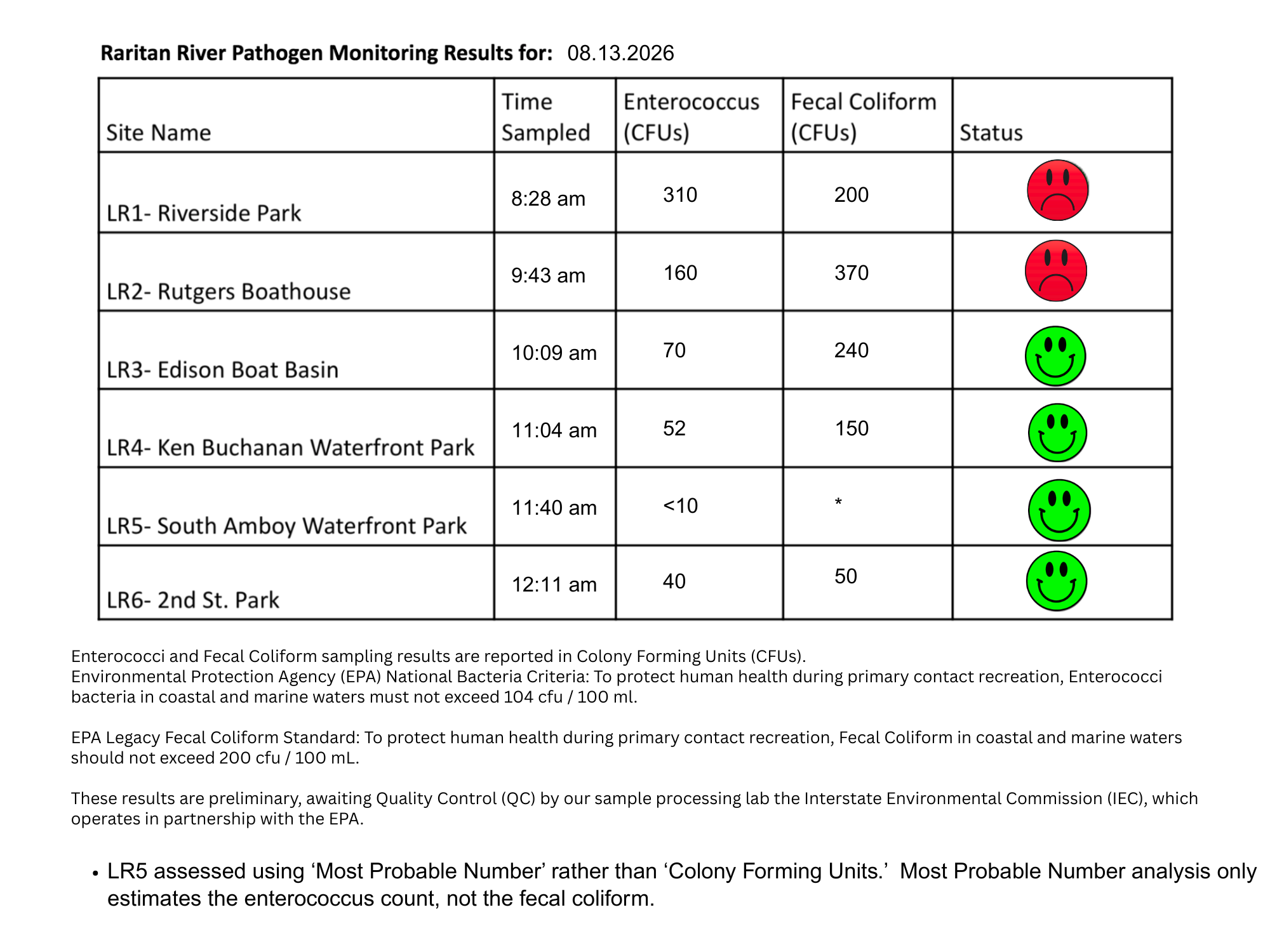
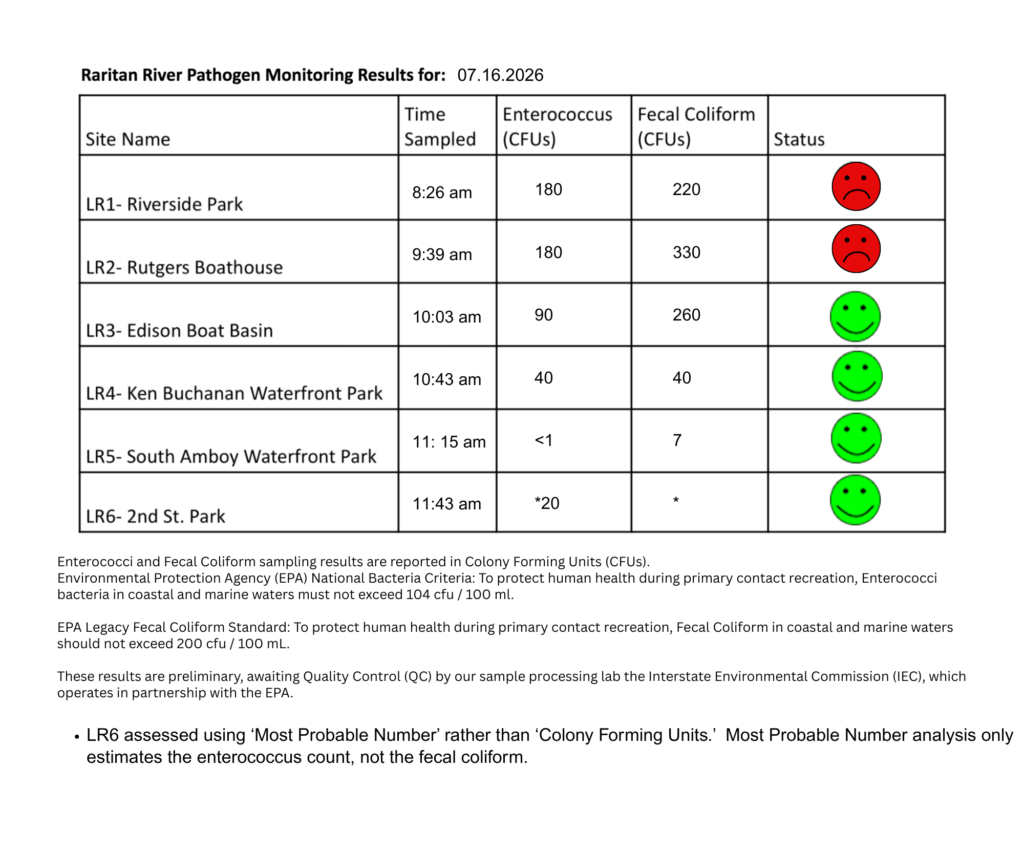
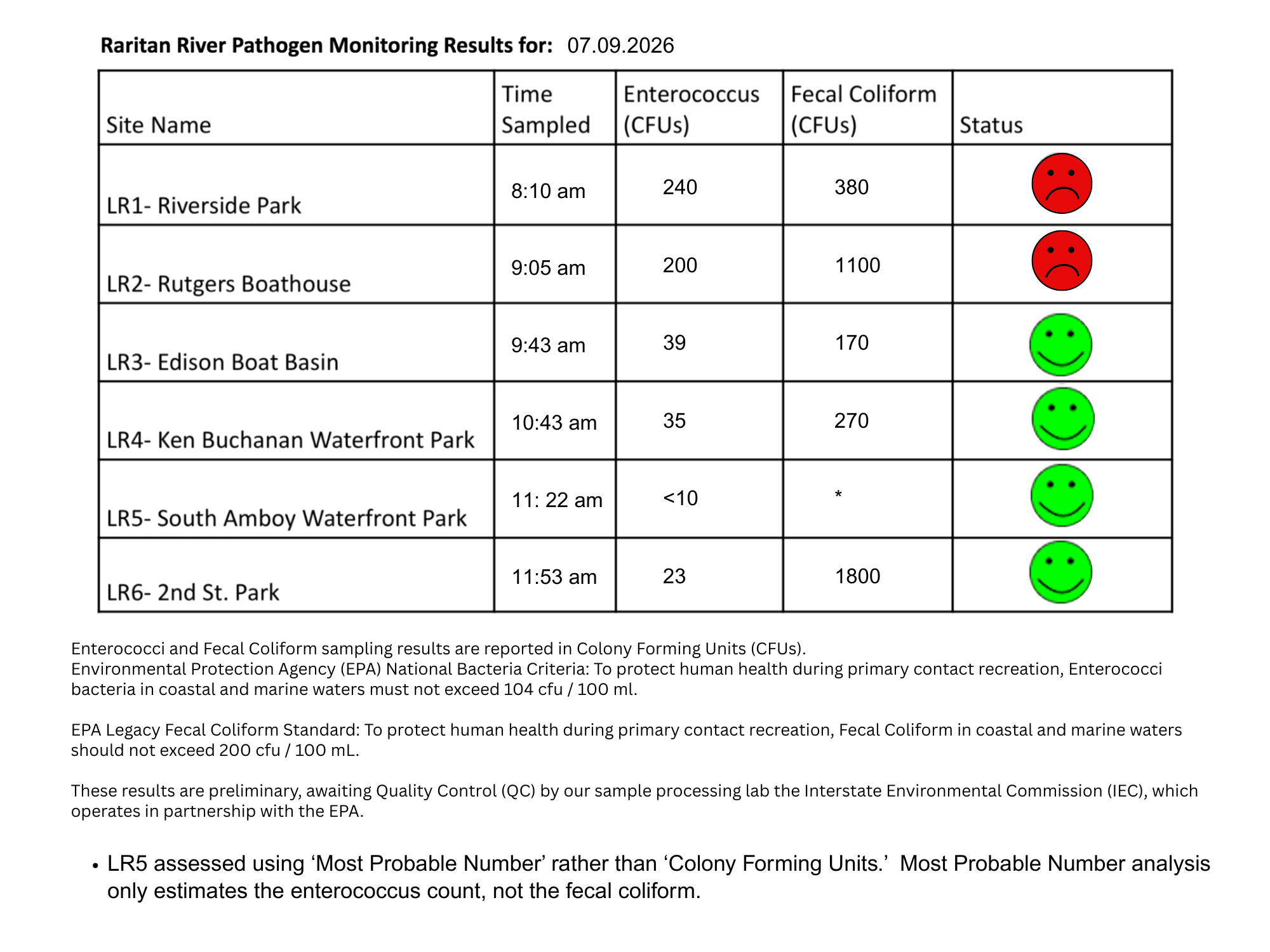
Our lab results for water quality samples taken on Thursday, August 20th, 2026, show Enterococcus bacteria levels exceeding the EPA federal water quality standard of 104 cfu/100mL at two of our regular monitoring sites this week. The problem sites are indicated by the red frown on the map and chart and include Riverside Park (Piscataway) and Ken Buchanan Waterfront Park (Sayreville).
Green smiles on the chart and map indicate the sites with bacteria levels safe for recreation and include the following: Rutgers Boat House (New Brunswick), Edison Boat Basin (Edison), 2nd Street Park (Perth Amboy), and South Amboy Waterfront Park.
A note of caution about Edison and New Brunswick: a strong thunderstorm swept through the area after we completed pathogens monitoring on Thursday, and this often flushes enterococci and fecal into the river. Thus, if we had tested on Friday instead of Thursday, we suspect these sites may have failed to meet the EPA standard for primary contact.
Pathogens/Enterococci levels are used as indicators of the possible presence of disease-causing bacteria in recreational waters. Such pathogens may pose health risks to people coming in primary contact with the water (touching) through recreational activities like fishing, kayaking or swimming in a water body. Possible sources of bacteria include Combined Sewer Overflows (CSOs), improperly functioning wastewater treatment plants, stormwater runoff, leaking septic systems, animal carcasses, pet waste, wildlife waste, and runoff from manure storage areas.
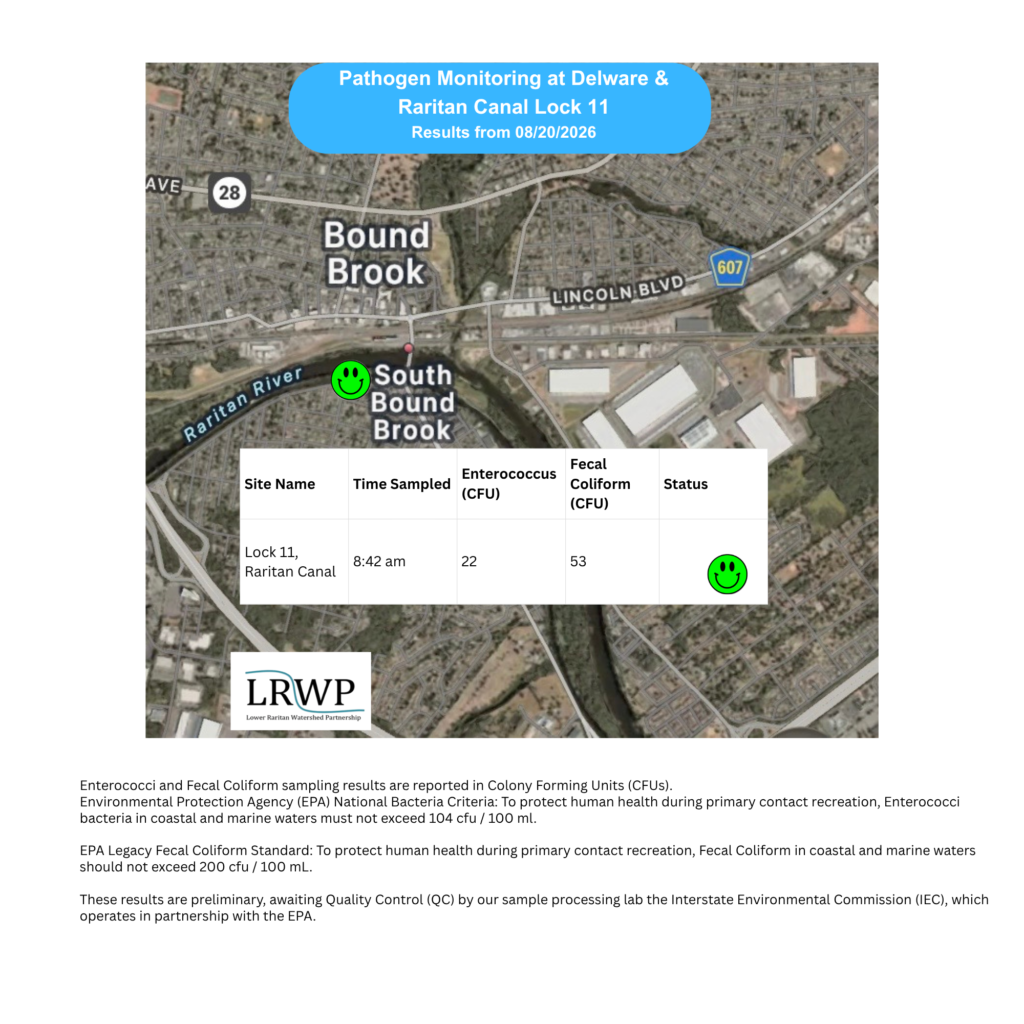
In order to better understand why Riverside Park, Piscataway has been our worst performing site over the past six years, we have started sampling at new sites in the vicinity. On August 20th, we sampled the Raritan Canal Lock 11, South Bound Brook for a fourth time since we started pathogens monitoring this season. The lab analysis produced 22 enterococci cfu per 100mL which is well below the EPA federal water quality standard of 104 cfu/100mL. Again, this site passed the test, as it has every week that we’ve tested it.
Our goal in reporting these results is to give residents a better understanding of the potential health risks related to primary contact during water-based recreation. If you are planning on recreating on the Raritan this weekend, make sure to stay safe and wash up after any activities!
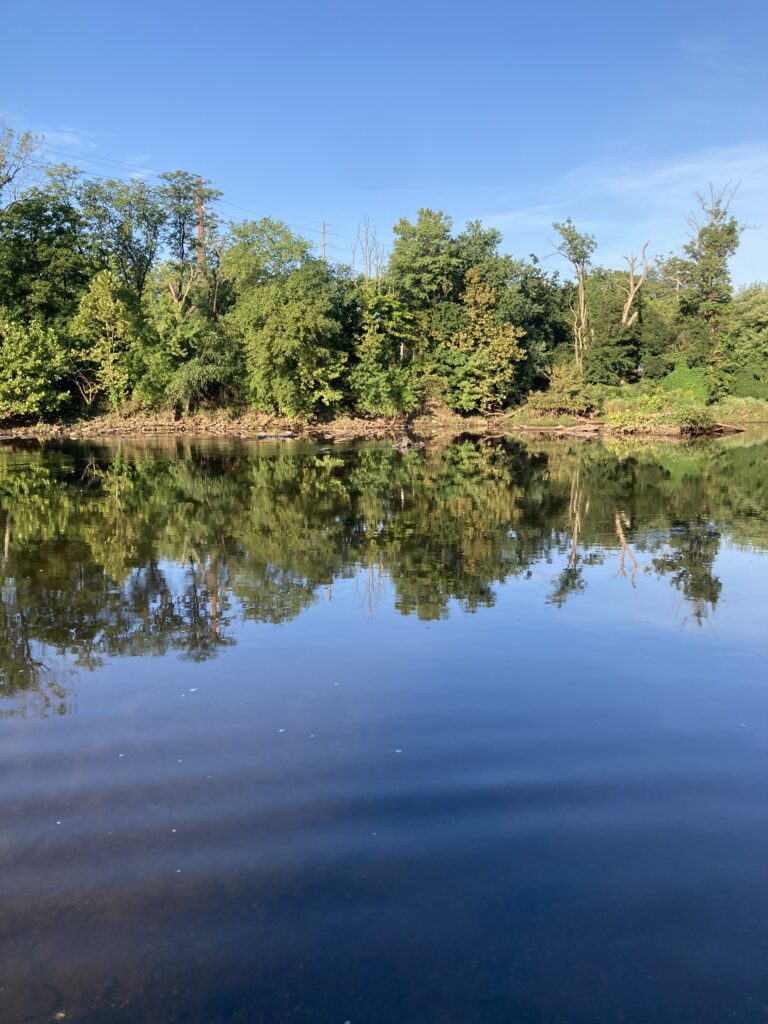
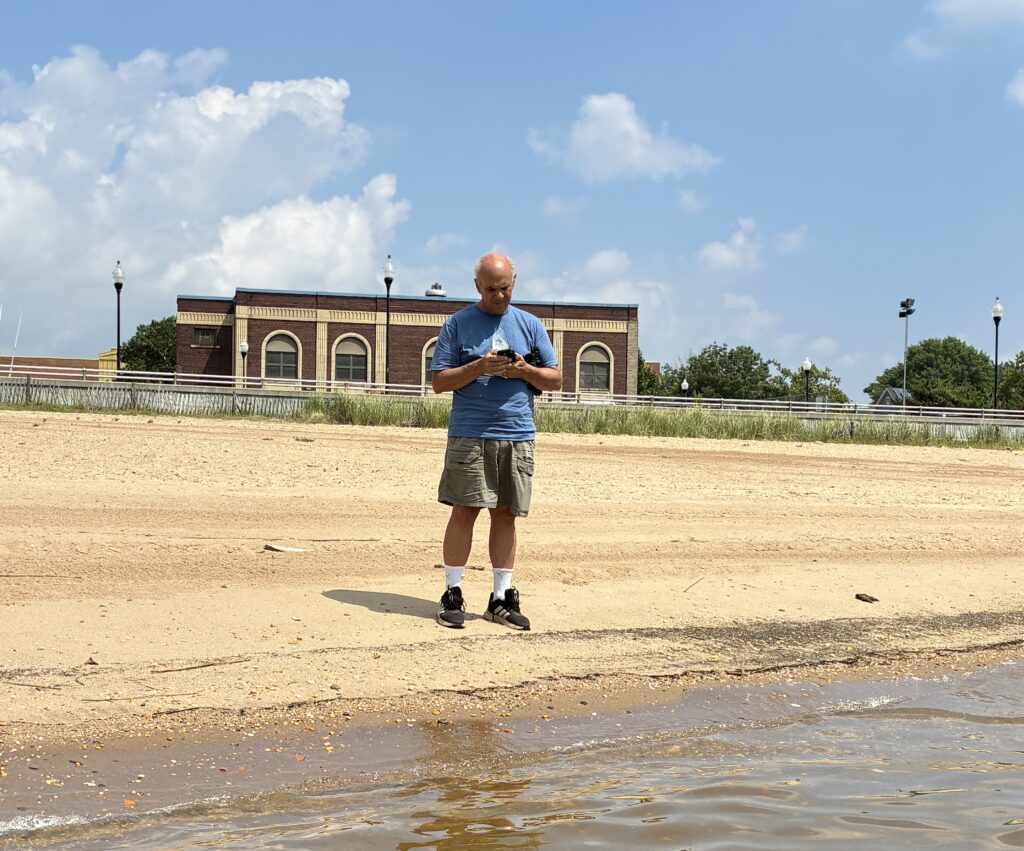
We began with a beautiful, sun shiny day in Piscataway.
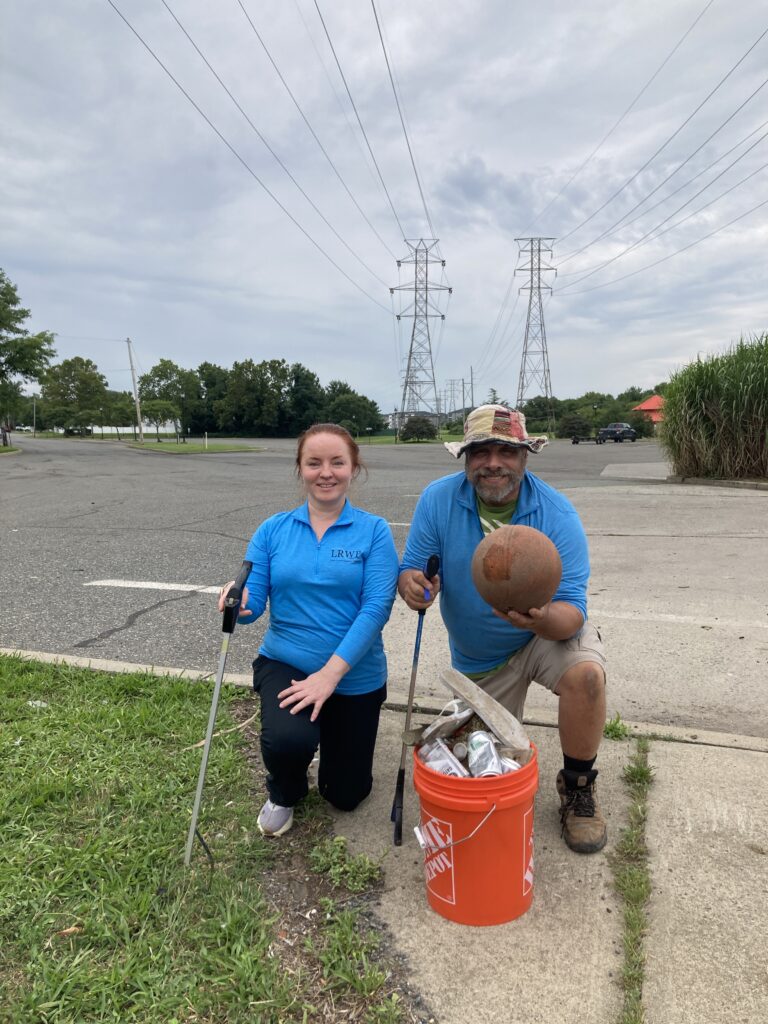
Including the basketball, Olesya and Mike picked up about seven gallons of trash in Sayreville.
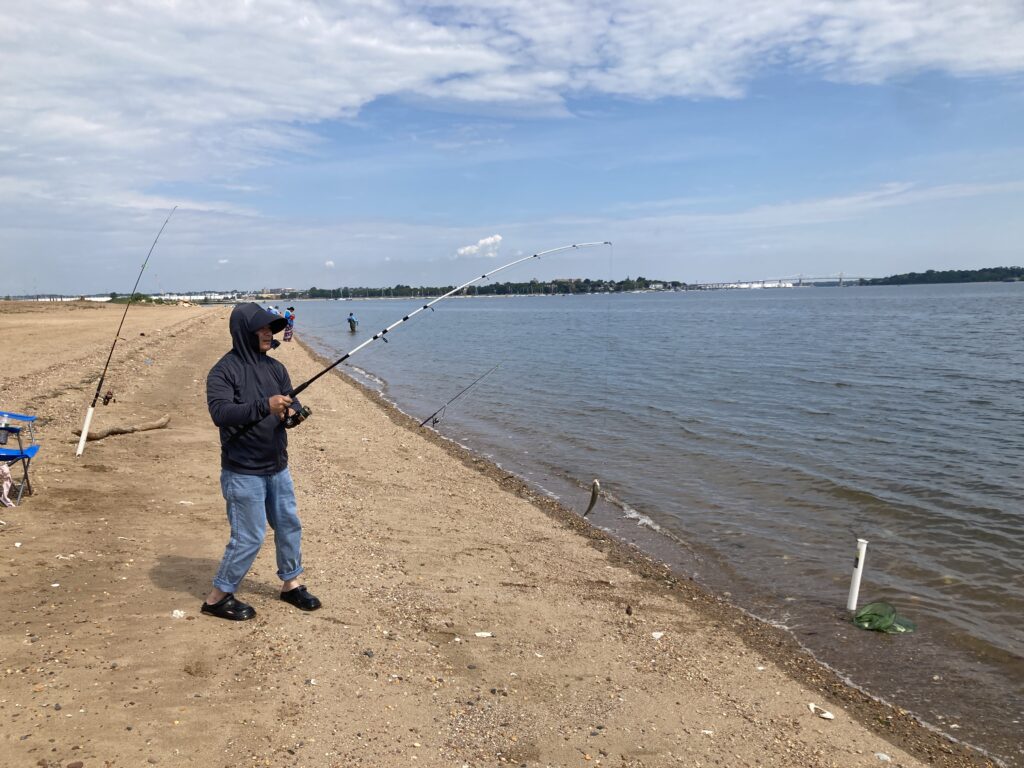
A fisherman in South Amboy reels in a small spot croaker (Leiostomus xanthurus) from Raritan Bay.
Endurance is a senior at Rutgers University, The State University of New Jersey—New Brunswick, majoring in Cell Biology and Neuroscience. This summer, she wanted to be involved in public service and community engagement which led her to apply for the 2026 Rutgers Scarlet Service Internship Program. Even though she did not know which organization she would end up interning with, she knew she wanted to do something that would require her to apply the knowledge she acquired in her coursework out on the field. After a rigorous interview process with five non-profit organizations, she matched with the Lower Raritan Watershed Partnership!
With the LRWP she serves as a Pathogens Monitoring and Communications Intern, where she works with volunteers to collect hydrological samples and record hydrological field data. Under the supervision of Dr. John Meyer, Endurance is also in charge of writing weekly blog posts that include results from the Interstate Environmental Commission (IEC) lab analysis of the water samples and a narrative of the pathogens monitoring sessions. Additionally, she works together with the LRWP team and its volunteers of diverse backgrounds in coming up with possible solutions to tackle water quality and environmental safety issues to improve the health of the communities that surround the Lower Raritan.
We asked Endurance what she has learned through her internship:
“I have developed strong communication across lingual bridges, refined written and spoken science communication and have strengthened leadership, organizations and teamwork skills!”
Endurance shared that she is passionate about medicine and using scientific insights to enhance community wellbeing and says her work with LRWP has offered an early, hands-on glimpse into what community-engaged science looks like in practice.
You can read Endurance’s journal entries about her pathogens monitoring experiences here:
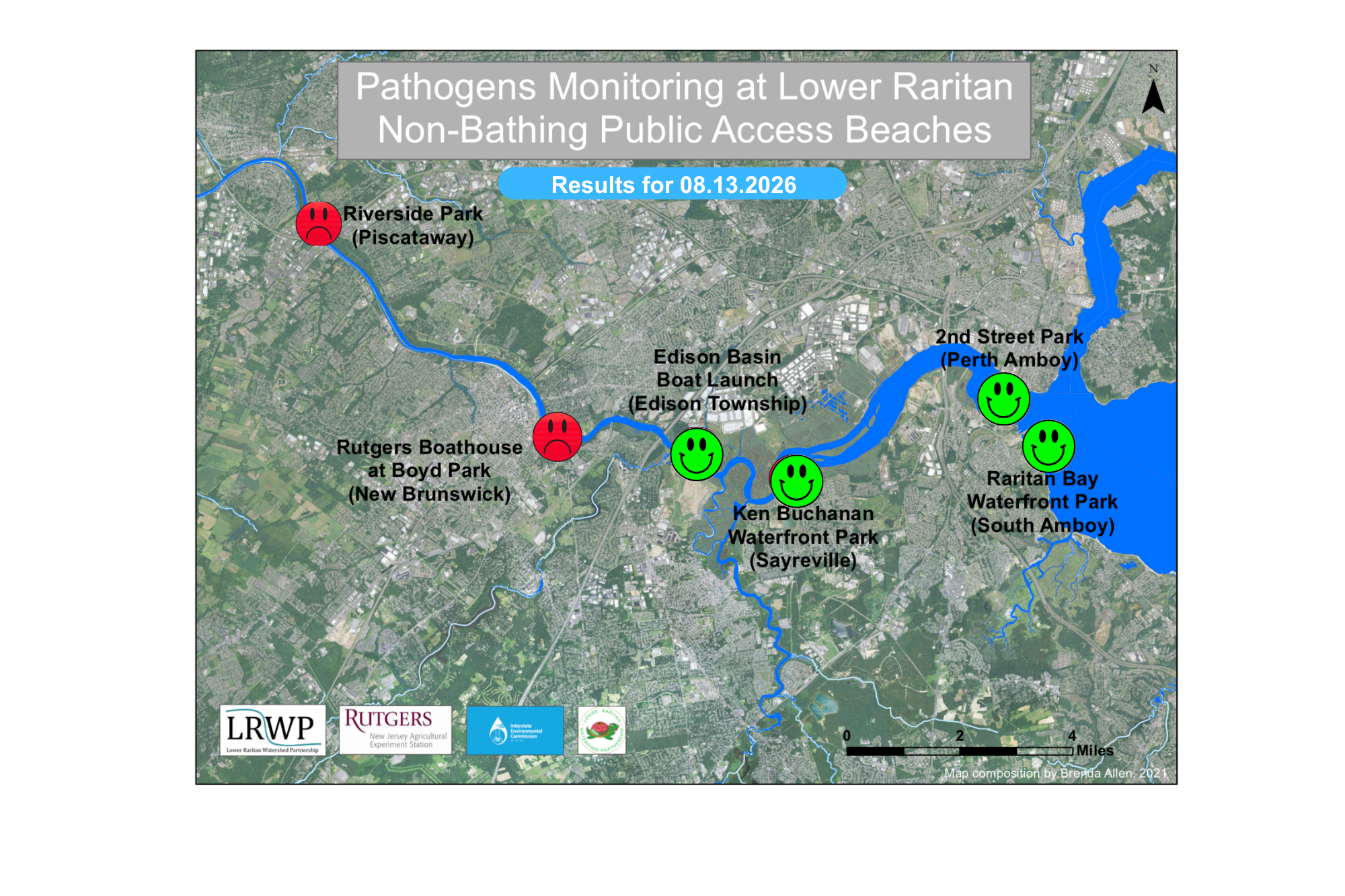
The second pathogen monitoring session of the month took place on Thursday, August 13th. Each week during the summer, from May to October, the Lower Raritan Watershed Partnership and Rutgers Cooperative Extension of Middlesex County run a volunteer-based monitoring program along the Raritan River. We collect water quality samples at six non-bathing public access beach sites, provide our samples to the Interstate Environmental Commission for analysis in their laboratory, and report the results to the public. Our mission is to share this data with the community and partners to ensure the safe use of the Raritan River for all.
Our lab results for water quality samples taken on Thursday, August 13th, 2026, show Enterococcus bacteria levels exceeding the EPA federal water quality standard of 104 cfu/100mL at one of our regular monitoring sites this week. The problem sites are indicated by the red frown on the map and chart and include Riverside Park (Piscataway) and Rutgers Boathouse (New Brunswick).
Green smiles on the chart and map indicate the sites with bacteria levels safe for recreation and include the following: Edison Boat Basin (Edison), Ken Buchanan Waterfront Park (Sayreville), 2nd Street Park (Perth Amboy), and South Amboy Waterfront Park.
A note of caution about Edison Boat Basin: enterococcus better correlates with disease causing bacteria, but the fecal coliform count in Perth Amboy was well above the EPA legacy standard of 200 colony-forming per milliliter.
Pathogens/Enterococci levels are used as indicators of the possible presence of disease-causing bacteria in recreational waters. Such pathogens may pose health risks to people coming in primary contact with the water (touching) through recreational activities like fishing, kayaking or swimming in a water body. Possible sources of bacteria include Combined Sewer Overflows (CSOs), improperly functioning wastewater treatment plants, stormwater runoff, leaking septic systems, animal carcasses, pet waste, wildlife waste, and runoff from manure storage areas.
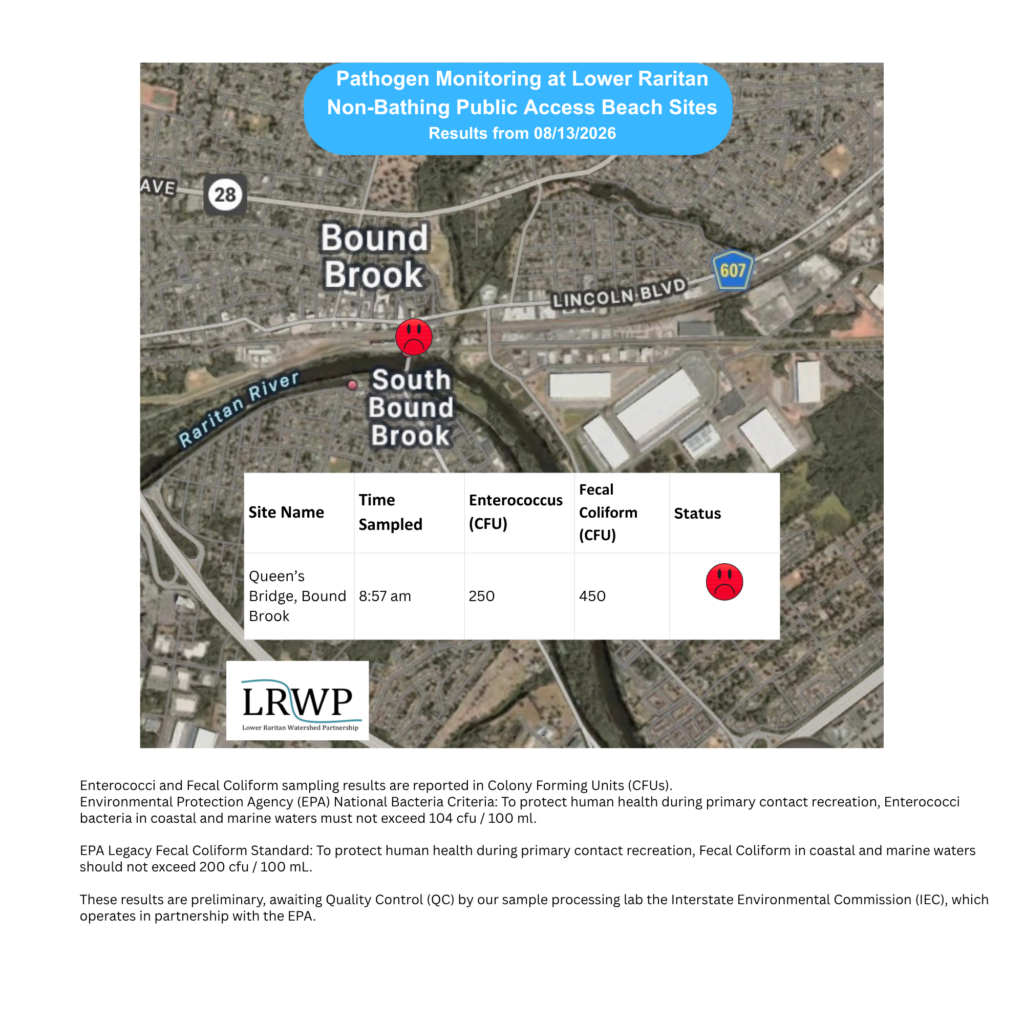
In order to better understand why Riverside Park, Piscataway has been our worst performing site over the past six years, we have started sampling at new sites in the vicinity . On August 13th, we sampled the Raritan River at Queen’s Bridge, Bound Brook for a fourth time since we started pathogens monitoring this season. The lab analysis produced 250 enterococci cfu per 100mL which is well above the EPA federal water quality standard of 104 cfu/100mL. Again, this site failed the test, as it has every week that we’ve tested it.
Our goal in reporting these results is to give residents a better understanding of the potential health risks related to primary contact during water-based recreation. If you are planning on recreating on the Raritan this weekend, make sure to stay safe and wash up after any activities!
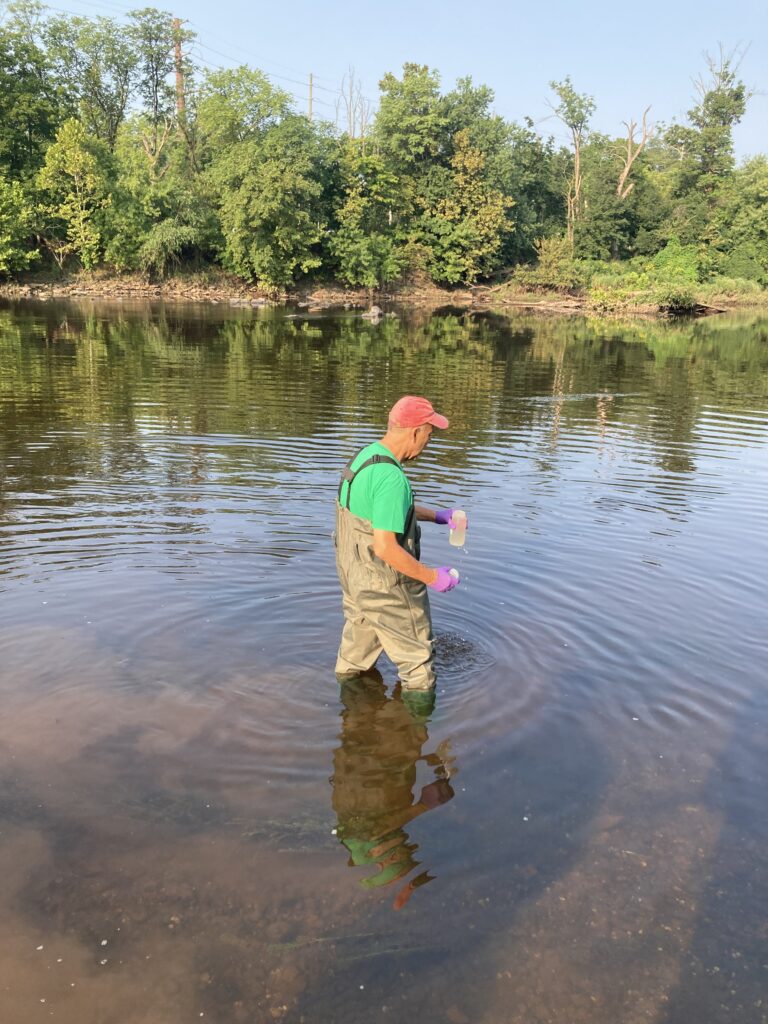
Art gathers a sample at Riverside Park.
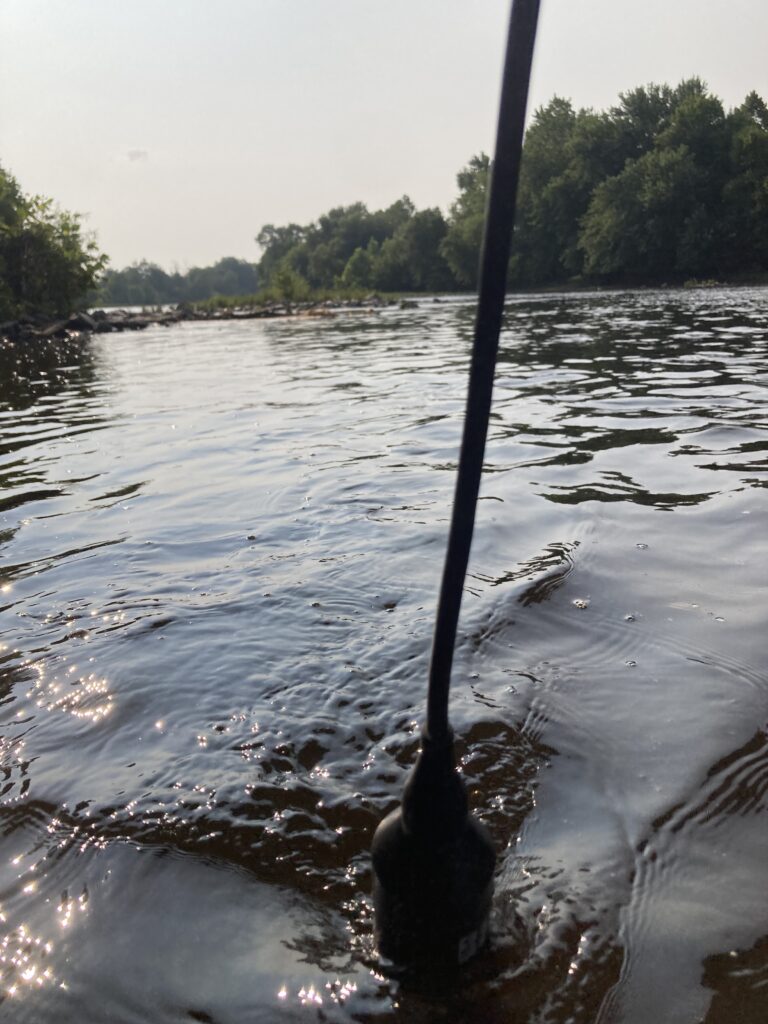
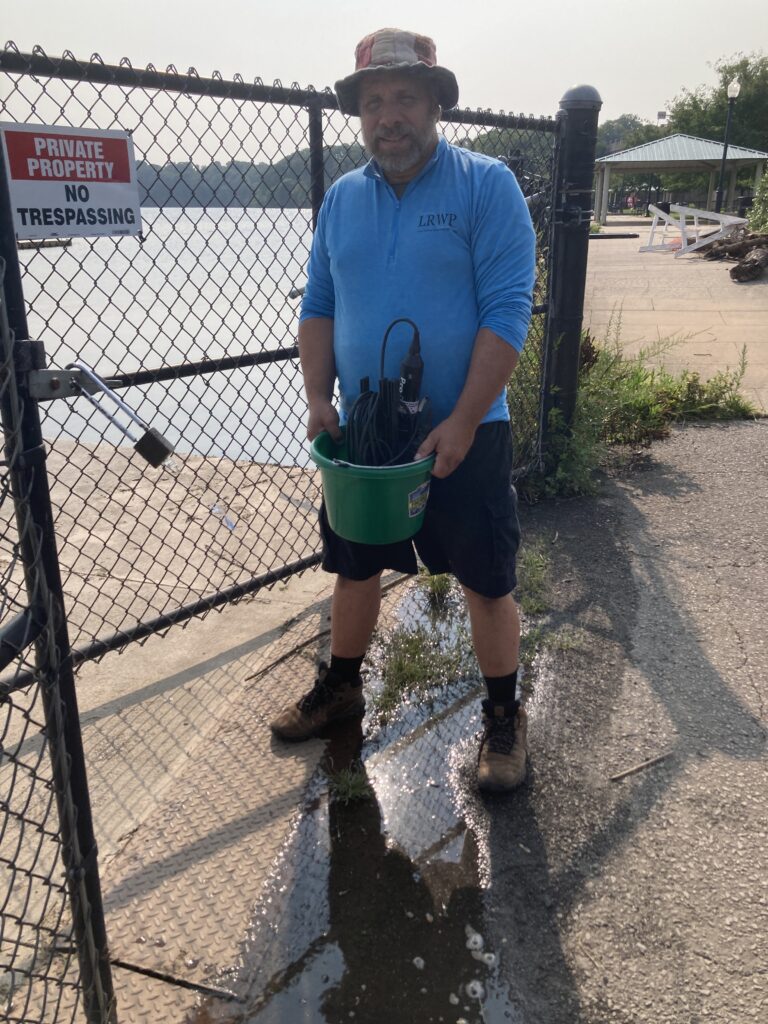
The sonde plunges into the water at Queen’s Bridge, Bound Brook.
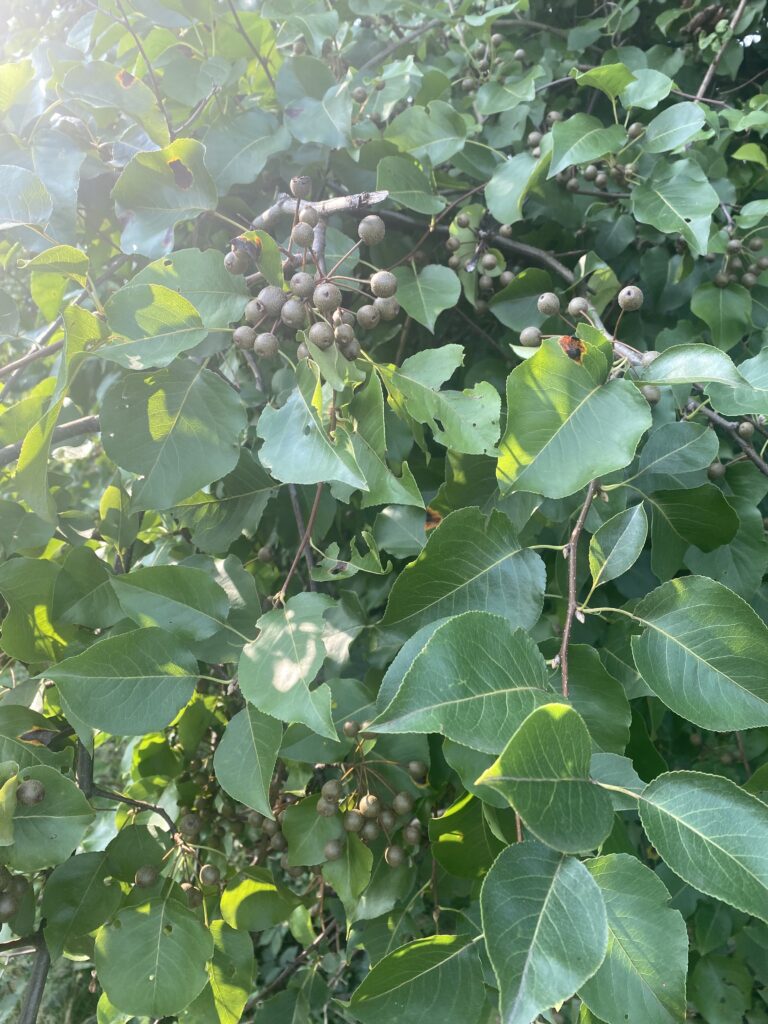
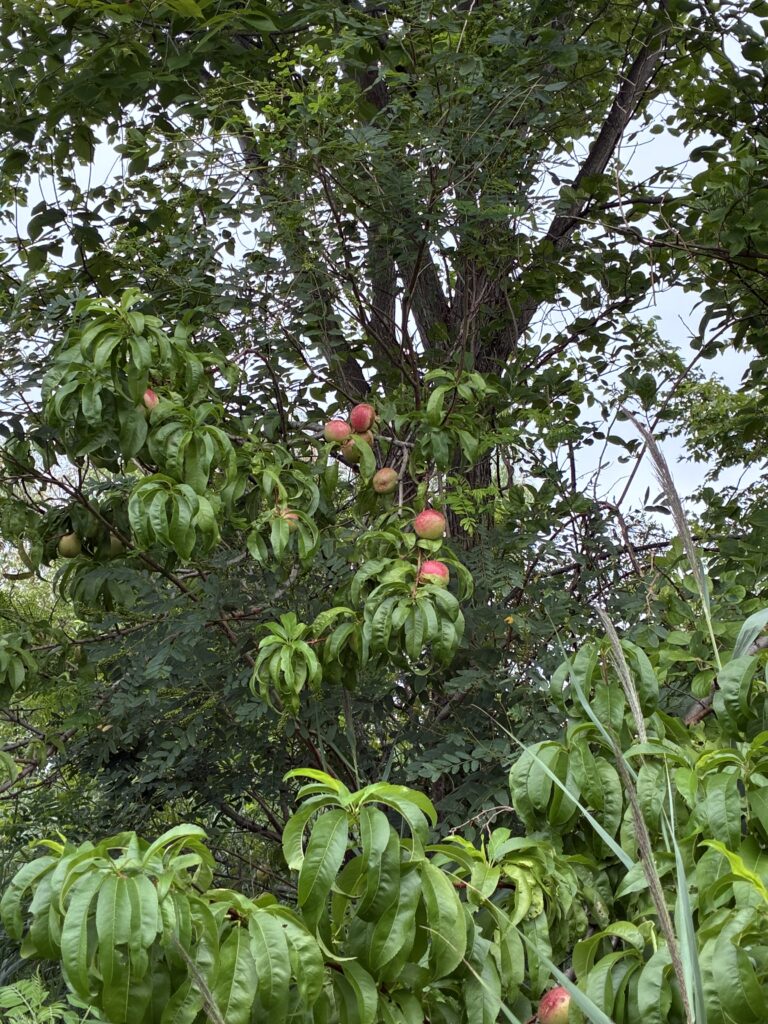
A Bradford pear tree in full fruit. Photo by Mike Orsini.
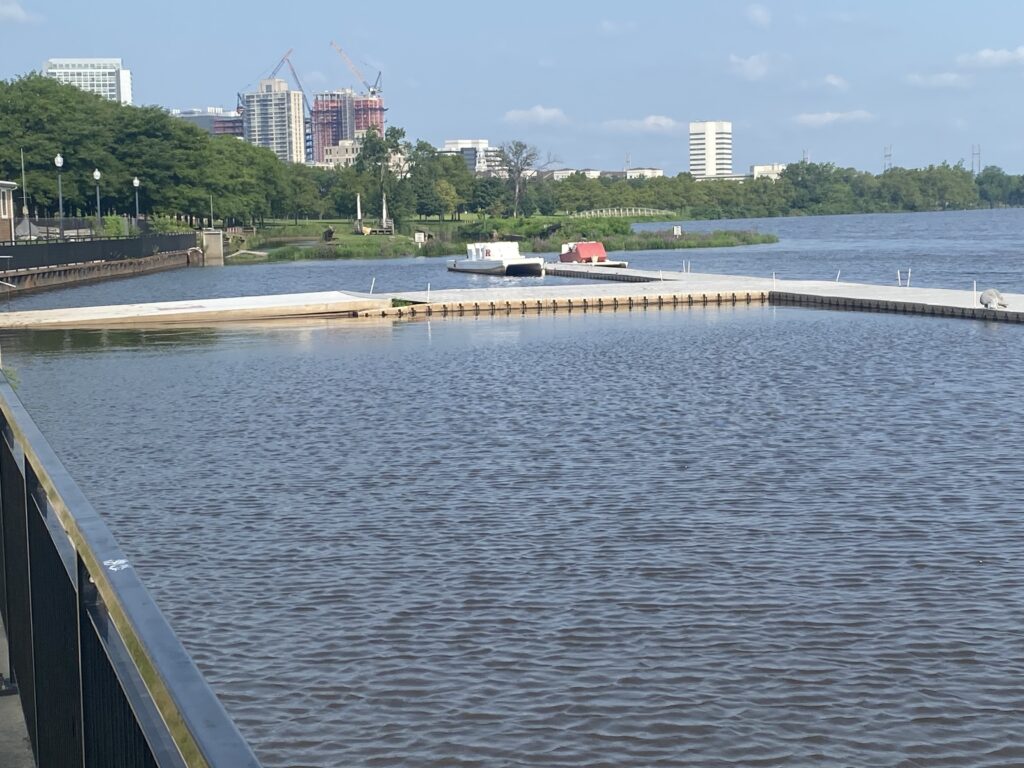
The city of New Brunswick at high tide. To reach this point, the Raritan rose six feet in just six hours. Photo by Mike Orsini.
At high tide, the river begins to pool across the opening of the Rutgers boat dock in New Brunswick. Mike traverses the waterway to deploy the YSI sonde. Photo by J.M. Meyer.
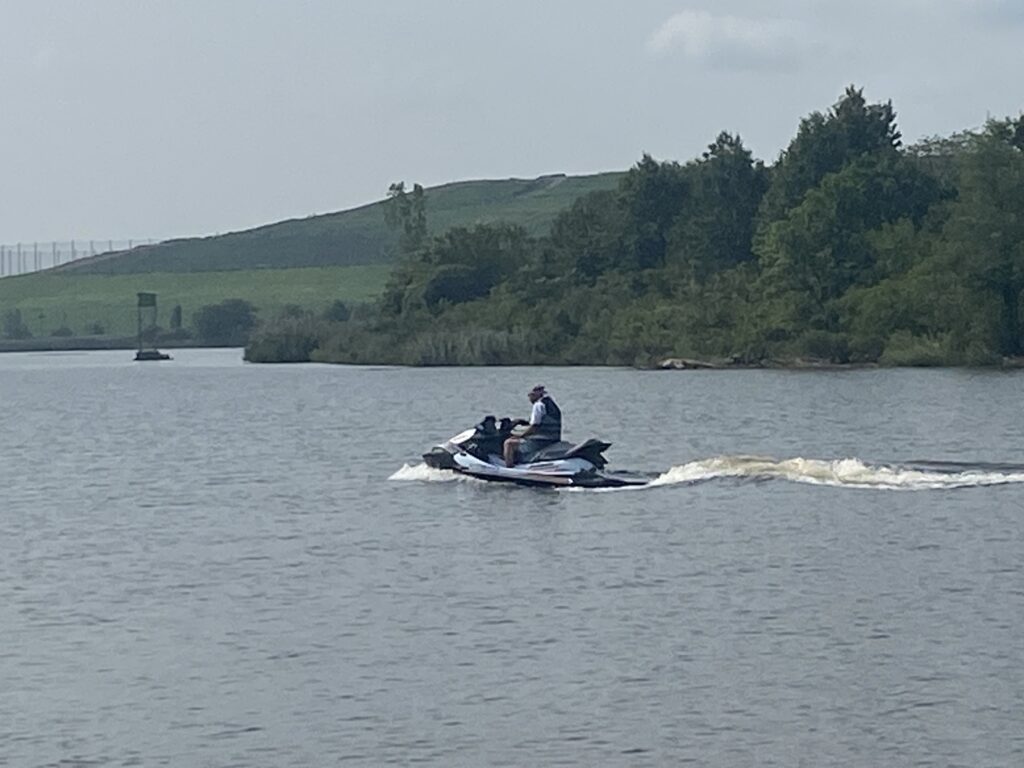
A jet skier on the river near Edison Boat Basin. The Middlesex County landfill rises in the background. Photo by Mike Orsini.
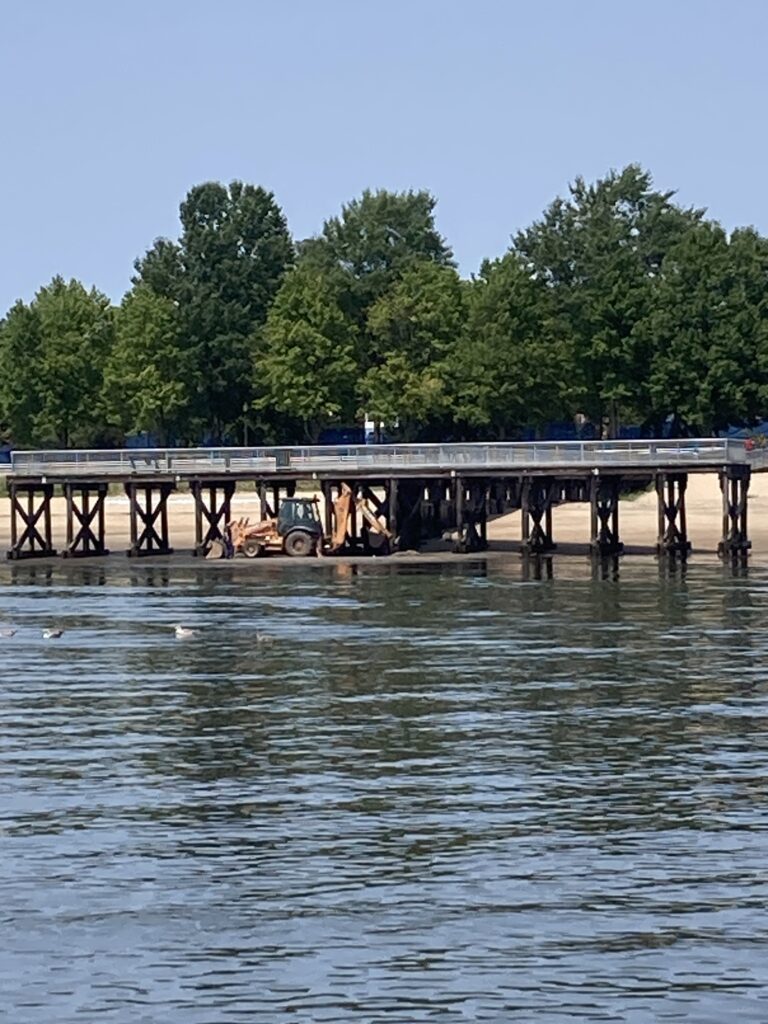
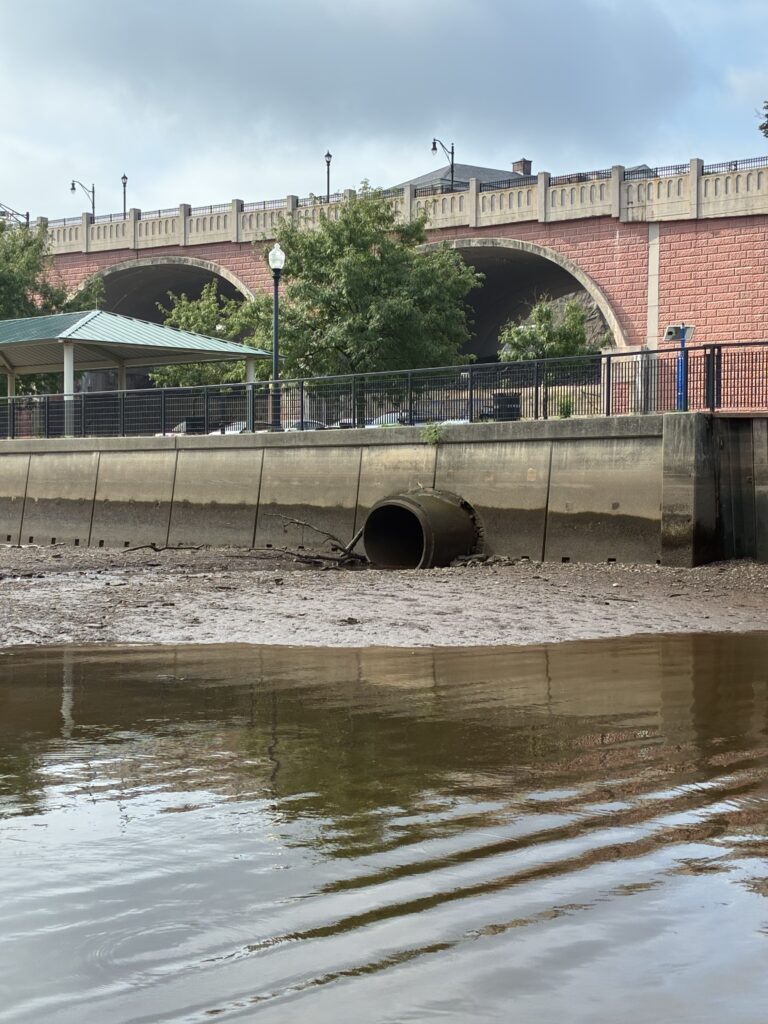
The day before sampling, we saw a backhoe dig sediment out of a Combined Sewer Outfall in Perth Amboy. Without this constant maintenance, the sewage and stormwater in Perth Amboy overflow into 2nd street park.
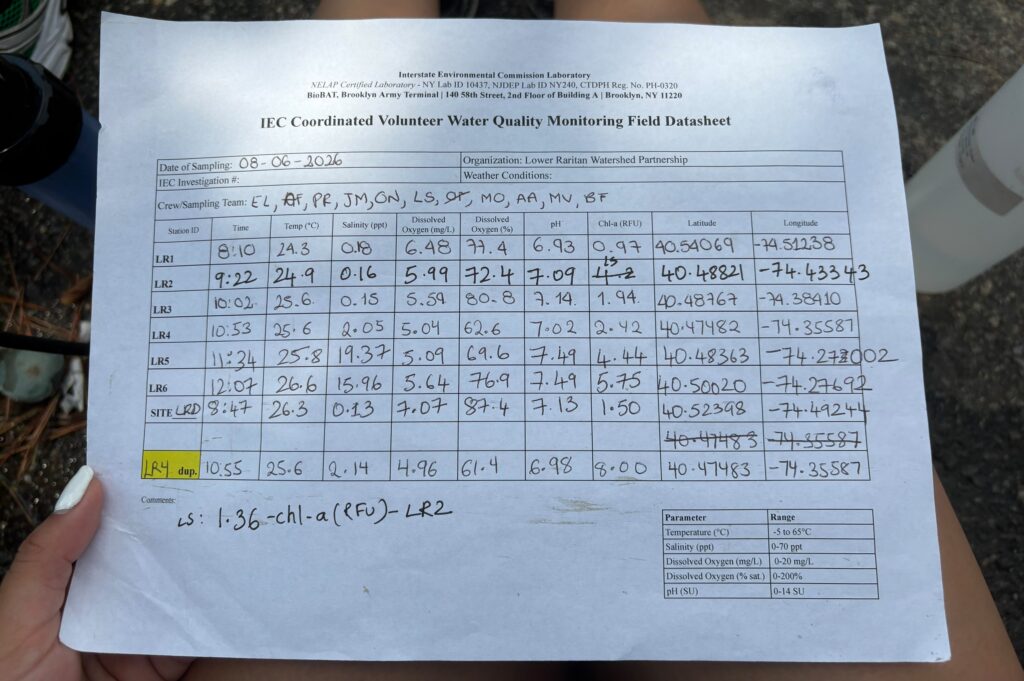
All parameters seemed to be in safe ranges at the time of monitoring today. Photo by Paula Rubio.
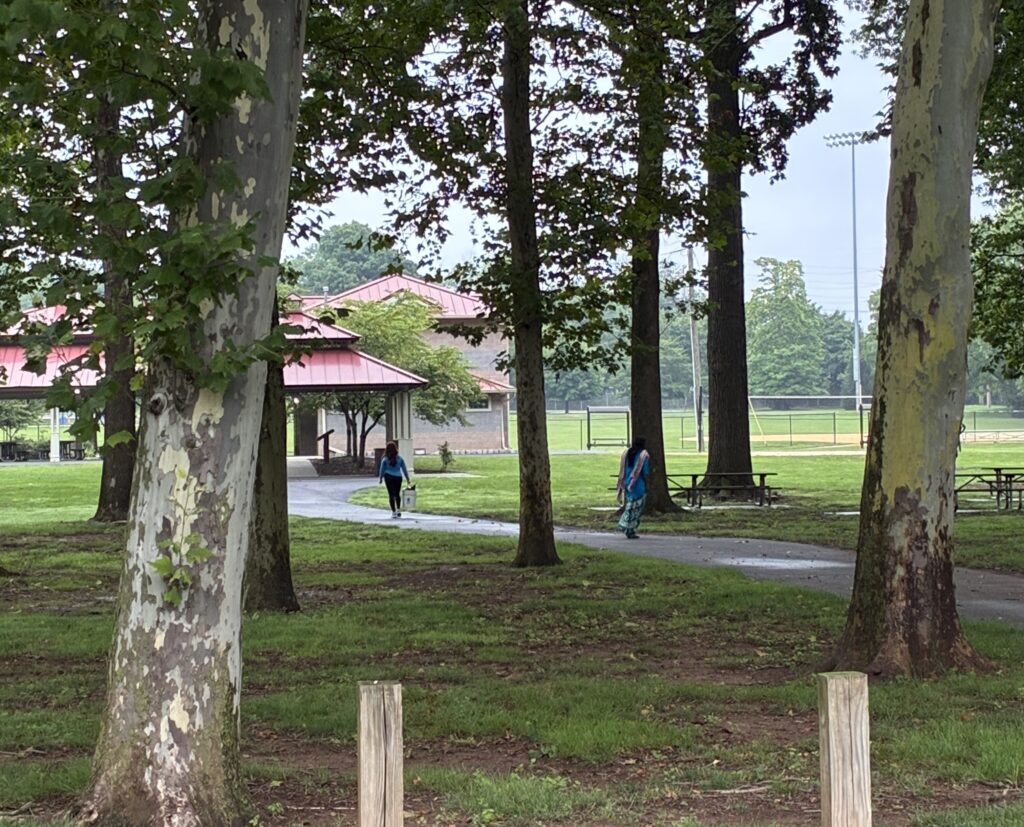
Olesya, Lakshmi and Bryanna collected five gallons of trash at Riverside Park. Laksmi and Olesya are seen going to empty the trash bucket into a larger trash can. Photo by Endurance Laryea
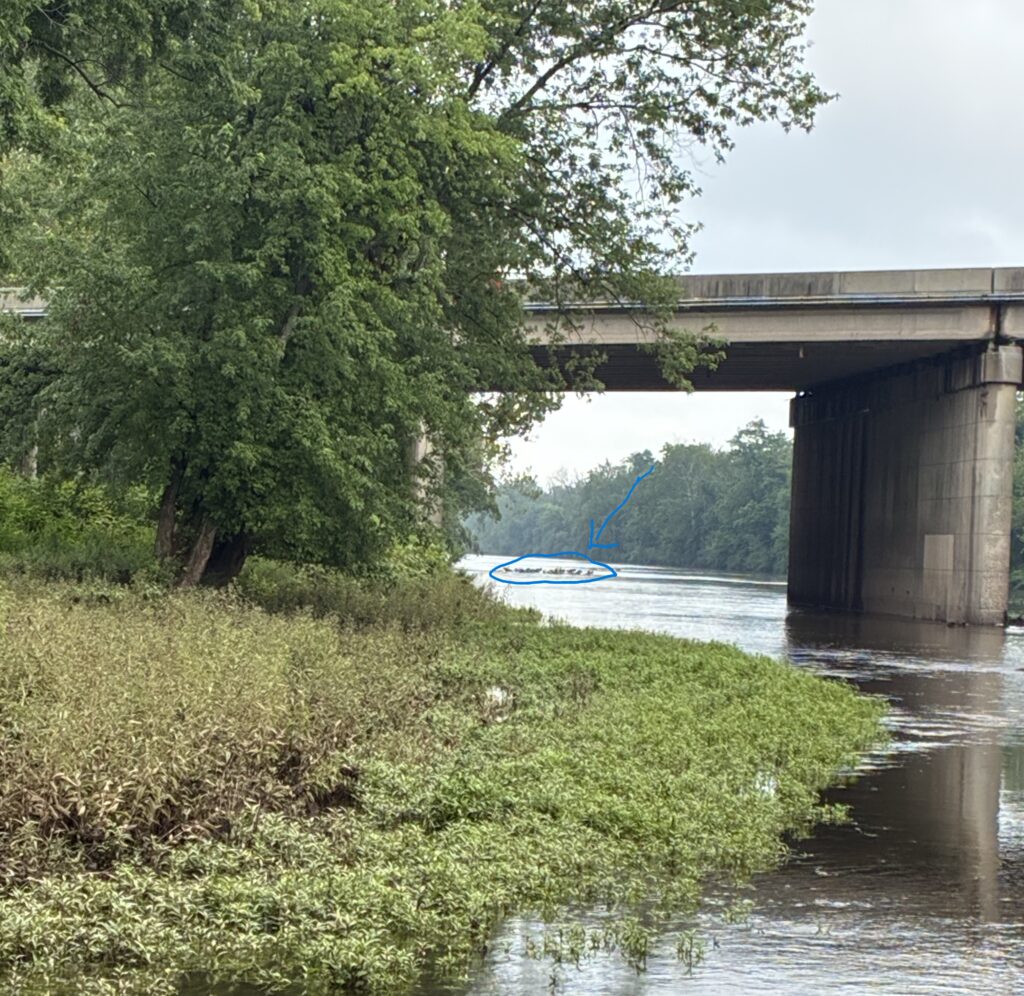
I wondered where all the geese were when we arrived at the parking lot today. After sampling, Olesya pointed them out to me– they had moved further downstream from the park. The increase in scrub growth along the bank of the river makes it difficult for them to access it from the parking lot. This is great for Riverside Park because it reduces the amount of fecal matter from the geese t that gets washed into the river during rainfall. But wouldn’t the geese just find somewhere else along the river? Yes, they might. However, it may not impact Riverside Park as much as it does when the geese are at this site. This site is one where people come into primary contact with the river, so it would best for the geese to move elsewhere where people do not come into contact with the river.
Photo by Endurance Laryea.
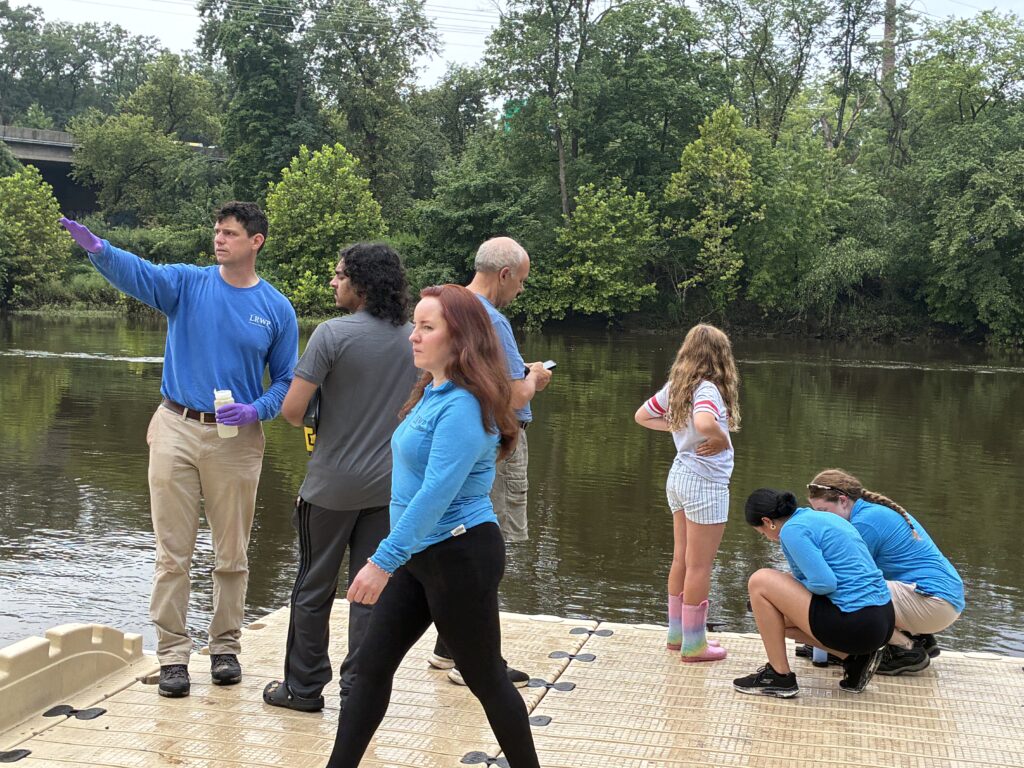
A huge team today! John explains the landscape at Riverside Park to Michael, a resident of Piscataway, Art completes the visual habitat assessment for Riverside Park, Ashley and Paula take hydrological measurement while Bryanna observes. By Endurance Laryea
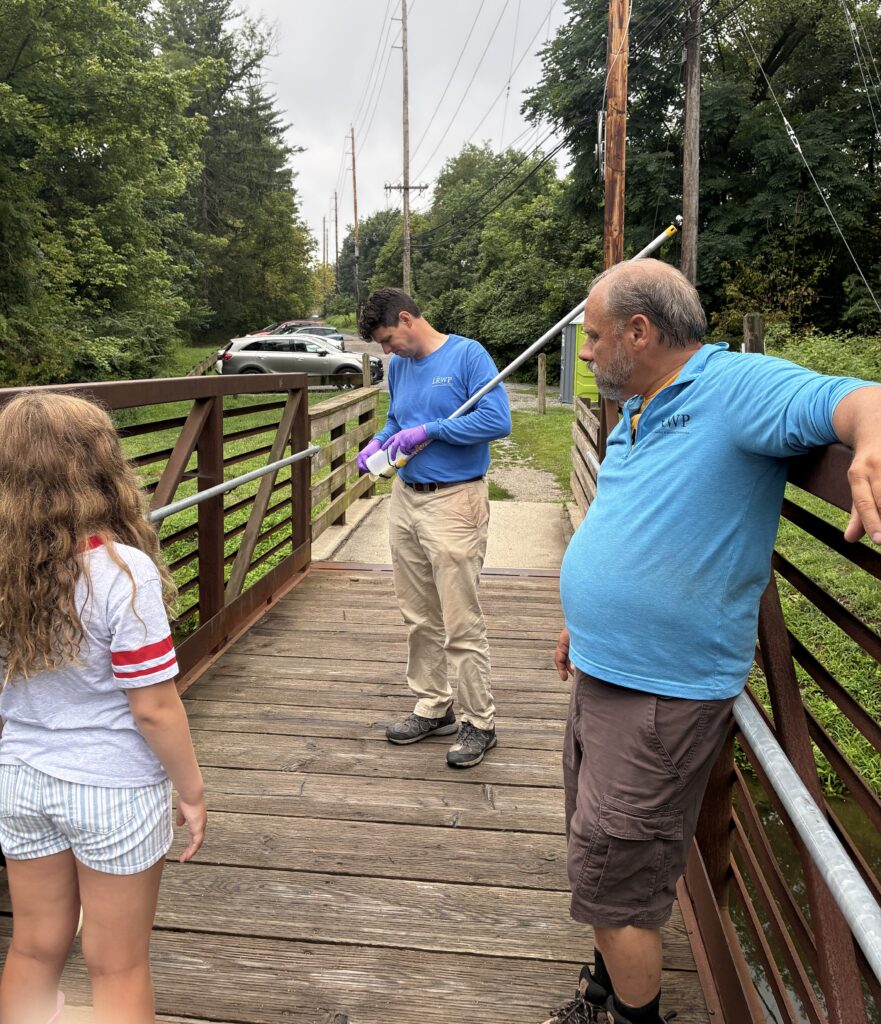
On the bridge of the D&R canal near the Van Wickle House, John gets ready for sampling duties as he straps the sample bottle on the sampling stick. The canals are the only sites that usually require a sampling stick because of how far the surface of the water is from wherever we stand. Photo by Endurance Laryea
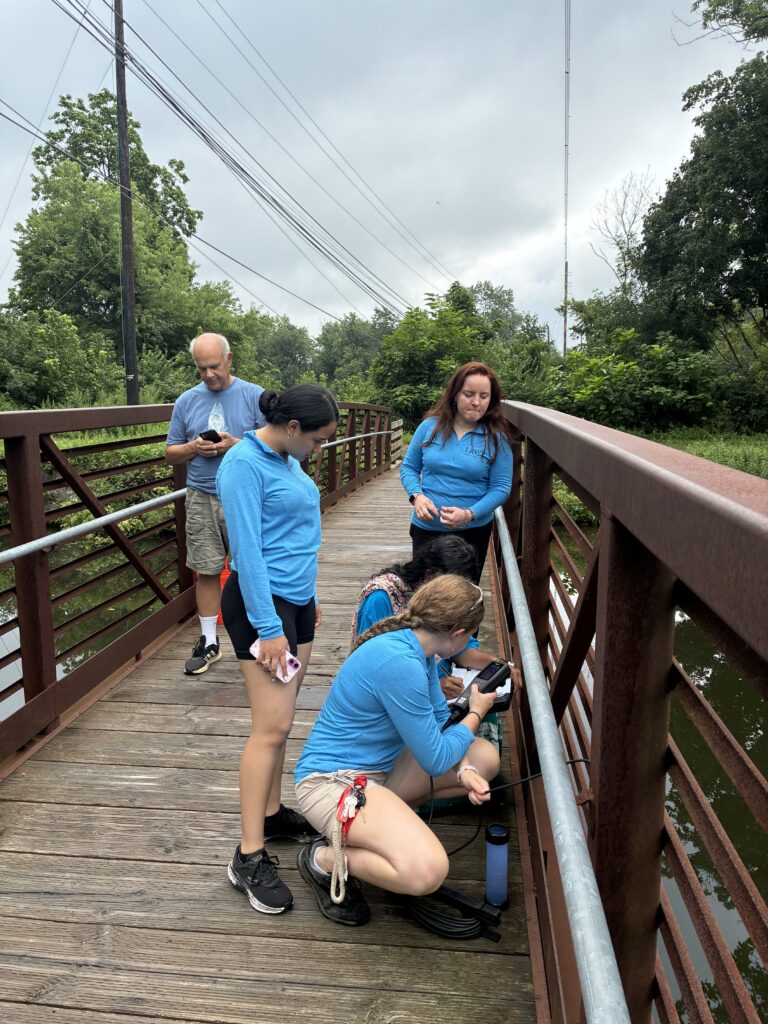
Art completes the habitat assessment for D&R canal whileLakshmi and Ashley handle measurement recording. Photo by Endurance Laryea.
Turns out I am not the only one who thinks this is a great photo spot. Two people appeared to be in the middle of a photo shoot at the site–I’m sure their pictures turned out great! Photo by Mike Orsini
The tide was higher at Piscataway when we started monitoring but it has gone out by the time we reached Rutgers Boat House, New Brunswick.
Photo by Endurance Laryea.
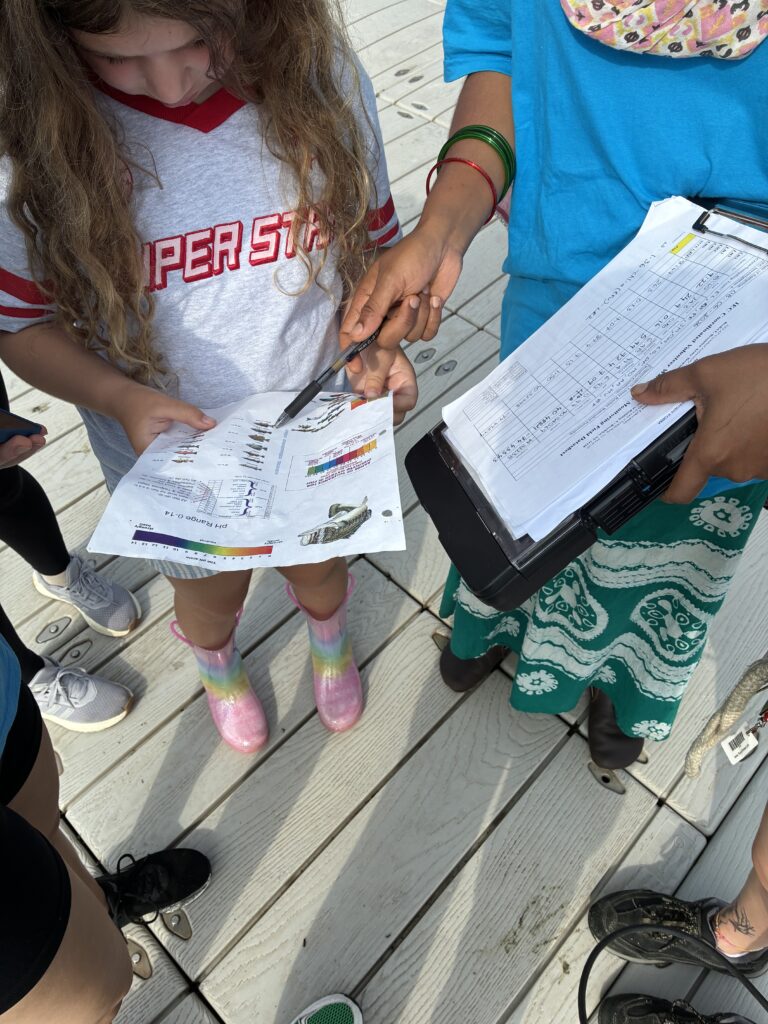
John had a fun activity for Bryanna. He gave her a sheet that had information on the ranges of temperature, pH and dissolved oxygen levels and their effect on fish activity. Lakshmi, Olesya, Paula, Ashley and I guided her as she compared the measurements we had gotten so far to the information on the sheet. She then concluded that all the fishes were fine because the parameters were all in the safe range according to the sheet.
Photo by Endurance Laryea.
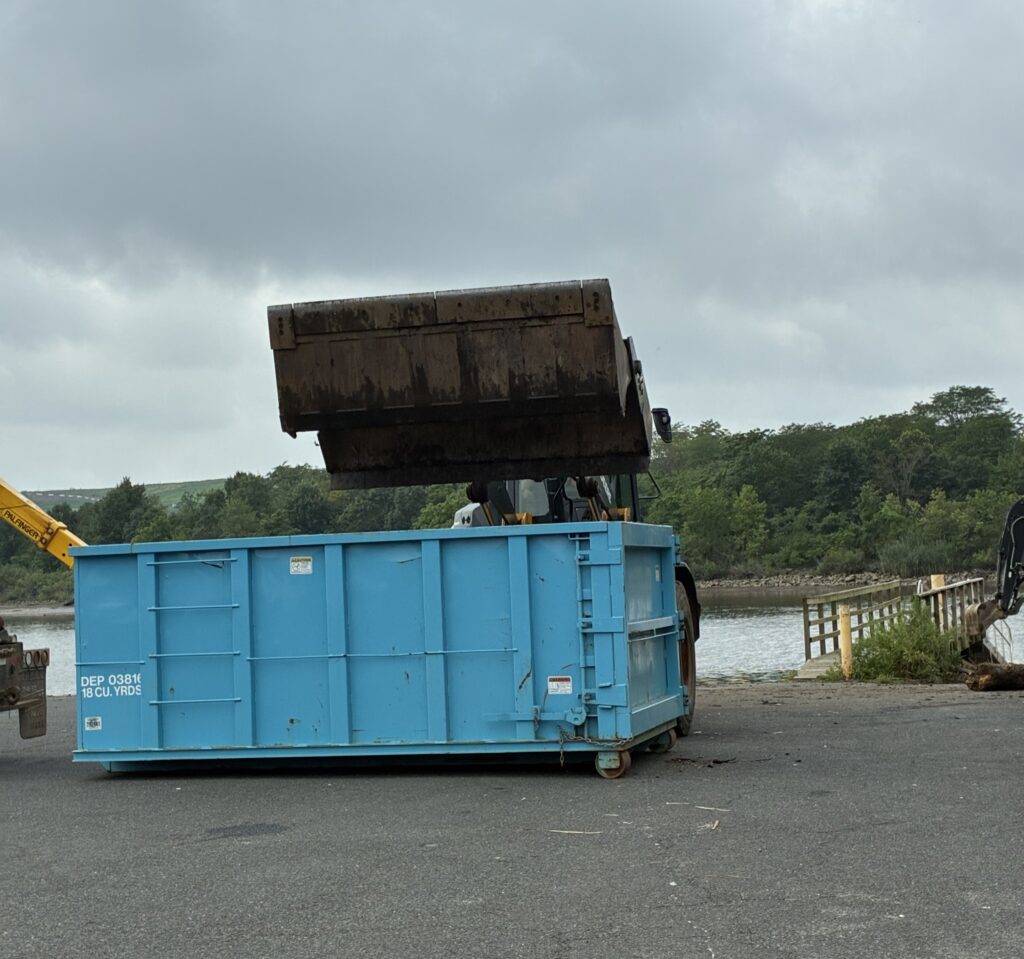
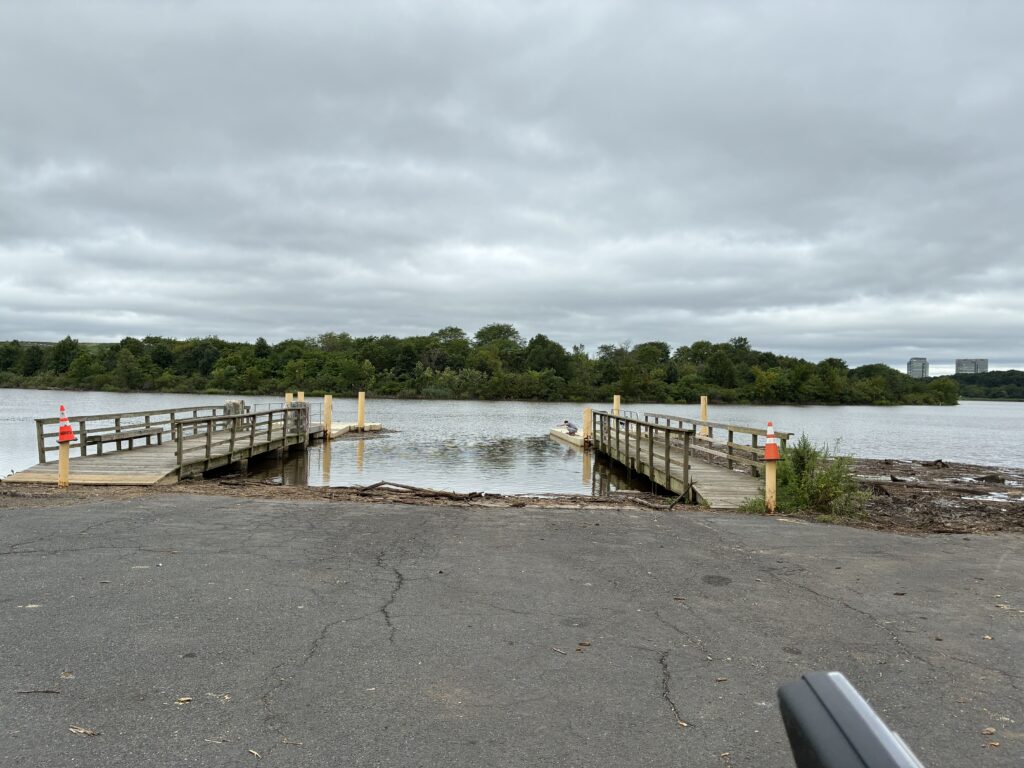
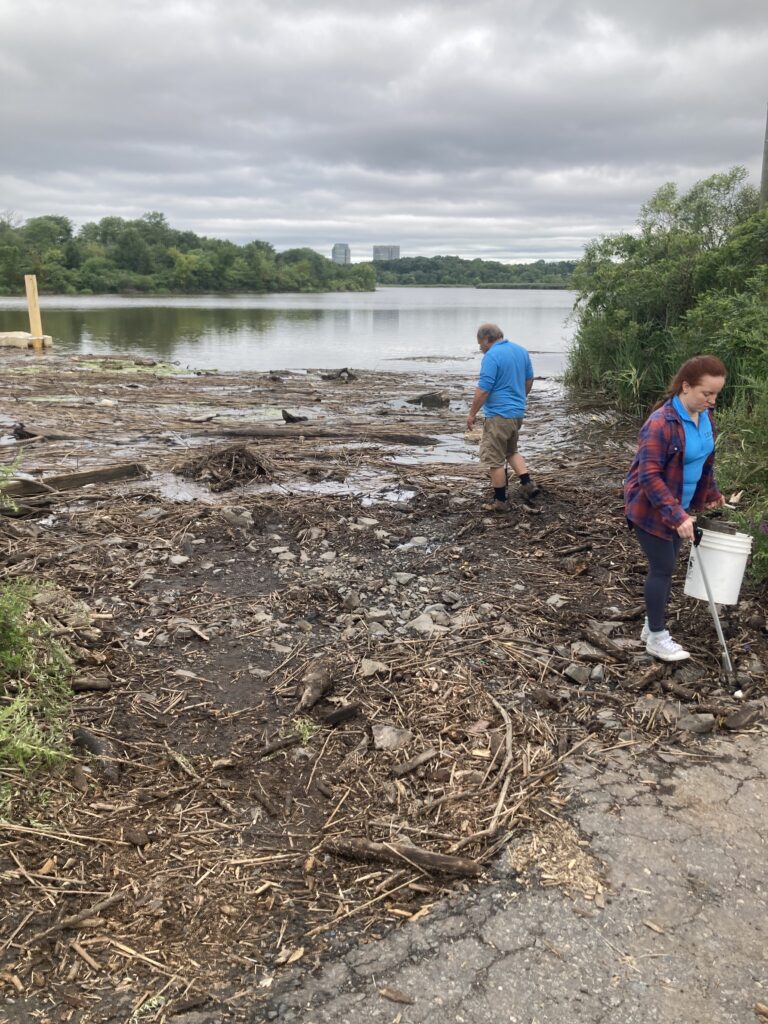
Second cleanup, since the start of pathogens monitoring this summer, witnessed at Edison Boat Launch today.
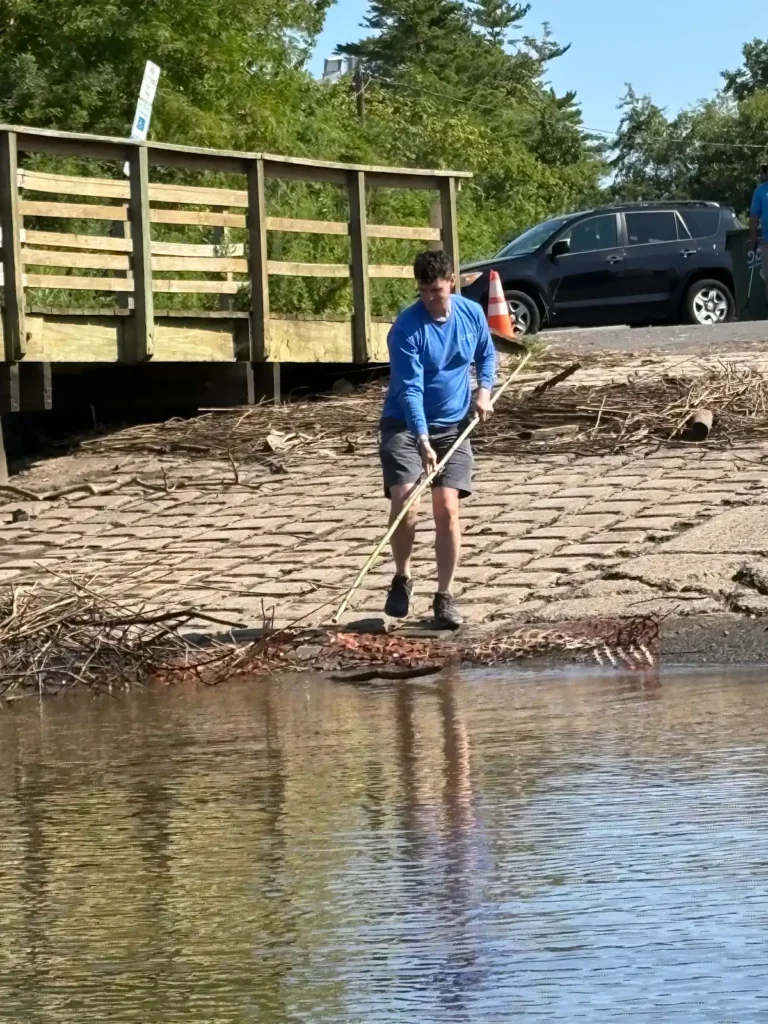
Last time, the cleanup was done between the two docks only. This time, it was being done at the right side of the right dock where most of the debris is and gets swept to the middle of the docks. It will now be easier for boats and kayaks to access the river at this site.
Photos by Endurance Laryea.
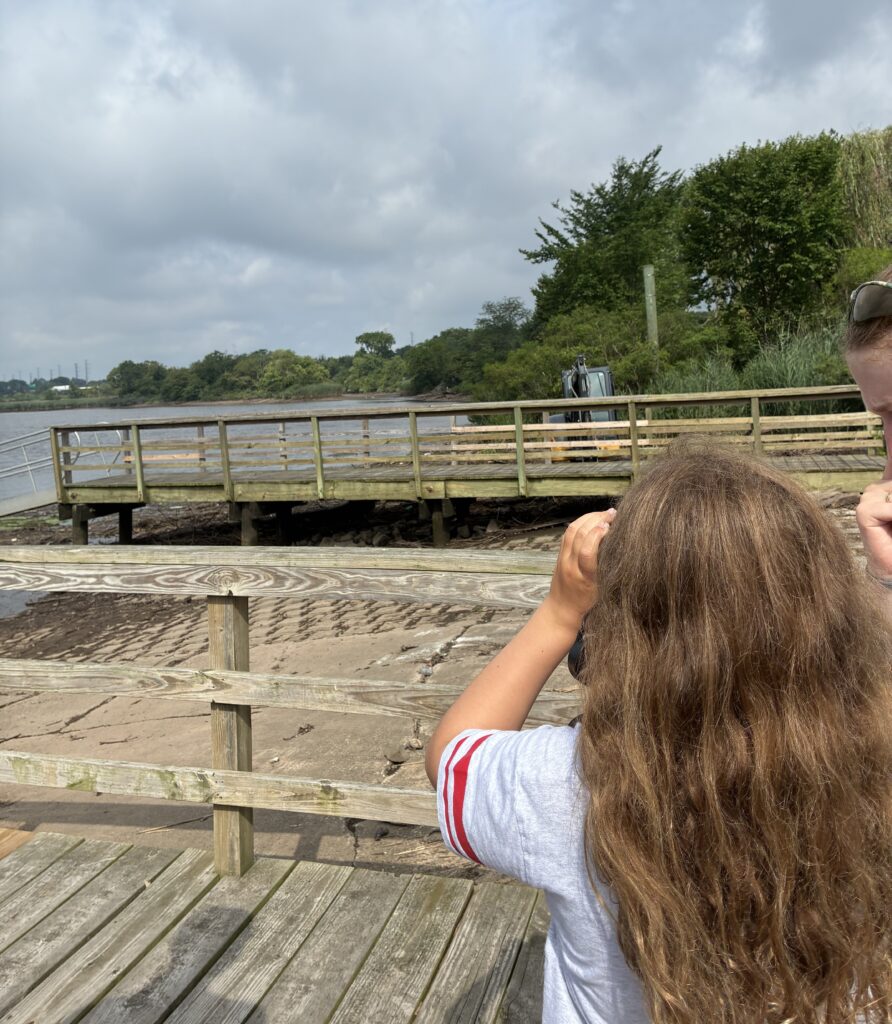
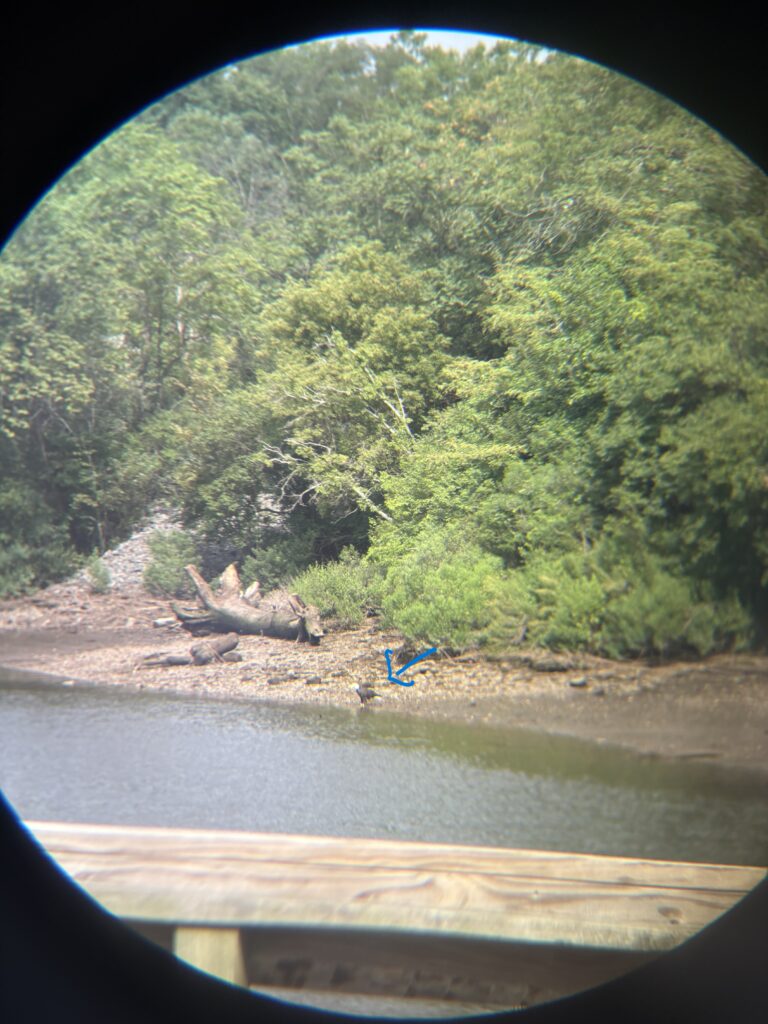
Art spotted a bird and gave his binoculars to Bryanna for her to try spotting and identifying it too. Photo by Endurance Laryea.
After a couple of minutes, she exclaimed, ‘Oh I see it, it’s a bald eagle!’ It was, indeed, a bald eagle. Photo by Ashley Fritz.
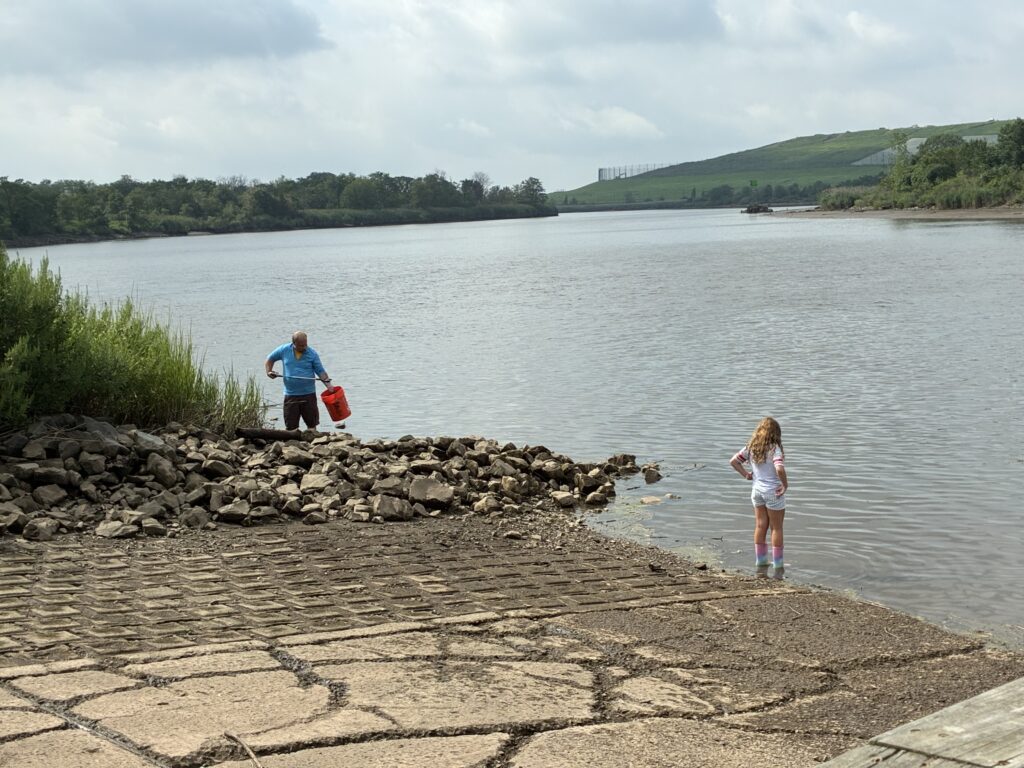
Mike on trash duty while Bryanna washes her boots at the bank of the river. Photo by Endurance Laryea.
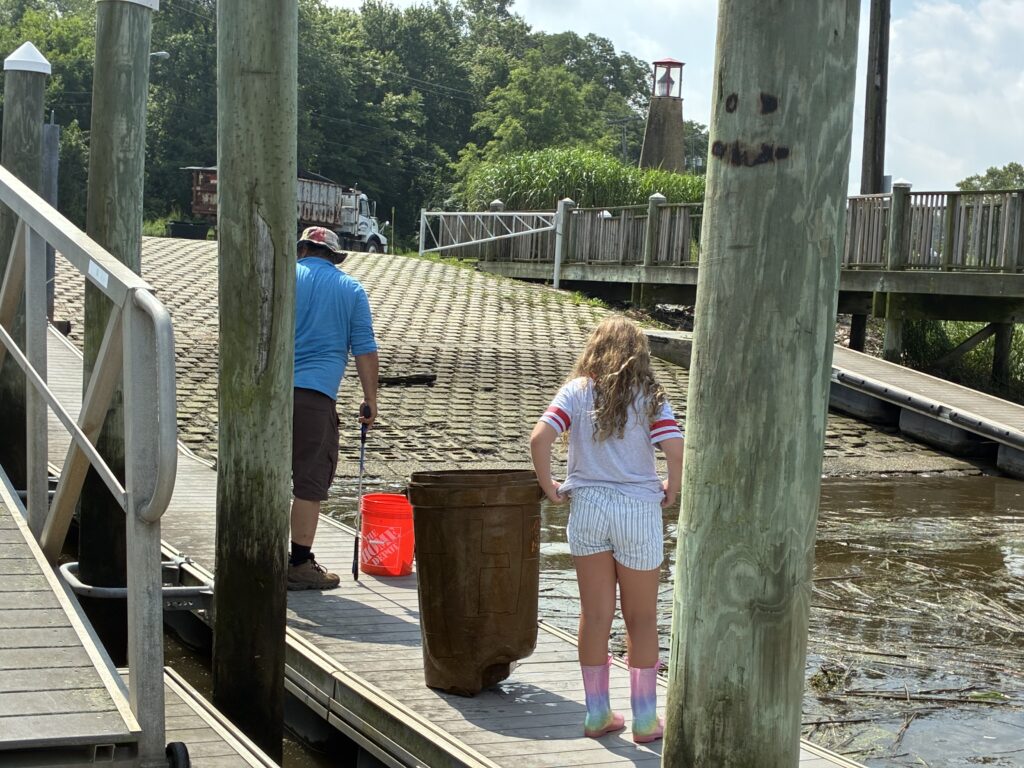
Mike pulled out this huge plastic bucket out from the river at Sayreville. This is his largest pick-up yet! Photo by Endurance Laryea.
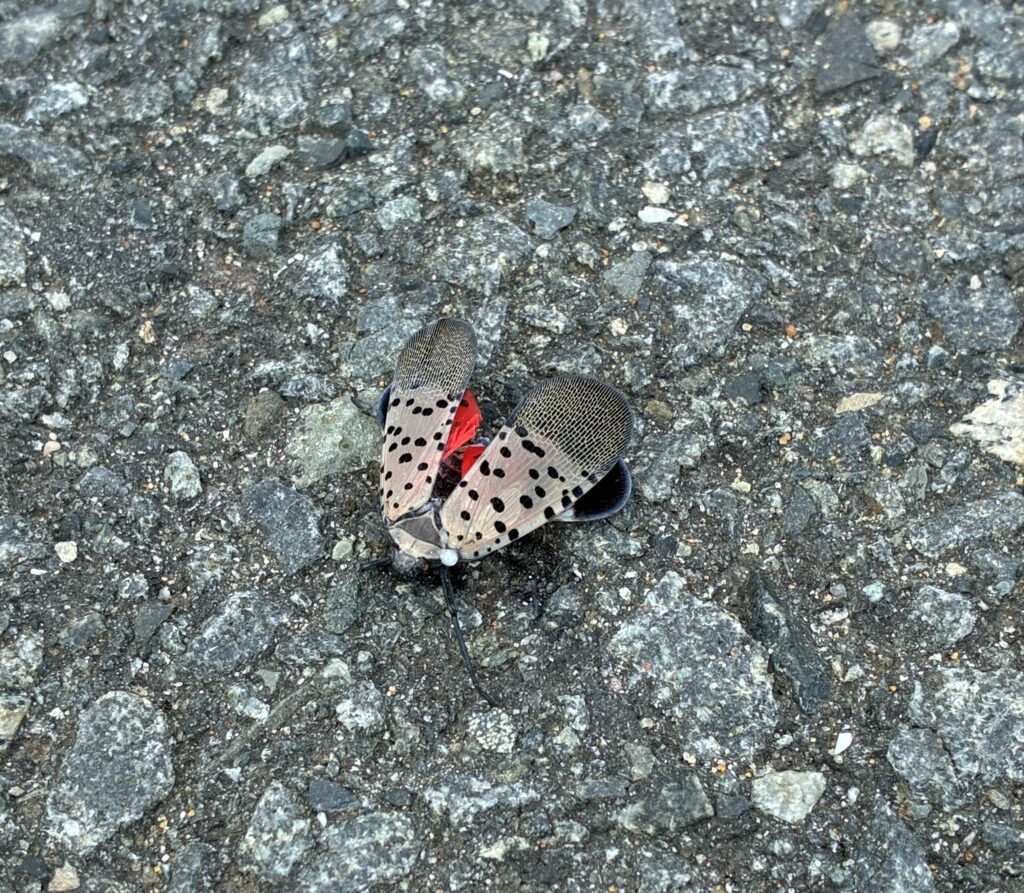
This is a spotted lantern fly, spotted (no pun intended) on the parking lot of Waterfront Park in South Amboy. Spotted lantern is an invasive species in the United States that cause significant damage to agricultural crops and ornamental plants as well. So, unfortunately, when seen, these beautiful flies need to be stepped on to prevent damage to prevent damage to New Jersey plants. Photo by Endurance Laryea
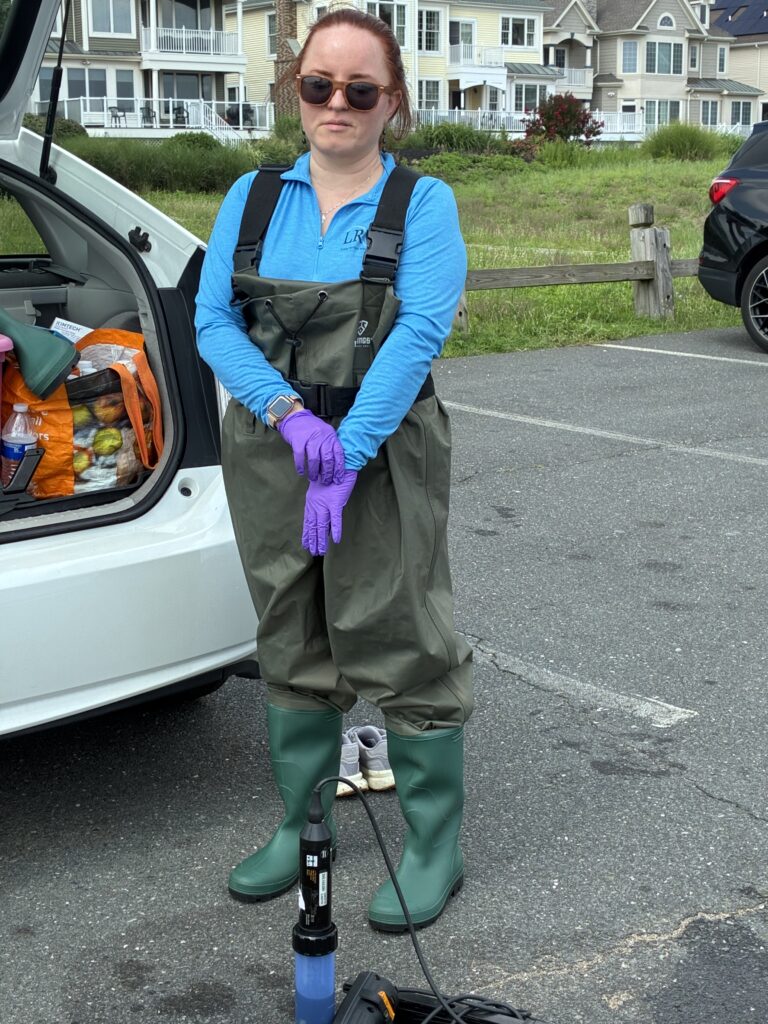
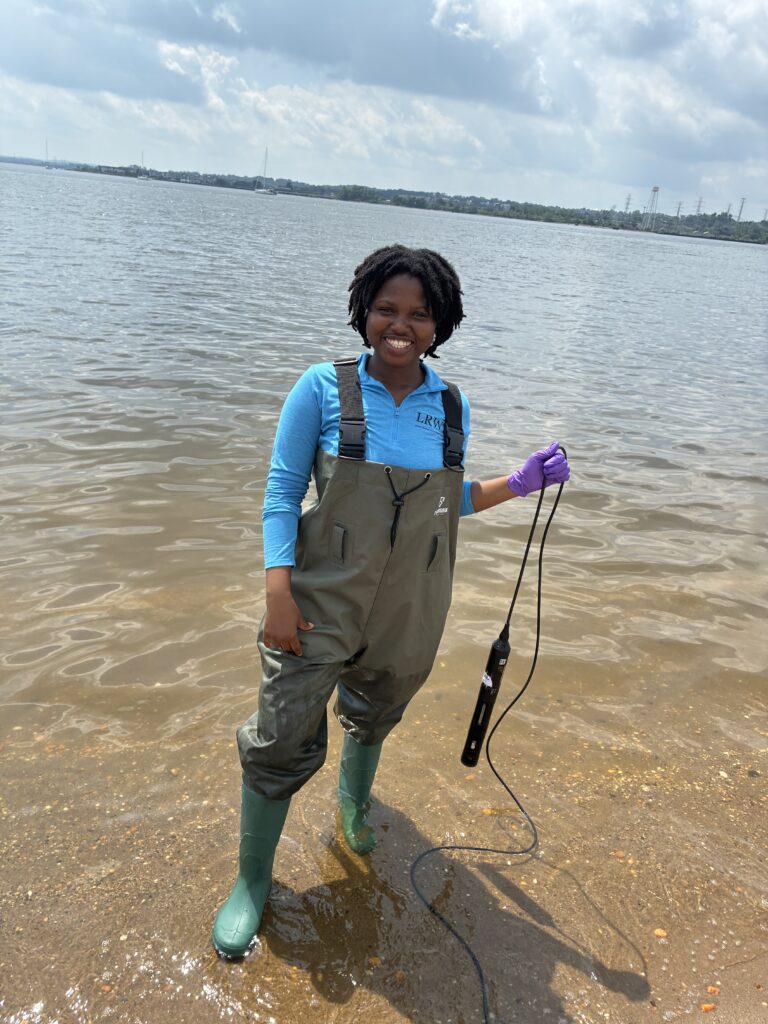
Olesya gets ready for sampling duties at Waterfront Park with her waders. Photo by Endurance Laryea.
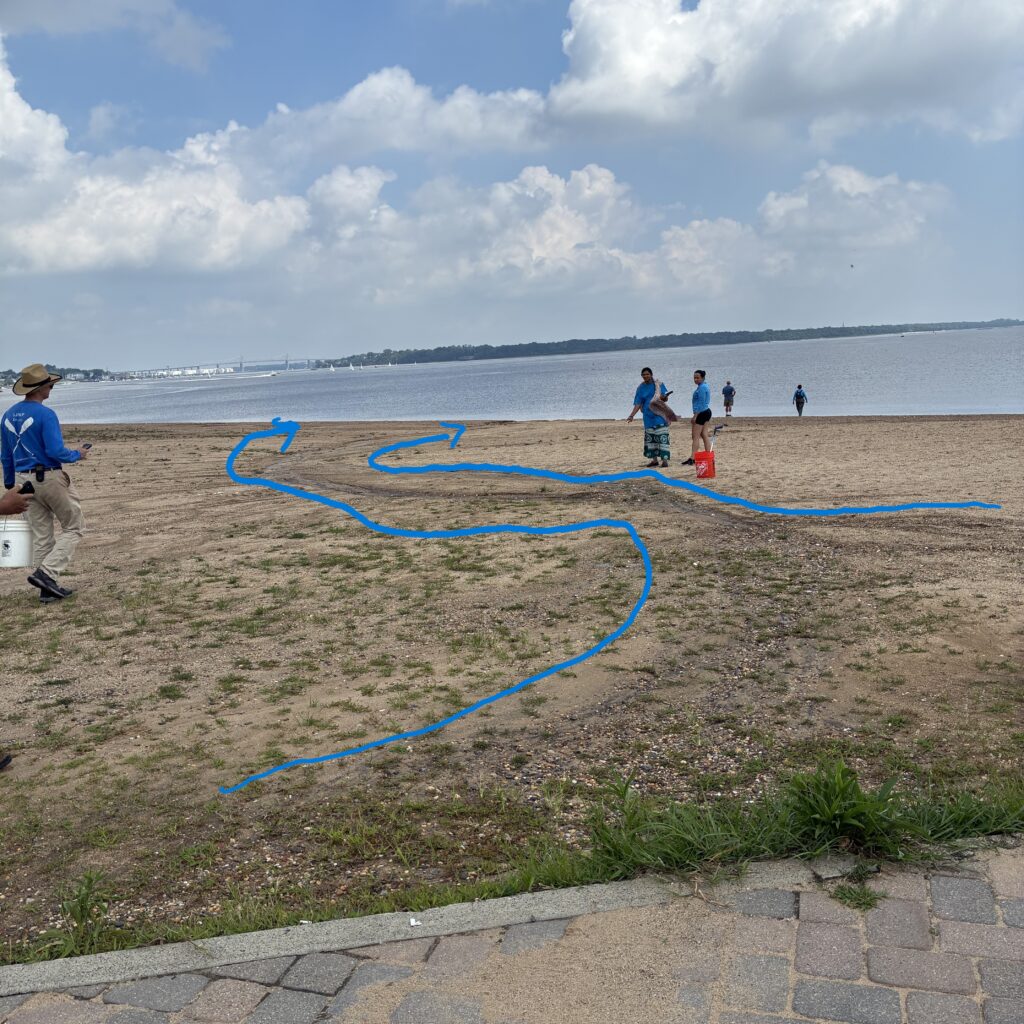
This erosion pathway created by rushing rainwater from the parking lot and walkway can be a highway for pollutants (like sediments, debris, litter) to get into the river. This is known as Nonpoint Source Pollution. Nonpoint Source Pollution (NPS), defined by the EPA, is any type of pollution that is not coming from a point source such as a sewage pipe, an industrial pipe or channel etc. It could be from land or road runoff. One simple way to curb Nonpoint Source Pollution is to keep litter, pet waste and debris out of roads, parking lots etc., to prevent them from getting washed into the river during precipitation. Basic Information about Nonpoint Source (NPS) Pollution | US EPA Photo by Endurance Laryea.
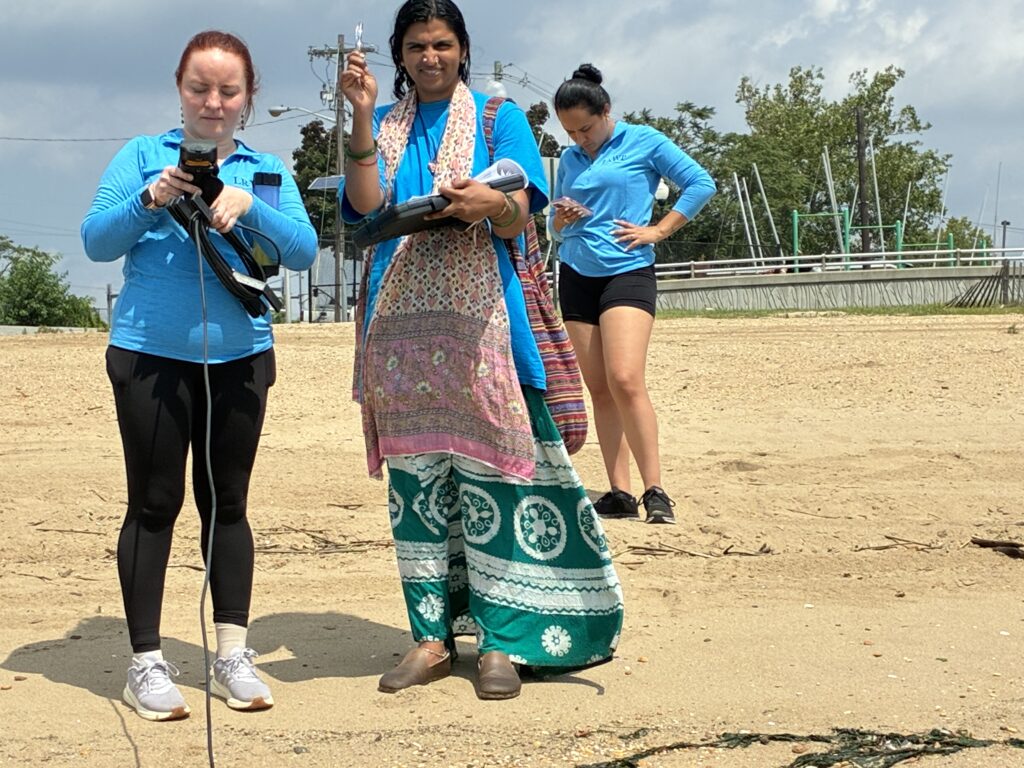
Olesya and Lakshmi on measurement recording duty. Photo by Endurance Laryea.
Art on visual habitat assessment duty. Photo by Endurance Laryea.
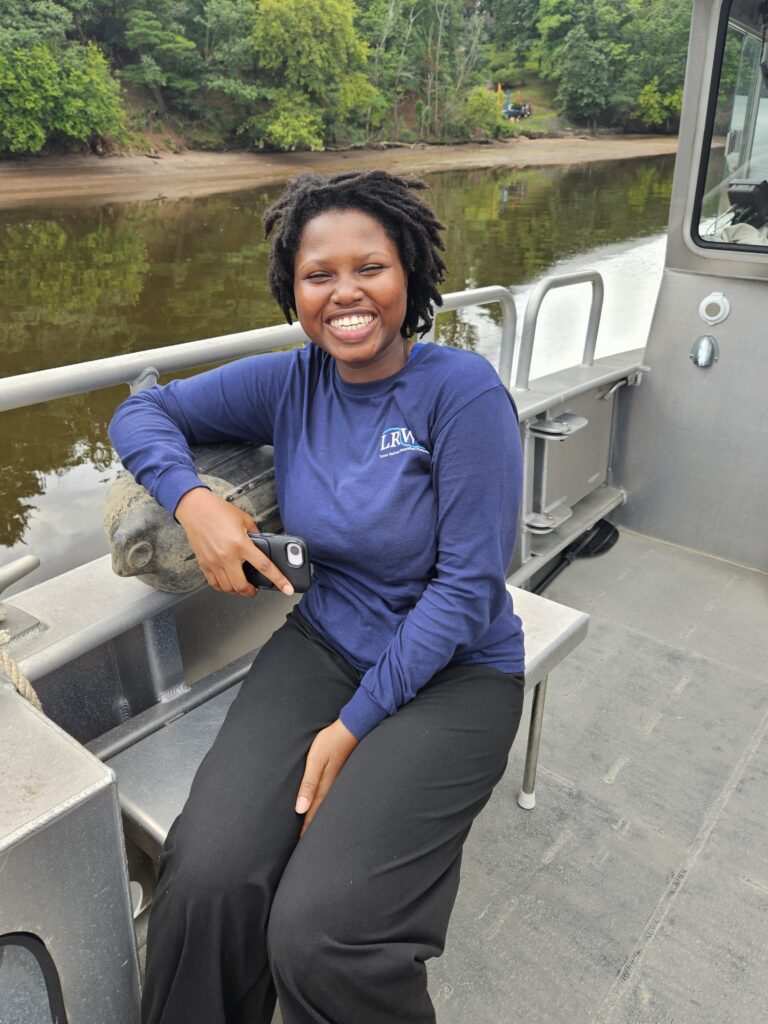
Endurance poses for a photo at the end of monitoring. Photo by Lakshmi
By Endurance Laryea, LRWP Summer Research Intern and J.M. Meyer.
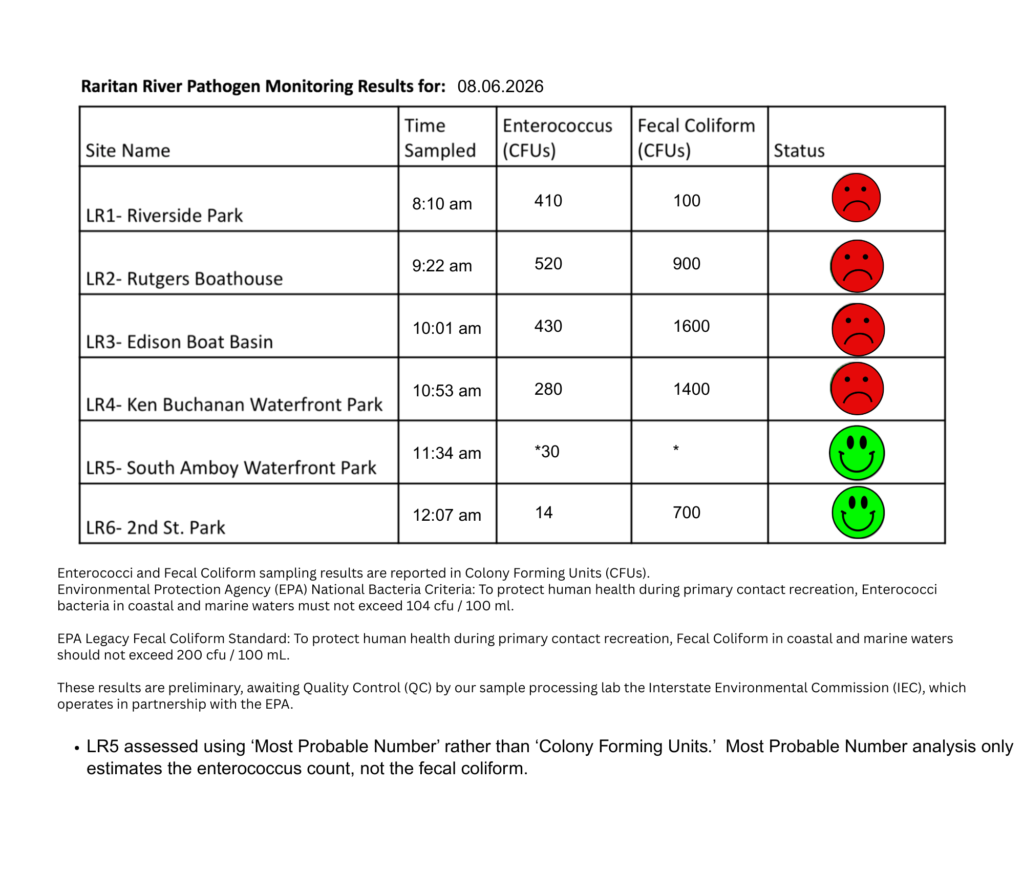
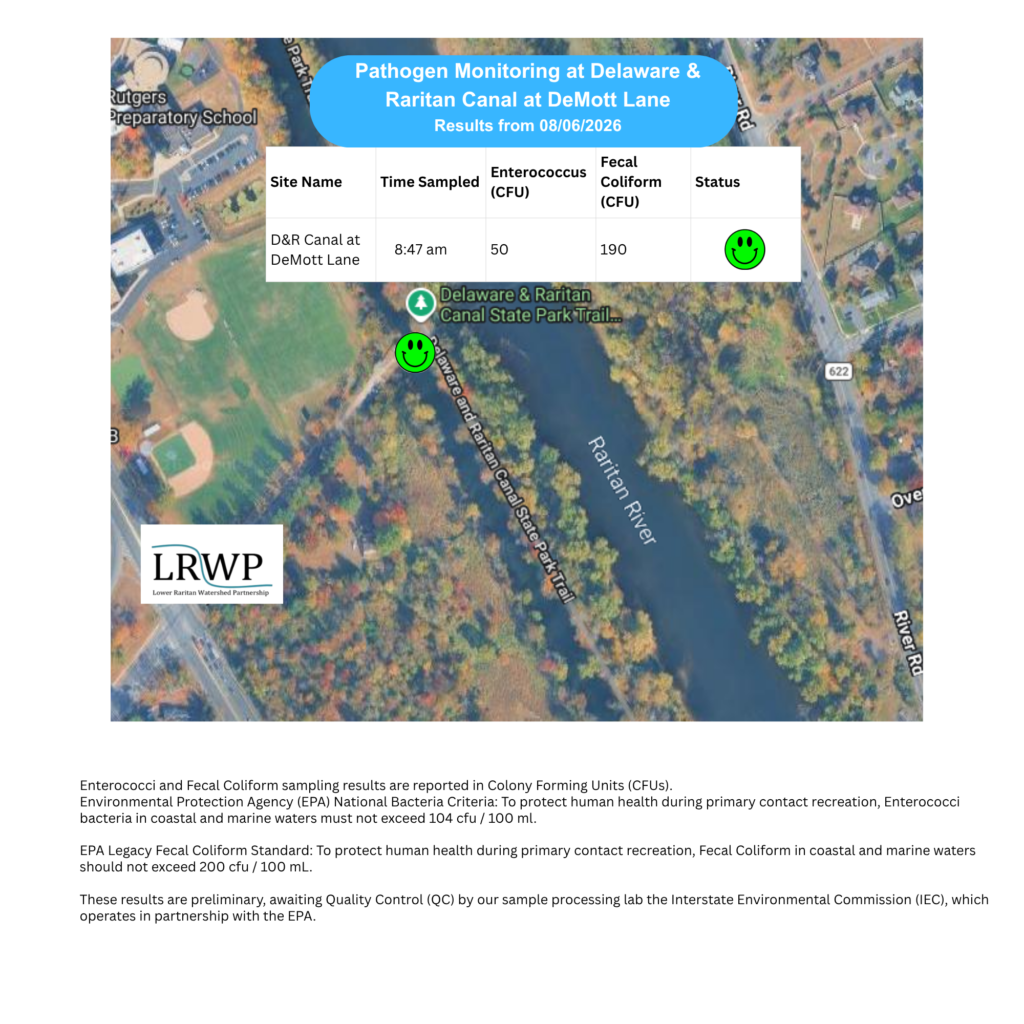
The first pathogen monitoring session of the month took place on Thursday, August 6th. Each week during the summer, from May to October, the Lower Raritan Watershed Partnership and Rutgers Cooperative Extension of Middlesex County run a volunteer-based monitoring program along the Raritan River. We collect water quality samples at six non-bathing public access beach sites, provide our samples to the Interstate Environmental Commission for analysis in their laboratory, and report the results to the public. Our mission is to share this data with the community and partners to ensure the safe use of the Raritan River for all.
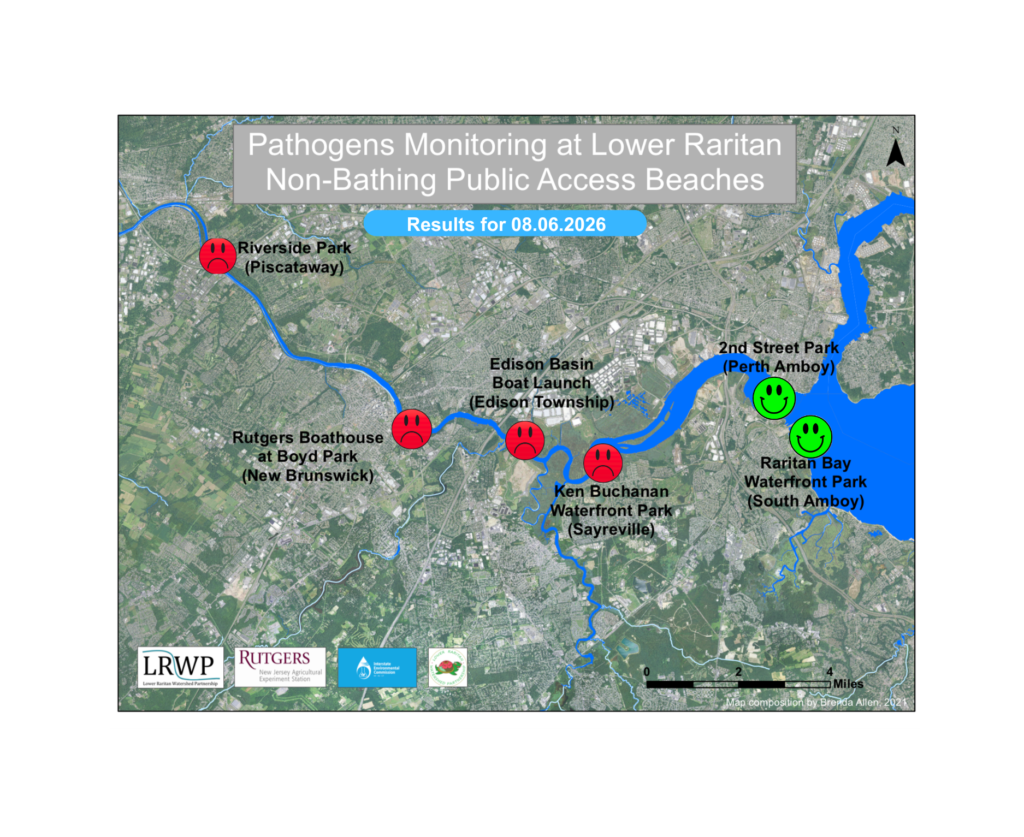
Our lab results for water quality samples taken on Thursday, August 6th, 2026, show Enterococcus bacteria levels exceeding the EPA federal water quality standard of 104 cfu/100mL at four of our regular monitoring sites this week. The problem sites are indicated by the red frown on the map and chart and include Riverside Park (Piscataway), Rutgers Boathouse (New Brunswick), Edison Boat Basin (Edison), Ken Buchanan Waterfront Park (Sayreville).
Green smiles on the chart and map indicate the sites with bacteria levels safe for recreation and include the following: 2nd Street Park (Perth Amboy), and South Amboy Waterfront Park.
A note of caution about Perth Amboy: enterococcus better correlates with disease causing bacteria, but the fecal coliform count in Perth Amboy was well above the EPA legacy standard of 200 colony-forming per milliliter.
Pathogens/Enterococci levels are used as indicators of the possible presence of disease-causing bacteria in recreational waters. Such pathogens may pose health risks to people coming in primary contact with the water (touching) through recreational activities like fishing, kayaking or swimming in a water body. Possible sources of bacteria include Combined Sewer Overflows (CSOs), improperly functioning wastewater treatment plants, stormwater runoff, leaking septic systems, animal carcasses, pet waste, wildlife waste, and runoff from manure storage areas.
In order to better understand why Riverside Park, Piscataway has been our worst performing site over the past six years, we have started sampling at new sites in the vicinity . On August 6th, we sampled the canal at DeMott Lane for a third time since we started pathogens monitoring this season. The lab analysis produced 50 enterococci cfu per 100mL which passes the EPA federal water quality standard of 104 cfu/100mL. Again, this site passed the test, as it has every week that we’ve tested it.
Our goal in reporting these results is to give residents a better understanding of the potential health risks related to primary contact during water-based recreation. If you are planning on recreating on the Raritan this weekend, make sure to stay safe and wash up after any activities!
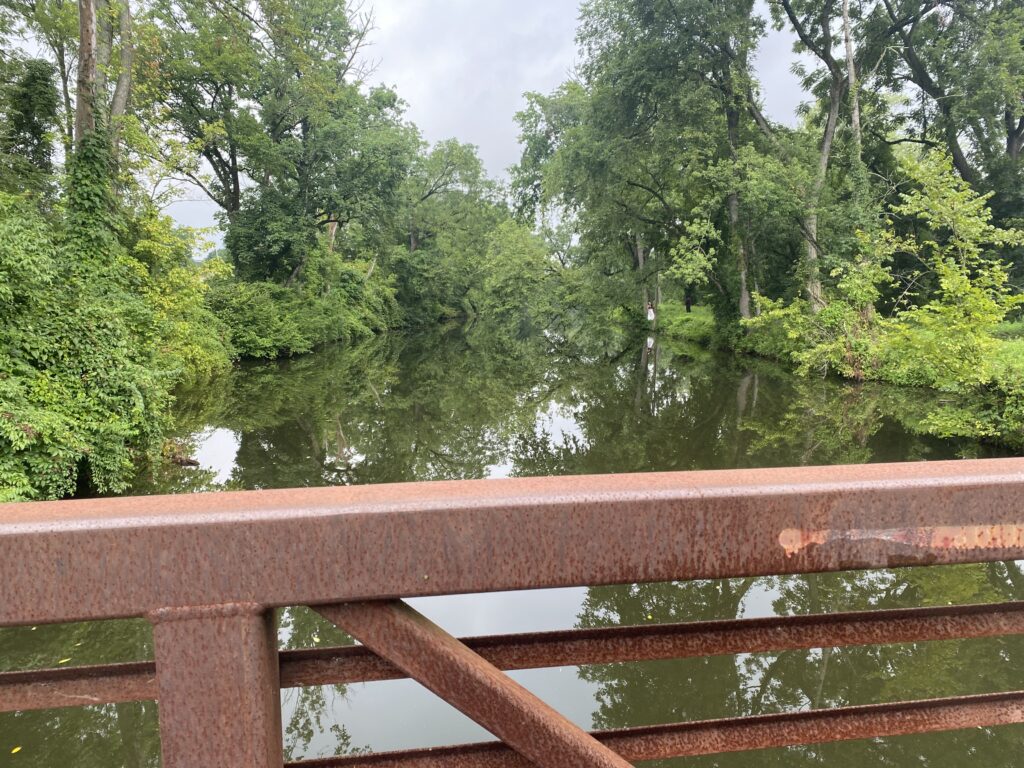
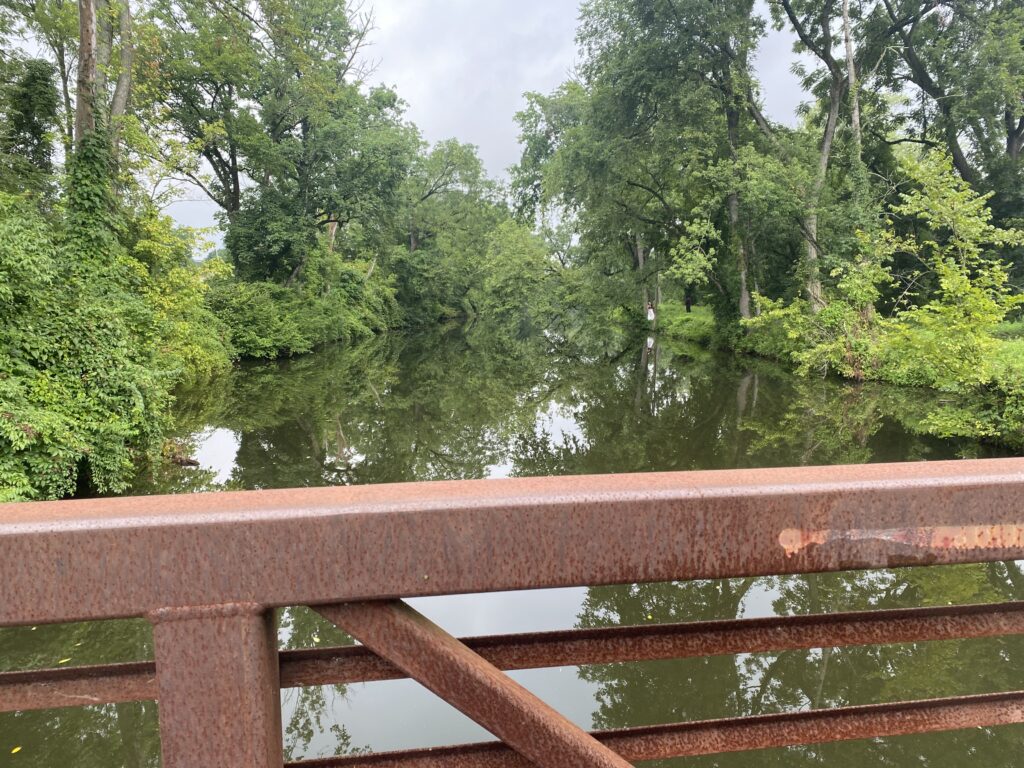
Early morning reflections on the Delaware & Raritan Canal. Photo by Mike Orsini.
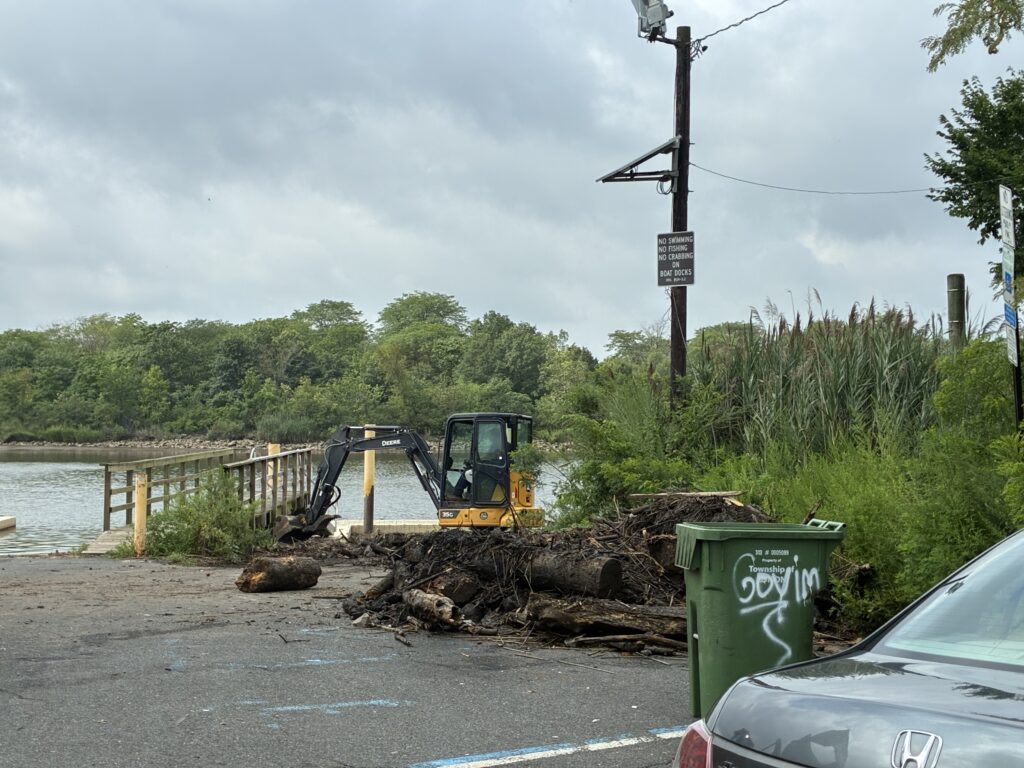
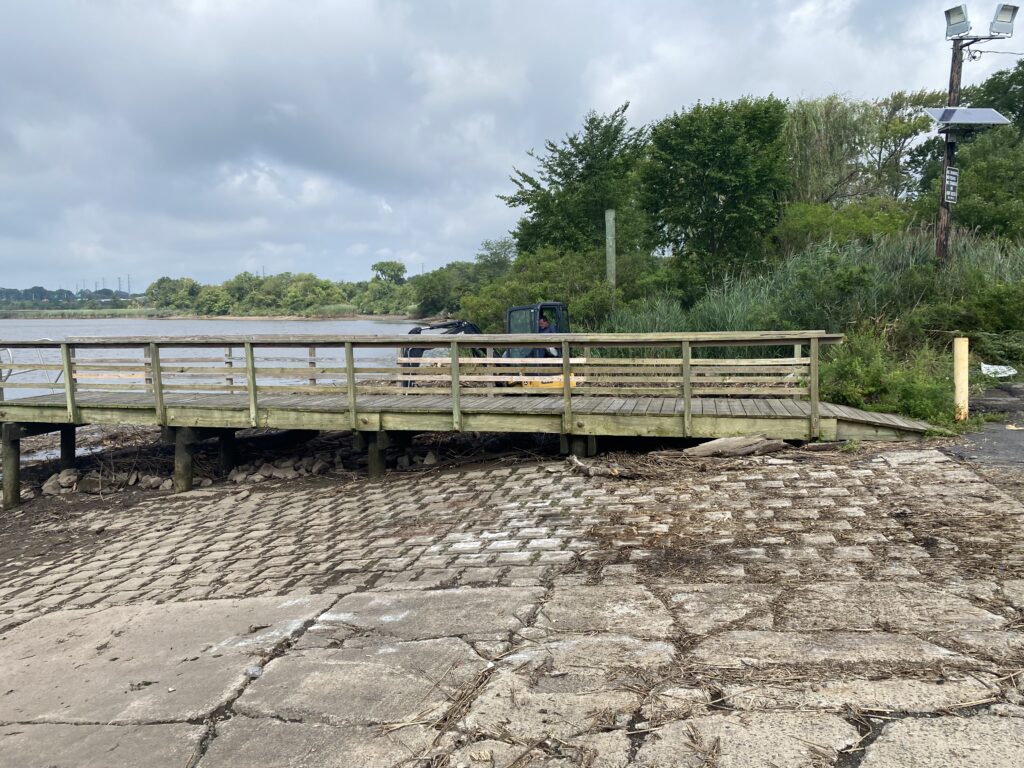
An excavator clears out woody debris lodged against the Edison Boat Basin. Photo by Mike Orsini.
We started and ended monitoring session today with cloudy skies and cool temperatures. While it rained before and after the session, we stayed dry thanks to some excellent timing.
All our parameters seemed to be in a good range; however, we expected the enterococci and fecal matter levels to be on the higher end due to the precipitation we experienced in the past 48 hours.
Photo by Endurance Laryea.
The team today! Lakshmi, Olesya, Endurance, Ashley, Paula and John (taking photo).
We were joined by Lakshmi at Edison where John pointed out some important features of the landscape around the river and explain the goals and activities of the LRWP Pathogens Monitoring sessions this summer.
This deer was seen wandering about in circles at Riverside Park, Piscataway when we got there this morning. It seemed to have lost its way–maybe strayed from its herd? Photo by Endurance Laryea.
High tide and stormwater led to high water levels at all seven sites.
An ash tree trunk floating near the dock. Several ash trees have died and fallen off near the river at Riverside Park, and this may have been washed in by the storm in the last couple of days. The LRWP team is currently working to try to restore trees in the riparian zone. Photo by Endurance Laryea.
John made some height demarcations on one of the poles to make it easier to see changes in river depth. Photo by Endurance Laryea.
Ashley, Paula and Endurance pose for a photo after taking samples and hydrological measurements at riverside Park. John can be spotted in the background measuring the river depth and making demarcations on the pole. Photo by Endurance Laryea.
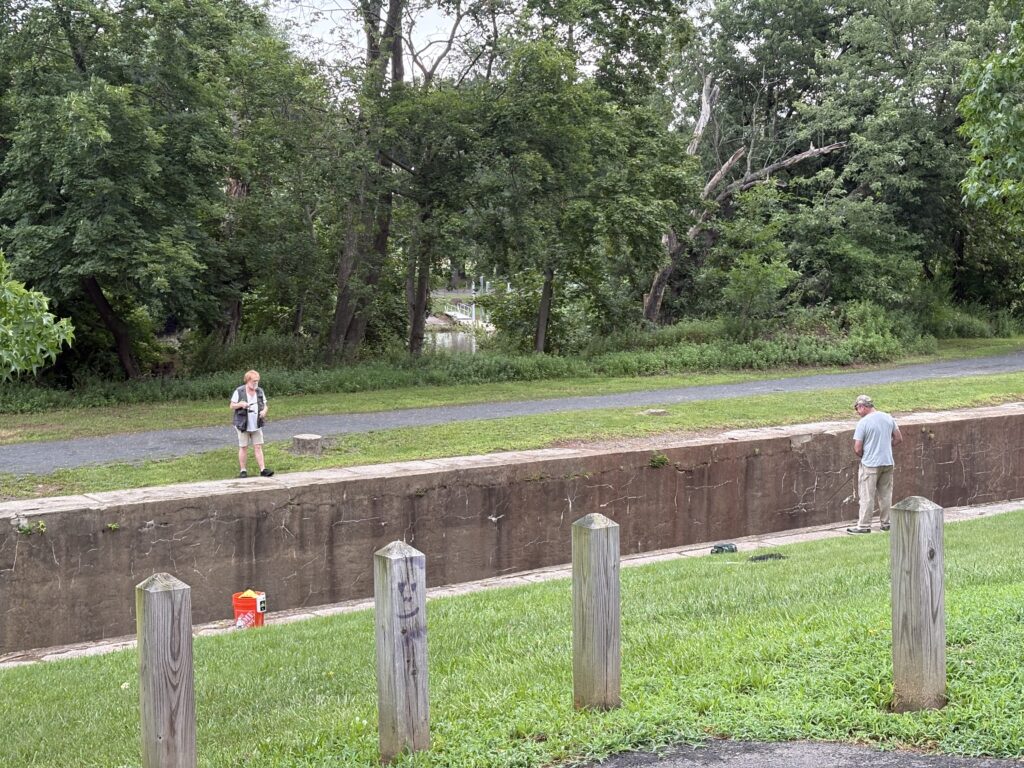
Two fishermen spotted at the Five-Mile Lock, Easton Avenue. At the time we came for monitoring and sampling, they had not had any luck. Hopefully they did after we had left. Photo by Ashley Fritz.
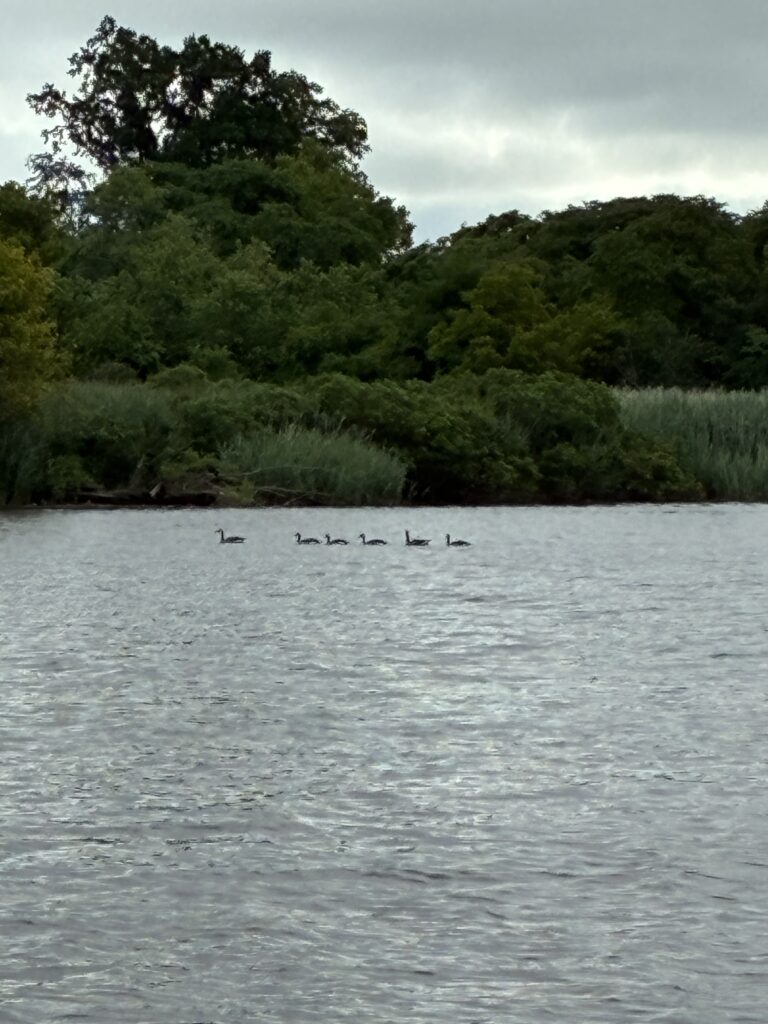
Ever wondered why ducks or geese move in a straight line on water? They remind me of elementary school kids being led by their teachers on a field trip. No teacher wants to get back to school only to realize that they lost a kid! It is a similar concept with these birds; however, another theory is that they do this to conserve their energy. The leader duck creates a ‘momentum’ ahead that the ones trailing behind paddle on. Less tiredness, less slacking!
Canada geese swimming in a straight line at Rutgers Boathouse, New Brunswick. Photo by Endurance Laryea.
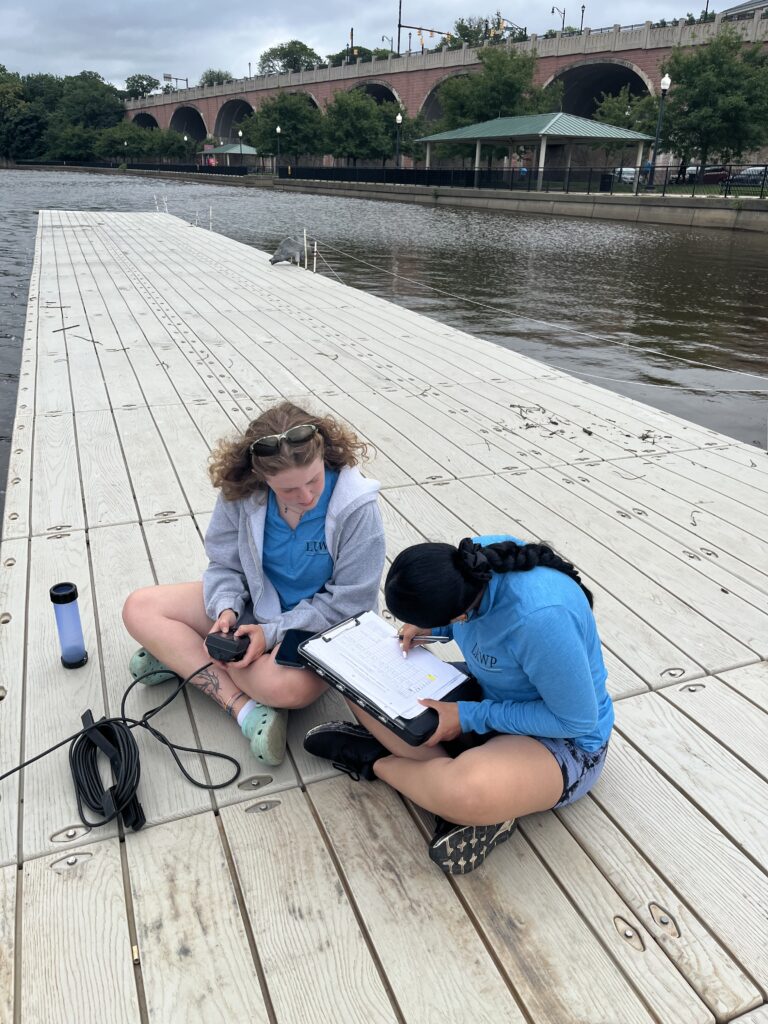
Paula and Ashley recording hydrological parameters at Rutgers Boathouse. Photo by Olesya Nabokova.
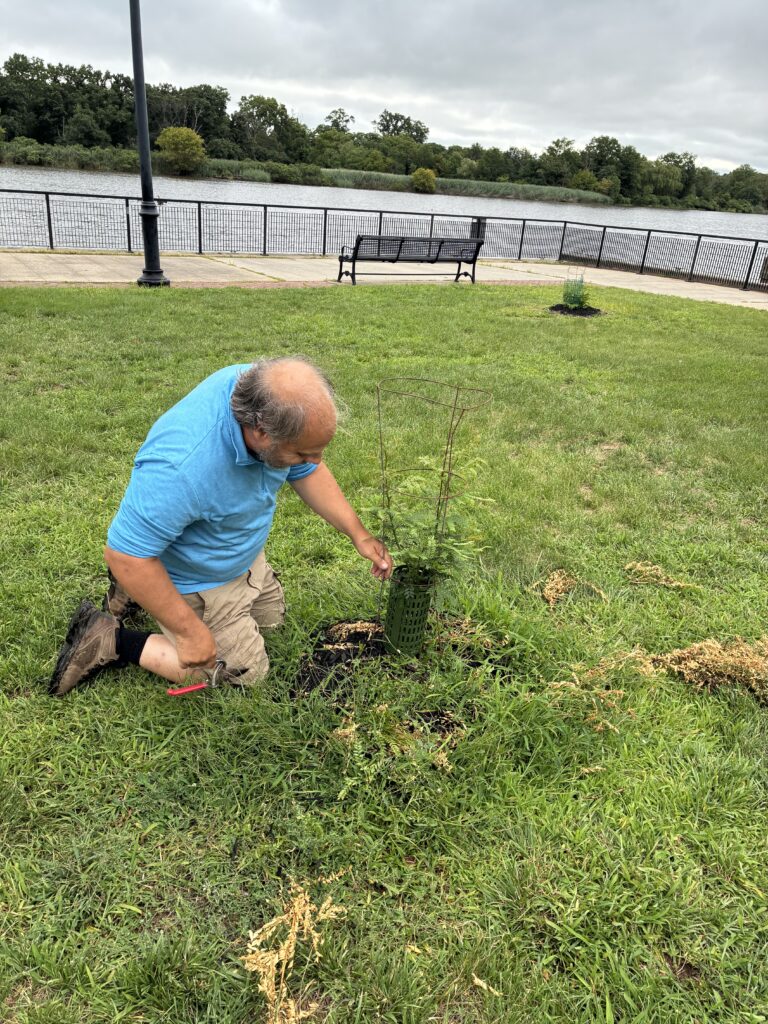
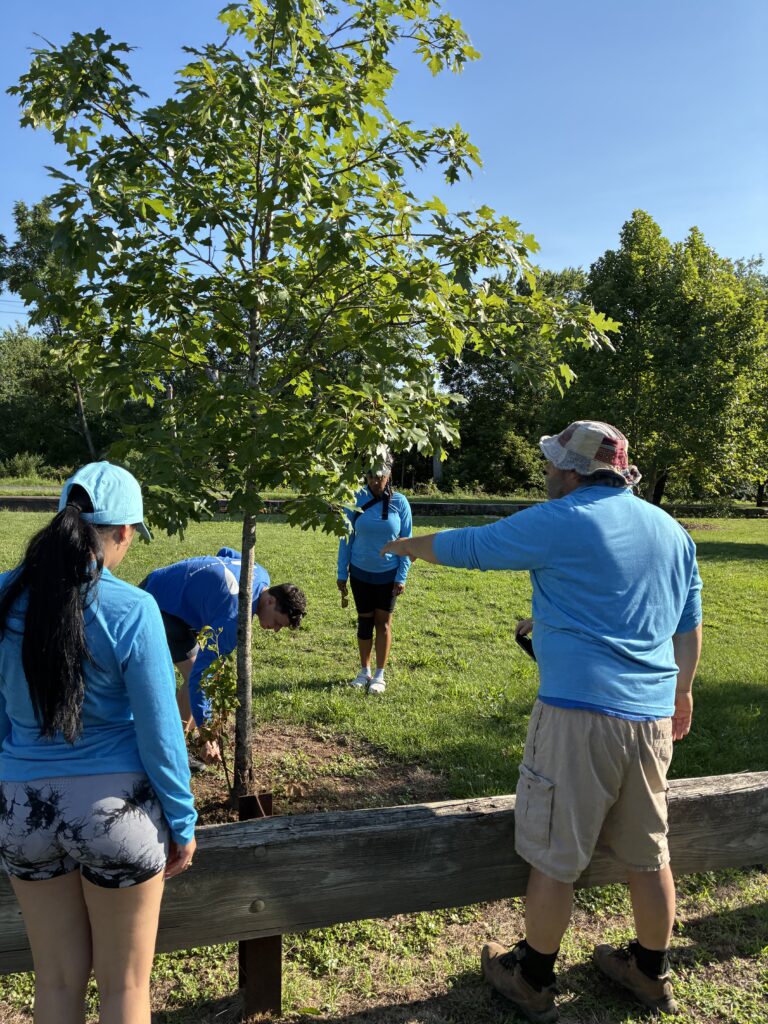
The honey locust trees pruned by Mike and John at Rutgers Boathouse have been fairing really well in the past couple of weeks. Thanks to the stewards at the Rutgers Boathouse who have been maintaining them and making they are not mowed down when cutting the grass.
Mike making sure the tree guards are sturdy. Photo by Endurance Laryea.
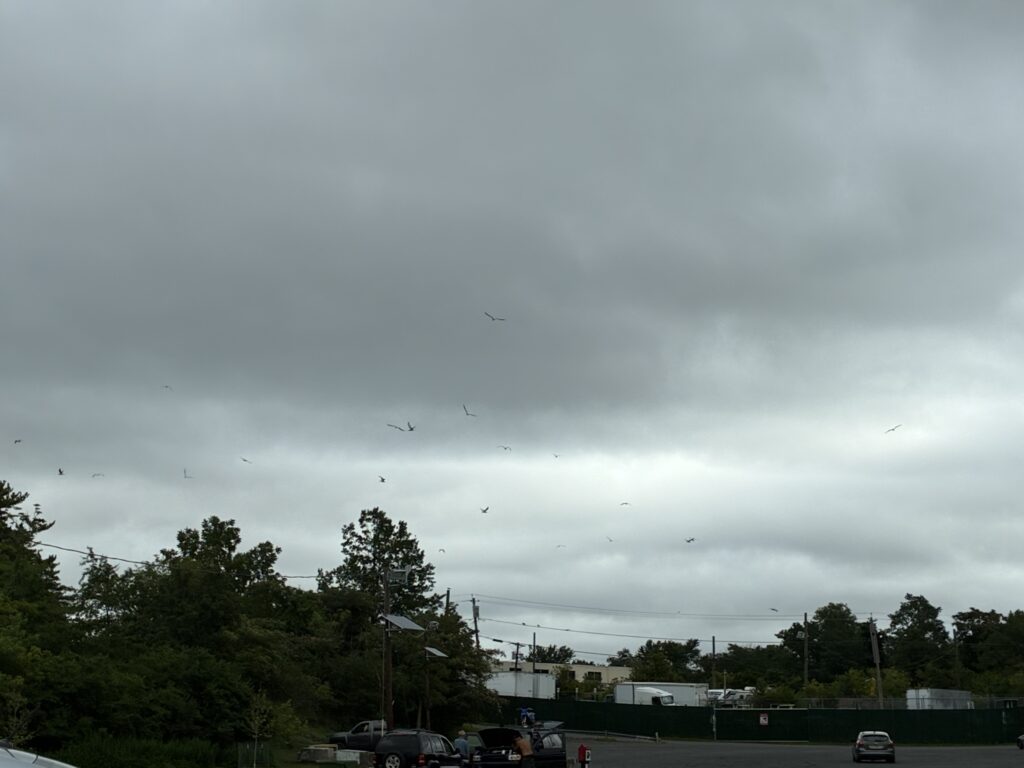
Seagulls flying frantically at Edison Boat Launch as the clouds get thicker and darker. Photo by Endurance Laryea.
Man crabbing during high tide at Edison. Photo by Endurance Laryea.
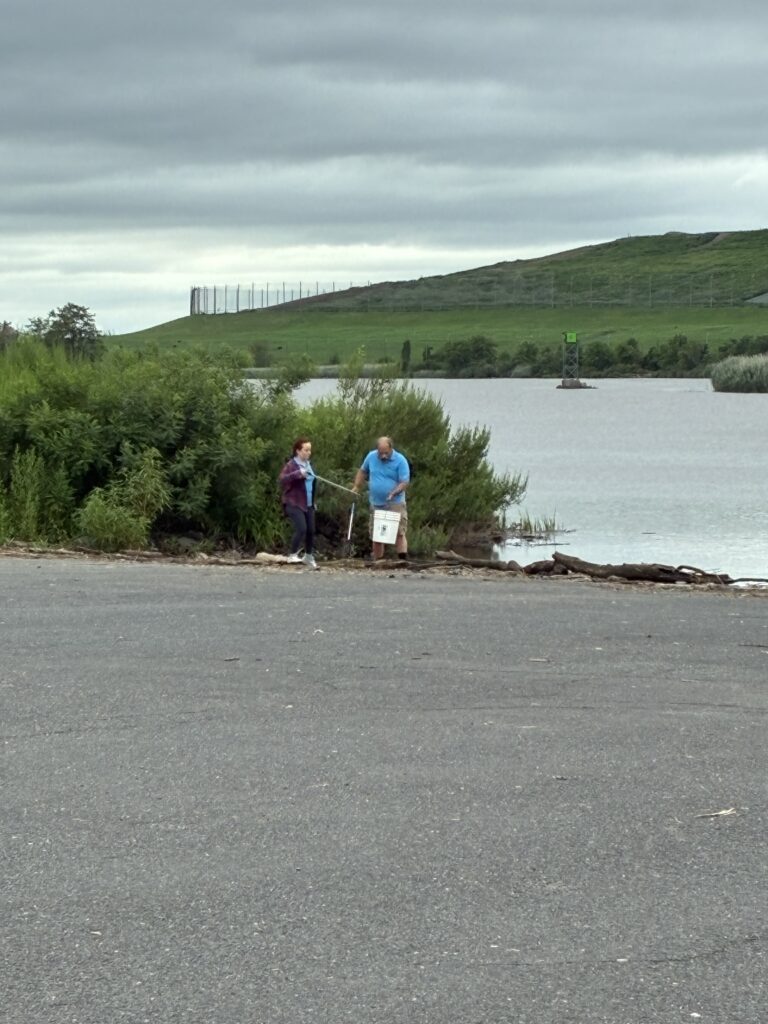
Olesya and Mike on Trash duty.Photo by Endurance Laryea.
John spotted this apple tree with its fruits almost ready to harvest. Apple flowers start to bloom in the spring. By early summer, pollination takes place and the fruits start to develop. Pollination is the beginning of the reproductive process in plants. It is followed by fertilization which is when the fruit start to develop. By late summer to early fall, the apples are ripe and ready to be harvested. Photo by Endurance Laryea
High tide in Sayreville too. Photo by Ashley Fritz.
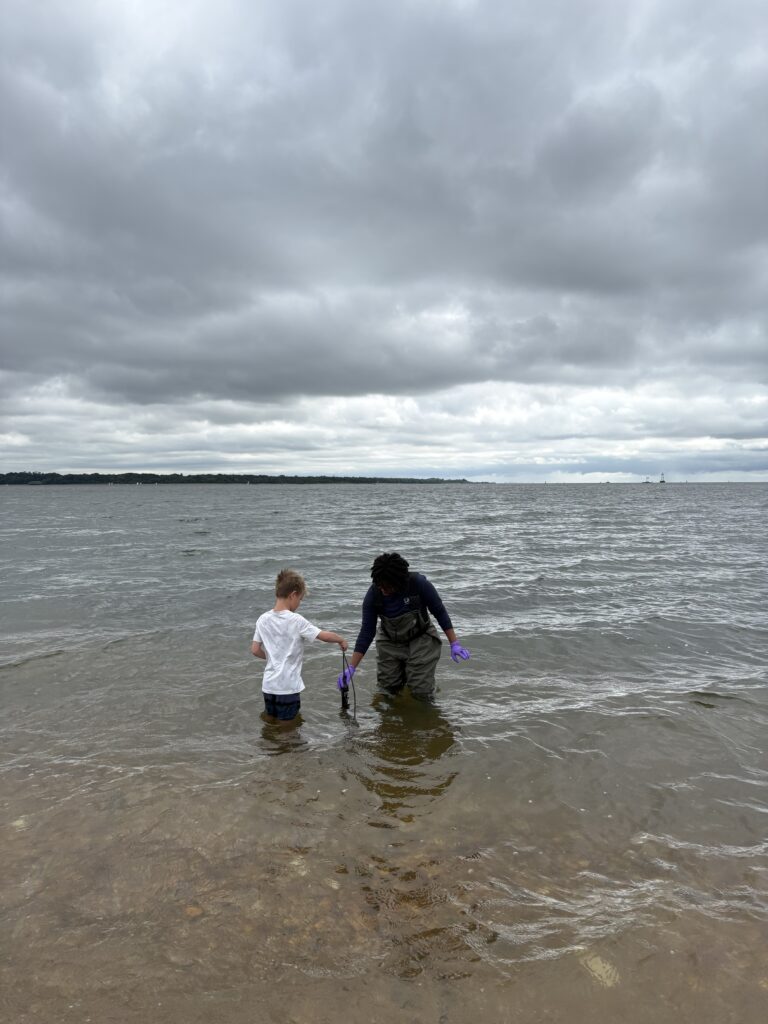
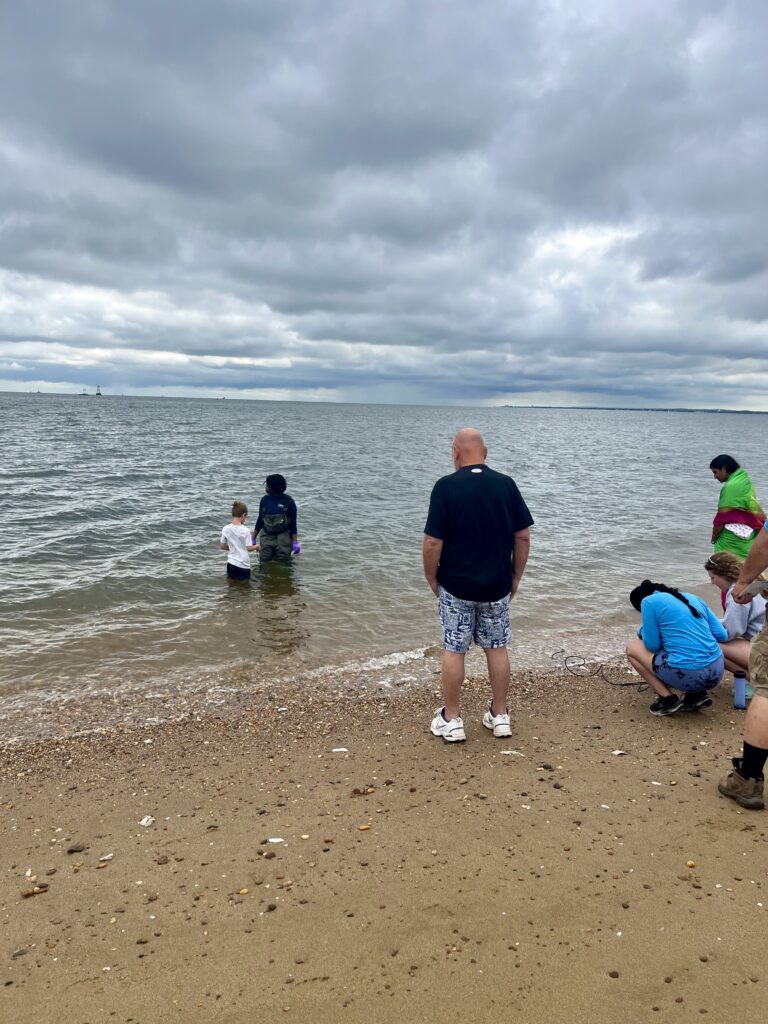
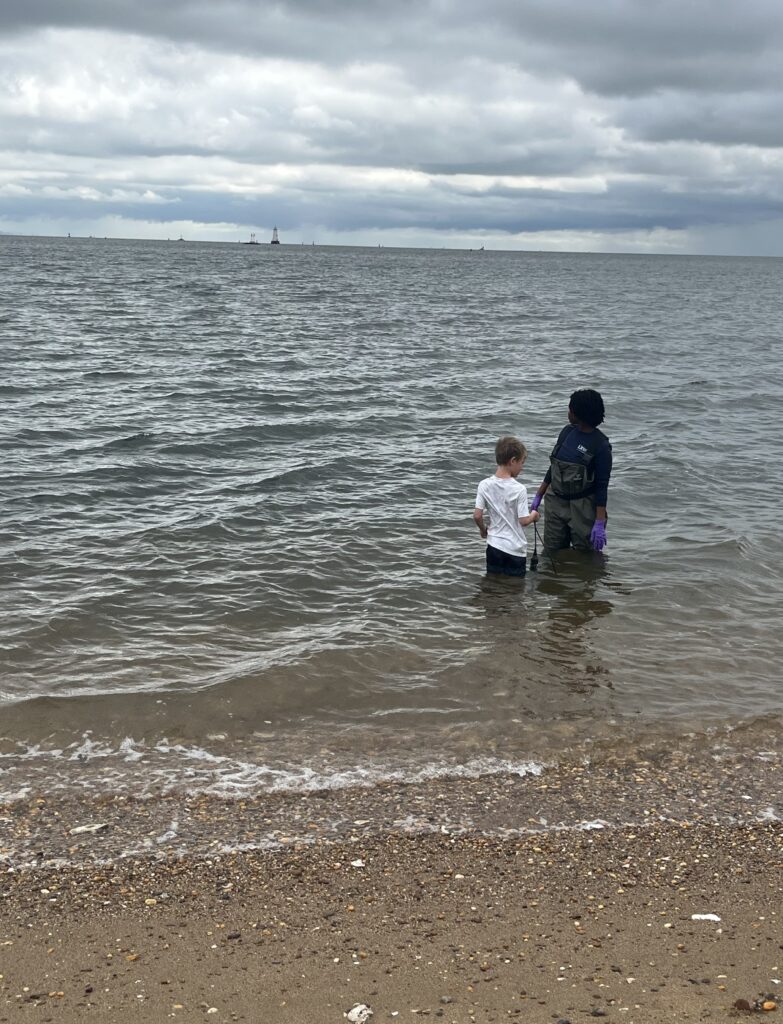
Remember the grandfather who reminded us of his grandson a couple of weeks ago at Waterfront Park, South Amboy? He came with his grandson, Gavin, to sample with us today at this site! Gavin has grown so much within the year that he outgrew his waders, so he had to go in with his swim shorts. We were excited that he was able to join us today! Photo by Ashley Fritz.
Gavin’s grandfather looks on while he and Endurance hold the sonde in the river and Paula and Ashley record the measurements. Photo by John Meyer.
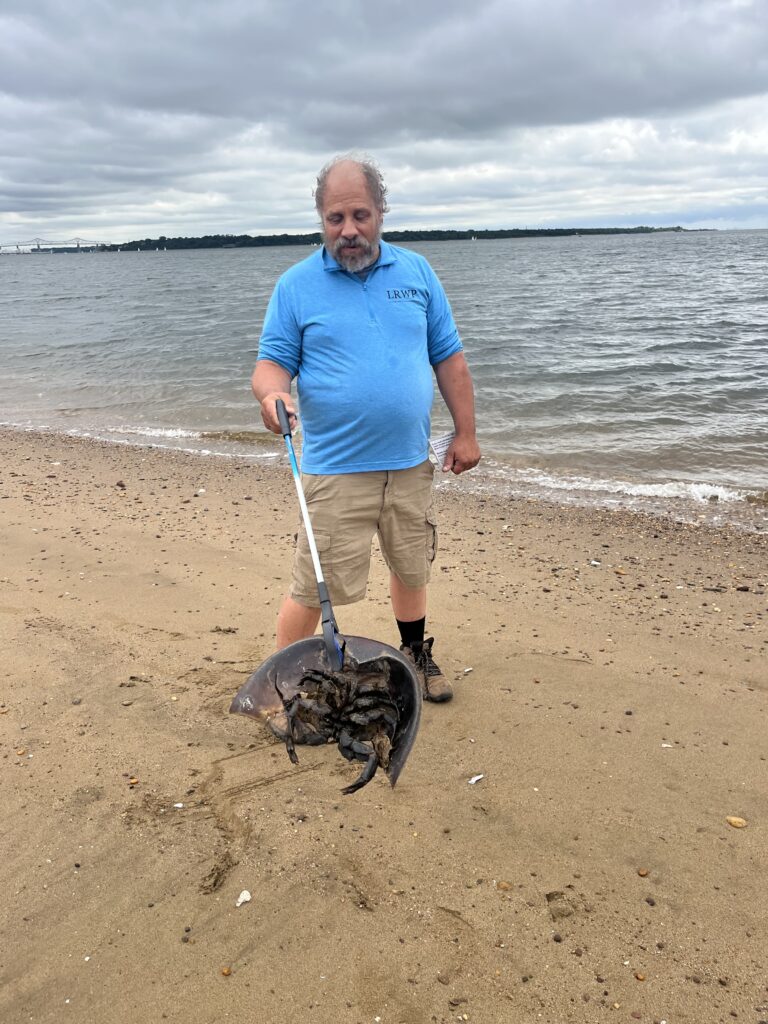
Mike holds up a half of a dead horseshoe crab. Photo by Olesya Nobokova.
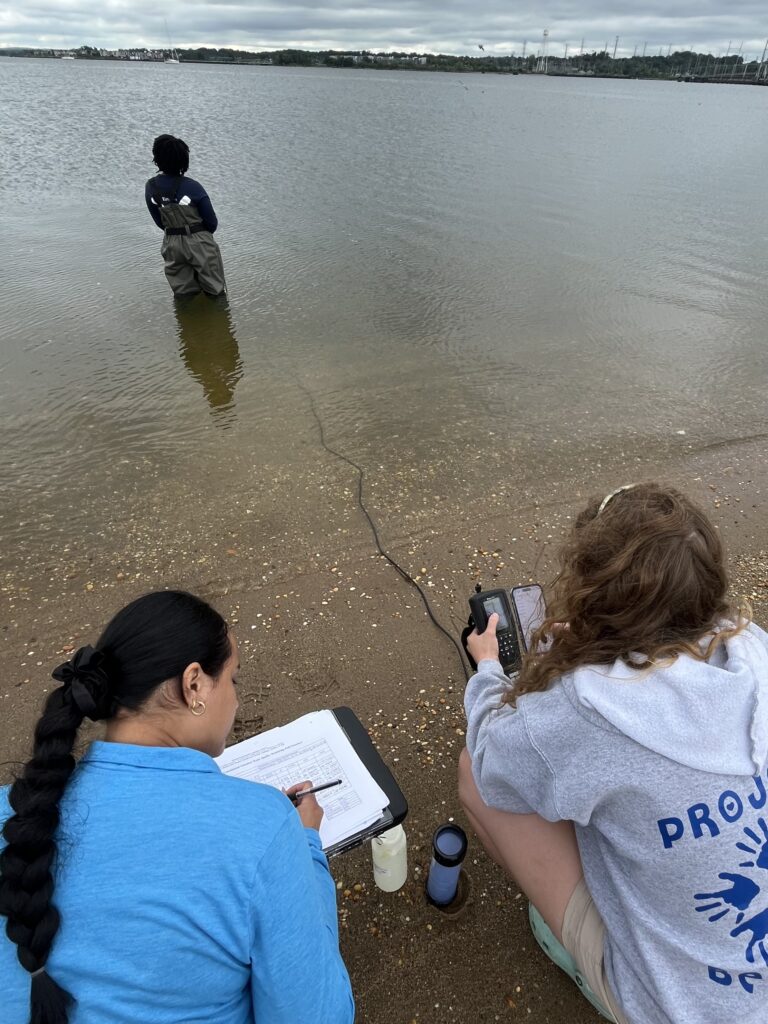
Paula, Ashley and Endurance on sampling duties in Perth Amboy. Photo by Olesya Nobokova.
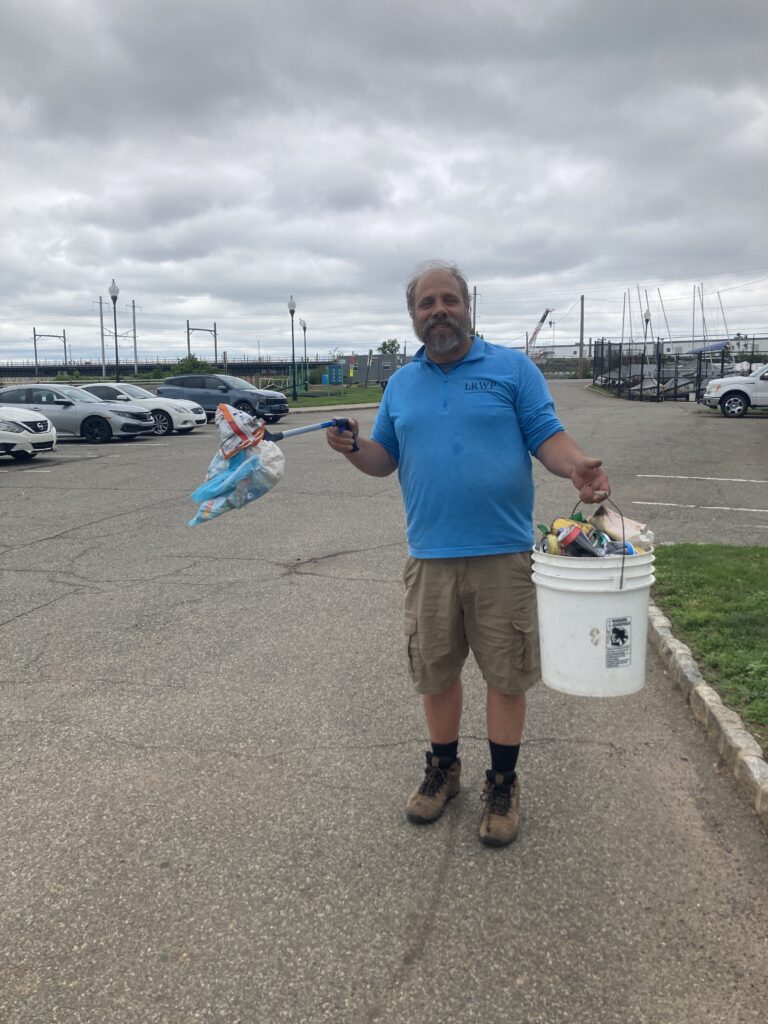
Mike holds up a baby diaper with his trash picker in one hand and 5-gallon bucket full of trash in the other at Perth Amboy. A poor sight to see! Photo by John Meyer.
Photo by Endurance Laryea.
Enjoy your weekend and remember to be safe if you decide to spend your time on the river this weekend!
By Endurance Laryea, LRWP Summer Research Intern and J.M. Meyer.
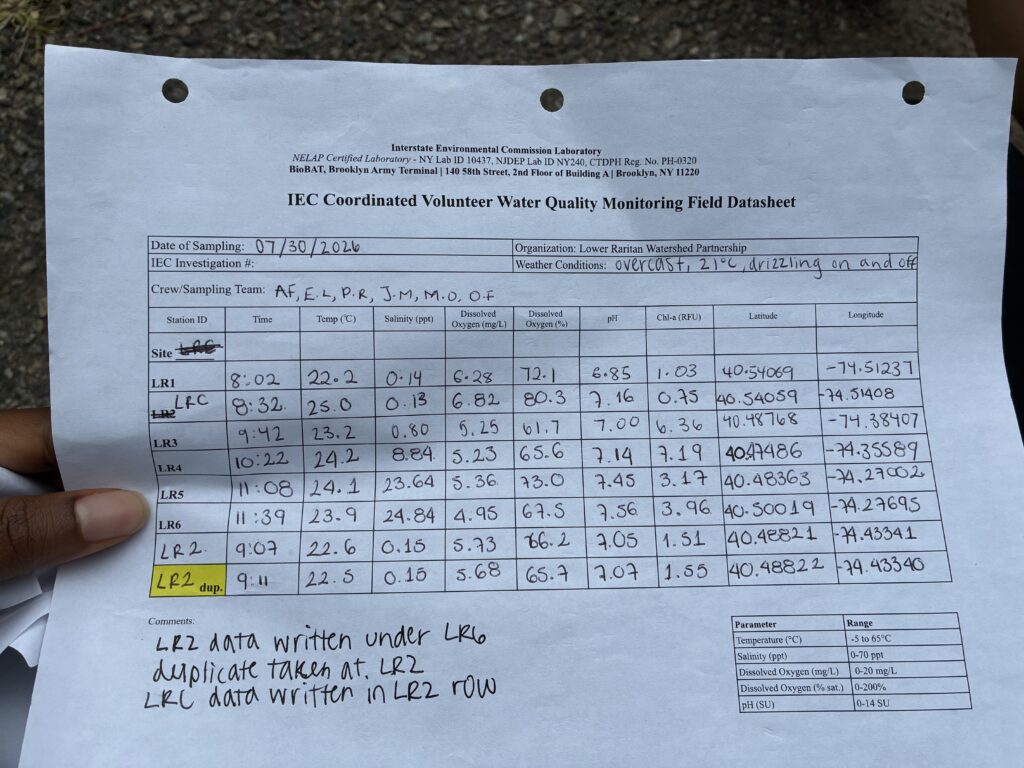
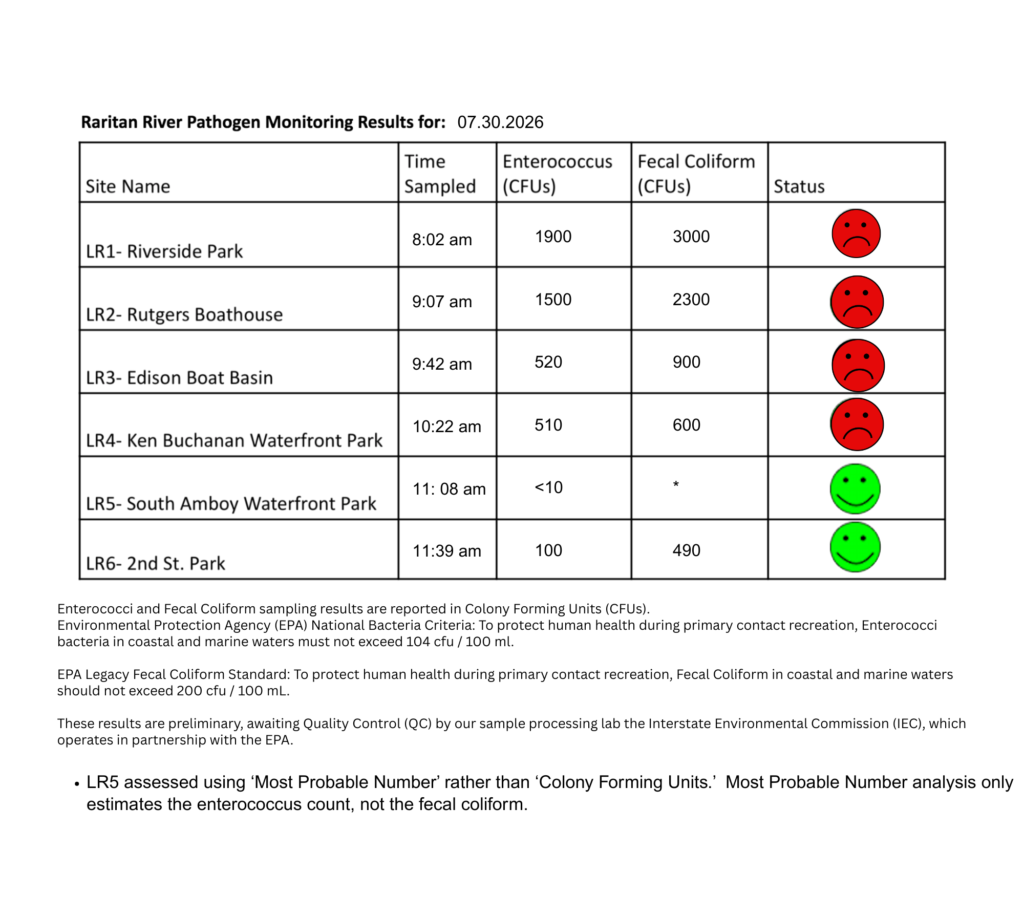
The final pathogen monitoring session of the month took place on Thursday, July 30th. Each week during the summer, from May to October, the Lower Raritan Watershed Partnership and Rutgers Cooperative Extension of Middlesex County run a volunteer-based monitoring program along the Raritan River. We collect water quality samples at six non-bathing public access beach sites, provide our samples to the Interstate Environmental Commission for analysis in their laboratory, and report the results to the public. Our mission is to share this data with the community and partners to ensure the safe use of the Raritan River for all.
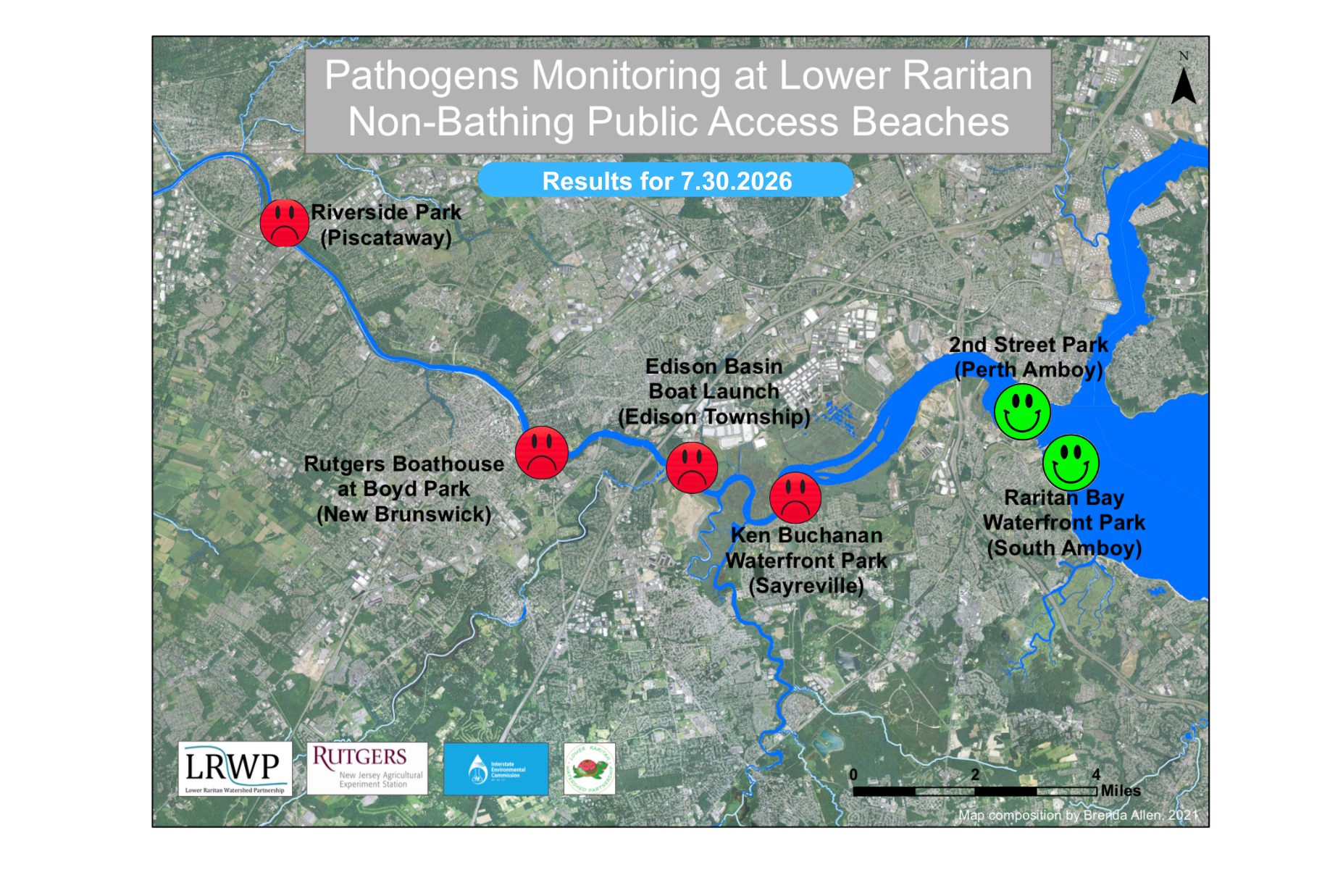
Our lab results for water quality samples taken on Thursday, July 30th, 2026, show Enterococcus bacteria levels exceeding the EPA federal water quality standard of 104 cfu/100mL at four of our regular monitoring sites this week. The problem sites are indicated by the red frown on the map and chart and include Riverside Park (Piscataway), Rutgers Boathouse (New Brunswick), Edison Boat Basin (Edison), Ken Buchanan Waterfront Park (Sayreville).
This was the worst result since May 21st, and the high failure rate is largely attributable to the rainfall we received in the previous 24 hours.
Green smiles on the chart and map indicate the sites with bacteria levels safe for recreation and include the following: 2nd Street Park (Perth Amboy), and South Amboy Waterfront Park.
We tested just after high tide on Thursday; if not for the tidal flush of Raritan Bay, Perth Amboy would have also likely failed to meet the EPA standard for safe primary contact.
Pathogens/Enterococci levels are used as indicators of the possible presence of disease-causing bacteria in recreational waters. Such pathogens may pose health risks to people coming in primary contact with the water (touching) through recreational activities like fishing, kayaking or swimming in a water body. Possible sources of bacteria include Combined Sewer Overflows (CSOs), improperly functioning wastewater treatment plants, stormwater runoff, leaking septic systems, animal carcasses, pet waste, wildlife waste, and runoff from manure storage areas.
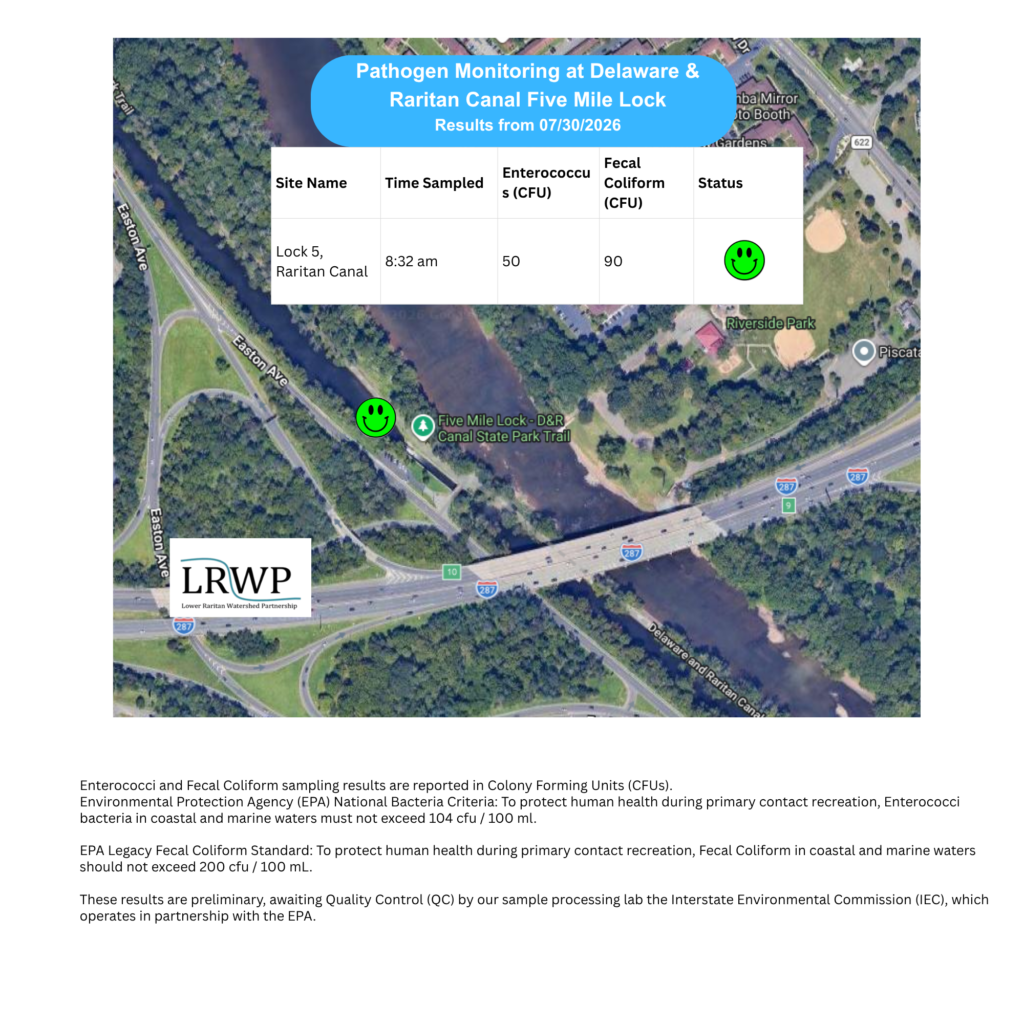
In order to better understand why Riverside Park, Piscataway has been our worst performing site over the past six years, we have started sampling further upstream. On July 30thj, we sampled the canal at Five Mile Lock, Easton Avenue, a third time since we started pathogens monitoring this season. The lab analysis produced 50 enterococci cfu per 100mL which passes the EPA federal water quality standard of 104 cfu/100mL. Again, this site passed the test, as it has every week that we’ve tested it.
Our goal in reporting these results is to give residents a better understanding of the potential health risks related to primary contact during water-based recreation. If you are planning on recreating on the Raritan this weekend, make sure to stay safe and wash up after any activities!
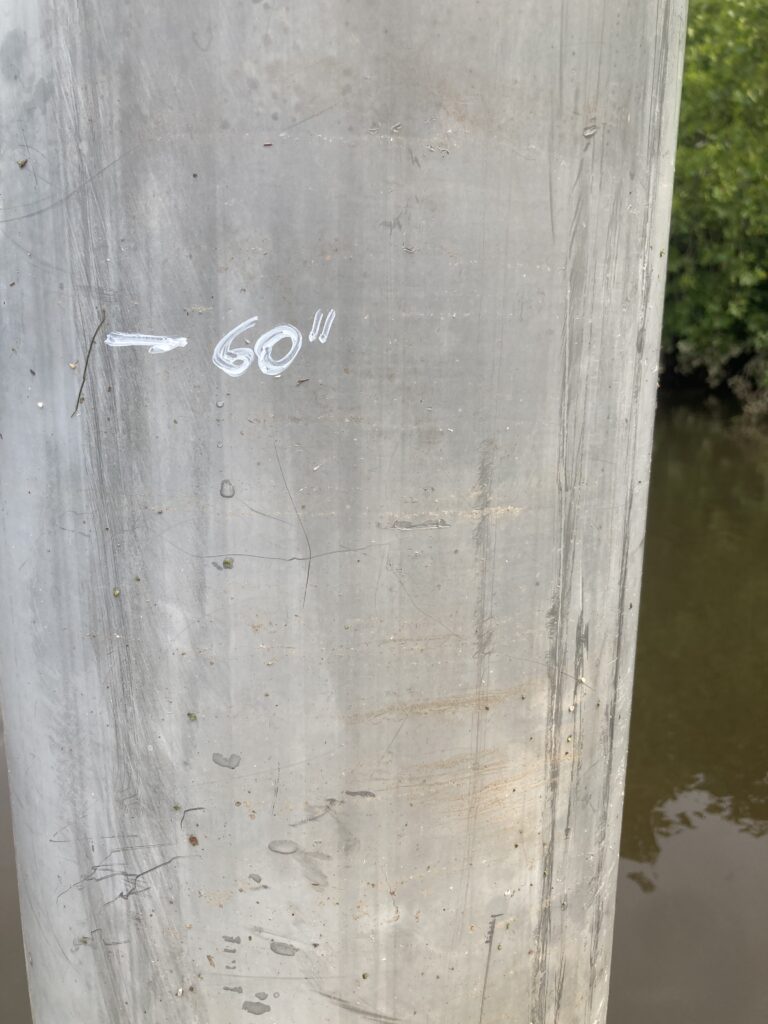
The lines of sediment across this Piscataway pier reached about 55 inches above the floor of the river bed, underscoring the dynamic power of watersheds during rainstorms. Last week, the river at this spot was only 8 inches deep, and it was only 19 inches deep at the time of testing. — Photo by J.M. Meyer.
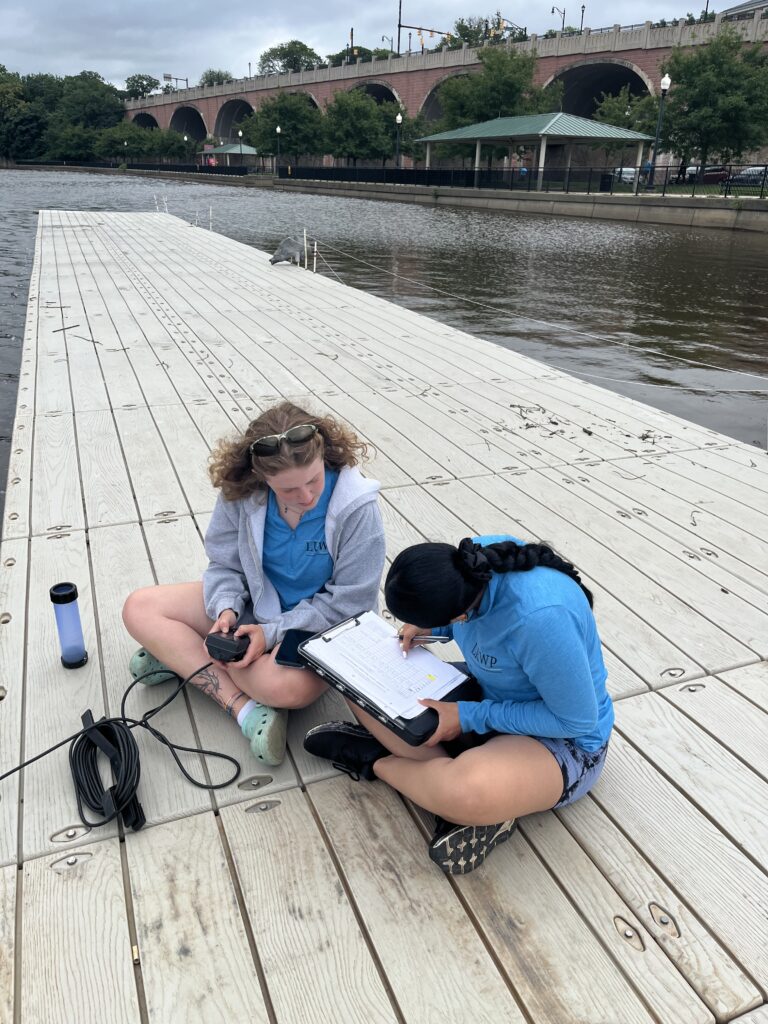
Ashley and Paula record data from the sonde at high tide at Rutgers Boat House, New Brunswick. — Photo by Olyesa Nabokova.
For the second year in a row, South Amboy grandfather brought his grandson to South Amboy specifically to learn from our water monitoring team.– Photo by Olyesa Nabokova.
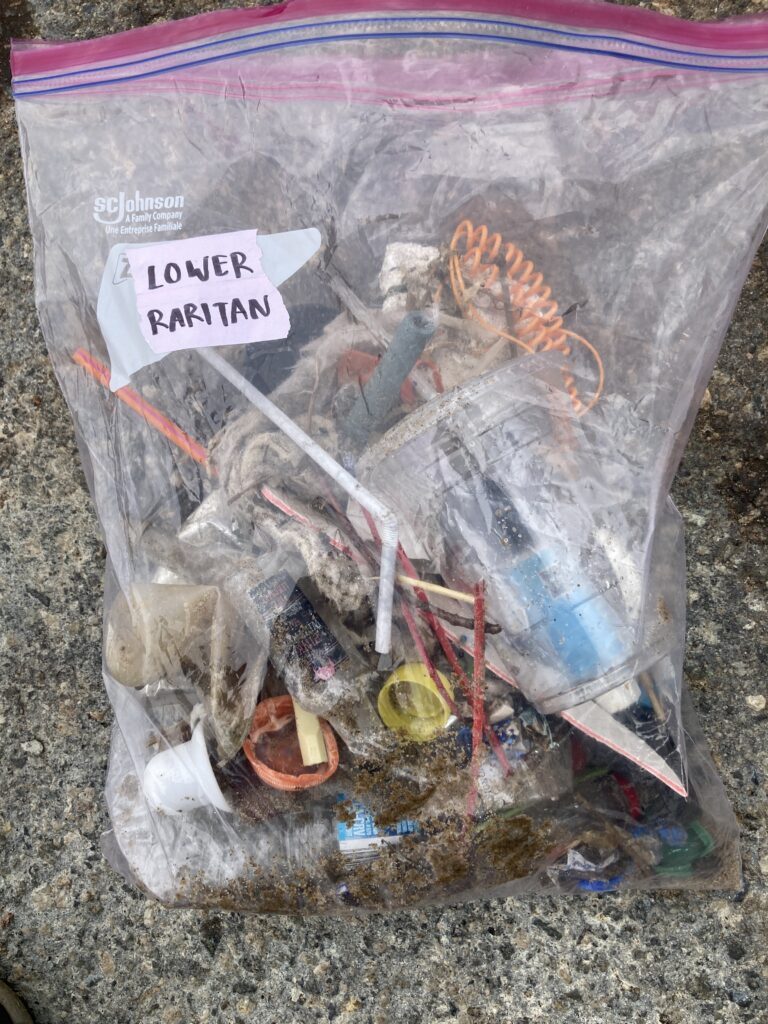
We collected eight gallons of trash off the beach in Perth Amboy. Much of the material, unfortunately, was sanitary products flushed from the sewage. We also found a diaper tucked among the rocks. Perth Amboy: don’t be like that. — Photo by J.M. Meyer.
This small honey locust shrub could grow into a good sized tree after just a couple of years if human left it alone.
Mike and Olyesa clean trash from the drift wood and mud lodged into the upstream side of Edison Boat Basin.
By Endurance Laryea, LRWP Summer Research Intern and J.M. Meyer.
The fourth pathogen monitoring session of the month took place on Thursday, July 23rd. Each week during the summer, from May to October, the Lower Raritan Watershed Partnership and Rutgers Cooperative Extension of Middlesex County run a volunteer-based monitoring program along the Raritan River. We collect water quality samples at six non-bathing public access beach sites, provide our samples to the Interstate Environmental Commission for analysis in their laboratory, and report the results to the public. Our mission is to share this data with the community and partners to ensure the safe use of the Raritan River for all.
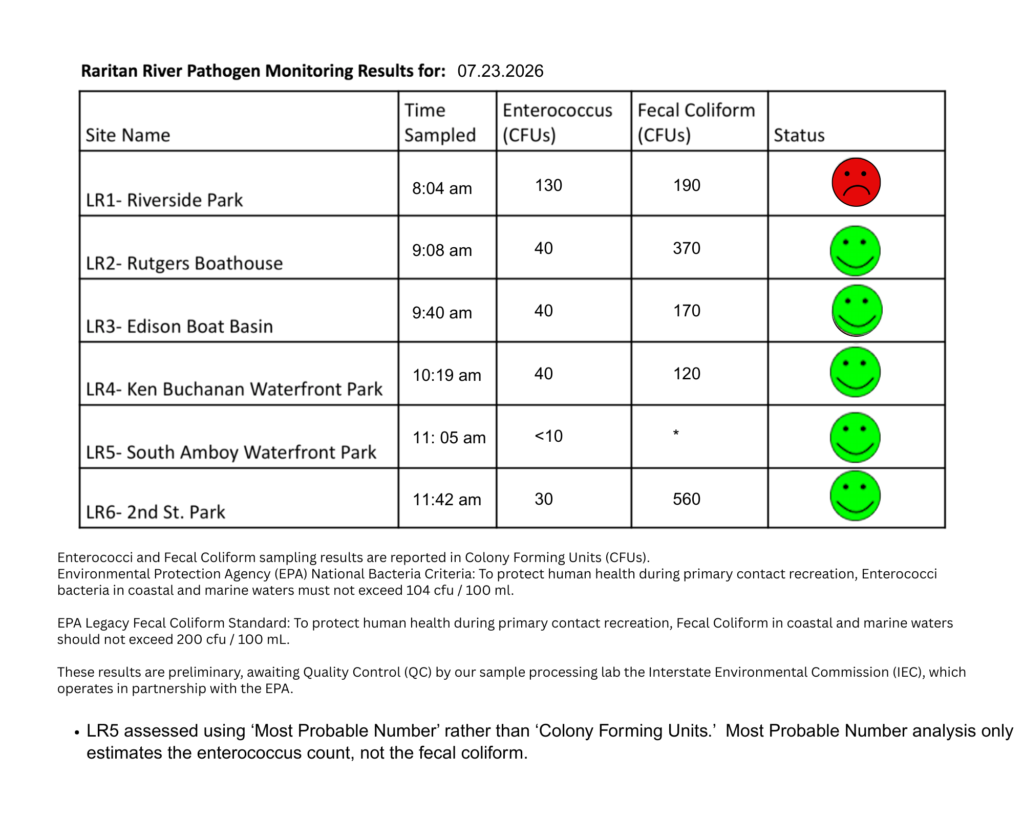
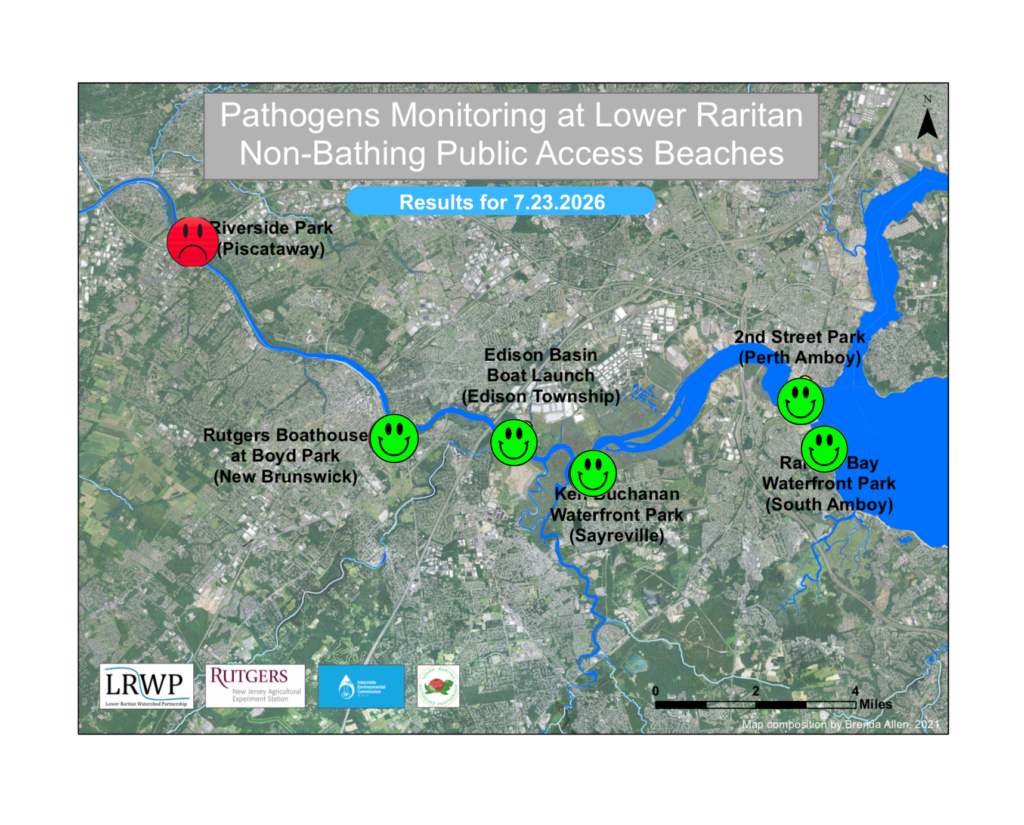
Our lab results for water quality samples taken on Thursday, July 23rd, 2026, show Enterococcus bacteria levels exceeding the EPA federal water quality standard of 104 cfu/100mL at one of our regular monitoring sites this week. The problem sites are indicated by the red frown on the map and chart and include Riverside Park (Piscataway). Green smiles on the chart and map indicate the sites with bacteria levels safe for recreation and include the following: Rutgers Boathouse (New Brunswick), Edison Boat Basin (Edison), Ken Buchanan Waterfront Park (Sayreville), 2nd Street Park (Perth Amboy), and South Amboy Waterfront Park.
Pathogens/Enterococci levels are used as indicators of the possible presence of disease-causing bacteria in recreational waters. Such pathogens may pose health risks to people coming in primary contact with the water (touching) through recreational activities like fishing, kayaking or swimming in a water body. Possible sources of bacteria include Combined Sewer Overflows (CSOs), improperly functioning wastewater treatment plants, stormwater runoff, leaking septic systems, animal carcasses, pet waste, wildlife waste, and runoff from manure storage areas.
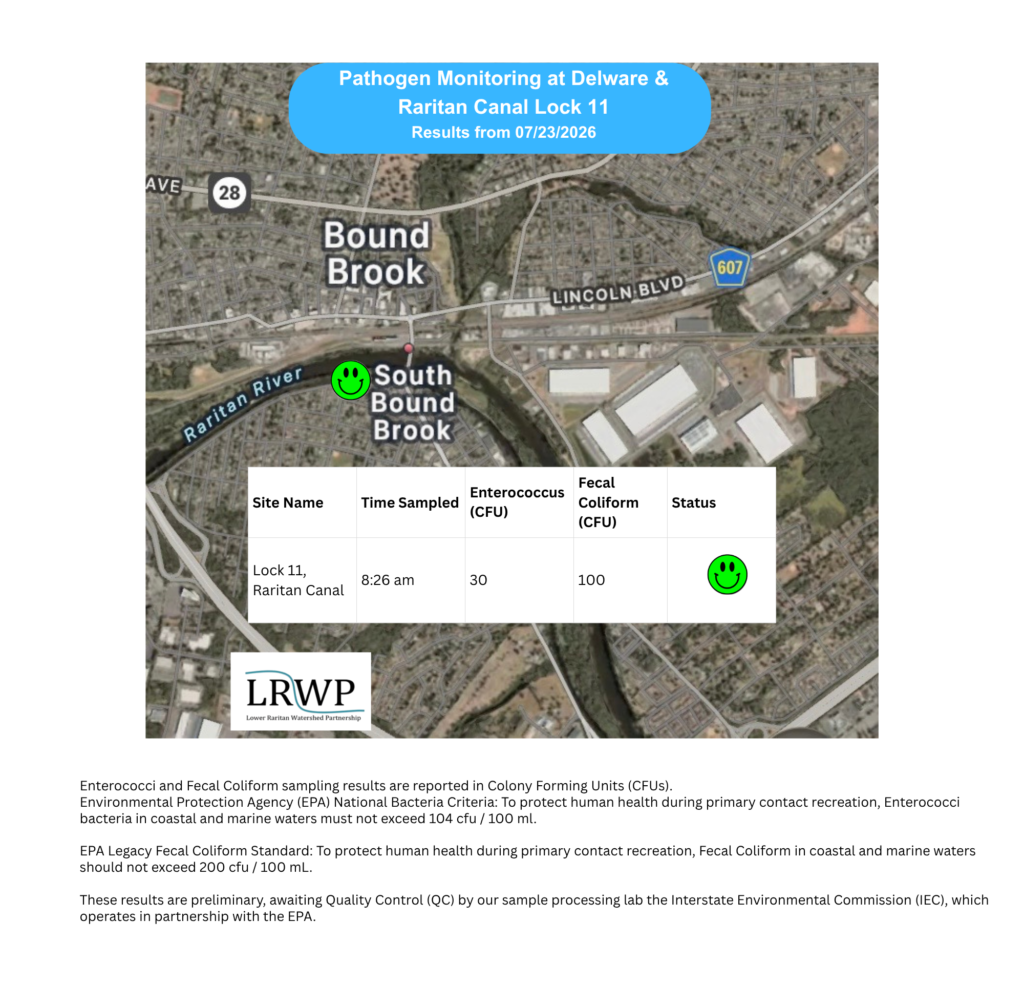
In order to better understand why Riverside Park, Piscataway has been our worst performing site over the past six years, we have started sampling further upstream. On July 23rd, we sampled the canal at Lock 11, South Bound Brook, a third time since we started pathogens monitoring this season. The lab analysis produced 30 enterococci cfu per 100mL which passes the EPA federal water quality standard of 104 cfu/100mL. Again, this site passed the test, as it has every week that we’ve tested it.
Our goal in reporting these results is to give residents a better understanding of the potential health risks related to primary contact during water-based recreation. If you are planning on recreating on the Raritan this weekend, make sure to stay safe and wash up after any activities!
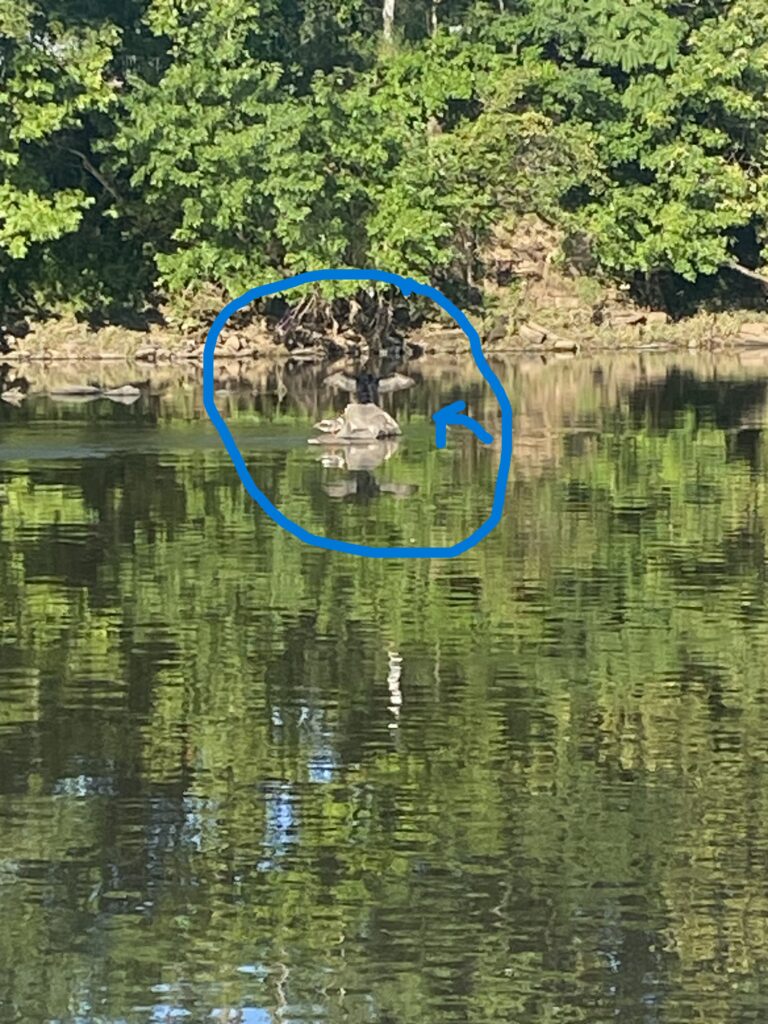
We were greeted by two birds this morning. One with its wings outstretched on a rock in the middle of the river and a smaller bird with orange feet and crest on a smaller rock beside it. Birds may stretch their wings for various reasons like temperature regulation, blood circulation, drying of their feathers or even a territorial sign. Not sure which this one was doing though. From where we stood, we were not able identify what kind of birds they were. Photo by Mike Orsini.
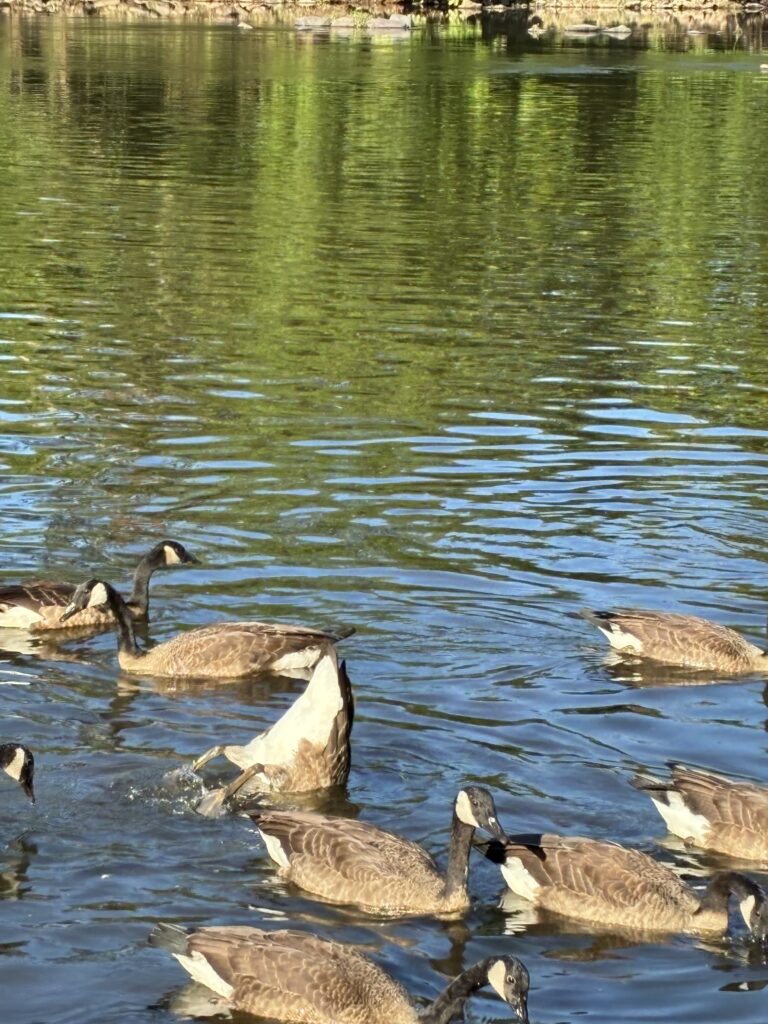
Who knew Canadian geese were into gymnastics? Here is a goose doing a handstand–or in this case, ‘beakstand’–to feed. We did not see them catch any fish, but they fed on some waterweeds while we were there. Photo by Endurance Laryea.
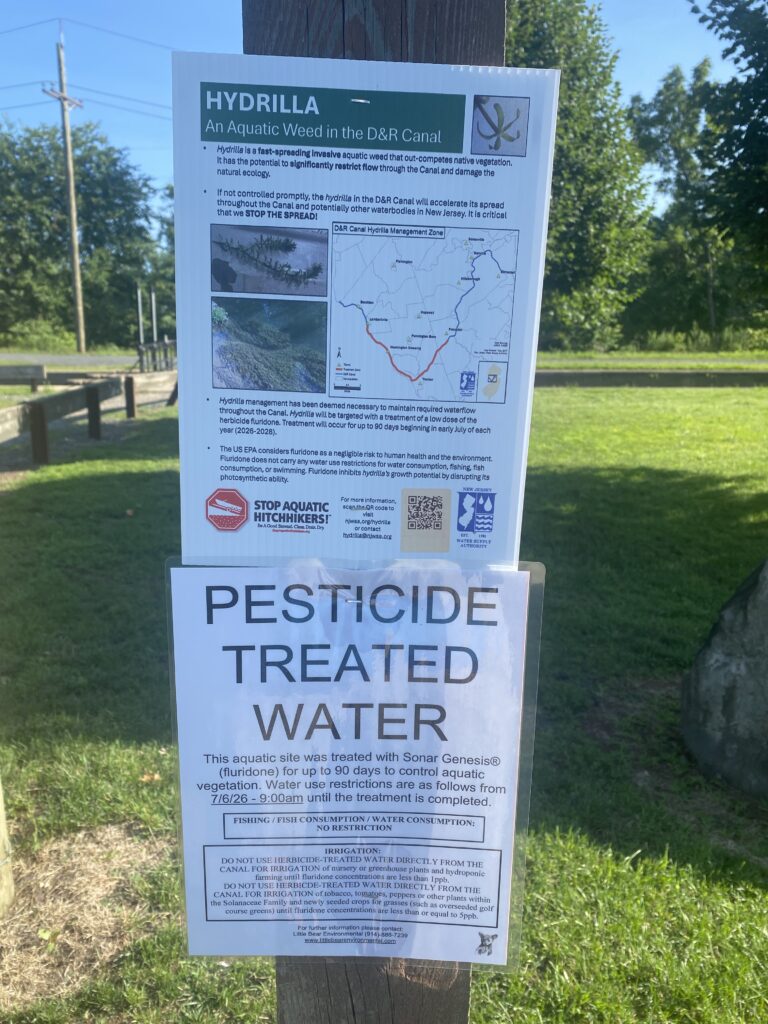
A public notice has been put up at Five Mile Lock, South Bound Brook, New Jersey to warn the community on usage of the D&R canal water. At the moment, there are no fishing or water consumption restrictions, however, there are warnings on the usage of the water for plant irrigation purposes. The canal has been treated with Sonar Genesis, an aquatic herbicide that is sprayed on the surface of the water to impede the photosynthetic processes of water weeds. The purpose of that was to control the growth of Hydrilla in the canal. Hydrilla is an invasive species. As discussed in last week’s post, invasive species are harmful to the ecosystems in which they are non-native hence, the need for management.
Photo by Mike Orsini.
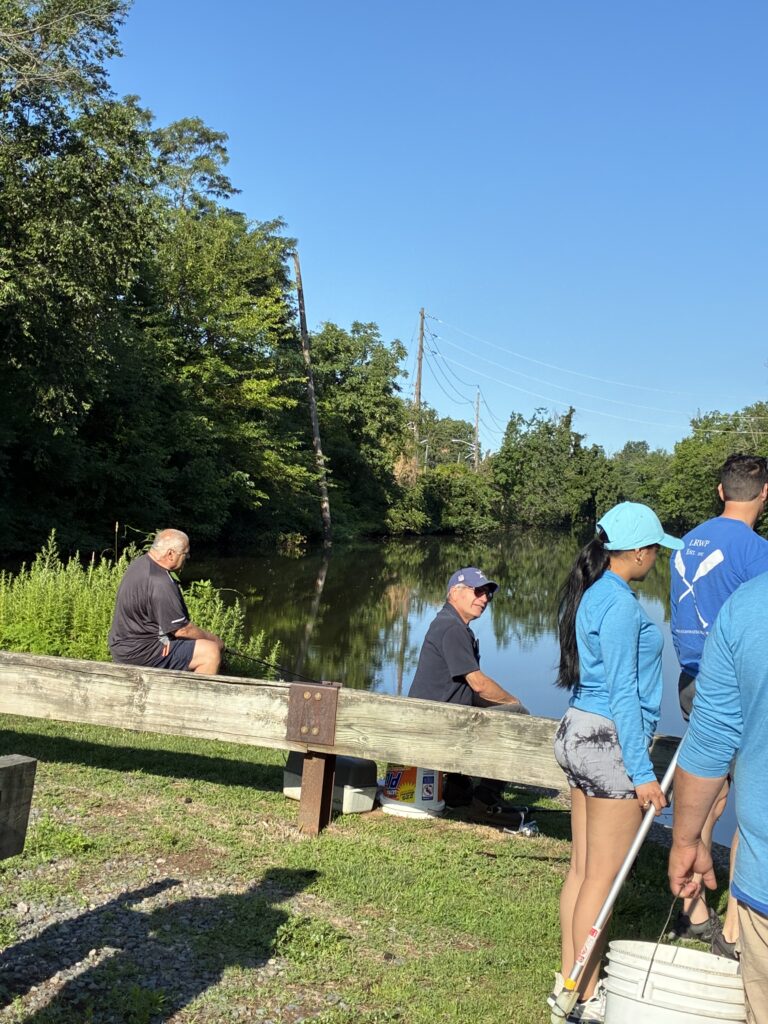
“Where are the fishes”, two fishermen inquired at Five Mile Lock, South Bound Brook , New Jersey. We have not spotted any fish at this site since we started monitoring this season and this was the first time seeing any fishing activity going on here. Photo by Endurance Laryea.
Photo by Endurance Laryea.
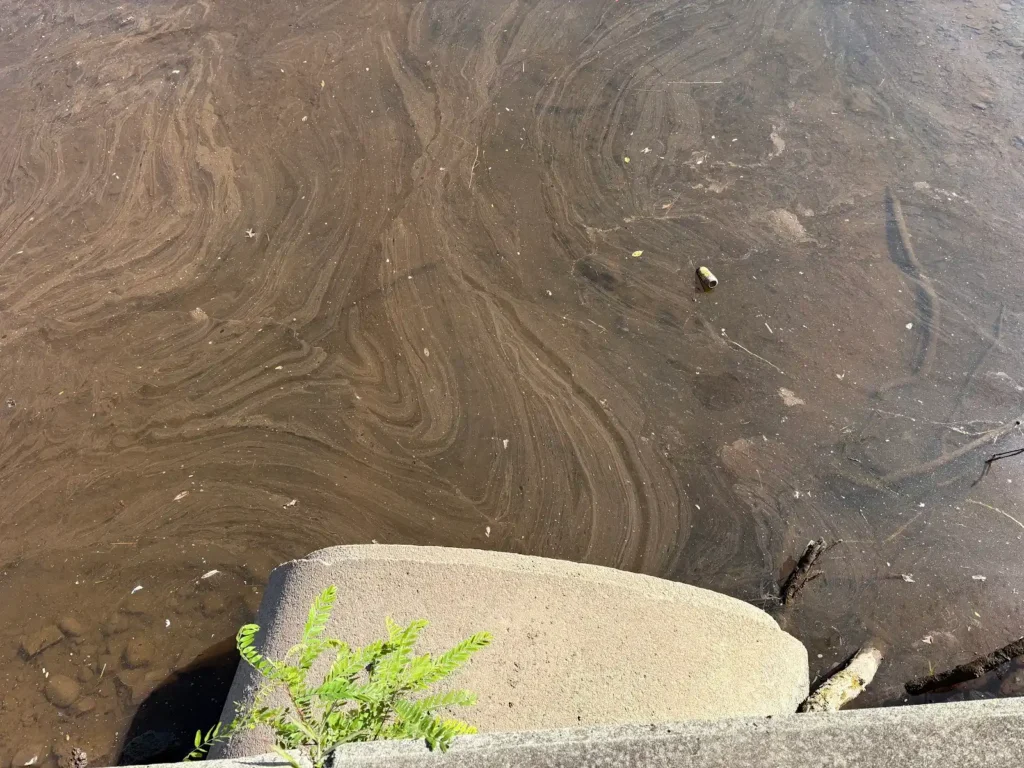
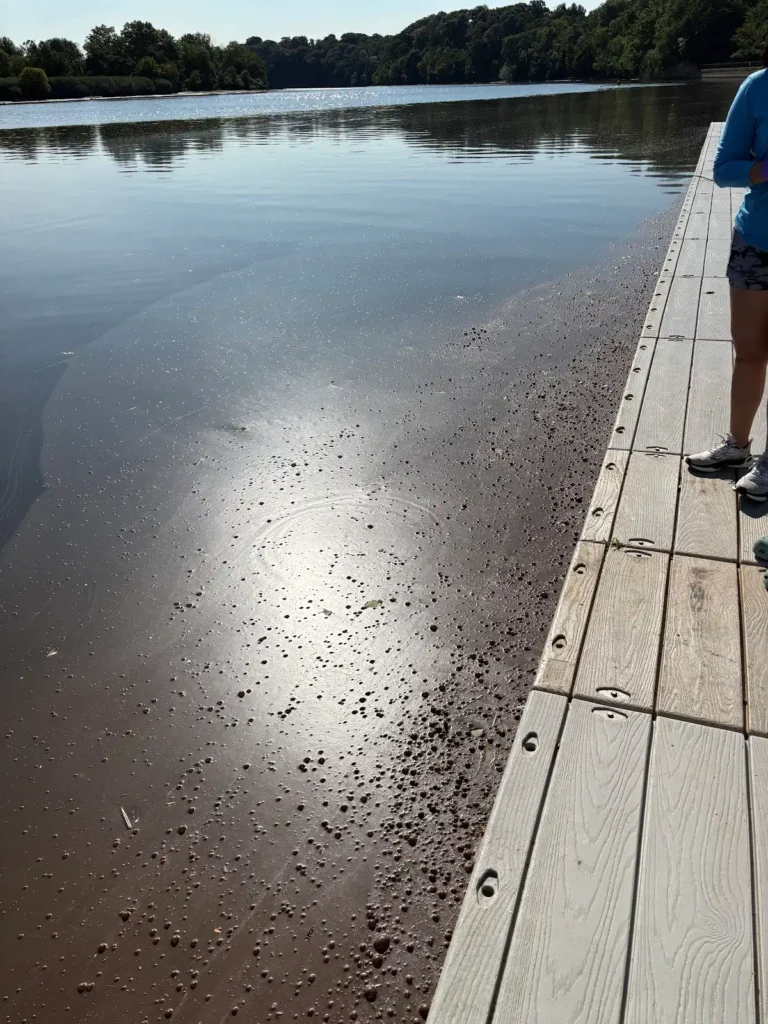
At Rutgers Boat House, New Brunswick, what looked like a biofilm was all over the surface of the water surrounding the dock. It appeared to be coming out of the outfall–possibly, organic matter being washed into the river. Think of a biofilm as a community of bacteria. They form when bacteria attach itself to a surface (In this case, the water surface), produce a glue-like substance called Extracellular Polymeric Substances (EPS) to help them stick to each other and the surface of attachment better, then reproduce forming a slimy layer of film on the surface of attchment. Biofilms can be found in various places, dranaige pipes, water storage tanks, down your kitchen drain, and even your teeth!
Photos by Paula Rubio.
Photo by Ashley Fritz.
John taking out plastic from the water at Edison Boat Launch. Photo by Ashley Fritz.
Ashley, John and Endurance on sampling and sonde measurement duties. Photos by Paula Rubio.
Endurance on sampling duty at South Amboy. Photo by John Meyer.
A massive algal bloom at Perth Amboy. The water was greenish and murky unlike the clear color it has had for the past couple of weeks. Photo by Endurance Laryea.
Photo by Endurance Laryea.
Thankfully, oxygen levels rose back to normal, and we did not experience the fish dead we feared!
By Endurance Laryea, LRWP Summer Research Intern and J.M. Meyer.
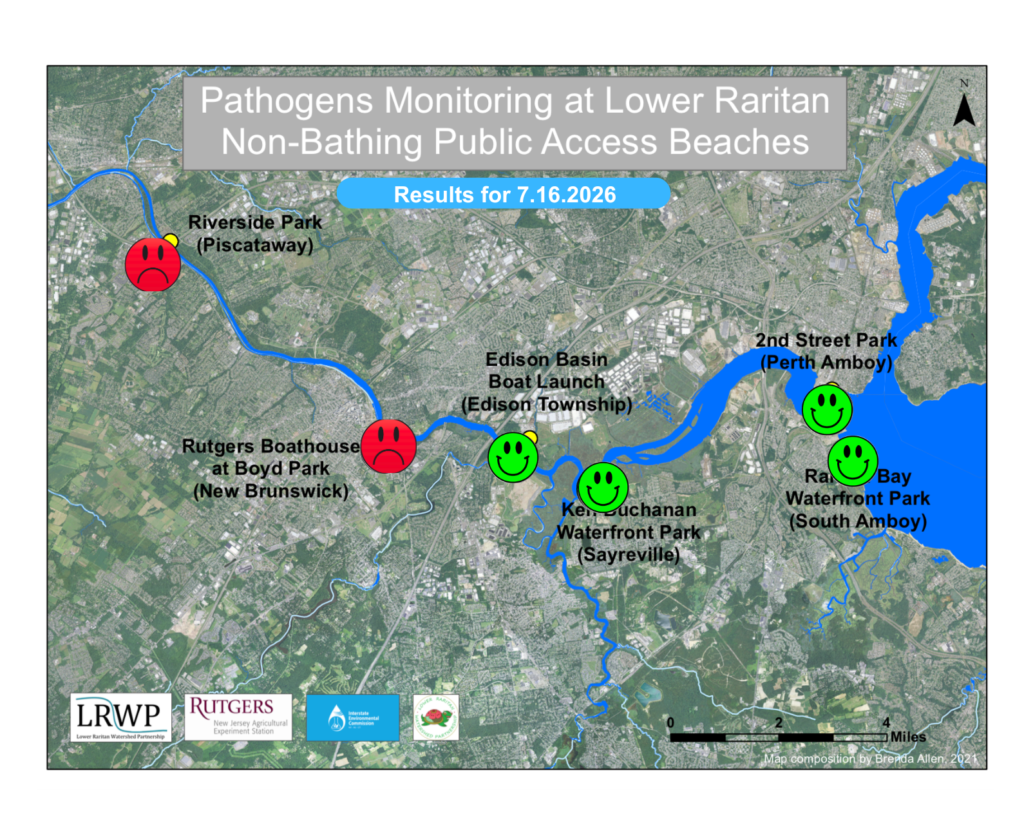
The third pathogen monitoring session of the month took place on Thursday, July 16th. Each week during the summer, from May to October, the Lower Raritan Watershed Partnership and Rutgers Cooperative Extension of Middlesex County run a volunteer-based monitoring program along the Raritan River. We collect water quality samples at six non-bathing public access beach sites, provide our samples to the Interstate Environmental Commission for analysis in their laboratory, and report the results to the public. Our mission is to share this data with the community and partners to ensure the safe use of the Raritan River for all.
Our lab results for water quality samples taken on Thursday, July 16th, 2026, show Enterococcus bacteria levels exceeding the EPA federal water quality standard of 104 cfu/100mL at two of our regular monitoring sites this week. The problem sites are indicated by the red frown on the map and chart and include Riverside Park (Piscataway), and Rutgers Boathouse (New Brunswick). Green smiles on the chart and map indicate the sites with bacteria levels safe for recreation and include the following: 2nd Street Park (Perth Amboy), and South Amboy Waterfront Park.
Pathogens/Enterococci levels are used as indicators of the possible presence of disease-causing bacteria in recreational waters. Such pathogens may pose health risks to people coming in primary contact with the water (touching) through recreational activities like fishing, kayaking or swimming in a water body. Possible sources of bacteria include Combined Sewer Overflows (CSOs), improperly functioning wastewater treatment plants, stormwater runoff, leaking septic systems, animal carcasses, pet waste, wildlife waste, and runoff from manure storage areas.
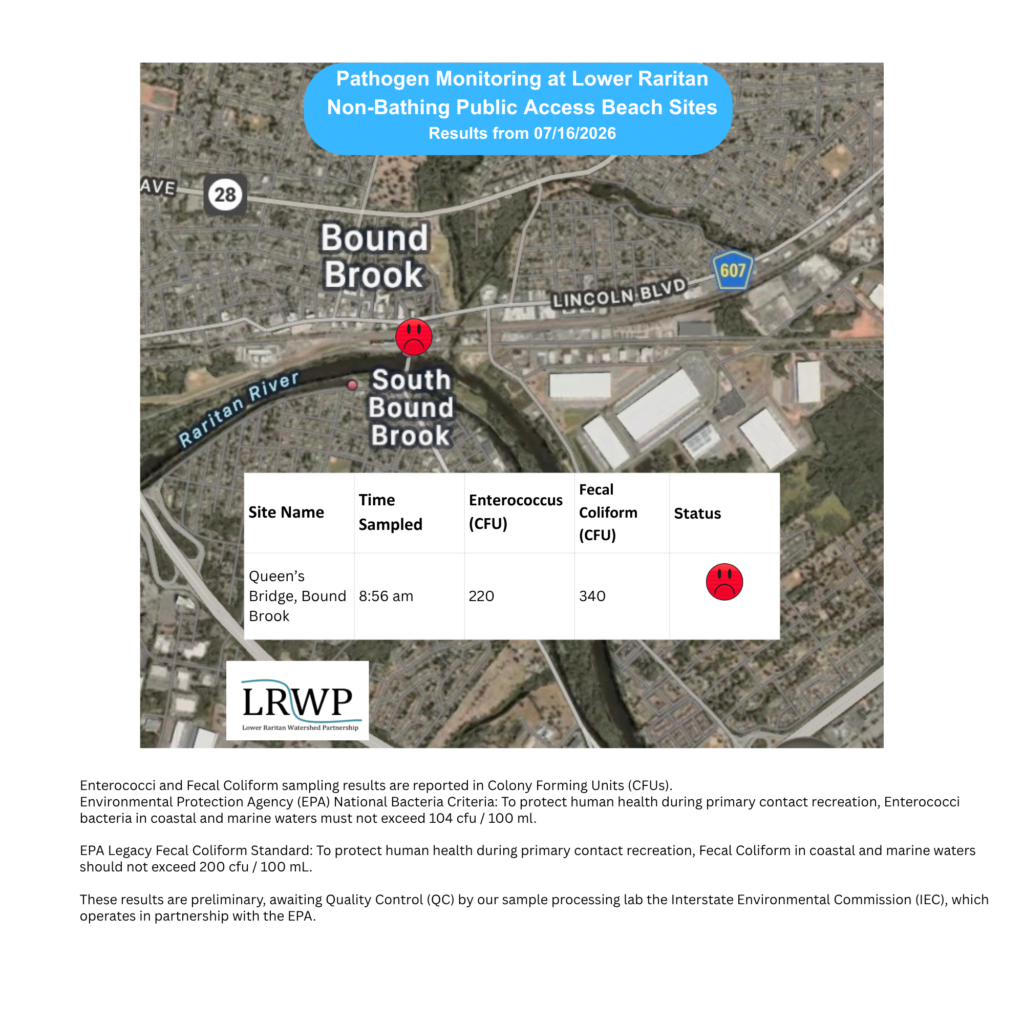
In order to better understand why Riverside Park, Piscataway has been our worst performing site over the past six years, we have started sampling further upstream. On July 16th, we sampled the Queen’s Bridge, Bound Brook site a third time since we started pathogens monitoring this season. The lab analysis produced 220 enterococci cfu per 100mL which crashes into the EPA federal water quality standard of 104 cfu/100mL. Again, this site failed the test, as it has every week that we’ve tested it. In contrast, the D&R canal has passed all six of its tests.
Our goal in reporting these results is to give residents a better understanding of the potential health risks related to primary contact during water-based recreation. If you are planning on recreating on the Raritan this weekend, make sure to stay safe and wash up after any activities!
Nilesh, one of our key Sewa International volunteers at last year’s Green Brook project, is working with Olyessa and other team members to plan a riparian restoration effort in Piscataway! In the above photo, Nilesh receives feedback on his proposal from Mike and Ruby.
In this photo, Mike is cleaning litter out of a backwater pool, an important part of the Riparian Zone. This backwater is particularly interesting because it is situated beneath a bridge.
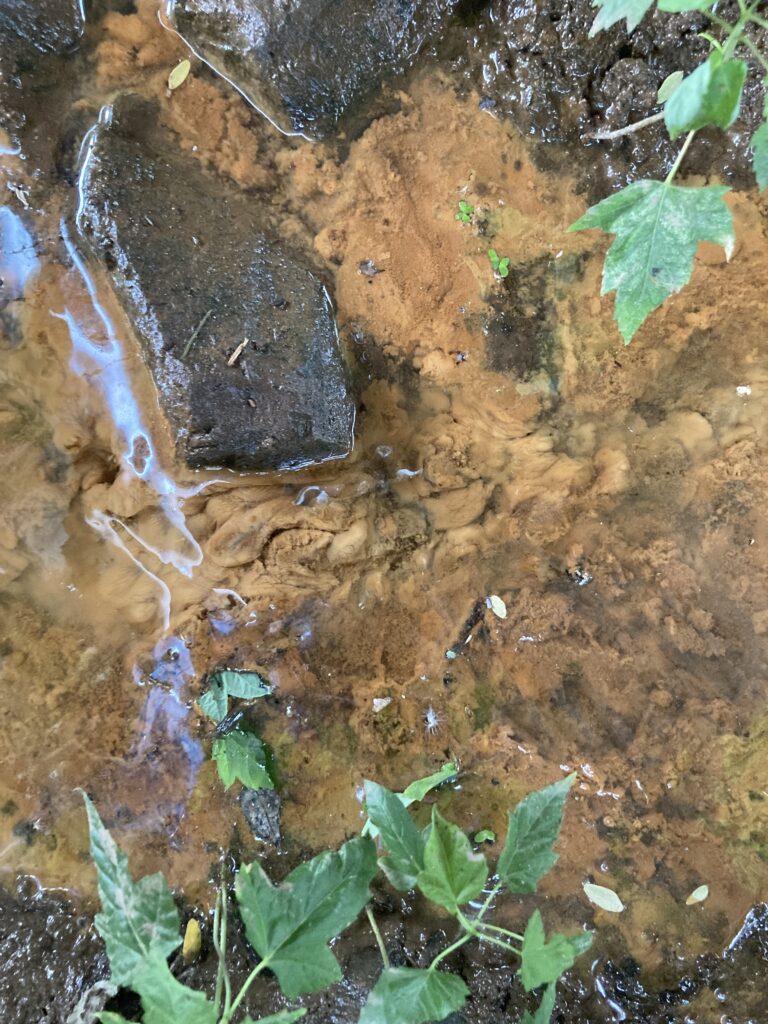
Have you ever noticed reddish, slimy water seeping out of the shale layers in western Middlesex County? You might have seen iron-rich bacteria! These tiny creatures are microorganisms that get energy by oxidizing dissolved ferrous iron (Fe²⁺) into ferric iron (Fe³⁺), which creates rust-like, reddish-brown, slimy deposits in water and soil. These bacteria are common in iron-rich groundwater, streams, and wells, and while generally not harmful to humans, they can cause foul odors, staining, and pipe blockages. Ancient peoples used these invisible critters to gather iron which could then be processed into a crude iron ore.
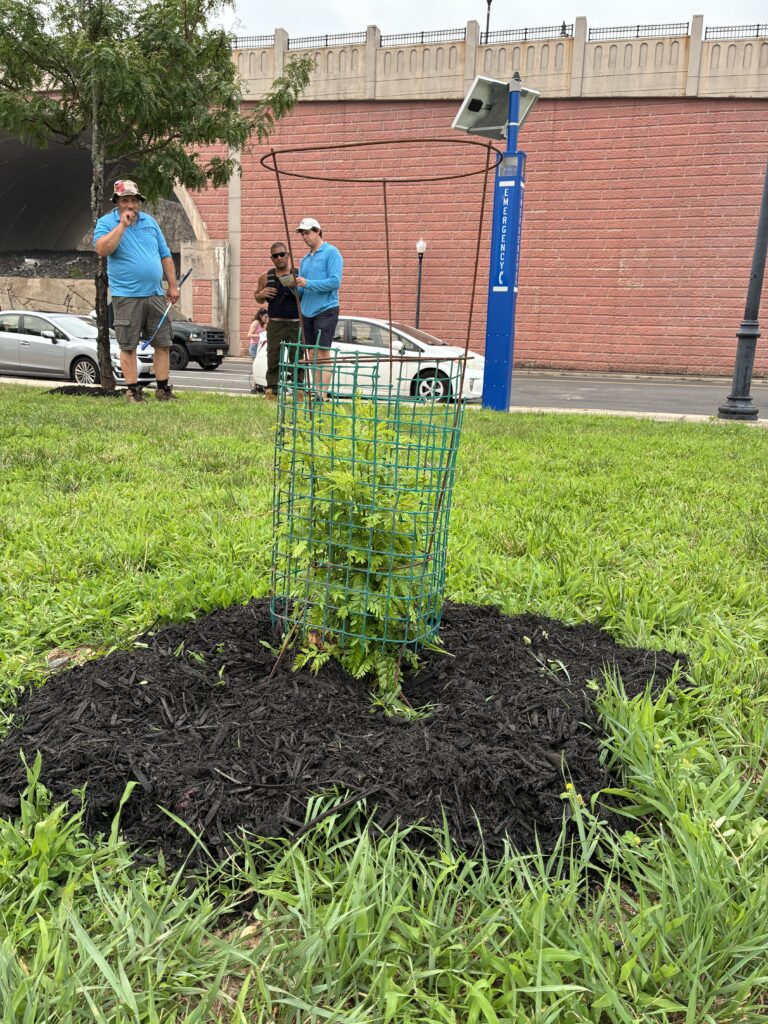
Mike, Eddy, and John installed new guards around the recovering honey locust trees.Photos by Endurance Laryea.
Thanks to the wonderful folks at New Brunswick Parks, we met with the lead steward of Boyd Park, Eddy, to discuss strategies for growing more shade trees in New Brunswick. Boyd Park is a huge tract of land separated from New Brunswick by state route 18; despite limited walking paths between New Brunswick and Boyd Park, the city currently struggles to maintain the park with extremely limited resources. The LRWP is currently lobbying the D&R canal to stretch an additional three miles to encompass the historic downstream Raritan lock. This would enable the D&R State Park, one of New Jersey’s greatest treasures, to reach our diverse, community-oriented citizens in eastern New Brunswick.
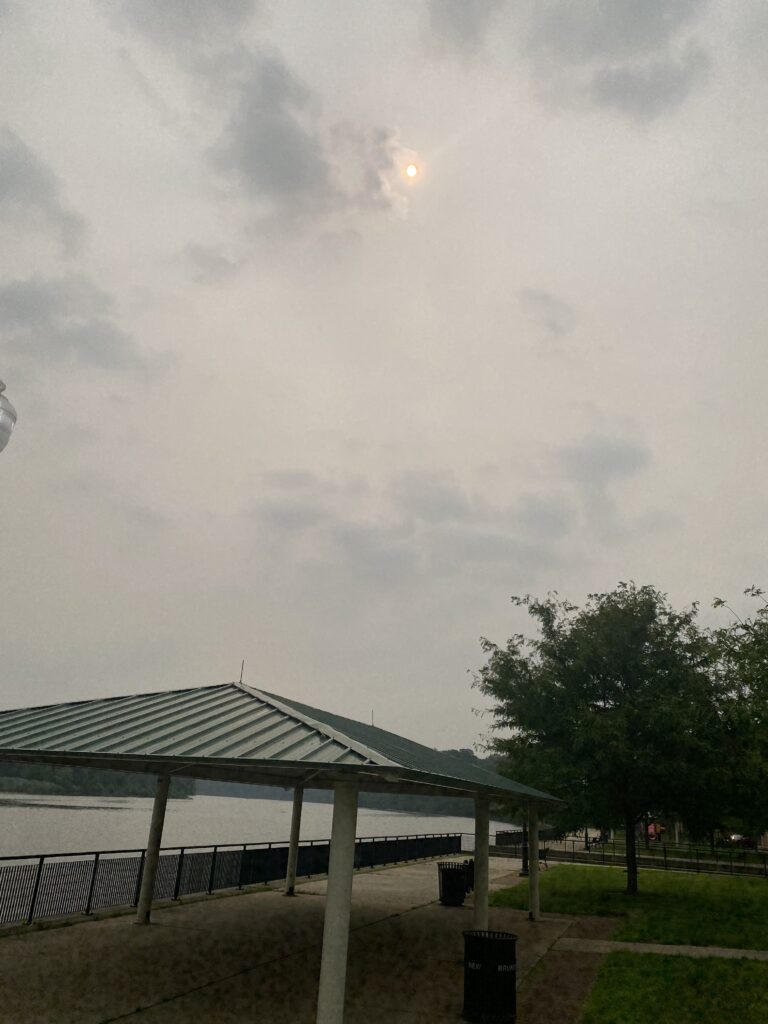
In the above photo from Mike Orsini, we can see the thick blanket of wildfire smog that smothered much of the mid-Atlantic this week. Breathing in fine particulate matter is associated with a myriad of health problems, including dementia. Please consider breaking out those pandemic-era n95 masks before going outdoors.
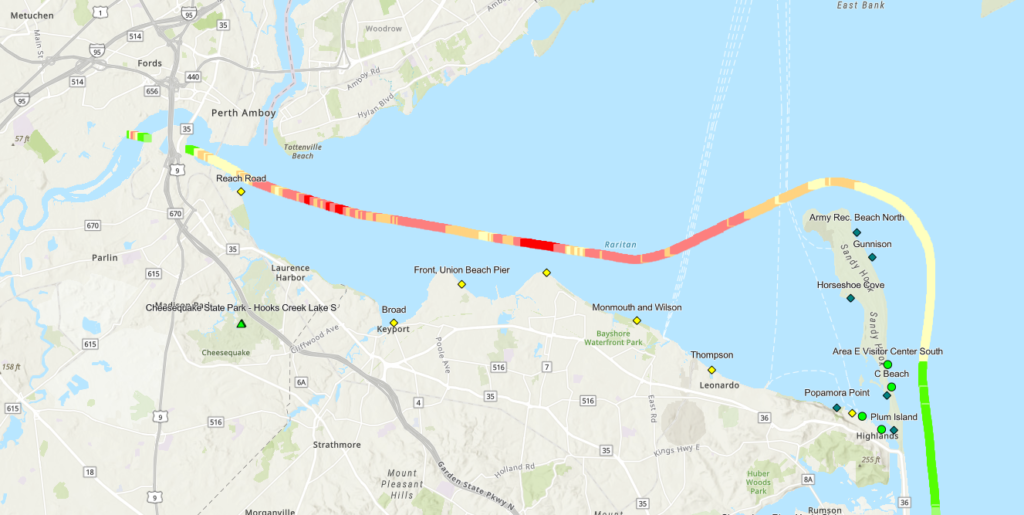
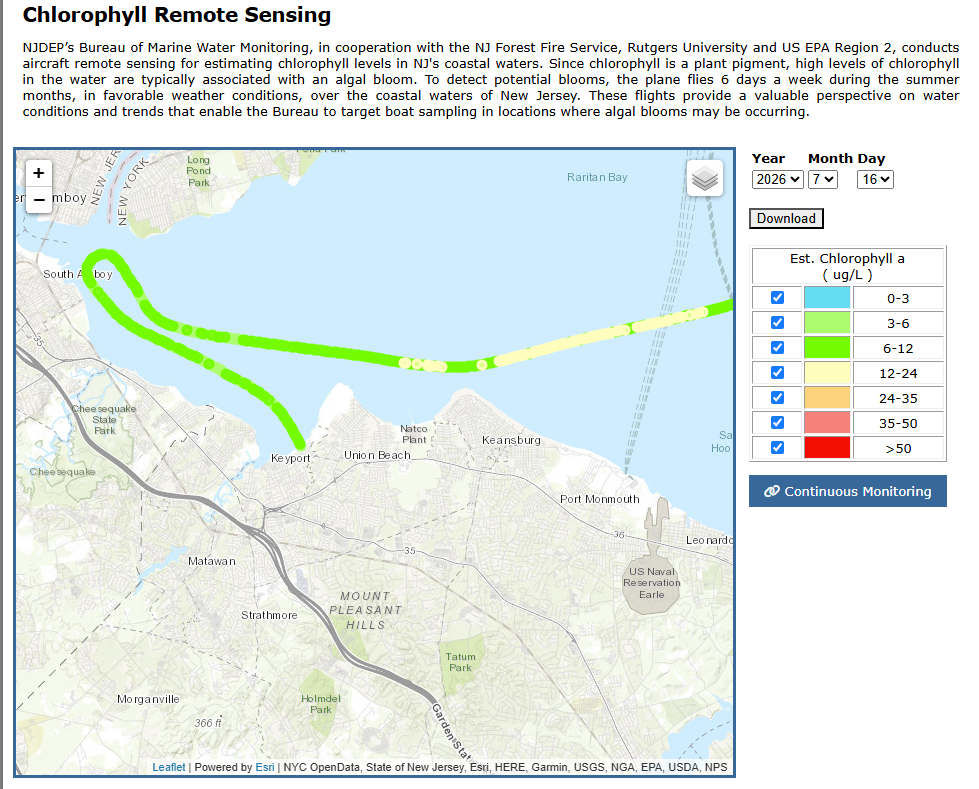
As the summer progresses, it is not unusual for chlorophyll counts to explode and for oxygen levels to drop. In Middlesex County, it is still common practice to fertilize parks and gardens, even in the riparian zone. By this time in the summer, the fertilizer has washed into the Raritan and out into Raritan Bay, where it feeds numerous aquatic plants; when those plants die, the bacteria that feed on the dead plants rapidly consume much of the oxygen in the water. The state’s ariel monitoring of Raritan Bay shows increasing evidence of chlorophyll.
Remote sensing map of Raritan Bay from NJDEP on July 15th, 2026, the day prior to our water monitoring. The red color indicated an estimated level of chlorophyll greater than 50 micrograms per centimeter — that is extremely high!
Remote sensing of Raritan Bay on July 16th, 2026 — the day of our sampling.
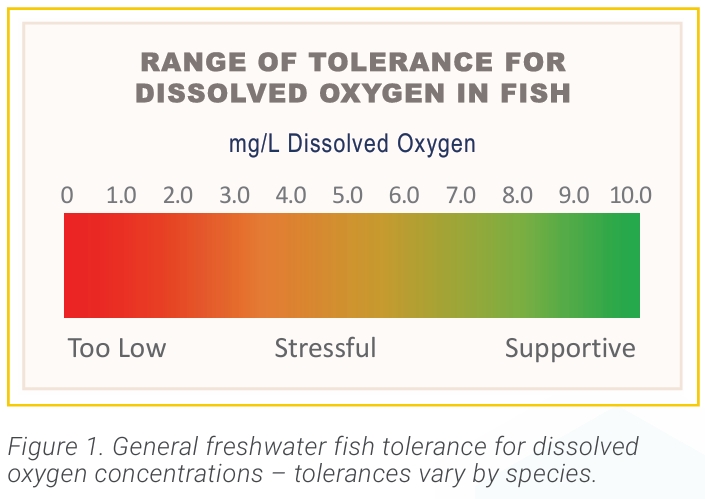
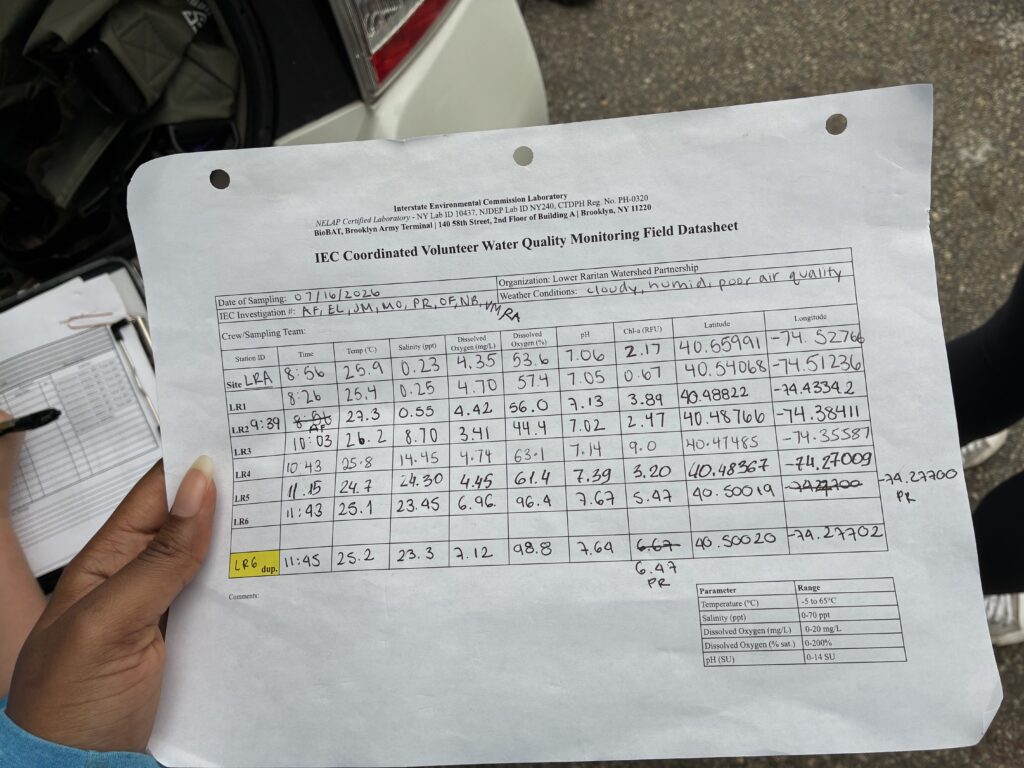
At the time of sampling, dissolved oxygen (DO) levels were below average at all of our sites except Perth Amboy. Dissolved oxygen is important for aquatic life. The lower the DO level the more stressful it is for fishes. On the other hand, higher DO levels support spawning, growth and activity of the fishes.
All the sites visited this week, except Perth Amboy, experienced low levels of oxygen in the ‘stressful’ range according to the EPA. If the oxygen levels do not increase in the next 48 to 72 hours, we may see our first fish die off of the season.
It is important to note that dissolved oxygen levels change throughout the day and waterbody, hence, the values we took at the time of sampling may not reflect the overall levels of the water at the sites.
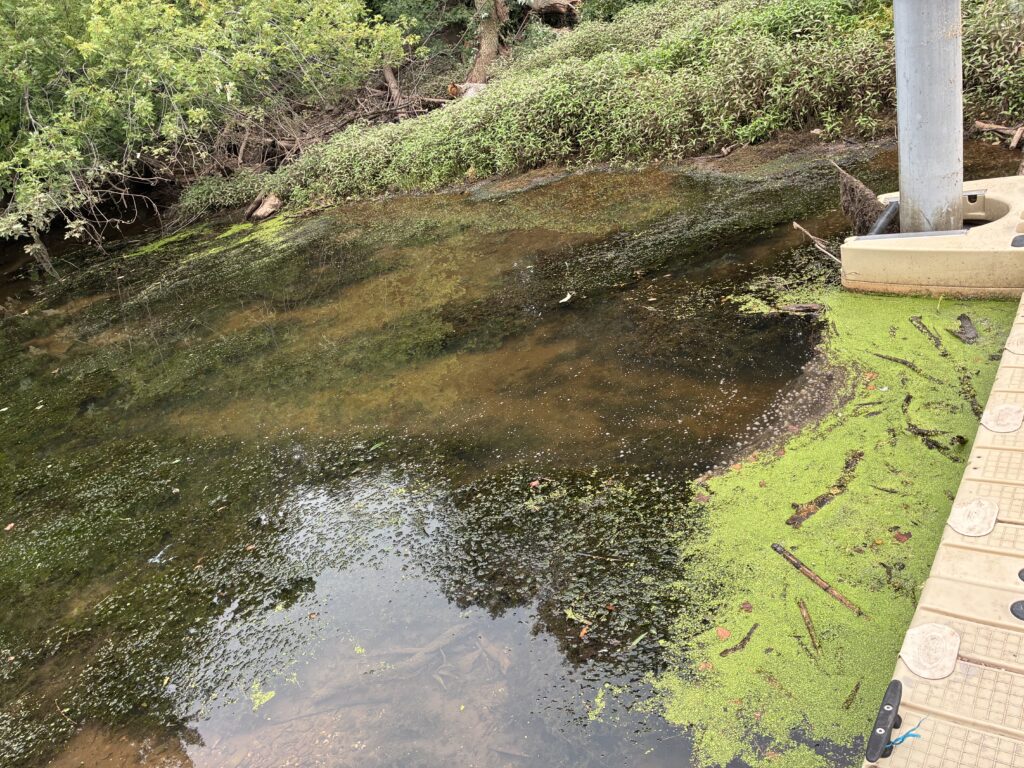
Algal bloom and duckweed growth sighted on the tidal flats of Piscataway. An indication of low oxygen levels and possible high phosphorous levels.Photo by Endurance Laryea.
Did you know that goslings can grow as big as the parent geese in 8-12 weeks? We can no longer tell the difference between the goslings we saw when we started monitoring this season. Photo by Endurance Laryea.
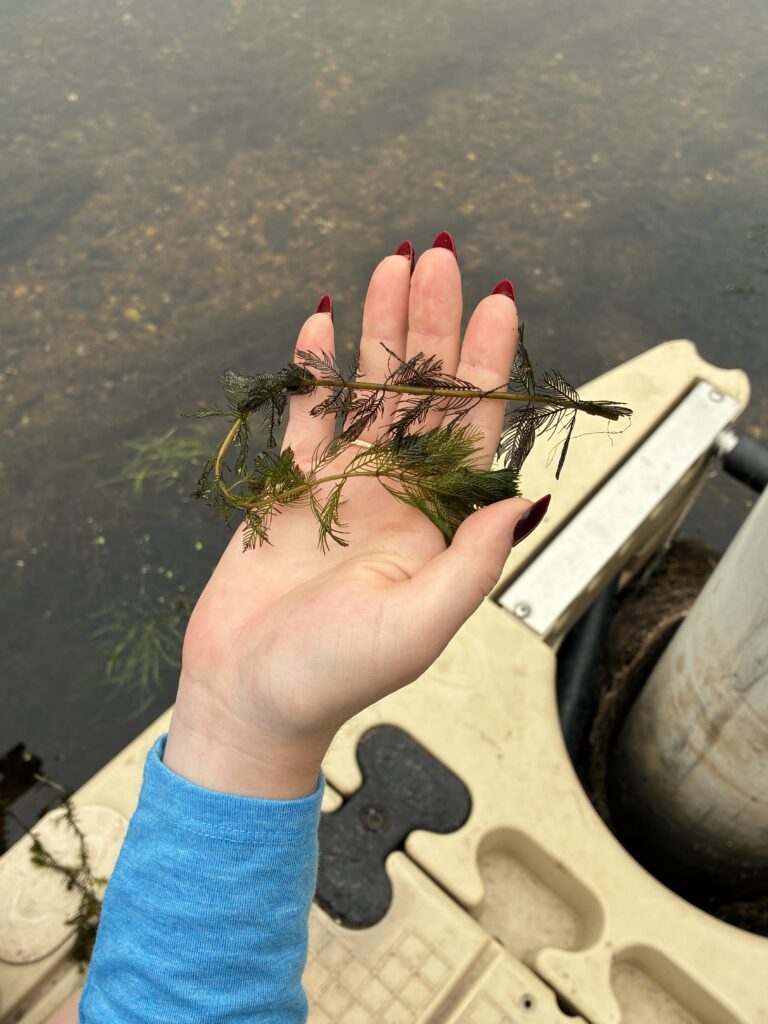
Ashley holds up a Eurasian Watermilfoil plant, an invasive species in large parts of the United States but native to Europe, Asia and North Africa. Photo by Endurance Laryea.
Invasive species are organisms that are not native to a particular ecosystem but can reproduce very quickly and out compete native organisms. The issue with this is that it erases the biodiversity in the ecosystem. Why is biodiversity important? In simple terms, different species in the ecosystem play different and important roles. If all other species were wiped out by one species, the system becomes imbalanced, and the equilibrium that holds the ecosystem together may crash. Though non-native plants may play a similar role in an ecosystem to native plants, they may
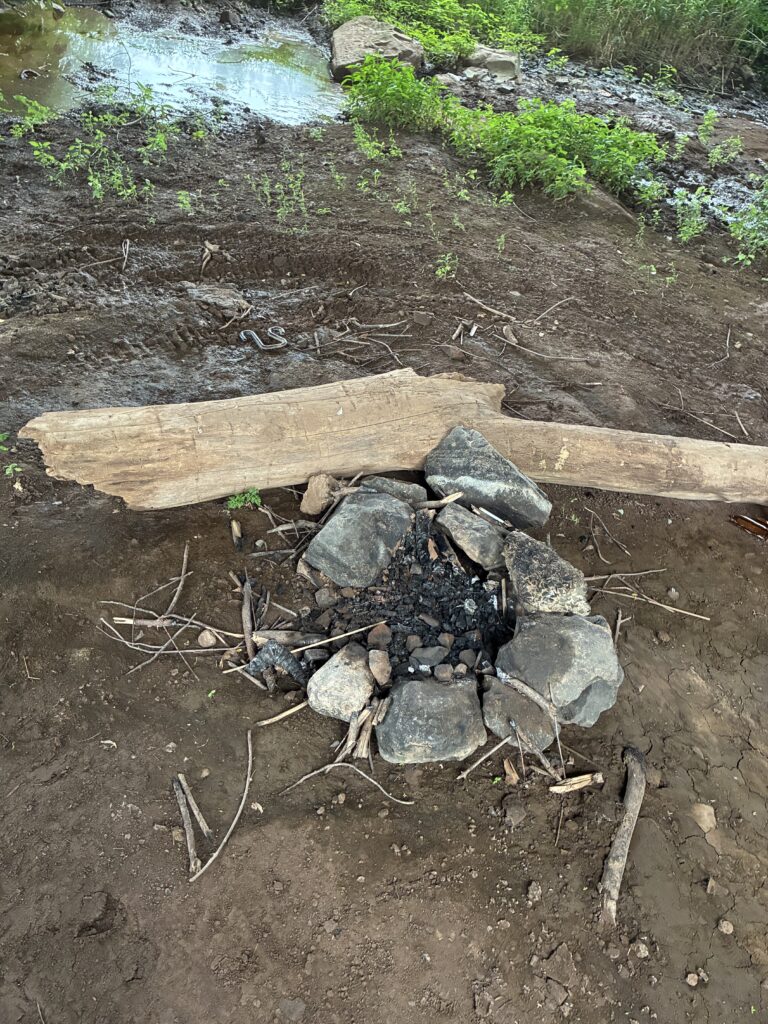
Mike was impressed with the neatness of this campfire ring under Queens Bridge! Photo by Endurance Laryea.
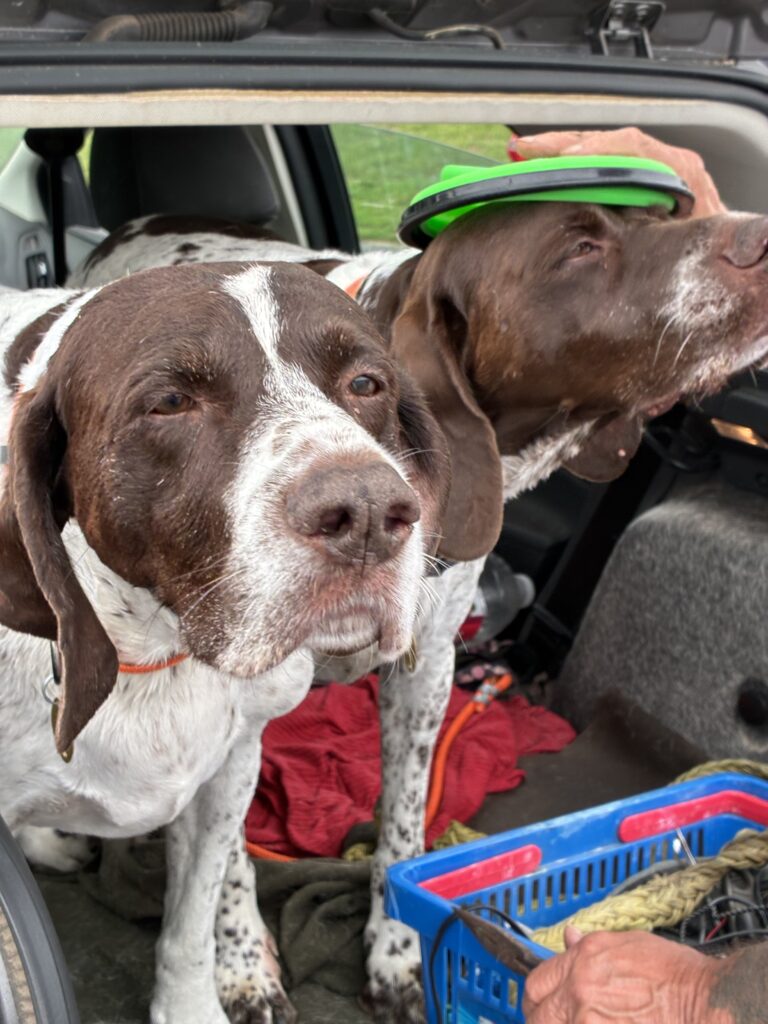
Melting hearts is what they do: Meet Bow and Junior, brothers who captured the hearts of the team at Edison. Photo by Endurance Laryea.
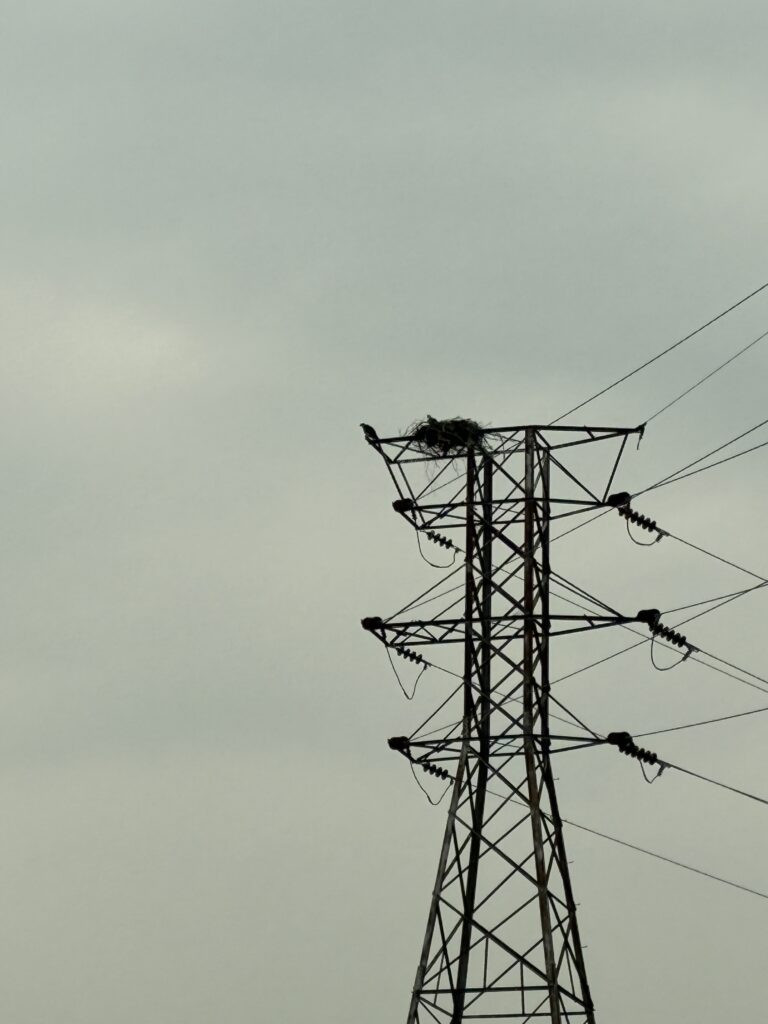
Baby ospreys at Sayreville confirmed! We couldn’t tell how many though. Photo by Endurance Laryea.
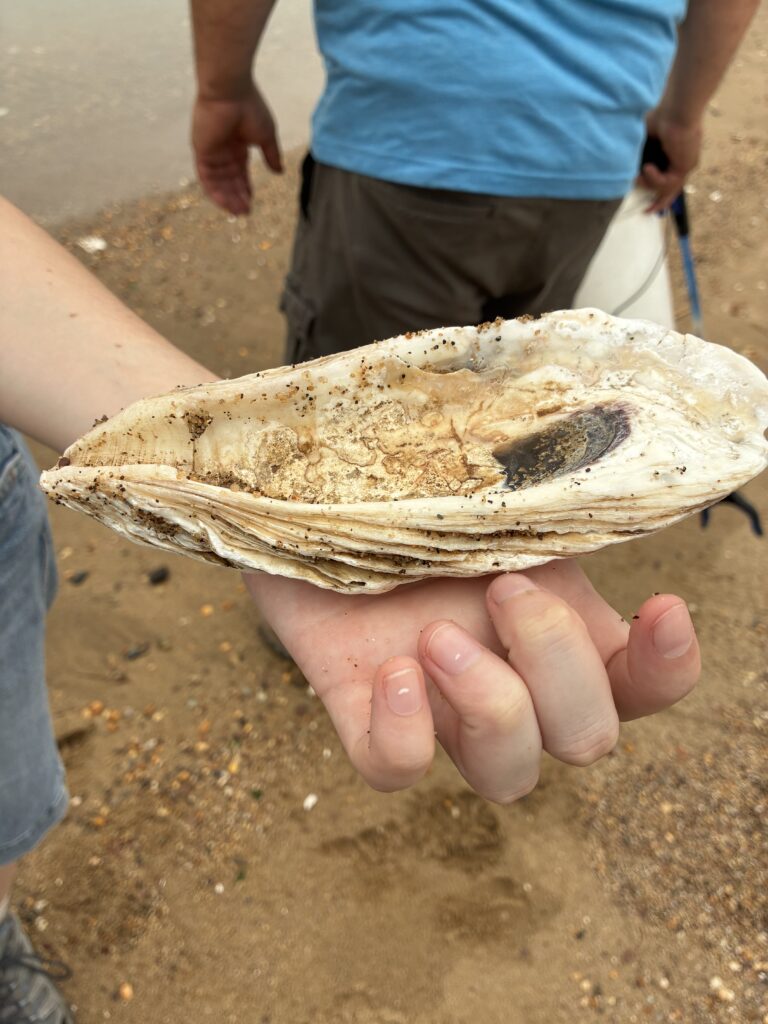
South Amboy is always giving us souvenirs. Today’s was a shell of an oyster, maybe? Photo by Endurance Laryea.
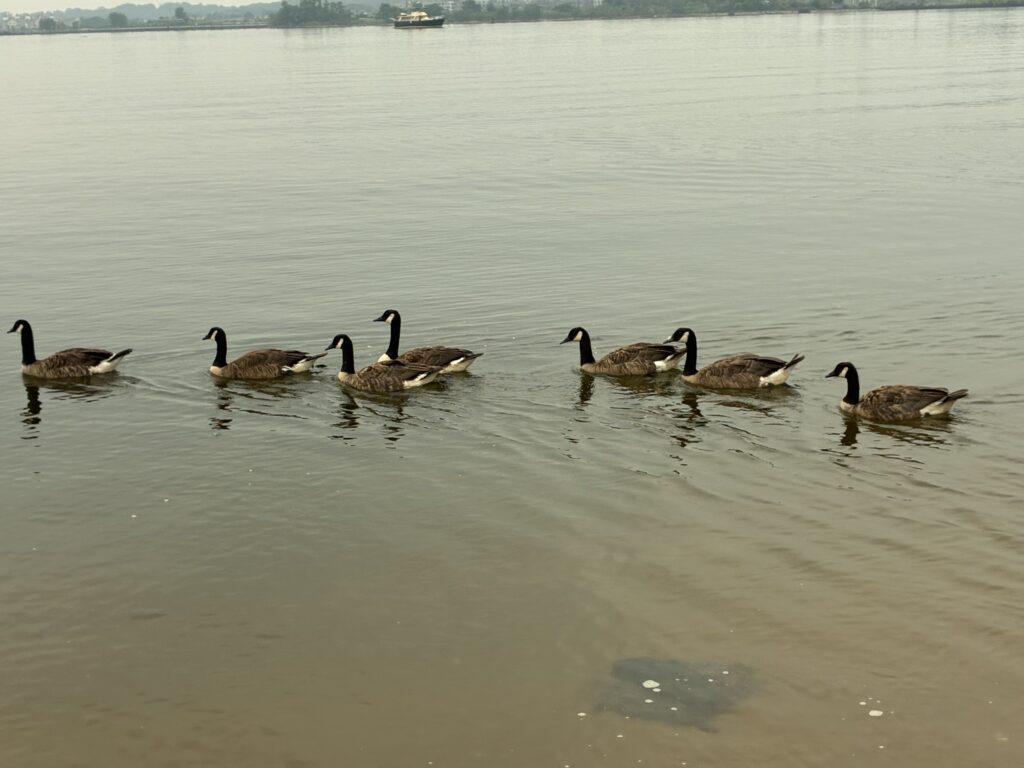
Last but not least, geese were sighted for the first time at Perth Amboy. Photo by Endurance Laryea.
The geese understand the importance of water monitoring, so they politely made way for our team. — Photo by J.M. Meyer.
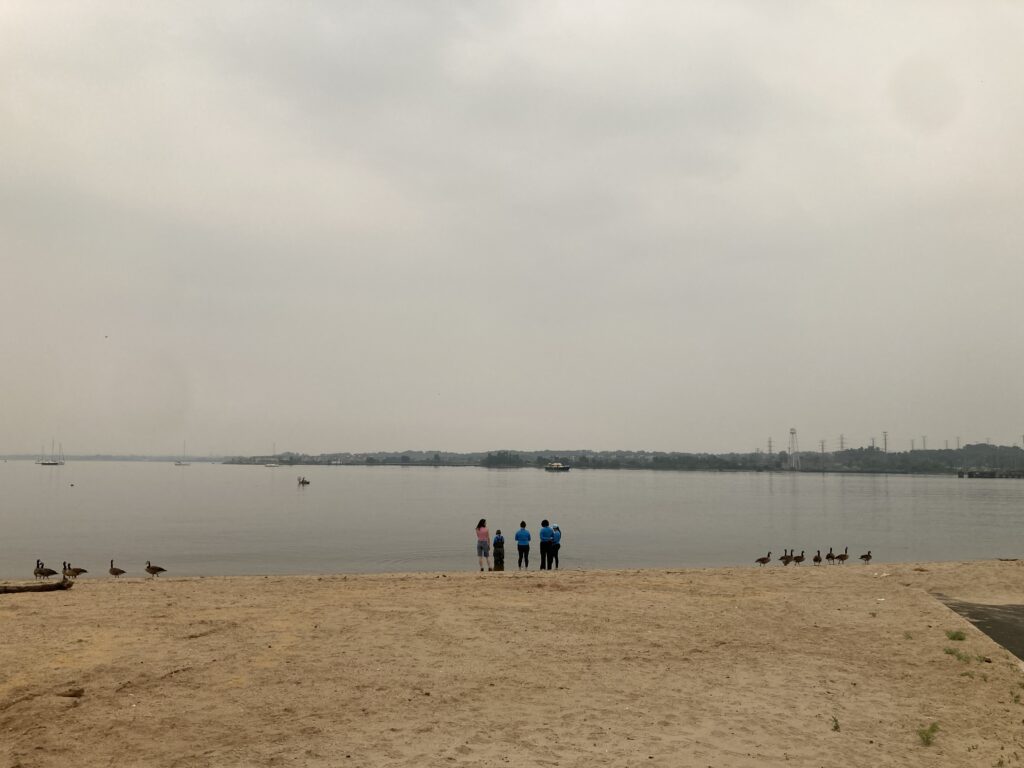
The session came to an end on a happy note and Ruby, from the Interstate of Environmental Commission (IEC) picked up the samples to take to the lab in Brooklyn. Ruby joined the team today to audit the sampling and monitoring session. Photo by Endurance Laryea.
By Endurance Laryea, LRWP Summer Research Intern and J.M. Meyer.
The second pathogen monitoring session of the month took place on Thursday, July 9th. Each week during the summer, from May to October, the Lower Raritan Watershed Partnership and Rutgers Cooperative Extension of Middlesex County run a volunteer-based monitoring program along the Raritan River. We collect water quality samples at six non-bathing public access beach sites, provide our samples to the Interstate Environmental Commission for analysis in their laboratory, and report the results to the public. Our mission is to share this data with the community and partners to ensure the safe use of the Raritan River for all.
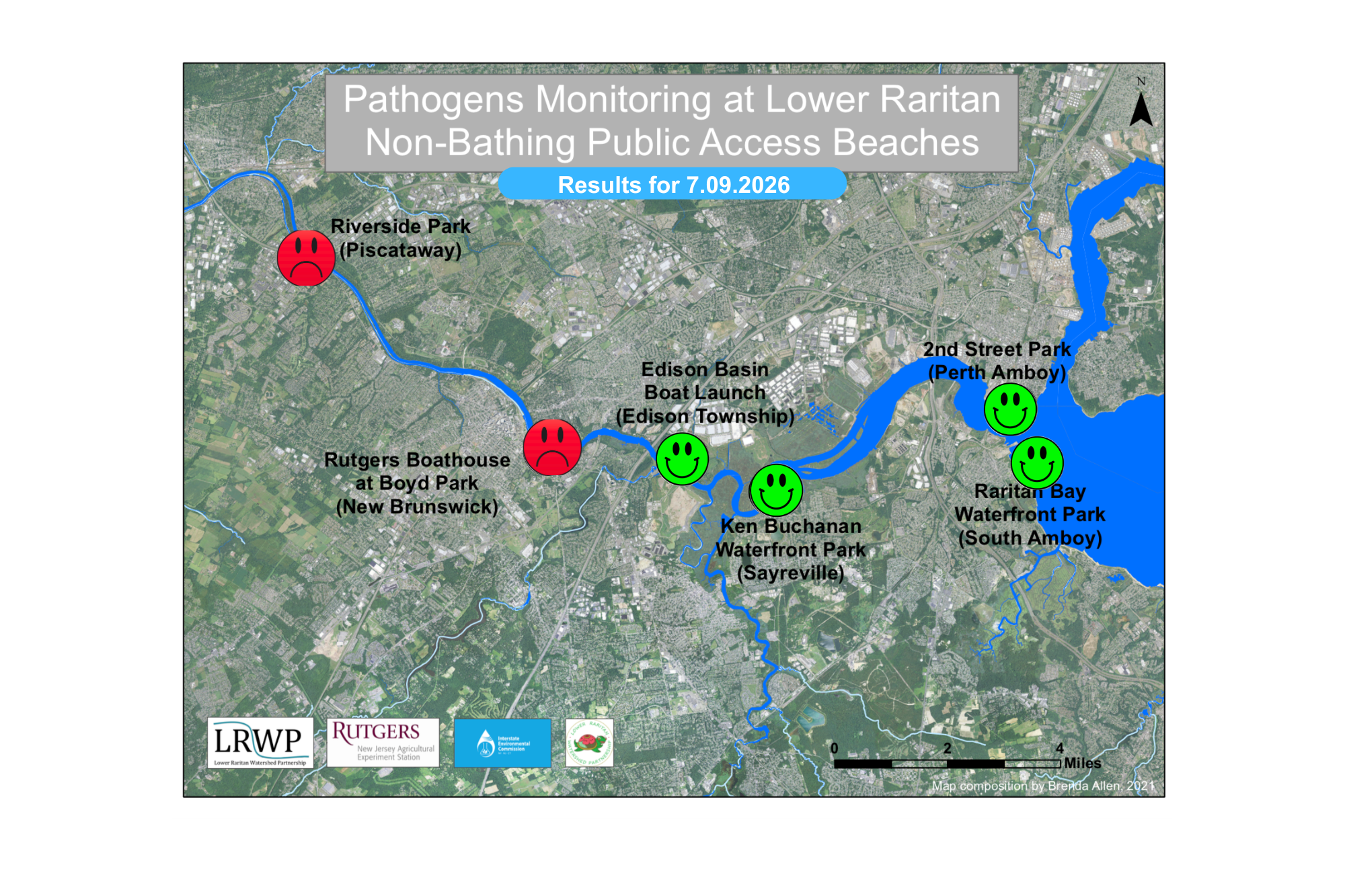
Our lab results for water quality samples taken on Thursday, July 9th, 2026, show Enterococcus bacteria levels exceeding the EPA federal water quality standard of 104 cfu/100mL at twoof our monitoring sites this week. The problem site is indicated by the red frown on the map and chart: Riverside Park (Piscataway) and Rutgers Boathouse (New Brunswick). Green smiles on the chart and map indicate the sites with bacteria levels safe for recreation and include the following: Edison Boat Basin (Edison), Ken Buchanan Waterfront Park (Sayreville)2nd Street Park (Perth Amboy).
Pathogens/Enterococci levels are used as indicators of the possible presence of disease-causing bacteria in recreational waters. Such pathogens may pose health risks to people coming in primary contact with the water (touching) through recreational activities like fishing, kayaking or swimming in a water body. Possible sources of bacteria include Combined Sewer Overflows (CSOs), improperly functioning wastewater treatment plants, stormwater runoff, leaking septic systems, animal carcasses, pet waste, wildlife waste, and runoff from manure storage areas.
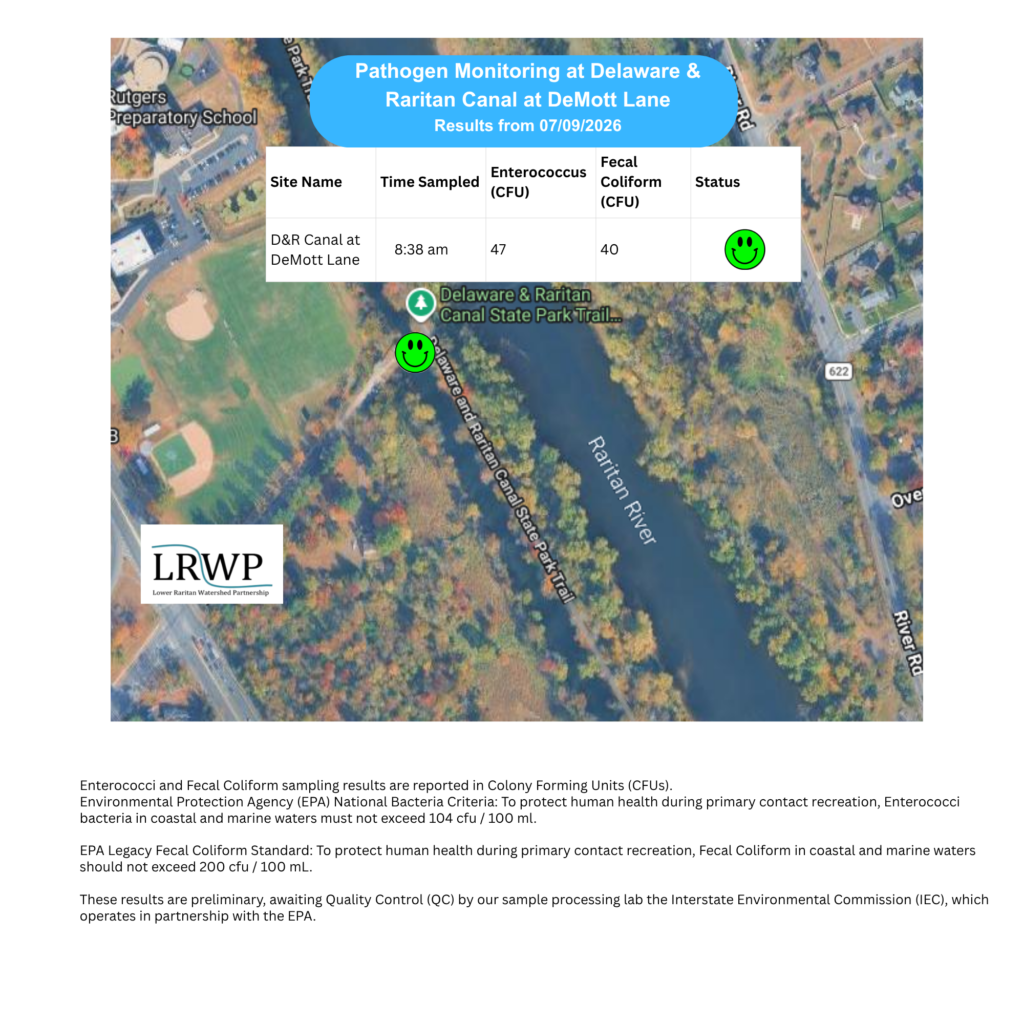
In order to better understand why Riverside Park, Piscataway has been our worst performing site over the past six years, we have started sampling further upstream. On July 7th, we sampled the DeMott Lane D&R Canal site a second time since we started pathogens monitoring this season. The lab analysis produced 47 enterococci colony per 100mL passing the EPA federal water quality standard of 104 cfu/100mL. It also passed the test during our first month of monitoring.
Our goal in reporting these results is to give residents a better understanding of the potential health risks related to primary contact during water-based recreation. If you are planning on recreating on the Raritan this weekend, make sure to stay safe and wash up after any activities!
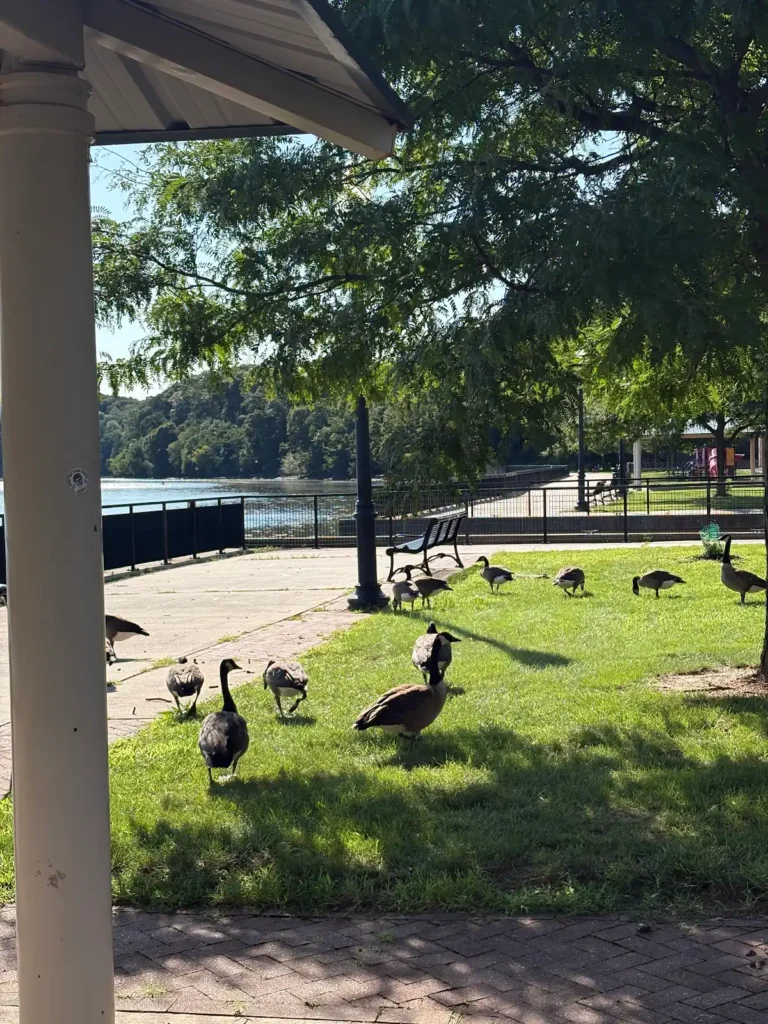
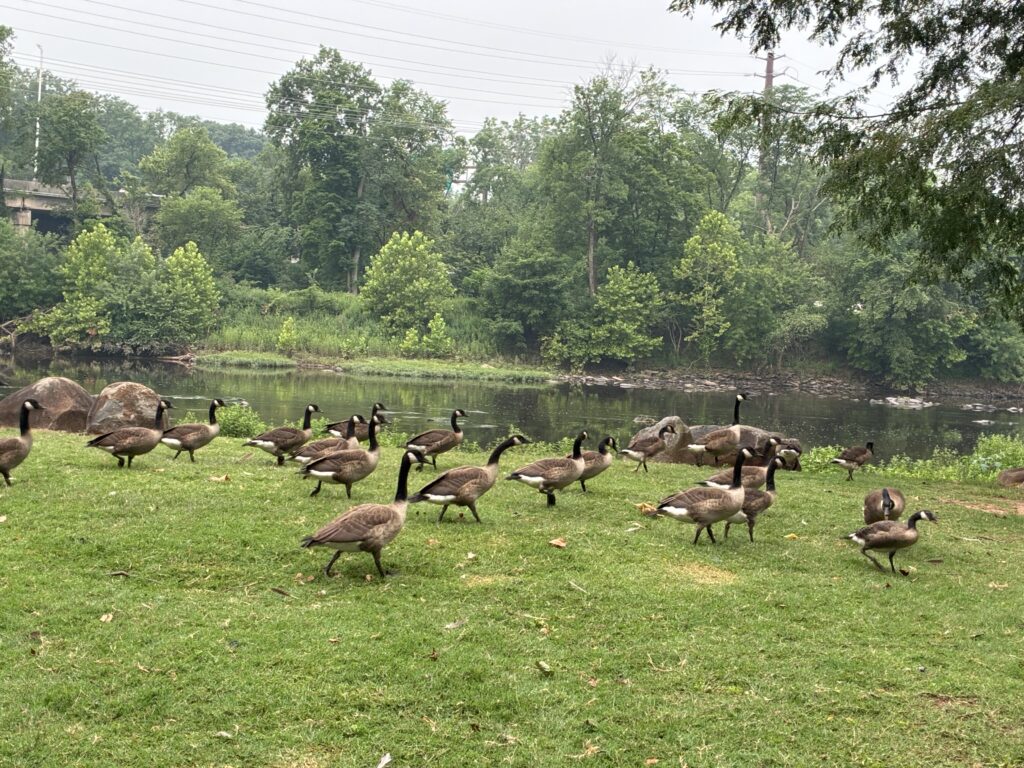
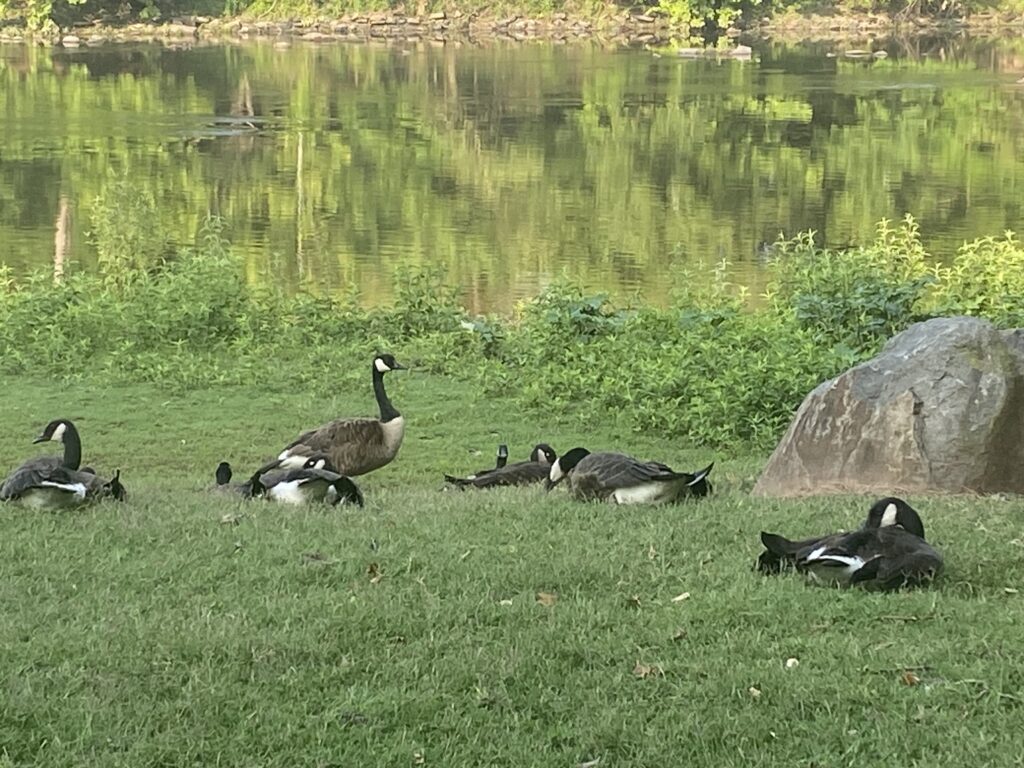
With no ‘goose chasing’ vehicles in sight, the Canada geese lounge in the summer shade at Riverside Park. Photo by Michael Orsini.
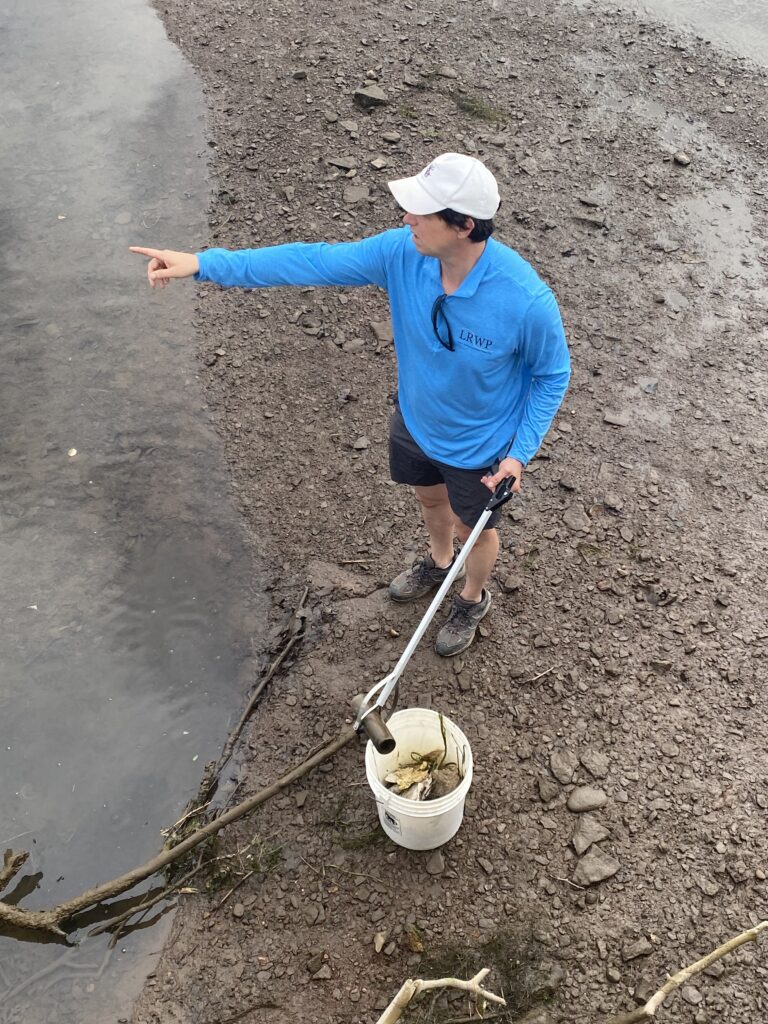
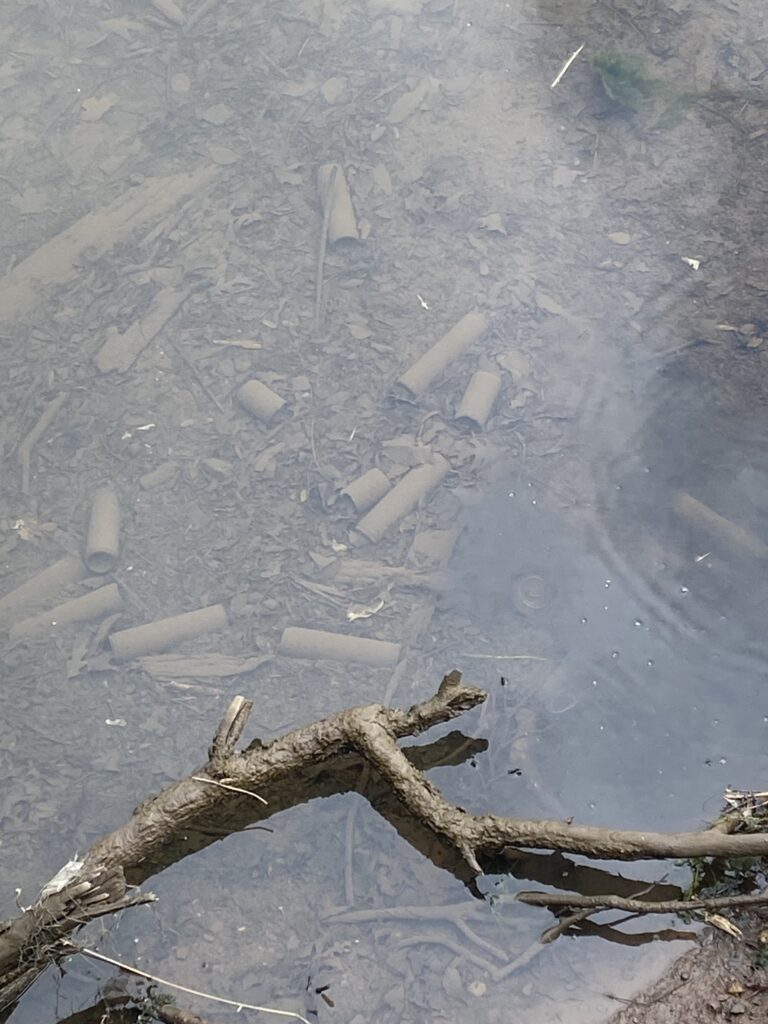
Thanks to the low tide, Dr. John found numerous ofrenda votive candles at the mouth of the Rutgers Boathouse Culvert. — Photo by Michael Orsini.
A close up of the votive candles. Photo by Michael Orsini.
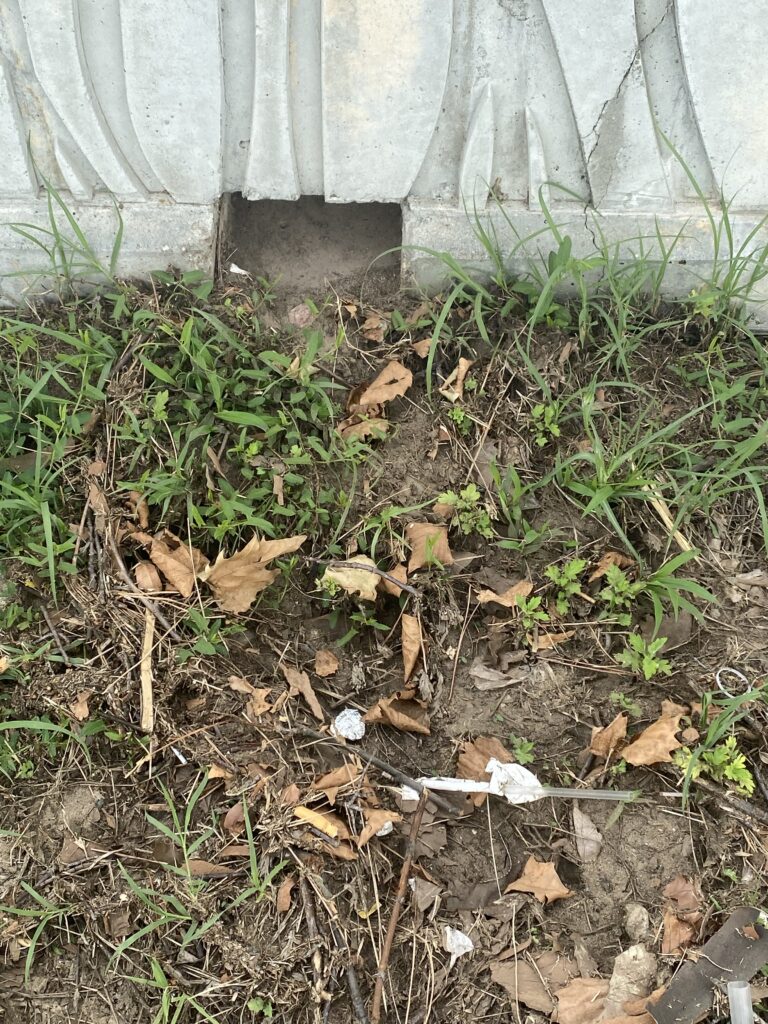
The Perth Amboy beach wall has numerous drainage openings to allow water to runoff onto the beach. Unfortunately, scores of cigarette butts and candy wrappers hitch a ride through the small portal. Please properly dispose of your trash! — Photo by Michael Orsini.