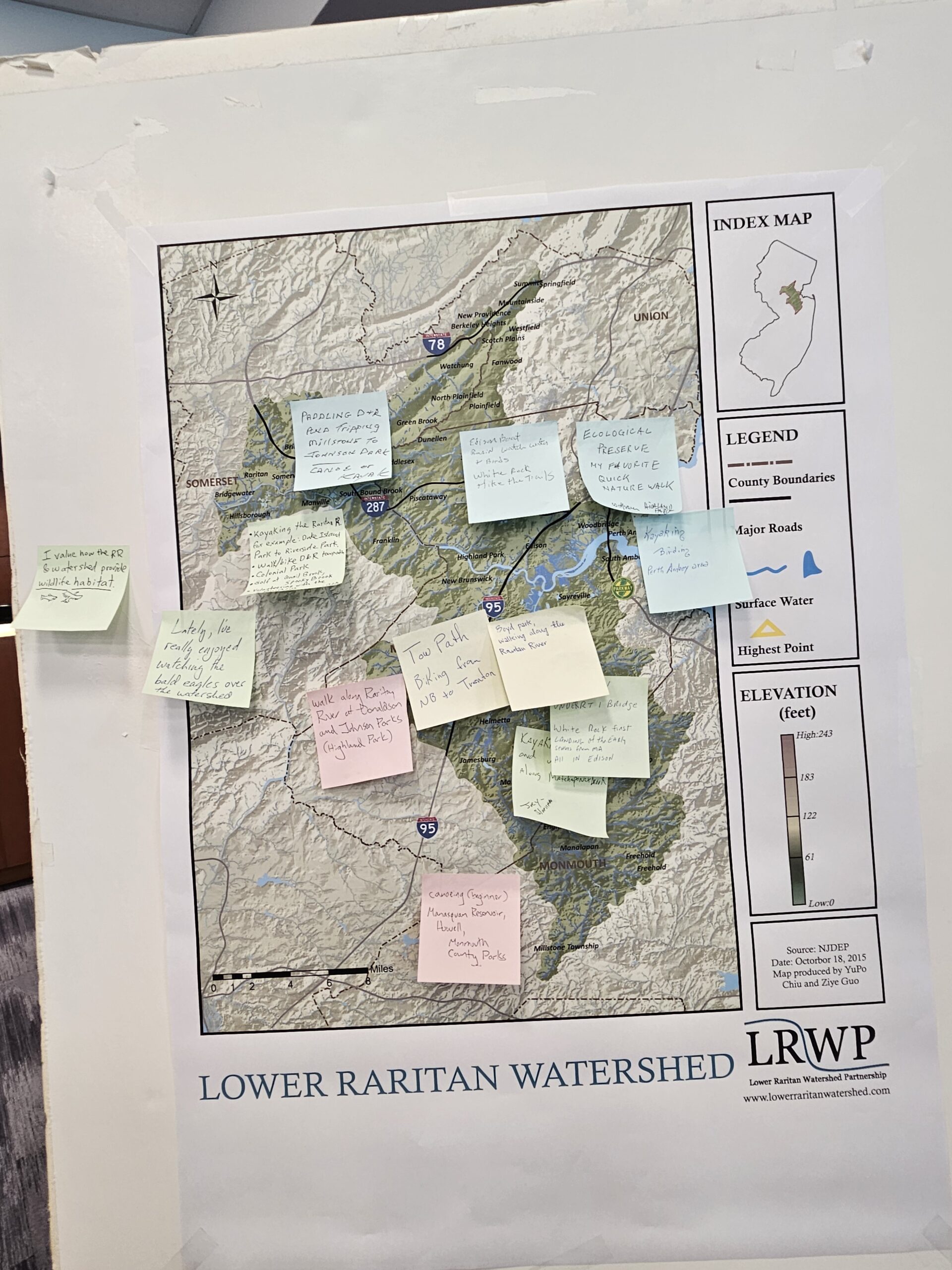
Yesterday, at a special listening session on recreational access to blue and green spaces within the Lower Raritan Watershed, one watershed resident shared their favorite way to access nature: “Lately, I’ve really enjoyed watching the bald eagles over the River.” Even 20 years ago, the idea that bald eagles could be a regular facet of our highly industrialized central New Jersey environment would have sounded like a fever dream, and now it is reality. During the June 11, 2024 listening session, hosted by the Lower Raritan Watershed Partnership (LRWP) and NY/NJ Harbor & Estuary Program (HEP), participants communicated a vision for the next 20 years: a robust network of blueways and greenways connecting local parkland and foot and bike paths within the Lower Raritan Watershed to larger regional and national networks of trails.
The input from this session, summarized below, will not only inform the LRWP’s understanding of recreational priorities but also help shape the HEP Action Agenda for recreation in our region for the next decade and beyond. The session was attended by 31 community members who contributed thoughts on recreational access and the larger state of the watershed. A recording of the session will be available on the LRWP youtube channel, and a bulleted summary of community member responses to a set of questions framed by HEP, is shared here:
Key takeaways can be summarized in response to two questions. The first, “If you could pick one change that’s necessary to have a greener, healthier, and more resilient community — what would that be?” and the second, “What are the challenges and obstacles that face local communities connection and access to nature?”
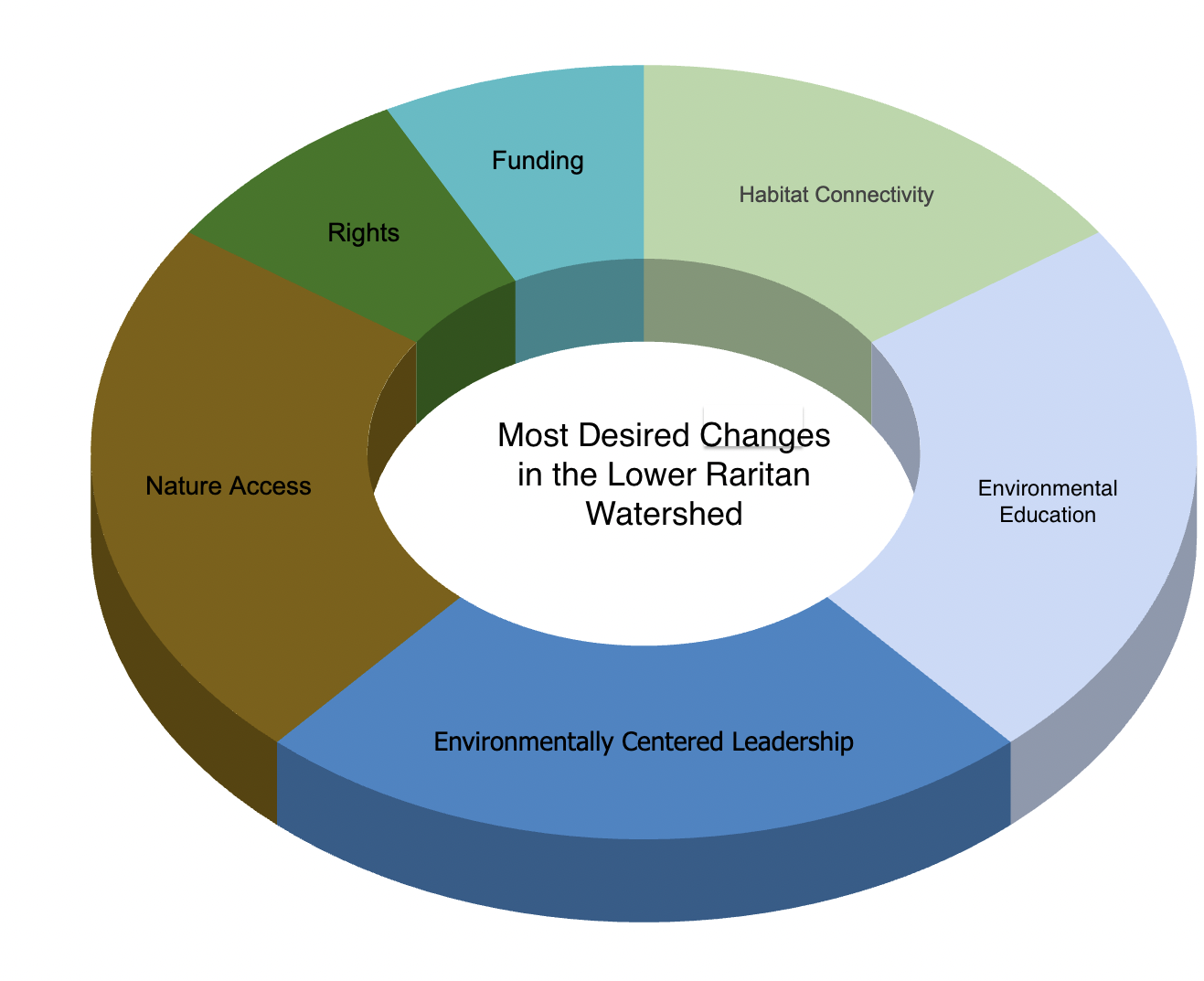
To the first question regarding required changes to realize a greener, healthier, more resilient community, participants communicated six core visions:
23% of respondents advocated for a shift towards environmentally centered leadership, policy, and planning, emphasizing the urgent need for eco-conscious governance.
23% of respondents voiced their desire for increased access to natural features, highlighting the intrinsic connection between human well-being and proximity to nature.
23% of respondents emphasized the critical role of environmental education, advocating for initiatives to raise awareness and empower communities to become stewards of their surroundings.
15% of participants underscored the importance of enhancing habitat connectivity, recognizing the significance of preserving ecological corridors for biodiversity and ecosystem resilience.
8% of respondents pinpointed increased funding as the key catalyst for change in the Lower Raritan Watershed, emphasizing the tangible impact of financial investment in environmental initiatives.
8% advocated for granting rights — akin to human rights — to the Raritan River, signaling a growing movement towards recognizing the intrinsic rights of natural entities.
To the second question regarding challenges and obstacles to realizing this vision, central concerns focused on infrastructure, transportation, and habitat fragmentation.
One participant highlighted how infrastructure like Route 18 acts as a formidable barrier, impeding access to many natural areas. Others pointed to lost opportunities for retrofits that could remedy past disconnections to natural spaces through, e.g. reengineering roadways or repairs of Landing Lane Bridge. As was noted in our session, the construction of Route 18 started as a slum clearing project. This reflects a historical pattern of social injustices where urban planning decisions disregarded not only the environmental impacts but also equity impacts on our communities, and highlights the need for a holistic approach to restoring community health. By acknowledging the historical context of such projects and their environmental implications, we can work towards more equitable and environmentally responsible solutions for our communities.
Limited mass transit connections to green/blue spaces was another concern voiced by participants, with suggestions made to not only prioritize transportation between live-work activities, but also to open and natural spaces. Addressing these challenges requires advocacy for infrastructure improvements, such as championing Boyd Park’s transformation into a state park, as suggested by community members at the session yesterday.
Additional questions included:
Do you wish you had more and/or different opportunities to experience the natural environment?
What kind of opportunities come to mind?
What are other concerns or stressors that your community is currently facing?
How has climate change impacted your community?
Are there places/sites in your community where these concerns are more prevalent?
We invite you to read through the full set of ideas generated during the community engagement session (see above), to watch the video of the session, and welcome your thoughts on how to improve recreational access to blue and green spaces within the Lower Raritan Watershed and beyond.
Although the information in this document has been funded wholly or in part by the United States Environmental Protection Agency under agreement to the Hudson River Foundation for the New York-New Jersey Harbor & Estuary Program, it has not undergone the Agency’s publications review process and therefore, may not necessarily reflect the views of the Agency, and no official endorsement should be inferred. The viewpoints expressed here do not necessarily represent the belief or opinions of the New York-New Jersey Harbor & Estuary Program, Hudson River Foundation, or United States Environmental Protection Agency. They assume no responsibility or liability for the contents or use of the information herein nor does mention of trade names, commercial products, or causes constitute endorsement or recommendation for use.
We love sharing our water quality (and other) data, and love hearing how folks analyze these data. Earlier this week we received the following message from the Admiral William F. Halsey Health & Public Safety Academy (Elizabeth, NJ):
Dear Lower Raritan Watershed Partnership –
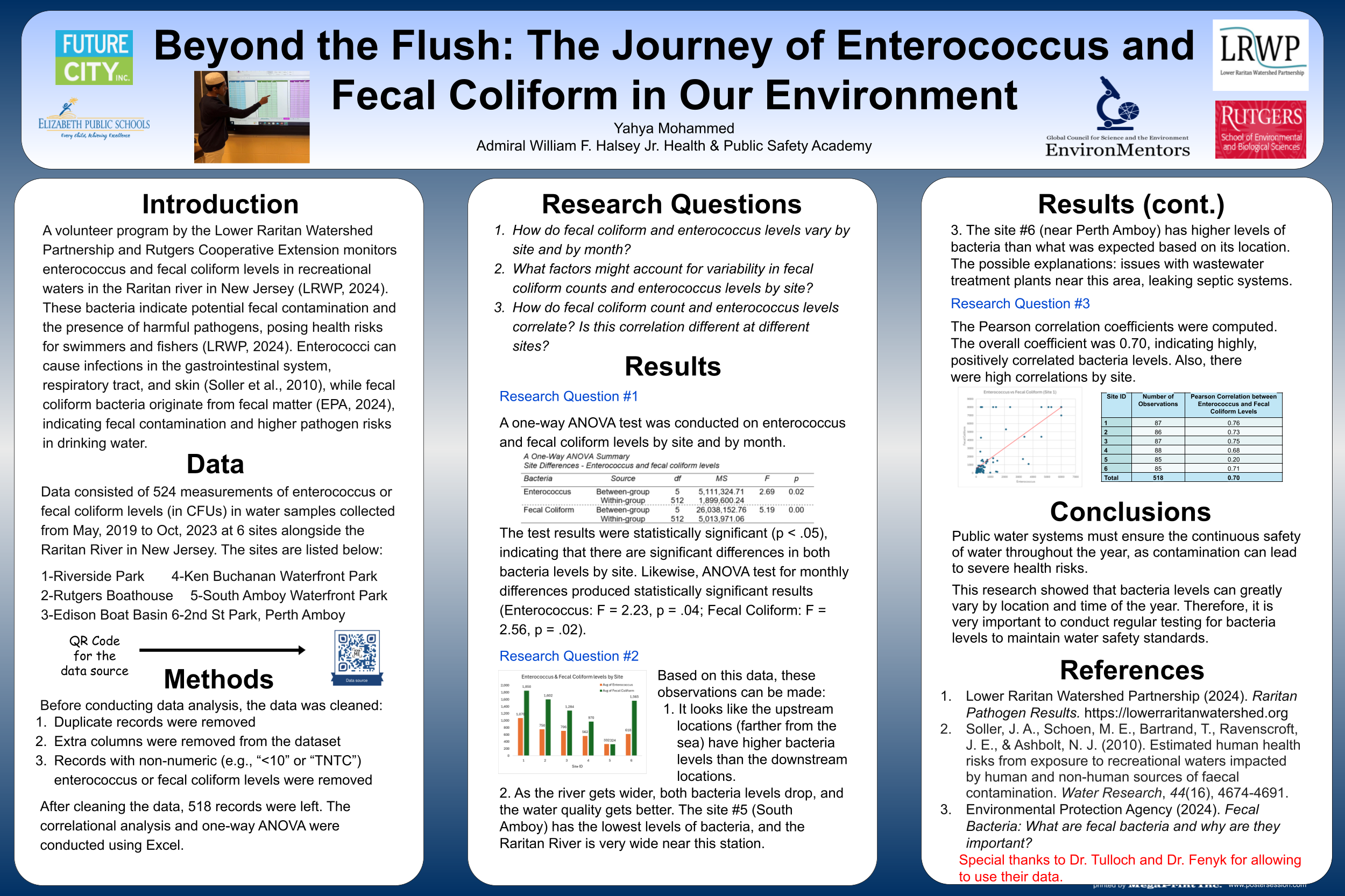
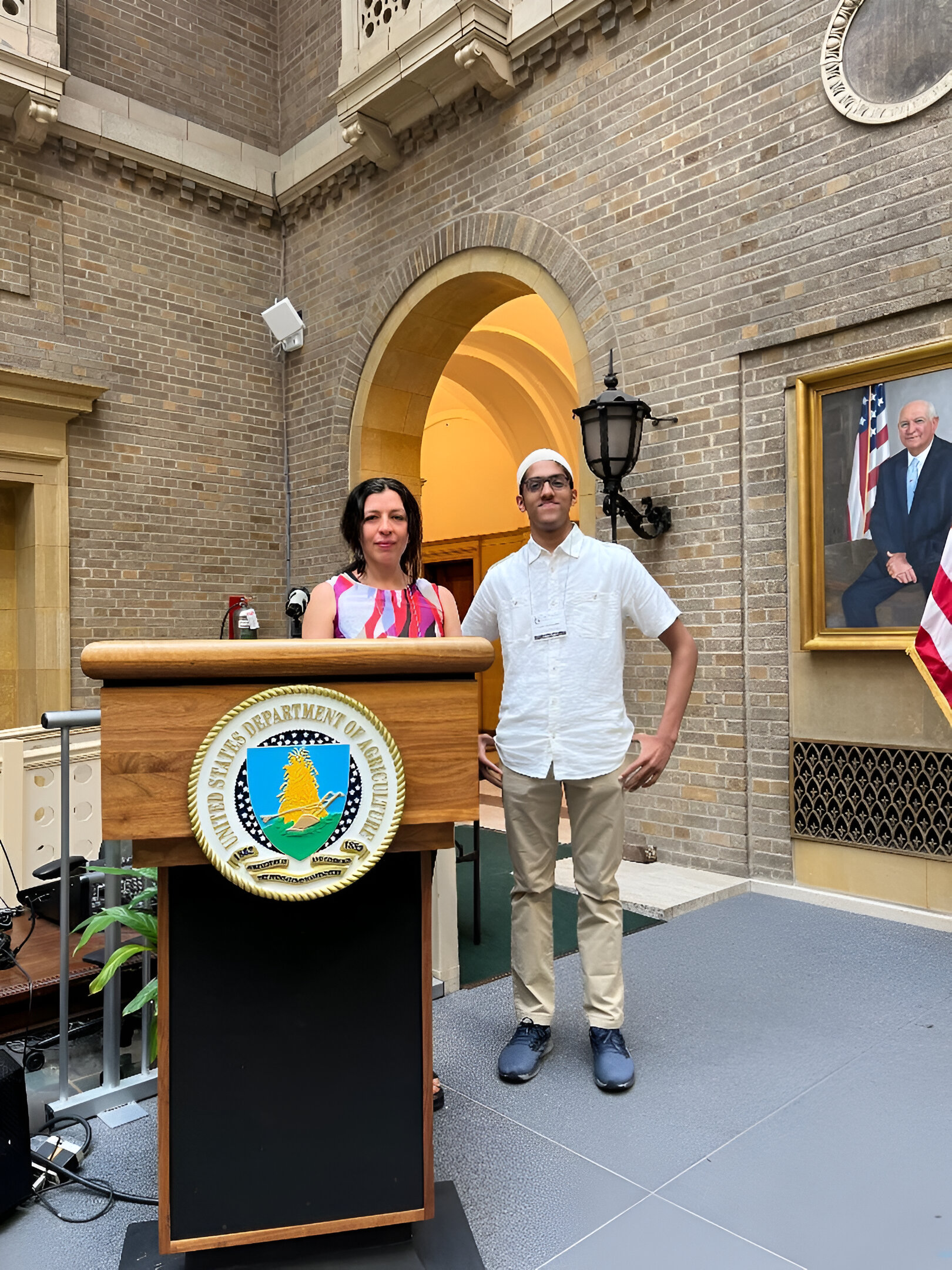
We are pleased to inform you that we utilized the data you provided to conduct statistical analyses, including a correlational study and one-way ANOVA, yielding interesting results. Our study, titled “Beyond the Flush: The Journey of Enterococcus and Fecal Coliform in Our Environment,” was presented at the GCSE’s 2024 EnvironMentors National Science Fair at the U.S. Department of Agriculture in Washington, D.C., where we placed third.
This award would not have been possible without your support and assistance. I would like to express my heartfelt thanks for allowing us to use your data.
Congratulations to all involved!
Admiral William F. Halsey High School student Yahya Mohammed was recognized by the United States Department of Agriculture for his analyses of the LRWP’s pathogens data for the years 2019-2023.
Article by LRWP Volunteer Monitoring Irene Riegner
“Water, water everywhere”—but can you drink it? For the last five years, citizen scientists under the guidance of the Lower Raritan Watershed Partnership have been monitoring the water quality of the lower Raritan River. Last summer, I was one of those monitors. Once a week from late spring through early fall, through spring rains and summer heat, we tested the waters from Perth Amboy north to Piscataway. We tested quantitatively through water samples and instrument readings and qualitatively through observation. The river was in better condition than I would have imagined: Despite abandoned factories along its banks; despite surrounding industrial neighborhoods, junk yards, and heavy industry; despite the usual litter; despite sewage outflow; despite bird guano.
Near Highland Park, I watched a great blue heron gracefully stalking its prey. Then, zap. The fish entered its eternal afterlife. In Piscataway, cormorants floated on the river and periodically dived for dinner. Near the Edison Boat Basin, osprey, scrutinizing the river from their high perch, nested across from a landfill and next to a petro-chemical factory. The river must be alive; there must be a plentiful source of food in its depths.
Water quality monitoring volunteer, and article author, Irene Riegner helps the LRWP and NJDEP scout locations installation of an ISCO water quality sampler for a Summer 2024 study
We took readings for dissolved oxygen, pH and salinity and measured the temperature. The numbers varied but usually landed within favorable parameters, pointing to a reasonably healthy aquatic life. On the other hand, elevated readings of enterococcus, an indicator of pathogenic disease, were troublesome. We took water samples for testing. A red face on our charts indicated that enterococcus was above the permitted level. Perhaps effluvia from a nearby outflow. Perhaps runoff after a rainstorm. Perhaps downstream waste flowing upstream with the current.
“Do you eat the fish you catch?” I asked the local fishermen casting their lines into the water. “We throw ‘em back,” most of them answered. Fishing and the river mean a morning with their buddies. Sailing and the river mean recreation with family and friends. The sailboats are moored in the river near South Amboy, near the million dollar, Victorian style homes, snuggled between factories and dumps. I never observed anyone swimming from the sand beach in front of these homes.
Last summer, I began learning about the river, learning to understand it as an organism with complex parts, both natural and human-constructed, whose reach radiates beyond its banks into the municipalities and parks that line its shores—and beyond. Maybe with the communal effort of municipalities lining the Raritan and its tributaries, the river once again can become a focal point for recreation—and maybe, someday, we could even eat the fish and swim in it.
The 2023 summer monitoring revealed the cleanest water yet.
In March the LRWP brought on Jeff Key as a part time business manager. We are so pleased to have him on board! Jeff has an extensive background in law and leadership. A former Americorps Teaching Fellow, Assistant Professor at Seton Hall Law, and now Founder/Principal Consultant with NFinityEnterprises, Jeff’s focus is on supporting New Jersey based nonprofits in their aims to provide equitable access to services and programming. Jeff currently serves on the board of the Center for NonProfits and the National Board of the Young Nonprofit Professionals Network. Spring 2024 Intern Maxim Pavon sat down with Jeff to learn more about him and his work, we share the interview below.
Welcome Jeff! We are happy to have you on board with the LRWP, and would love for our community to get to know a little more about you and your work:
What’s your favorite outdoor spot in the Lower Raritan?
I enjoy spending time at Boyd Park, which was built when I was growing up in the area and has been expanded over the years. I’m always a big fan and advocate of maintaining and creating green spaces in cities as gathering spaces, a way to have sustainable development, and important spaces for residents to have accessible space for outdoor activities and recreation. The Delaware and Raritan Canal State Park is a close second spot with amazing trails to explore and I’ve been excited to see the expansion of projects like the East Coast Greenway to connect different trail systems through multiple states.
With an extensive background in law and leadership, what has interested you so much in the realm of virtual communications as to found Nfinity Enterprises, a web design and technology consulting firm devoted to the success of small businesses and nonprofits?
I started working with nonprofits immediately after graduating law school at a time when social media and website presence was a growing trend, and some of my responsibilities that developed over time involved working in these areas. Meeting so many people working at amazing nonprofits let me know that they were making an amazing impact that was being overlooked in some cases, and with up to date websites and systems to show impact and tell their story they could connect with more donors and volunteers to get the support they deserve. Technology is advancing so rapidly that I think it’s crucial that nonprofits working on some of the most important social challenges have access to these tools for positive impact and also have a voice in advocating how these advances affect the communities they work in.
What is the most common struggle you see among small and mid-size nonprofit organizations?
With small and mid-size nonprofit organizations, there is a challenge around scaling programming for growth and effectively using staff capacity. I definitely see technology playing a role in helping with that, since one of the most valuable resources for nonprofits is staff time and capacity and efficient systems, automation, and time-saving processes free up staff members to focus more on critical day-to-day work and strategic planning.
How do you see your work assisting the LRWP to address such hurdles?
I see my work with LRWP helping to build out systems and processes to make it easier for folks at every level to engage with the organization or complete their work: volunteers, staff, and donors/supporters. A second area that I hope to assist LRWP is thinking about how to build systems that will work for current programming and operations, but also be ready to scale to meet needs as the organization grows and adds additional staff, programming, and events.
I think my connections have put me in contact with an amazing network of professionals working at nonprofits that are very different from the organizations that I’ve had personal experience working at. That opportunity to share with and learn from ideas and approaches that have been successful at other organizations has been amazing, and is one of the things that I appreciate about working in the nonprofit sector. It did take me some time to recognize the importance of networking on a wider scale outside of the immediate area where you work, so I try to encourage students, interns, and younger nonprofit professionals to do that as soon as possible in their careers.
Finally, what is one mantra that you live by?
One mantra that I live by is that all failure is an opportunity to learn, grow, and engage in self-reflection. As someone who definitely tends to be a perfectionist, this is something that I’ve had to learn as I’ve progressed in my career and be intentional about remembering. With many of the skills and abilities that I now consider myself to be good at, there was definitely an initial learning curve and instances where something I tried or was in charge of did not meet expectations. Anyone who ends up being really good at anything or considered an amazing expert absolutely made mistakes along the way and didn’t let those setbacks stop them from continuing to work and improve their craft.
The changing climate and development patterns of the Lower Raritan Watershed occur against a backdrop of substantial impervious surface coverage (approximately 34%), high population density, and significantly modified stream networks (e.g., stream straightening and burial, culverts, underground retention). Through hundreds of years of anthropogenic influence, the historic stream channels have been altered or “disappeared,” resulting in increased flooding, compromised water quality, and decreases in aquatic and other species. The added influence of climate change heightens these impacts. In addition, many Lower Raritan Watershed municipalities have no way to understand the lost natural and cultural heritage represented by the historic hydrology, the failing underground infrastructure and the collapse of buried streams.
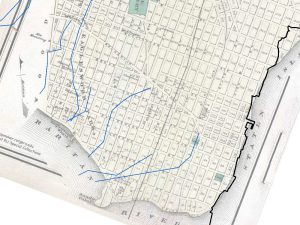
Figure 1. An 1872 map of Perth Amboy overlaid with linework (in blue) showing potential streams from other map sources.
The research is intended to develop a systematic approach to define, identify, and describe the progression of the geographic pattern of “hidden” and “dynamic” streams in the Lower Raritan Watershed — that is, those areas that no longer exhibit all of their surface stream channels due to the effects of human development and population growth. It will allow for creation of an organized system for relevant stream and hydrology maps and map downloads to assist in “finding” the lost and hidden waterways in our watershed. This research is important as a way to understand our historic ecology and also to inform efforts that seek to use stream daylighting as a form of Green Infrastructure for stormwater management, water infrastructure management, and water quality improvements in our urban communities. Sharing the resulting data and materials will represent a first step towards the creation of a comprehensive data clearinghouse for the communities of this landscape.
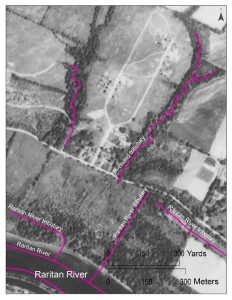
Figure 2. This early 1930s black and white aerial photography of Piscataway shows the early development of Ross Hall Blvd and parts of what is now the Rutgers Ecopreserve. The fuscia linework shows the current NHD stream dataset that was used for comparison in the project.
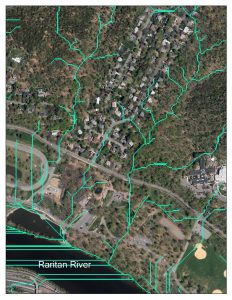
Figure 3. A recent color photo of the same area in Piscataway overlain with the GIS-generated linework (in green) showing terrain-based analysis of potential drainage and stream patterns.
This project captures the Raritan River’s lost heritage by creating new data while making existing records more widely available and used. This ongoing research endeavors to define, identify, and describe the progression of the geographic pattern of “hidden” and “forgotten” streams in the Lower Raritan Watershed — that is, those areas that no longer exhibit all of their surface stream channels due to the effects of human development and population growth. This research helps us understand our historic ecology and also can inform future efforts that seek to use stream daylighting as a form of Green Infrastructure for stormwater management, water infrastructure management, and water quality improvements in our urban communities.
Initial outcomes included:
Created a research catalog linking to 40 sites with potential materials for ongoing evaluation and inclusion
Evaluated materials at 22 of those sites
Catalogued 230 maps to evaluate
Developed 41 sharable georectified version of historic maps
Identified over 2000 line segments on the historic maps that do not closely match those in the contemporary stream data
The GeoHealth Lab at the CRSSA and the LRWP intend to supplement the ongoing project with volunteers while seeking additional funding in order to continue, (a) acquiring, compiling, and georectifying historic maps, (b) expanding and improving the project website, and (c) field check sites to determine the streams’ status.
Please note: the boat shop will be closed on Saturday May 18. We will be back at work on Wednesday May 22, 6-8pm. As always, please pre-register for our programs to receive notice of any cancellations or changes to programming.
Article and photos by Theo McDermott-Hughes. The LRWP is grateful to the PSEG Foundation for generous funding support through the PSEG Neighborhood Partners Grant Program for our “Youth Empowerment Through Boat Building”.
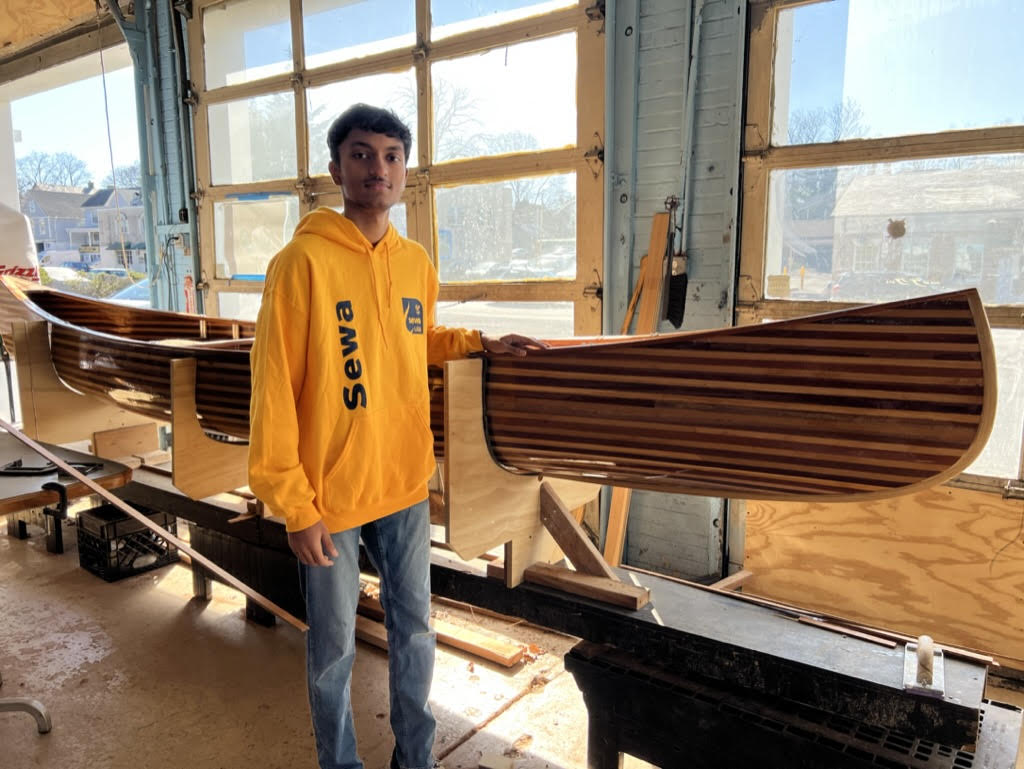
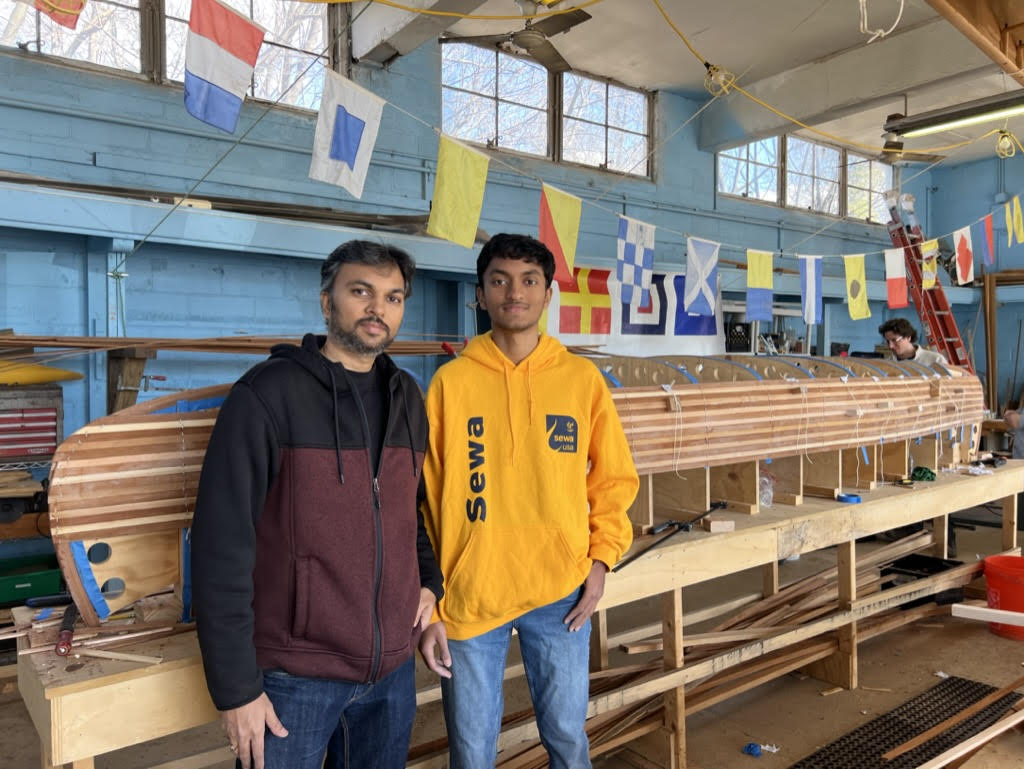
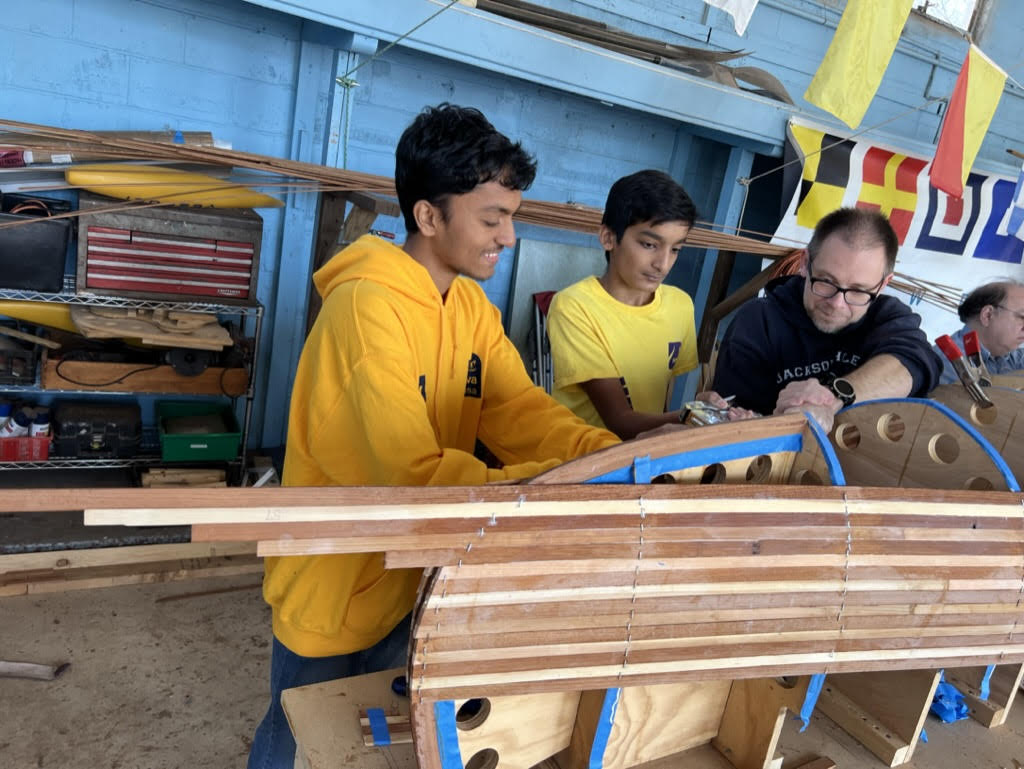
Aadharsh, 16, has always feared the water, making him a perhaps unlikely volunteer for the Lower Raritan Watershed Partnership boat build. This LRWP program aims to increase engagement with and understanding of the Raritan River. Moving water is something Aadharsh had avoided for years, yet this was his second year participating in building a canoe as a member of the Sewa International Central Jersey youth program, which he participates in as a junior at JP Stevens high school.
Aadharsh was drawn to the boat building project and the LRWP because of his love for the environment and dream of being an engineer. After building these boats, starting from the paper designs and research all the way through the construction process of fixing the panels in place and weaving the cane seats, Aadharsh now leads his engineering class at school as they use the same processes and skills he’s already learned in the boat house.
Even more than practical skills and insight into the engineering process, he’s gained deep sense of fulfillment, one he struggled to express as he laid his hands on the lacquered hull of last year’s canoe. “Watching the boat come to life” under his hands gives him the energy to come back each week. He gazed at the panels striping the side of the boat with a sense of awe, bordering on reverence. “You see that?,” he said. “We did that.”
As Aadharsh’s father, Sakkaravarthy, watched his son work with other volunteers to attach the paneling, he expressed his great pride. He always tries to sign up to chaperone the teen volunteers when Aadharsh comes to the build. Not only does he get to watch his son explore his passion, when they return home and Aadharsh inevitably spends dinner enthusiastically talking about what he did at the boat build, Amid can smile along with understanding and pride.
Now, both father and son look forward to the boat launch, when the new canoe will hit the water for the first time this summer along with past years’ boats. Aadharsh can’t wait to paddle down the river that was once such a source of fear.
Join LRWP volunteers like Aadharsh and Sakkaravarthy at our boat-building session on Wednesdays from 6-8 and Saturdays 9-11. Pre-registration required. See you soon!