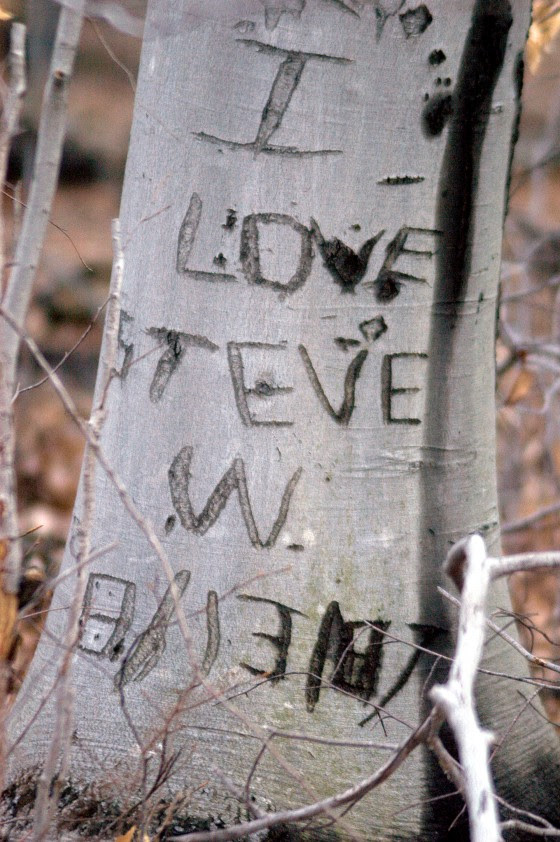
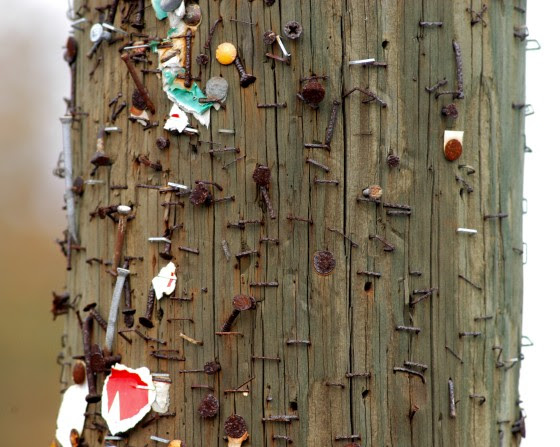
Message from the early nineteenth century remains in place. Hand carved declaration memorializing the men involved in the construction of the bridge. No so different in style and material than petroglyphs from paleo times. Words replace symbols to convey a message deemed important to future travelers.
The stone plaque set in the fieldstone bridge over Cat Tail Brook is crudely chiseled with the date 1825 along with the name of the mason and men who directed its construction.
The graves of the early settlers preserved in a small patch of land are marked with red shale stones, some with hand carved epitaph’s, other small, weathered stones barely decipherable, some messages completely eroded.
A block of shale rests in the river with the inscription J N Stout along with the Roman numeral XVI. Well into the twentieth century, property lines were represented by rocks or trees with slash marks.
The need to communicate is an innate human behavior, messages scribed on whatever canvas is available, whether it be scribbled on a napkin, roadside billboard, or graffiti on the side of a building. From the Chauvet Pont d’ arc caves of France and their well-preserved pictographs, to the Parsippany petroglyphs in north Jersey, each generation of humans, worldwide, expressed themselves in the most rudimentary ways, using whatever medium was on hand.
My interest is in the paleo or pre-colonial people who lived in our area whose rationale for leaving signs and messages is no different than those seen today. Messages that were the precursor of books, told stories of the hunt or other rituals in pictographs, dendroglyphs and petroglyphs. Pictographs are paintings placed in a protected area, dendroglyphs were images carved into a tree who bark had been partially stripped, petroglyphs were figures carved or etched into stone, usually in the open for travelers to see.
Just as the local Indians used trees to convey messages along travel paths, the desire for humans to communicate is as strong today as it was when paleo people walked the North and South Branch of the Raritan river. The search for petroglyphs is not confined to the realm of certified experts.
In the book, “Rock Art of Eastern North America”, the author notes the scarcity of primitive art in the eastern woodlands versus the numerous examples in the western states, primarily due to climate. As trees were the dominant canvasses of the woodlands, trees carved with dendroglyphs are not likely to be found. The rock strewn Sourland mountains would be a prime location for glyphs, while in the glacial scoured highlands of northern NJ, petroglyphs been authenticated.
An example noted in the book explains dendroglyphs were located on well-travelled trails, river crossings and prominences. The topography of the land was also a factor as it restricted or directed travel around obstacles, along rivers or mountain trails. Humans as well as wildlife seek out paths of least resistance as well as places which provide a view. What traveler has not succumbed to the temptation to climb a huge boulder alongside a hiking trail? In paleo times that rock was a safe place to camp, seek refuge from a wolf, or ambush a deer. Some successful hunter might leave a mark to commemorate his luck.
Without having read or heard of such a ritual, I would leave a coin where a deer fell to my arrow. I don’t know why I did that; no one will ever find that coin. Maybe a lingering primal behavior acted out to ensure my clan’s survival by telling another hunter, that the location was a good place to hunt.
The South and North branch and Raritan rivers are prime places to look for petroglyphs on the shale cliffs. You are not likely to discover one, but certainly these would be the places to look. Indian artifacts abound and stories of local collectors are many. The cliffs protruding from the flood plain attracted passersby to the precipice, to see what they might see. We can only imagine a glyph carved into a nearby tree by the Unami clan, represented by the image of a turtle. Perhaps it marked territory, a place to camp or images of a turtle holding a tomahawk to signify a war party, as mentioned in the Rock Art book. Chance of finding artifacts at these outcroppings are greater than finding stone carvings.
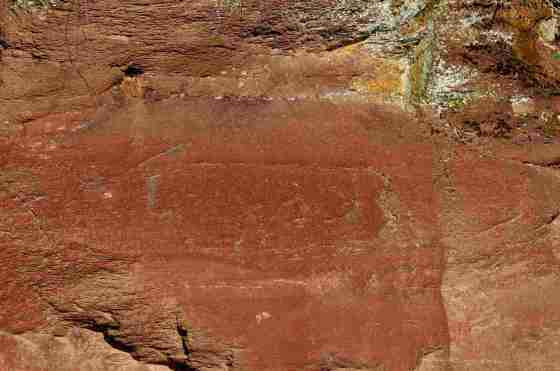
Knowing that our rivers were the highways of pre-colonial times, I cannot resist re-examining one particular, smooth red shale cliff, for the remains of an eroded petroglyph. That rare, smooth red shale canvas must have served as a primitive billboard with images of fish and deer taken by the Unami clan. I can’t find a sign, but I keep on looking at that cliff as if the imagined carvings were somehow transcribed to mental images perceived only by kindred spirits who traveled the same watery path.
I keep staring at this smooth cliff face along the river, hoping imagination will be the key to discovering an actual petroglyph. There is no way an early traveler could resist leaving a message on that unusual, smooth red shale tablet!
Further proof of the unbroken, innate need for humans to communicate along travel routes. Just as in paleo times a message board would be updated with symbols perhaps to show the results of a raiding party or successful hunt.
Author Joe Mish has been running wild in New Jersey since childhood when he found ways to escape his mother’s watchful eyes. He continues to trek the swamps, rivers and thickets seeking to share, with the residents and visitors, all of the state’s natural beauty hidden within full view. To read more of his writing and view more of his gorgeous photographs visit Winter Bear Rising, his wordpress blog. Joe’s series “Nature on the Raritan, Hidden in Plain View” runs monthly as part of the LRWP “Voices of the Watershed” series. Writing and photos used with permission from the author. Contact jjmish57@msn.com.
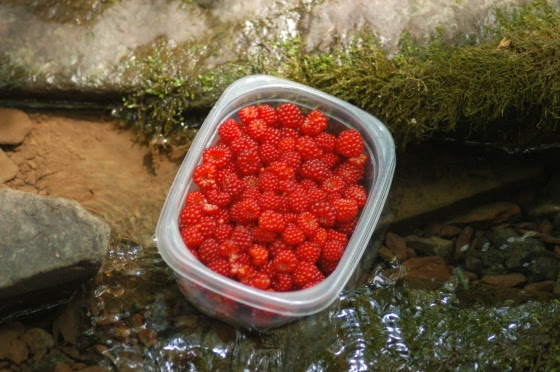
Fresh picked bright red dewberries, packed in open top containers, cooling in the shade on a partially submerged rock, in a shallow flowing stream, elbows its way to mind when thoughts of summer arise.
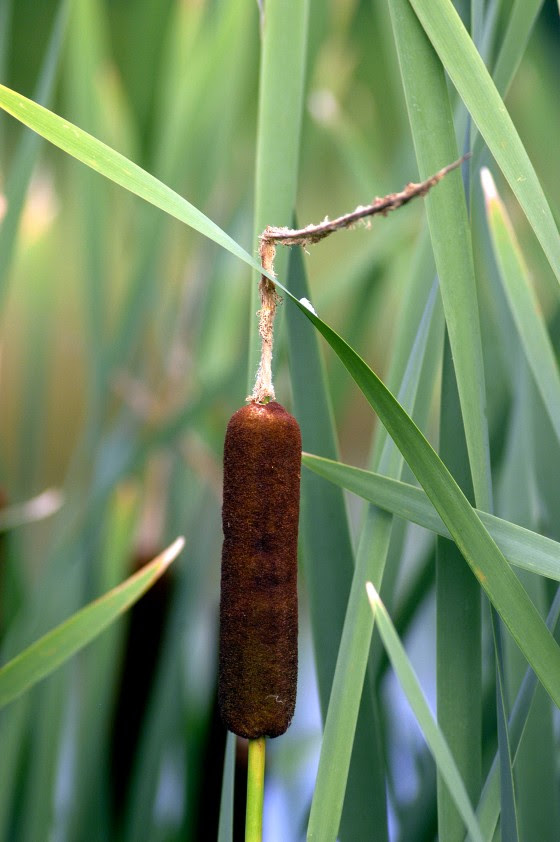
Cattails grow in profusion and provide food for humans and animals. Golden cattail pollen used as flour is a summer treat, while its roots are edible year round. Burned for entertainment or mosquito repellent, the fluff of the brown heads have been to stop bleeding from deep cuts.
An hour past dawn, the source of daylight was still obscured, as if the sun took a holiday and to honor its daily commitment, left its dimmest bulb to light the overcast mid-summer day. The reference points of shadow and light, used to mark the progress of the day, melted in compromise to obscure the passing of time. The temperature change from night to day, that stirs the wind, was on this day, unable to raise a breeze. The stillness and faded light were precursors to either rain or bright sun, as the saying goes, “a morning fog burns ere the noon”. Either way, this quintessential day defines the comfortable retreat into the natural harbor of deep summer.
Summer may be considered the offspring of the coordinated efforts of winter, spring and autumn. All preparation for a time, when new life and old, can strengthen and renew energy spent on elemental survival. Summer temperatures reduce the energy cost of life to maintain its existence. A savings that allows imagination and creativity to be directed to places other than immediate survival and to accumulate warm memories to heat the cold days of winter.
Stacking the wood shed with summer memories leaves no carbon footprint, is considered renewable and burns as an eternal flame.
Images of fresh picked bright red dewberries, packed in open top containers, cooling in the shade on a partially submerged rock, in a shallow flowing stream, elbows its way to mind when thoughts of summer arise. Enough berries to make two batches of jam, used to spread summer throughout the year, to share with family and friends.
The light show performed by fireflies, in the meadow along the river, is a legacy act that reaches back in time to childhood and a world of wonder. The purpose of the display, critical to the lightning bugs, is lost to the magic of tiny incandescent dots of yellow light, floating in the air above the darkened meadow. Magic is the honey tasted by the mind that initiates a journey of exploration. Its direction and depth as unpredictable as the choreography of this mid-summer light show.
Cattails are another image stored in the summer album of memories and trademarks. They grew in profusion along with swarms of mosquitoes which would forage for fresh blood when the sun went down. The summer heat would force neighbors outside to sit on porch steps, their presence betrayed in the darkness by the red glow of their burning cigarettes. The smoke was a deterrent to the mosquitoes, though restricted to smokers and anyone immediately downstream. Through primitive oral history, the legacy of burning sun dried cattails to keep mosquitoes at bay and safely light fireworks was kept alive. Cattails would be cut and brought home, muddy dungarees a dead giveaway that you roamed beyond the territory deemed safe by mom. The price of the harvest was a lecture from mom about being swallowed up by quicksand in the swamps. Cattails were picked while still slightly green as they could be stored over winter without losing their fluff. Courting danger, I would scramble up to the neighbor’s low, flat garage roof then take a running leap onto our peaked garage roof and set the cattails out to dry. After a week on the garage roof aged the cattails were ready to be lit and fend off the nightly aerial attack and defend the blood supply. Waving the burning cattail produced a cloud of smoke and unlike the anemic volume of cigarette smoke, could be directed upwind to wash over the legs or neck. Aside from the favorable aroma and copious smoke, you were sanctioned to play with fire and produce your own light show by waving the glowing brown magic wand, to create the illusion of circles, figure eights and words, which disappeared as if using invisible ink.
The images and memories contained in your summer archives are yours alone, collected at a moment when time stood still, indelibly etched, to be released when the right combination of summer conditions align.
Author Joe Mish has been running wild in New Jersey since childhood when he found ways to escape his mother’s watchful eyes. He continues to trek the swamps, rivers and thickets seeking to share, with the residents and visitors, all of the state’s natural beauty hidden within full view. To read more of his writing and view more of his gorgeous photographs visit Winter Bear Rising, his wordpress blog. Joe’s series “Nature on the Raritan, Hidden in Plain View” runs monthly as part of the LRWP “Voices of the Watershed” series. Writing and photos used with permission from the author. Contact jjmish57@msn.com.
The gentle rain falling on the reflective water, lined with muted shades of gray and green foliage, combine to create a scene so peaceful, you must remember to take a next breath.
The late spring rain continued without interruption into summer, though the shower only lasted two minutes.
Somewhere within those two minutes, the earth’s position in its yearlong orbit around the sun, triggered changes in daylength. The change from spring to summer appears seamless though the end of one season and the beginning of the next is measured to the nanosecond. Life on earth has evolved to respond to the predictable ebb and flow of daylength. Light sensitive receptors direct chemical changes within the body affecting behavior and development as seen most obviously in trees and plants.
The weeks before and after the arrival of summer hold the potential for producing magical moments of timeless beauty and peaceful retreat when nature takes a deep warm, relaxing breath and exhales.
A whisper of mist and gentle rain partner to dim the light, hide the sun, and erase all perception of time. The chill of spring and warmth of summer agree to mediation, making either imperceptible to detect. The wind’s contribution is so minimal, the moisture and misty curtain of fog offer more than enough resistance to silence all sound and movement. The only detectable motion is that of an isolated leaf rising from genuflection, after the weight of accumulated moisture forced it to bow to gravity.
On just such a day, when the world was huddled and dry and nature between breaths, I stowed my carbon fiber paddles, lightweight fishing rod into my Kevlar canoe, shouldered my pack and walked toward the river. The trail through the succession growth, transitioning from tilled crop field to woodlands, is hardly recognizable to a stranger despite years of use. Intentionally so, following a philosophy of, “leave no trace” my path roughly sought the shortest route, ever changing so slightly as shade and sun tolerant plants competed for dominance.
Passing first through a canopy of red oak branches, spawn of the giant that stood tall for a century, the thin bare oak branches performed a scratchy tune on the boat’s hull which magnified the uncomfortable sound to disturb the silence. Once in the open, tufts of amber grass, darkened by the rain to a rusty orange color, took advantage of a once mowed path to dominate as if marking the center of a road. Rose hips, escaped from the garden, and multiflora rose, spread their tentacles across the path, redirecting travel to avoid the curved thorns and torn clothes.
As the field grew, the occasional black walnut would tower above the spreading rose bushes, small red cedars, dried stalks of swamp milkweed and dogbane, to act as a lighthouse beacon marking the faint trail.
Breaking free onto the open flood plain, the river came into view. Isolated sections of its banks retained a few sentinel trees interspersed by a variety of brush and wild celery acted as a tattered tapestry revealing patches of flowing water.
The variety of trees and woody plants shared the same pale green color to suggest all were kindred spirits. In the distance looking down river, the fallow crop field allowed an unobstructed view beyond the bend in the river’s course, a quarter mile away. The green belt was notched at the bend by a tall American sycamore tree whose characteristic white trunk stood in sharp contrast as a neon landmark. Approaching the river at a breach in the eroded riverbank, I waded in and set the canoe on the still water below an island, which was once part of the pasture. The remains of tree stumps underwater, mid river, validated that the land was subject to the meandering river.
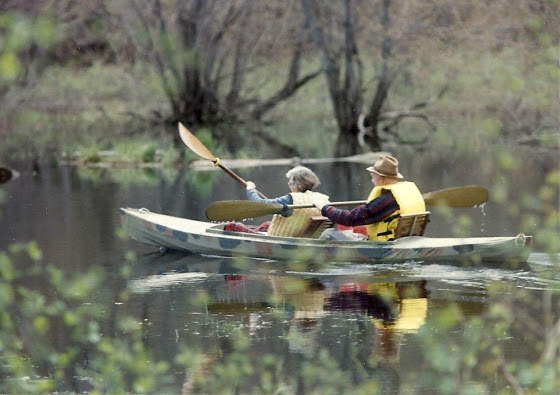
I set my pack behind the center seat and tied it to the slotted gunnel on a length of paracord. One bent shaft paddle was unstowed and leaned across the front thwart. Once aboard, I sat for a long moment to feel the gentle current, energized by gravity, magically carrying me downstream into summer. The sight and sound of the water’s surface, dappled by sparse raindrops surging from the falling mist, was meditative. I leaned forward, paddle across my lap, head pulled deep into my hood, I peered out of an imaginary cave, dry and comfortable, satisfied to move at the pace of the slow current on a journey from spring into summer.
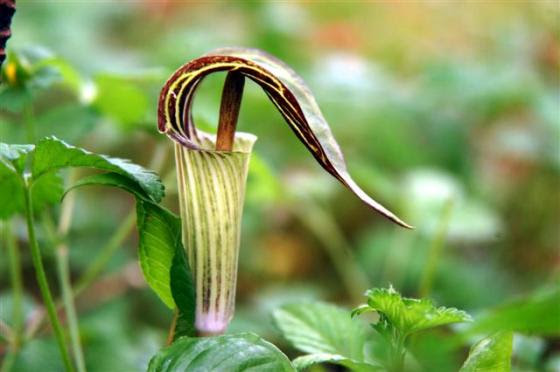
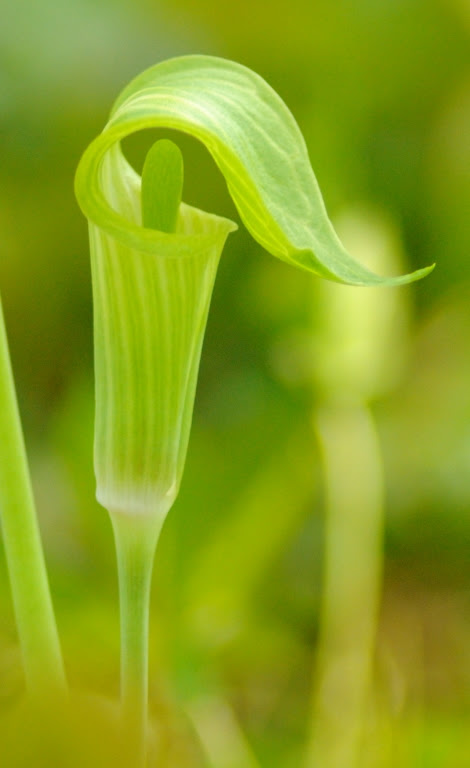
Jack in the pulpit announces the coming of summer and the passing of another spring
Author Joe Mish has been running wild in New Jersey since childhood when he found ways to escape his mother’s watchful eyes. He continues to trek the swamps, rivers and thickets seeking to share, with the residents and visitors, all of the state’s natural beauty hidden within full view. To read more of his writing and view more of his gorgeous photographs visit Winter Bear Rising, his wordpress blog. Joe’s series “Nature on the Raritan, Hidden in Plain View” runs monthly as part of the LRWP “Voices of the Watershed” series. Writing and photos used with permission from the author. Contact jjmish57@msn.com.
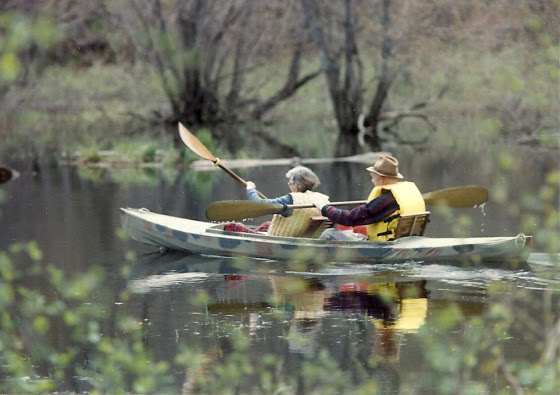
Imagine a colorful fleet of canoes and kayaks gathered at the confluence of the north and south branch in anticipation of the start of a dash down the Raritan River to the sea. Described as a sojourn, dash, race and tour to accommodate all levels of experience, the finish lines for each class can be a different take out along the way. Classes for racers, timed for placement and simply celebration upon reaching any chosen finish line for the touring dashers. Distance or time become the personal feedback for participants who may wish to improve their last year’s performance. In that way the ‘race’ has the elements of developing into a tradition where dad’s and daughters, moms and sons, look forward to next year and maybe in anticipation, focus on improving their health and physical conditioning.
The paddler’s intimacy with the Raritan brings with it a deeper appreciation of the river, which has existed as more of a concept to most people who may only glimpse it at a distance, while passing over a bridge on the way to work. With intimacy comes consideration and concern about all things impacting the river and its watershed.
The possibilities to grow a network of support for the treasure that is the Raritan River, are limited only by imagination. Photographs and art work inspired by the river’s appearance through the seasons could be celebrated by riverside towns, restaurants, schools and galleries to be dispersed far and wide. Like seeds in the wind, the beauty and appreciation of the Raritan may be an inspiration to awaken distant communities to the riverine treasures in their backyard.
One example of a successful effort to market a once polluted river, is the Kenduskeag Stream Canoe Race, held each April, in Maine. At one time salmon and eels returned from the sea via the Penobscot River to the Kenduskeag stream. By the time Thoreau walked he shores of the Kenduskeag in the mid 19th century, tanneries and flour mills blocked and poisoned the stream and continued well into the 1960s. A group of local canoeists came up with the idea for a canoe race to showcase the Kenduskeag and bring attention to its health. Eventually the race expanded to be televised and enjoyed by hundreds of viewers and attendees. The salmon run is making a comeback and even Sports Illustrated found room on its cover to celebrate the longest early season canoe race in New England. I participated in this race for eighteen years and carried the seeds of inspiration back to the Raritan. It is no small coincidence that Henry David Thoreau left indelible footprints along the Raritan River and the Kenduskeag for future generations to follow.
The crowd of streamside supporters bundled dry and warm, cheer on canoeists who await the countdown for the start of the Kenduskeag Stream Race. The countdown to the start of the race, 5. 4. 3. 2. 1.gets the adrenaline flowing. This is a scenario that may someday be played out at the confluence of the Raritan River.
Author Joe Mish has been running wild in New Jersey since childhood when he found ways to escape his mother’s watchful eyes. He continues to trek the swamps, rivers and thickets seeking to share, with the residents and visitors, all of the state’s natural beauty hidden within full view. To read more of his writing and view more of his gorgeous photographs visit Winter Bear Rising, his wordpress blog. Joe’s series “Nature on the Raritan, Hidden in Plain View” runs monthly as part of the LRWP “Voices of the Watershed” series. Writing and photos used with permission from the author. Contact jjmish57@msn.com.
During one, six thousand year moment, in the eons of glacial expansion and retreat, the Queen of Rivers was born. So described by an early nineteenth century writer, inspired by the bucolic Raritan River. The beauty of the river’s pastural floodplain dotted with colorful native flowers and grasses, stood in contrast to the intermittent high, red shale cliffs. Spring floods scrubbed the red shale soil from its banks to turn the raging river into a semi solid crimson torrent. The contrast in color is dramatic where gravel lined upland streams tumble into the main river current.
From sweet water freshet to the brackish tide water of its bay, the Raritan’s unimpeded flow expressed its seasonal moods in uninhibited water-colored brush strokes across the landscape, as if it were a living canvas.
So, the Raritan River proper, as it is defined today, deserves the recognition of a natural wonder, a reference point in geological history, worthy of attention in a state marked by an ever changing manmade landscape.
The Raritan’s headwaters arise from two major sources in the north, the South Branch from Budd Lake, and the North Branch from a swamp in Chester. The confluence of these two rivers join (in Branchburg) to form the Raritan River.
Facing upstream at the confluence, the river on the left enters from the south and is so named the South Branch, despite its origin in the north. The river on the right comes in from the north and is aptly named the North Branch.
If ever a natural wonder needed to be celebrated it would be the Raritan River. Toward that end I always imagined a rough stone marker of an age befitting the river queen’s origin be placed at the confluence, “the meeting place of waters”, Tuck-ramma-hacking”. Informal and primitive to match the uninhibited behavior of this ancient watercourse, a perfect partner to mark the celebrated river’s place of birth: a monument that will be submerged during spring floods and bear the scars of ice flows.
I imagine a bronze plaque bearing the name of the river and its birthdate set among petroglyphs of animal tracks and wild flowers carved into the stone by local artists to represent the community the river serves.
The spot for eventual placement of a “birthplace of the Raritan” marker
Bringing a dream to reality often turns to fantasy. At least now an attempt is being made to explore the possibility of placing such a stone at the apex of the North and South Branch Rivers. Through a network of well-placed friends, we have approached the state with this request to determine feasibility. A labyrinth of permits and permissions remains to be navigated if given conditional approval. At the very least, the ship has left the dock and we will soon learn if it is seaworthy.
A stone, not yet chosen, has been promised and placement will be included. The river deserves to have a name and birthstone. Erroneously, the North Branch has official signage that declares it to be the Raritan River. If nothing else, it would be a worthy accomplishment to establish the correct identity.
“Like a pine tree linin’ the windin’ road, I’ve got a name, I’ve got a name…..” go the lyrics to a song. What is in a name is respect. It is our nature to treat anonymity differently than familiarity. Walk through a field, not knowing one plant from another, go from point A to point B and we naturally take a straight-line course. Eyes planted on the far side, anything in the way gets stepped upon. Guarantee that if a plant is identified to the trekker, whether it be fleabane or little bluestem, the path will be adjusted to avoid stepping on the now identified plant. So it is with names that emerge from anonymity, they project some kindred link that brings conscious thought to bear. A good reason to identify the Queen of Rivers and engender some new found respect for a natural wonder that will be here after we and our kin are long gone.
Author Joe Mish has been running wild in New Jersey since childhood when he found ways to escape his mother’s watchful eyes. He continues to trek the swamps, rivers and thickets seeking to share, with the residents and visitors, all of the state’s natural beauty hidden within full view. To read more of his writing and view more of his gorgeous photographs visit Winter Bear Rising, his wordpress blog. Joe’s series “Nature on the Raritan, Hidden in Plain View” runs monthly as part of the LRWP “Voices of the Watershed” series. Writing and photos used with permission from the author. Contact jjmish57@msn.com.
This maroon shale cliff forming the river’s bend, serves as a memory retrieval bank for times gone by. I was canoeing with my late friend Jimmy, who caught and released a feisty smallmouth bass just upstream of that shale prominence. Memory storage may be why the shore of a river is referred to as a ‘bank’.
Over the course of time everything we experience is stored as a memory. Having limited capacity for recall, it is the most impactful memories that linger. By no means are memories ever lost, they are stored in pristine condition in unconscious archives. The key to recovery can be a scent, sight or a sound. Prompted by clues hidden in unrelated conversations, a single phrase or word can bring an experience back into sharp focus. Old, faded photographs of no particular beauty or composition can instantly bring the past into laser focus as the prompts to our memories are as individual as fingerprints.
So it is that each time I paddle the river, it becomes a physical journey through the accumulated memories collected over hundreds of miles, paddled on the same stretch of river. Each trip is like opening the old family album to add new photographs and seeing the older images as the pages are turned. It is as if a gravitational pull compels you to linger a bit longer in the realm of old memories.
There is hardly a location on the river that does not hold a memory for me. Digital images and photographs, abound, however, it is being present on the river that provides access to memories not captured by the camera or pushed aside by the endless flow of freshly minted memories.
Every time I pass the drainage above the mouth of Pleasant Run, my mind immediately plays the video of the snowy winter day I pulled out of the current into the safe harbor of a drainage stream to warm my hands under my arms. The heavy snow quickly covered me and my boat as I leaned forward, folded arms resting on my thighs. I felt safe and comfortable as the canoe was stabilized in the heavy slush and well within the six-foot-wide drainage stream away from the main current. The snow was almost a foot deep along the high bank and to my surprise a dark brown mink was porpoising through the deep snow toward the drainage and my canoe. The mink came within arm’s reach before it realized the convenient bridge and large lump of snow was an existential threat.
One summer day I had my young daughter in the bow of my canoe, as we approached the tower line near home, a large fish jumped clear of the water, hit the gallon jug of juice she was holding, bounced off the opposite gunnel and fell back into the river. Her expression was priceless, as was mine, to witness a scene that could only happen in a cartoon. Can’t pass under that tower line without reliving that moment! Though many years have passed, the clarity and even the emotion of that comedy is still retained in the tower line archives.
On an initiation canoe trip with my four-year-old grandson, I paddled close to a high shale cliff, as in my experience cliffs were a major attraction to young boys. Sure enough, Caleb was impressed and asked how to get to the top. Before I could answer I noticed a large animal on the narrow shelf at water’s edge below the cliff. We closed in on a supersized beaver munching some delicate vines growing on the cliff face. The beaver slowly moved into deeper water but not before swimming on the surface a few yards in front of the canoe. You will not be able to see it, but when I pass that cliff, it reveals a crystal-clear video of that priceless moment. Of course, the next day Caleb never mentioned the beaver to mom but was totally impressed by Grampy carrying the canoe over his head.
One early spring day after ice-out, the river was running high, and the only ice that remained was found in deep cuts into the bank where trees were washed away. As I rounded a sharp bend in the river, I kept about three feet off the left bank to avoid the main current. Immediately on my left was a large ice-covered cove about twelve feet into the high vertical bank. I could not believe what I saw! Standing in sharp contrast to the empty expanse of graying ice, was an otter! As it ran toward me, I realized its only escape route was into the water next to my canoe. At less than two feet away I watched the otter dive into the fast-moving muddy water in the narrow space between my boat and the ice shelf. I thought I was hallucinating, perhaps hypothermic. I never saw an otter on the river before or since. Consider, this bend in the river projects the memory of my close encounter with an otter, exclusively for me. It is my personal archive, available to no one else.
Memories are where you first met them, they are safe from prying eyes and remain where you last left them. The storage capacity is infinite and the keys to unlock them are everywhere.
Author Joe Mish has been running wild in New Jersey since childhood when he found ways to escape his mother’s watchful eyes. He continues to trek the swamps, rivers and thickets seeking to share, with the residents and visitors, all of the state’s natural beauty hidden within full view. To read more of his writing and view more of his gorgeous photographs visit Winter Bear Rising, his wordpress blog. Joe’s series “Nature on the Raritan, Hidden in Plain View” runs monthly as part of the LRWP “Voices of the Watershed” series. Writing and photos used with permission from the author. Contact jjmish57@msn.com.
A small patch of red monarda grew wild in one corner of the fenced in garden, survivors of at least one deer who decided their minty flavor to be a perfect palate cleanser. Much to the dismay of the late season hummingbirds, their over browsed food source left fewer opportunities for nourishment at a critical time, just prior to migration south.
The ownership of this last loaf of bread on the shelf, further intensified the territorial disputes that typically take place among hummers.
A young of the year male was feeding on the monarda, his dining strategy was to circle to the right, probing each scarlet tubule, then pulling back to hover for a moment, before repeating the flight pattern around the next floral head. Suddenly a second immature male appeared and the two began aerial acrobatics almost too fast to follow. Each bird disputed the property claim of the other. After close face to face sparring, they took off out of sight, separated by no more than a few inches.
It was impossible to differentiate one darting hummer from another, though the aggressor appeared to be the same bird, how many different challengers was in question.
Five minutes later another hummer appeared and began to feed with uncharacteristic speed, as if knowingly violating another’s territory, stealing as much as it could before the expected challenge from the self-proclaimed owner.
As expected, the challenge ensued. This time the interloper was inside the garden fence while the claim owner hovered outside the fence. So intense was their dispute, each floated in place commencing an aerial duel, with their needle like beaks, separated by the fence. It was a high noon showdown with unloaded weapons, as neither could be intimidated nor vanquished. The spectacle continued for a full minute until the aggressor realized the futility of his efforts and flew over the wire barrier to engage the trespasser. The two fencers immediately dropped their foils in favor of high aerial maneuvers to settle this territorial dispute.
While most hummingbird disputes consist of posturing, and aggressive aerial pursuits end harmlessly, another unexpected threat targeting hummers lurks among the flowers. The brown Asian preying mantis, an introduced species, will on occasion attempt to take and kill an unsuspecting hummer. Having read about the relationship of mantis and hummer, it seemed a rare occurrence of low probability until one early September afternoon.
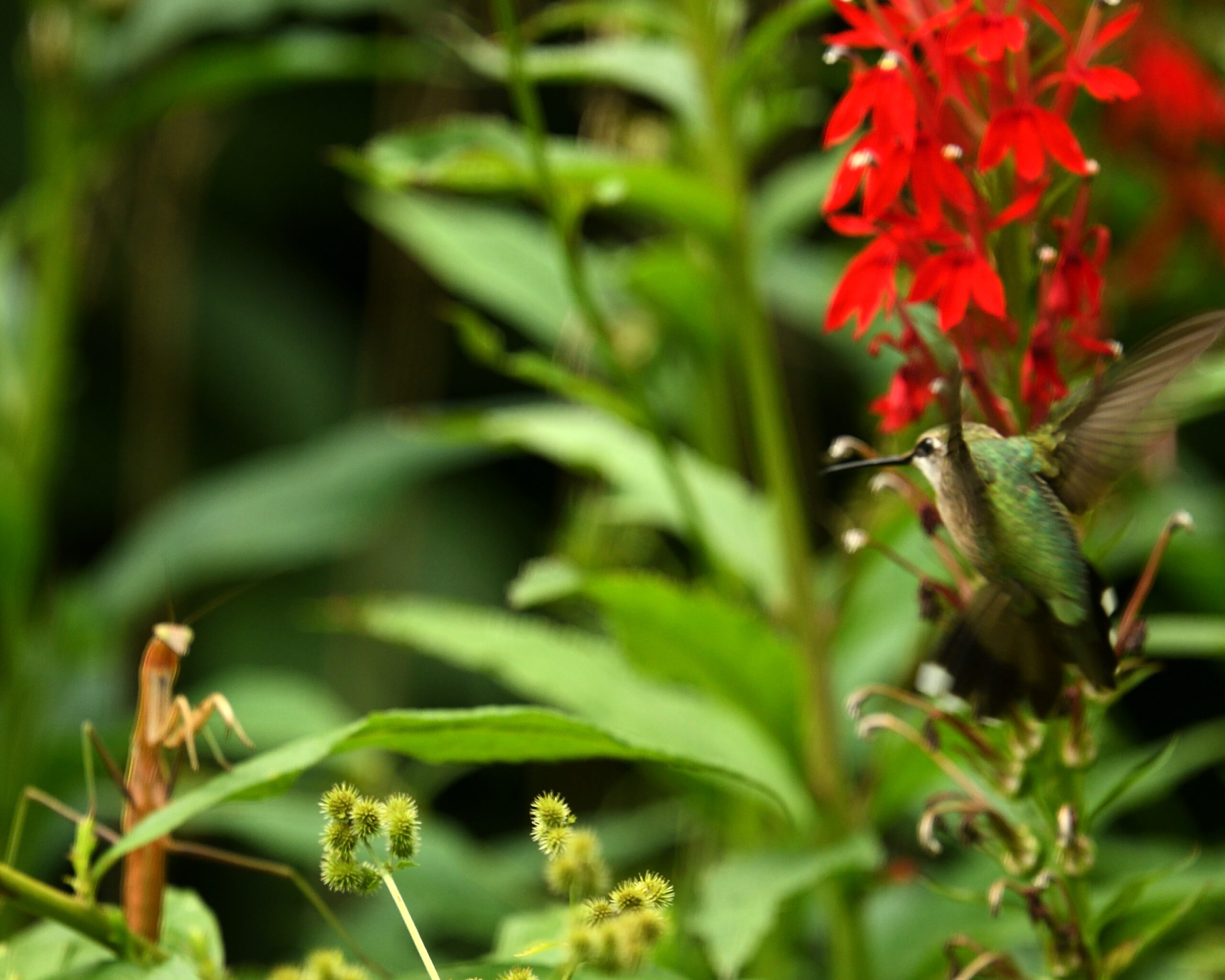
A female hummer was feeding on the blooms of native red cardinal flower. Being aware of how individual hummers have their own feeding strategy, circling always to the right or left, pulling back for a moment before going on to the next flower or just moving on to the next bloom without a slightest hesitation, I noticed something odd about this hummer. She seemed to take sideways glances diverting attention from the business at hand. Sure enough, there was the focus of her attention. A light brown Asian preying mantis whose body length exceeded that of the hummer. Likewise the mantis appeared aware of the hummer and waited to strike. As the hummer worked the flower, she always maintained awareness of the mantis and at one point faced it directly. All ended well for the hummer, though it is easy to imagine a new fledged hummer falling victim to this insect predator.
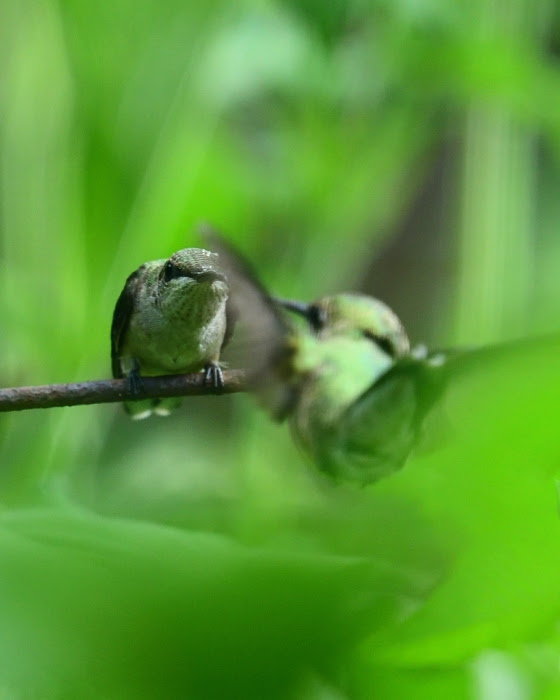
Two hummers in this image, one perched, the other making an intimidating fly by.
As delicate and diminutive as hummingbirds appear, they are tough, aggressive creatures whose late summer-early fall southward migration defies the imagination. Hummers are as close to magic and myth as anything in nature. The ability to hover and maneuver with almost invisible wings and float in the air probing brilliantly colored flowers, while robed in iridescent feathers that seem more metallic than organic and change color with movement, surely earns mythical status. As is within a hummer’s personality, it will often initiate a face face introduction as it stays suspended in mid air inches from your nose, looking directly in your eyes. It is a wild thought that the hummer has captured the image of your face as readily as you hold his image in memory, to be recalled and reviewed, perhaps in a future pleasant dream, whose memory fades upon waking, leaving only the hint of a smile on your lips.
Author Joe Mish has been running wild in New Jersey since childhood when he found ways to escape his mother’s watchful eyes. He continues to trek the swamps, rivers and thickets seeking to share, with the residents and visitors, all of the state’s natural beauty hidden within full view. To read more of his writing and view more of his gorgeous photographs visit Winter Bear Rising, his wordpress blog. Joe’s series “Nature on the Raritan, Hidden in Plain View” runs monthly as part of the LRWP “Voices of the Watershed” series. Writing and photos used with permission from the author. Contact jjmish57@msn.com.
The gentle summer rain falling on the reflective water, lined with muted shades of gray and green foliage, combine to create a scene so peaceful, you must remember to take a next breath.
The gentle summer rain falling on the reflective water, lined with muted shades of gray and green foliage, combine to create a scene so peaceful, you must remember to take a next breath.
The mid-summer sunlight dimmed, as amorphous white clouds, heavy with moisture, washed over the blue sky. Deep shadows settled in among the layers of leaves that blended the crowns of oaks and maples into a coarse, solid green curtain. The leaves of the Norway maples on the outer edge of the woodlot appeared pale matte green in the dim light and hung motionless at a sixty-five-degree angle as the atmosphere held its breath in anticipation of the impending rain.
As the rain began, the earliest errant drops chose random dance partners among the leafy branches. Though not a breeze was evident, individual leaves began to dance while others remained perfectly still. Partners were exchanged and switched until the full burst of rain fell from the clouds to engage all the leaves to move to the rhythm of the falling rain.
A gentle summer rain is a perfect complement to a warm summer day. Clear blue skies and unfiltered sunshine heat the earth and plants to further warm the air from below. Pollen and dust, at the mercy of the breeze, settle everywhere.
The heat rising from the earth mixes with the already warmed atmosphere to create a layer of suffocating air. The promise of relief comes, when in late afternoon, billowy white clouds appear on the horizon in dramatic contrast against the unobstructed azure blue sky. The transient clouds, directed by upper atmosphere winds, obscure the sun as they drift across the sky, trailing rain in their wake. Immediately the stifling temperature falls as cool raindrops hit the dry earth. Each drop a micro explosion, as dust and pollen are washed away and reconstituted into the soil. In the aftermath, on the field where the clash of violent heat transfer and exploding dust particles flew, a veil of white mist hangs low over the battleground as the sunshine returns.
While the rainfall was sudden, it was expected. In fact, the coming rain was preceded by a distinct odor.
Researchers claim the familiar scent that sometimes fills the air prior to a coming rain is ozone being pulled to earth from high in the atmosphere and most often occurs after a dry spell.
In the temporary shelter under a full leafed tree, another odor, distinct from the ozone, fills your nostrils. It is best described as organic and to me, smells like what I think rich moist soil smells like. Even without rain, upon entering mature woods there is that same odor, enhanced by the heavy foliage which contains the moisture in the air as it mixes with the natural composting of decaying plant matter. The odor, initially after a rain begins to fall, is from the composting bacteria in the soil mixed with ozone, the combination named petrichor.
Sun showers are a summer event where magic seems to partner with nature to produce a contradictory reality. The sun shines while the rain falls, no clouds obscure the sun. A meteorological phenomenon that is best left unexplained to be thoroughly enjoyed. Consider it a momentary truce among the elements who constantly clash for dominance in the atmospheric heavens.
Whether a sun shower, cloud burst or late afternoon thunderstorm, refreshing, best describes a summer rain, it is an invitation to step out and feel the cool gentle rain on your face, and try to catch a few drops on your tongue. It is life, composed mostly of water, who recognizes itself in the heaven sent drops of rain, especially during a warm and gentle summer rain.
Author Joe Mish has been running wild in New Jersey since childhood when he found ways to escape his mother’s watchful eyes. He continues to trek the swamps, rivers and thickets seeking to share, with the residents and visitors, all of the state’s natural beauty hidden within full view. To read more of his writing and view more of his gorgeous photographs visit Winter Bear Rising, his wordpress blog. Joe’s series “Nature on the Raritan, Hidden in Plain View” runs monthly as part of the LRWP “Voices of the Watershed” series. Writing and photos used with permission from the author. Contact jjmish57@msn.com. See more articles and photos at winterbearrising.wordpress.com.
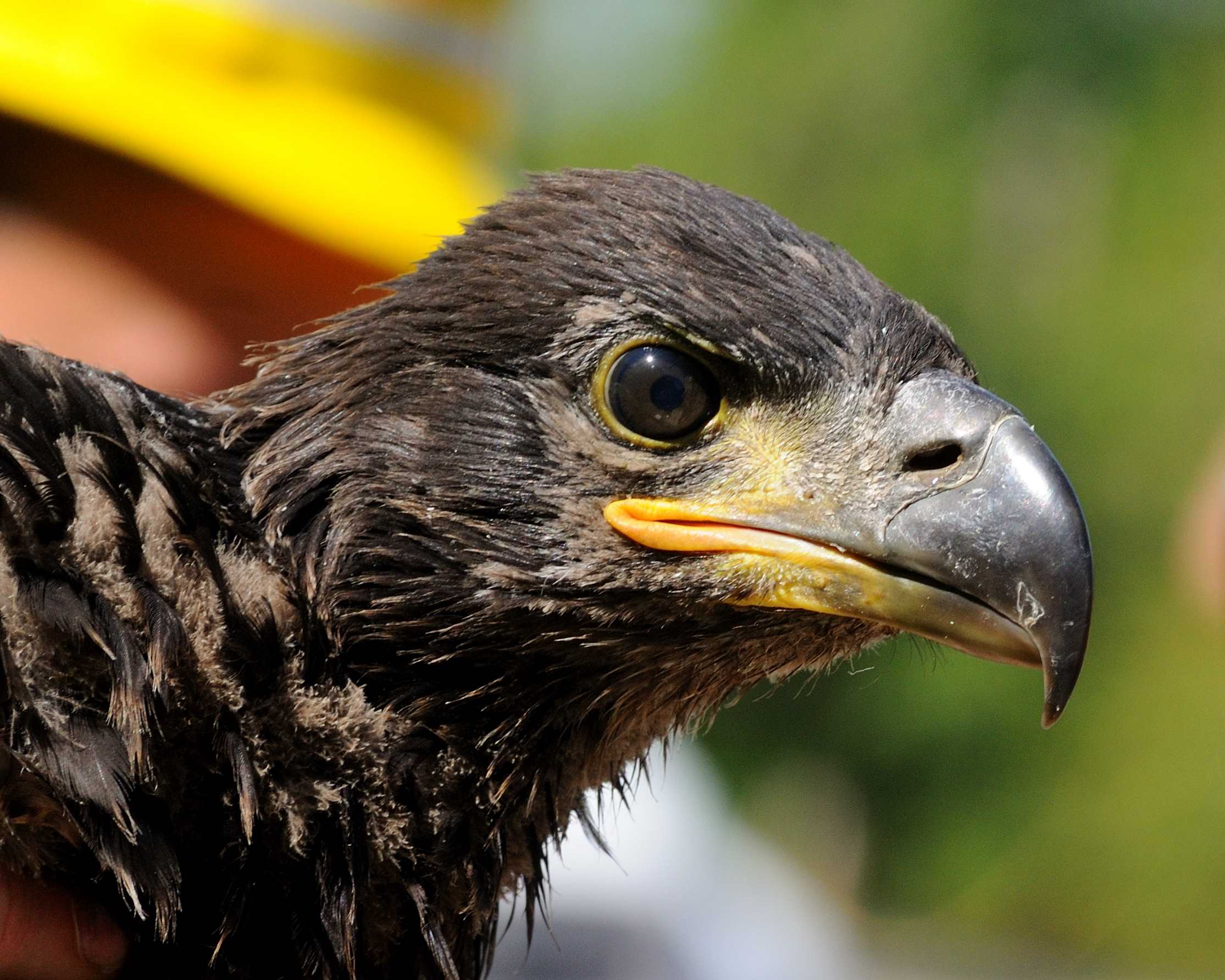
Eagle chick is alert as it is prepped for a physical exam by Dr. Erica Miller, DVM.
Not that the eagles ever left, however, their nest of six years was removed, which gave rise to wild speculation as to their fate.
High tension towers were being replaced, one of which held their nest. Though in past years, the nest had been removed accidently, remodeled and relocated from the left to the right to the center by the eagles themselves, the middle of the tower arm seemed to be the final site.
Much to the eagle’s surprise, the home tower dating back to the 1920s was removed and a new style tower constructed in its place. Though ‘science’ says eagles bond and nest in January, our eagles were never polled and began to bond and touch up the nest in October. Just as the power company took down the tower.
The eagles appeared upset, one screeching at the other as they were perched nearby. Hearts were breaking in sympathy. Before the old tower was deconstructed, the giant nest was cradled, lowered by crane and stored on site. The plan was to return the nest on a new style platform as encouragement for the eagles to return. That was the plan but would the eagles agree?
We watched that pair daily and never once did an eagle land on that tower. It didn’t look good.
Then a new nest was started a mile downstream and hopes soared for our faithful pair. During one twenty minute period, the suspected male brought six large branches to the nest where both eagles discussed their placement.
The nest grew larger and finally looked like it was move-in ready. Still, no eagle would land on the nest platform in the new tower. It was in a way, comforting, to see eagles nesting in a giant sycamore tree rather than in non organic, cold metal tower draped with high tension wires.
During nest construction many images were taken and shared. On one occasion, a pair of adult eagles was observed downstream of the nest and another pair at the nest in the sycamore. Were there two pair of eagles or did the eagles seen downstream make it to the nest before the observer could?
Sure enough photo evidence and direct simultaneous observation revealed there were two pairs of eagles seen at different times on the new nest. Now what?
Then one day an eagle was seen perched on the rail at the nest on the tower! Would eagles occupy both nests, would there be a territorial dispute?
One eagle on the tower nest was hopeful, but why would they go through the trouble and wasted energy to construct a beautiful downstream nest?
It was a confusing time, as we all concluded the sycamore nest was the nest of record. Then both eagles were seen on the tower, the suspected male bringing material to the rebuild the nest. January twenty-third was the last date eagles were recorded on the downstream nest while activity picked up at the tower.
Now the question was, who were the eagles at the tower, the interlopers or the faithful pair? Try as we might from images and observed past individual behavior, we could not definitively conclude their identity.
The original pair had an easily seen size difference, the conclusion was the larger bird was the female. This is a generalization which may not be true in every case. This pair was closer in size to each other. The original larger bird had a unique expressive head movement not seen by the bird identified as the female.
Was the male from the original pair with a new female? We concluded there was no sure way to tell.
Now a fully prepared downstream nest awaited tenants, hopefully, the other eagle pair. No such luck as the nest was now declared abandoned. At one point a local red tail hawk and then an immature eagle briefly visited the nest.
The other eagle pair left the area though several un-banded immature eagles were commonly observed.
Now all attention was on the pair of eagles nesting at the tower. When the nest was relocated in the new tower, an eagle cam was installed but failed to function. The plan was to remedy the camera during the banding session.
When the eagles were observed mating, the countdown to egg laying began. Hatching followed on schedule and the day to conduct the banding of the chicks was set.
May fourteenth, a crew from PSE&G, the state zoologist heading the project, and the state veterinarian, along with eagle project volunteers, participated in the banding of two eagles determined to be males. Each bird given a thorough physical exam, blood samples drawn, beak, talons and primary feather measured, weights taken. Green aluminum bands, H-04 and H-05 were placed around the legs. The concerned parents circled the tower while the banding was in progress.
The two eagles were determined to be males and banded with green anodized aluminum leg bands inscribed, H-04 and H-05. H-04 had the green band placed on the left leg, H-05 on the right leg. The intent is to make identification at a distance easier.
Both eagles passed the exam with flying colors and were rewarded with two whole fish placed in the nest compliment of the NJ Endangered and Non Game Species Program, headed by Kathy Clark.
When the eagles were returned to the nest, a consolation prize of two large fish was left as a compensation for their trouble. After everyone left, the parents returned to the nest and as in past years, continued to care for their young. This year, the world will stand witness to the rearing and eventual fledging of two young eagles whose shadows will glide over the earth to the amazement and wonder of our children and grandchildren.
Thanks to PSE&G we now have a live webcam, an incredible gift to the world of nature and environmental education. The eagle webcam may be accessed at:
This will spark curiosity to ignite the desire to seek deeper knowledge, not just about eagles but the entire interrelated community of nature, of which we are a part; a benefit to all.
Author Joe Mish has been running wild in New Jersey since childhood when he found ways to escape his mother’s watchful eyes. He continues to trek the swamps, rivers and thickets seeking to share, with the residents and visitors, all of the state’s natural beauty hidden within full view. To read more of his writing and view more of his gorgeous photographs visit Winter Bear Rising, his wordpress blog. Joe’s series “Nature on the Raritan, Hidden in Plain View” runs monthly as part of the LRWP “Voices of the Watershed” series. Writing and photos used with permission from the author. Contact jjmish57@msn.com. See more articles and photos at winterbearrising.wordpress.com.
Surrounded by colorful tree buds, a newborn great horned owl left its nest to begin ‘branching’. The owl will walk, hop, flap its wings and glide short distances in preparation for its first flight, only a few weeks away.
The gentle month of May steps out of character to finally terminate winter’s lease on the land. May does what March and April were unable to do and does it with authority and grace.
Winter has been served an ironclad, last frost warning, and nature celebrates. Delicate plant life now bursts from its dormancy to join their hardier kin who dared unpredictable early spring conditions.
Floral scent now fills the morning air to conjure pleasant memories of warm weather suppressed by winter doldrums.
Walking through the meadow grass, canoe balanced on my shoulders, the scent of multiflora rose fills the air. My path meanders around these thorny bushes and prickly eastern redcedar as if I were bouncing around in a pinball machine.
As I walked into the wind, aromatic meadow grass replaced the floral scent of the scattered bouquets of wild rose. A three-strand barbed wire fence, intended to keep generations of dairy cows honest, now delineated the lush meadow, but could not contain the whimsical direction of the perfumed air. I slid the boat under the sagging bottom wire, laid face down on the grass and inched to the other side.
The river was flowing gently, sun sparkling off its rippled surface which lay just beneath a parallel current of air which carried, intermittent quantums of the unmistakable perfume of black locust blossoms.
Though my olfactory senses were immersed in the current of scent, I had to walk further into the river to set my boat in water deep enough to float, with me aboard. I had to walk-in ankle-deep water to the main channel and each step sent a cloud of muddy water downstream, while upstream, the water ran clear. A pickerel frog escaped my intrusion by lying motionless on the bottom of the shallow water. His spots blending in so well among the small stones. Fresh water clams showed telltale depressions in the mud that revealed their presence. I stopped for a moment to pull up a clam, check to see if it was alive and set it back down to watch it bury itself out of sight.
I had been dragging my boat by a short bow line through the shallows. As I near the main flow and deeper water the current swung the stern downstream. I pulled the boat back up to the center seat to set my paddle in against the forward thwart and snapped my spare into clips mounted on the seats’ pedestal. Then secured my pack behind the center seat with a figure eight knot and two half hitches. Swinging the boat around with the bow now facing downstream, I gingerly got in, sat down, picked up the paddle and just drifted for a long minute before I made a correction. I began to slowly paddle downstream, careful to take in a 360 view. The clear water, blue, cloudless sky, both lush overgrown river banks and the water ahead all held my interest.
May is the time of year to see young creatures of all species and thier parents gathering food to feed hungry pups or kits freshly weaned.
The first week in May I saw and photographed a mink transferring her kits to a new den. That was certainly unexpected. Fox will also move pups from one den to another. One den with six pups, situated in the pasture, was abandoned after two weeks. The pups were moved further uphill and closer to human habitation. As the meadow was really a flood plain, the vixen made a smart move, perhaps for the wrong reason, but her pups did survive the next week’s flood.
A high vertical bank, perhaps constructed by a muskrat and remodeled by a groundhog, now served as harbor for a daydreaming raccoon. A masked face momentarily peered out as a face might be seen glancing out behind the sheer drapery of a window in a high-rise city building. Yellow, white and purple flowers screened the den’s doorway.
Further downstream a flightless great horned owl perched in a tangle of a fallen tree beneath a red shale cliff. It was now old enough to ‘branch’. The stage where the owl leaves the nest and begins to walk, climb and flap its wings, strengthening them for a first attempt at flight.
The sights sounds and smells that appear in late spring under the banner of May, whether from the perspective of the rivers or backyard gardens, are the first floral wrapped gift box, filled to the brim with new life, to be opened after winter’s reign has ended.
Author Joe Mish has been running wild in New Jersey since childhood when he found ways to escape his mother’s watchful eyes. He continues to trek the swamps, rivers and thickets seeking to share, with the residents and visitors, all of the state’s natural beauty hidden within full view. To read more of his writing and view more of his gorgeous photographs visit Winter Bear Rising, his wordpress blog. Joe’s series “Nature on the Raritan, Hidden in Plain View” runs monthly as part of the LRWP “Voices of the Watershed” series. Writing and photos used with permission from the author. Contact jjmish57@msn.com. See more articles and photos at winterbearrising.wordpress.com.