By LRWP Monitoring Outreach Coordinator Jocelyn Palomino
Every Thursday from May to October, the Lower Raritan Watershed Partnership and Rutgers Cooperative Extension of Middlesex County run a volunteer-based monitoring program along the Raritan river. During the summer, we collect water quality samples at six non-bathing public access beach sites, provide our samples to the Interstate Environmental Commission for analysis in their laboratory and report the results to the public on Friday afternoons. Our mission is to share this data with the community and partners to ensure the safe use of the Raritan river for all.
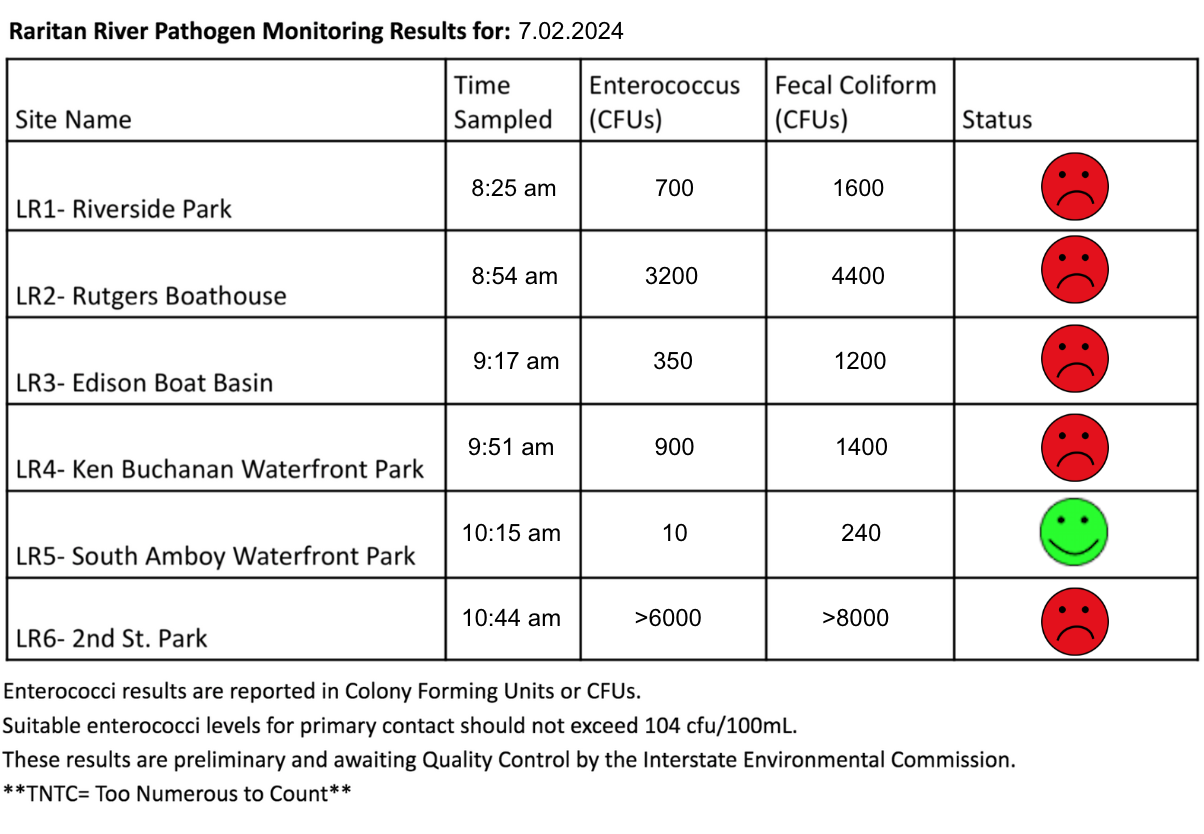
Our lab results for water quality samples taken on Thursday August 15, 2024 show Enterococcus bacteria levels exceeding the EPA federal water quality standard of 104 cfu/100mL at TWO of our monitoring sites. Problem sites are indicated by red frowns on the map and chart which includes: Riverside Park (Piscataway) and 2nd Street Park (Perth Amboy). Green smiles on the chart and map indicate the sites with bacteria levels safe for recreation, which include: Rutgers Boathouse (New Brunswick), Edison Boat Basin and Ken Buchanan Waterfront Park (Edison), and South Amboy Waterfront Park (South Amboy).
Pathogens/Enterococci levels are used as indicators of the possible presence of disease-causing bacteriain recreational waters. Such pathogens may pose health risks to people coming in primary contact with the water (touching) through recreational activities like fishing, kayaking or swimming in a water body. Possible sources of bacteria include stormwater runoff, Combined Sewer Overflows (CSOs), improperly functioning wastewater treatment plants, leaking septic systems, animal carcasses, and runoff from manure storage areas.
Our goal in reporting these results is to give residents a better understanding of the potential health risks related to primary contact during water-based recreation. If you plan on recreating on the Raritan, be sure to take all safety precautions by washing up after any activities!
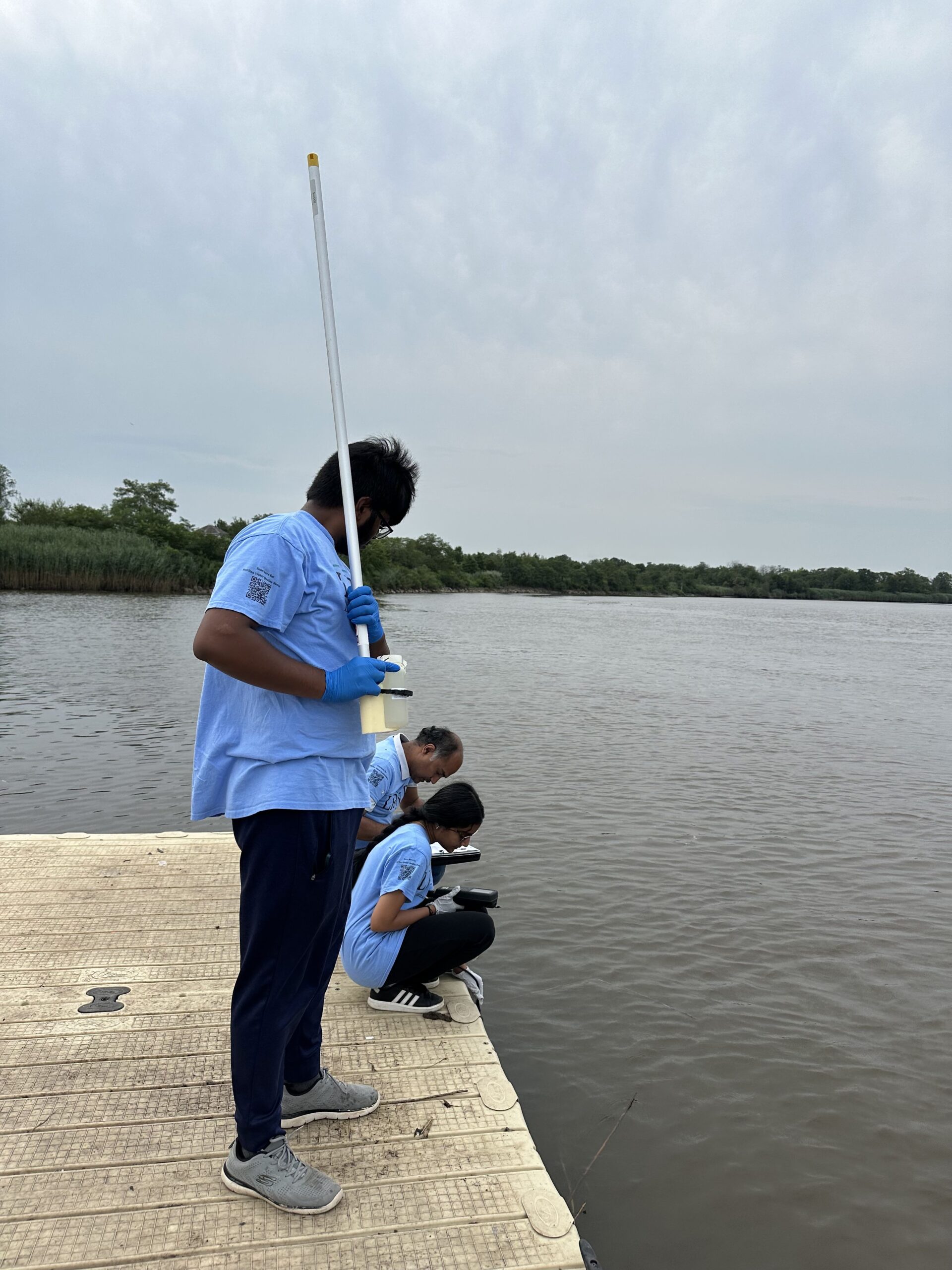
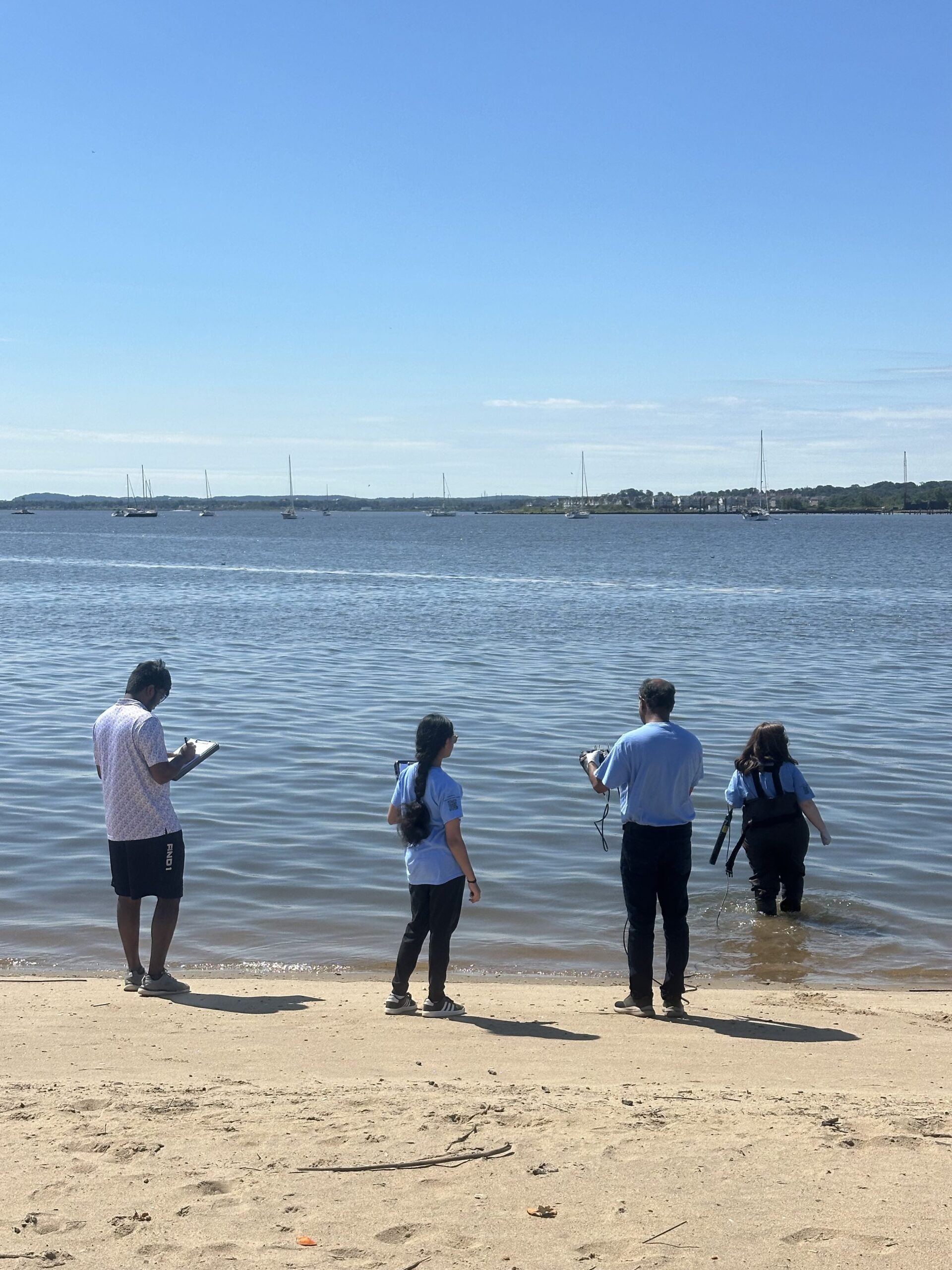
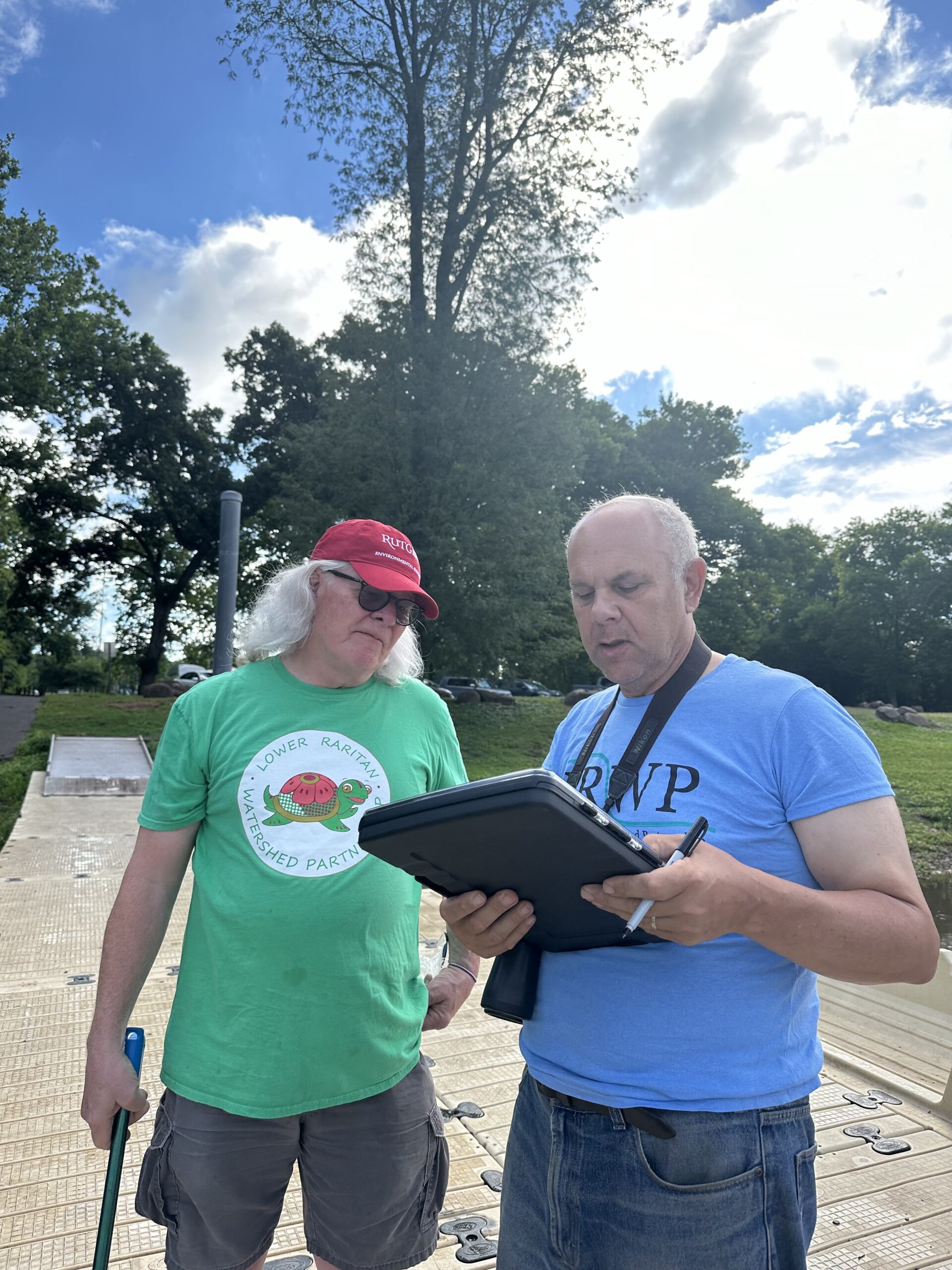
Our Thursday mornings begin with volunteers helping Program Coordinator Jocelyn Palomino with the pre-calibration of our equipment, while the rest of the team gears up for sampling. Photo Credit: Frank Dahl
Leave it to Rose to capture close-up shots like this that allow us to see nature in all its beauty! Photo Credit: Rose Lawless
Frank Dahl was in charge of managing the YSI this week, Shely Dash got to borrow his binoculars to catch a good look at some herons at the Edison Boat Basin. Photo Credit: Rose Lawless
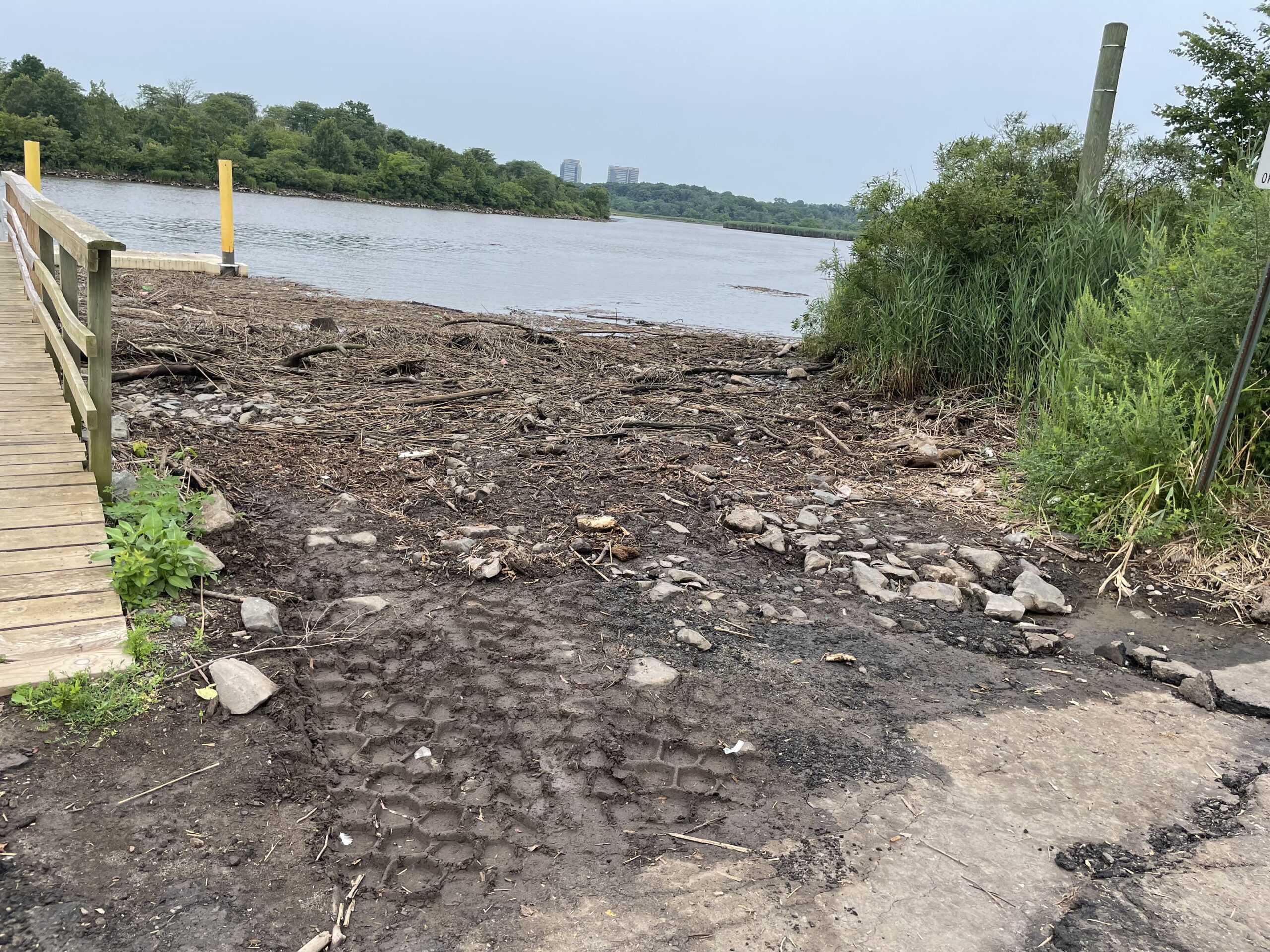
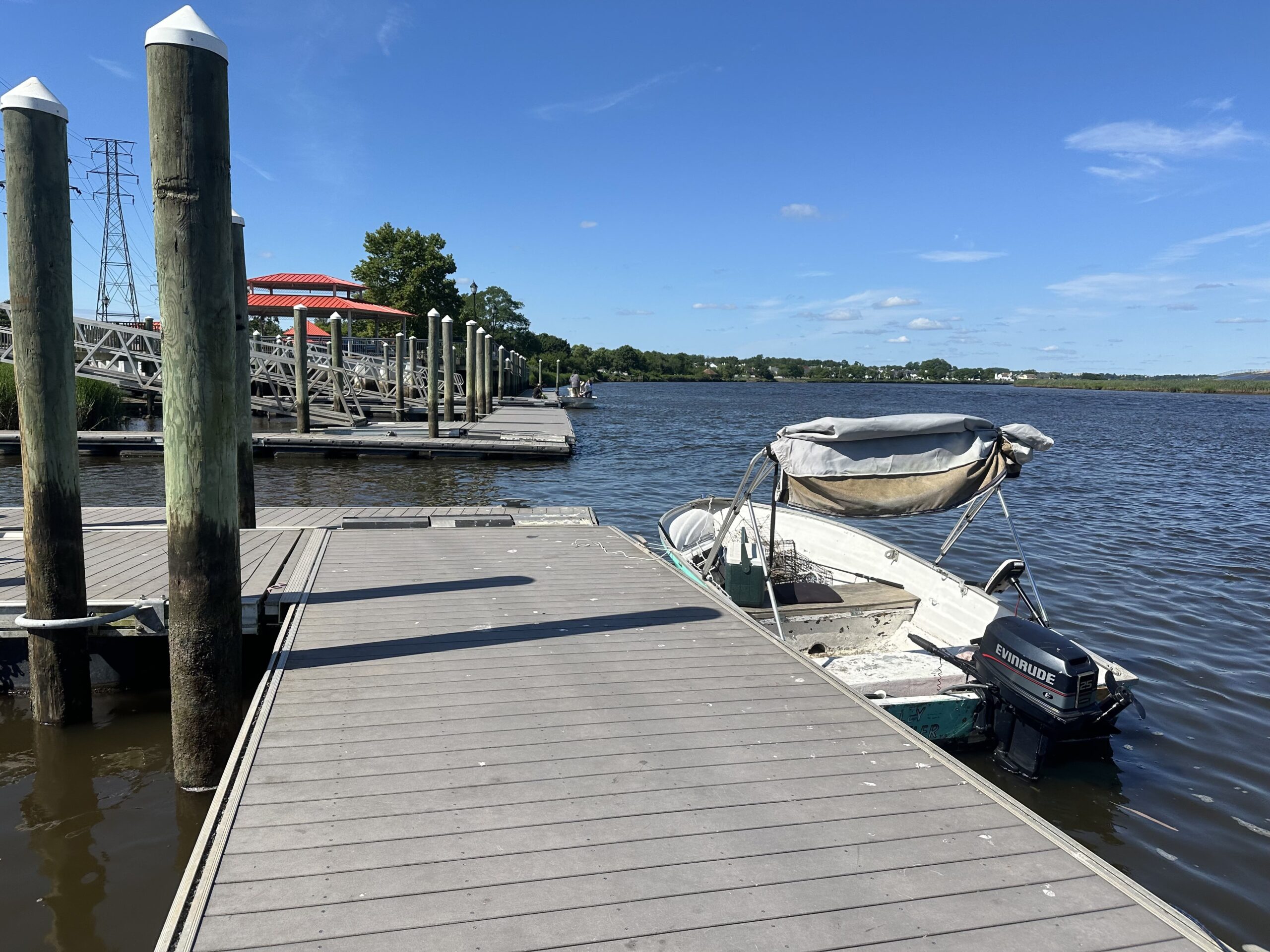
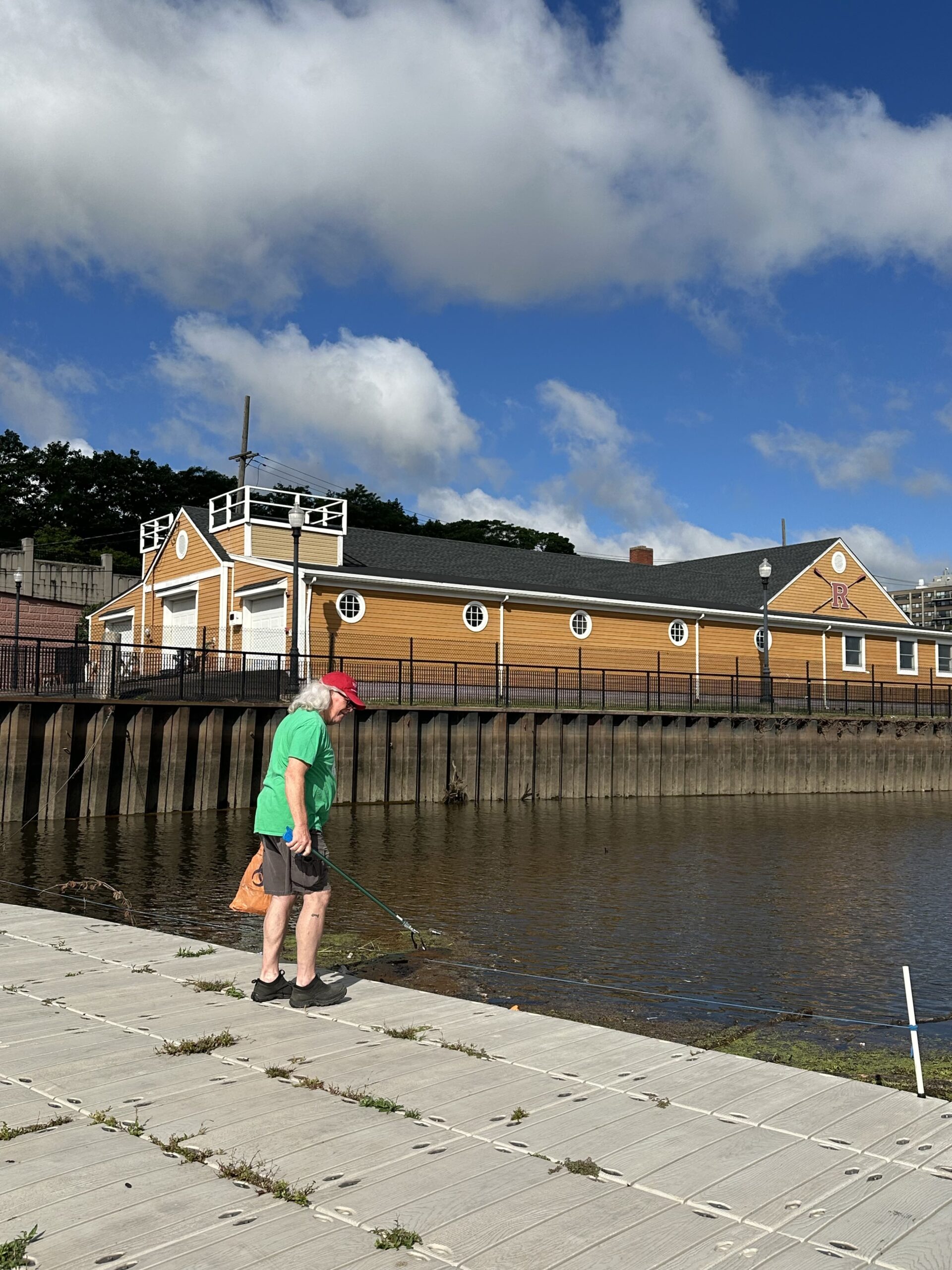
Messy docks at LR4, I wonder who the culprits could have been… Photo Credit: Rose Lawless
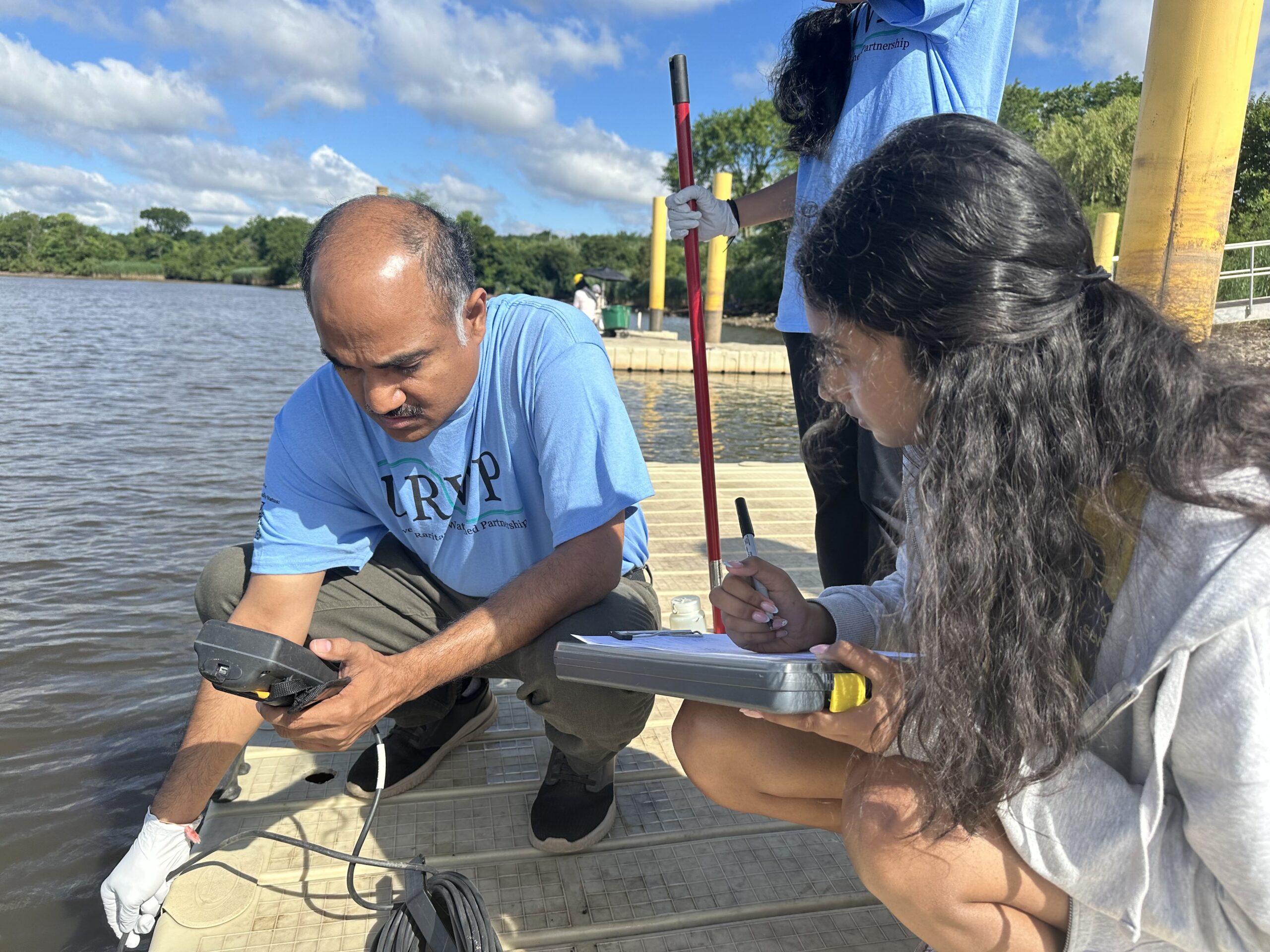
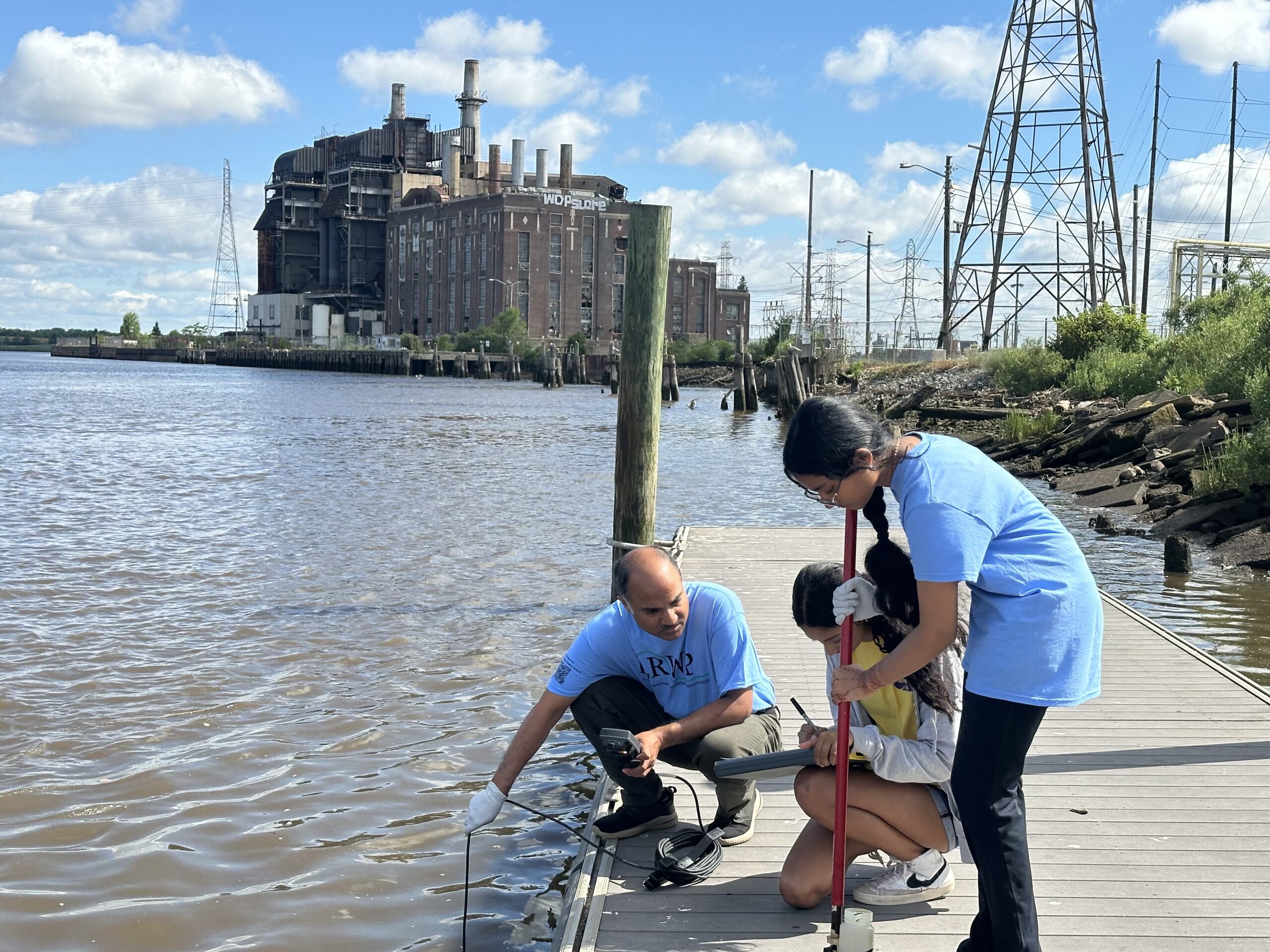
Our AMAZING team of volunteers collecting water samples, cleaning up the shore and sharing our data with local residents while at LR5- South Amboy Waterfront Beach, Photo Credit: Rose Lawless
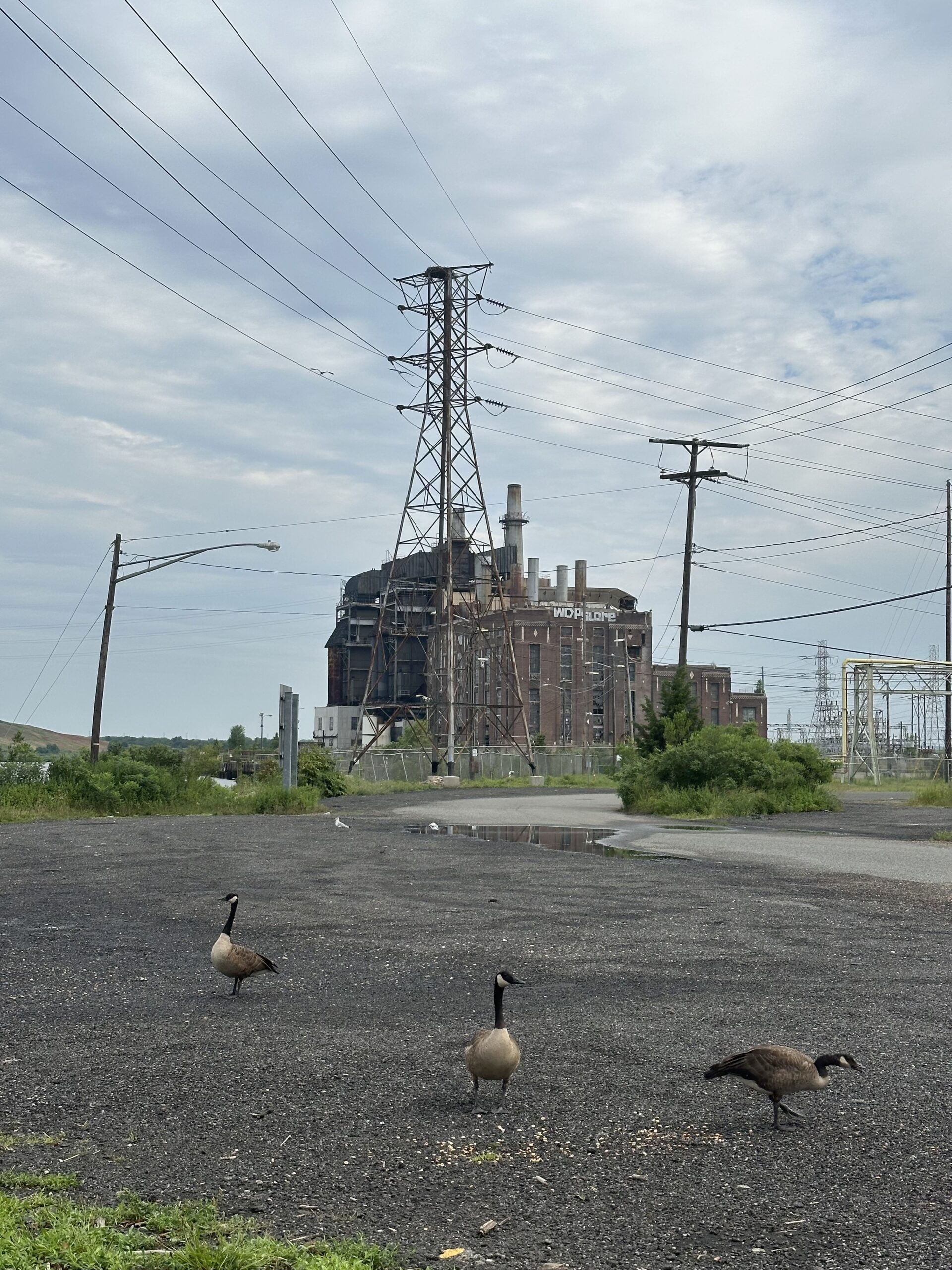
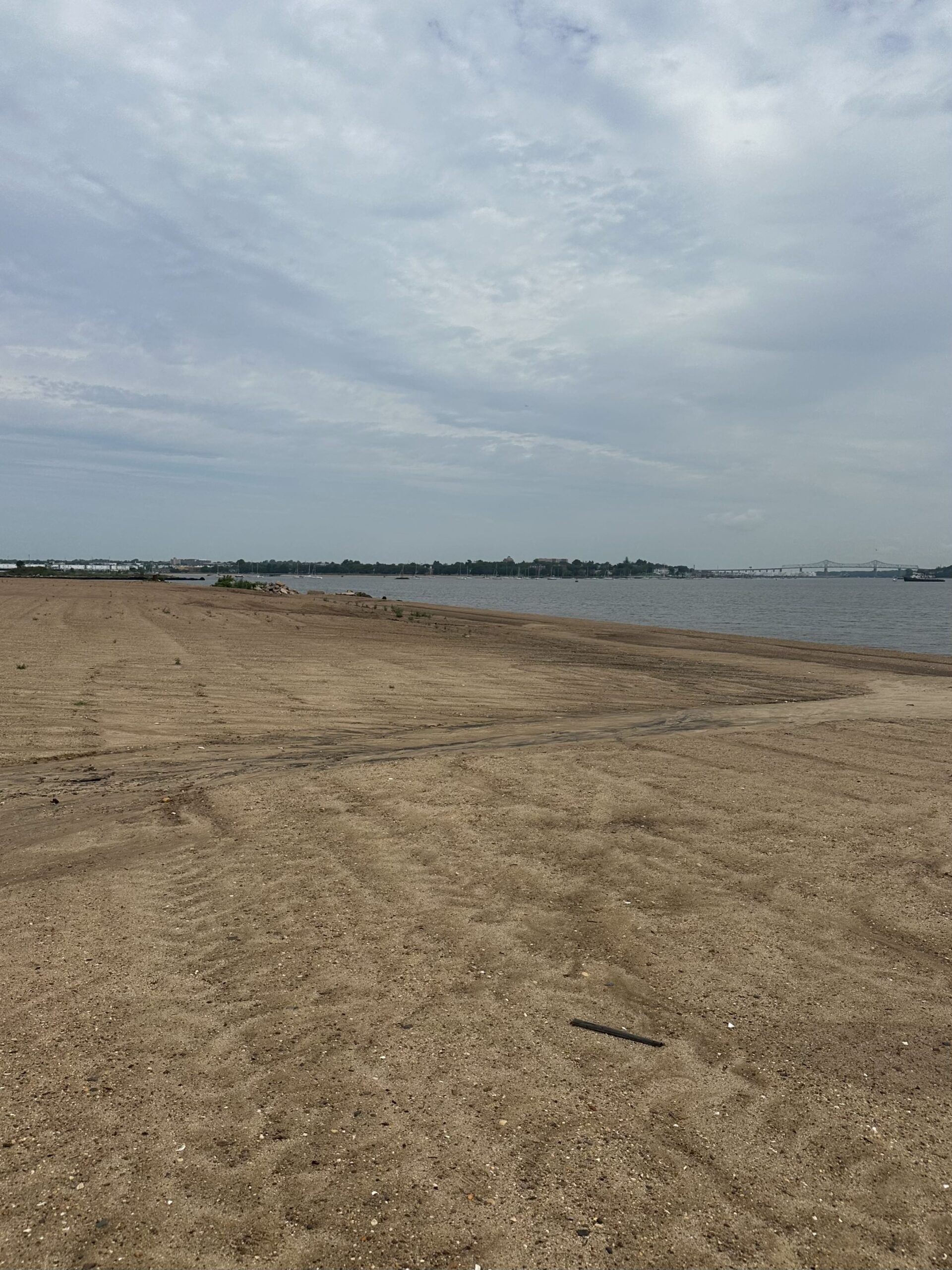
During low tide, we noticed very murky and grey water at LR6-2nd. Street Park with a large amount of scum built up on the rocks, despite the dry weather in recent days. Photo Credit: Rose Lawless
By LRWP Monitoring Outreach Coordinator Jocelyn Palomino
Every Thursday from May to October, the Lower Raritan Watershed Partnership and Rutgers Cooperative Extension of Middlesex County run a volunteer-based monitoring program along the Raritan river. During the summer, we collect water quality samples at six non-bathing public access beach sites, provide our samples to the Interstate Environmental Commission for analysis in their laboratory and report the results to the public on Friday afternoons. Our mission is to share this data with the community and partners to ensure the safe use of the Raritan river for all.
After receiving such heavy rainfall this week due to Tropical Storm Debby, our lab results for water quality samples taken on Thursday August 08, 2024 show Enterococcus bacteria levels exceeding the EPA federal water quality standard of 104 cfu/100mL at all SIX of our monitoring sites. Problem sites are indicated by red frowns on the map and chart which includes: Riverside Park (Piscataway), Rutgers Boathouse (New Brunswick), Edison Boat Basin and Ken Buchanan Waterfront Park (Edison), South Amboy Waterfront Park (South Amboy) and 2nd Street Park (Perth Amboy). Green smiles on the chart and map would normally indicate the sites with bacteria levels safe for recreation, which does not include any sites this week.
Pathogens/Enterococci levels are used as indicators of the possible presence of disease-causing bacteriain recreational waters. Such pathogens may pose health risks to people coming in primary contact with the water (touching) through recreational activities like fishing, kayaking or swimming in a water body. Possible sources of bacteria include stormwater runoff, Combined Sewer Overflows (CSOs), improperly functioning wastewater treatment plants, leaking septic systems, animal carcasses, and runoff from manure storage areas.
Our goal in reporting these results is to give residents a better understanding of the potential health risks related to primary contact during water-based recreation. If you plan on recreating on the Raritan, be sure to take all safety precautions by washing up after any activities!
A dark morning filled with strong winds and plenty of rain to make water quality monitoring an adventure!! Photo Credit: Jocelyn Palomino (left) and Irene Riegner (right)
Loads of debris/trash washed up by the docks of the Edison Boat Basin. You can see how all the stormwater runoff washed from the parking lot makes its path to the river! Photo Credit: Jocelyn Palomino
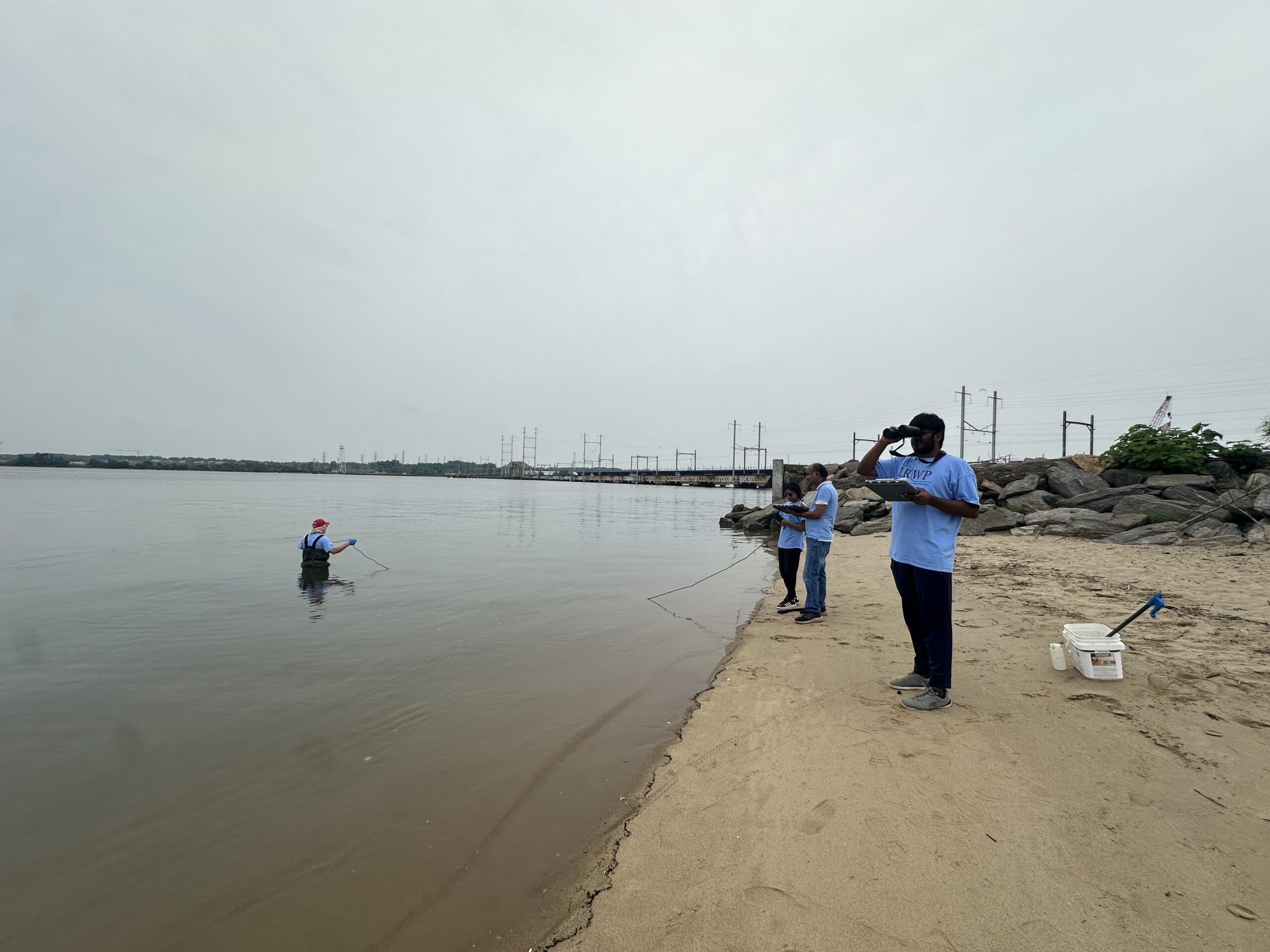
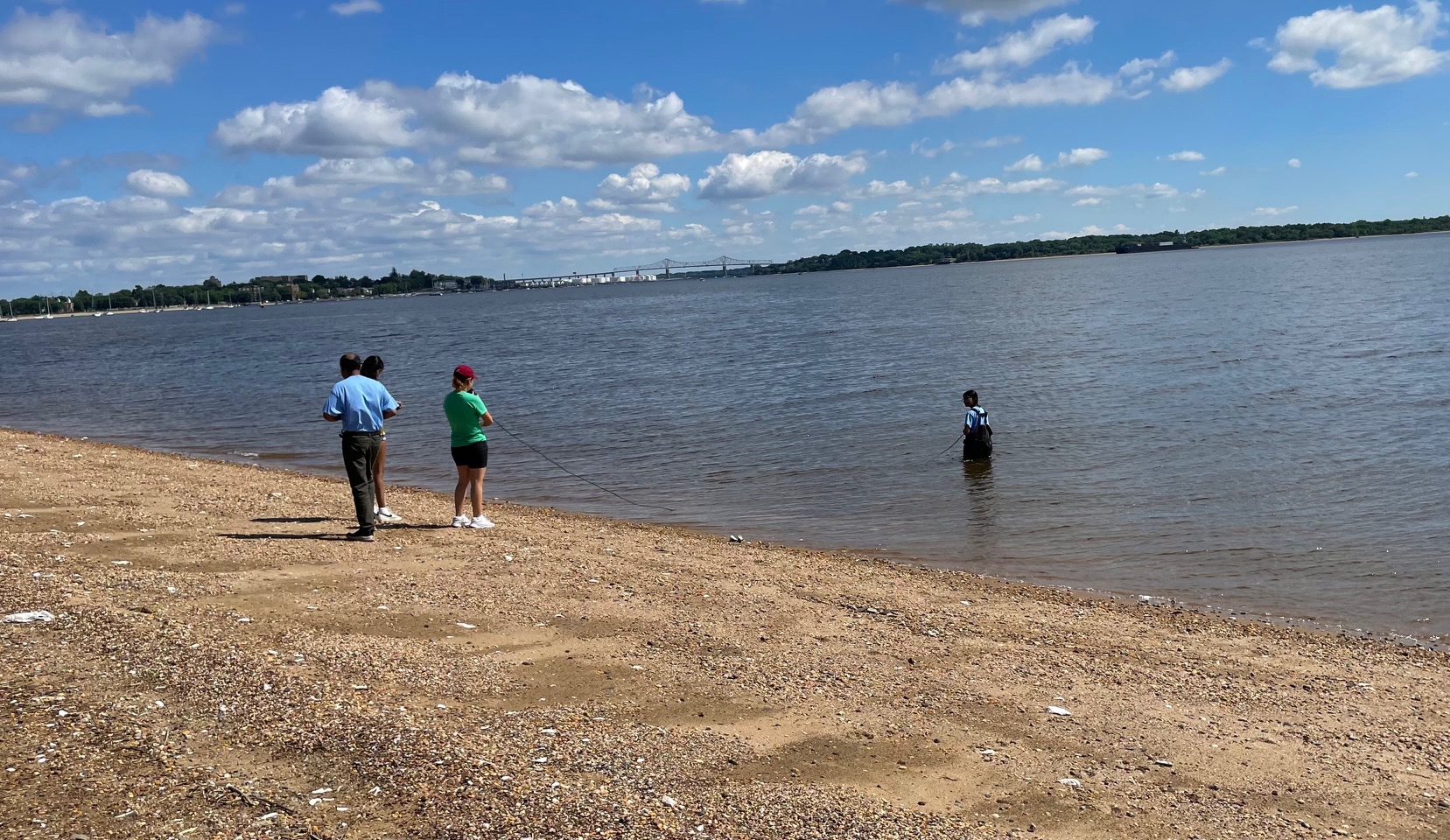
While one of our volunteers wades into the river to collect our weekly sample, the rest of the team stays ashore to record the data relayed by the YSI, which indicates the real-time levels of Dissolved Oxygen, pH, salinity and more. Photo Credit: Jocelyn Palomino (left) and Irene Riegner (right)
HUGE THANKS to Nibav Velan and Irene Riegner for their contributions this week and for enduring the conditions of Tropical Storm Debby!Photo Credit: Jocelyn Palomino (left) and Irene Riegner (right)
By LRWP Monitoring Outreach Coordinator Jocelyn Palomino
Every Thursday from May to October, the Lower Raritan Watershed Partnership and Rutgers Cooperative Extension of Middlesex County run a volunteer-based monitoring program along the Raritan river. During the summer, we collect water quality samples at six non-bathing public access beach sites, provide our samples to the Interstate Environmental Commission for analysis in their laboratory and report the results to the public on Friday afternoons. Our mission is to share this data with the community and partners to ensure the safe use of the Raritan river for all.
Our lab results for water quality samples taken on Thursday August 01, 2024 show Enterococcus bacteria levels exceeding the EPA federal water quality standard of 104 cfu/100mL at only ONE of our monitoring sites this week. Problem sites are indicated by red frowns on the map and chart which includes: 2nd Street Park (Perth Amboy). Green smiles on the chart and map indicate the sites with bacteria levels safe for recreation, and include the following: Riverside Park (Piscataway), Rutgers Boathouse (New Brunswick), Edison Boat Basin and Ken Buchanan Waterfront Park (Edison), South Amboy Waterfront Park (South Amboy).
Pathogens/Enterococci levels are used as indicators of the possible presence of disease-causing bacteriain recreational waters. Such pathogens may pose health risks to people coming in primary contact with the water (touching) through recreational activities like fishing, kayaking or swimming in a water body. Possible sources of bacteria include Combined Sewer Overflows (CSOs), improperly functioning wastewater treatment plants, stormwater runoff, leaking septic systems, animal carcasses, and runoff from manure storage areas.
Our goal in reporting these results is to give residents a better understanding of the potential health risks related to primary contact during water-based recreation. If you are planning on recreating on the Raritan this weekend, stay safe by properly washing up after any activities!
Clear and sunny skies on Thursday morning helped us collect our samples smoothly before the heat caught up to us!Photo Credit: Jocelyn Palomino
Water quality at LR3- Edison Boat Basin was noticeably greasy and scummy this week, Photo Credit: Jocelyn Palomino
We did not observe much recreational or wildlife activity at our sites this Thursday, but we can always count on the seagulls and ducklings that greet us on the Ken Buchanan docks! Photo Credit: Jocelyn Palomino
Heavy discharge coming from the Combined Sewer Overflow (CSO) located right by the shore at Perth Amboy’s 2nd Street Park… the water quality was murky with an overwhelming smell of sewage and is our only site that exceeds the federal standard this week. Photo Credit: Jocelyn Palomino
BIG thanks again to our volunteers this week for helping us collect informational data for the community: Nibav Velan, Sanil Nambiar and Thulasi Nambiar!!
By LRWP Monitoring Outreach Coordinator Jocelyn Palomino
Every Thursday from May to October, the Lower Raritan Watershed Partnership and Rutgers Cooperative Extension of Middlesex County run a volunteer-based monitoring program along the Raritan River. During the summer, we collect water quality samples at six non-bathing public access beach sites, provide our samples to the Interstate Environmental Commission for analysis in their laboratory and report the results to the public on Friday afternoons. Our mission is to share this data with the community and partners to ensure the safe use of the Raritan river for all.
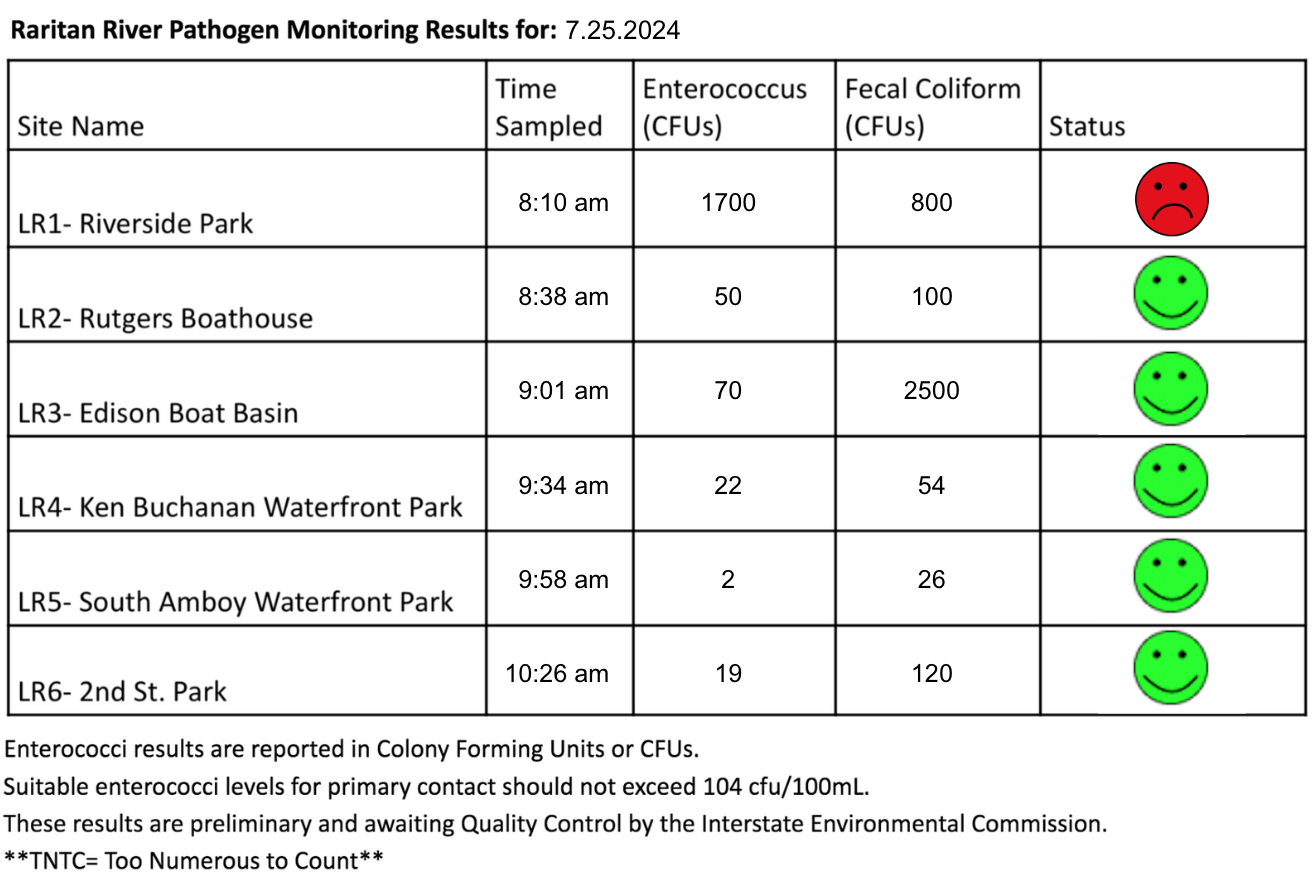
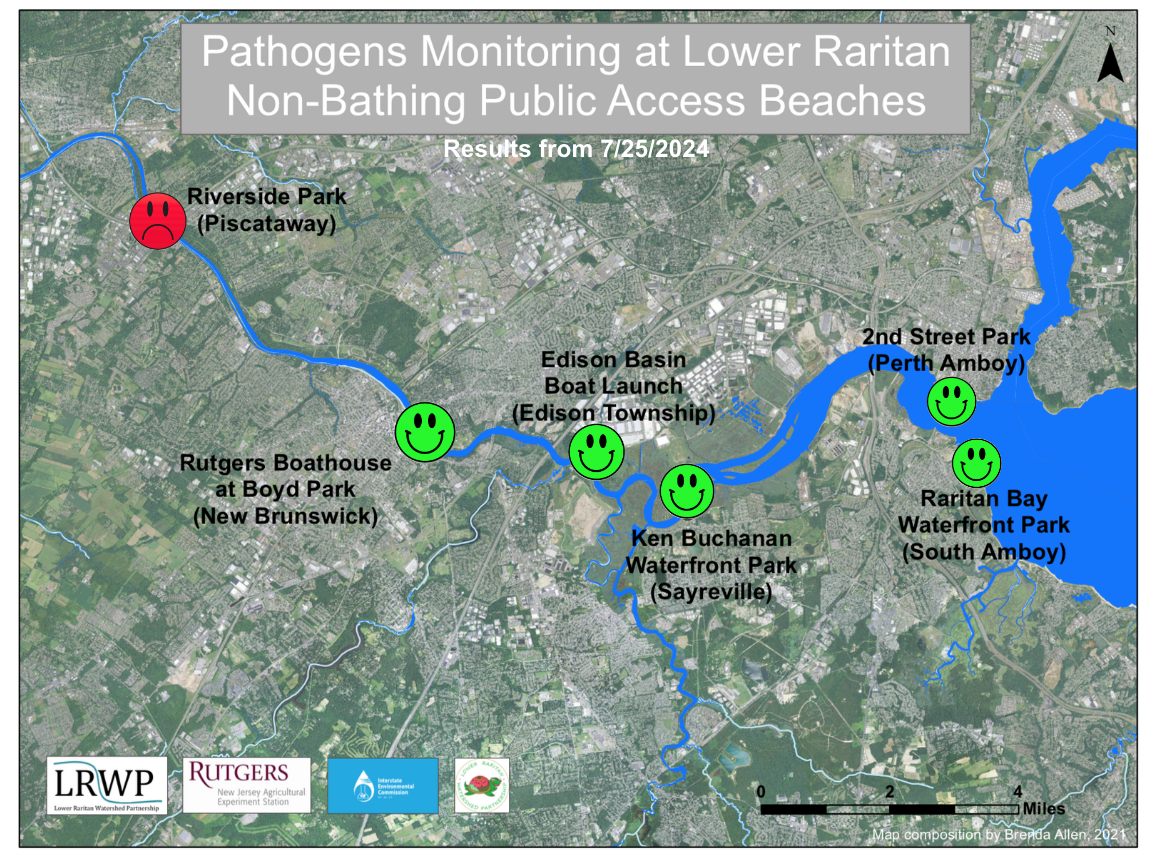
Our lab results for water quality samples taken on Thursday July 25, 2024 show Enterococcus bacteria levels exceeding the EPA federal water quality standard of 104 cfu/100mL at only ONE of our monitoring sites this week. Problem sites are indicated by red frowns on the map and chart which includes: Riverside Park (Piscataway). Green smiles on the chart and map indicate the sites with bacteria levels safe for recreation, and include the following: Rutgers Boathouse (New Brunswick), Edison Boat Basin and Ken Buchanan Waterfront Park (Edison), South Amboy Waterfront Park (South Amboy) and 2nd Street Park (Perth Amboy).
Pathogens/Enterococci levels are used as indicators of the possible presence of disease-causing bacteriain recreational waters. Such pathogens may pose health risks to people coming in primary contact with the water (touching) through recreational activities like fishing, kayaking or swimming in a water body. Possible sources of bacteria include Combined Sewer Overflows (CSOs), improperly functioning wastewater treatment plants, stormwater runoff, leaking septic systems, animal carcasses, and runoff from manure storage areas.
Our goal in reporting these results is to give residents a better understanding of the potential health risks related to primary contact during water-based recreation. If you are planning on recreating on the Raritan this weekend, stay safe by properly washing up after any activities!
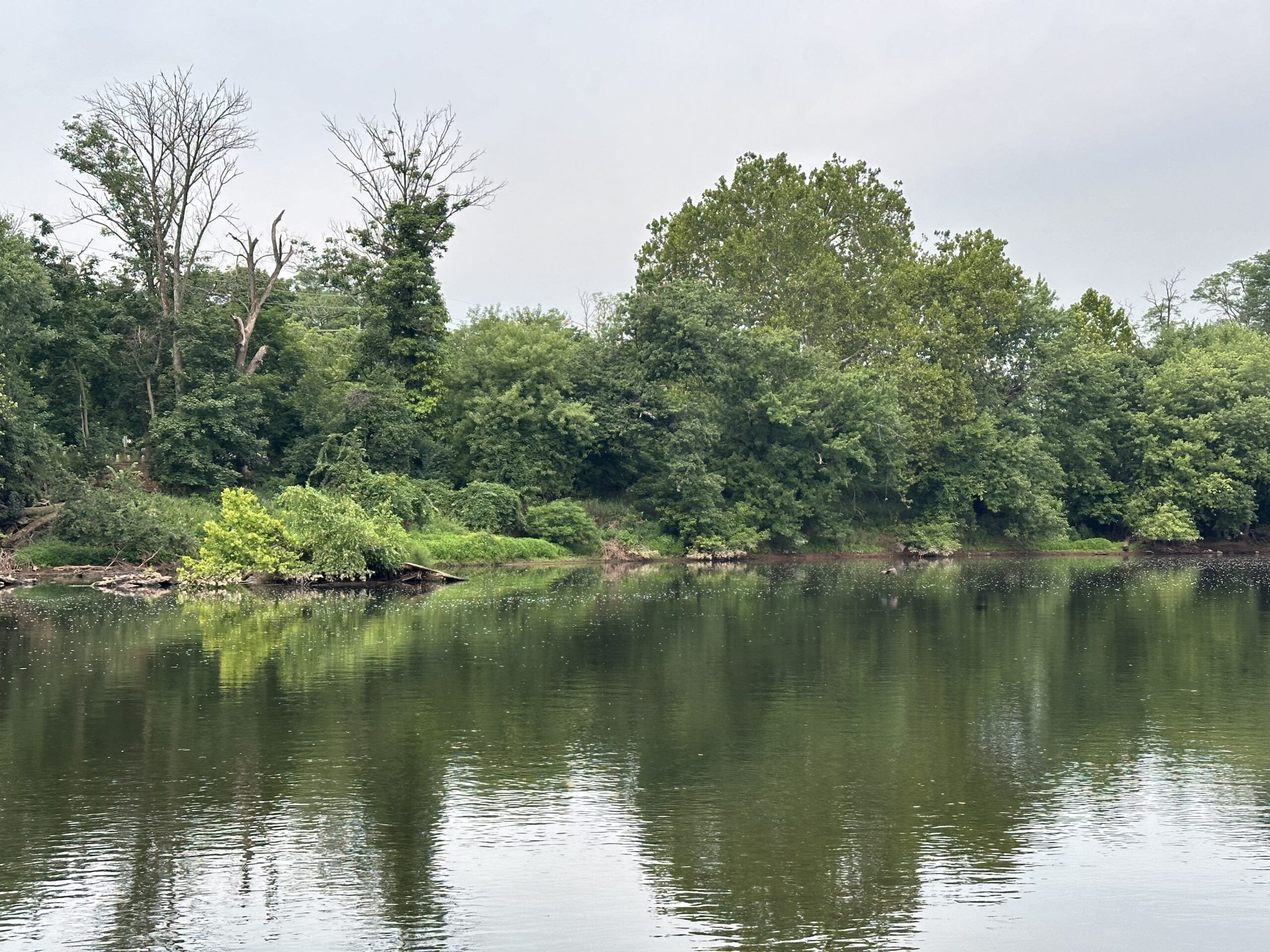
Turbid and scummy waters at LR1- Riverside Park this Thursday morning, pathogen results showed high Enterococcus levels only for this site. Photo Credit: Jocelyn Palomino
A tremendous amount of debris washed up at the Edison boat launch, Photo Credit: Frank Dahl
SEWA volunteers have worked closely with the LRWP over the last couple weeks on the Pathogens Monitoring Team, they are becoming excellent water quality professionals!Photo Credit: Jocelyn Palomino
Overcast and gloomy skies on Thursday morning, however, no precipitation was recorded 24 to 48 hours prior to monitoring. Photo Credit: Jocelyn Palomino
Special thanks to our monitoring team of volunteers who joined us this week: Frank Dahl, Thulasi Nambiar, Sanil Nambiar and Nibav Velan!Photo Credit: Jocelyn Palomino
By LRWP Monitoring Outreach Coordinator Jocelyn Palomino
Every Thursday from May to October, the Lower Raritan Watershed Partnership and Rutgers Cooperative Extension of Middlesex County run a volunteer-based monitoring program along the Raritan River. During the summer, we collect water quality samples at six non-bathing public access beach sites, provide our samples to the Interstate Environmental Commission for analysis in their laboratory and report the results to the public on Friday afternoons. Our mission is to share this data with the community and partners to ensure the safe use of the Raritan river for all.
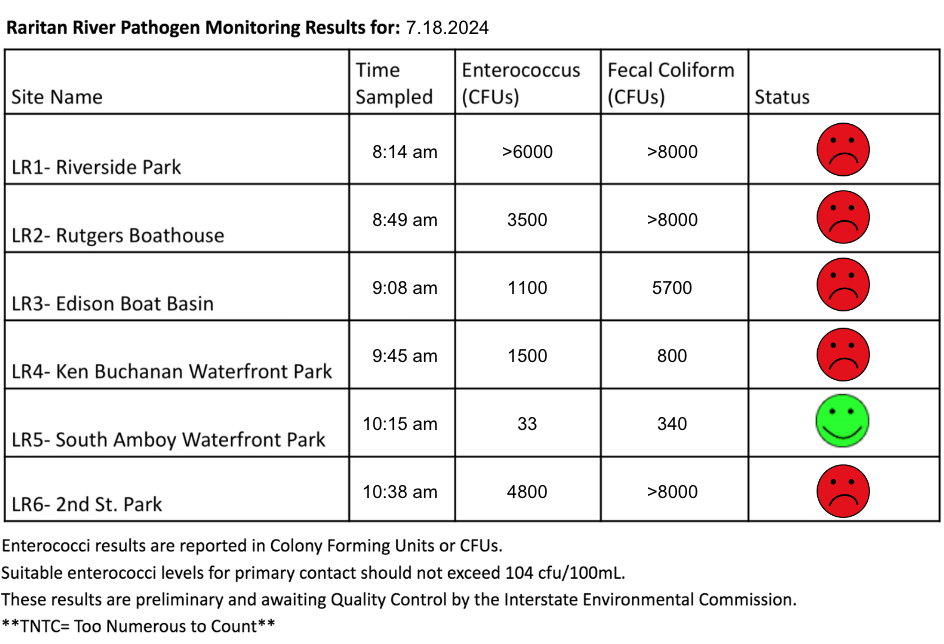
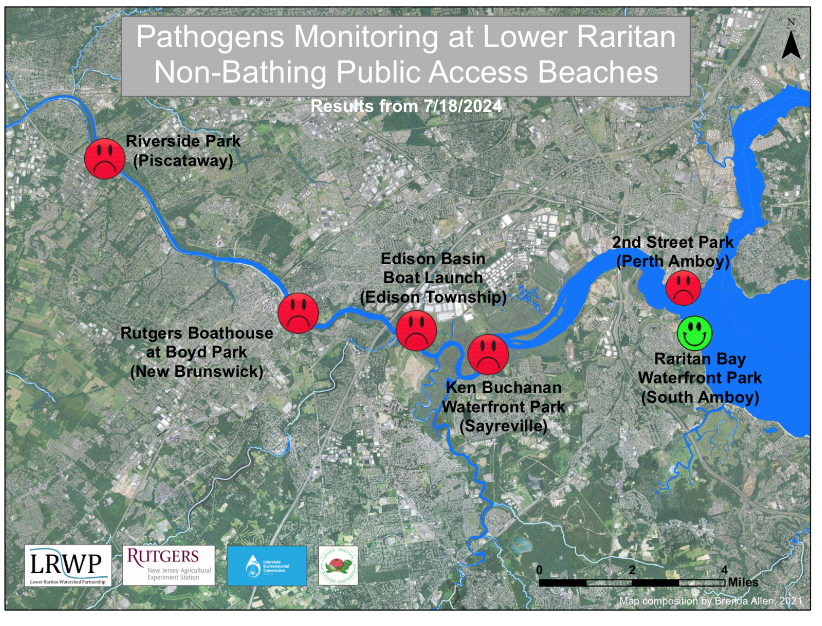
After multiple days of precipitation and thunderstorms, our lab results for water quality samples taken on Thursday July 18, 2024 show Enterococcus bacteria levels exceeding the EPA federal water quality standard of 104 cfu/100mL at FIVE of our monitoring sites this week. Problem sites are indicated by red frowns on the map and chart which includes: Riverside Park (Piscataway), Rutgers Boathouse (New Brunswick), Edison Boat Basin and Ken Buchanan Waterfront Park (Edison), and 2nd Street Park (Perth Amboy). Green smiles on the chart and map indicate the sites with bacteria levels safe for recreation, and include the following: South Amboy Waterfront Park (South Amboy).
Pathogens/Enterococci levels are used as indicators of the possible presence of disease-causing bacteriain recreational waters. Such pathogens may pose health risks to people coming in primary contact with the water (touching) through recreational activities like fishing, kayaking or swimming in a water body. Possible sources of bacteria include Combined Sewer Overflows (CSOs), improperly functioning wastewater treatment plants, stormwater runoff, leaking septic systems, animal carcasses, and runoff from manure storage areas.
Our goal in reporting these results is to give residents a better understanding of the potential health risks related to primary contact during water-based recreation. If you are planning on recreating on the Raritan this weekend, stay safe by properly washing up after any activities!
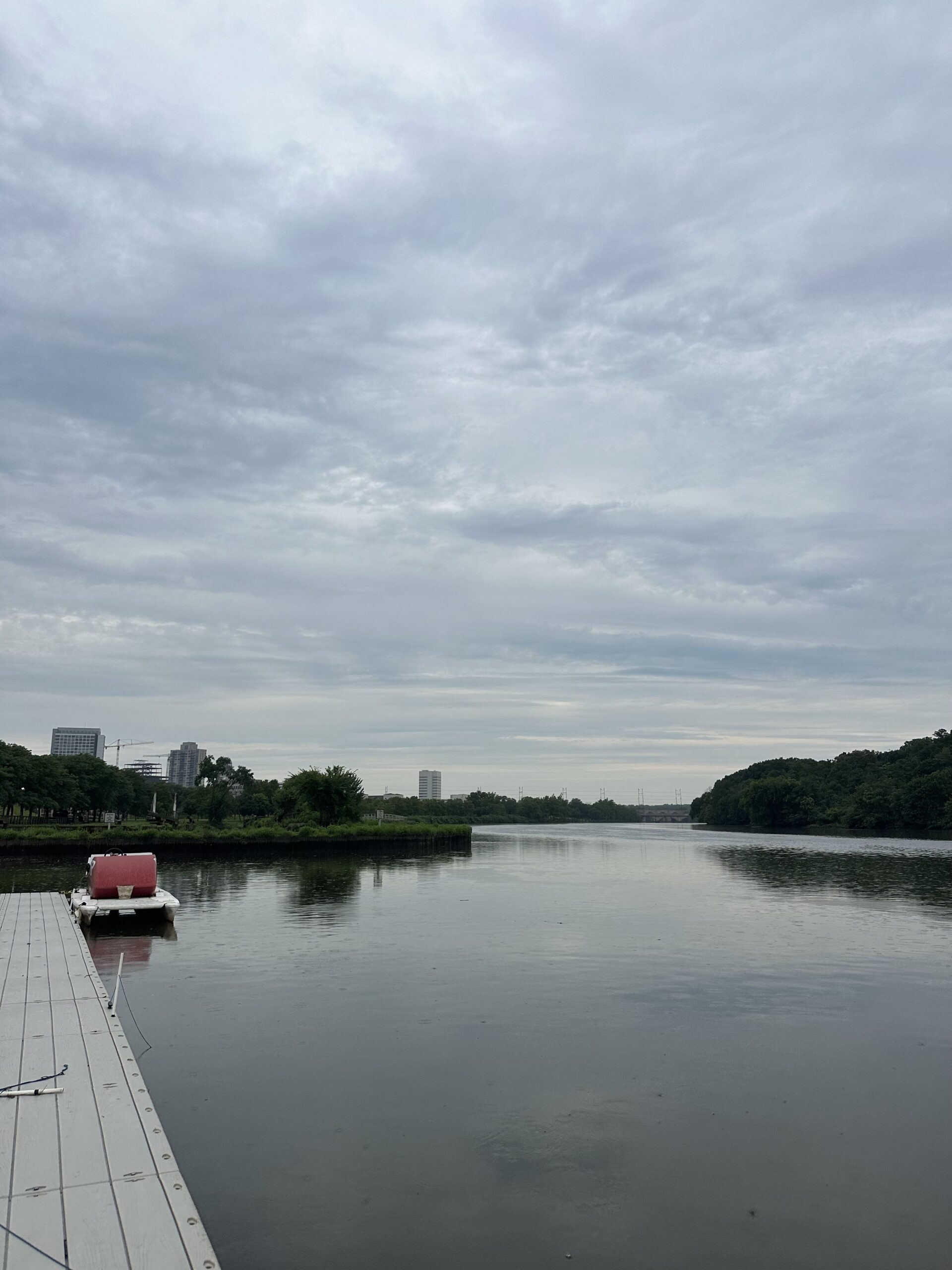
Cloudy skies and light rain over the Rutgers boat docks during our monitoring session this week, Photo Credit: Jocelyn Palomino
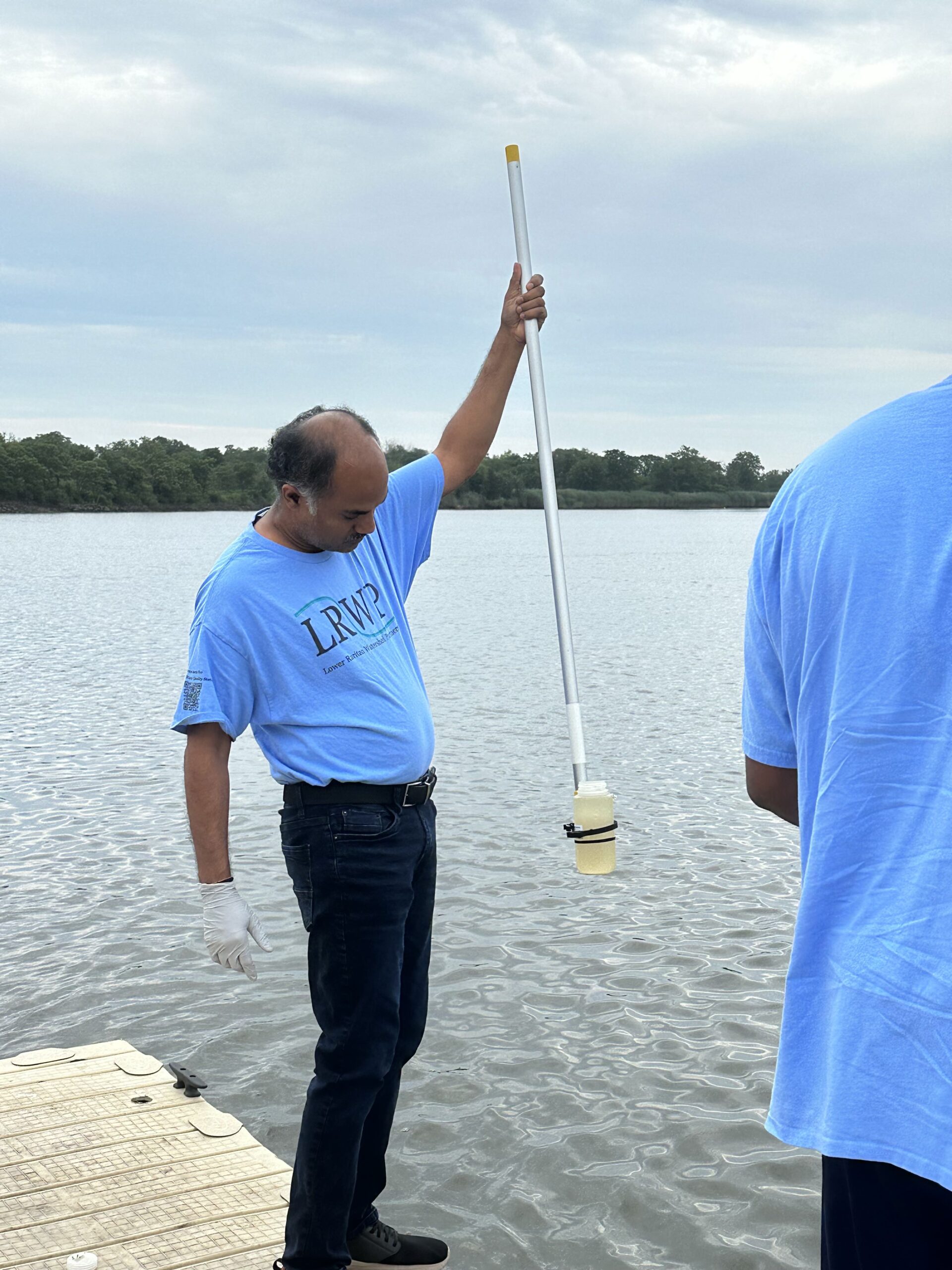
Sanil Nambiar collected our samples for the week with our new and improved sampling stick that we use to retrieve our bottles, Photo Credit: Jocelyn Palomino
Canadian geese were present at all of our monitoring sites Thursday morning, which was noted in our visual habitat assessment as it may have contributed to some of the fecal matter in our samples, Photo Credit: Jocelyn Palomino
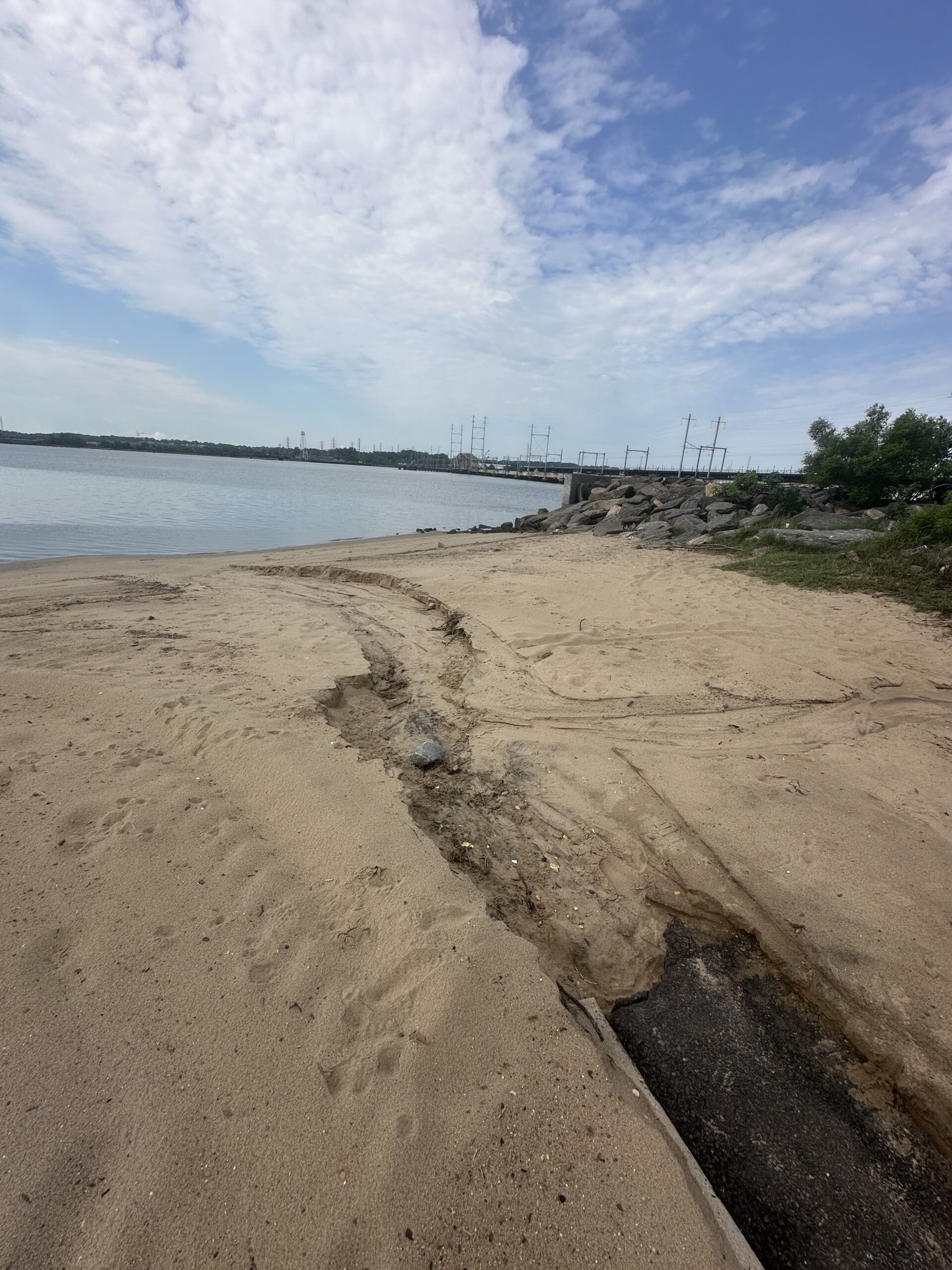
With such heavy precipitation on Wednesday night, the stormwater runoff left trails on the sand of its path leading right into the water at LR5 and LR6, Photo Credit: Jocelyn Palomino
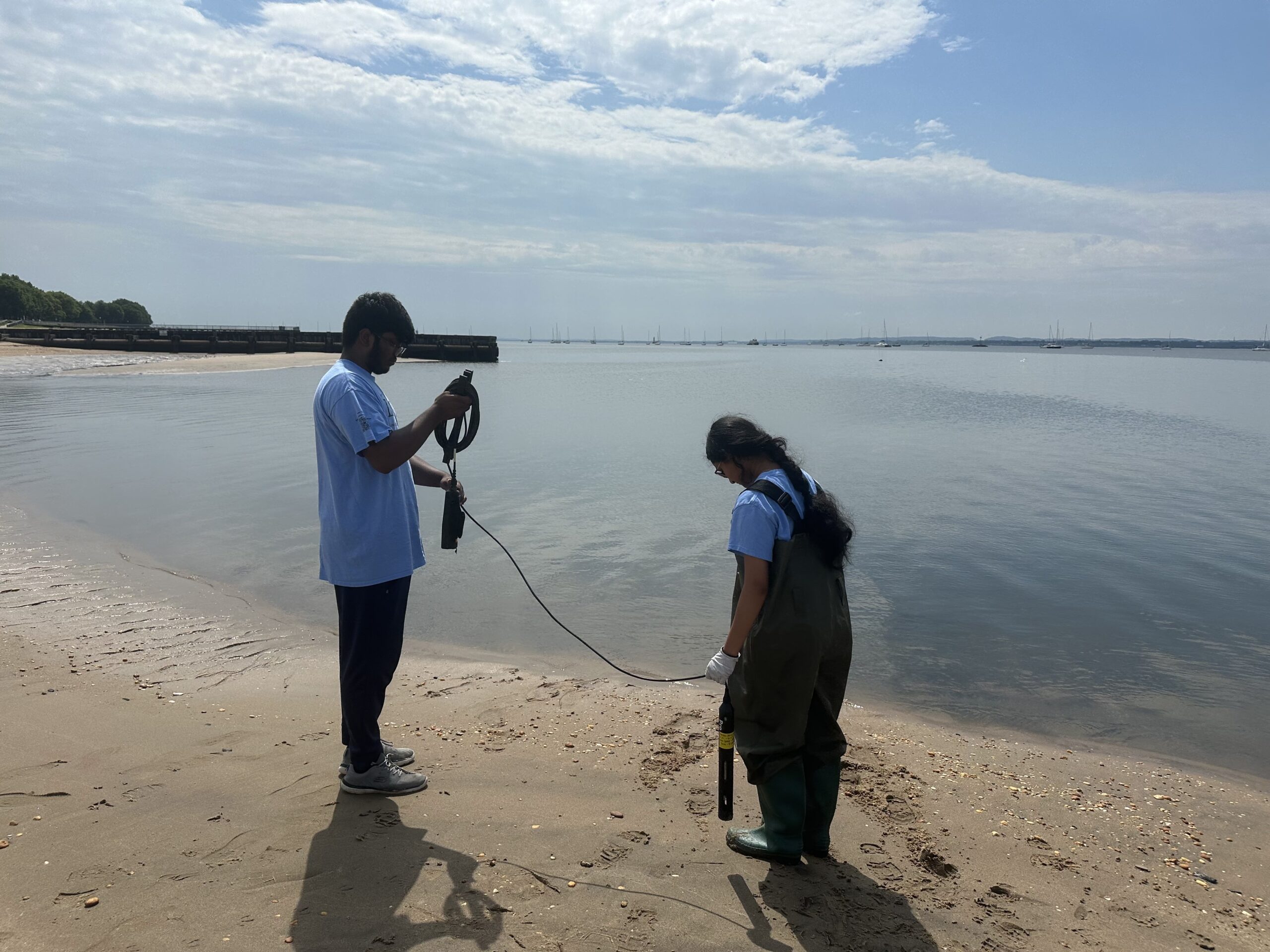
Nibav helping Thulasi gear up before wading into our last site of the day, Perth Amboy’s 2nd. Street Park! Photo Credit: Jocelyn Palomino
By LRWP Monitoring Outreach Coordinator Jocelyn Palomino
Every Thursday from May to October, the Lower Raritan Watershed Partnership and Rutgers Cooperative Extension of Middlesex County run a volunteer-based monitoring program along the Raritan River. During the summer, we collect water quality samples at six non-bathing public access beach sites, provide our samples to the Interstate Environmental Commission for analysis in their laboratory and report the results to the public on Friday afternoons. Our mission is to share this data with the community and partners to ensure the safe use of the Raritan river for all.
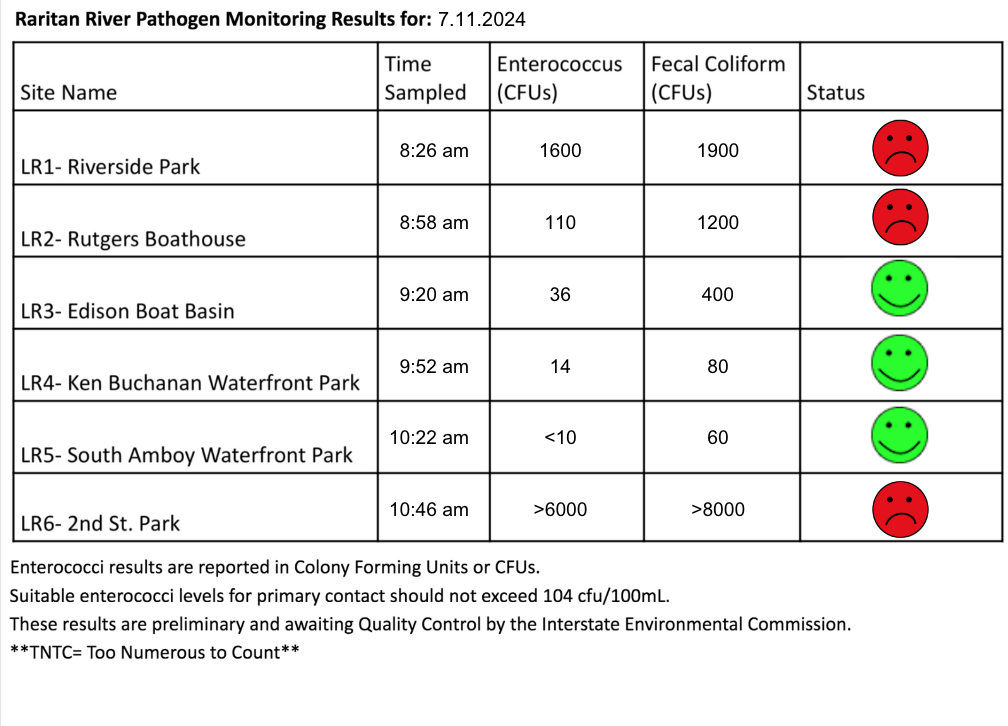
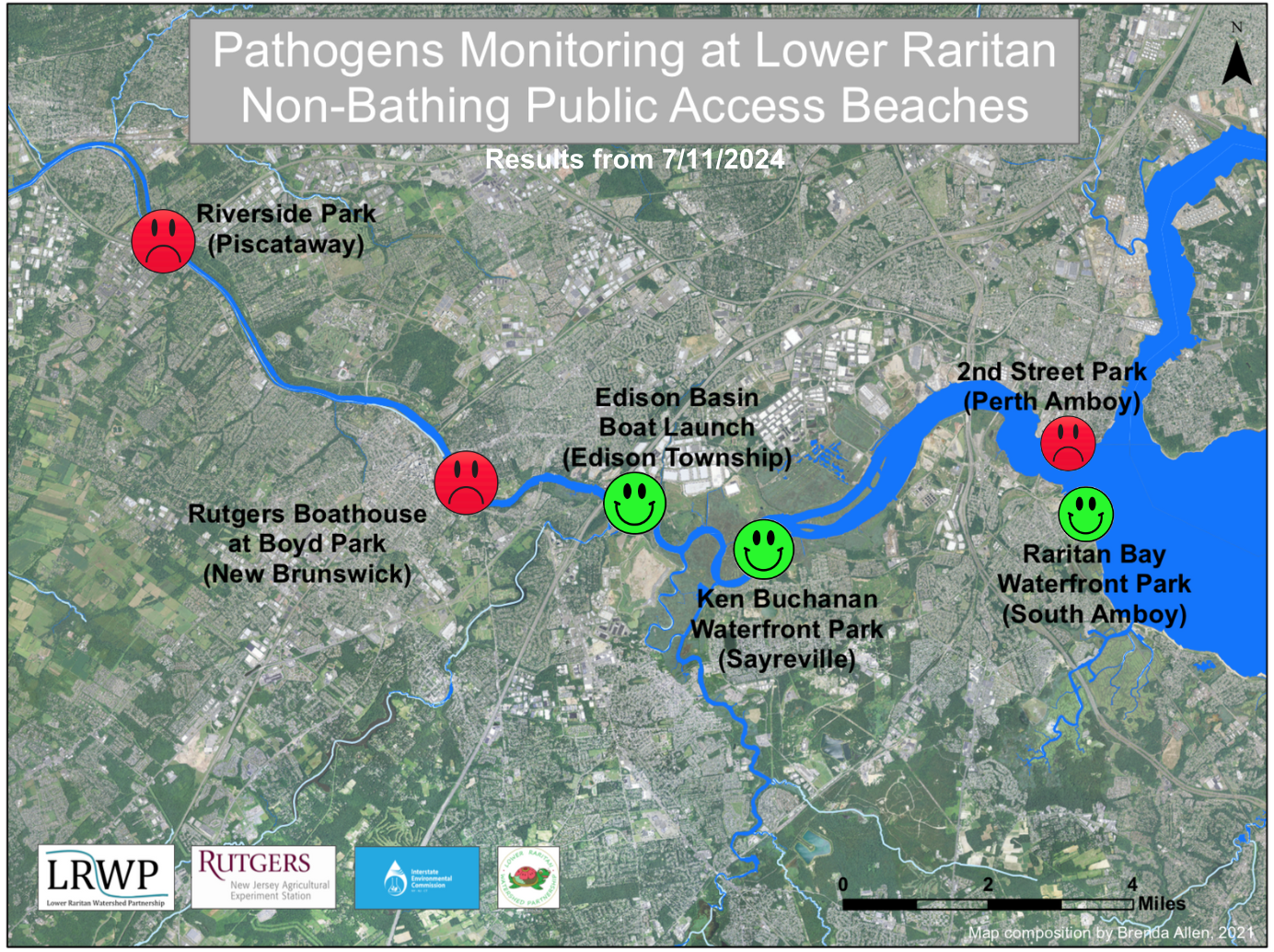
Our lab results for water quality samples taken on Thursday July 11, 2024 show Enterococcus bacteria levels exceeding the EPA federal water quality standard of 104 cfu/100mL at THREE of our monitoring sites this week. Problem sites are indicated by red frowns on the map and chart which includes: Riverside Park (Piscataway), Rutgers Boathouse (New Brunswick), and 2nd Street Park (Perth Amboy). Green smiles on the chart and map indicate the sites with bacteria levels safe for recreation, and include the following: Edison Boat Basin, Ken Buchanan Waterfront Park (Edison) and the South Amboy Waterfront Park (South Amboy).
Pathogens/Enterococci levels are used as indicators of the possible presence of disease-causing bacteriain recreational waters. Such pathogens may pose health risks to people coming in primary contact with the water (touching) through recreational activities like fishing, kayaking or swimming in a water body. Possible sources of bacteria include Combined Sewer Overflows (CSOs), improperly functioning wastewater treatment plants, stormwater runoff, leaking septic systems, animal carcasses, and runoff from manure storage areas.
Our goal in reporting these results is to give residents a better understanding of the potential health risks related to primary contact during water-based recreation. If you are planning on recreating on the Raritan this weekend, make sure to stay safe and wash up after any activities!
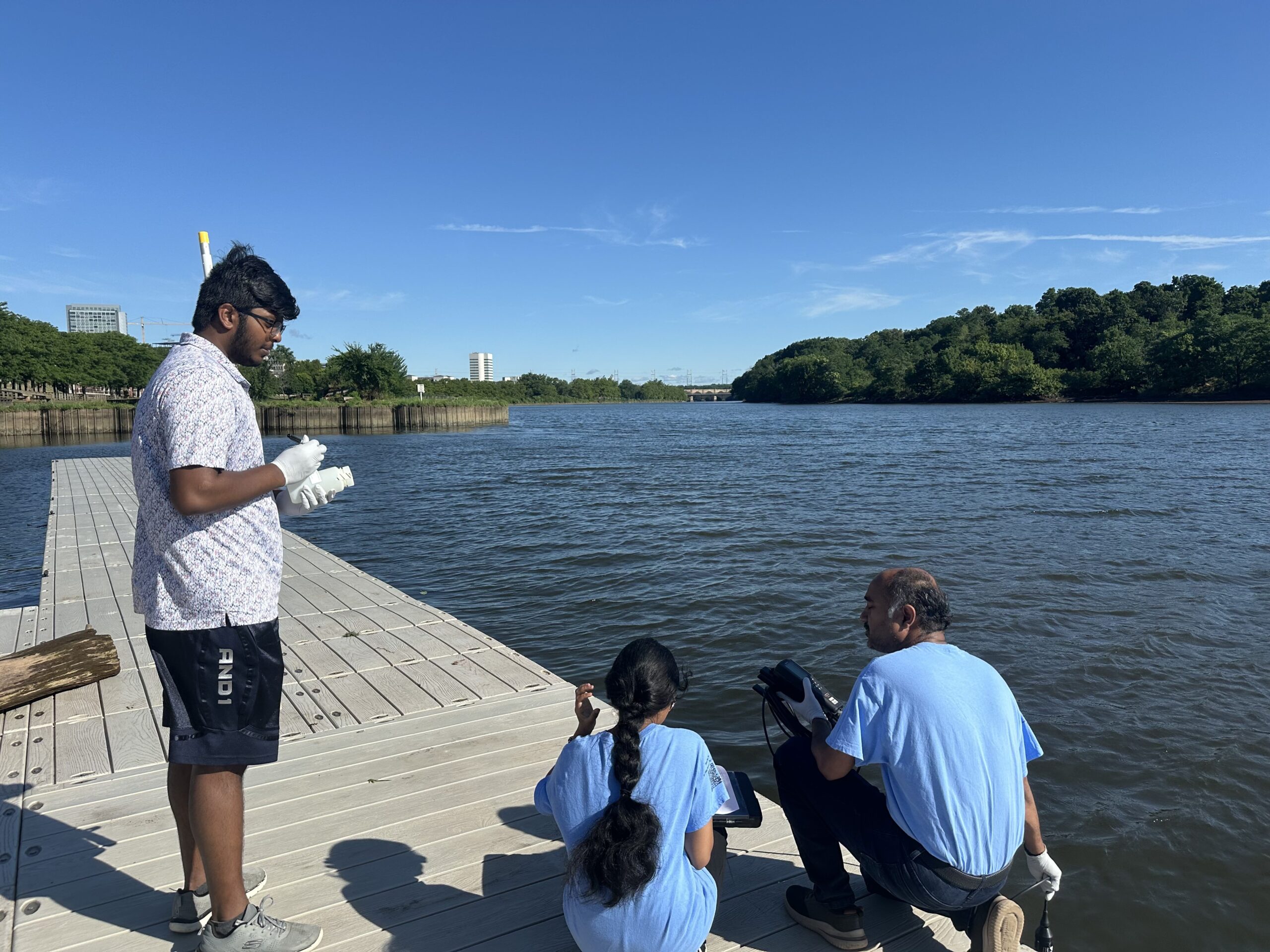
VolunteersNibav, Thulasi and Sanil collecting data from each other while on the docks at the Rutgers Boathouse, Photo Credit: Jocelyn Palomino
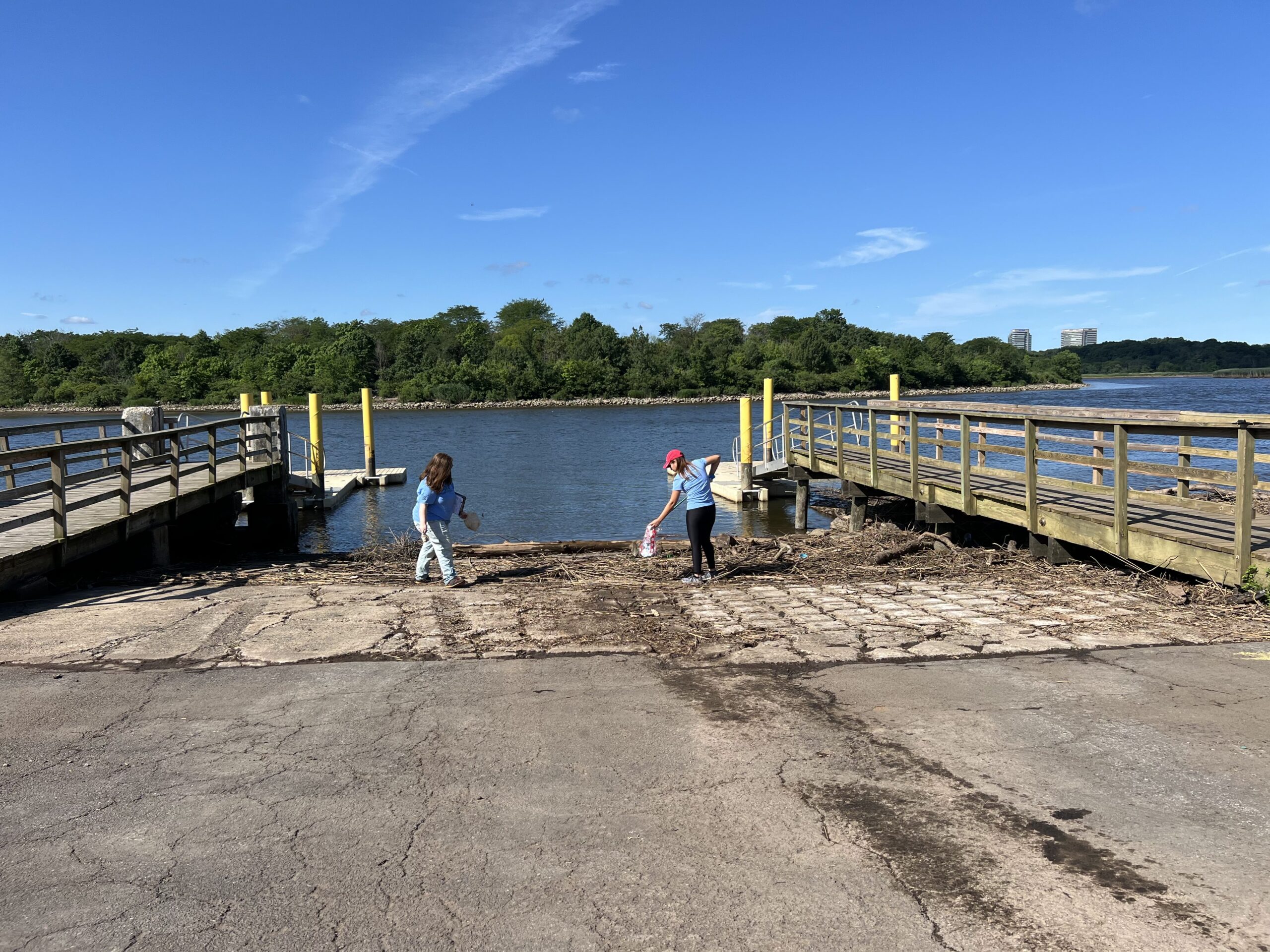
Before heading to the next site, Sofi and Jocelyn picked-up trash that had been washed up at the Edison Boat Basin, Photo Credit: Sanil Nambiar
Plenty of boating activity at our monitoring sites along the Raritan this Thursday, please be sure to properly wash-up after all water-related activities for safety! Photo Credit: Jocelyn Palomino
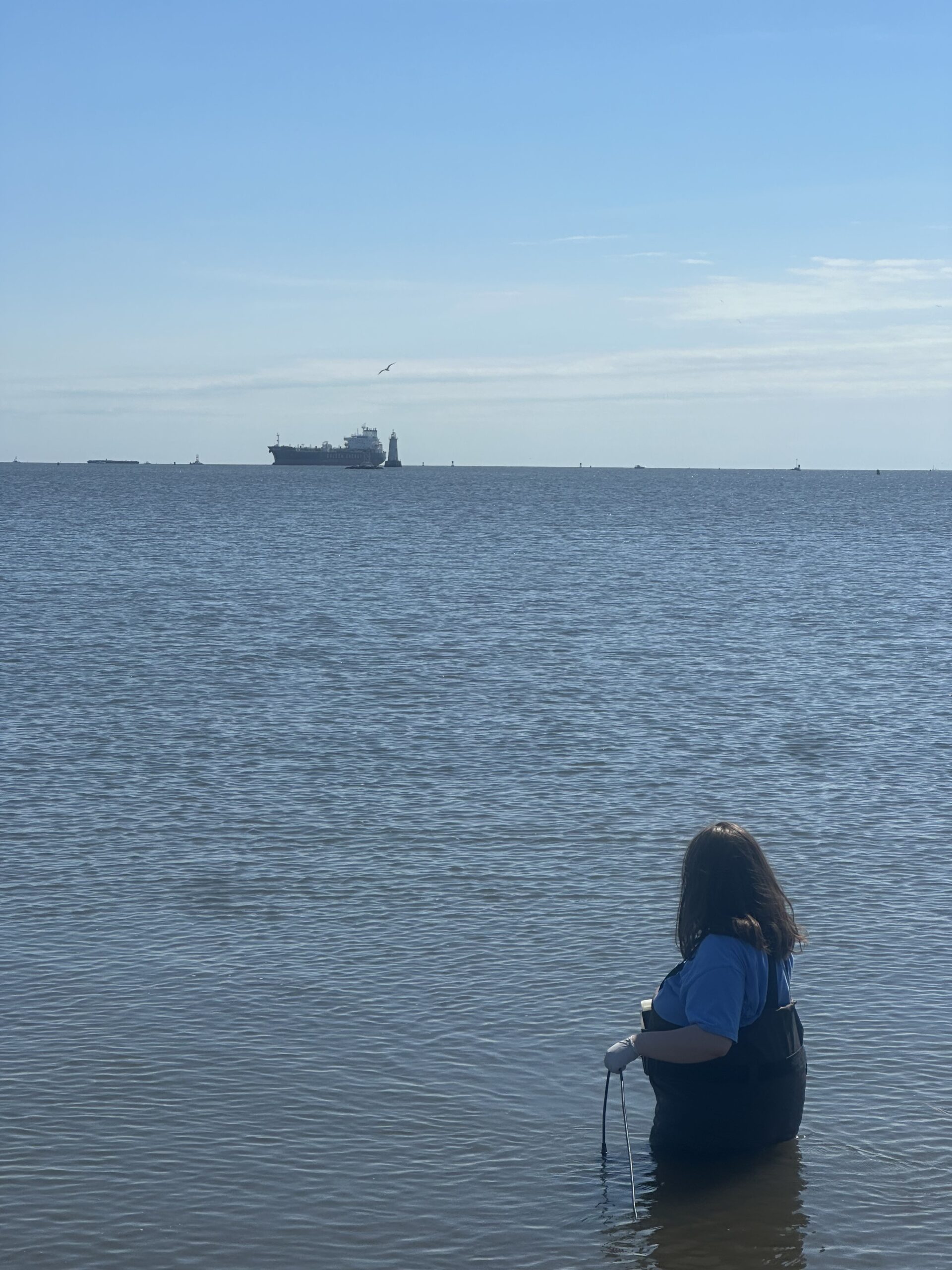
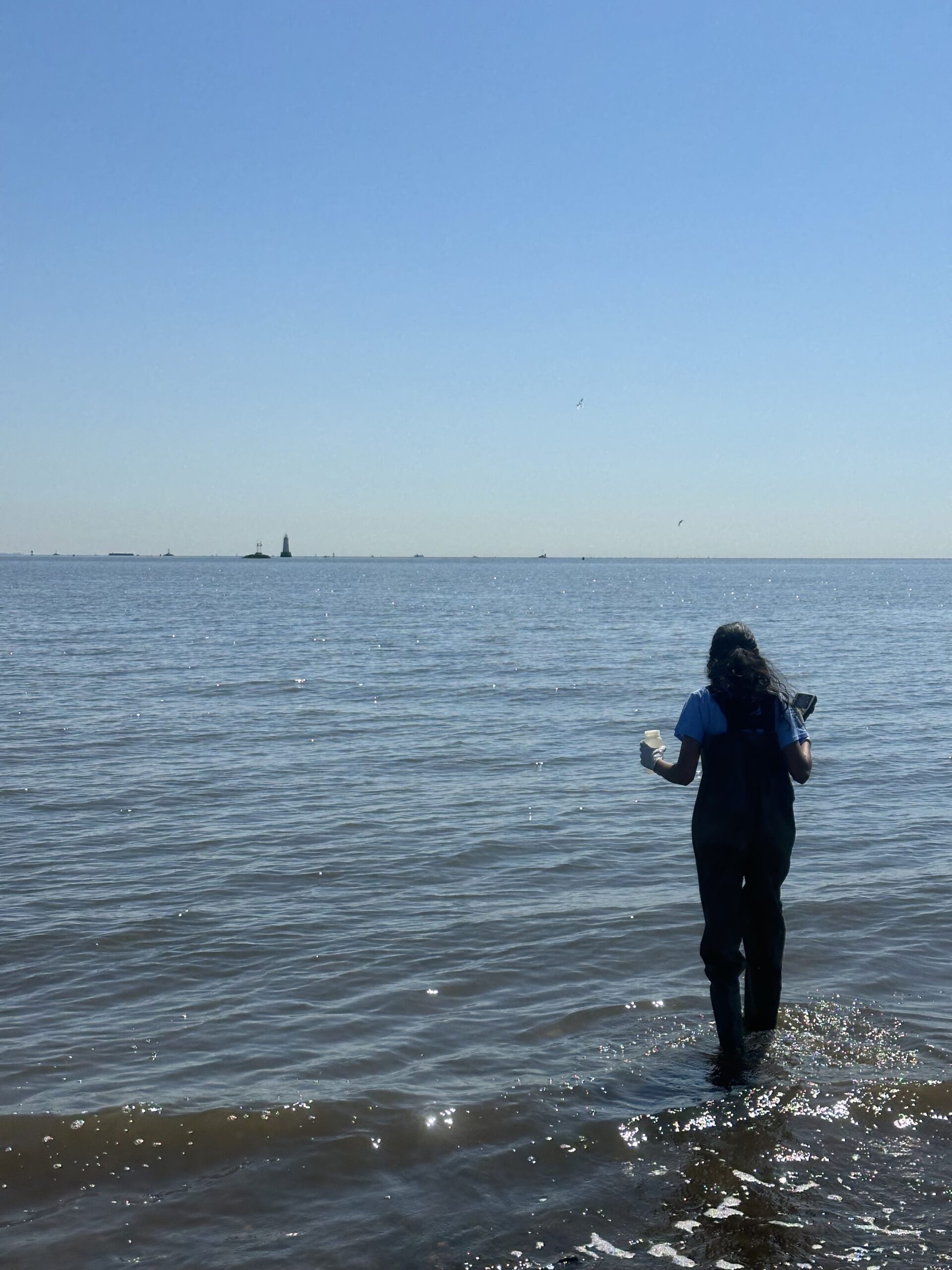
While at the South Amboy Waterfront, we observed a large cargo ship out in the distance right behind the lighthouse- Sofi was able to get a pretty good view since she volunteered to wade in. Looking good out there Sofi! Photo Credit: Jocelyn Palomino
MANY THANKS to the volunteers who joined us this week: Nibav Velan, Thulasi Nambiar, Sanil Nambiar, and Sofi Grossman! Photo Credit: Jocelyn Palomino
By LRWP Monitoring Outreach Coordinator Jocelyn Palomino
Every Thursday from May to October, the Lower Raritan Watershed Partnership and Rutgers Cooperative Extension of Middlesex County run a volunteer-based monitoring program along the Raritan River. During the summer, we collect water quality samples at six non-bathing public access beach sites, provide our samples to the Interstate Environmental Commission for analysis in their laboratory and report the results to the public on Friday afternoons. Our mission is to share this data with the community and partners to ensure the safe use of the Raritan river for all.
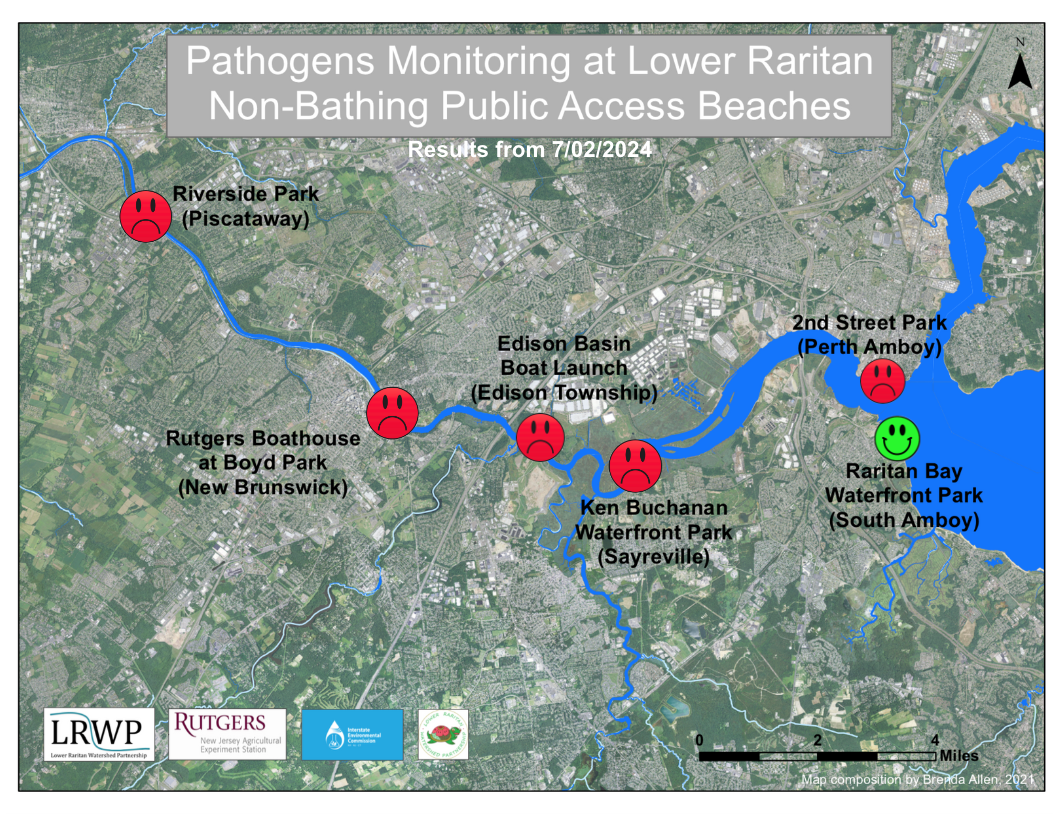
In anticipation of the upcoming holiday this Thursday, the LRWP Pathogens Monitoring team collected samples on TUESDAY July 2, 2024. Our samples taken show Enterococcus bacteria levels exceeding the EPA federal water quality standard of 104 cfu/100mL at FIVE of our monitoring sites this week. Problem sites are indicated by red frowns on the map and chart which includes: Riverside Park (Piscataway), Rutgers Boathouse (New Brunswick) , Edison Boat Basin and Ken Buchanan Waterfront Park (Sayreville), and 2nd Street Park (Perth Amboy). Green smiles on the chart and map indicate the sites with bacteria levels safe for recreation, and include the following: South Amboy Waterfront Park (South Amboy).
Pathogens/Enterococci levels are used as indicators of the possible presence of disease-causing bacteriain recreational waters. Such pathogens may pose health risks to people coming in primary contact with the water (touching) through recreational activities like fishing, kayaking or swimming in a water body. If your plans for the 4th of July holiday include recreation on the Raritan, please keep these results in mind and be sure to clean up properly after all water-related activities.
Our goal in reporting these results is to give residents a better understanding of the potential health risks related to primary contact while recreating on the river. Possible sources of bacteria include Combined Sewer Overflows (CSOs), improperly functioning wastewater treatment plants, stormwater runoff, leaking septic systems, animal carcasses, and runoff from manure storage areas.
We provide this data to offer residents peace of mind when planning their weekend and summer activities on the Raritan, we hope you enjoy your Fourth of July holiday in a safe and cautious manner!!
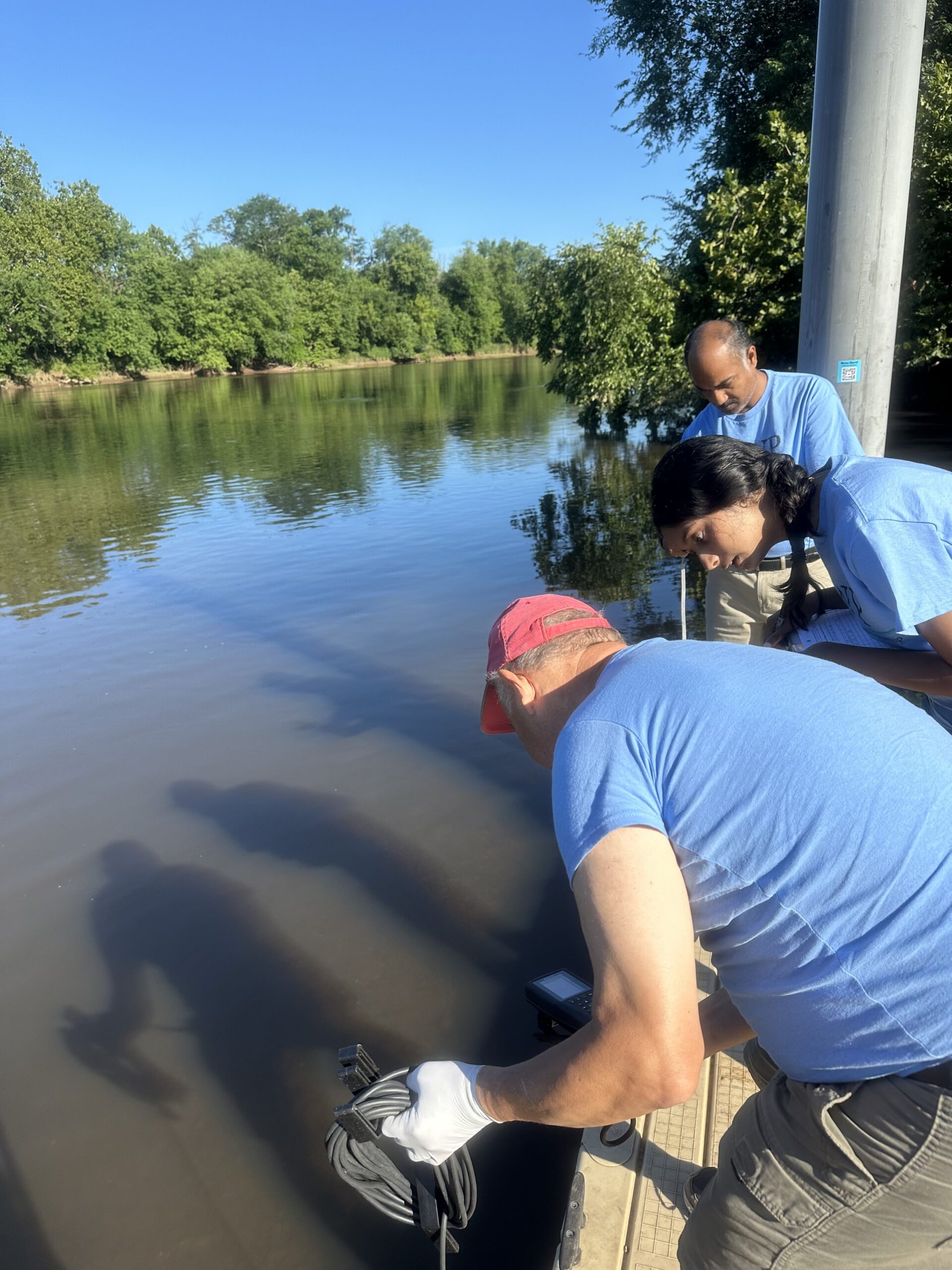
Sanil, Shely and Art cooperating diligently at our first site of the day, LR1 Riverside Park in Piscataway. Photo Credit: Jocelyn Palomino
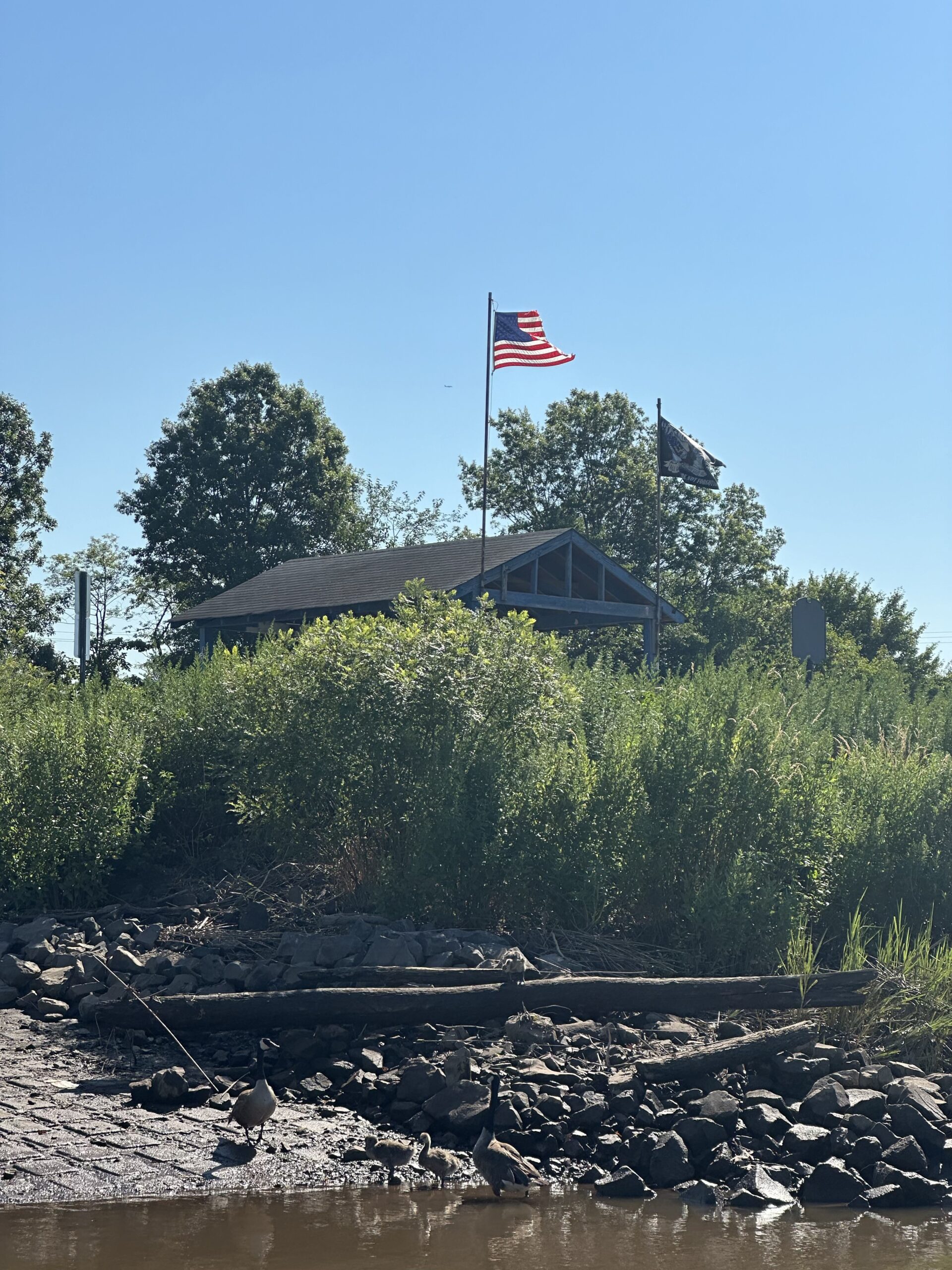
The vibrant colors of the American flag blowing from the winds at the Edison Boat Basin, HAVE A HAPPY FOURTH OF JULY! Photo Credit: Jocelyn Palomino
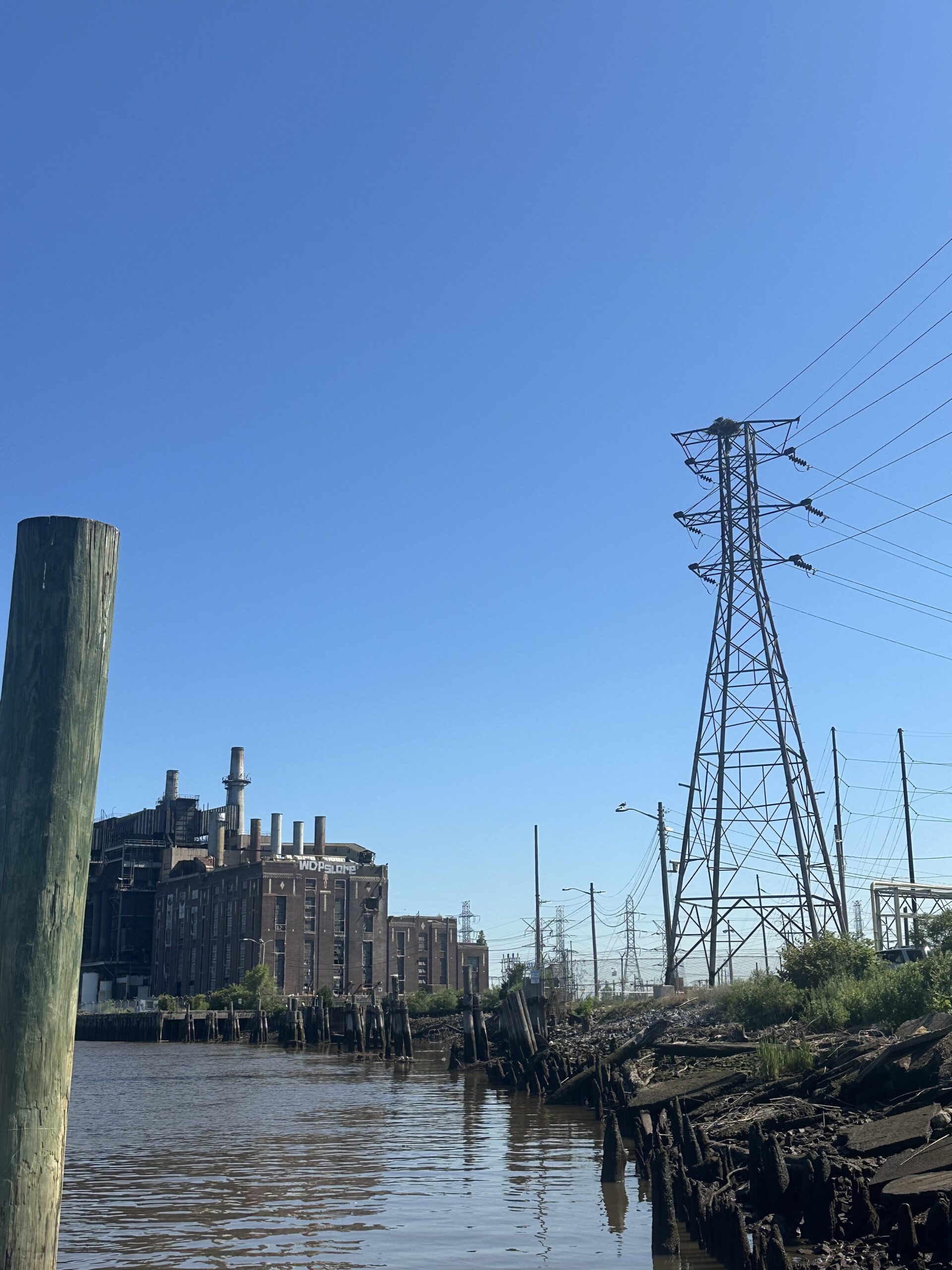
At our Sayreville site (Ken Buchanan Waterfront Park), we got a good look of the osprey nest that rests above the power line. We often see the parents hunting for their young, Photo Credit: Jocelyn Palomino
Sewa volunteer Shely Dash took her turn at wading into our downstream sites, managing both the YSI and sample catching. Thank you Shely! Photo Credit: Jocelyn Palomino
Very low tides at LR6 allowed the team to witness an extreme overflow of untreated sewage directly entering the water at Perth Amboy’s 2nd. Street Park. As always, please be sure to wash up after water-related activities on the Raritan, Photo Credit: Jocelyn Palomino
Every Thursday during the summer, from May to October, the Lower Raritan Watershed Partnership and Rutgers Cooperative Extension of Middlesex County run a volunteer-based monitoring program along the Raritan River. We collect water quality samples at six non-bathing public access beach sites, provide our samples to the Interstate Environmental Commission for analysis in their laboratory, and report the results to the public on Friday afternoons. Our mission is to share this data with the community and partners to ensure the safe use of the Raritan river for all.
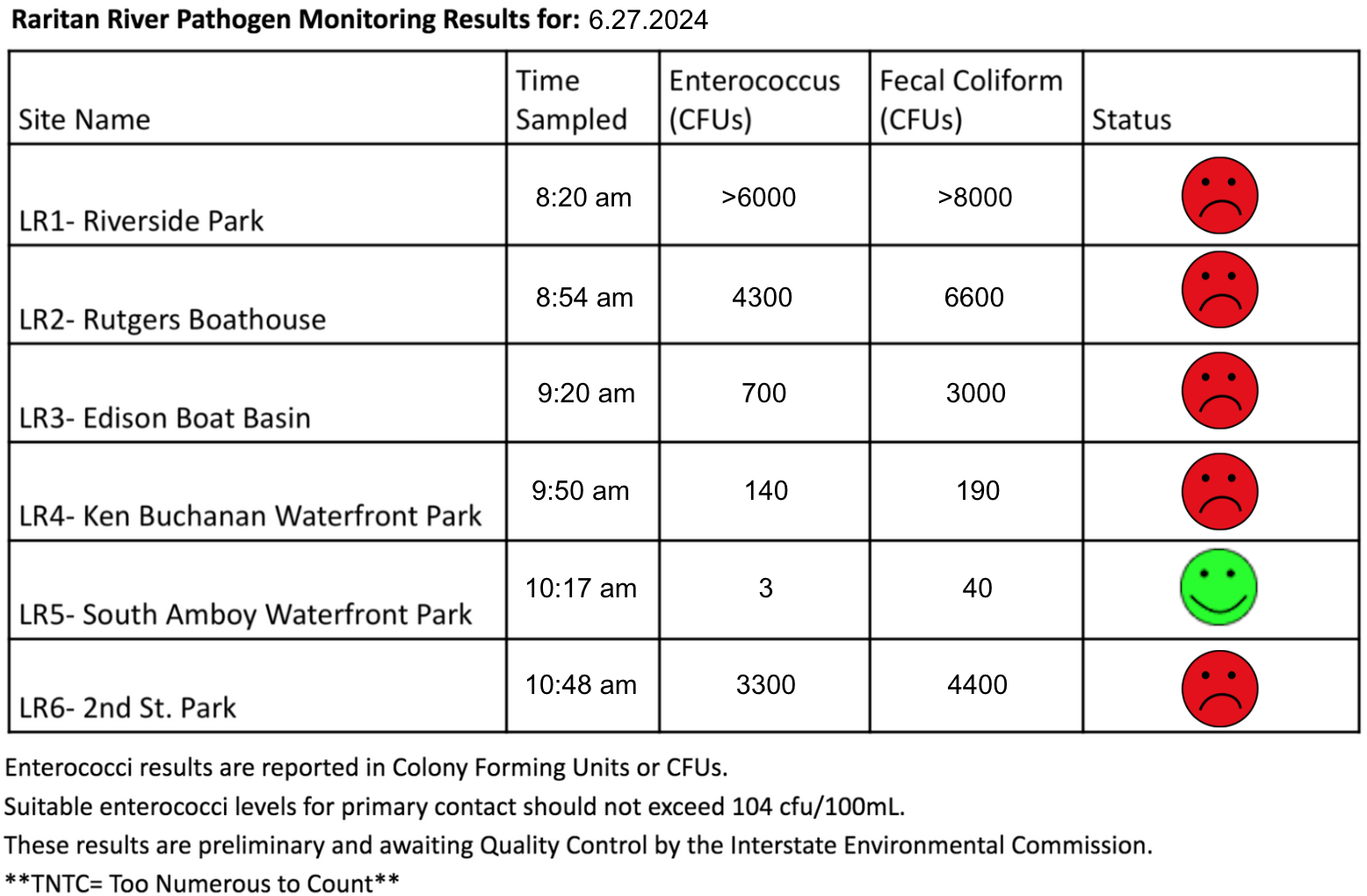
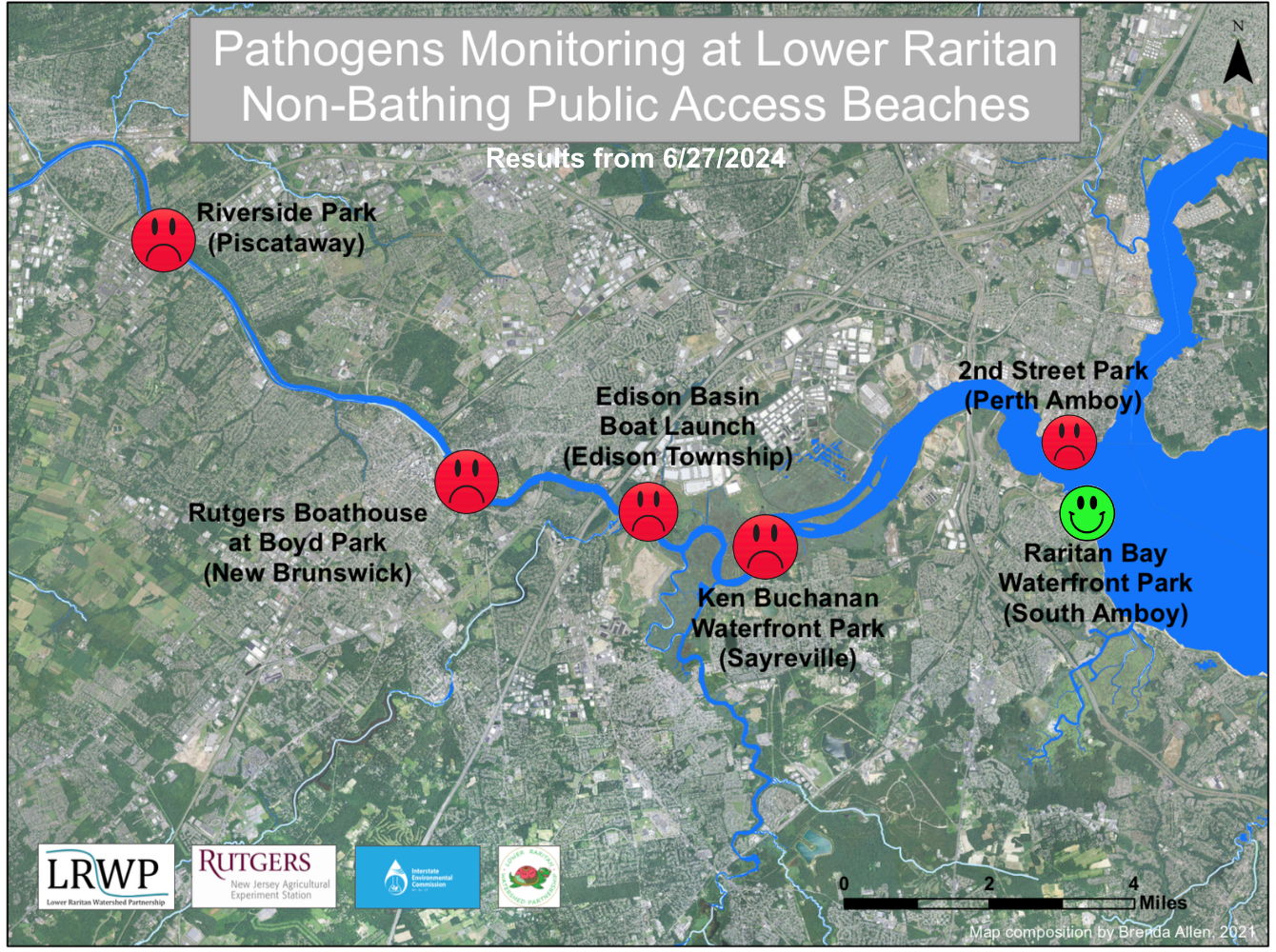
Our lab results for water quality samples taken on Thursday June 27, 2024 show Enterococcus bacteria levels exceeding the EPA federal water quality standard of 104 cfu/100mL at FIVE of our monitoring sites this week. Problem sites are indicated by red frowns on the map and chart which includes: Riverside Park (Piscataway), Rutgers Boathouse (New Brunswick) , Edison Boat Basin and Ken Buchanan Waterfront Park (Sayreville), and 2nd Street Park (Perth Amboy). Green smiles on the chart and map indicate the sites with bacteria levels safe for recreation, and include the following:, and South Amboy Waterfront Park (South Amboy).
Pathogens/Enterococci levels are used as indicators of the possible presence of disease-causing bacteriain recreational waters. Such pathogens may pose health risks to people coming in primary contact with the water (touching) through recreational activities like fishing, kayaking or swimming in a water body. Possible sources of bacteria include Combined Sewer Overflows (CSOs), improperly functioning wastewater treatment plants, stormwater runoff, leaking septic systems, animal carcasses, and runoff from manure storage areas.
Our goal in reporting these results is to give residents a better understanding of the potential health risks related to primary contact during water-based recreation. If you are planning on recreating on the Raritan this weekend, make sure to stay safe and wash up after any activities!
Long-time volunteer Frank Dahl showing first-time water quality volunteer Art Allgauer the ropes on conducting a visual habitat assessment at our monitoring sites, Photo Credit: Jocelyn Palomino
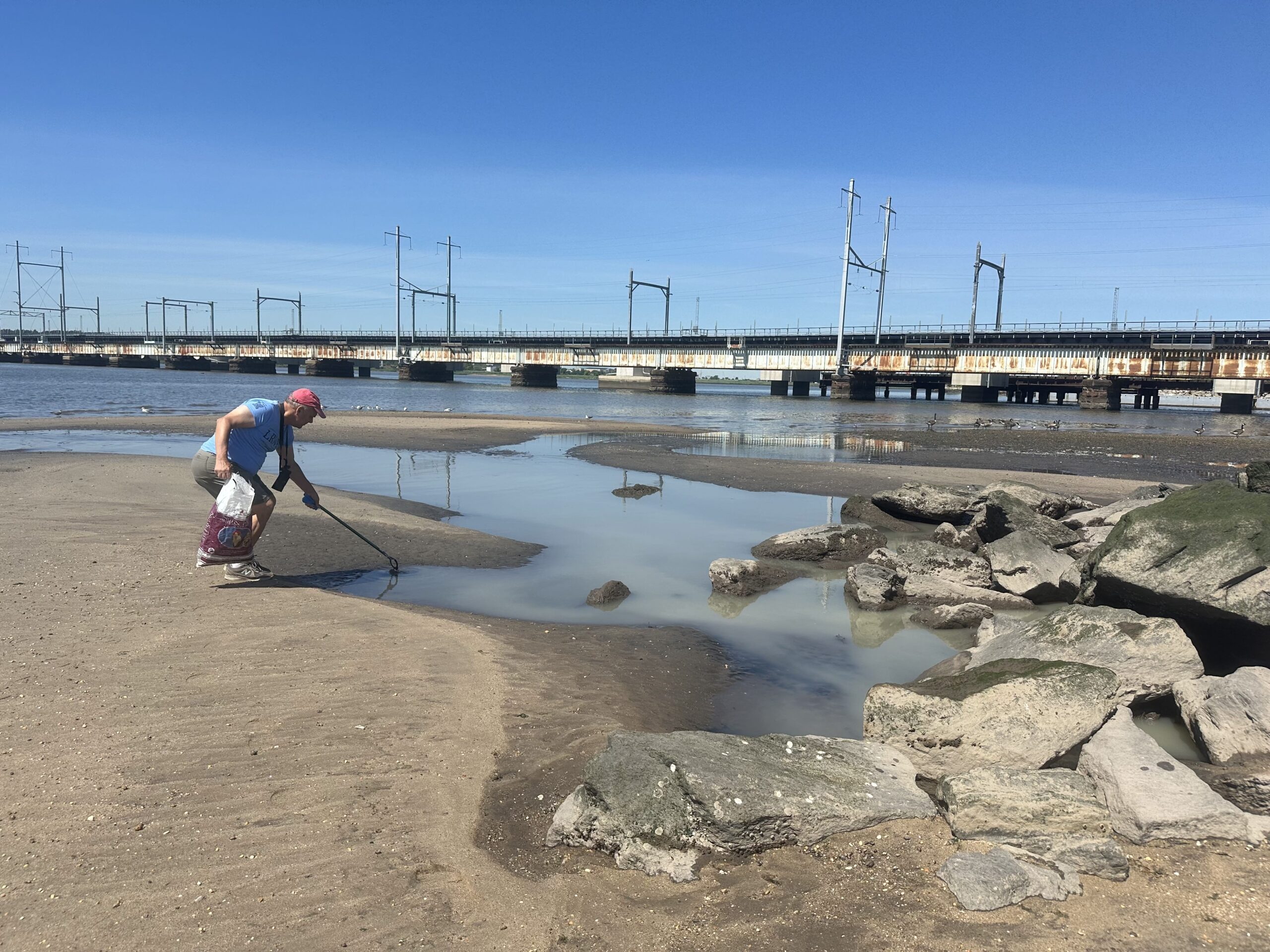
This year, we implemented a new role for volunteers to perform “mini clean-ups” of our sites while the rest of team collects samples and field data, it gives us an opportunity to leave our sites a little cleaner each week, Photo Credit: Jocelyn Palomino
We were also joined by our friends from Sewa International Central Jersey Chapter who were a great contribution to catching our samples for the week: Shely Dash, Thulasi Nambiar and Sanil Nambiar!
Water quality monitoring is indeed a team effort- big thanks to all our volunteers this week for coming out to do their part for the benefit of the community and environment!! Photo Credit: Frank Dahl (left) and Jocelyn Palomino (right)
On Sunday May 19th the LRWP hosted a ribbon cutting for a very special project within the Lower Raritan Watershed, a mechanical in-stream pollution reduction device installed at the Green Brook at the convergence of three towns (Dunellen, Middlesex and Plainfield) and three counties (Somerset, Middlesex and Union). The “Bandalong Bandit Litter Trap” in the Green Brook, designed and manufactured by the Georgia-based Stormwater Systems, Inc. and maintained by the Borough of Dunellen, is the first of its kind in New Jersey.
The Litter Trap project was selected for implementation as part of the Cornell-Dubilier Electronics Natural Resource Damage Assessment and Restoration (NRDAR) Restoration Plan. The Cornell-Dubilier NRDAR Plan is an example of how the nation’s strong Superfund Laws truly hold polluters accountable for environmental damages in our communities. A project seven years in the making, the LRWP appreciates the hard work and dedication of our project partners: Central Jersey Stream Team, the Boroughs of Dunellen and Green Brook, and the Cornell-Dubilier Superfund Site Trustees including the National Oceanic and Atmospheric Administration, the US Fish and Wildlife Service and the New Jersey Department of Environmental Protection. Several members of these organizations were on hand to celebrate installation of this mechanical in-stream pollution reduction device.
The “Bandit Litter Trap” is a floating cage anchored by two booms which direct floating trash into the cage where it is captured to be removed at regular intervals by municipal staff. The device is designed to simplify removal of litter from the waterway, minimizing DPW and volunteer efforts to keep our streams clean, and helping to improve water quality, environmental habitat, and human drinking water supplies. In addition to aiding in management of floatable waste in the Green Brook, the device will help us better understand the types of waste that end up in our local streams, and will help amplify community stewardship efforts for healthier urban waterways throughout the state.
In addition to LRWP Board Members Anton Getz and Heather Fenyk, LRWP Project Coordinator Clare Levourne and Project Volunteer Gregg Bucino, attending the ribbon cutting were Cornell Dubilier Superfund Site Trustee Jillian Stark with the US Fish and Wildlife Service, Dunellen Mayor Jason Cilento, Green Brook Mayor Jim Van Ardsdale, Assemblywoman Linda S. Carter, and Environmental Commissioners and Council members from surrounding towns.
Simultaneous to the ribbon cutting, over a hundred volunteers joined in the annual multi-site clean-up of the Green Brook, with clean-up activities at public parks in Dunellen, Green Brook, Plainfield and Middlesex and thousands of pounds trash were removed from the Green Brook floodplains and waterways. Trash is the most visible form of pollution in the Green Brook, and aquatic trash significantly reduces water quality, damages habitats, and causes aesthetic blight, ecological effects, economic impacts, and potential human health risks.
A key goal of the Litter Trap is to reduce the need for volunteer clean-ups, and to benefit aquatic and semi-aquatic wildlife. To better understand the impact of the Litter Trap on aquatic life going forward, from February-May 2024 the LRWP invited the Green Brook community to partner in a baseline study of American Glass Eel at an artificial eel habitat (an “eel mop”) installed approximately 100 feet upstream of the Litter Trap site. Read more about our eel study, and our findings, here. Apart from improving water quality and benefiting aquatic life, the implementation of the trap should also enhance the area’s aesthetics and improve public perception.
The Bandalong Bandit Litter Trap can operate year-round under various flow conditions without mechanical assistance, but the trash needs to be emptied at appropriate intervals, and the device must be checked after every rainfall exceeding 1 inch. It takes 2-3 months to figure out debris management and to establish a maintenance schedule. Litter surveys and collection of litter data are part of establishing this schedule, and can yield information about device impact. The LRWP will develop an outreach program for Bandalong installation in the Green Brook, including at least two public litter surveys and collection and reporting of litter data. This will involve a partial-volunteer trash removal program with training on how to measure and remove trash from the litter traps. This should also further strengthen community ties and current litter reduction efforts.