The last pathogen monitoring session of the season took place on Thursday, October 2nd. Each week during the summer, from May to October, the Lower Raritan Watershed Partnership and Rutgers Cooperative Extension of Middlesex County run a volunteer-based monitoring program along the Raritan River. We collect water quality samples at six non-bathing public access beach sites, provide our samples to the Interstate Environmental Commission for analysis in their laboratory, and report the results to the public. Our mission is to share this data with the community and partners to ensure the safe use of the Raritan river for all.
To close out the 2026 season, we were joined in the field by Dr. Anne Gharaibeh, Visiting Professor of Landscape Architecture from Jordan University of Science and Technology, and Patty Oehmke, Rutgers Family and Community Health Sciences Professor of Practice. We were also joined by our new Rutgers research intern Margaret Reinerth. Welcome, Margaret!
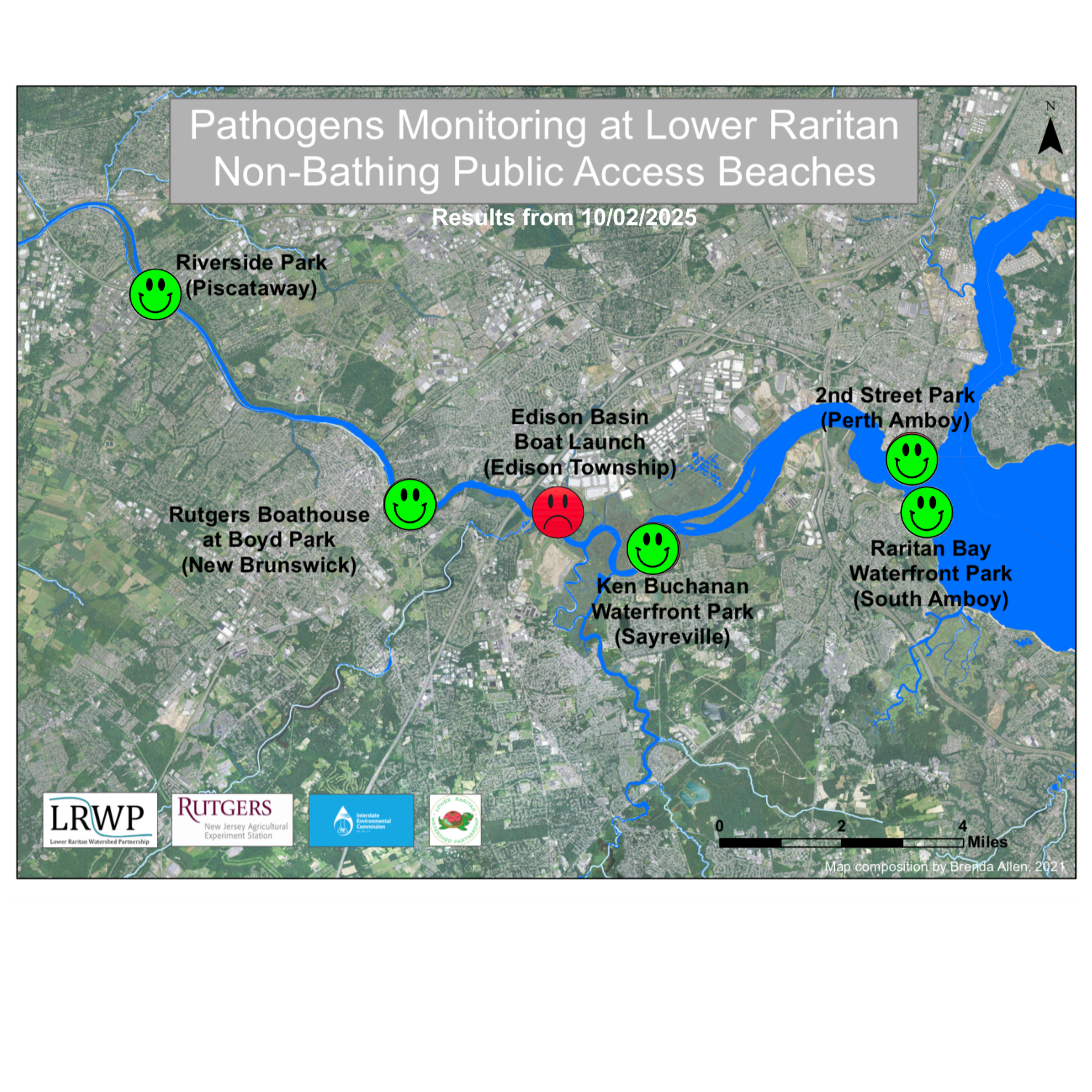
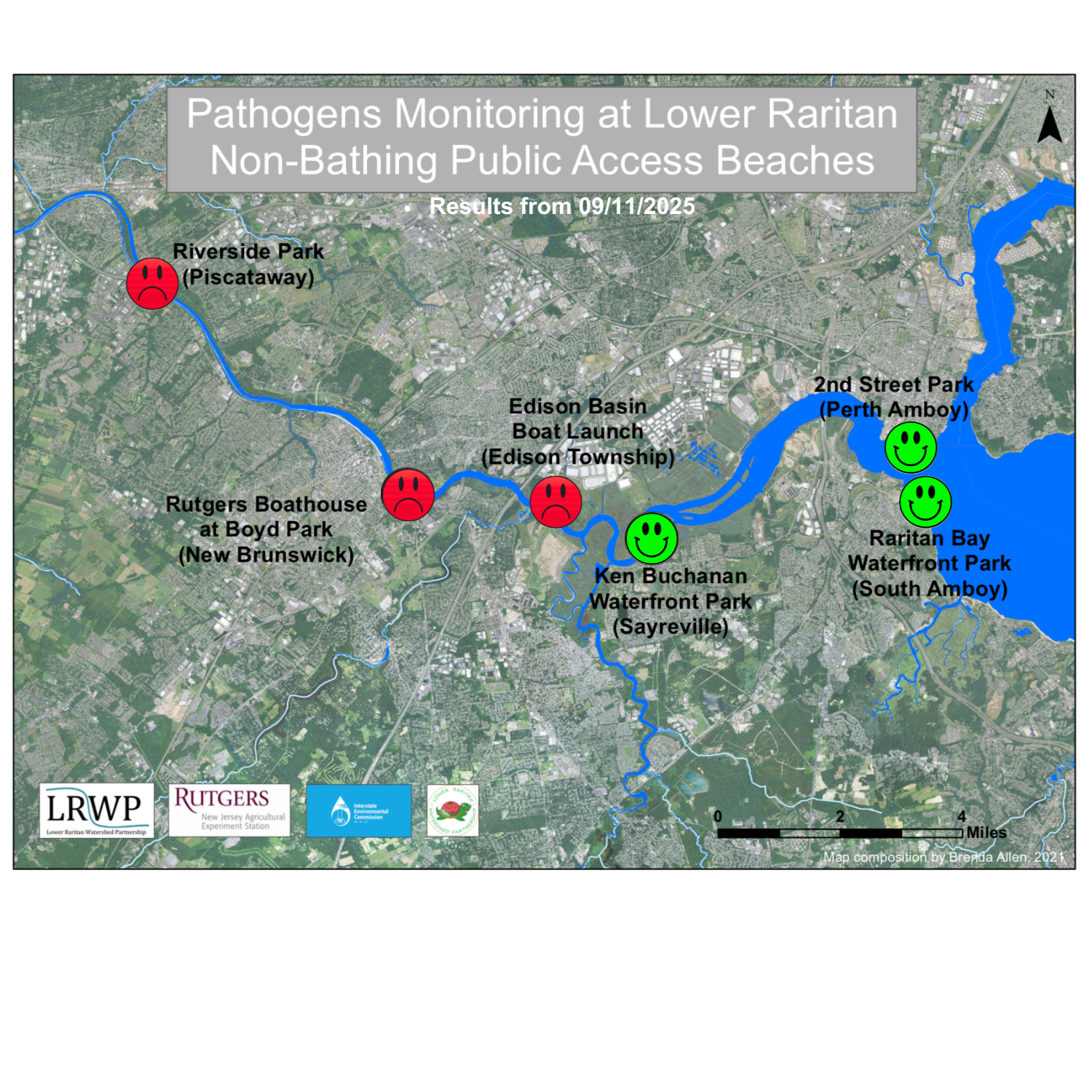
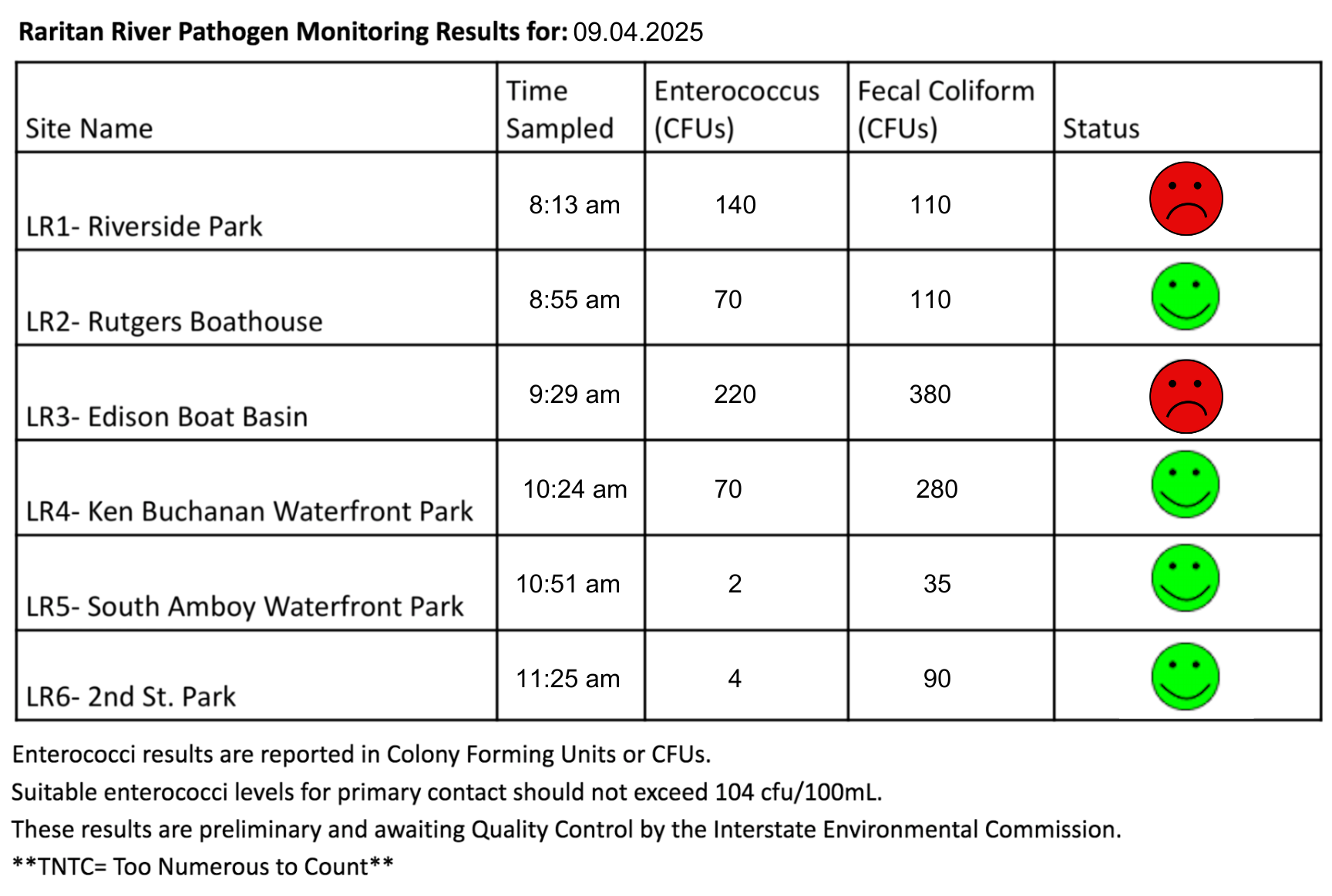
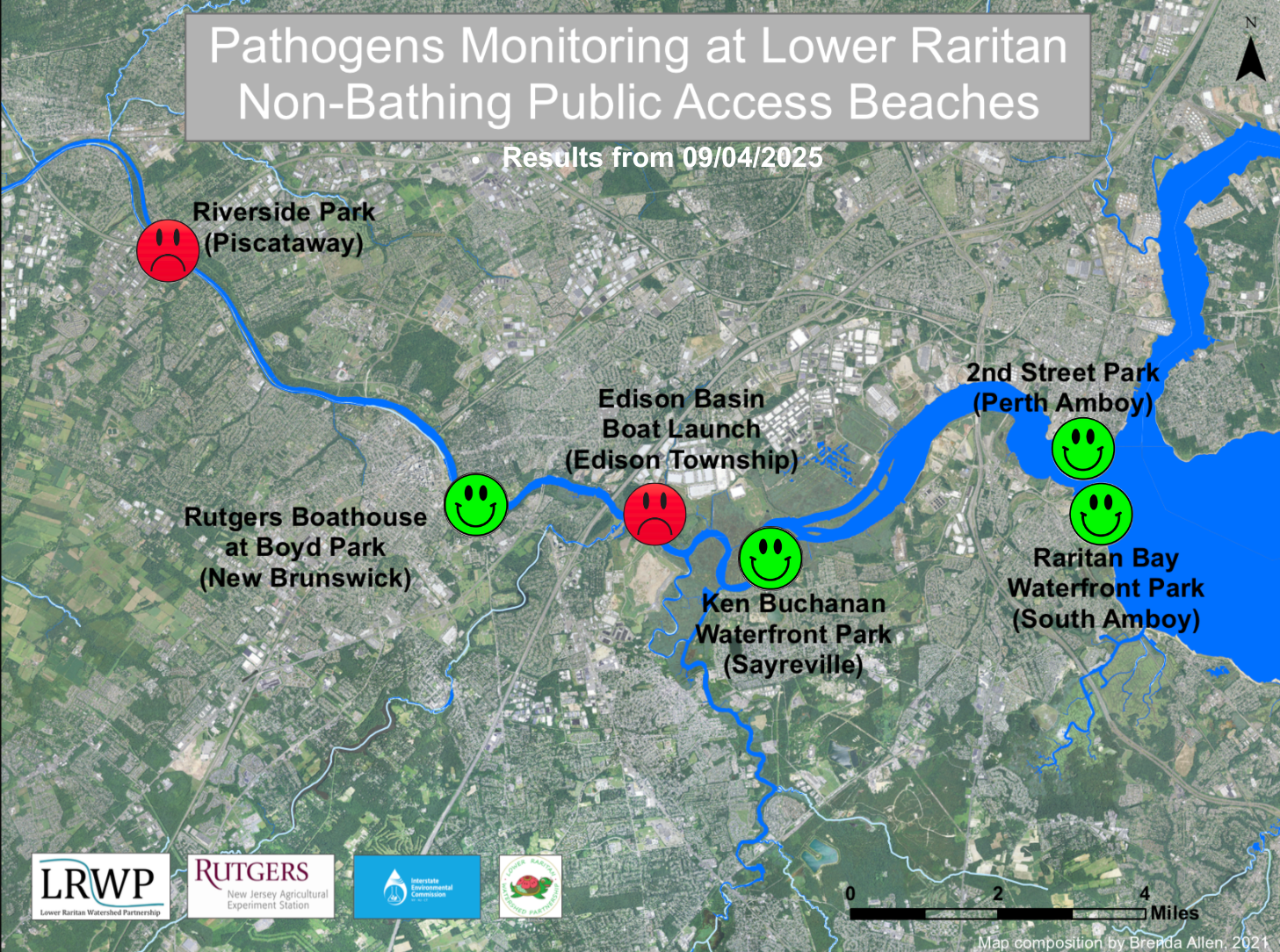
Our lab results for water quality samples taken on Thursday, October 2nd, 2025 show Enterococcus bacteria levels exceeding the EPA federal water quality standard of 104 cfu/100mL at one of our monitoring sites this week. Problem sites would be indicated by red frowns on the map and chart; this week, the only red frown was at the Edison Boat Basin(Edison Township). Green smiles on the chart and map indicate the sites with bacteria levels safe for recreation, and include the following: Riverside Park (Piscataway), Rutgers Boathouse (New Brunswick), Ken Buchanan Waterfront Park (Sayreville), Raritan Bay Waterfront Park (South Amboy), and 2nd Street Park (Perth Amboy).
Pathogens/Enterococci levels are used as indicators of the possible presence of disease-causing bacteria in recreational waters. Such pathogens may pose health risks to people coming in primary contact with the water (touching) through recreational activities like fishing, kayaking or swimming in a water body. Possible sources of bacteria include Combined Sewer Overflows (CSOs), improperly functioning wastewater treatment plants, stormwater runoff, leaking septic systems, animal carcasses, pet waste, wildlife waste, and runoff from manure storage areas.
Our goal in reporting these results is to give residents a better understanding of the potential health risks related to primary contact during water-based recreation. If you are planning on recreating on the Raritan this weekend, make sure to stay safe and wash up after any activities!
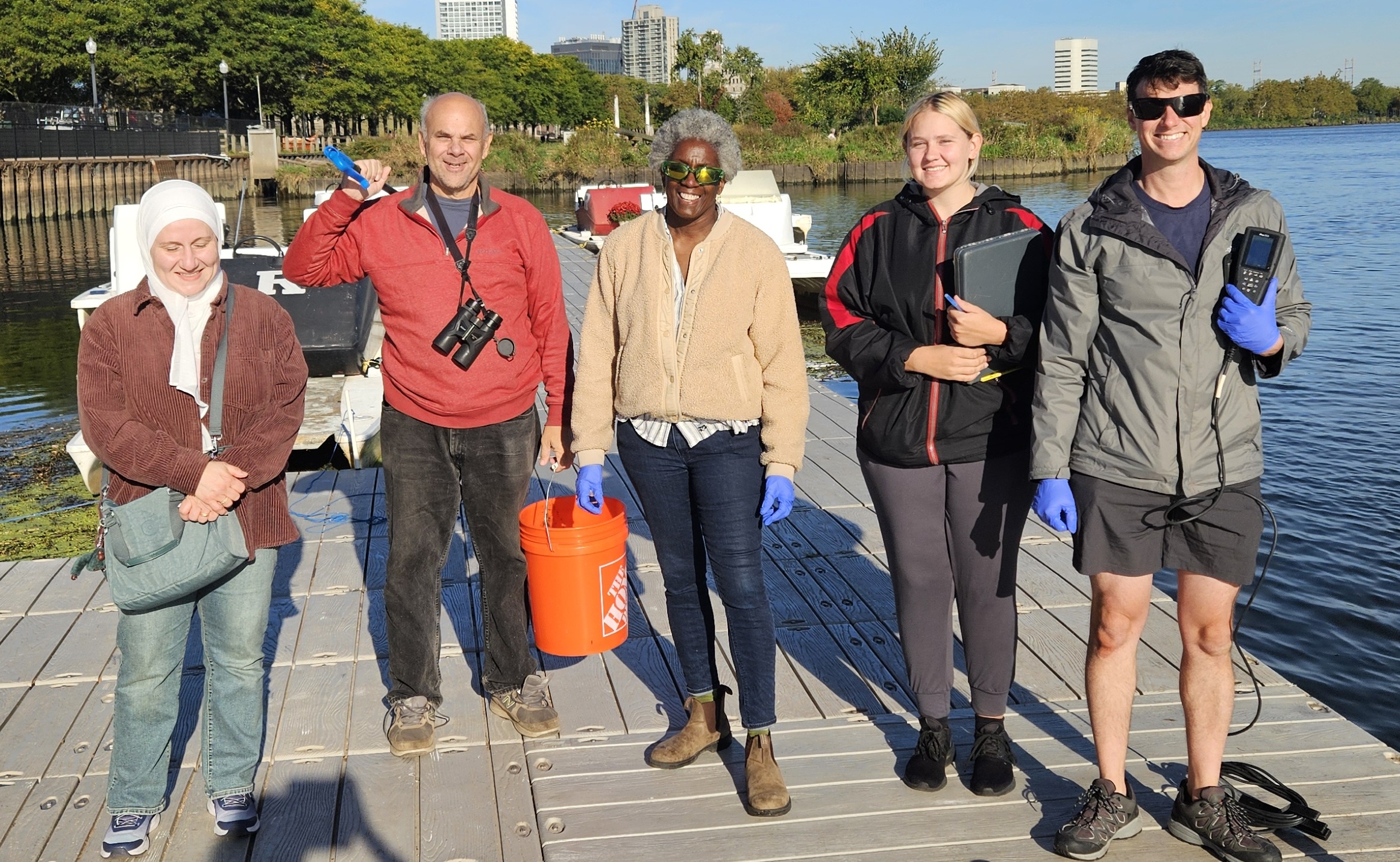
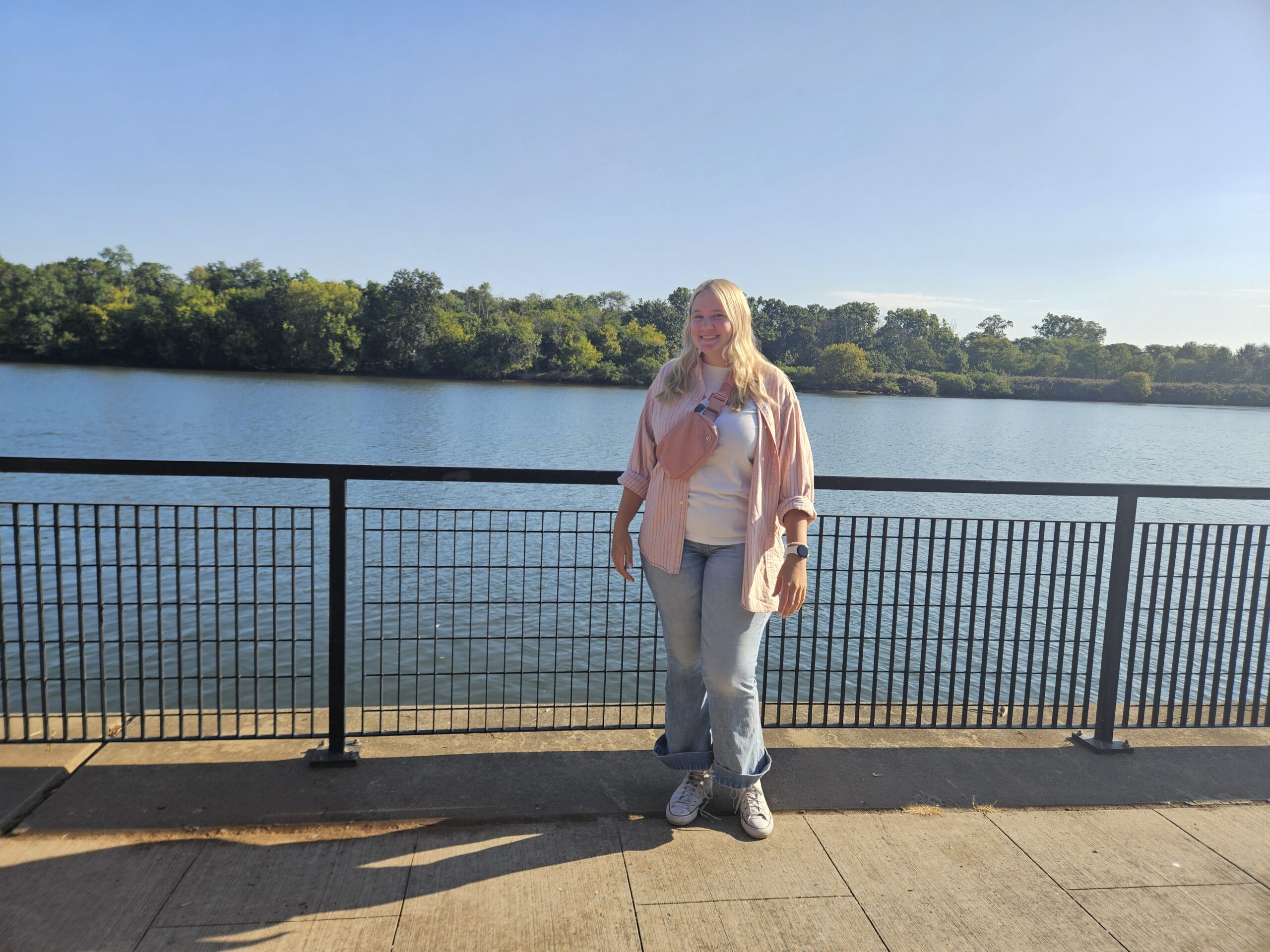
From left to right, Dr. Anne Gharaibeh (Visiting Professor of Landscape Architecture from Jordan University of Science and Technology), Art Allgauer, Patty Oehmke (Rutgers Family and Community Health Sciences Professor of Practice), Margaret Reinerth, and John Meyer. Photo credit: Heather Fenyk.
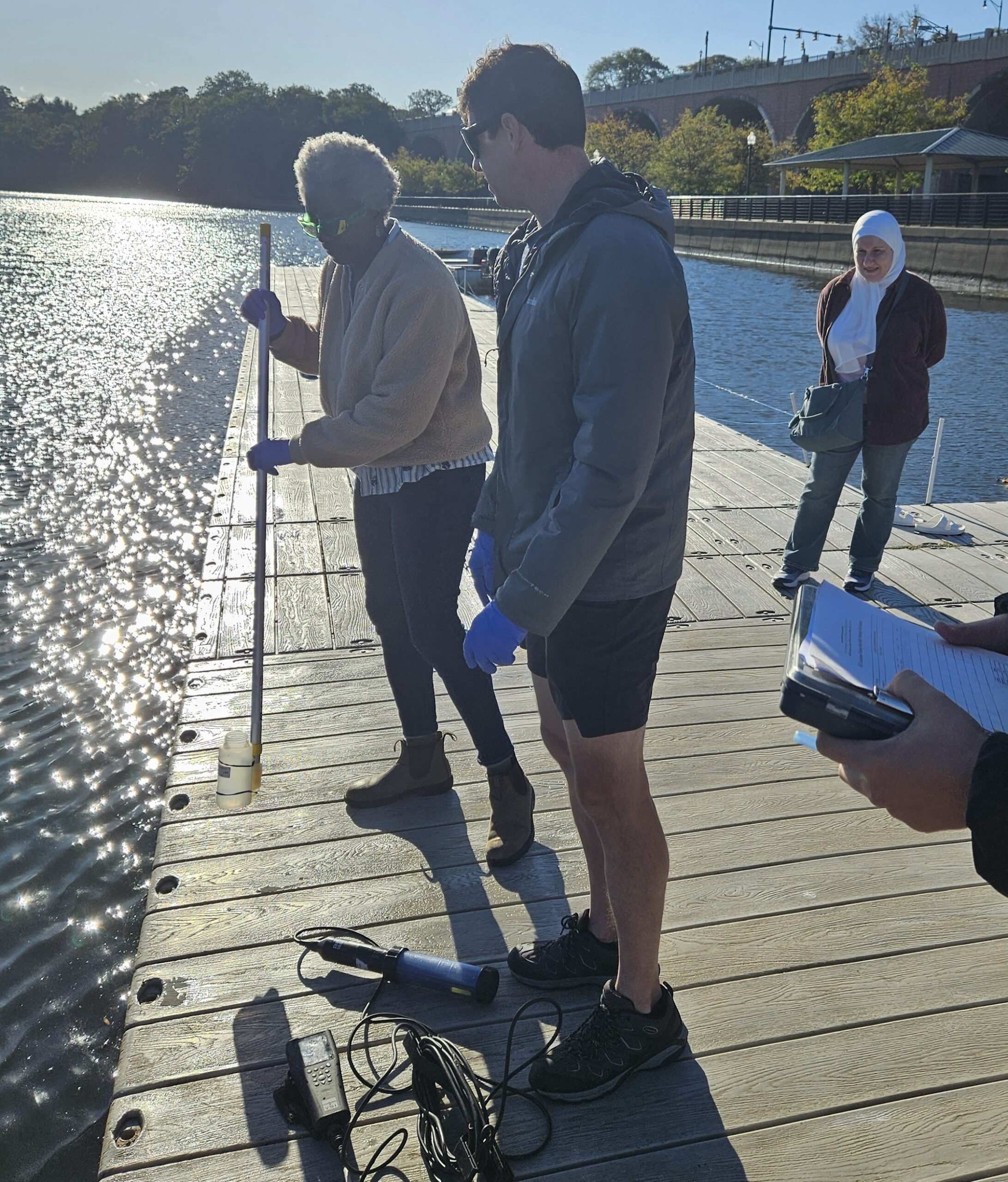
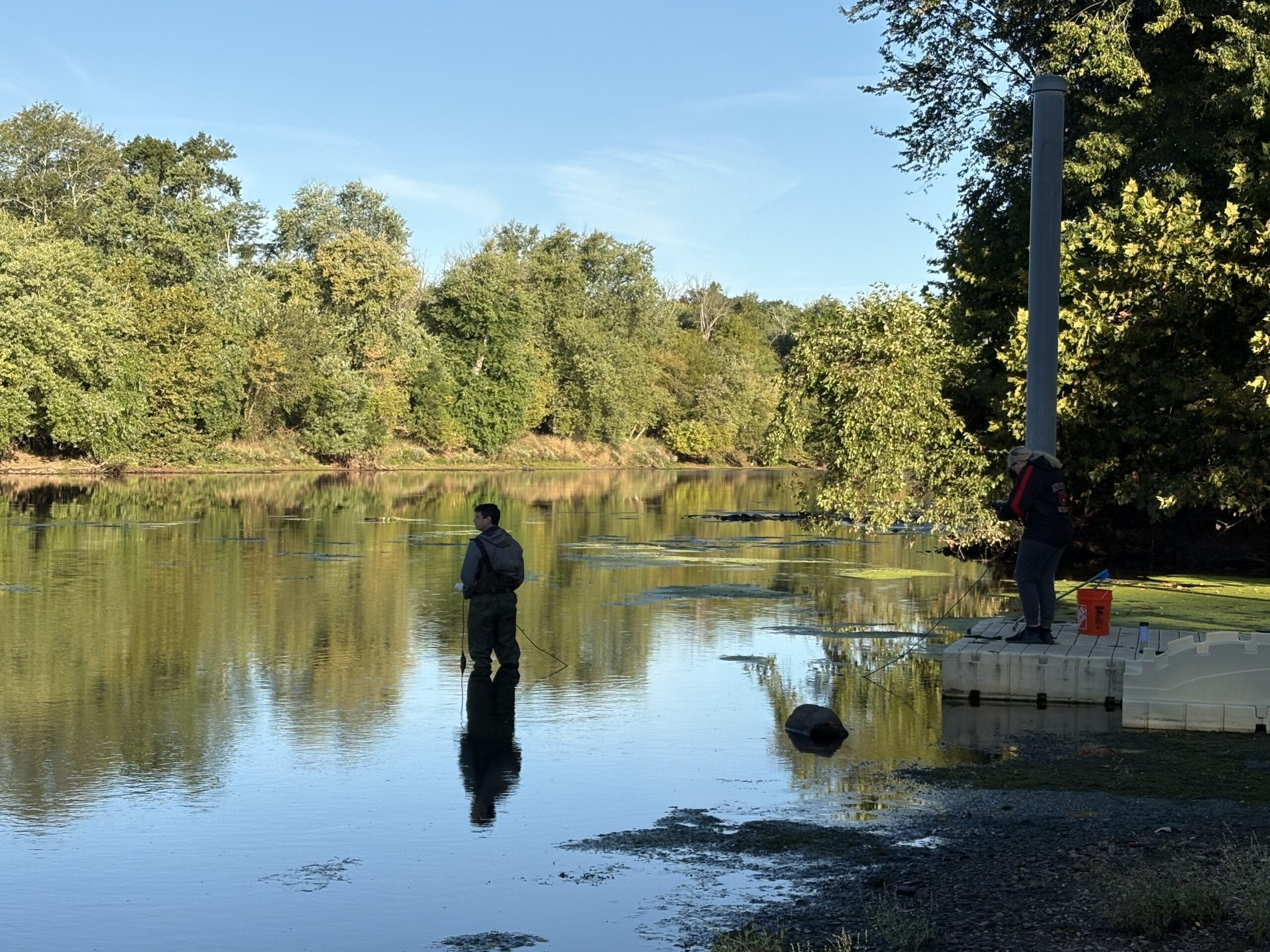
Patty Oehmke gathers a sample from the Raritan River. Photo credit: Heather Fenyk.
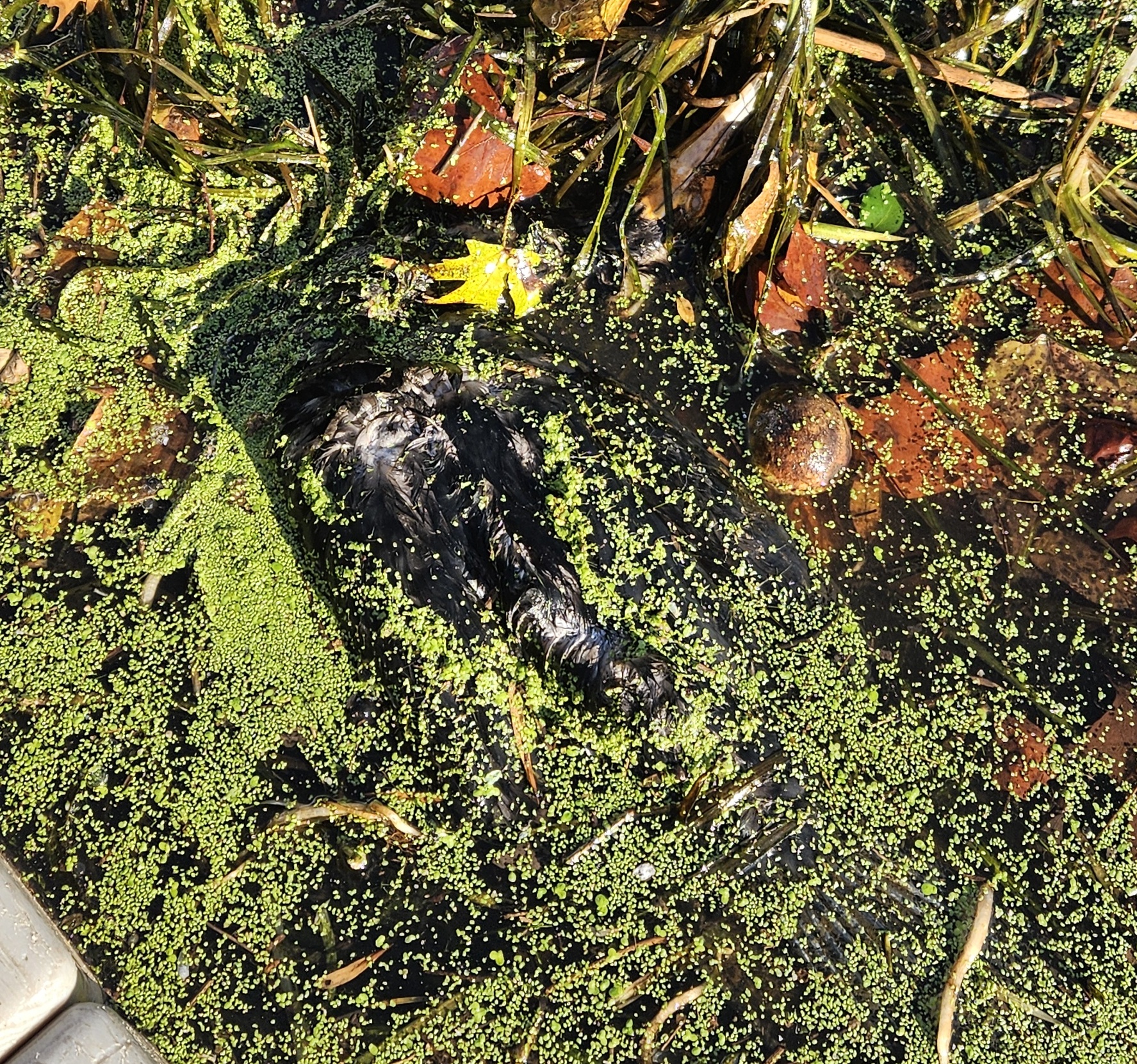
A deceased double-crested cormorant (Nannopterum auritum) floats in the water near the Rutgers Boat House in New Brunswick. Photo credit: Heather Fenyk.
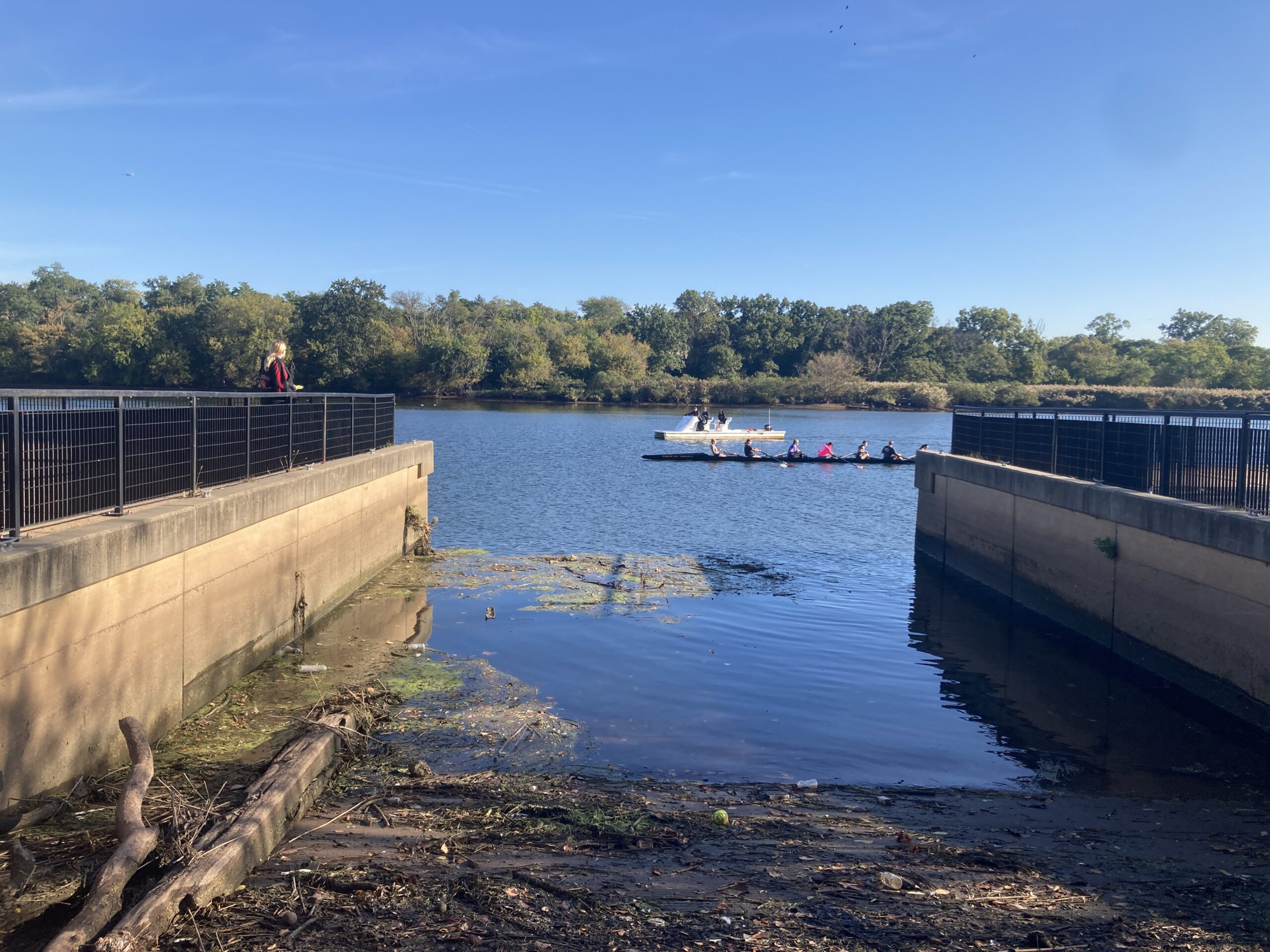
A Rutgers crew team pulls past the Boyd Park boat launch in New Brunswick. Photo credit: J.M. Meyer.
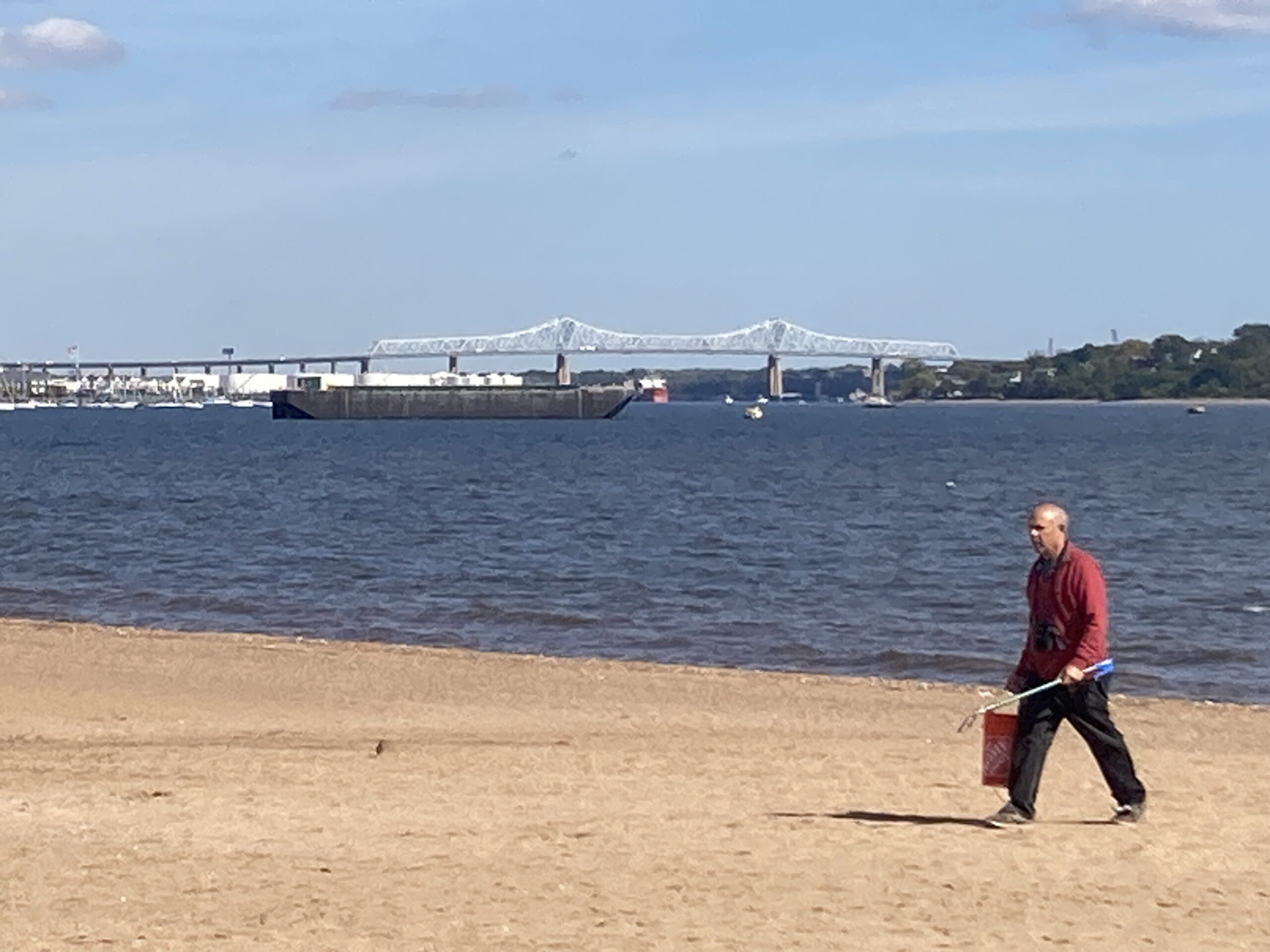
Art Allgauer has been our most steadfast volunteer this season. He specialized in completing our visual habitat assessment at each of the six sites, and he personally removed over 50 gallons of litter from our shoreline (possibly far more). Thank you, Art! Photo credit: J.M. Meyer.
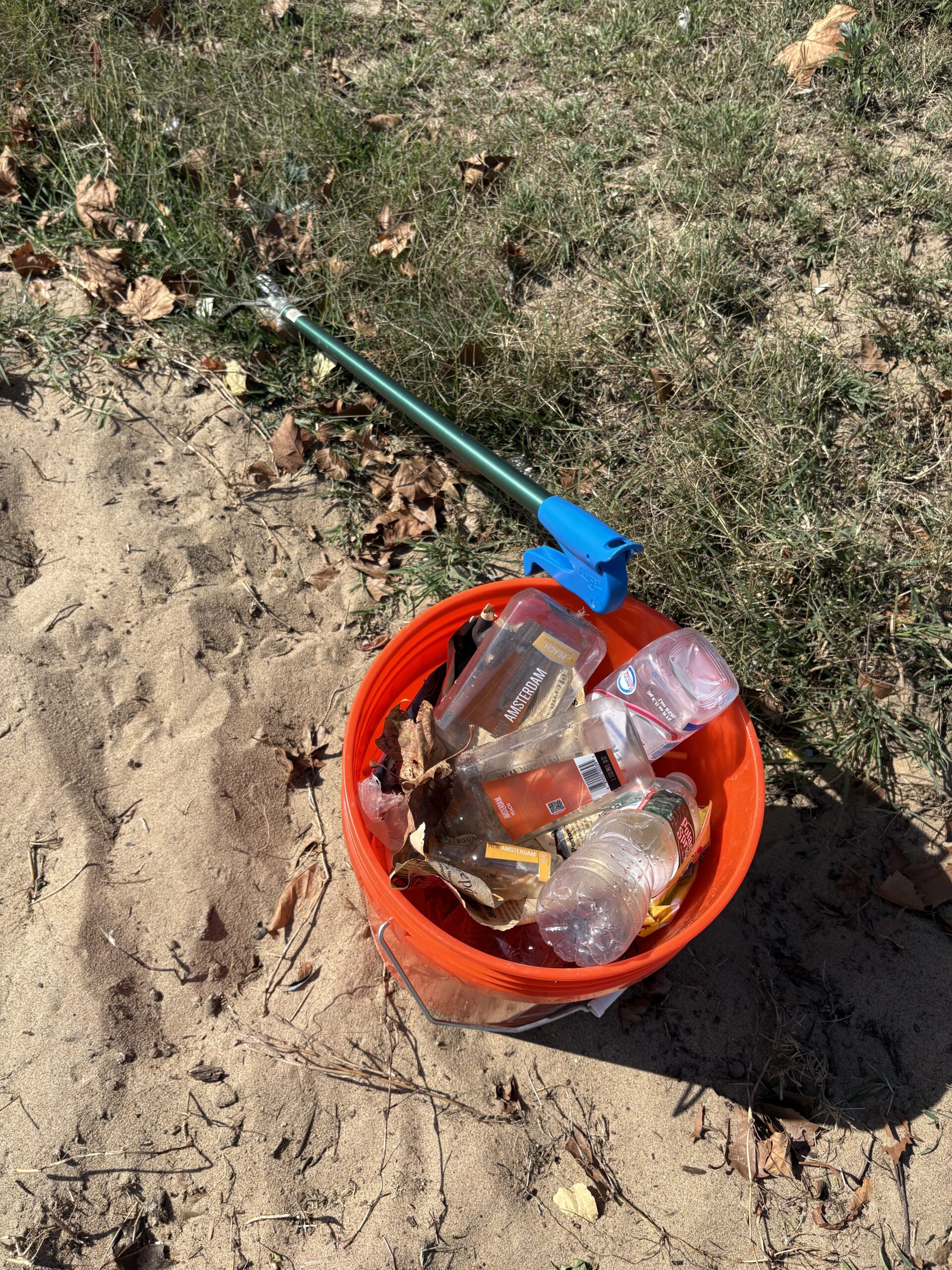
Trash collected from Perth Amboy’s 2nd Street park. Photo credit: Art Allgauer.
John and Margaret use the YSI sonde to gather data in Piscataway. Photo credit: Art Allgauer.
The third pathogen monitoring session of the month took place on Thursday, September 18th. Each week during the summer, from May to October, the Lower Raritan Watershed Partnership and Rutgers Cooperative Extension of Middlesex County run a volunteer-based monitoring program along the Raritan River. We collect water quality samples at six non-bathing public access beach sites, provide our samples to the Interstate Environmental Commission for analysis in their laboratory, and report the results to the public. Our mission is to share this data with the community and partners to ensure the safe use of the Raritan river for all.
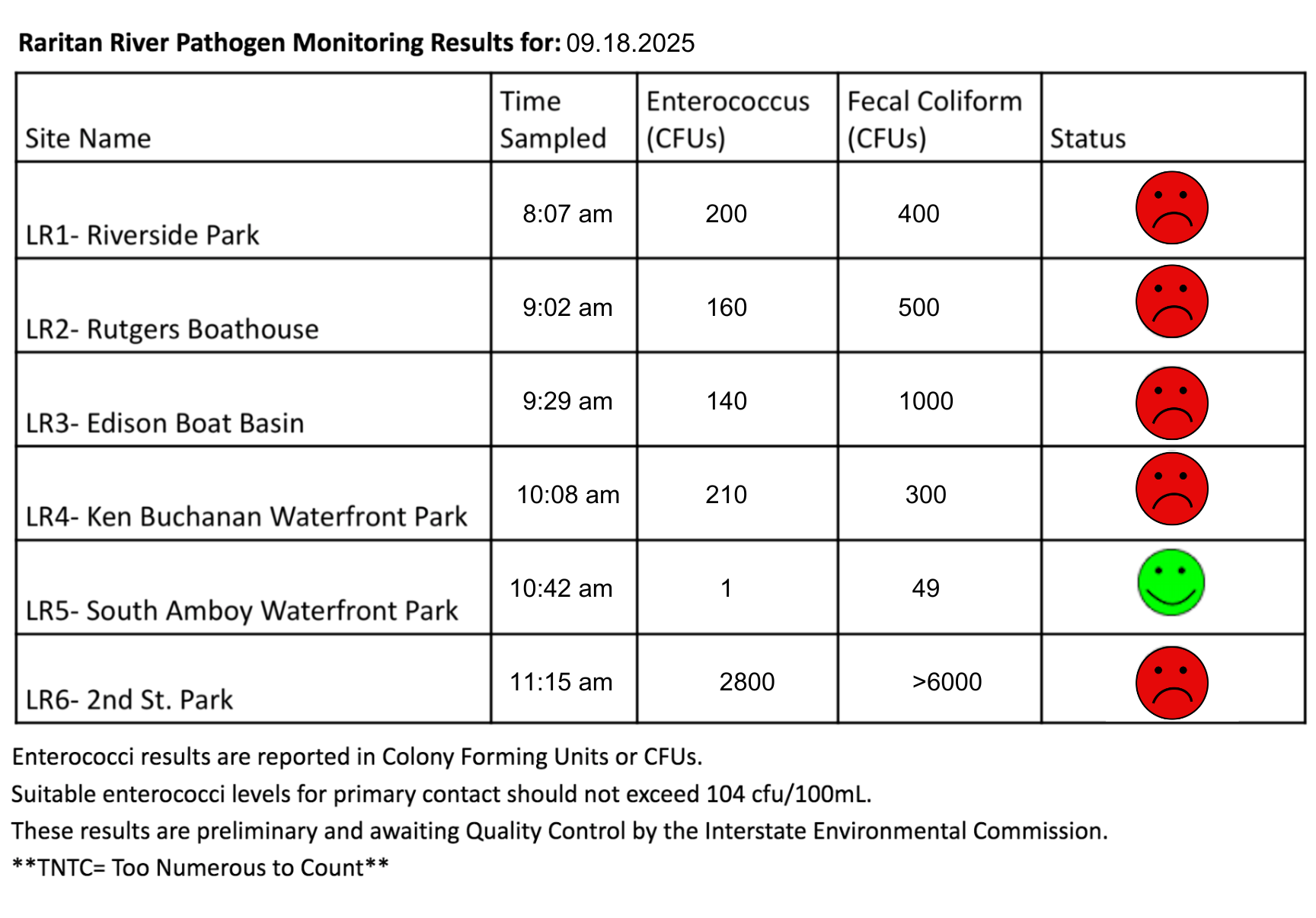
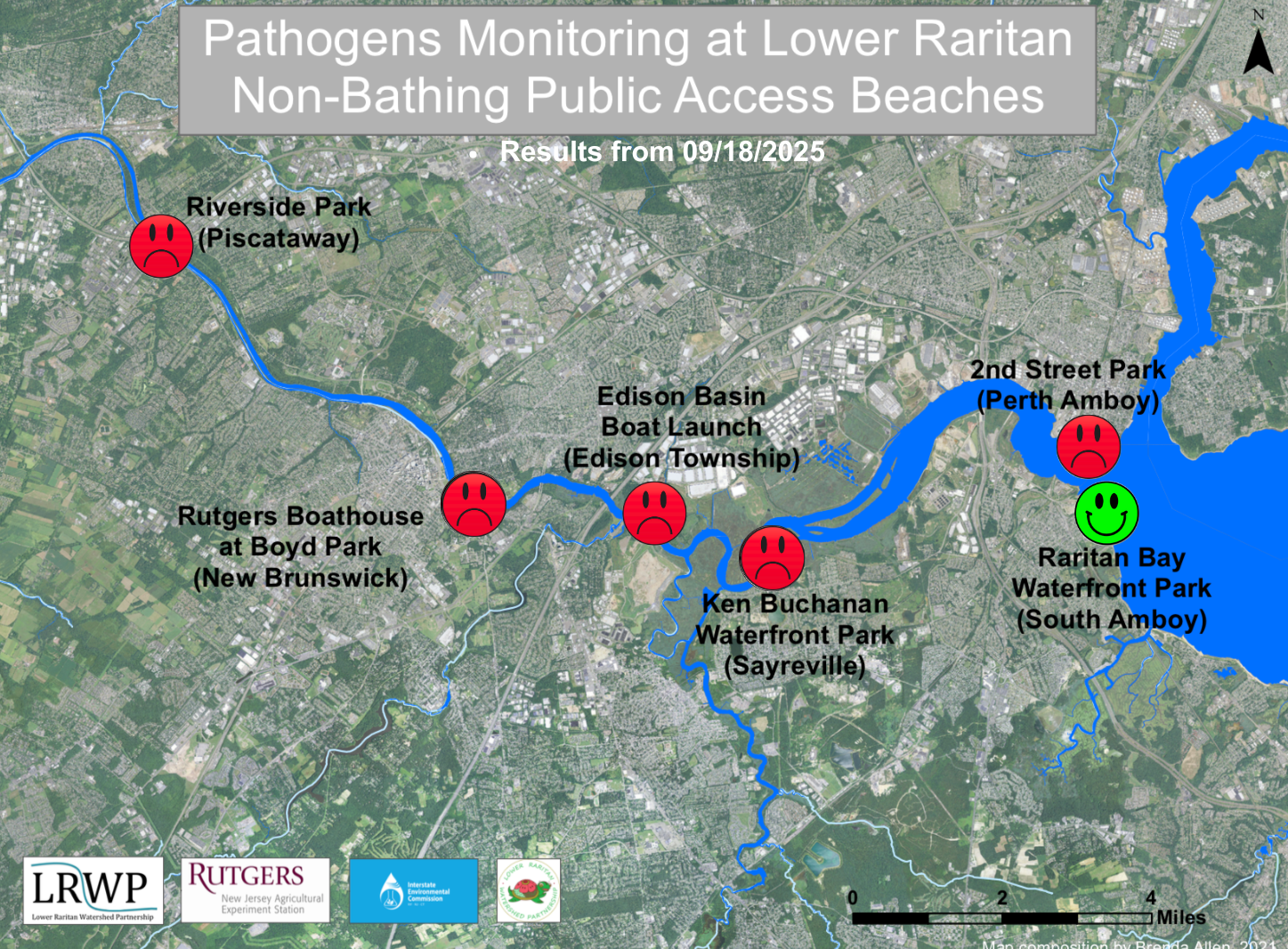
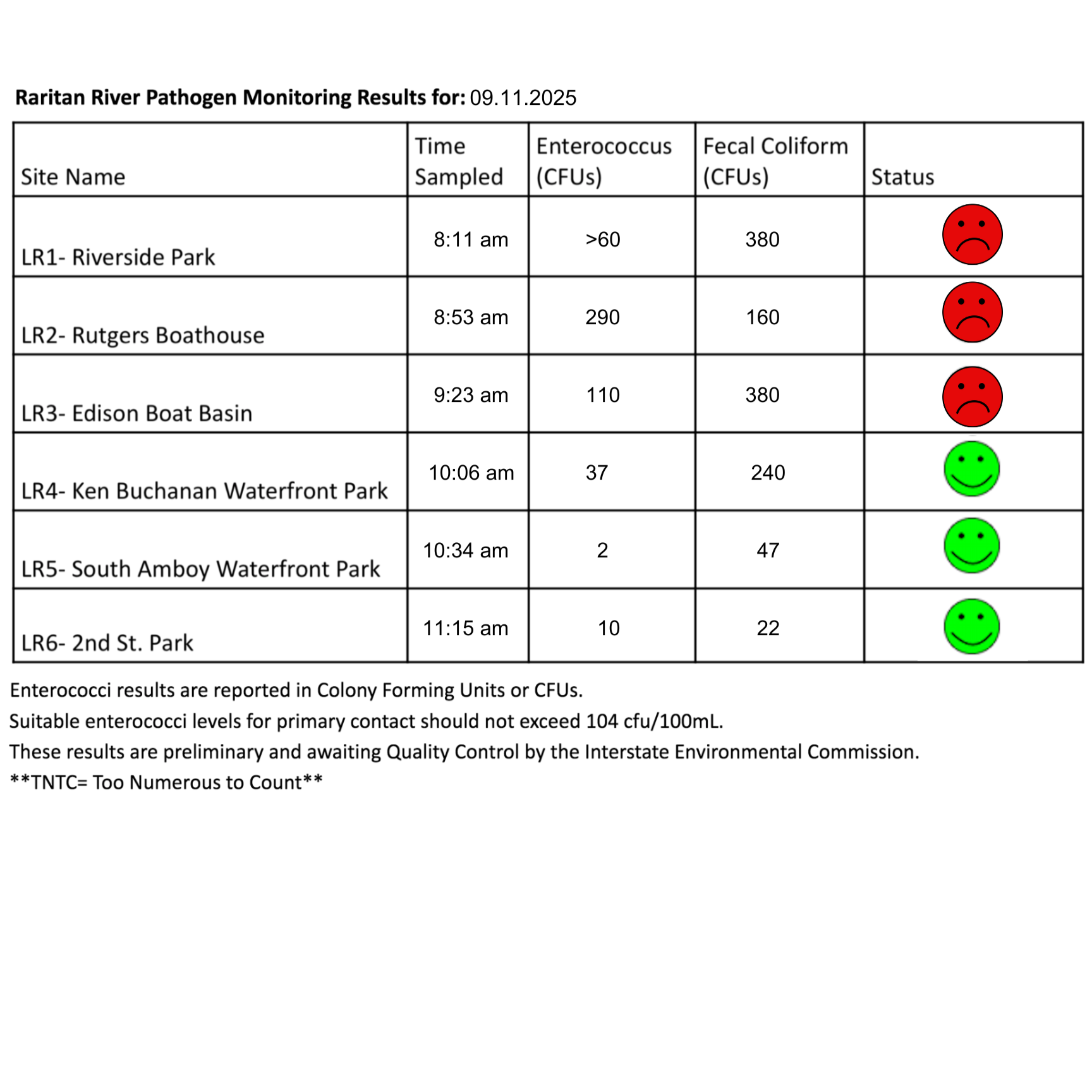
Our lab results for water quality samples taken on Thursday, September 18th, 2025 show Enterococcus bacteria levels exceeding the EPA federal water quality standard of 104 cfu/100mL at five of our monitoring sites this week. Problem sites would be indicated by red frowns on the map and chart which includes: Riverside Park (Piscataway), Rutgers Boathouse (New Brunswick), Edison Boat Basin(Edison Township), and Ken Buchanan Waterfront Park (Sayreville), and 2nd Street Park (Perth Amboy). Out of an abundance of caution, a red fown has been assigned to it. Green smiles on the chart and map indicate the sites with bacteria levels safe for recreation, and include the following: Raritan Bay Waterfront Park (South Amboy).
Pathogens/Enterococci levels are used as indicators of the possible presence of disease-causing bacteria in recreational waters. Such pathogens may pose health risks to people coming in primary contact with the water (touching) through recreational activities like fishing, kayaking or swimming in a water body. Possible sources of bacteria include Combined Sewer Overflows (CSOs), improperly functioning wastewater treatment plants, stormwater runoff, leaking septic systems, animal carcasses, pet waste, wildlife waste, and runoff from manure storage areas.
Our goal in reporting these results is to give residents a better understanding of the potential health risks related to primary contact during water-based recreation. If you are planning on recreating on the Raritan this weekend, make sure to stay safe and wash up after any activities!
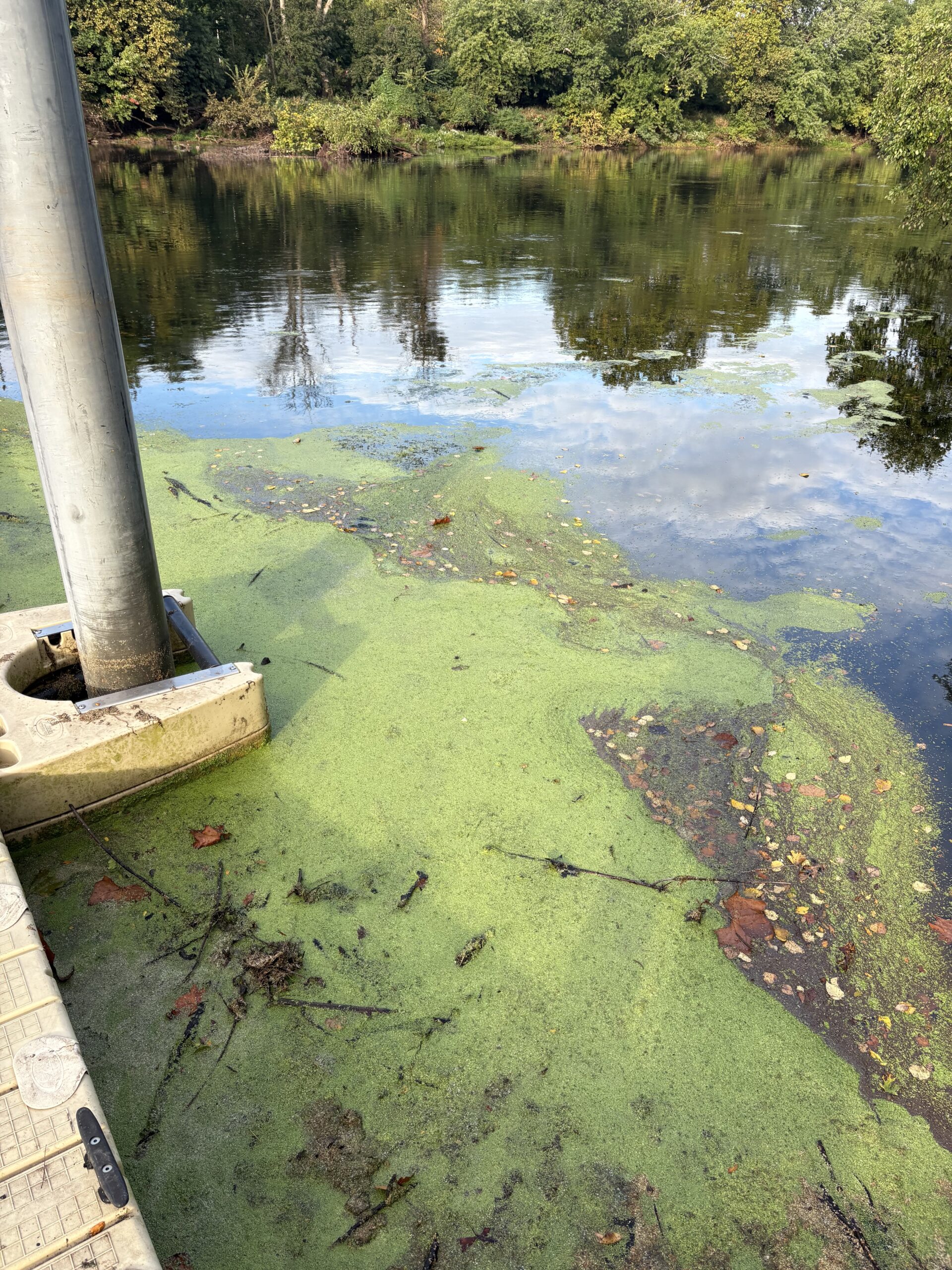
After the rains on Wednesday, we saw quite a bit of sediment and algae in the water on Thursday. Here’s what the buildup looked like at Riverside Park in Piscataway. Photo credit: Art Allgauer.
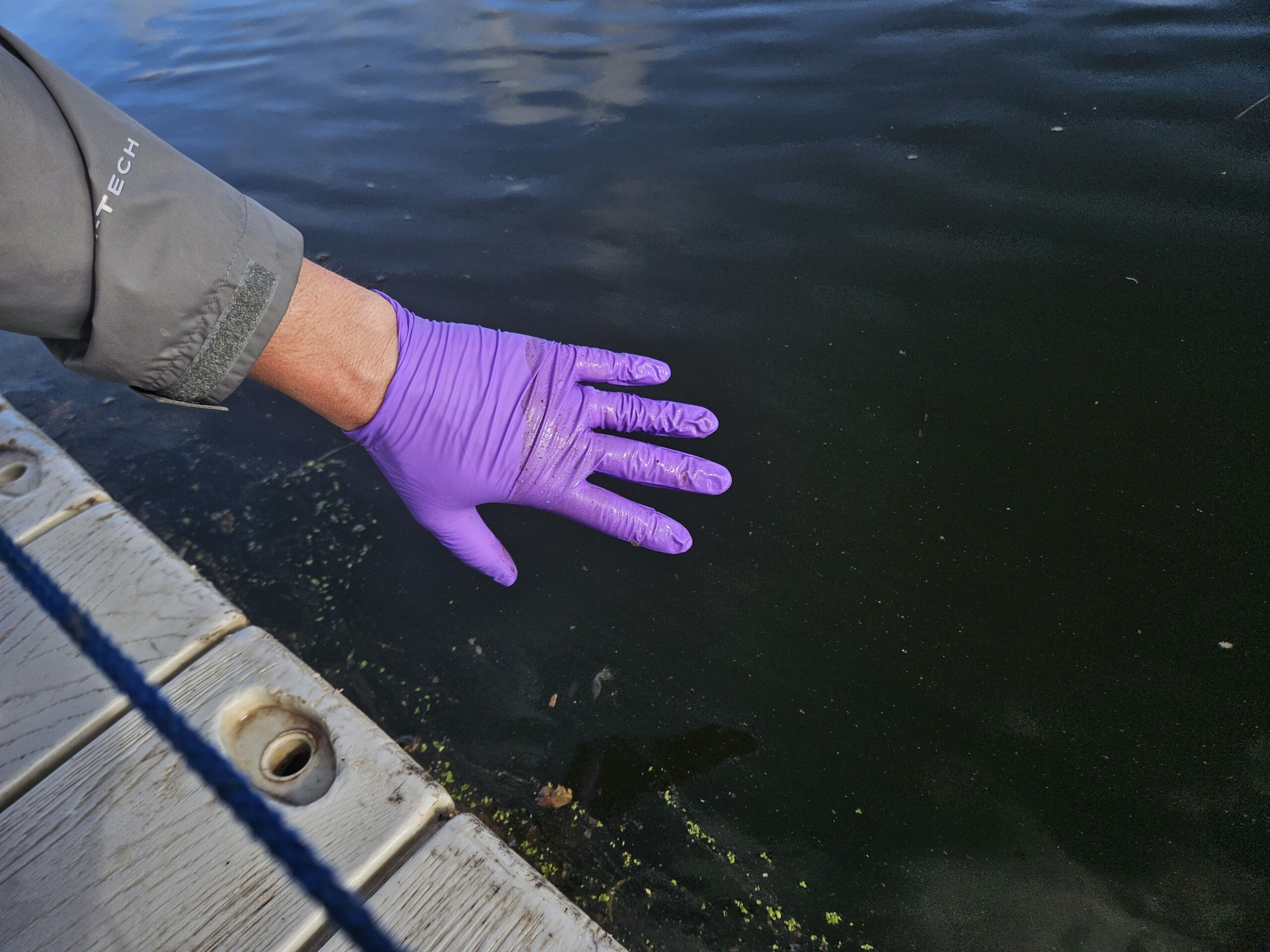
High levels of sediment in the Raritan River at Rutgers Boathouse stain John’s gloves as he takes a sample. Photo credit: Danielle Bongiovanni.
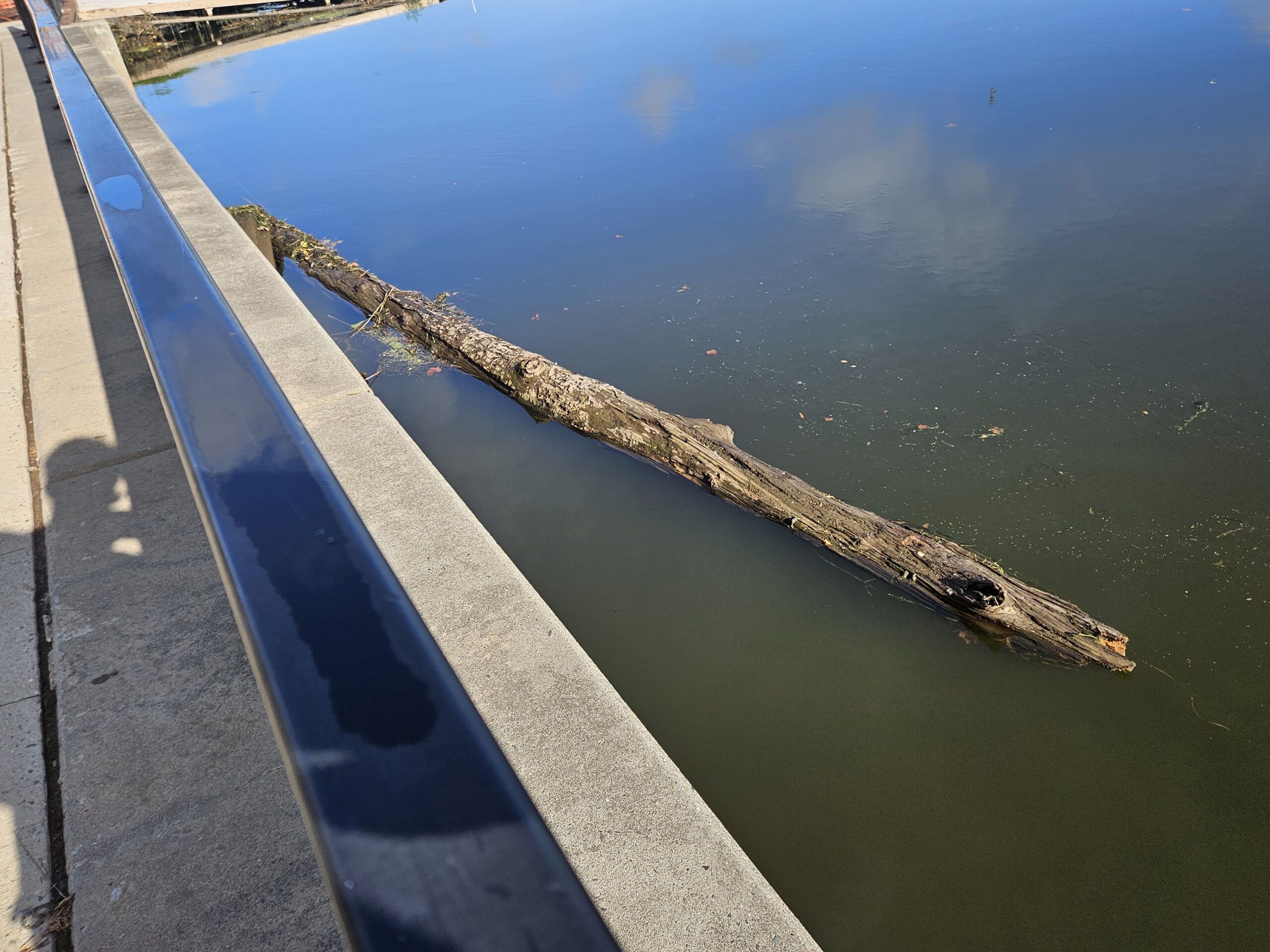
A log blocks outflow from New Brunswick into the Raritan River. Photo credit: Danielle Bongiovanni.
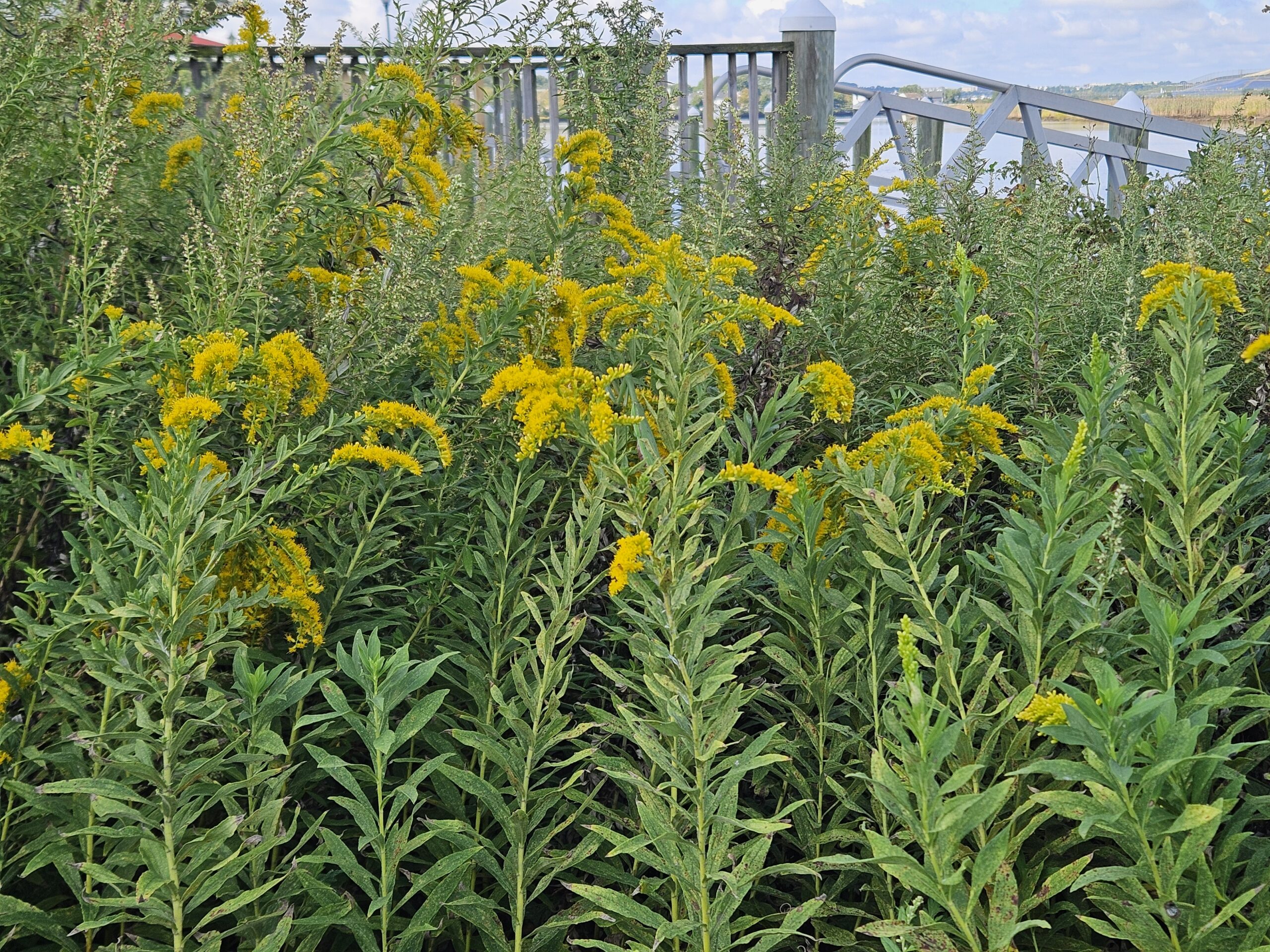
A sunny day at Ken Buchanan Waterfront Park brings out the brillant yellow flowers of seaside goldenrod (Solidago sempervirens). Photo credit: Danielle Bongiovanni.
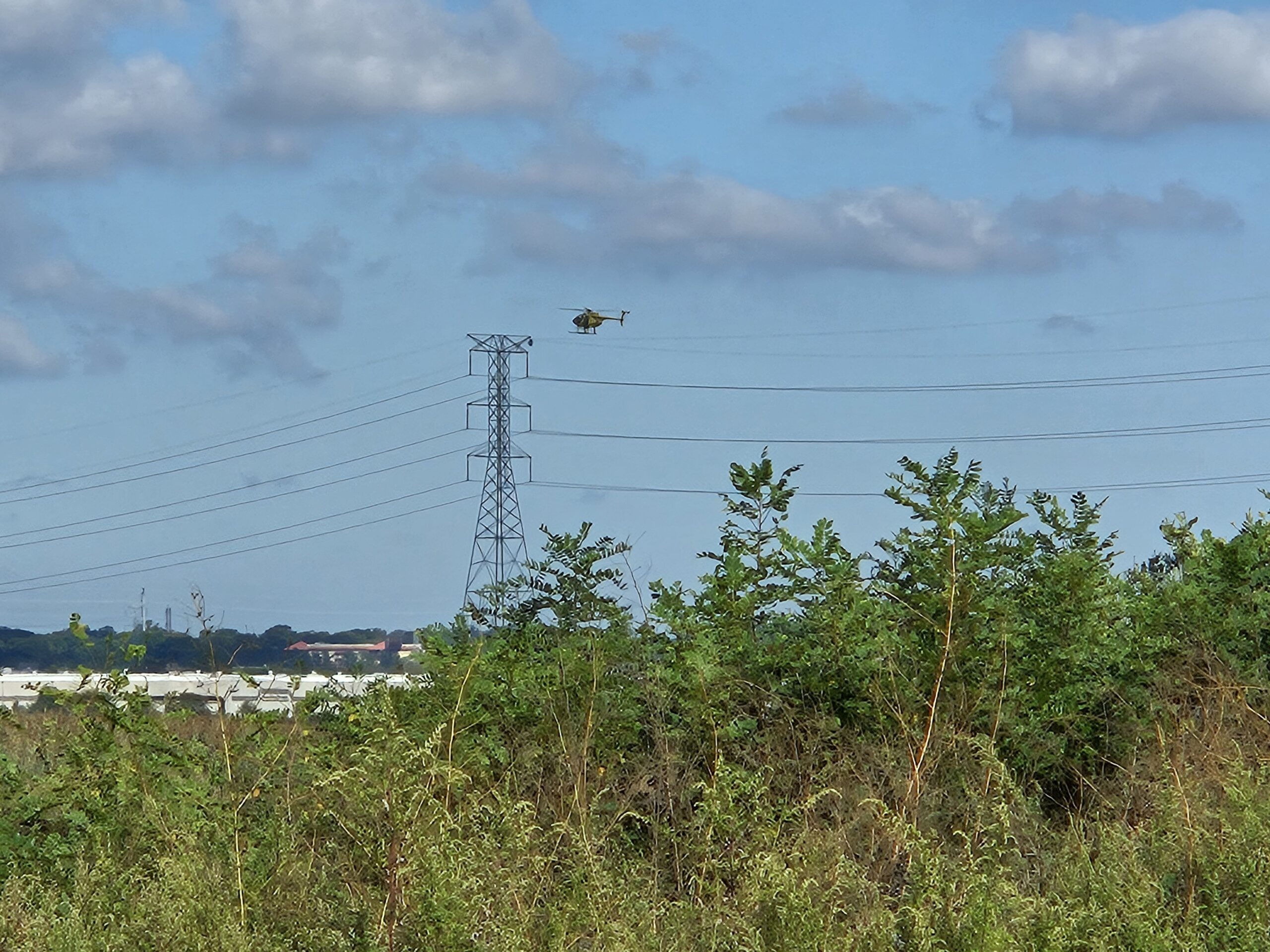
A helicopter inspects power lines over Sayreville. Photo credit: Danielle Bongiovanni.
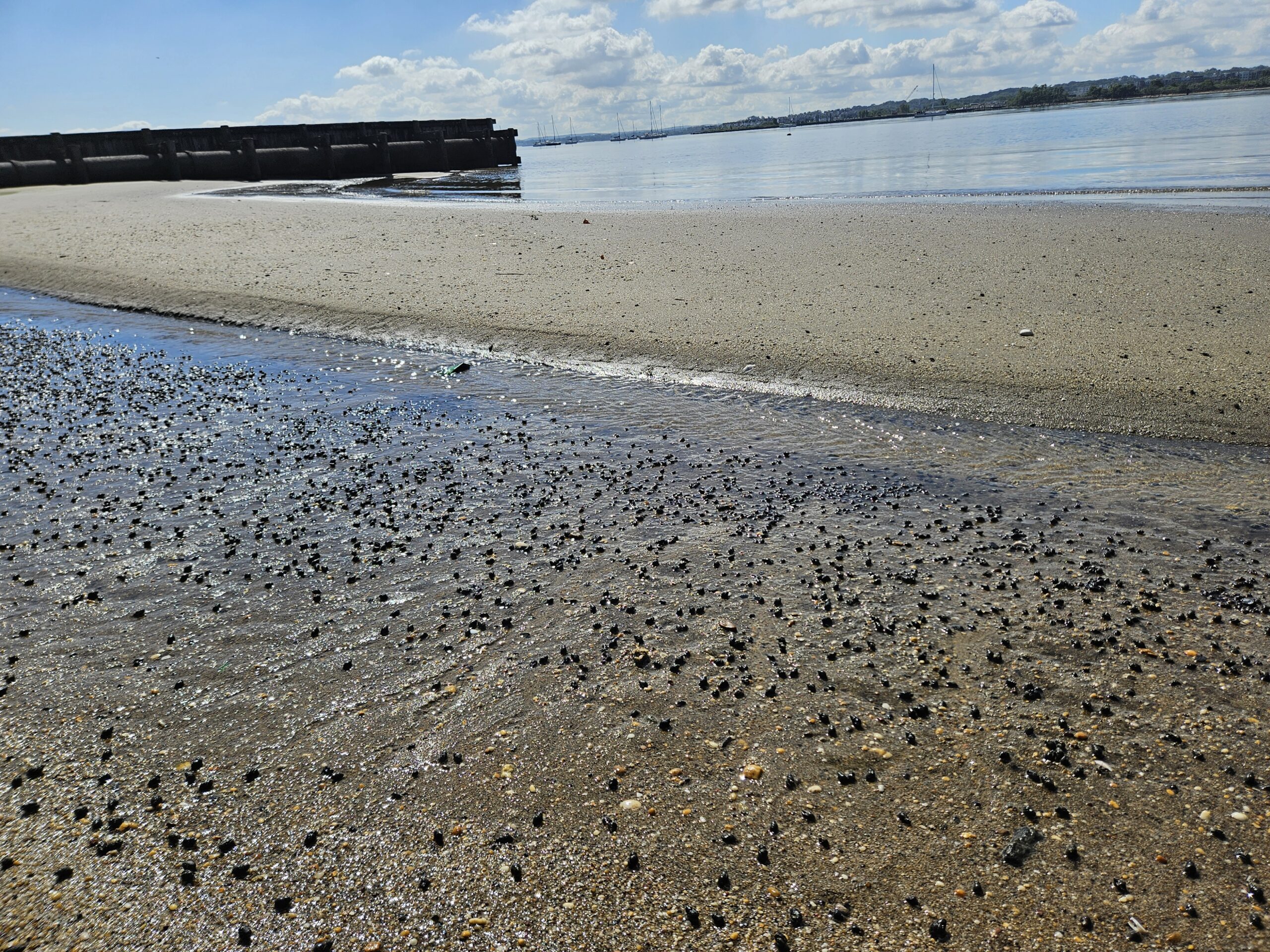
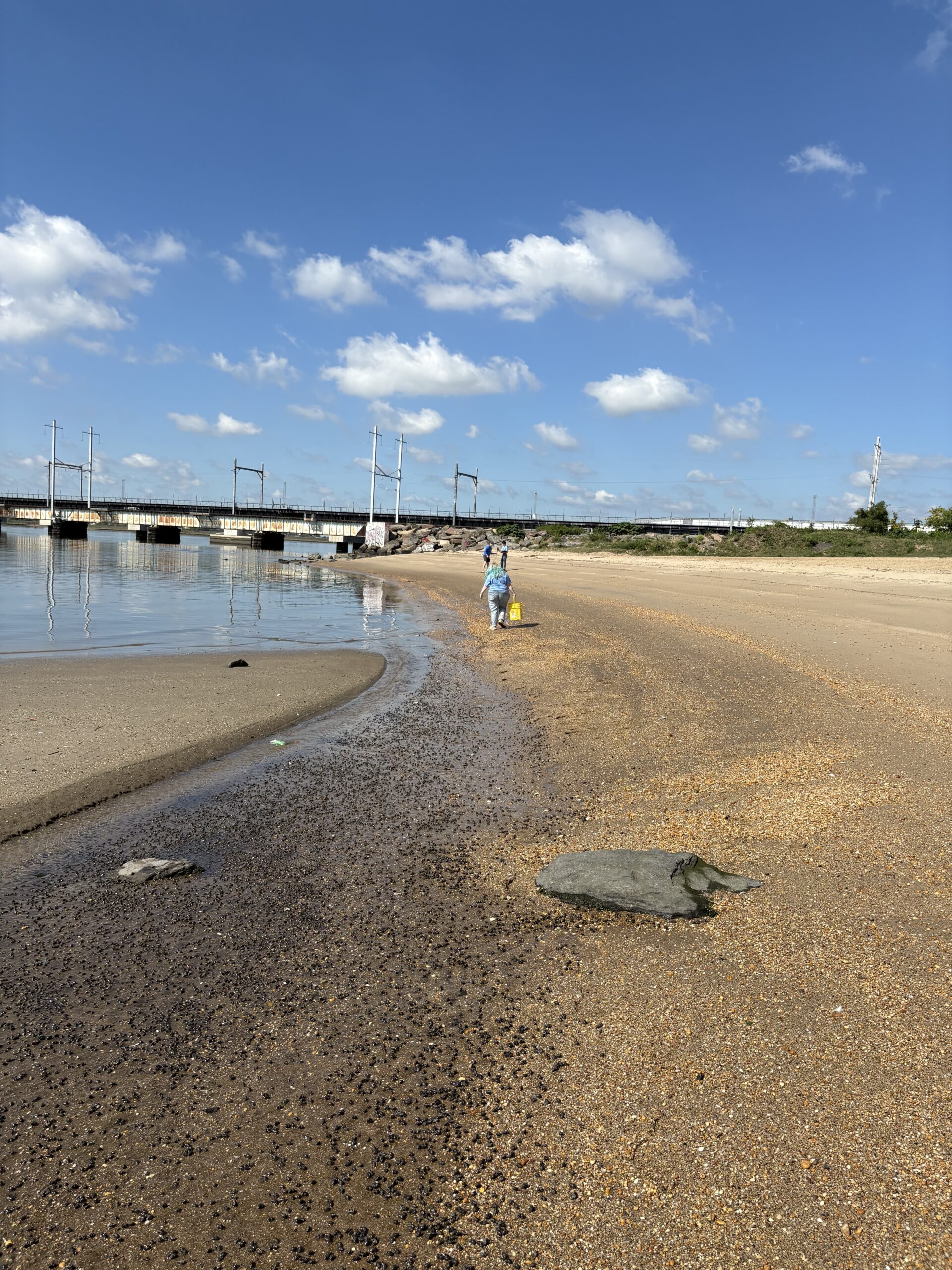
A sandbar blocks snails from being carried out with the tide in Perth Amboy. Photo credit: Danielle Bongiovanni.
Sofi patrols the Perth Amboy shoreline for litter. Unfortunately, baby wipes spilling out of the Combined Sewer Outfalls (CSO’s) are the most common kind of litter in the 2nd street park. A combined sewer system is one in which the sewage and the stormwater flow together in the same pipes. In normal weather, it all gets treated. But in stormy weather, much of the sewage gets washed into Raritan Bay. This is is probably why we saw one of the worst results of the season in Perth Amboy on Thursday. Photo credit: Photo credit: Art Allgauer.
The second pathogen monitoring session of the month took place on Thursday, September 11th. Each week during the summer, from May to October, the Lower Raritan Watershed Partnership and Rutgers Cooperative Extension of Middlesex County run a volunteer-based monitoring program along the Raritan River. We collect water quality samples at six non-bathing public access beach sites, provide our samples to the Interstate Environmental Commission for analysis in their laboratory, and report the results to the public. Our mission is to share this data with the community and partners to ensure the safe use of the Raritan river for all.
Our lab results for water quality samples taken on Thursday, September 11th, 2025 show Enterococcus bacteria levels exceeding the EPA federal water quality standard of 104 cfu/100mL at three of our monitoring sites this week. Problem sites would be indicated by red frowns on the map and chart which includes: Rutgers Boat House (New Brunswick), Edison Boat Basin(Edison Township), and Ken Buchanan Waterfront Park (Sayreville). Riverside Park (Piscataway) had inconclusive results. Out of an abundance of caution, a red fown has been assigned to it. Green smiles on the chart and map indicate the sites with bacteria levels safe for recreation, and include the following: Raritan Bay Waterfront Park (South Amboy), and 2nd Street Park (Perth Amboy).
Pathogens/Enterococci levels are used as indicators of the possible presence of disease-causing bacteria in recreational waters. Such pathogens may pose health risks to people coming in primary contact with the water (touching) through recreational activities like fishing, kayaking or swimming in a water body. Possible sources of bacteria include Combined Sewer Overflows (CSOs), improperly functioning wastewater treatment plants, stormwater runoff, leaking septic systems, animal carcasses, pet waste, wildlife waste, and runoff from manure storage areas.
Our goal in reporting these results is to give residents a better understanding of the potential health risks related to primary contact during water-based recreation. If you are planning on recreating on the Raritan this weekend, make sure to stay safe and wash up after any activities!
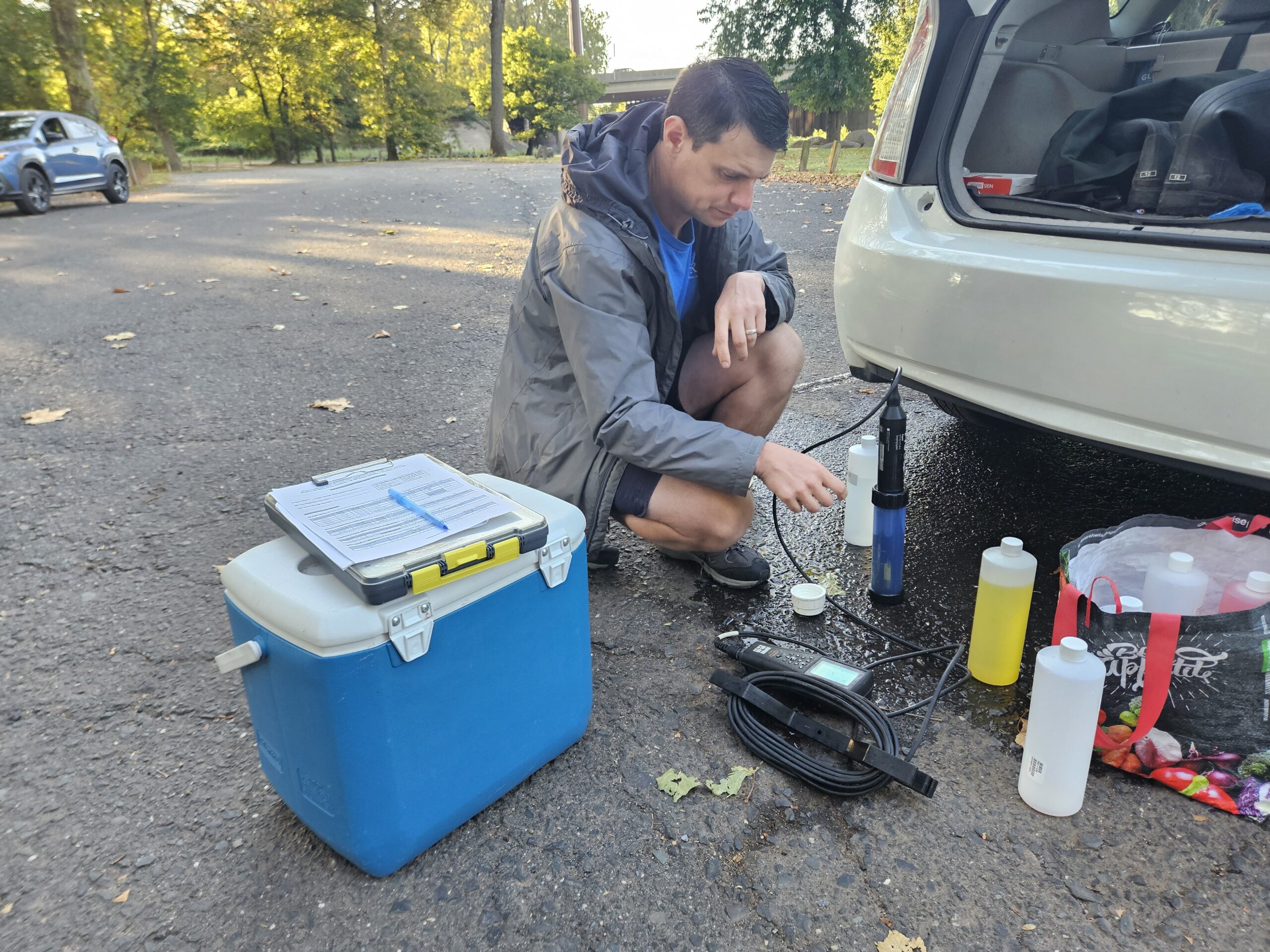
Before pathogen monitoring can begin, the sonde is calibrated. Preparations include confirming the sonde accurately measures pH by submerging it in different buffers. The yellow solution is neutral with a pH of 7. Photo credit: Danielle Bongiovanni.
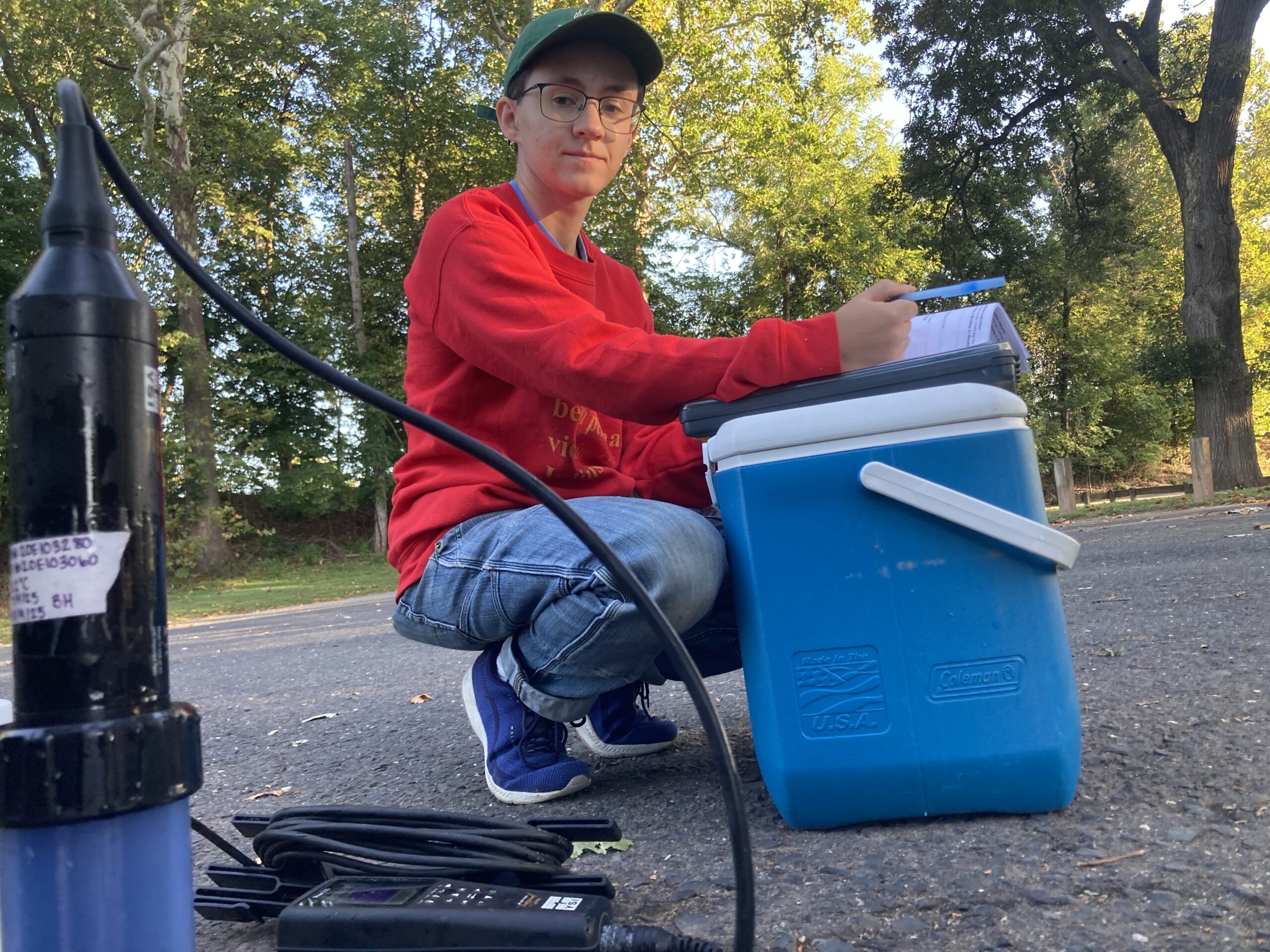
Our partners at the Interstate Environmental Commission provide us with thorough instructions on how to calibrate the sensors on the sonde. Rather than working off of memory, we prefer to have one person read the instructions aloud to avoid mistakes–in this, case Danielle is reading the instructions and recording the results of the calibration. Photo credit: J.M. Meyer.
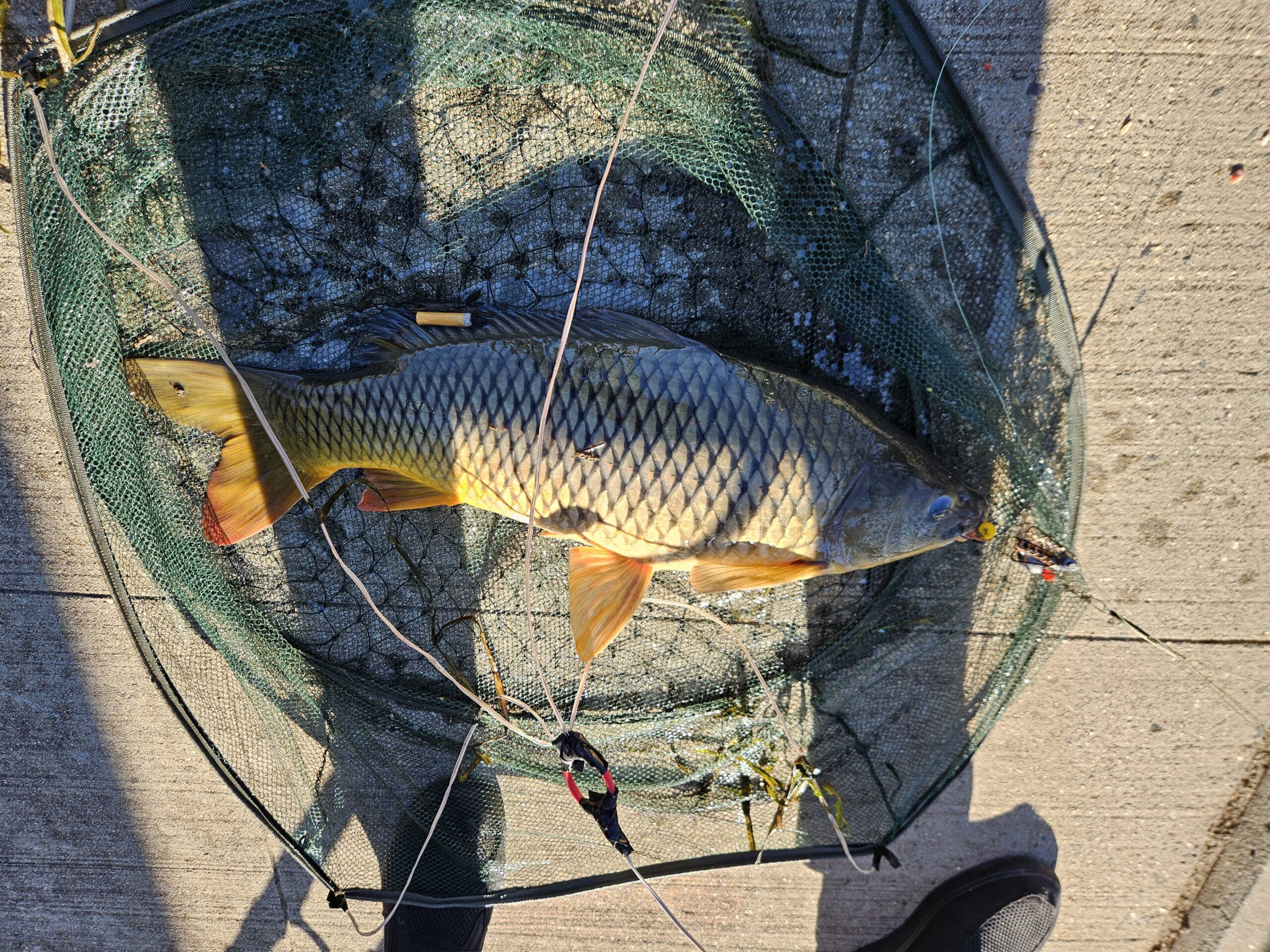
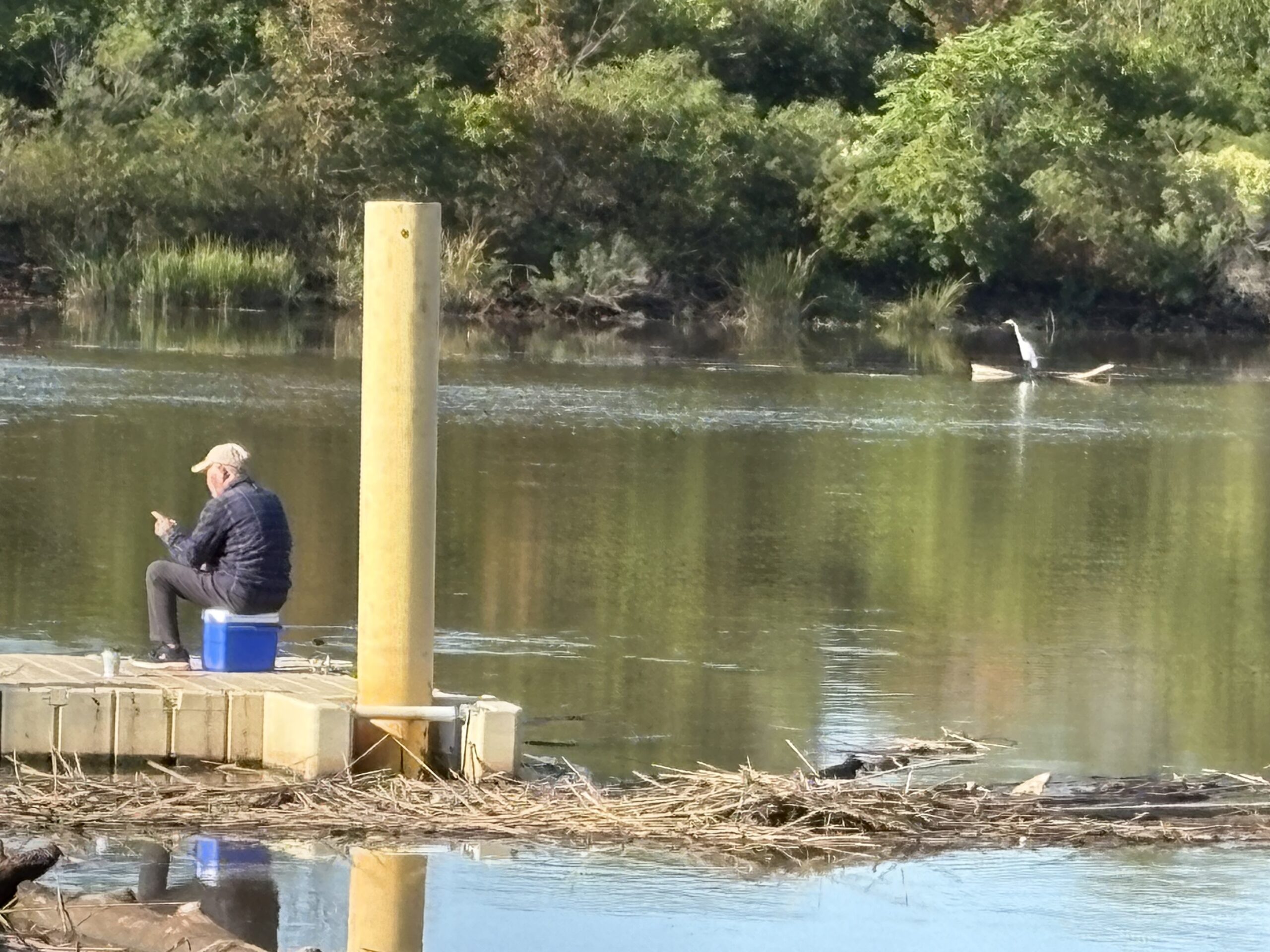
Fishermen at Rutgers Boathouse reeled in a massive common carp (Cyprinus carpio), an invasive freshwater fish commonly found in the Raritan River. With it came a cigarette butt, illustrating how the trash tossed into the water does not instantly break down. Photo credit: Danielle Bongiovanni.
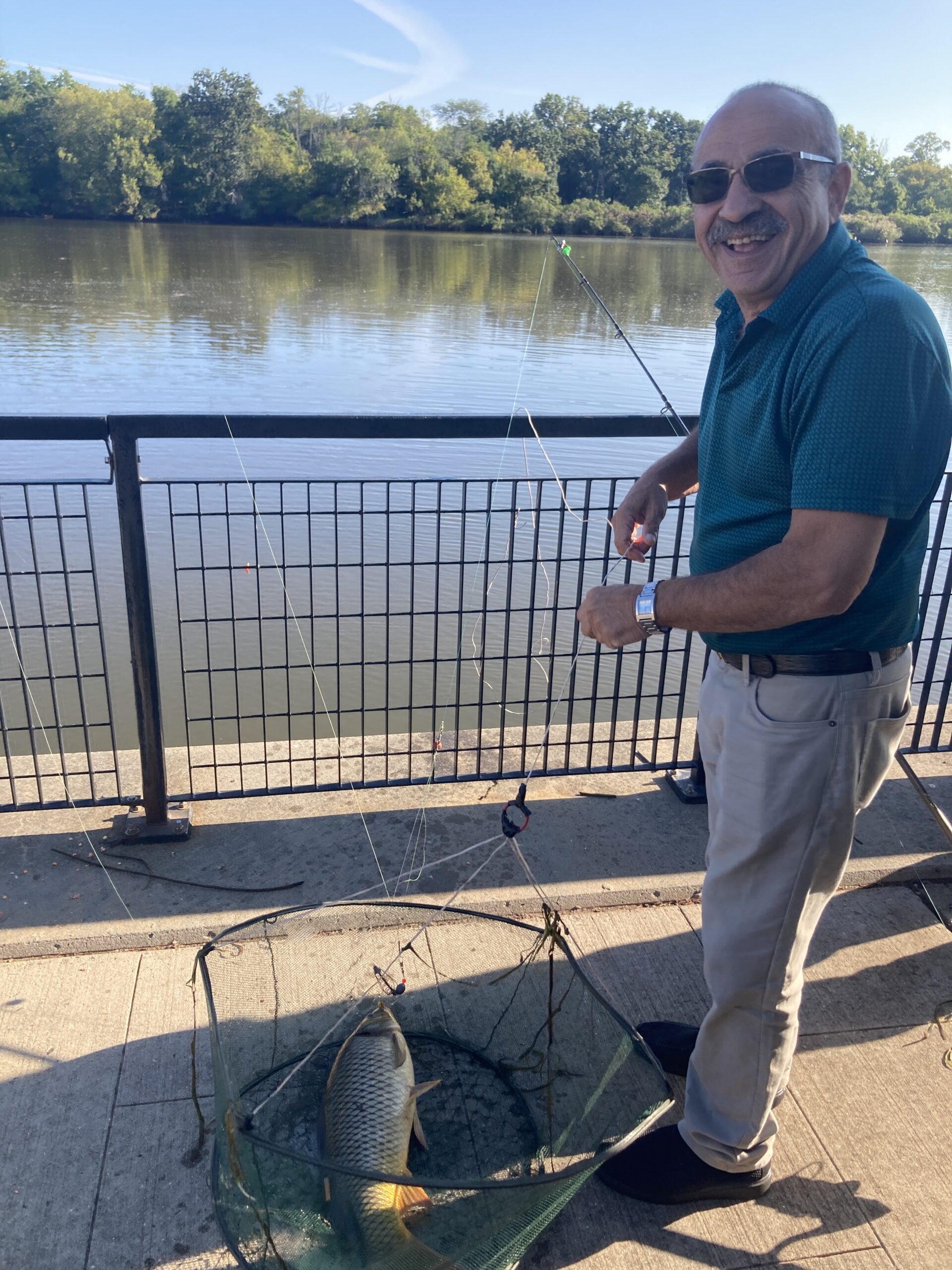
A happy fisherman with his netted carp. Our proximity to the river means people often fish before or after work. Photo credit: J.M. Meyer.
In Edison, as the tide rolled in, we witnessed no less than seven egrets riding fallen logs upstream against the current. Photo credit: Arthur Allgauer.
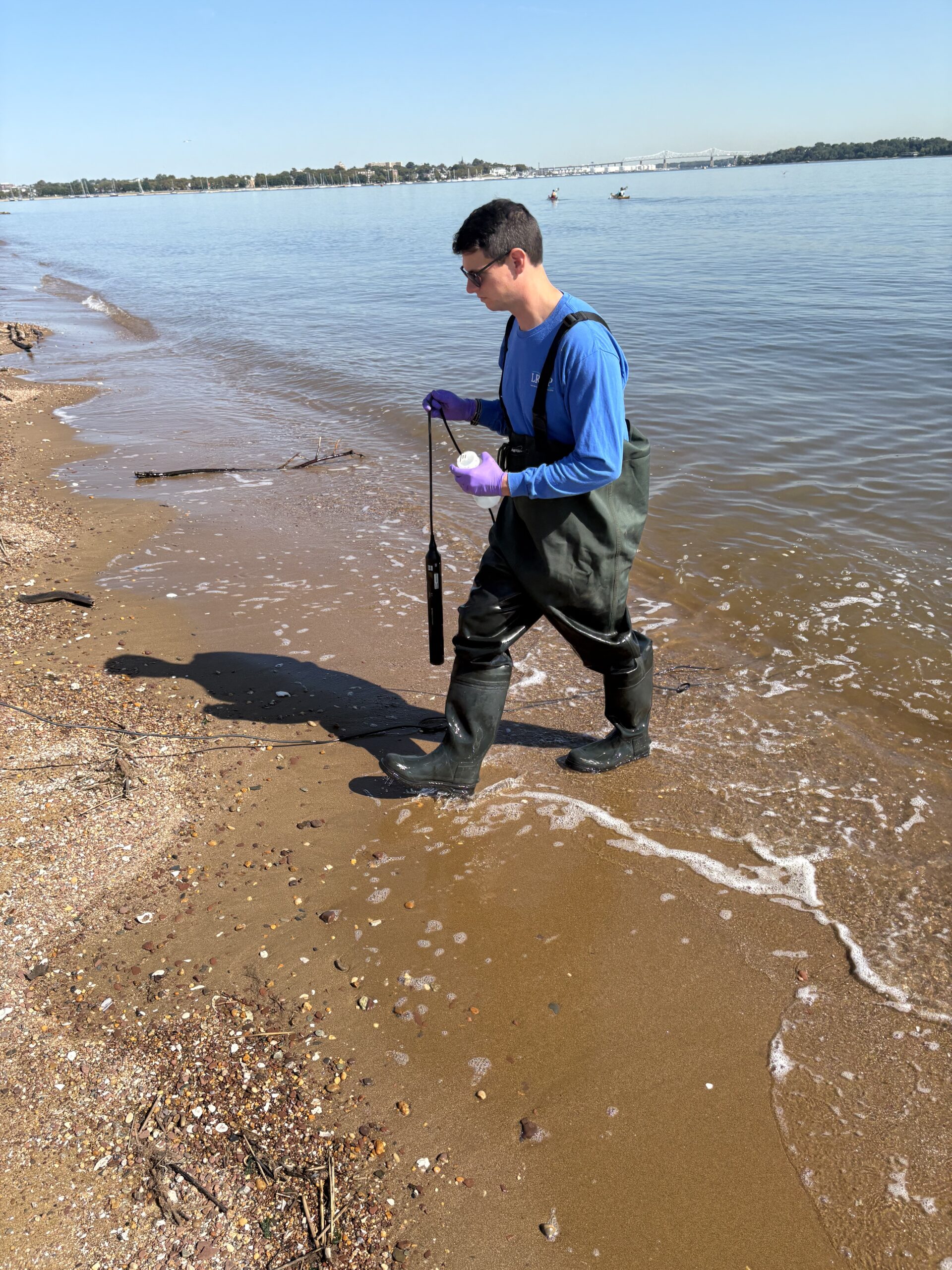
Gloves, sonde, and sample: John returns from wading into the waters in South Amboy. Photo credit: Arthur Allgauer.
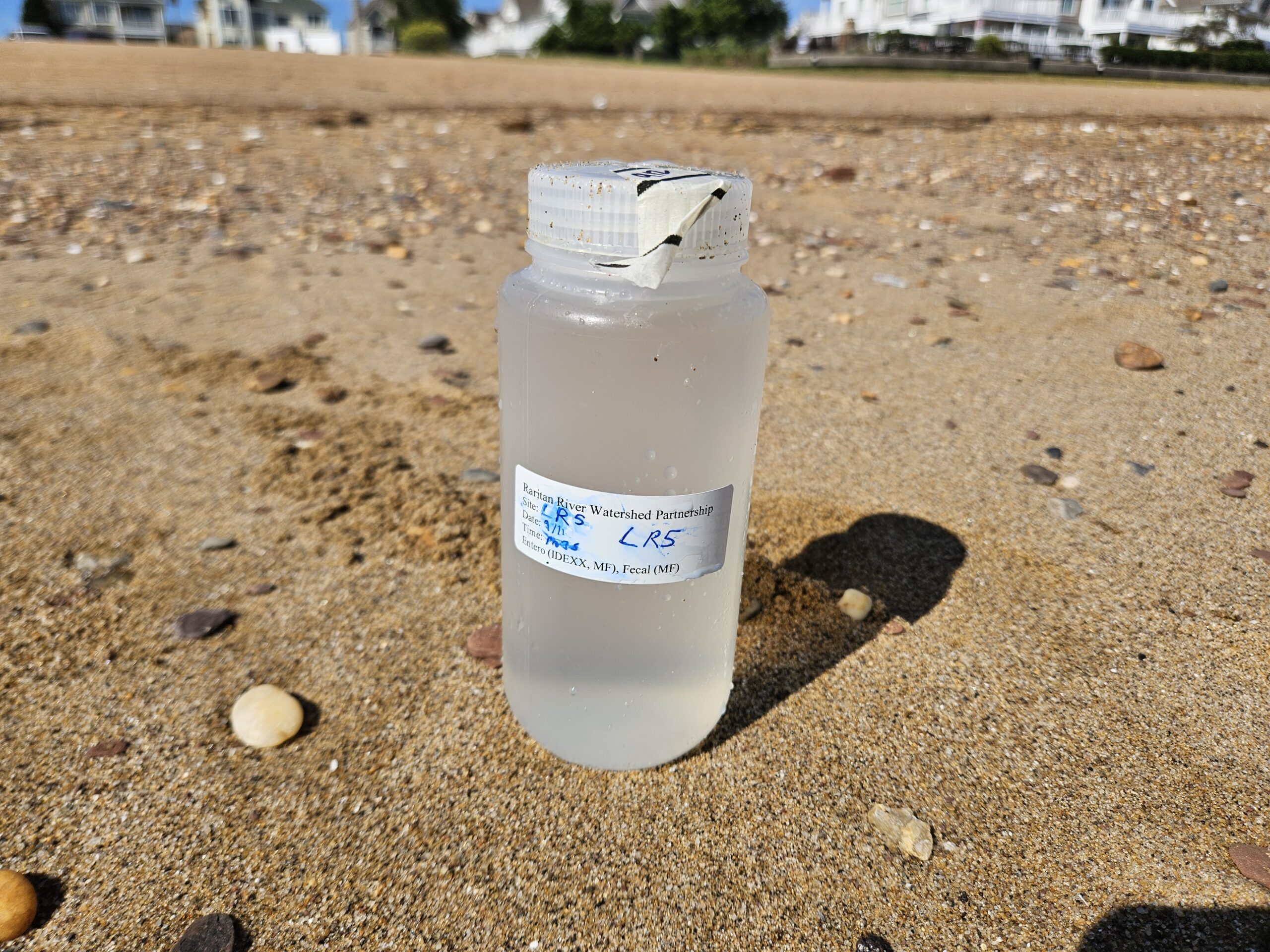
The bottles used to collect samples are sterilized beforehand. The tape on the lid remains intact until a gloved volunteer is about to use it. This reduces the chance of contamination skewing the lab results. Photo credit: Danielle Bongiovanni.
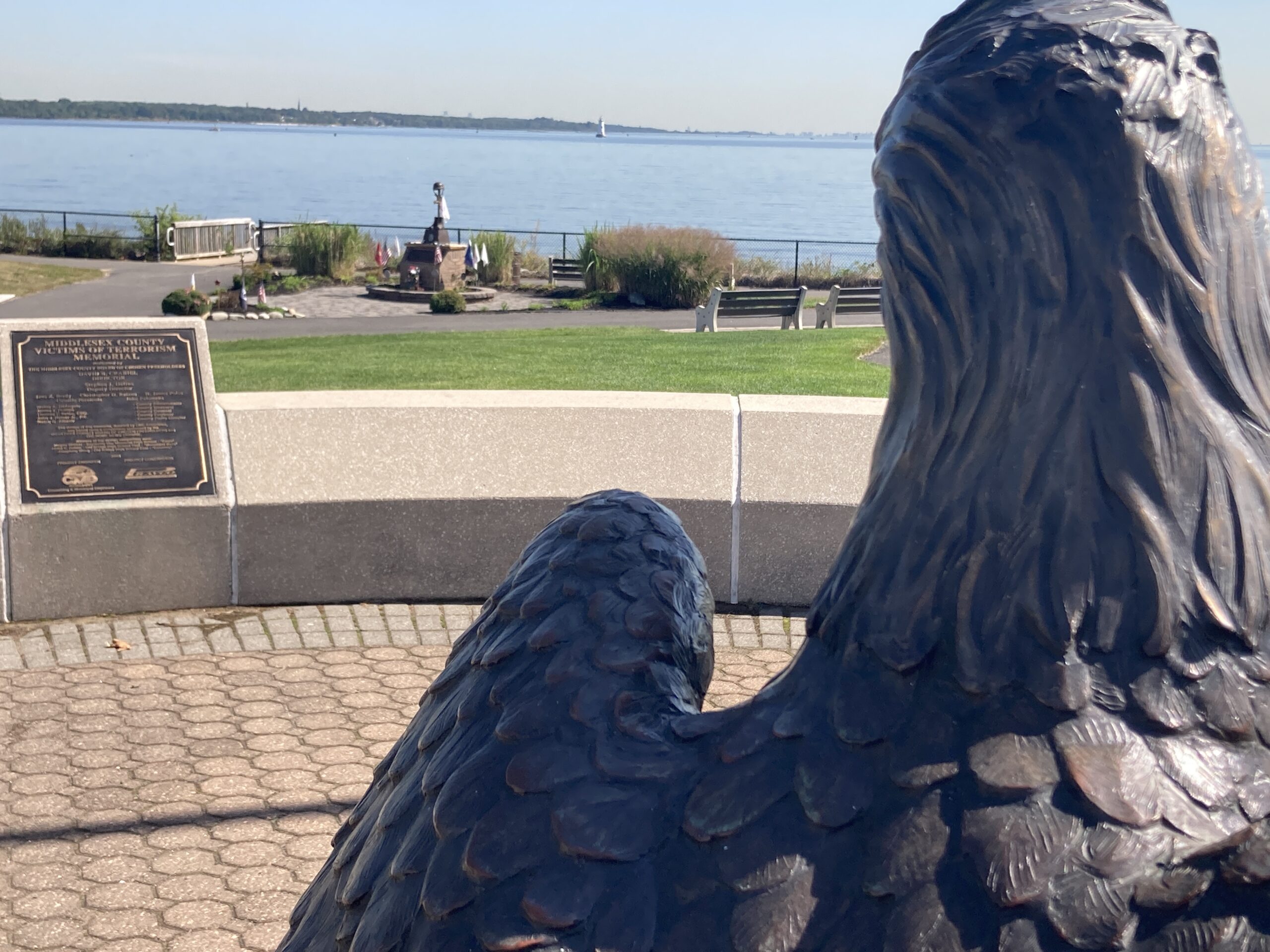
In remembrance of Sepetember 11th, we stopped at the Middlesex County memorial in South Amboy. This eagle sculpture stares across Raritan Bay and across Staten Island — the Twin Towers were once visible in the distance. Photo credit: J.M. Meyer.
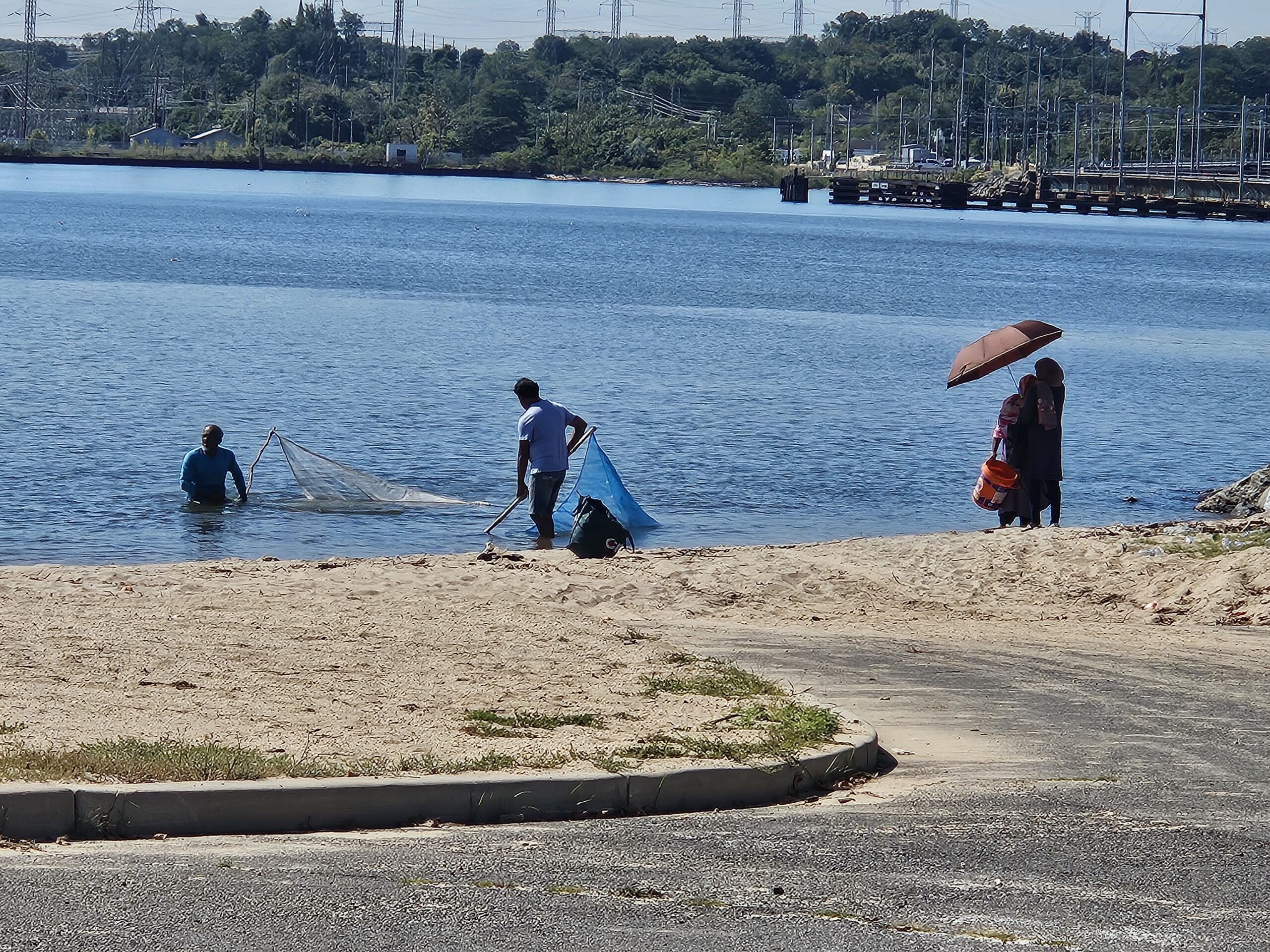
Beachgoers at 2nd St. Park deploy a seine net to catch fish and shellfish fishing for consumptions remains common throughout the Raritan watershed, and reminds us of the importance of keeping our waters clean. Photo credit: Danielle Bongiovanni.
The first pathogen monitoring session of the month took place on Thursday, September 5th. Each week during the summer, from May to October, the Lower Raritan Watershed Partnership and Rutgers Cooperative Extension of Middlesex County run a volunteer-based monitoring program along the Raritan River. We collect water quality samples at six non-bathing public access beach sites, provide our samples to the Interstate Environmental Commission for analysis in their laboratory, and report the results to the public. Our mission is to share this data with the community and partners to ensure the safe use of the Raritan river for all.
Our lab results for water quality samples taken on Thursday, September 5th, 2025 show Enterococcus bacteria levels exceeding the EPA federal water quality standard of 104 cfu/100mL at two of our monitoring sites this week. Problem sites would be indicated by red frowns on the map and chart which includes: Riverside Park (Piscataway) and Edison Boat Basin(Edison Township). Green smiles on the chart and map indicate the sites with bacteria levels safe for recreation, and include the following: Rutgers Boat House (New Brunswick), Ken Buchanan Waterfront Park (Sayreville), Raritan Bay Waterfront Park (South Amboy), and 2nd Street Park (Perth Amboy).
Pathogens/Enterococci levels are used as indicators of the possible presence of disease-causing bacteria in recreational waters. Such pathogens may pose health risks to people coming in primary contact with the water (touching) through recreational activities like fishing, kayaking or swimming in a water body. Possible sources of bacteria include Combined Sewer Overflows (CSOs), improperly functioning wastewater treatment plants, stormwater runoff, leaking septic systems, animal carcasses, pet waste, wildlife waste, and runoff from manure storage areas.
Our goal in reporting these results is to give residents a better understanding of the potential health risks related to primary contact during water-based recreation. If you are planning on recreating on the Raritan this weekend, make sure to stay safe and wash up after any activities!
The Lower Raritan Watershed Partnership welcomes Margaret, a new science communications intern! Margaret accompanied the volunteers to the first two monitoring sites to record observations for her upcoming project on accessible waterfront recreation. Photo credit: Danielle Bongiovanni.
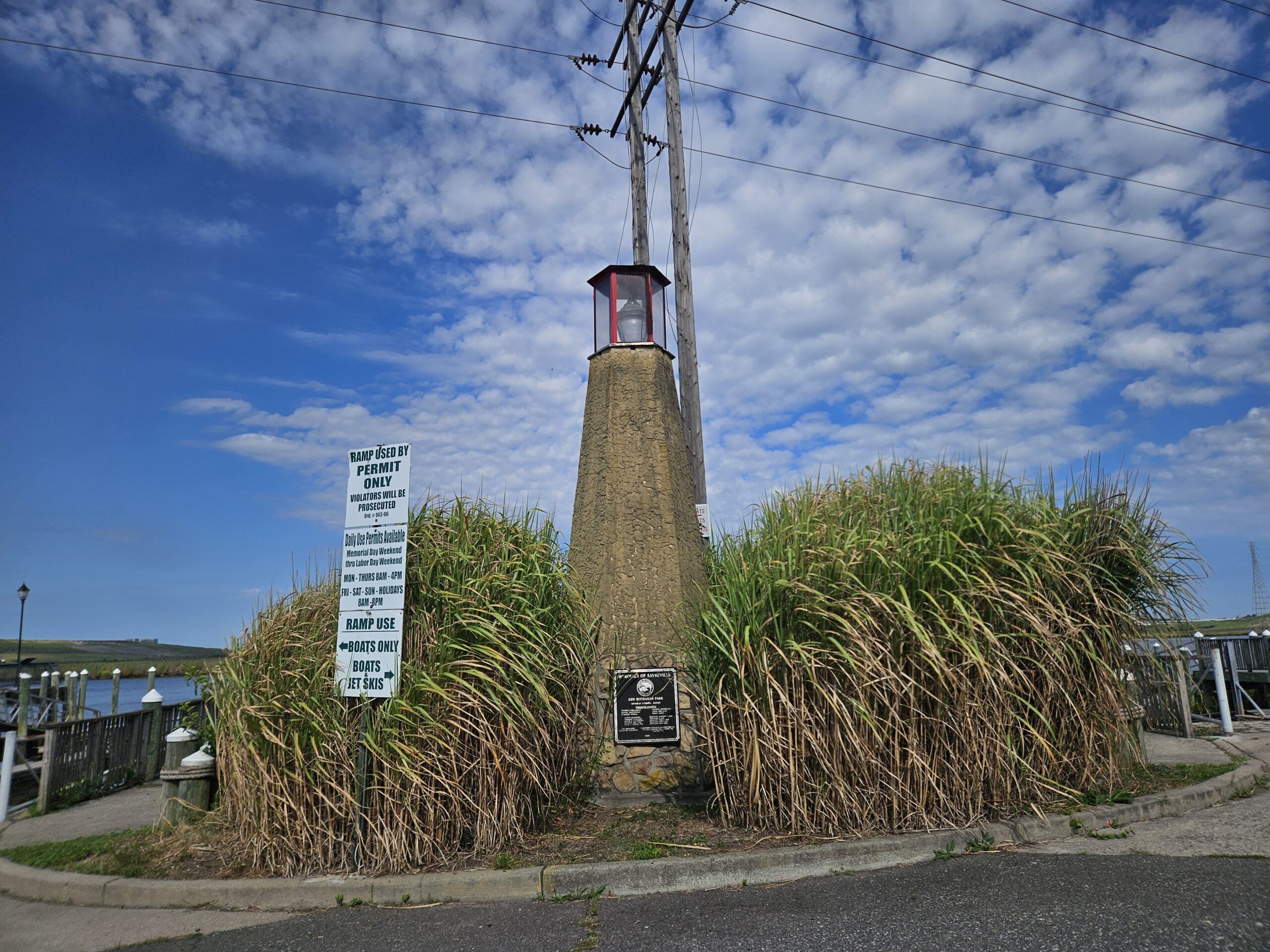
Ken Buchanan Waterfront Park and its miniature lighthouse are dedicated to a former Sayreville councilman who dedicated 18 years of his life to public service before his passing in 1991. Photo credit: Danielle Bongiovanni.
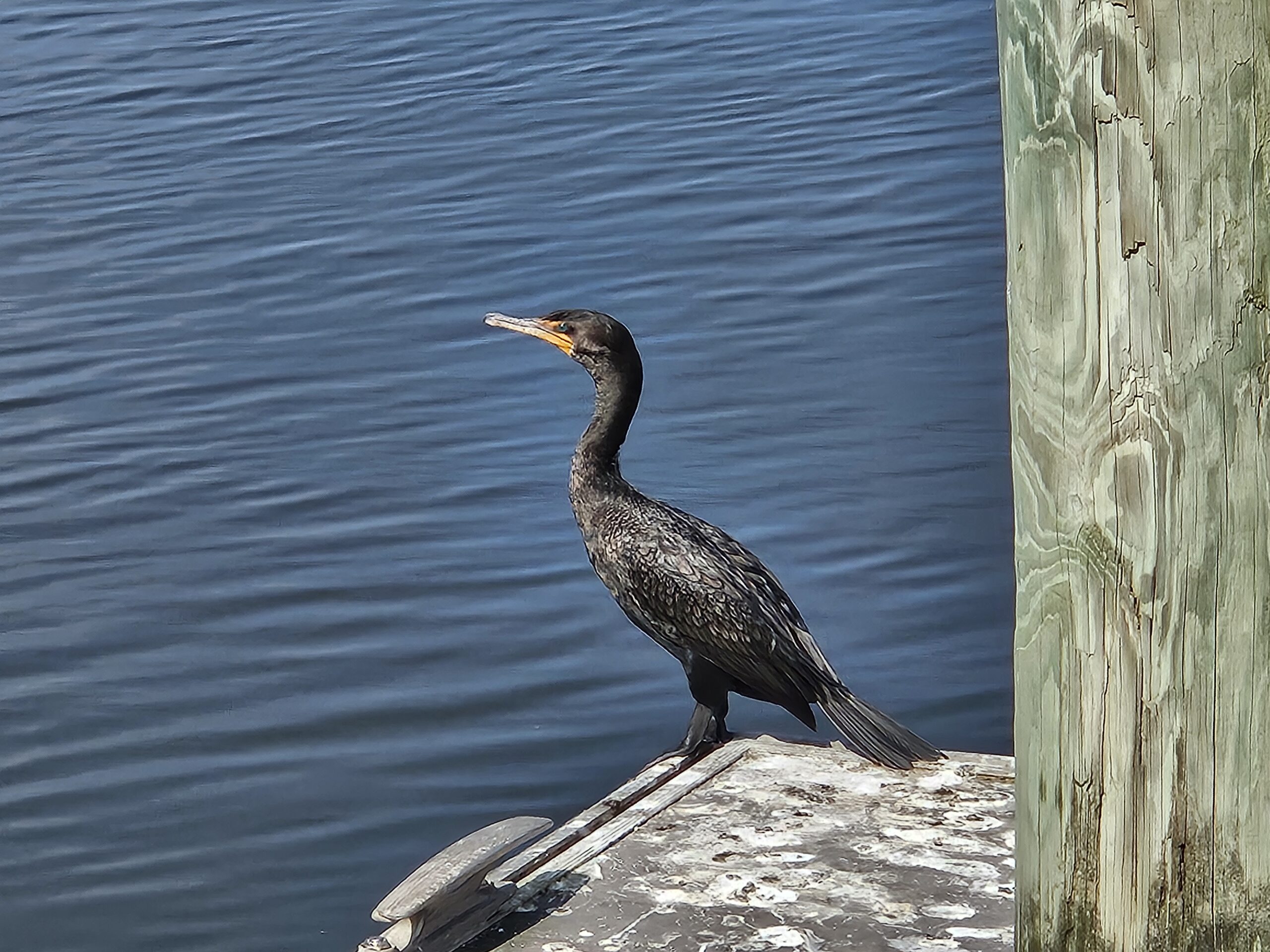
Repeated exposure to human visitors at Ken Buchanan Waterfront Park emboldens wildlife such as this double-crested cormorant (Nannopterum auritum) to hold their ground when people approach. Photo credit: Danielle Bongiovanni.
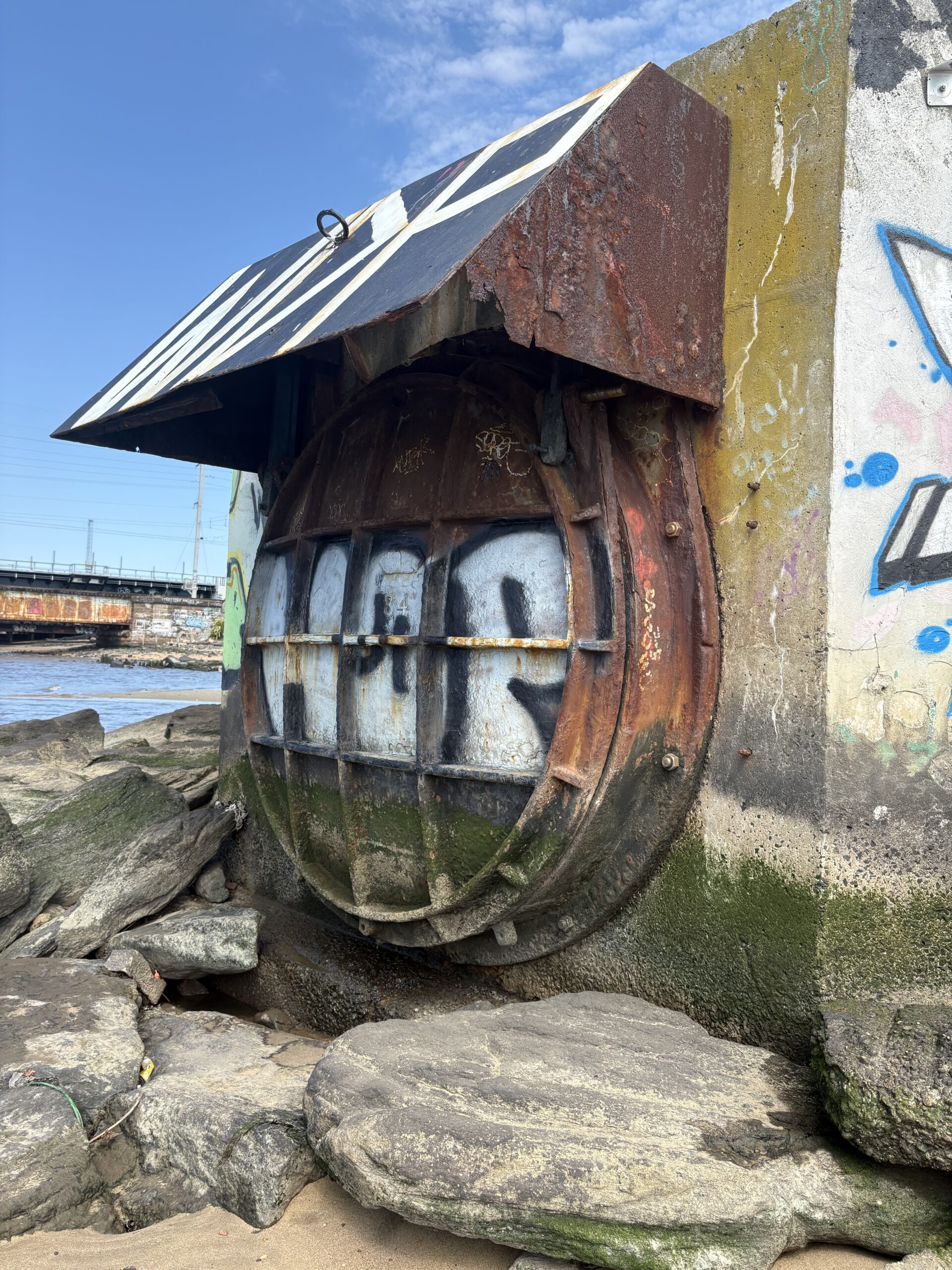
Unofficial artistic efforts have added urban flair to the outlet pipe in 2nd Street Park, Perth Amboy. Photo credit: Art Allgauer.
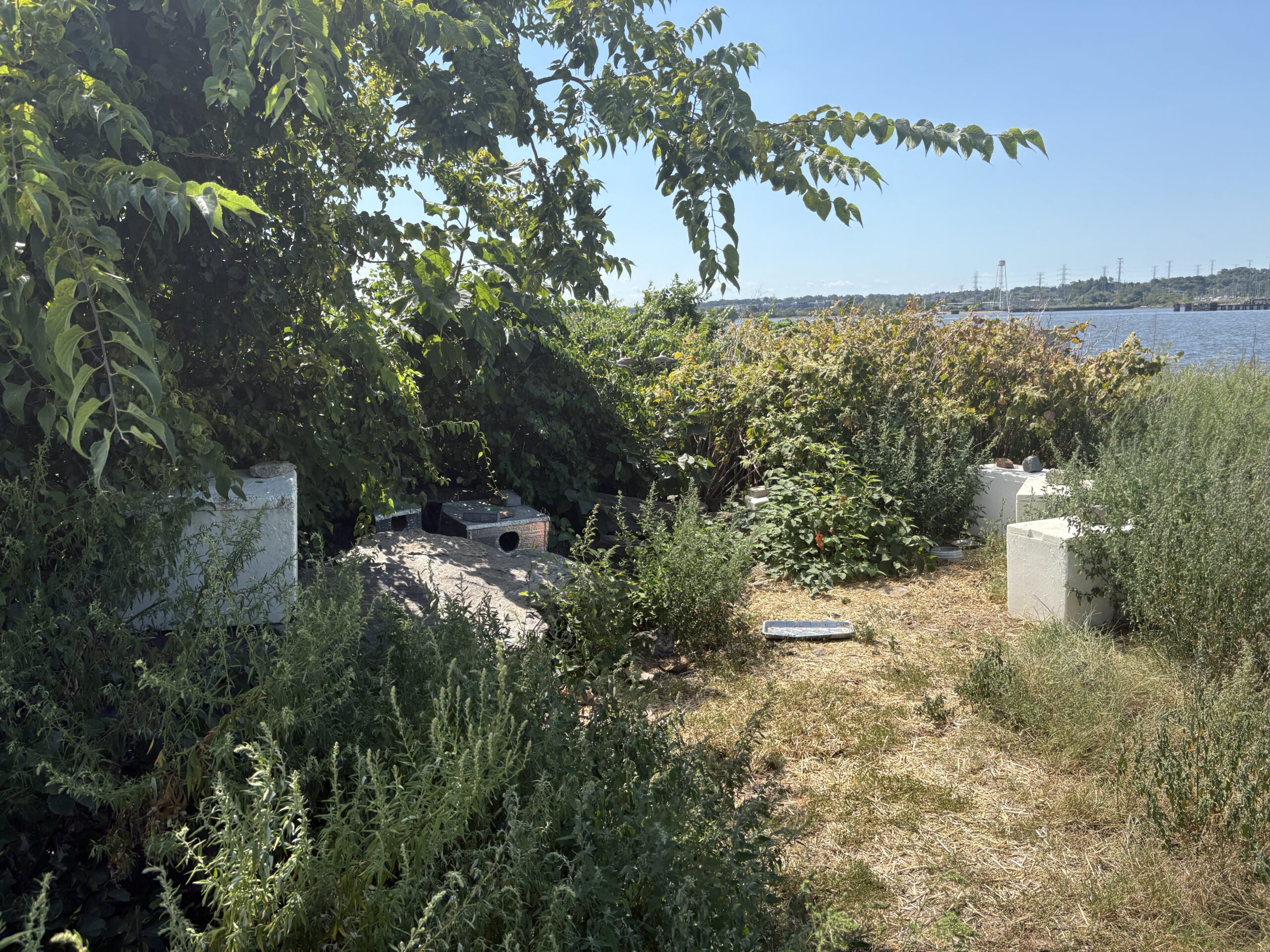
This hidden cat village in Perth Amboy provides shelter for cats that have gone through the city’s trap-neuter-release program. Photo credit: Art Allgauer.
The LRWP and SEWA volunteers went out to the litter trap in the Green Brook on Saturday, August 9th, 2025, to conduct a litter tally. Huge thanks to our SEWA International Central Jersey youth partners! Thanks to their efforts, we’ll have much better data on how the litter trap keeps our watershed clean. Learn more about the litter trap initiative here. And learn more about the LRWP’s litter tally project with SEWA here. Below, you’ll find Sewa’s Nilesh Bhat describing the litter we picked up and conditions surrounding the litter trap.
Blog post by Yashashvi Pabbisetty
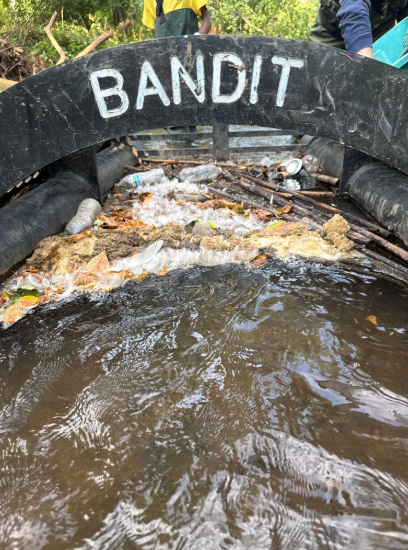
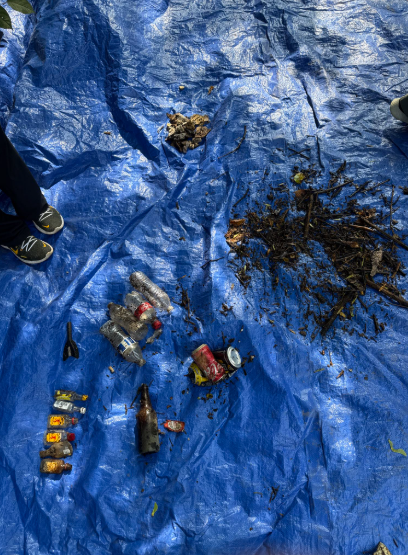
After several weeks of cleaning up and observing the Greenbrook stream and the litter trap, we have finished our final cleanup. During this meeting we noticed a significant amount of litter built up inside the trap as well as outside in the stream, met with two board members of the Lower Raritan Watershed Partnership, and ended the meeting by testing how various different pieces of litter go through the trap.
Trash Inside the Litter Trap:
4 plastic bottles
2 aluminum cans
1 glass bottle
1 paper wrapper
6 shot bottles
1 foam rocket
15-20 pieces of styrofoam
1 piece of cardboard
4 cigarette butts
Trash Outside the Litter Trap
1 broken down mattress
18 broken glass pieces
5 ceramic pieces
3 glass bottles
16 plastic bottles
8 aluminum cans
17 plastic wrappers
1 metal rod
2 tires
1 styrofoam food container
2 shot bottles
1 piece of fabric
1 strap
1 purse
1 toolbox piece with nails
26 plastic bags
1 umbrella
5 styrofoam pieces
1 piece of paper
During this meeting we had the opportunity to present to two members of the LRWP board, Nandini Checko and Anton Getz. First, we presented our findings from our group report on the storm which took place on July 14th, and then we discussed what we’ve learned about the litter trap. Afterwards, Dini and Anton shared their professional experiences with us, as well as their path to careers in environmental activism, safety, and science.
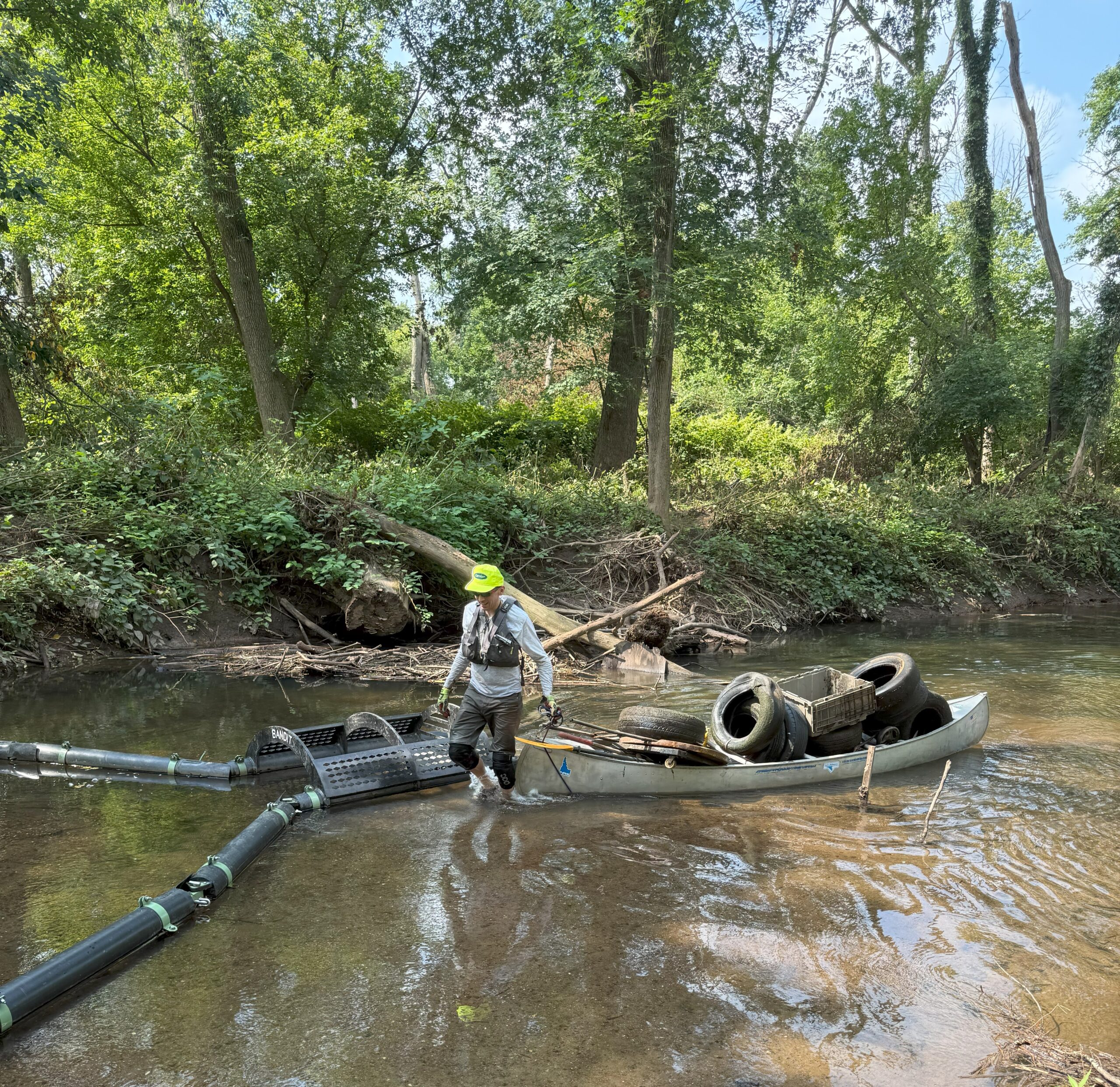
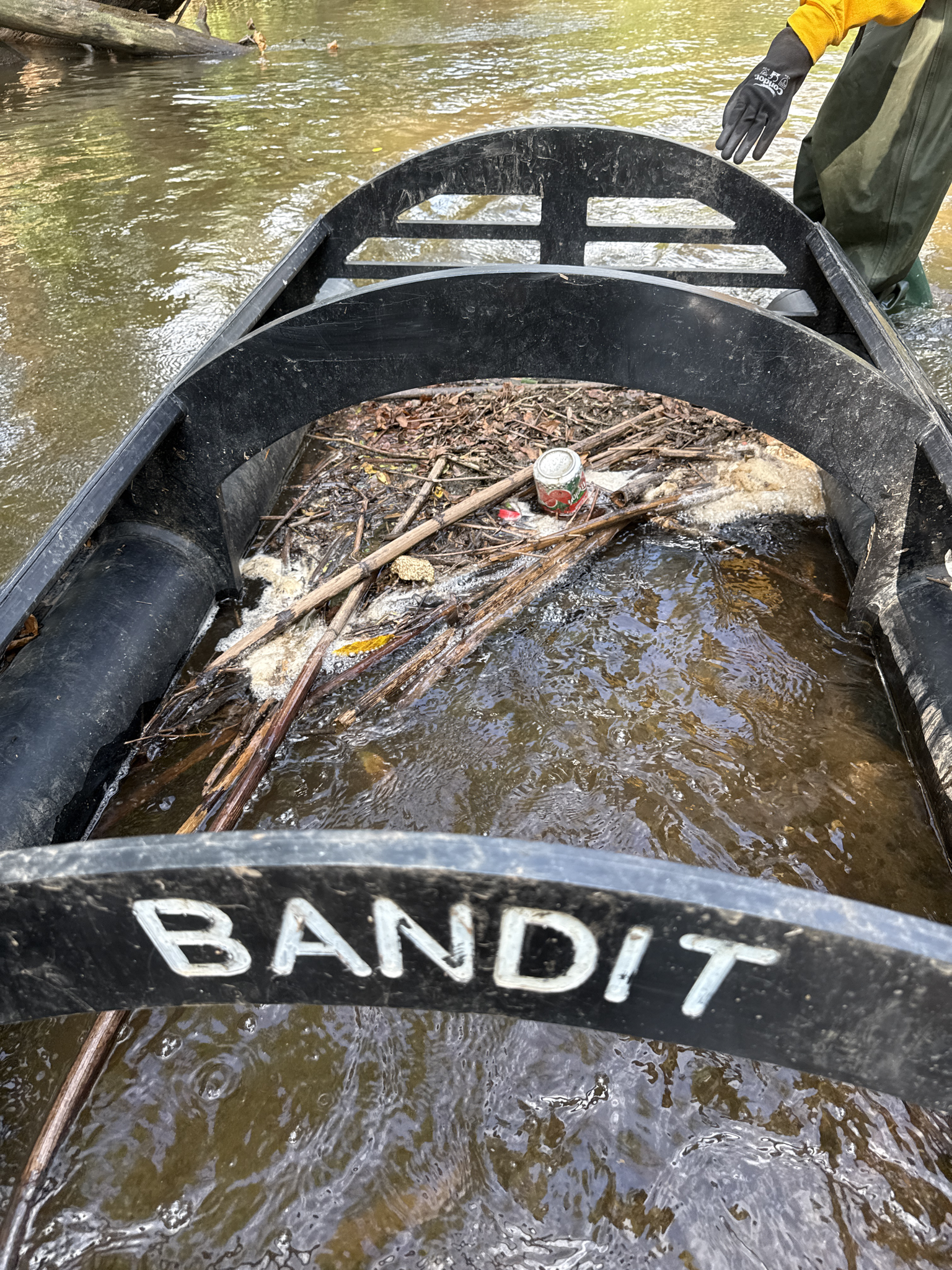
After our discussion, we collected and counted the litter. Anton helpfully brought a metal canoe to move swiftly through the stream, and collect tires and large objects; his canoe allowed him to float heavy debris up and down the stream.
Our meeting with Nandini and Anton gave us insights into the importance of the work that we do each week, how it fits into the bigger picture, and the ways in which volunteer organizations fill important gaps in the fight against plastic pollution.
To finish off our final meeting, we decided to each pick an item from the day’s cleanup to put back in the stream behind the litter trap and had a race; whichever item went into the trap first, would be victorious. This final experience answered a question that was on many of our minds: what item moves through the stream the fastest. The item which ended up winning was a piece of a styrofoam tray. This collaboration between the Sewa central jersey chapter volunteer organization and LRWP turned out as a huge success; we have gained accurate data about the trash flows in the Green Brook, and learned a tremendous amount about riparian floodways, environmental activism, plastic pollution, and community engagement!
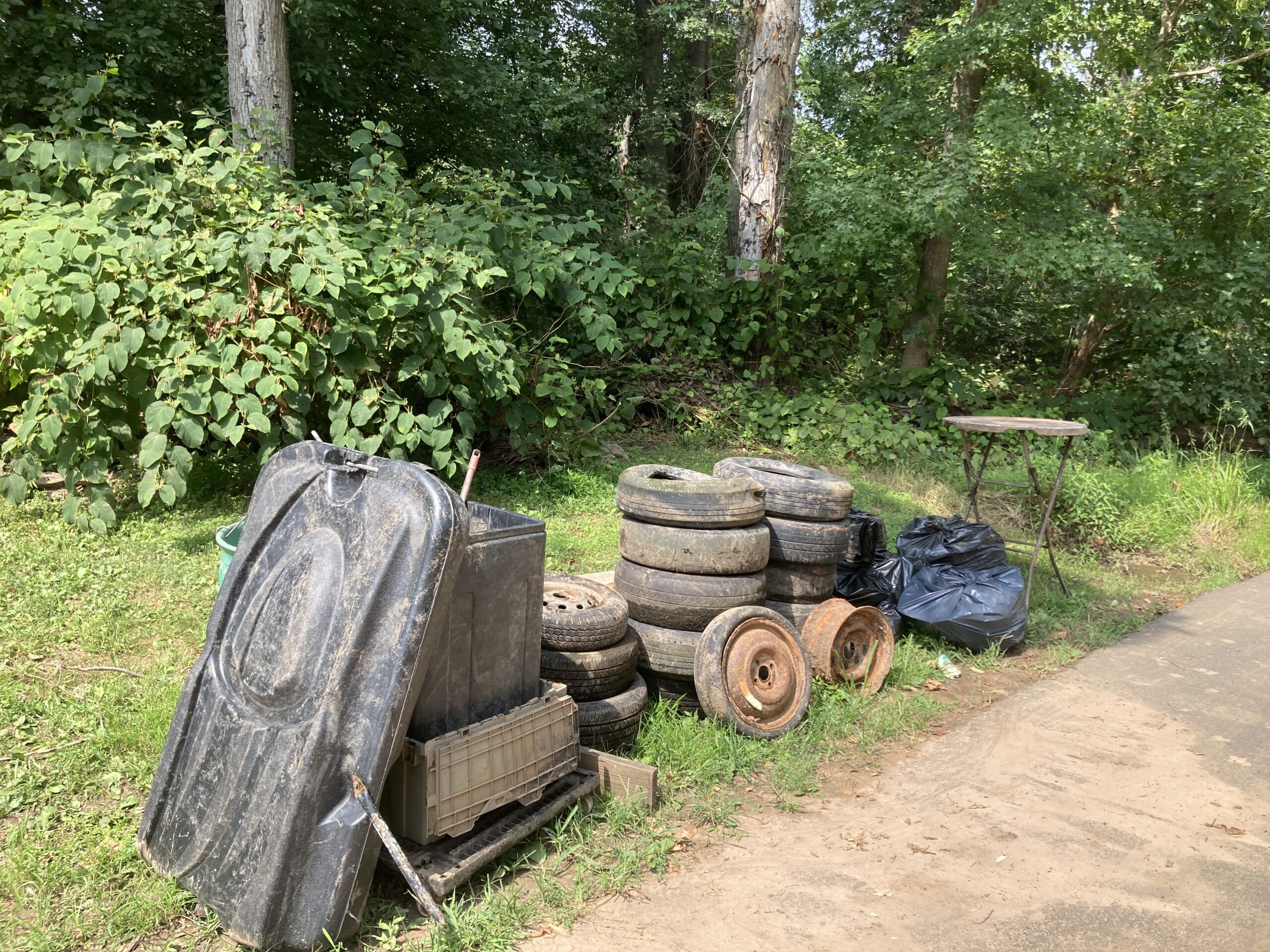
The trash is neatly stacked and ready for pickup by our partners at the Dunellen Department of Public Works. Thank you, Dunellen!
The LRWP and SEWA volunteers went out to the litter trap in the Green Brook on Saturday, August 9th, 2025, to conduct a litter tally. Huge thanks to our SEWA International Central Jersey youth partners! Thanks to their efforts, we’ll have much better data on how the litter trap keeps our watershed clean. Learn more about the litter trap initiative here. And learn more about the LRWP’s litter tally project with SEWA here. Below, you’ll find Sewa’s Nilesh Bhat describing the litter we picked up and conditions surrounding the litter trap.
Blog post by Aasmi Bora
This past week, the litter trap was heavily impacted by the flash floods that occurred on 7/31. Unlike our usual schedule, this cleanup was after two weeks and not one. The trap had accumulated hundreds of tree branches: caught inside, lodged under it, or beside it. Luckily, with the help of our Sewa volunteers, we were able to completely remove all of the organic matter surrounding the litter trap, restoring its ability to freely collect waste without any obstruction.
This week, we collecting the following litter from inside the trap:
11 shot bottles
1 prescription container
20 plastic bottles
1 glass bottle
1 bottom of a basketball hoop
1 soccer ball
1 marker
1 headlight
1 cigar
8 aluminum cans
1 eye drop
1 nail separator
about 20-30 pieces of styrofoam
1 tire
1 wooden slab
1 juice box
We also found litter outside the trap:
6 glass bottles
1 hand sanitizer
1 lighter
1 tennis ball
22 plastic bottles
4 shot bottles2 plastic container
2 eye drops
1 half of an easter egg
5 aluminum cans
4 plastic bottle caps
1 fishing bobble
1 straw
About 110 pieces of styrofoam
1 test kit
1 plastic piece
2 slabs of insulation
1 shovel bottom
1 shoe
16 plastic bags
2 balloons
1 piece of glass
1 marker
This week, we observed that the majority of the styrofoam we collected had been damaged by fire. The styrofoam pieces were also much larger in comparison to what we have collected in the past. There was also a multitude of building materials in the collection this week.
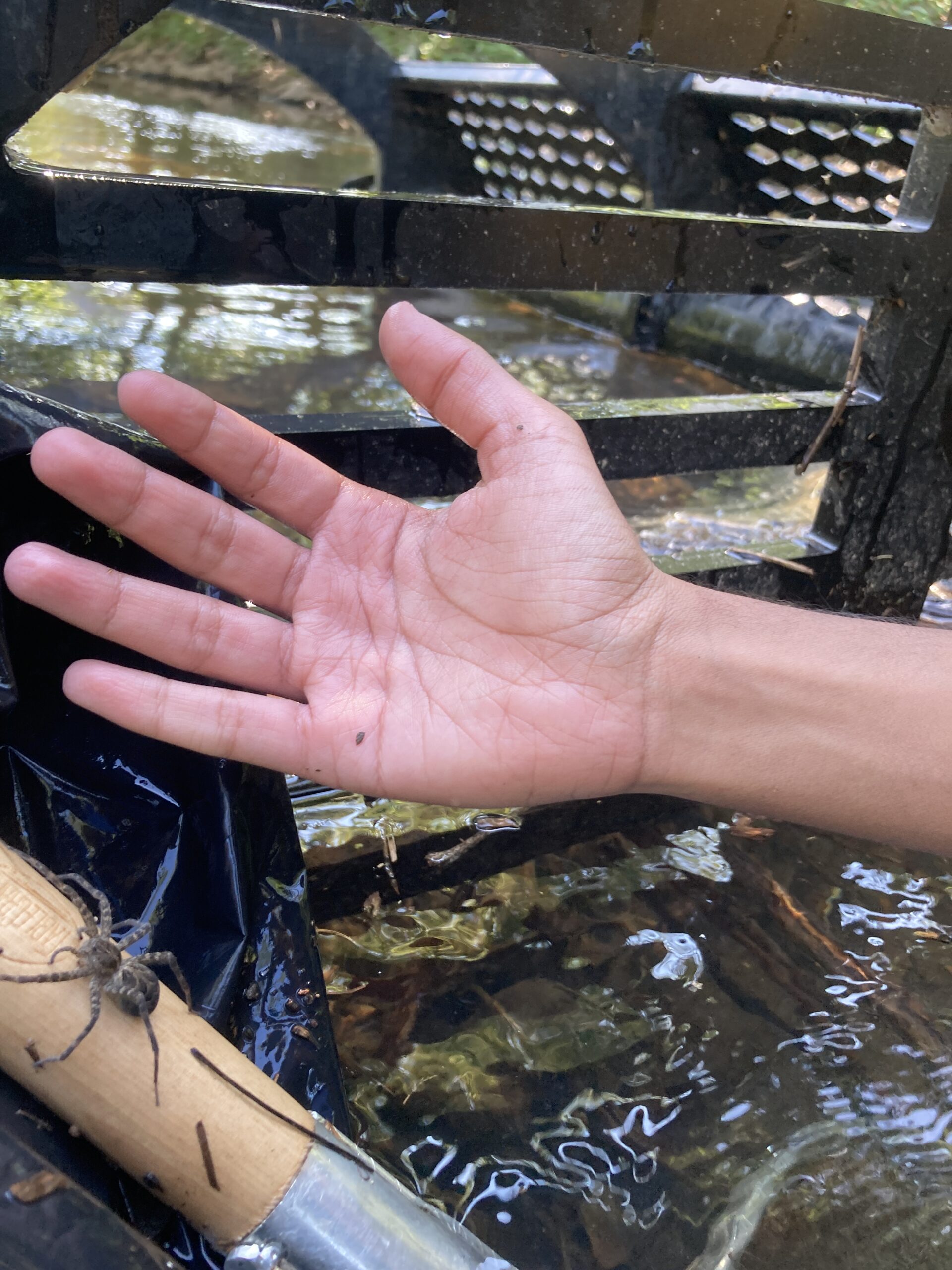
Finally, we found a large fishing spider hiding among the trash in the debris!
A fishing spider (dolomedes tenebrosus) was found in the litter trap.
As we have been conducting this project for the past few weeks, we have been exploring ways to improve the litter trap’s design. This week’s cleanup allowed us to witness how organic matter, such as a tree branch, was able to act as a net and catch a large portion of the litter that was collected in the trap. We found that organic matter is used in many countries, especially in smaller villages, to prevent the debris from moving forward. Often known as debris barriers, the use of organic matter is especially convenient when collecting smaller pieces of waste like Styrofoam which can be tedious to collect by hand due to the size of some Styrofoam pieces. However, we also have to consider that these natural barriers may require some upkeep in order to remain effective.
This cleanup was very insightful and provided us with more ways to make the litter trap a much more convenient and more efficient mechanism.
The third pathogen monitoring session of the month took place on Thursday, August 21st. Each week during the summer, from May to October, the Lower Raritan Watershed Partnership and Rutgers Cooperative Extension of Middlesex County run a volunteer-based monitoring program along the Raritan River. We collect water quality samples at six non-bathing public access beach sites, provide our samples to the Interstate Environmental Commission for analysis in their laboratory, and report the results to the public. Our mission is to share this data with the community and partners to ensure the safe use of the Raritan river for all.
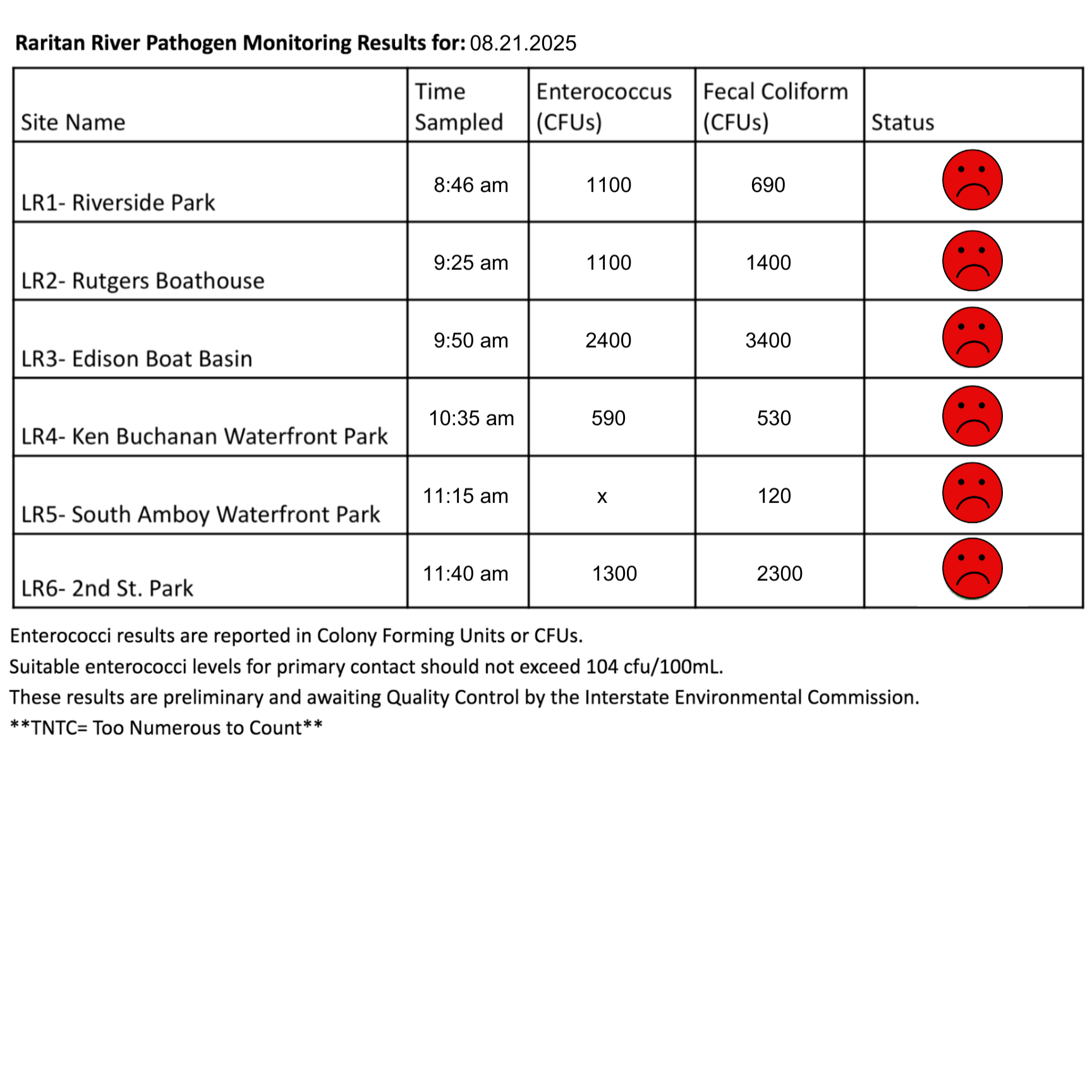
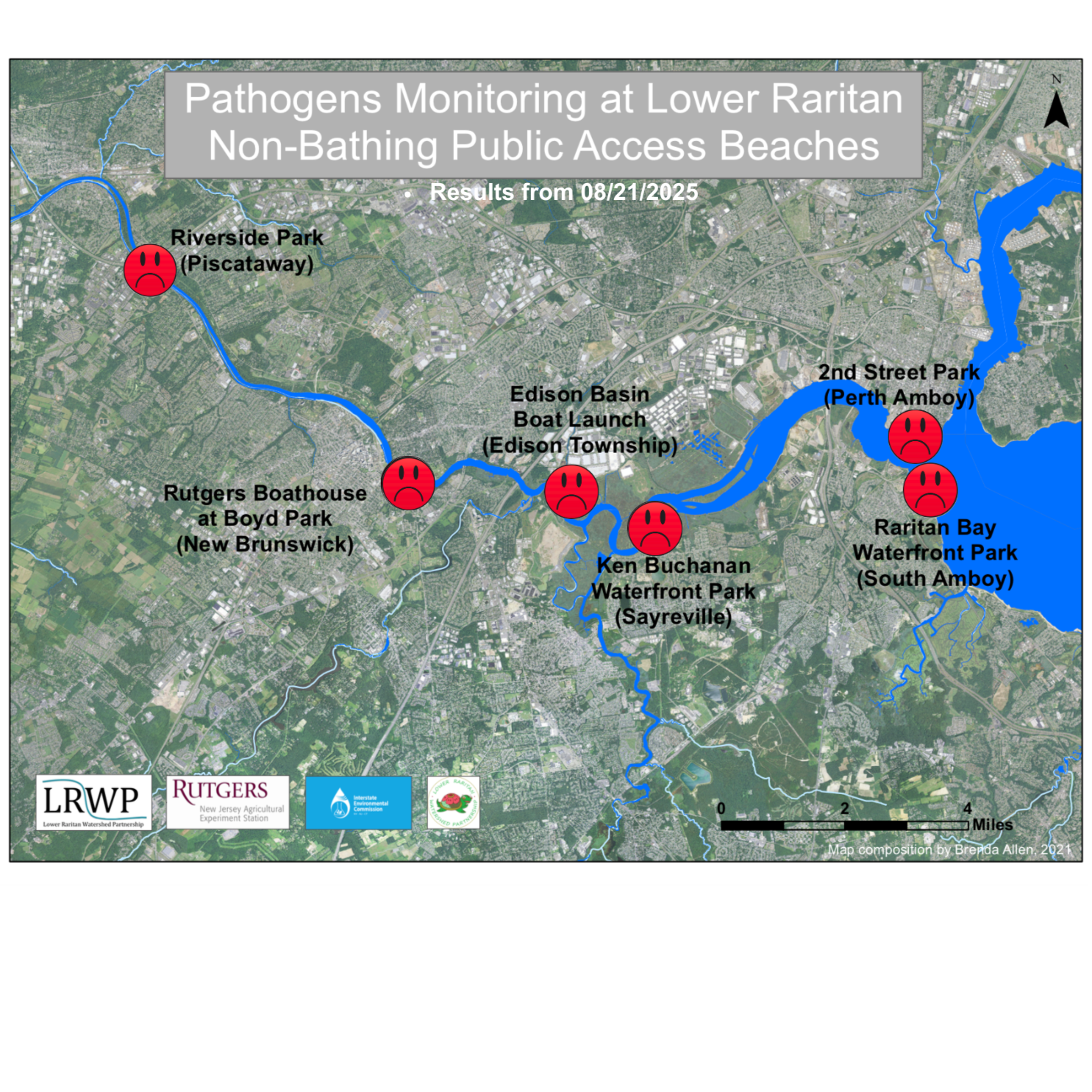
Our lab results for water quality samples taken on Thursday, August 21, 2025 show Enterococcus bacteria levels exceeding the EPA federal water quality standard of 104 cfu/100mL at five of our monitoring sites this week. On the chart below, red frowns indicate problem sites, and these include Riverside Park (Piscataway), Rutgers Boat House (New Brunswick), Edison Boat Basin(Edison Township), Ken Buchanan Waterfront Park (Sayreville), and 2nd Street Park (Perth Amboy).
We do not have complete data for South Amboy due to an abnormality in the lab results. Out of an abundance of caution, we are issuing a red smiley face to South Amboy as well. If the status of the lab result changes and we receive a different verdict from the Interstate Environmental Commission (IEC), then we will update our chart and map on this blog and on our social media.
Green smiles on the chart and map indicate the sites with bacteria levels safe for recreation. Unfortunately, we are not handing out any green smiles this week.
Pathogens/Enterococci levels are used as indicators of the possible presence of disease-causing bacteria in recreational waters. Such pathogens may pose health risks to people coming in primary contact with the water (touching) through recreational activities like fishing, kayaking or swimming in a water body. Possible sources of bacteria include Combined Sewer Overflows (CSOs), improperly functioning wastewater treatment plants, stormwater runoff, leaking septic systems, animal carcasses, pet waste, wildlife waste, and runoff from manure storage areas.
Our goal in reporting these results is to give residents a better understanding of the potential health risks related to primary contact during water-based recreation. If you are planning on recreating on the Raritan this weekend, make sure to stay safe and wash up after any activities!
Internationally-acclaimed artist Ania Upstill volunteered for pathogen monitoring this week! In this photo, Ania greets Elver the eel. At each of our sites, Ania picked up litter and learned about how the Raritan River Watershed has been affected by nonpoint source pollutants. Photo credit: –J.M. Meyer.
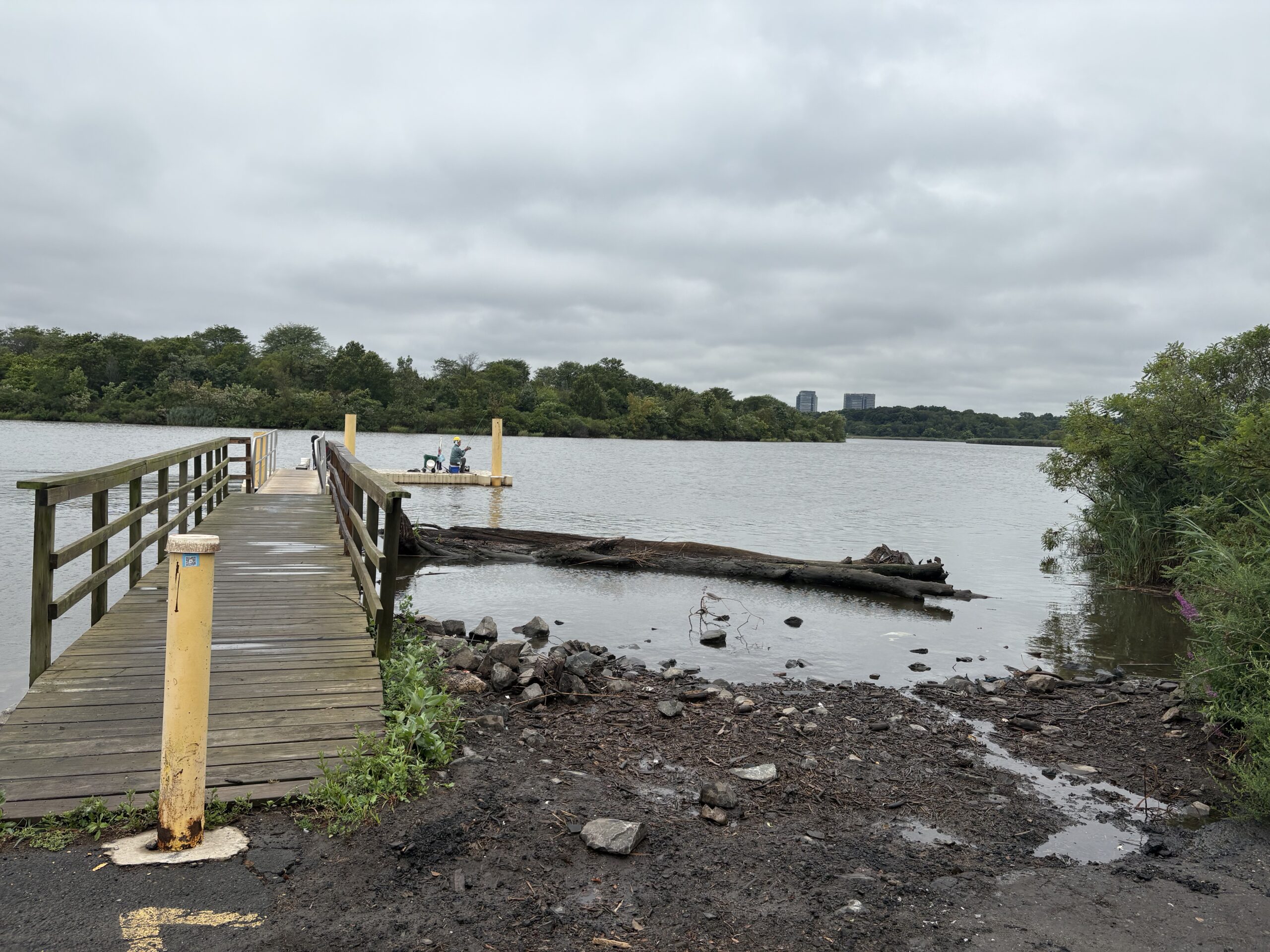
A fisher at Edison Boat Basin takes advantage of the cloudy day and the dock ramp. Photo credit: –Art Allgauer.
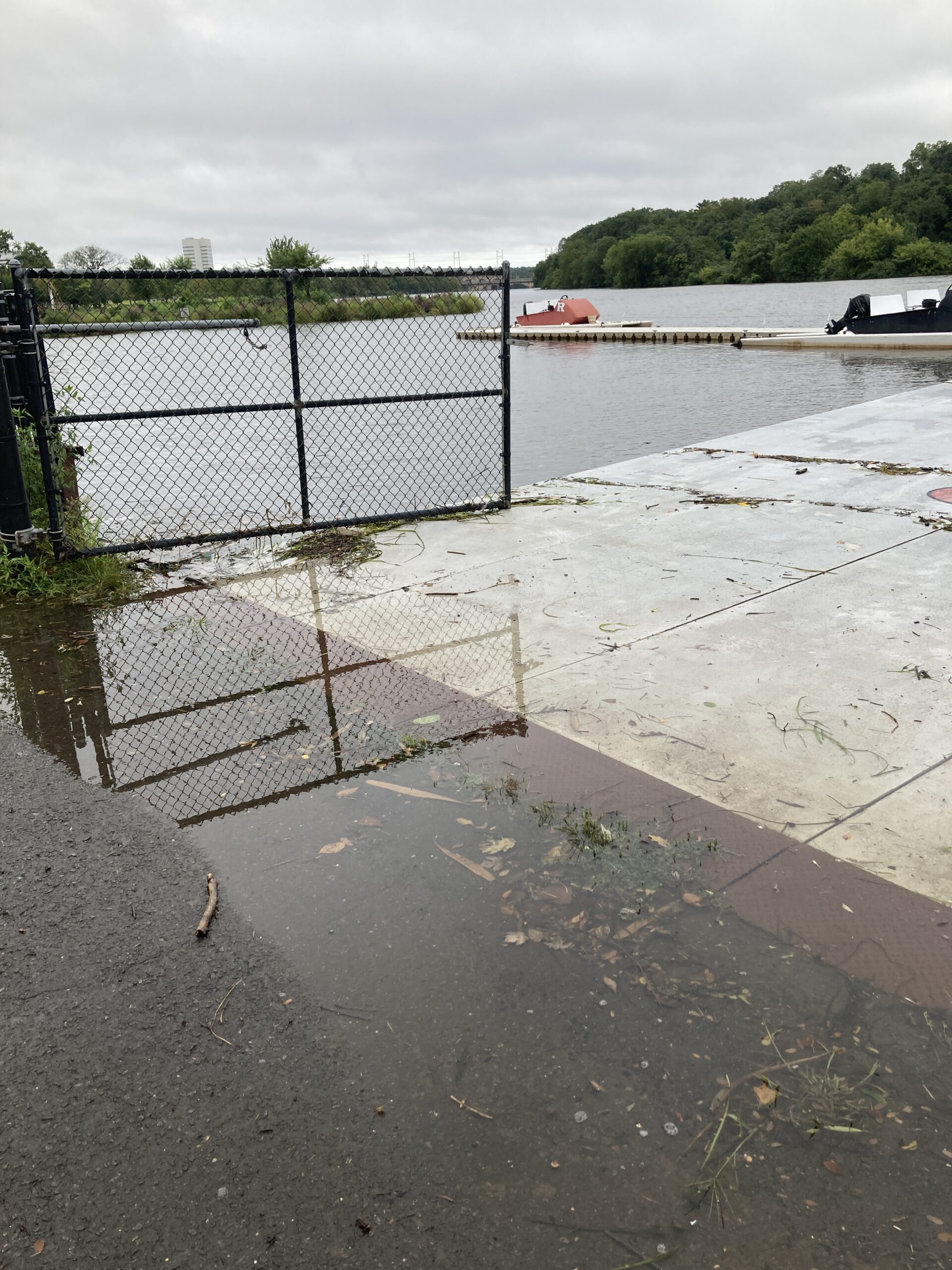
High tide combined with the outer bands of Hurricane Erin led to flooding at the Class of 1914 Rutgers Boat House in New Brunswick. Photo credit: –J.M. Meyer.
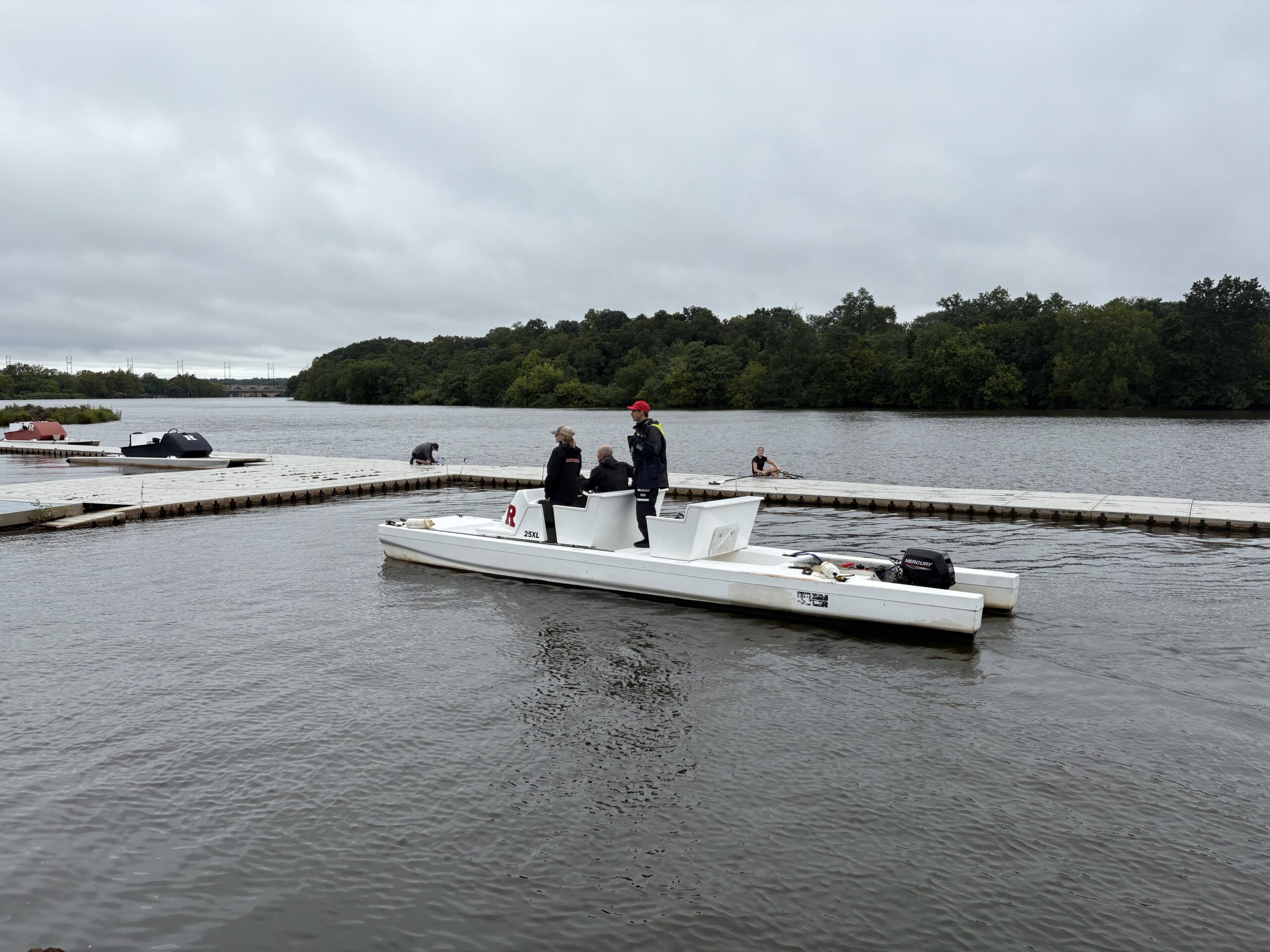
Rutgers coaches help their athletes navigate a swollen Raritan River near Rutgers Boat House. Photo credit: — Art Allgauer.
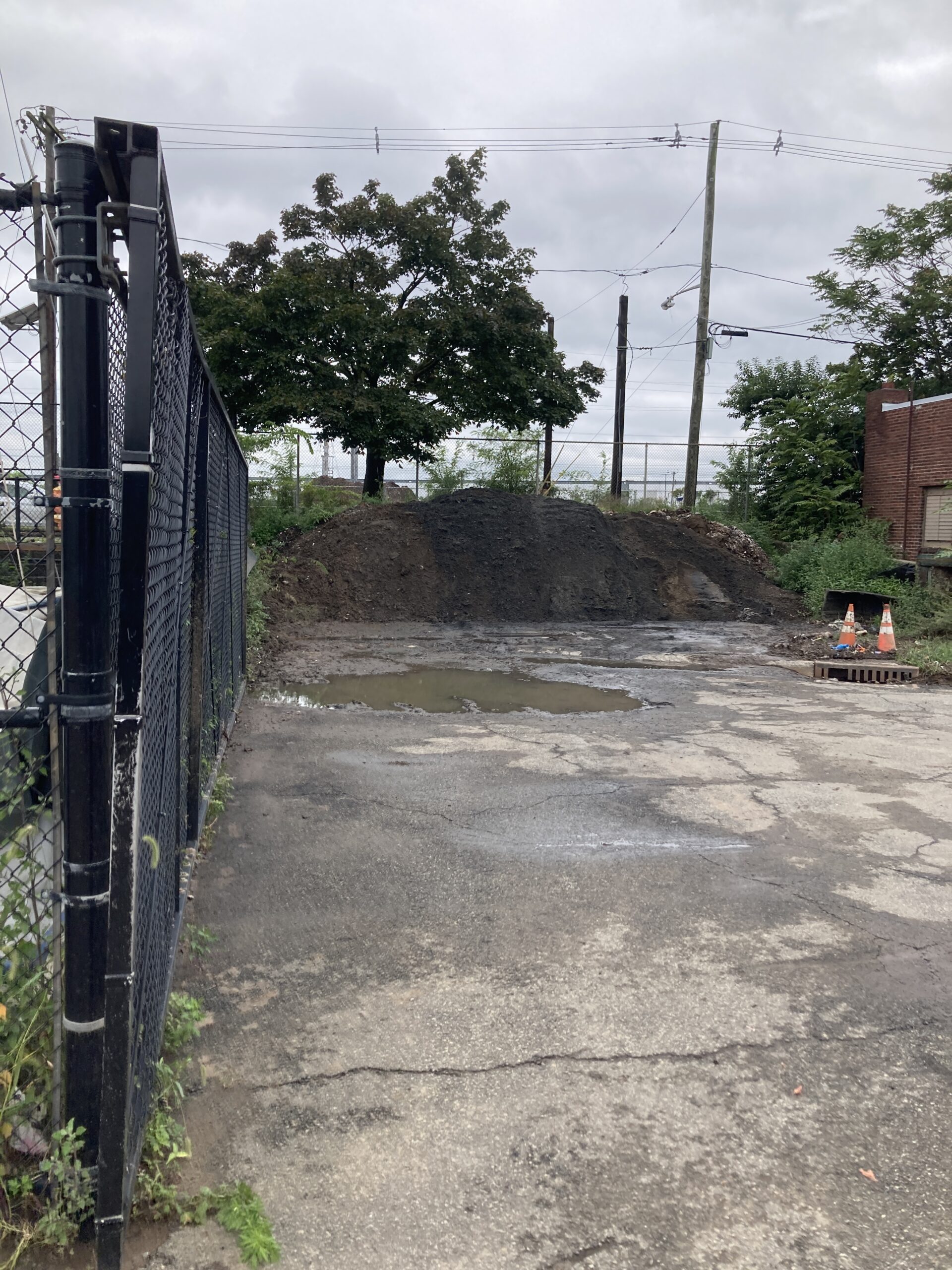
In Perth Amboy, the pile of sanitary products and sewage sediment has been partially capped by top soil. The sewage smell is less noticeable compared to previous visits, but still present. Photo credit: –J.M. Meyer.
In the sample from Sayreville, our IEC lab technicians found a moon jellyfish (Aurelia aurita)! Though jellyfish are often thought of as ocean animals, some species enjoy the brackish waters such as those found at the Ken Buchanan Waterfront Park. Photo credit: –Ruby Alcorn.
The second pathogen monitoring session of the month took place on Thursday, August 14th. Each week during the summer, from May to October, the Lower Raritan Watershed Partnership and Rutgers Cooperative Extension of Middlesex County run a volunteer-based monitoring program along the Raritan River. We collect water quality samples at six non-bathing public access beach sites, provide our samples to the Interstate Environmental Commission for analysis in their laboratory, and report the results to the public. Our mission is to share this data with the community and partners to ensure the safe use of the Raritan river for all.
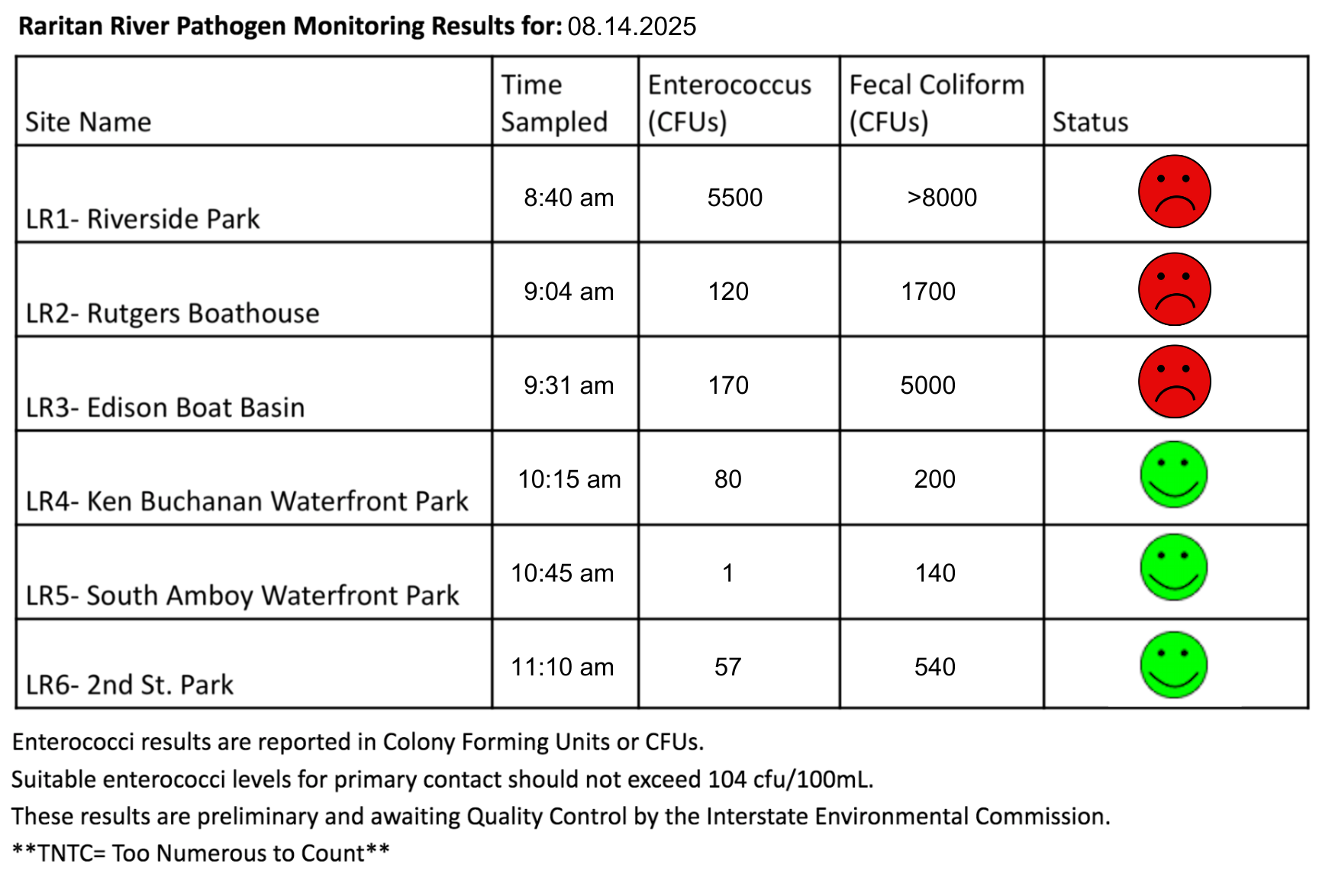
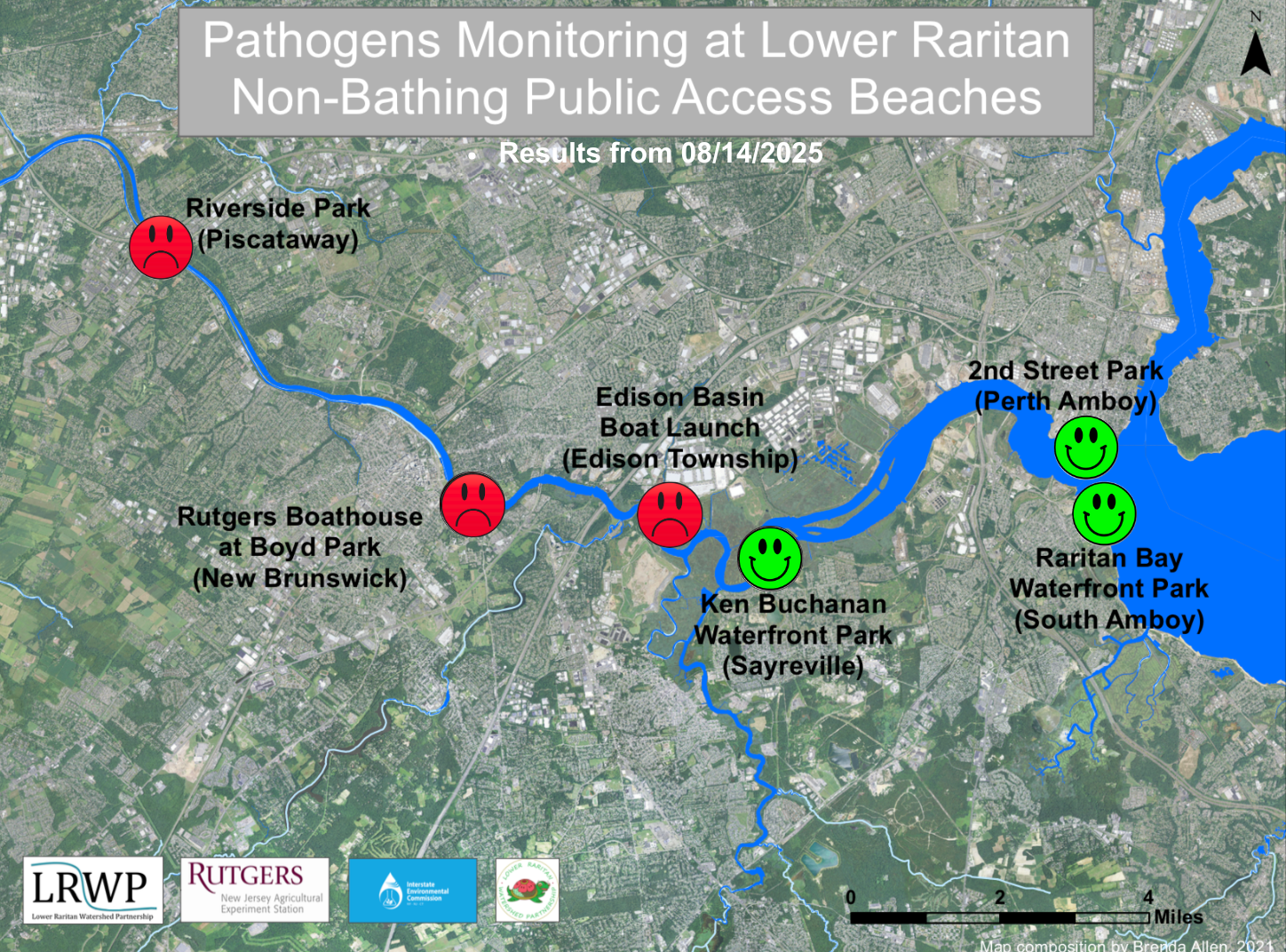
Our lab results for water quality samples taken on Thursday, August 14, 2025 show Enterococcus bacteria levels exceeding the EPA federal water quality standard of 104 cfu/100mL at three of our monitoring sites this week. Problem sites would be indicated by red frowns on the map and chart which includes: Riverside Park (Piscataway), Rutgers Boat House (New Brunswick), and Edison Boat Basin(Edison Township). Green smiles on the chart and map indicate the sites with bacteria levels safe for recreation, and include the following: Ken Buchanan Waterfront Park (Sayreville), Raritan Bay Waterfront Park (South Amboy), and 2nd Street Park (Perth Amboy).
Pathogens/Enterococci levels are used as indicators of the possible presence of disease-causing bacteria in recreational waters. Such pathogens may pose health risks to people coming in primary contact with the water (touching) through recreational activities like fishing, kayaking or swimming in a water body. Possible sources of bacteria include Combined Sewer Overflows (CSOs), improperly functioning wastewater treatment plants, stormwater runoff, leaking septic systems, animal carcasses, pet waste, wildlife waste, and runoff from manure storage areas.
Our goal in reporting these results is to give residents a better understanding of the potential health risks related to primary contact during water-based recreation. If you are planning on recreating on the Raritan this weekend, make sure to stay safe and wash up after any activities!
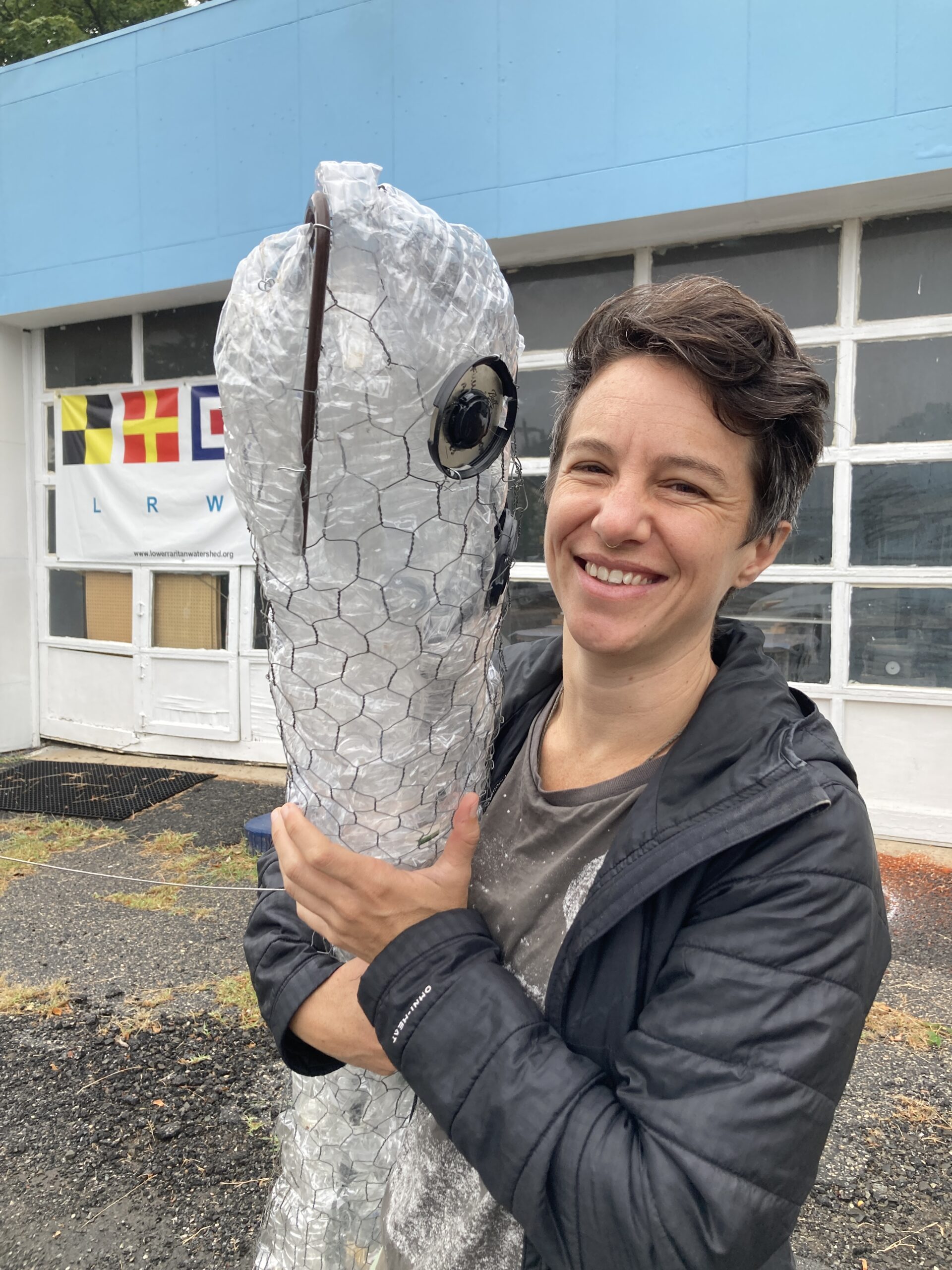
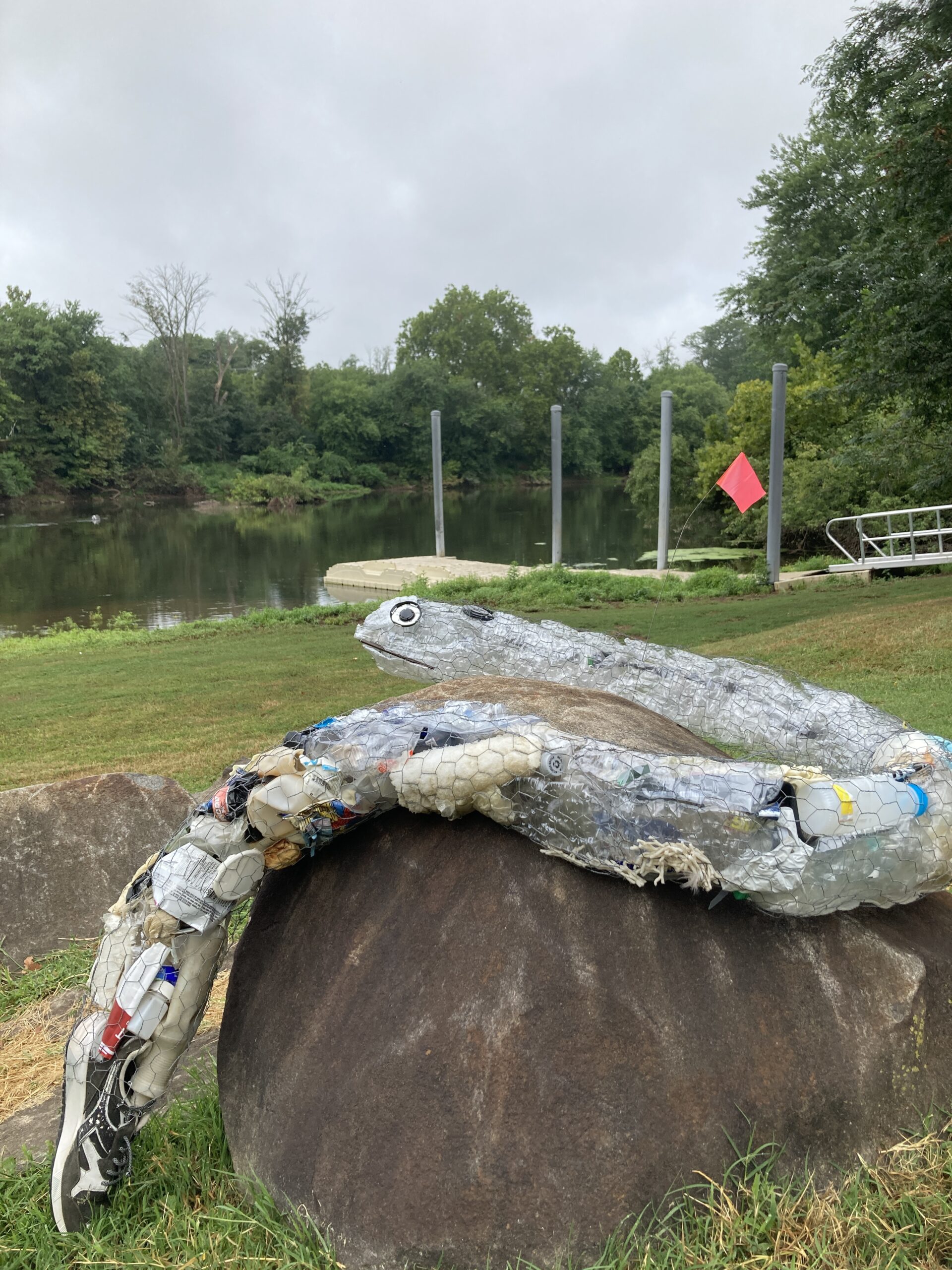
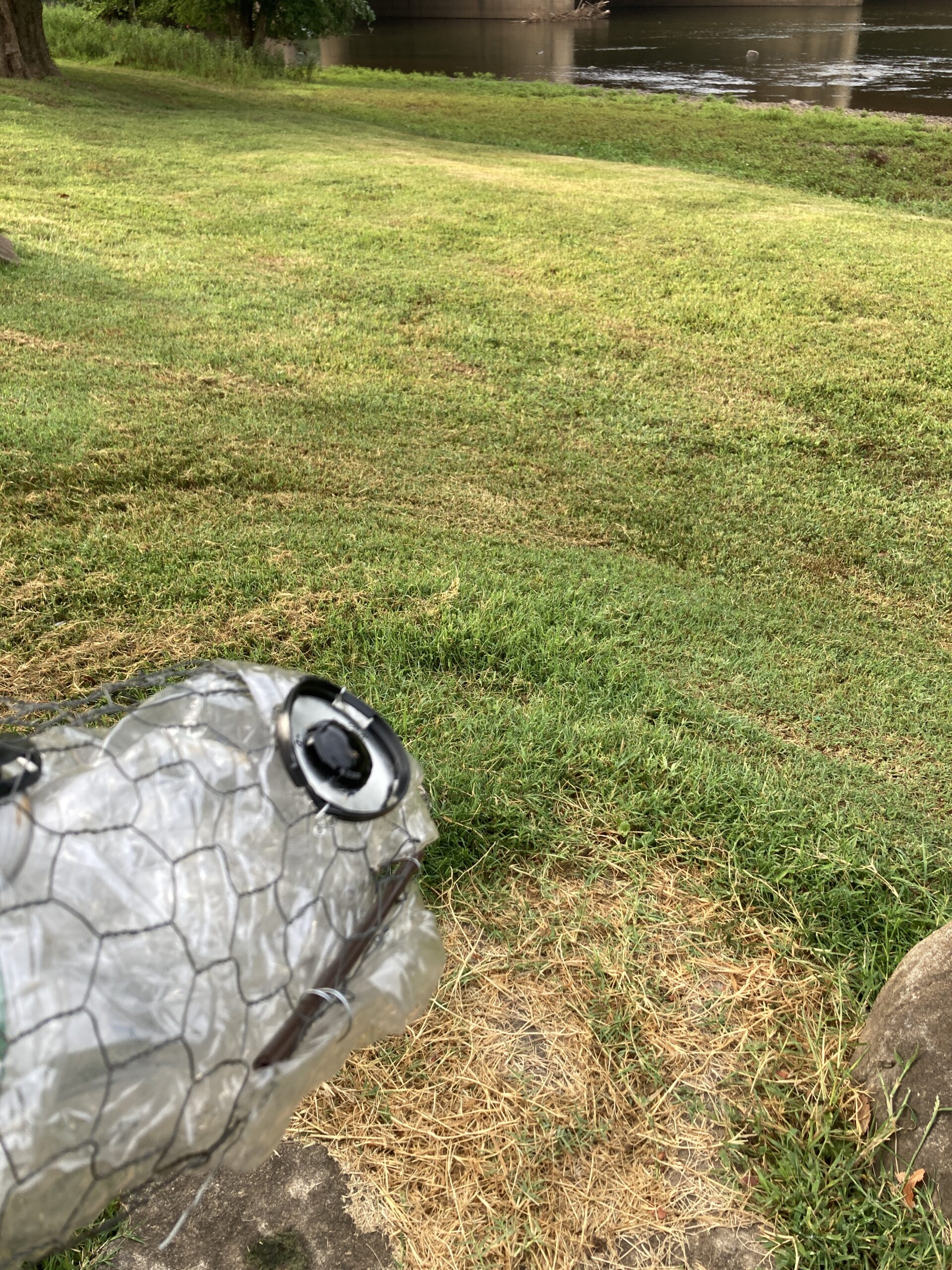
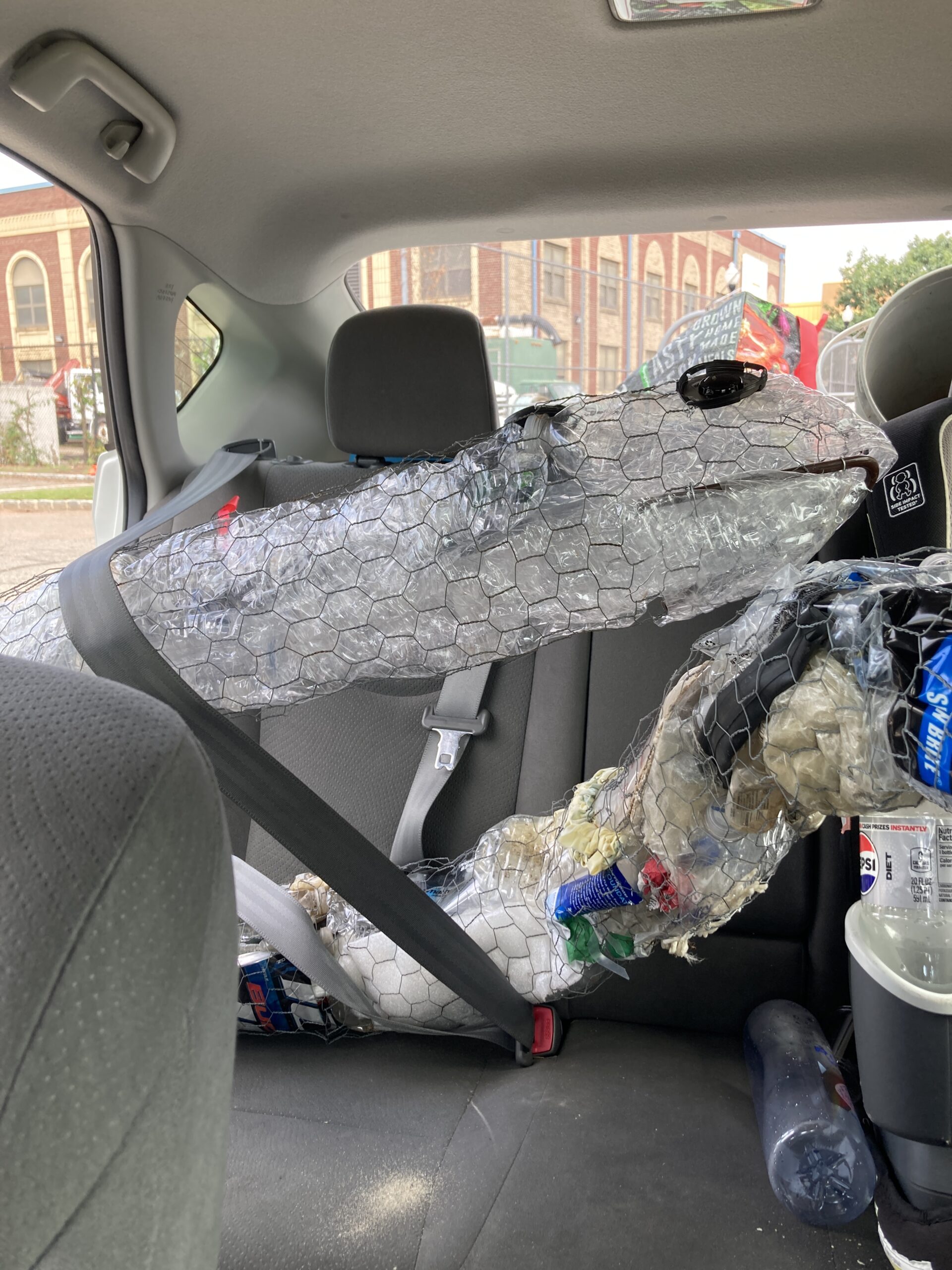
Elver the Eel joins volunteers for water monitoring at Riverside Park. Artist Lisa Bagwell constructed Elver entirely out of trash from the Raritan River, making him the only American eel (Anguilla rostrata) able to survive out of water for so long! Instead of migrating to the Sargasso Sea to mate with other eels, Elver migrates from school to school to educate students about water quality. Photo credit: J.M. Meyer.
During a visual habitat assessment of Riverside Park, Elver notices the land has been mowed down right to the water line. Unfortunately, this prevents the riparian plant life from filtering pollutants out of our water. This can contribute to poor water quality. Photo credit: J.M. Meyer.
Invasive emerald ash borers (Agrilus planipennis) have killed many of the white ash trees (Fraxinus americana) near the Raritan River. Less shade means hotter water and more algal blooms, making it unpleasant for Elver to swim. Photo credit: J.M. Meyer.
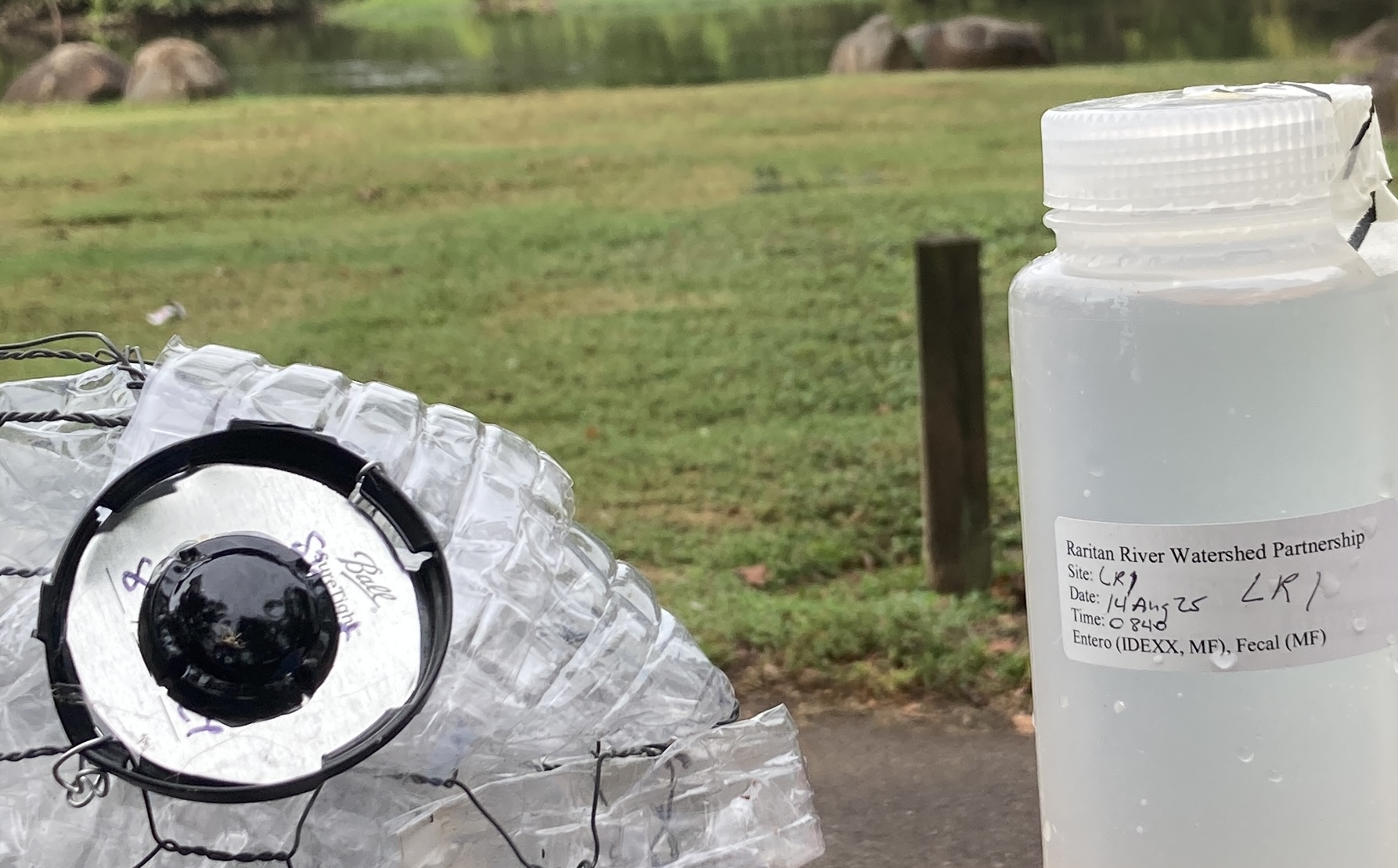
Elver visually inspects the Riverside Park (LR1) water sample before sending it off to the lab. Yikes! Lab analysis the next day showed that Piscataway’s Riverside Park is suffering from fecal polluted water. Photo credit: J.M. Meyer.
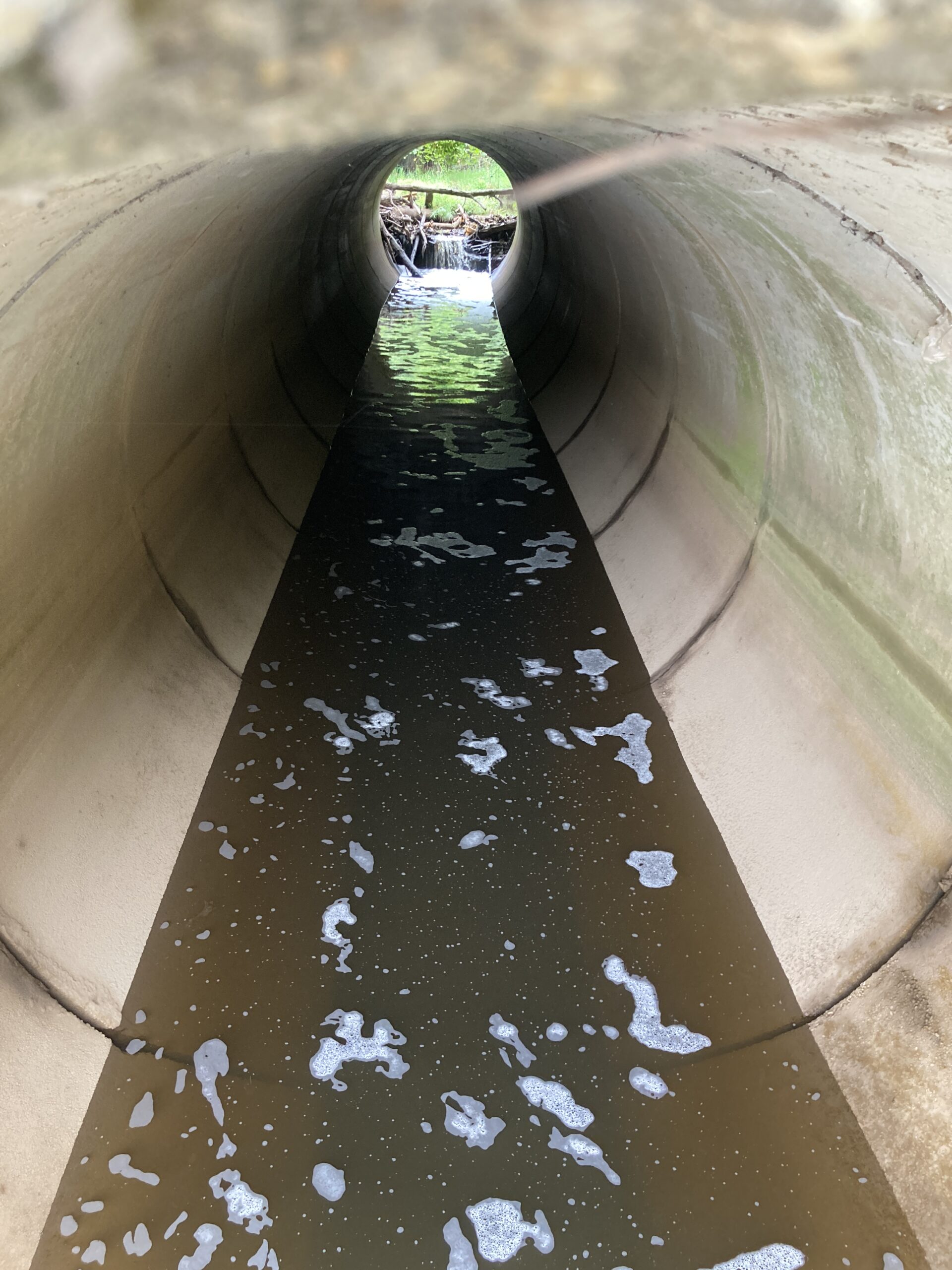
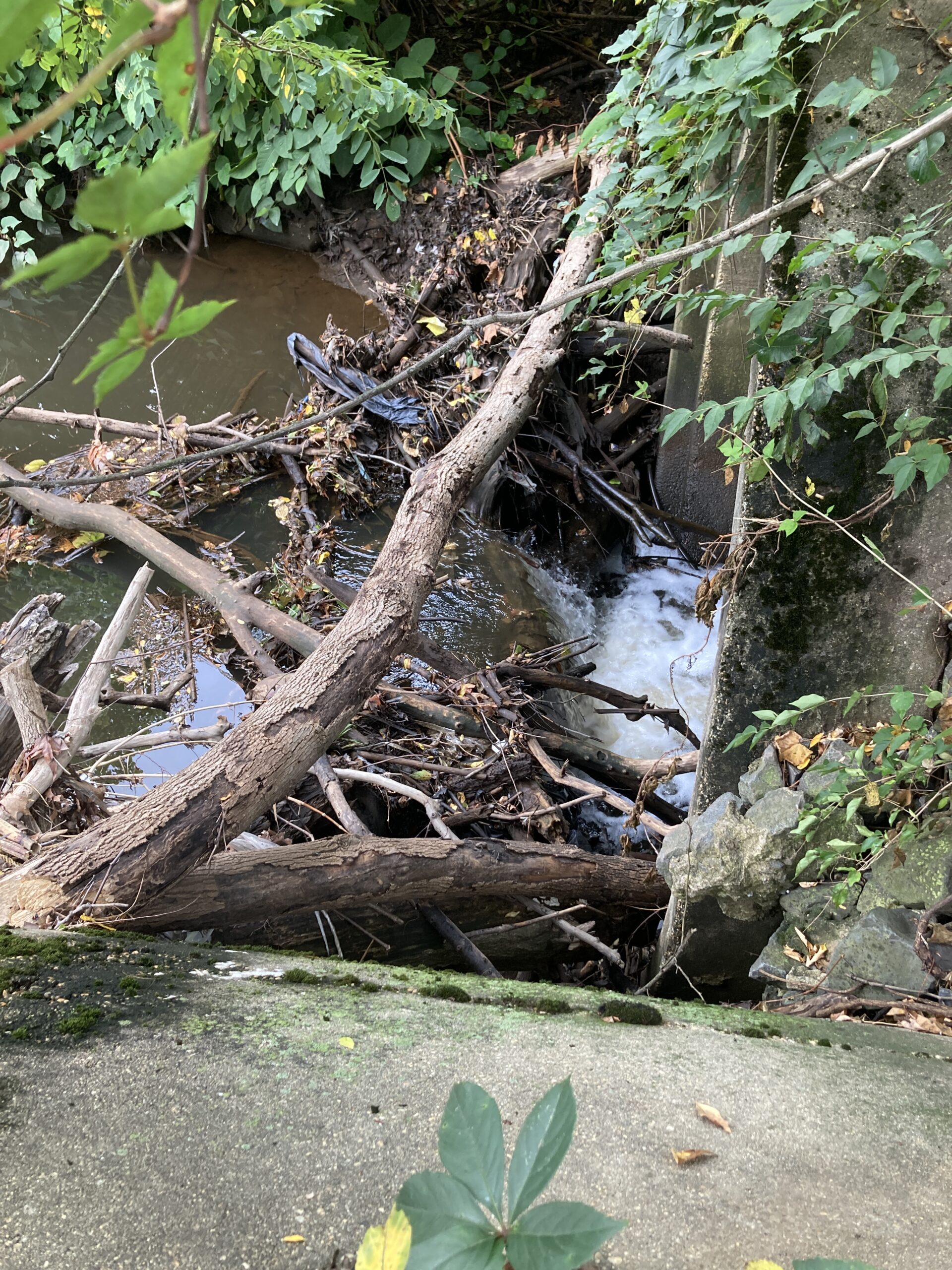
Ashley observes how the massive culvert of Mill Brook flows into the Edison Boat Basin, eroding the far shore and carrying debris from the Kin-Buc Landfill Superfund Site. Photo credit: J.M. Meyer.
Natural sources of foam include plant matter decaying, runoff, and turbulence, such as the waterfall at the mouth of the culvert. Photo credit: J.M. Meyer
An ash log creates a waterfall flowing into the culvert at Mill Brook in Edison Boat Basin. Photo credit: J.M. Meyer.
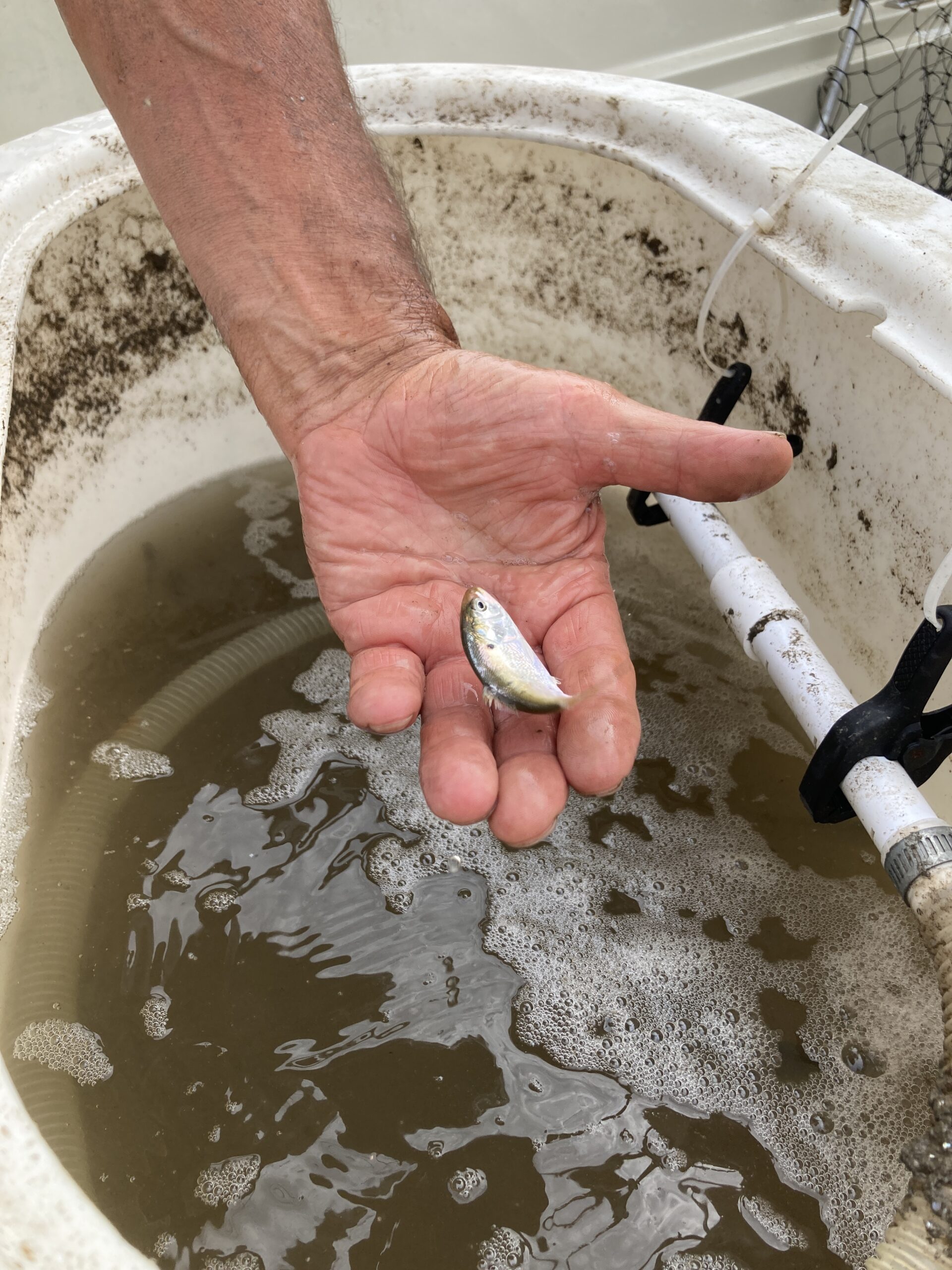
A fisherman displays a juvenile white mullet (Mugil curema) he caught in Sayreville. When handling fish like this juvenile white mullet, be gentle and return them to the water as quickly as possible! Photo credit: J.M. Meyer.
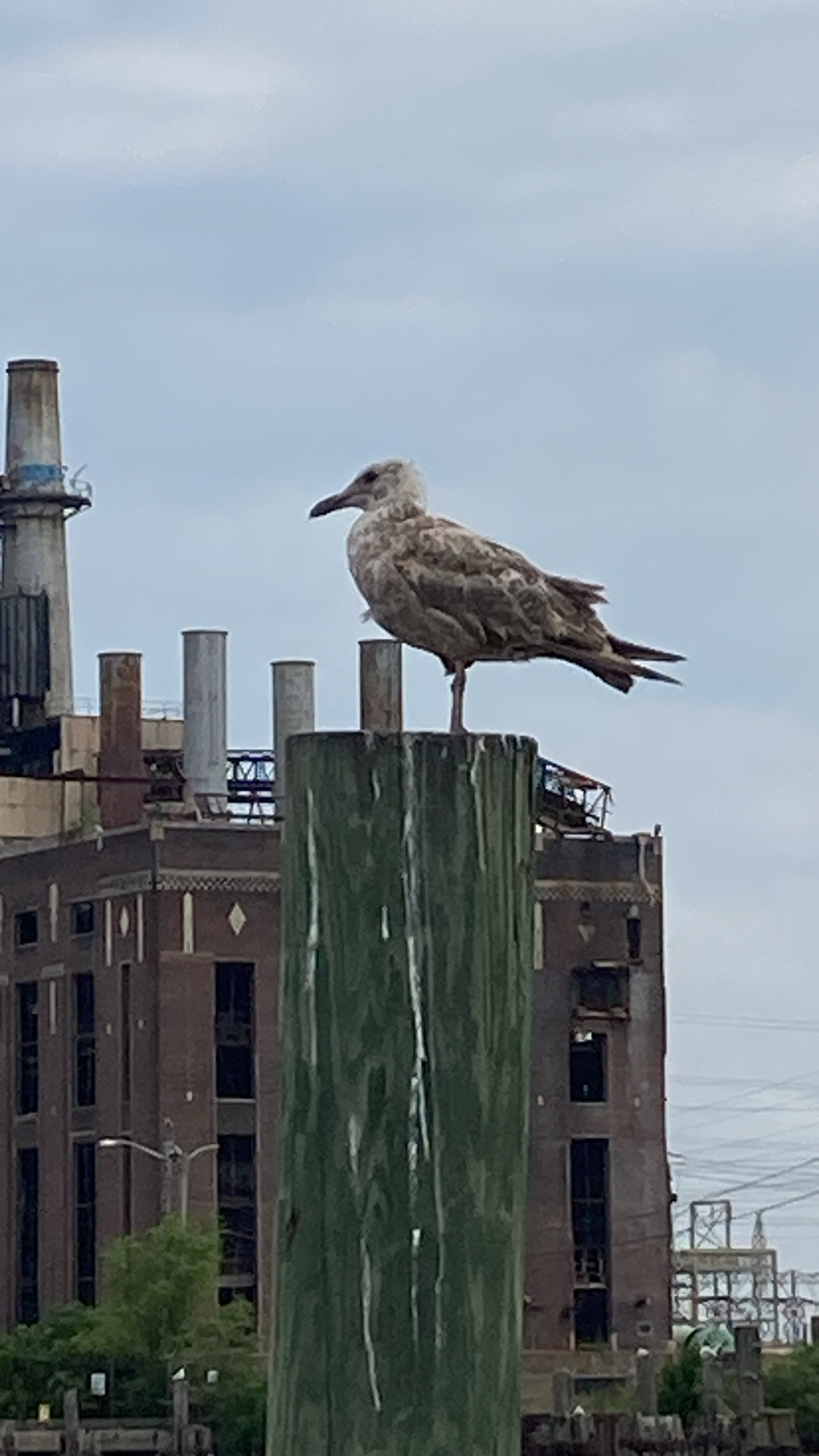
This juvenile European herring gull (Larus argentatus) will look very different as an adult, trading its mottled white and brown feathers for a mostly white body with gray wings and black accents. Photo credit: J.M. Meyer.
Driving between sites is perhaps the most dangerous part of water monitoring. Buckle up, Elver! Photo credit: J.M. Meyer.
The last pathogen monitoring session for the month took place on July 31st. Each week during the summer, from May to October, the Lower Raritan Watershed Partnership and Rutgers Cooperative Extension of Middlesex County run a volunteer-based monitoring program along the Raritan River. We collect water quality samples at six non-bathing public access beach sites, provide our samples to the Interstate Environmental Commission for analysis in their laboratory, and report the results to the public. Our mission is to share this data with the community and partners to ensure the safe use of the Raritan river for all.
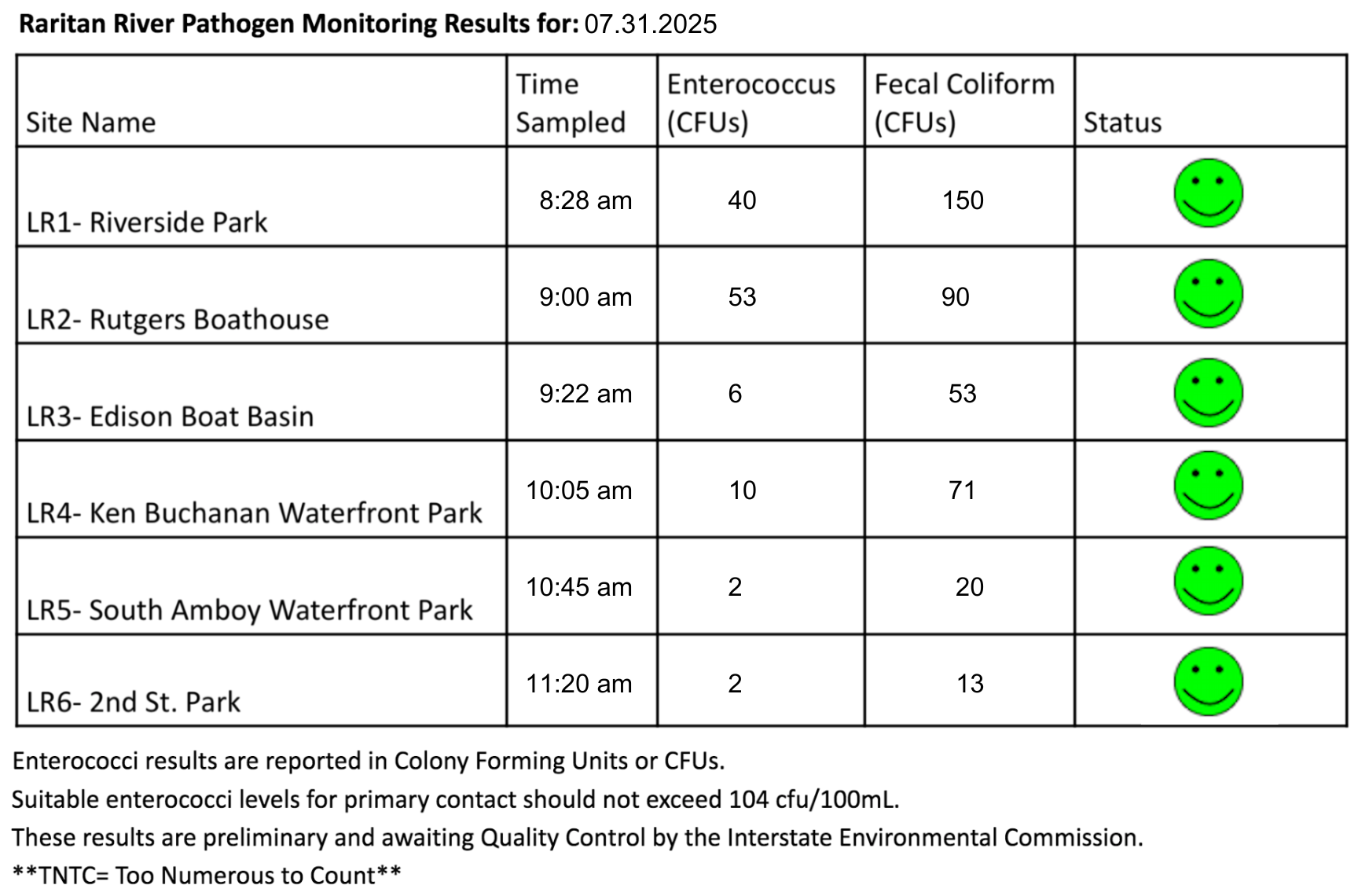
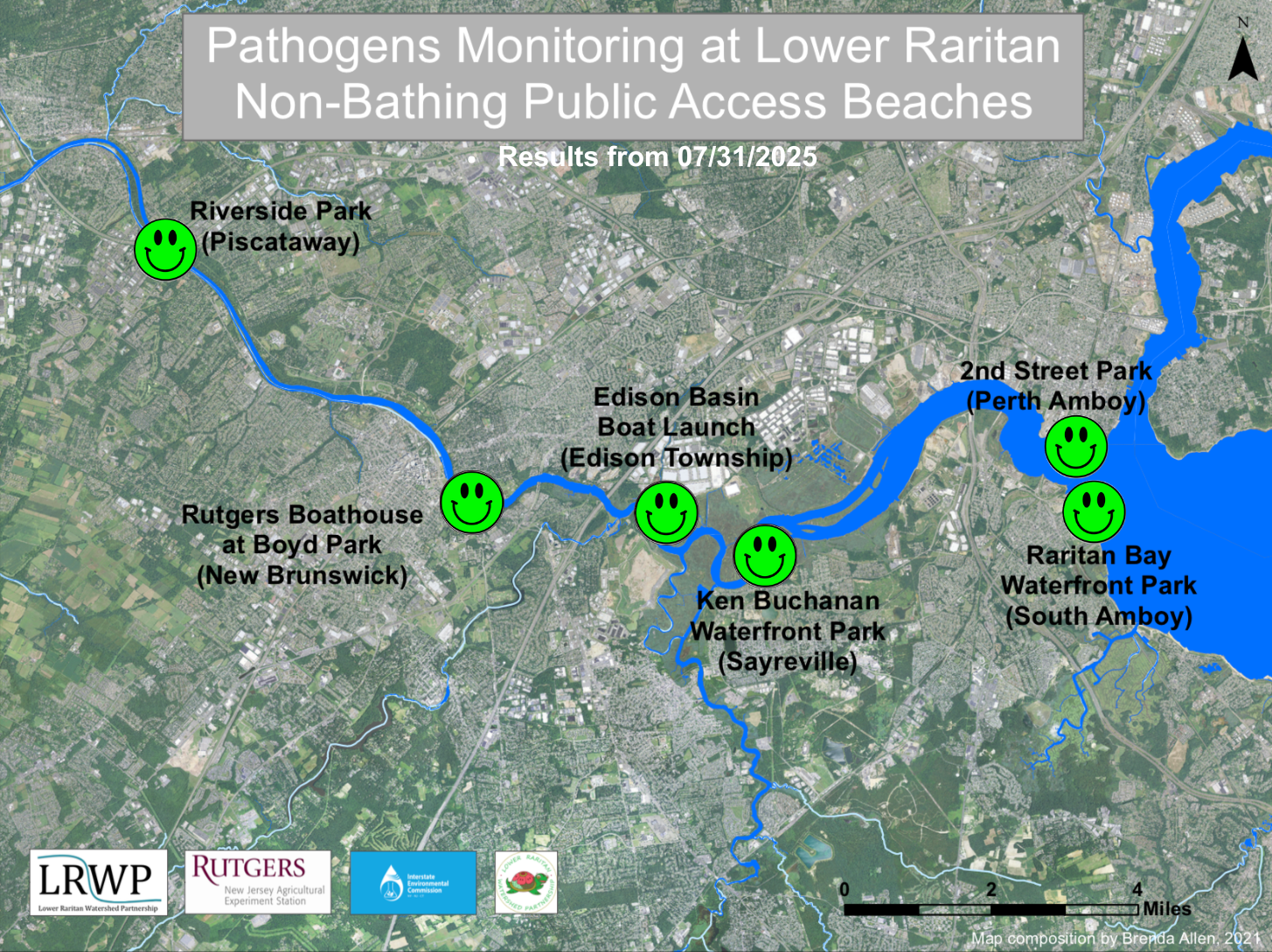
Our lab results for water quality samples taken on Thursday, July 31, 2025 show Enterococcus bacteria levels exceeding the EPA federal water quality standard of 104 cfu/100mL at none of our monitoring sites this week. Problem sites would be indicated by red frowns on the map and chart. Green smiles on the chart and map indicate the sites with bacteria levels safe for recreation, and include the following: Riverside Park (Piscataway), Rutgers Boat House (New Brunswick), Edison Boat Launch (Edison Township), Ken Buchanan Waterfront Park (Sayreville), Raritan Bay Waterfront Park (South Amboy), and 2nd Street Park (Perth Amboy).
While we are thrilled to see such great results along the Lower Raritan, we want to advise the public that our watershed experienced heavy rain almost immediately after our testing period on Thursday morning. Heavy rainfall tends to wash pollutants into the river. Therefore, we suspect at least some of our sites would fail our test if we were to repeat the sampling session this morning. Please take the following table and map with a grain of salt, and enjoy your weekend!
Pathogens/Enterococci levels are used as indicators of the possible presence of disease-causing bacteria in recreational waters. Such pathogens may pose health risks to people coming in primary contact with the water (touching) through recreational activities like fishing, kayaking or swimming in a water body. Possible sources of bacteria include Combined Sewer Overflows (CSOs), improperly functioning wastewater treatment plants, stormwater runoff, leaking septic systems, animal carcasses, and runoff from manure storage areas.
Our goal in reporting these results is to give residents a better understanding of the potential health risks related to primary contact during water-based recreation. If you are planning on recreating on the Raritan this weekend, make sure to stay safe and wash up after any activities!
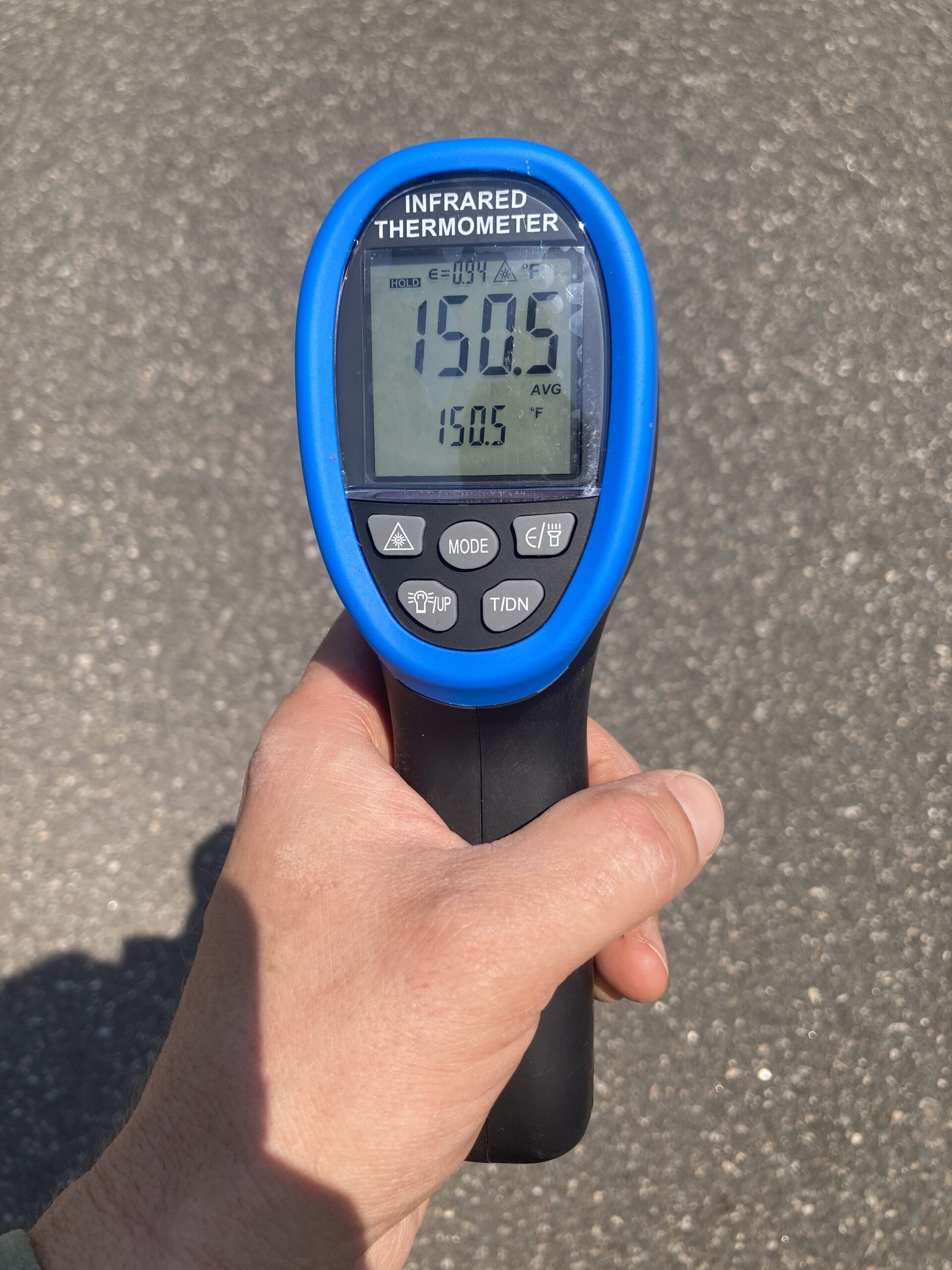
We found surface temperatures of more than 150 degrees Fahrenheit on the asphalt parking lot in New Brunswick. Please be careful this summer. Drink water, stay in the shade, and advocate for our municipalities to use cooler, more permeable surfaces in our parks and neighborhoods. Photo credit: — J.M. Meyer.
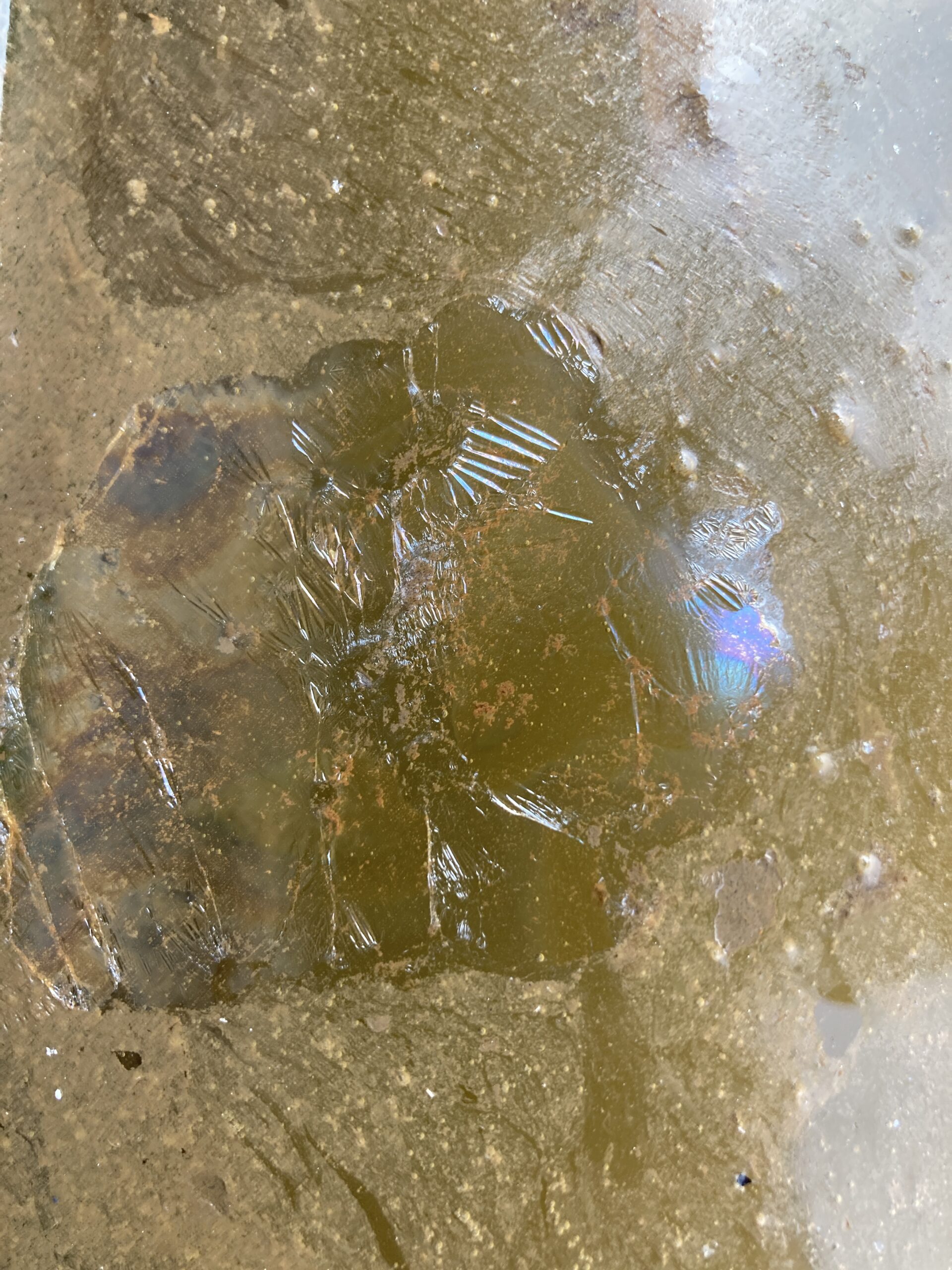
What’s in your water? In Sayreville, Edison Boat Basin, and New Brunswick we often find shiny pieces of film with a crackly texture. Some of our colleagues in the New York City area have suggested that this substance is ‘coal tar,’ a hazardous waste often produced when refining coal. But we would like more information! Have you seen anything strange in the Raritan River? Please contact us and let us know. Photo credit — J.M. Meyer.
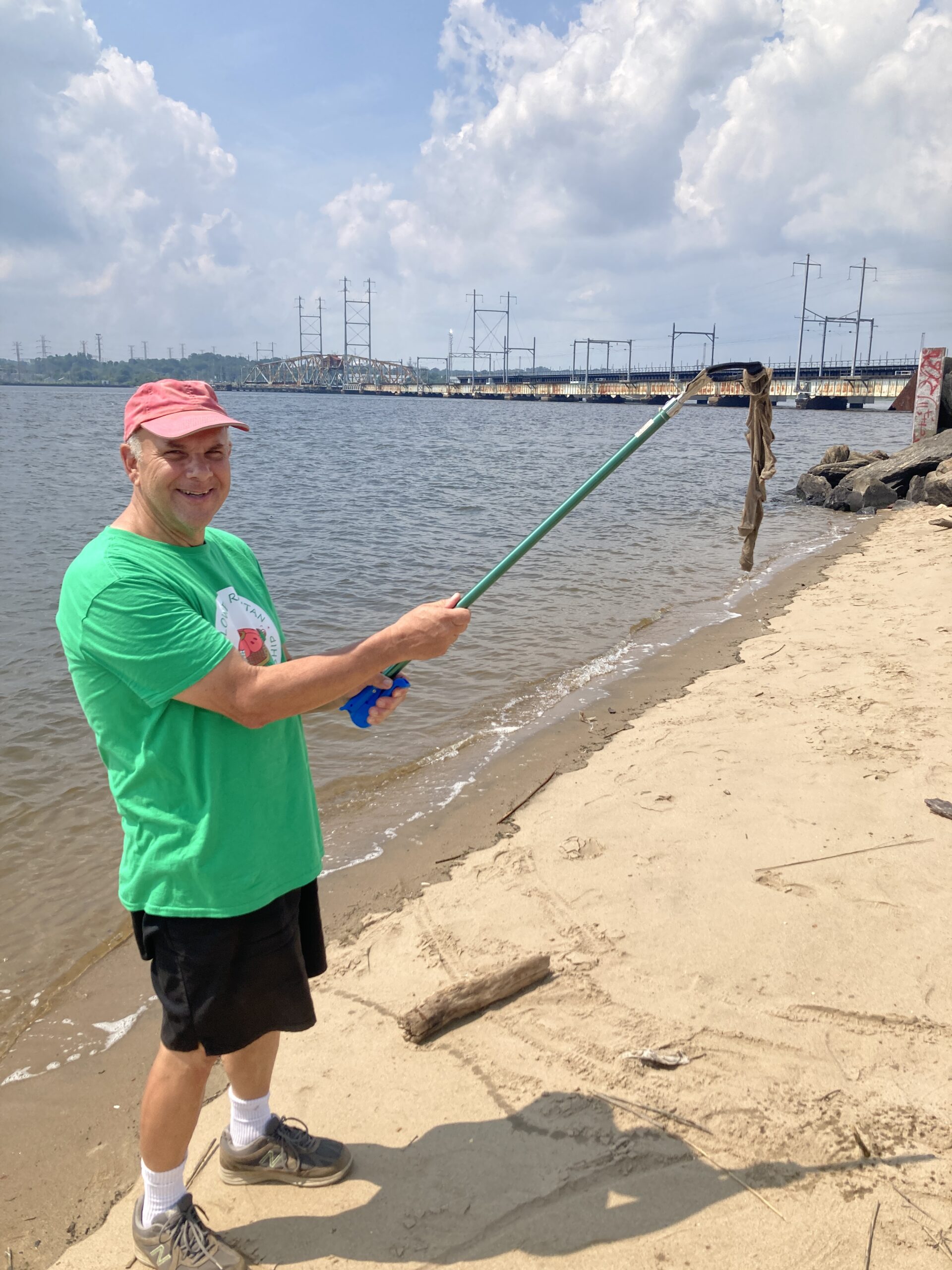
As we move through the monitoring sites, we always try to pick up the litter we stumble across. In this photo, Art courageously removes a sanitary cloth from the waters along Perth Amboy. Photo credit: — J.M. Meyer.
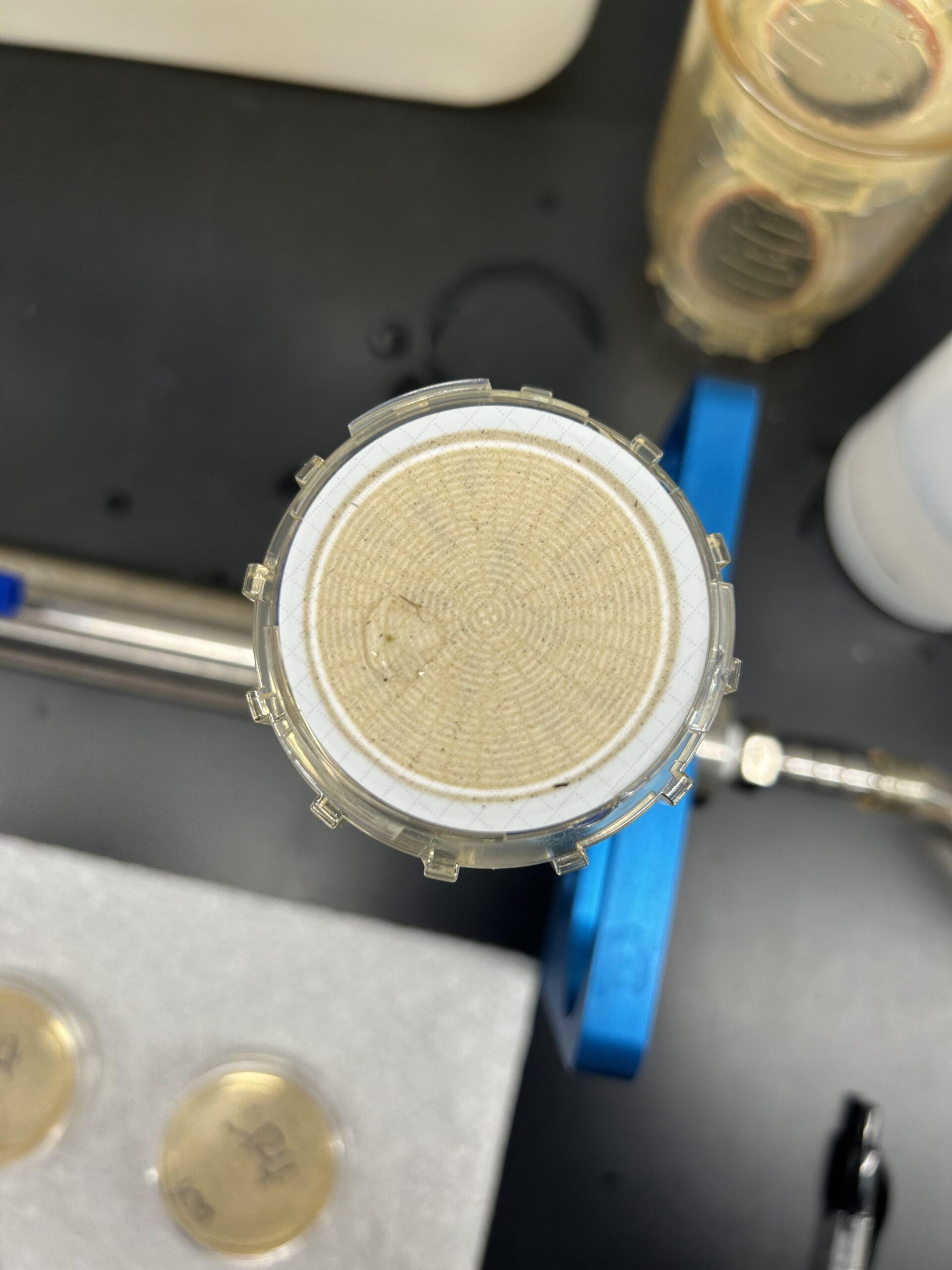
In South Amboy, our testers may have stepped into an active algae bloom. We found the highest concentrations of chlorophyl of the season, with a reading of over 41 Chlorophyll-a Relative Fluorescence Units (RFU). Chlorophyll-a RFU is a measurement used to quantify chlorophyll-a, a pigment found in algae and plants, based on the intensity of fluorescence emitted when the pigment is excited by light. In our lab analysis, our filtration process confirmed the finding. We’ll continue to monitor the water quality at South Amboy and elsewhere. Photo credit: — Ruby Alcorn.
The LRWP and SEWA volunteers went out to the litter trap in the Green Brook on Saturday, July 26th, 2025, to conduct a litter tally. Huge thanks to our SEWA International Central Jersey youth partners! Thanks to their efforts, we’ll have much better data on how the litter trap keeps our watershed clean. Learn more about the litter trap initiative here. And learn more about the LRWP’s litter tally project with SEWA here. Below, you’ll find Sewa’s Nilesh Bhat describing the litter we picked up and conditions surrounding the litter trap.
Blog post by Nilesh Bhat
On July 26th, Sewa leads checked on the litter trap for the 6th week. The litter trap only collected a few pieces of Styrofoam and some plastic. This was much less compared to other weeks. We moved on to picking up litter that we could see outside the trap. Here, we found a lot of plastic bags, plastic bottles, and other such litter. We also found a discarded appliance that we theorized to be either a wax melter or a humidifier. We also planted some seeds by the support rods holding the litter trap. This was in hopes that the roots could stabilize the ground and mitigate erosion during storms. We had put bug spray on as always, but we were swarmed with mosquitoes regardless. This resulted in one of the leads having a minor allergic reaction. The mosquitoes might have been higher in number this week due to high temperatures exceeding 100ºF and recent storms increasing water levels. It was an interesting week, and we will continue to monitor the trap.