June flew by, and the last Pathogen Monitoring session of the month occured on Thursday, the 26th. Every Thursday during the summer, from May to October, the Lower Raritan Watershed Partnership and Rutgers Cooperative Extension of Middlesex County run a volunteer-based monitoring program along the Raritan River. We collect water quality samples at six non-bathing public access beach sites, provide our samples to the Interstate Environmental Commission for analysis in their laboratory, and report the results to the public on Friday afternoons. Our mission is to share this data with the community and partners to ensure the safe use of the Raritan river for all.
Our lab results for water quality samples taken on Thursday, June 26, 2025 show Enterococcus bacteria levels exceeding the EPA federal water quality standard of 104 cfu/100mL at 3 of our monitoring sites this week. Problem sites are indicated by red frowns on the map and chart which includes: Rutgers Boathouse (New Brunswick), Raritan Bay Waterfront Park (South Amboy), and 2nd Street Park (Perth Amboy). Green smiles on the chart and map indicate the sites with bacteria levels safe for recreation, and include the following: Riverside Park (Piscataway), Edison Boat Basin (Edison), and Ken Buchanan Waterfront Park (Sayreville).
Pathogens/Enterococci levels are used as indicators of the possible presence of disease-causing bacteria in recreational waters. Such pathogens may pose health risks to people coming in primary contact with the water (touching) through recreational activities like fishing, kayaking or swimming in a water body. Possible sources of bacteria include Combined Sewer Overflows (CSOs), improperly functioning wastewater treatment plants, stormwater runoff, leaking septic systems, animal carcasses, and runoff from manure storage areas.
Our goal in reporting these results is to give residents a better understanding of the potential health risks related to primary contact during water-based recreation. If you are planning on recreating on the Raritan this weekend, make sure to stay safe and wash up after any activities!
The sonde nearly disappears below the water’s surface due to low clarity at Edison Boat Basin. Photo credit: J.M. Meyer.
A Heineken bottle floats amidst debris in the water near the Rutgers Boat House. Photo credit: J.M. Meyer.
Ashley keeps a firm grip on the sonde as she leans over the edge of the dock ramp at Riverside Park. Photo credit: J.M. Meyer.
Aquatic plants like algae thrive in the nutrient-rich waters by Riverside Park. Photo credit: J.M. Meyer.
American herring gulls (Larus smithsonianus) gather by the edge of the dock at Ken Buchanan Waterfront Park. Photo credit: Ashley Fritz.
by Danielle Bongiovanni, J.M. Meyer, and Jocelyn Palomino
Our sampling on Thursday, June 5th began the second month of the Pathogen Monitoring 2025 season. Every Thursday during the summer, from May to October, the Lower Raritan Watershed Partnership and Rutgers Cooperative Extension of Middlesex County run a volunteer-based monitoring program along the Raritan River. We collect water quality samples at six non-bathing public access beach sites, provide our samples to the Interstate Environmental Commission for analysis in their laboratory, and report the results to the public on Friday afternoons. Our mission is to share this data with the community and partners to ensure the safe use of the Raritan river for all.
Our lab results for water quality samples taken on Thursday June 5, 2025 show Enterococcus bacteria levels exceeding the EPA federal water quality standard of 104 cfu/100mL at two of our monitoring sites this week. Problem sites are indicated by red frowns on the map and chart and include: Riverside Park (Piscataway) and Rutgers Boathouse (New Brunswick). Green smiles on the chart and map indicate the sites with bacteria levels safe for recreation, and include the following: Edison Boat Basin (Edison), Ken Buchanan Waterfront Park (Sayreville), South Amboy Waterfront Park (South Amboy), and 2nd Street Park (Perth Amboy).
Pathogens/Enterococci levels are used as indicators of the possible presence of disease-causing bacteria in recreational waters. Such pathogens may pose health risks to people coming in primary contact with the water (touching) through recreational activities like fishing, kayaking or swimming in a water body. Possible sources of bacteria include Combined Sewer Overflows (CSOs), improperly functioning wastewater treatment plants, stormwater runoff, leaking septic systems, animal carcasses, and runoff from manure storage areas.
Our goal in reporting these results is to give residents a better understanding of the potential health risks related to primary contact during water-based recreation. If you are planning on recreating on the Raritan this weekend, make sure to stay safe and wash up after any activities!
The low water level at Riverside Park reveals the eroded bank and forces the dock ramp to rest on the ground. Photo credit: Rose Lawless.
John and Ashley record data under bright skies at the Edison Boat Basin. Photo credit: Rose Lawless.
The nice weather provides a clear view of the landfill across from the Edison Boat Basin. Photo credit: Rose Lawless.
Low tide at Ken Buchanan Waterfront Park reveals bricks left over from Sayre & Fisher Brick Company Sayreville manufacturing plant, which closed in 1970. Photo credit: Rose Lawless.
An Atlantic horseshoe crab (Limulus polyphemus) left a piece of molted shell behind on the bank in South Amboy. Photo credit: Rose Lawless.
Anchored boats bob on gentle waves at Perth Amboy. Photo credit: Rose Lawless.
In Perth Amboy, the team encountered a large pile of dredged sediment, sanitary products, and feces a few paces from the Robert N. Wilentz elementary school playground. The liquid leaking from the pile flowed directly into an outflow pipe leading to Raritan Bay. NJDEP is now aware of the situation; please check our website in 1-2 weeks for further updates. Photo credit: J.M. Meyer.
A healthy stream is a complex place. Vegetation grows along its banks, shading the stream and filtering pollutants before they enter the waters. Wildlife find shelter and food near and in its waters. And within the stream itself are fish, insects, and other organisms with specific needs for oxygen, food, and shelter. Certain land uses affect habitat quality and stream health. A stream corridor functions holistically, and any changes to a part may affect the entire habitat.
A habitat assessment is a summary of different characteristics of a stream segment that help us better understand the health of our area streams. When we understand issues that affect our streams, we can do a better job of protecting them.
Please join the LRWP and Americorps Watershed Ambassador Caitlin DiCara on Monday November 30 for a two-hour FREE virtual Stream Habitat Assessment training.
This training will detail the “how-tos” of assessing the health of our local streams in preparation for Spring 2021 monitoring.
We will also provide general overview of our adopt-a-stream and stream monitoring program, and answer participant questions about these program and program requirements.
This FREE training will run from 5:30-7:30 PM from the comfort of your own home. Registration required.
We look forward to seeing you on November 30!
Heather Fenyk
Jon Dugan
Caitlin DiCara, NJ Watershed Ambassador Program
For more information, contact Heather Fenyk: hfenyk@lowerraritanwatershed.org OR #908.349.0281
A healthy stream is a complex place. Vegetation grows along its banks, shading the stream and filtering pollutants before they enter the waters. Wildlife find shelter and food near and in its waters. And within the stream itself are fish, insects, and other organisms with specific needs for oxygen, food, and shelter. Certain land uses affect habitat quality and stream health. A stream corridor functions holistically, and any changes to a part may affect the entire habitat.
A habitat assessment is a summary of different characteristics of a stream segment that help us better understand the health of our area streams. When we understand issues that affect our streams, we can do a better job of protecting them.
Please join the LRWP and Americorps Watershed Ambassador Caitlin DiCara on Monday November 30 for a two-hour FREE virtual Stream Habitat Assessment training.
This training will detail the “how-tos” of assessing the health of our local streams in preparation for Spring 2021 monitoring.
We will also provide general overview of our adopt-a-stream and stream monitoring program, and answer participant questions about these program and program requirements.
This FREE training will run from 9–11 AM from the comfort of your own home. Registration required.
We look forward to seeing you on November 30!
Heather Fenyk
Jon Dugan
Caitlin DiCara, NJ Watershed Ambassador Program
For more information, contact Heather Fenyk: hfenyk@lowerraritanwatershed.org OR #908.349.0281
The Lower Raritan Watershed Partnership and Rutgers Cooperative Extension of Middlesex County seek civic science volunteers to assist with the Summer 2019 “Citizen Science Monitoring for Pathogens Indicators on the Raritan River.” This program will run every Thursday from mid-May to the end of September. Volunteers will travel with a monitoring team to capture water quality samples at sites along the Raritan River, followed by a trip to the IEC lab in Staten Island to assist with preparation of samples for analysis. A 2 hour training is required, after which the Project Team would like volunteers to commit to assisting with at least five (5) sampling events throughout Summer 2020.
Please join us for a virtual training on Monday April 20, 4:30-6:30 PM. Registration required.
This project will allow us to gather data and other information on water quality for six public access sites along the tidal portions of the Raritan River at locations considered non-bathing beaches. In addition to capturing water samples at each of the six public access sites, volunteers will have the opportunity to go to the IEC lab on Staten Island to learn how samples are processed for monitoring.
We will monitor non-bathing beach sites with active kayak/canoe launches and/or fishing and other primary contact activities that are not regularly monitored by the New Jersey Department of Environmental Protection or the New Jersey Department of Health and Human Services and lack sufficient water quality data.
Bacteria data will be reported in “real-time” on Friday afternoons to allow Lower Raritan residents and others to make informed decisions about their on-water recreation activities for the weekend.
The Project will also allow for development of civic science and expanded volunteer environmental monitoring programming within the Lower Raritan Watershed and Middlesex County, NJ. Working with an approved Quality Assurance Project Plan (QAPP) will allow for data generated from this project to inform water quality policy and regulatory decisions at all levels of government (state, federal, local) within the project area, and to educate the public.
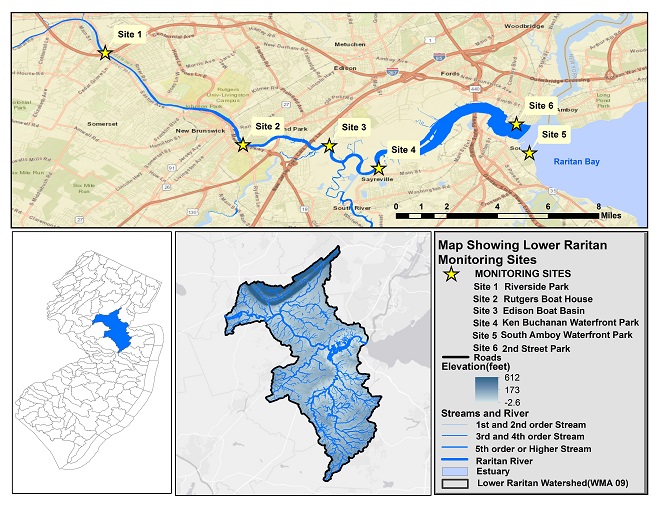
Water quality monitoring sampling will directly inform public access decision-making for six (6) diverse Lower Raritan Watershed municipalities (see site map below). These sites include:
Riverside Park (Piscataway)
Rutgers Boathouse at Boyd Park (New Brunswick)
Edison Basin Boat Launch (Edison Township)
Ken Buchanan Riverfront Park (Sayreville)
Raritan Bay Waterfront Park (South Amboy)
2nd Street / Brighton Avenue Beach (Perth Amboy)
Sites were chosen to inform decision-making about access and use, to aid understanding of municipal stormwater and sewage flows, and to inform current and future landuse planning and restoration efforts. Sites include the following known activities: 1) launch sites for personal non-motorized watercraft (sites 1-5); 2) fishing (sites 2-6); 3) birding hotspots (site 5); 4) crabbing (sites 2,4,5,6); 5) proximate to Combined Sewer Overflow (site 6); 6) unofficial bathing activity (sites 2,5,6); 7) collegiate watersport competition (site 2).
Generous support for equipment and data analysis is provided by the Interstate Environmental Commission.