Out of respect for Juneteenth, the fifth Pathogen Monitoring session occured on Tuesday, June 17 instead of a Thursday. Each week during the summer, from May to October, the Lower Raritan Watershed Partnership and Rutgers Cooperative Extension of Middlesex County run a volunteer-based monitoring program along the Raritan River. We collect water quality samples at six non-bathing public access beach sites, provide our samples to the Interstate Environmental Commission for analysis in their laboratory, and report the results to the public. Our mission is to share this data with the community and partners to ensure the safe use of the Raritan river for all.
Our lab results for water quality samples taken on Tuesday, June 17, 2025 show Enterococcus bacteria levels exceeding the EPA federal water quality standard of 104 cfu/100mL at two of our monitoring sites this week. Problem sites are indicated by red frowns on the map and chart which includes: Riverside Park (Piscataway) and 2nd Street Park (Perth Amboy). Green smiles on the chart and map indicate the sites with bacteria levels safe for recreation, and include the following: Rutgers Boathouse (New Brunswick), Raritan Bay Waterfront Park (South Amboy), Ken Buchanan Waterfront Park (Sayreville), and Edison Boat Launch (Edison Township).
Pathogens/Enterococci levels are used as indicators of the possible presence of disease-causing bacteria in recreational waters. Such pathogens may pose health risks to people coming in primary contact with the water (touching) through recreational activities like fishing, kayaking or swimming in a water body. Possible sources of bacteria include Combined Sewer Overflows (CSOs), improperly functioning wastewater treatment plants, stormwater runoff, leaking septic systems, animal carcasses, and runoff from manure storage areas.
Our goal in reporting these results is to give residents a better understanding of the potential health risks related to primary contact during water-based recreation. If you are planning on recreating on the Raritan this weekend, make sure to stay safe and wash up after any activities!
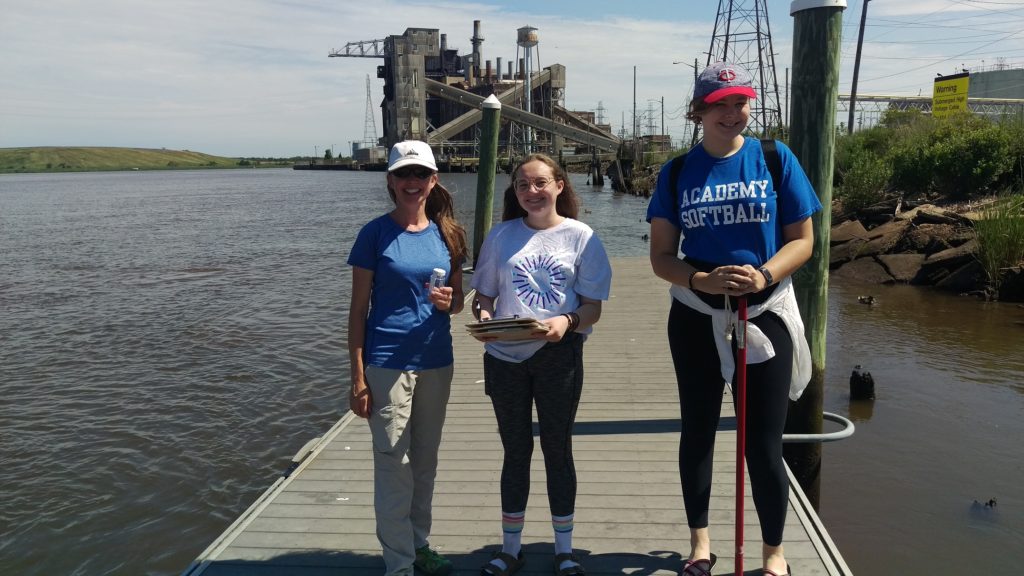
Ashley and John inspect the water from the boat dock at Riverside Park. Photo credit: Art Allgauer.
According to a member of the public who spoke with LRWP volunteers, a hazmat team recently investigated a diesel fuel spill in Edison’s Mill Brook. Photo credit: Art Allgauer.
A family of Canada geese (Branta canadensis) relax at Ken Buchanan Waterfront Park. Photo credit: Art Allgauer.
Sofi studies the pebbles and shells that washed up on South Amboy’s shoreline. Photo credit: J.M. Meyer.
A stray cat hides in the grass along the fence bordering Raritan Bay Waterfront Park. Photo credt: J.M. Meyer.
by Danielle Bongiovanni, J.M. Meyer, and Jocelyn Palomino
On Thursday, May 29th we marked our second week of the Pathogens Monitoring 2025 season! Every Thursday during the summer, from May to October, the Lower Raritan Watershed Partnership and Rutgers Cooperative Extension of Middlesex County run a volunteer-based monitoring program along the Raritan River. We collect water quality samples at six non-bathing public access beach sites, provide our samples to the Interstate Environmental Commission for analysis in their laboratory, and report the results to the public on Friday afternoons. Our mission is to share this data with the community and partners to ensure the safe use of the Raritan river for all.
Our lab results for water quality samples taken on Thursday May, 29, 2025 show Enterococcus bacteria levels exceeding the EPA federal water quality standard of 104 cfu/100mL at three of our monitoring sites this week. Problem sites are indicated by red frowns on the map and chart which includes: Riverside Park (Piscataway), Rutgers Boathouse (New Brunswick), and Edison Boat Basin (Edison). Green smiles on the chart and map indicate the sites with bacteria levels safe for recreation, and include the following: Ken Buchanan Waterfront Park (Sayreville), South Amboy Waterfront Park (South Amboy), and 2nd Street Park (Perth Amboy).
Pathogens/Enterococci levels are used as indicators of the possible presence of disease-causing bacteria in recreational waters. Such pathogens may pose health risks to people coming in primary contact with the water (touching) through recreational activities like fishing, kayaking or swimming in a water body. Possible sources of bacteria include Combined Sewer Overflows (CSOs), improperly functioning wastewater treatment plants, stormwater runoff, leaking septic systems, animal carcasses, and runoff from manure storage areas.
Our goal in reporting these results is to give residents a better understanding of the potential health risks related to primary contact during water-based recreation. If you are planning on recreating on the Raritan this weekend, make sure to stay safe and wash up after any activities!
Canada geese (Branta Canadensis) swim and mingle at Riverside Park. Photo credit: Rose Lawless.
An oily sheen of pollution is visible on the surface of the water at the Rutgers Boat House. Photo credit: Rose Lawless.
Litter and debris clogged the water alongside the dock ramp at the Edison Boat Basin. Photo credit: Rose Lawless.
Jocelyn collects a water sample while John prepares to submerge the YSI sonde at South Amboy Waterfront Park. Photo credit: Rose Lawless.
(From left to right) John, Jocelyn, Art, Rose, and Ashley take a moment to celebrate their progress at the beach in South Amboy. Photo credit: Rose Lawless.
Spawning season for Atlantic horseshoe crabs (Limulus polyphemus) like this one seen in Perth Amboy lasts from Mid-May to Mid-June. Photo credit: Rose Lawless.
Our team conducted pathogens (enterococci) monitoring of six Raritan River public access sites a bit early this week so as to report out in time for the holiday weekend. We are very happy to report that with a few exceptions (Piscatway and Perth Amboy), our numbers look pretty good!
Enterococci results are reported in Colony Forming Units or CFUs. Suitable levels should not exceed 104 cfu/100mL.
The Lower Raritan Watershed Partnership is grateful to our
EARTH Center of Middlesex County partners, to the Interstate Environmental
Commission for lab analysis, to the Sustainable Raritan River Initiative for
providing grant support, to Jesse Stratowski and his team at the Rutgers
Boathouse, and of course to our wonderful volunteers!
**Please note: these results are preliminary and awaiting Quality Control**